


Apollo 1

Encyclopedia
Apollo 1 was scheduled to be the first manned mission of the Apollo manned lunar landing program, with a target launch date of February 21, 1967. A cabin fire during a launch pad test on January 27 at Launch Pad 34
at Cape Canaveral
killed all three crew members: Command Pilot Virgil "Gus" Grissom
, Senior Pilot Edward H. White
and Pilot Roger B. Chaffee; and destroyed the Command Module. The mission name Apollo 1, chosen by the crew, was officially retired by NASA
in commemoration of them on April 24, 1967.
Immediately after the fire, NASA convened the Apollo 204 Accident Review Board to determine the cause of the fire. Although the ignition source was never conclusively identified, the astronauts' deaths were attributed to a wide range of lethal design and construction flaws in the early Apollo Command Module. The manned phase of the project was delayed for twenty months while these problems were corrected.
The Saturn IB
launch vehicle, SA-204, scheduled for use on this mission, was later used for the first unmanned Lunar Module
test flight, Apollo 5
. The first successful manned Apollo mission was flown by Apollo 1's backup crew on Apollo 7
in October, 1968.
(CSM) to Earth orbit, launched on a Saturn IB
rocket. AS-204 was to test launch operations, ground tracking and control facilities and the performance of the Apollo-Saturn launch assembly and would have lasted up to two weeks, depending on how the spacecraft performed.
The CSM for this flight, number 012 built by North American Aviation
(NAA), was a Block I version designed before the lunar orbit rendezvous
landing strategy was chosen; therefore it lacked capability of docking with the Lunar Module
. This was incorporated into the Block II CSM design, along with lessons learned in Block I. Block II would be test-flown with the LM when the latter was ready, and would be used on the Moon
landing flights.
NASA announced on March 21, 1966 that Grissom, White and Chaffee had been selected to fly the first manned mission. James McDivitt
, David Scott
and Rusty Schweikart were named as the backup crew, and Walter Schirra, Donn Eisele and Walter Cunningham
were named as the prime crew for a second Block I CSM flight, AS-205. NASA planned to follow this with an unmanned test flight of the LM (AS-206), then the third manned mission would be a dual flight designated AS-278, in which AS-207 would launch the first manned Block II CSM, which would then rendezvous and dock with the LM launched unmanned on AS-208.
At the time, NASA was studying the possibility of flying the first Apollo mission as a joint space rendezvous
with the final Project Gemini
mission, Gemini 12
in November 1966. But by May, delays in making Apollo ready for flight just by itself, and the extra time needed to incorporate compatibility with the Gemini, made that impractical. This became moot when slippage in readiness of the AS-204 spacecraft caused the last-quarter 1966 target date to be missed, and the mission was rescheduled for February 21, 1967. Grissom was resolved to keep his craft in orbit for a full 14 days if there was any way to do so.
A newspaper article published on August 4, 1966 referred to the flight as "Apollo 1". CM-012 arrived at the Kennedy Space Center on August 26, labeled Apollo One by NAA on its packaging.
In October 1966, NASA announced the flight would carry a small television
camera to broadcast live from the Command Module. The camera would also be used to allow flight controllers to monitor the spacecraft's instrument panel in flight. Television cameras were carried aboard all manned Apollo missions.
By December 1966, the second Block I flight AS-205 was canceled as unnecessary, and Schirra, Eisele and Cunningham were reassigned as the backup crew for Apollo 1. McDivitt's crew were now promoted to prime crew of the Block II / LM mission, re-designated AS-258 because the AS-205 launch vehicle would be used in place of AS-207. A third manned mission was planned to launch the CSM and LM together on a Saturn V
(AS-503) to an elliptical medium Earth orbit
, to be crewed by Frank Borman
, Michael Collins
and William Anders
. McDivitt, Scott and Schweikart had started their training for AS-278 in CM-101 when the Apollo 1 accident occurred.
(the launch point) prominent. The Moon is seen in the distance, symbolic of the eventual program goal. A yellow border carries the mission and astronaut names with another border set with stars and stripes, trimmed in gold. The insignia was designed by the crew, with the artwork done by NAA employee Allen Stevens.
 The Apollo Command/Service Module spacecraft was much bigger and far more complex than any previously implemented spacecraft design. In October 1963, Dr. Joseph F. Shea
was named Apollo Spacecraft Program Office (ASPO) manager, responsible for managing the design and construction of both the CSM and the LM.
When North American shipped spacecraft CM-012 to Kennedy Space Center
on August 26, 1966, there were 113 significant incomplete planned engineering changes, and an additional 623 engineering change orders were made after delivery. Grissom was so frustrated with the inability of the training simulator engineers to keep up with the actual spacecraft changes, that he took a lemon from a tree by his house, and hung it on the simulator.
In a spacecraft review meeting held with Shea on August 19, 1966 (a week before delivery), the crew expressed concern about the amount of flammable material (mainly nylon
netting and Velcro
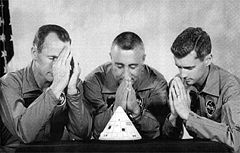
) in the cabin, which the technicians found convenient for holding tools and equipment in place. Though Shea gave the spacecraft a passing grade, after the meeting they gave him a crew portrait they had posed with heads bowed and hands clasped in prayer, with the inscription:
Shea gave his staff orders to tell North American to remove the flammables from the cabin, but did not supervise the issue personally.
, and all pyrotechnic
systems were disabled.
At 1:00 PM EST
(1800 GMT
) on January 27, first Grissom, then Chaffee, and White entered the command module fully pressure-suited, and were strapped into their seats and hooked up to the spacecraft's oxygen and communication systems. There was an immediate problem: Grissom noticed a strange odor in the air circulating through his suit which he compared to "sour buttermilk", and the simulated countdown was held at 1:20 PM, while air samples were taken. No cause of the odor could be found, and the countdown was resumed at 2:42 PM. (The accident investigation found this odor not to be related in any way to the fire.)
Three minutes after the count was resumed, the hatch installation was started. The hatch consisted of three parts: a removable inner hatch which stayed inside the cabin; a hinged outer hatch which was part of the spacecraft's heat shield; and an outer hatch cover which was part of the boost protective cover enveloping the entire command module to protect it from aerodynamic heating during launch, and from launch escape rocket exhaust in the event of a launch abort. The boost hatch cover was partially but not fully latched in place, because the flexible boost protective cover was slightly distorted by some cabling run under it to provide the simulated internal power. (The spacecraft's fuel cell reactants were not loaded for this test.) After the hatches were sealed, the air in the cabin was replaced with high-pressure (16.7 psia) pure oxygen.
Further problems included episodes of high oxygen spacesuit flow which tripped an alarm. The likely cause was determined to be the astronauts' movements, which were detected by the spacecraft's inertial guidance gyroscope
and Grissom's stuck-open microphone. The open microphone was part of the third major problem, with the communications loop connecting the crew, the Operations and Checkout Building
and the Complex 34 blockhouse control room. The problems led Grissom to remark, "How are we going to get to the Moon if we can't talk between three buildings?" The simulated countdown was held again at 5:40 PM while attempts were made to fix the problem. All countdown functions up to the simulated internal power transfer had been successfully completed by 6:20 PM, but at 6:30 the count remained on hold at T minus 10 minutes.
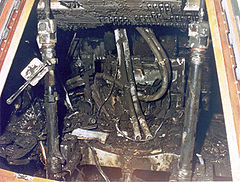 The crew members were using the time to run through their checklist again, when a voltage transient was recorded at 6:30:54 (23:30:54 GMT). Ten seconds later (at 6:31:04), after Chaffee said the word "Hey", scuffling sounds followed for three seconds before Grissom reported a fire that began that minute. Chaffee then reported, "We've got a fire in the cockpit," while White responded to Chaffee's comment. After 12 seconds, Chaffee urged the crew to get out of the command module. Some witnesses said they saw White on the television monitors, reaching for the inner hatch release handle as flames in the cabin spread from left to right and licked the window. The final voice transmission from the crew was very garbled. "They’re fighting a bad fire—let’s get out. Open ‘er up" or, "We’ve got a bad fire—let’s get out. We’re burning up" or, "I’m reporting a bad fire. I’m getting out." Only 17 seconds after the first indication by crew of any fire, the transmission ended abruptly at 6:31:21 with a cry of pain and then a hiss as the cabin ruptured after rapidly expanding gases from the fire over-pressurized the CM to 29 psi
(200 kPa
) and burst the cabin interior.
Flames and gases then rushed outside the command module through open access panels to two levels of the pad service structure. Intense heat, dense smoke, and ineffective gas masks designed for toxic fumes rather than heavy smoke hampered the ground crew's attempts to rescue the men. There were fears the command module had exploded, or soon would, and that the fire might ignite the solid fuel rockets in the launch escape tower above the command module, which would have likely killed nearby ground personnel. It took five minutes to open all three hatch layers, and they could not drop the inner hatch to the cabin floor as intended, so they pushed it out of the way to one side.
By this time the fire in the command module had gone out, robbed of its high-pressure pure oxygen environment. Although the cabin lights remained lit, the ground crew was at first unable to find the astronauts through the dense smoke. As the smoke cleared they found the bodies but were not able to remove them. The fire had partly melted Grissom's and White's nylon space suits and the hoses connecting them to the life support system. Grissom had removed his restraints and was lying on the floor of the spacecraft. White's restraints were burned through, and he was found lying sideways just below the hatch. It was determined that he had tried to open the hatch per the emergency procedure, but was not able to do so against the internal pressure. Chaffee was found strapped into his right-hand seat, as procedure called for him to maintain communication until White opened the hatch.
mission on March 17, 1966, NASA Deputy Administrator Dr. Robert Seamans
wrote and implemented Management Instruction 8621.1 on April 14, 1966, defining Mission Failure Investigation Policy And Procedures. This modified NASA's existing accident procedures, based on military aircraft accident investigation, by giving the Deputy Administrator the option of performing independent investigations of "major failures", beyond those failure investigations for which the various Program Office officials were normally responsible. It declared: "It is NASA policy to investigate and document the causes of all major mission failures which occur in the conduct of its space and aeronautical activities and to take appropriate corrective actions as a result of the findings and recommendations."
Immediately after the Apollo 1 fire, Seamans directed establishment of the Apollo 204 Review Board chaired by Langley Research Center
director Dr. Floyd L. Thompson, which included astronaut Frank Borman
, spacecraft designer Maxime Faget
, and six others. To avoid the possible appearance of a conflict of interest, NASA Administrator James E. Webb
got the approval of President Lyndon Johnson for an internal NASA investigation, and notified appropriate leaders of Congress. According to Webb's official NASA bio:
Seamans immediately ordered all Apollo 1 hardware and software impounded, to be released only under control of the Board. On February 3, two members, a Cornell University professor and North American's Chief engineer for Apollo, left the Board, and a U.S. Bureau of Mines
professor joined. After thorough stereo photographic
documentation of the CM-012 interior, the board ordered its disassembly using procedures tested by disassembling the identical CM-014, and conducted a thorough investigation of every part. The board also reviewed the astronauts' autopsy results and interviewed witnesses. Seamans sent Webb weekly status reports of the investigation's progress, and the Board issued its final report on April 5, 1967.
According to the Board, Grissom suffered severe third degree burns on over a third of his body and his spacesuit was mostly destroyed. White suffered third degree burns on almost half of his body and a quarter of his spacesuit had melted away. Chaffee suffered third degree burns over almost a quarter of his body and a small portion of his spacesuit was damaged. It was later confirmed the crew had died of smoke inhalation
with burns contributing. In later lawsuits brought by Gus Grissom's widow Betty Grissom there were claims the astronauts had lived longer than NASA claimed publicly.
The review board found the documentation for CM-012 so lacking that they were at times unable to determine what had been installed in the spacecraft or what was in it at the time of the accident.
The review board identified five major factors which combined to cause the fire and the astronauts' deaths:
They noted a silver
-plated copper
wire running through an environmental control unit near the center couch had become stripped of its Teflon
insulation and abraded by repeated opening and closing of a small access door. This weak point in the wiring also ran near a junction in an ethylene glycol
/water cooling line which had been prone to leaks. The electrolysis
of ethylene glycol solution with the silver anode
was a notable hazard which could cause a violent exothermic reaction
, igniting the ethylene glycol mixture in the CM's corrosive test atmosphere of pure, high-pressure oxygen.
In 1968, a team of MIT physicists went to Cape Kennedy and performed a static discharge test in the CM-103 command module while it was being prepared for the launch of Apollo 8
. With an electroscope
, they measured the approximate energy of static discharges caused by a test crew dressed in nylon flight pressure suits and reclining on the nylon flight seats. The MIT investigators found sufficient energy for ignition discharged repeatedly when crew-members shifted in their seats and then touched the spacecraft's aluminum panels.
Buzz Aldrin
states in his book Men From Earth that the flammable material had been removed (per the crew's August 19 complaints and Joseph Shea's order), but was replaced prior to the August 26 delivery to Cape Kennedy.
The high-pressure oxygen atmosphere was consistent with that used in the Mercury
and Gemini
programs. The pressure before launch was deliberately greater than ambient in order to drive out the nitrogen-containing air and replace it with pure oxygen. After liftoff, the pressure would have been reduced to the in-flight level of 5 pound per square inches (34.5 kPa), providing sufficient oxygen for the astronauts to breathe while reducing the fire risk. The Apollo 1 crew had tested this procedure with their spacecraft in the Operations and Checkout Building
altitude (vacuum) chamber on October 18 and 19, 1966, and the backup crew of Schirra, Eisele and Cunningham had repeated it on December 30.
When designing the Mercury spacecraft, NASA had considered using a nitrogen/oxygen mixture to reduce the fire risk near launch, but rejected it based on two considerations. First, nitrogen used with the in-flight pressure reduction carried the clear risk of decompression sickness
(known as "the bends"). But the decision to eliminate the use of any gas but oxygen was crystalized when a serious accident occurred on April 21, 1960, in which McDonnell Aircraft
test pilot G.B. North passed out and was seriously injured when testing a Mercury cabin / spacesuit atmosphere system in a vacuum chamber. The problem was found to be nitrogen-rich (oxygen-poor) air leaking from the cabin into his spacesuit feed. North American Aviation had suggested using an oxygen/nitrogen mixture for Apollo, but NASA overruled this. The pure oxygen design also carried the benefit of saving weight, by eliminating the need for nitrogen tanks.
In a BBC documentary NASA: Triumph and Tragedy, Jim McDivitt said that NASA had no idea how 100% oxygen atmosphere would influence burning. Similar remarks by other astronauts were expressed in the documentary In the Shadow of the Moon. Deputy Administrator Seamans has said that NASA's single worst mistake in engineering judgement was not to run a fire test on the Command Module.
Colonel
B. Dean Smith was conducting a test of the Gemini space suit
with a colleague in a pure oxygen chamber at Brooks Air Force Base in San Antonio, Texas, when a fire broke out, destroying the chamber. Smith and his partner narrowly escaped.
Other oxygen fire occurrences are documented in certain US reports archived in the National Air and Space Museum
, such as:
On January 28, 1986, the Soviet Union disclosed that cosmonaut Valentin Bondarenko
died after a fire in a high-oxygen isolation chamber on March 23, 1961, less than three weeks before the first Vostok
manned space flight. This revelation caused some speculation whether the Apollo 1 disaster might have been averted had NASA been aware of the incident.
North American had originally suggested the hatch open outward and use explosive bolts to blow the hatch in case of emergency, as had been done in Project Mercury
. NASA
didn't agree, arguing the hatch could accidentally open, as it had on Grissom's Liberty Bell 7 flight, so the inward-opening hatch was selected early in the Block I design.
Before the fire, the Apollo astronauts had recommended changing the design to an outward-opening hatch, and this was already slated for inclusion in the Block II Command Module design. According to Donald K. Slayton's testimony before the House investigation of the accident, this was based on ease of exit for spacewalks and at the end of flight, rather than for emergency exit.
with oversight of the space program soon launched their own investigations, including the Senate Committee on Aeronautical and Space Sciences, chaired by Senator Clinton P. Anderson. Seamans, Webb, Manned Space Flight Administrator Dr. George Mueller
, and Apollo Program Director Maj Gen
Samuel C. Phillips
were called to testify before Sen. Anderson's committee.
In the February 27 hearing, Senator Walter F. Mondale asked Webb if he knew of a "report" of extraordinary problems with the performance of North American Aviation
on the Apollo contract. Webb replied he did not, and deferred to his subordinates on the witness panel. Mueller and Phillips responded they too were unaware of any such "report".
However, in late 1965, just over one year before the accident, Phillips had headed a "tiger team
" investigating the causes of inadequate quality, schedule delays, and cost overruns in both the Apollo CSM and the Saturn V second stage (for which North American was also prime contractor.) He gave an oral presentation (with transparencies) of his team's findings to Mueller and Seamans, and also presented them in a memo to North American president Lee Atwood, to which Mueller appended his own strongly worded memo to Atwood. Mondale said he had been told of the existence of the "Phillips report", and Seamans was afraid that Mondale might be in possession of a hard copy of the presentation, so he said tentatively that contractors have occasionally been given negative reviews, but that he knew of no such extraordinary report. Mondale raised controversy over "the Phillips Report", despite Phillips' refusal to characterize it as such before Congress, and was angered by what he perceived as Webb's deception and concealment of important program problems from Congress, and questioned NASA's selection of North American as prime contractor. Webb eventually provided a controlled copy of Phillips' memo to Congress. Seamans later wrote that Webb roundly chastised him in the cab ride leaving the hearing, for volunteering information which led to the disclosure of Phillips' memo.
The committee noted in its final report NASA's testimony that "the findings of the [Phillips] task force had no effect on the accident, did not lead to the accident, and were not related to the accident," but stated in its recommendations:
Freshman Senators Edward Brooke
and Charles H. Percy
jointly wrote an "Additional Views" section appended to the committee report, expressing a bit more strongly that the Phillips review should have been disclosed to Congress. Mondale wrote his own Additional View, voicing his complaints in the most strongly worded terms.
The potential political threat to Apollo blew over, due in large part to the support of President Lyndon Johnson, who at the time still wielded a measure of influence with the Congress from his own Senatorial experience. He was a staunch supporter of NASA since its inception, had even recommended the Moon program to President John F. Kennedy
in 1961, and was skilled at portraying it as part of Kennedy's legacy.
But internal acrimony developed between NASA and North American over assignment of blame. North American argued unsuccessfully that it was not responsible for the fatal error in spacecraft atmosphere design. Finally, Webb contacted Atwood, and demanded that either he or Chief Engineer Harrison "Stormy" Storms
resign. Atwood elected to fire Storms.
On the NASA side, Joseph Shea became unfit for duty in the aftermath and was removed from his position, although not fired.
” about the schedule and we locked out all of the problems we saw each day in our work. Every element of the program was in trouble and so were we." He reminded the team of the perils and mercilessness of their endeavor, and stated the new requirement that every member of every team in mission control be "tough and competent", requiring nothing less than perfection throughout NASA's programs. 36 years later, following the Space Shuttle Columbia disaster
, then-NASA administrator Sean O'Keefe
quoted Krantz's speech, adopting it in principle to honor the lives of Apollo 1's and Columbia's astronauts.
It was decided that remaining Block I spacecraft would only be used for unmanned Saturn V test flights. All manned missions would use the Block II spacecraft, to which many Command Module design changes were made:
Thorough protocols were implemented for documenting spacecraft construction and maintenance.
In July 2009, the 40th anniversary of the Apollo 11
first Moon landing, archived notes made by Apollo astronauts Charles Duke and Jack Swigert
on the accident investigation and re-design were donated to the Kansas Cosmosphere and Space Center
in Hutchinson
, and were digitized and made accessible on the Internet.
, AS-202
, and AS-203
) had previously occurred, the next mission, the first unmanned Saturn V
test flight (AS-501) would be designated Apollo 4
, with all subsequent flights numbered sequentially in the order flown. The first three flights would not be renumbered, and the names Apollo 2 and Apollo 3 would go unused.
The manned flight hiatus allowed work to catch up on the Saturn V and Apollo Lunar Module
, which were encountering their own delays. Apollo 4 flew in November 1967. Apollo 1's (AS-204) Saturn IB rocket was taken down from Launch Complex 34, later reassembled at Launch Complex 37B and used to launch Apollo 5
, an unmanned Earth orbital test flight of the first Lunar Module LM-1, in January 1968. A second unmanned Saturn V AS-502 flew as Apollo 6
in April 1968, and Grissom's backup crew of Wally Schirra
, Don Eisele, and Walter Cunningham
, finally flew the first manned mission AS-205, Apollo 7
, in a Block II CSM in October 1968.
 Gus Grissom and Roger Chaffee were buried at Arlington National Cemetery
. Ed White was buried at the cemetery
of the United States Military Academy
in West Point, New York
.
Their names are among those of several astronauts and cosmonauts who have died in the line of duty, listed on the Space Mirror Memorial at the Kennedy Space Center Visitor Complex in Merritt Island, Florida
.
An Apollo 1 mission patch was left on the Moon's surface after the first manned lunar landing by Apollo 11
crew members Neil Armstrong
and Buzz Aldrin
.
was subsequently used only for the launch of Apollo 7
and later dismantled down to the concrete launch pedestal, which remains at the site (28.52182°N 80.561258°W) along with a few other concrete and steel-reinforced structures. The pedestal bears two plaques commemorating the crew. Each year the families of the Apollo 1 crew are invited to the site for a memorial, and the Kennedy Space Center Visitor Center includes the site in its tour of the historic Cape Canaveral launch sites.

 In January 2005, three granite benches, built by a college classmate of one of the astronauts, were installed at the site on the southern edge of the launch pad. Each bears the name of one of the astronauts and his military service insignia.
in Hampton, Virginia
and placed in a secured storage warehouse.
On February 17, 2007 the wreckage of CM-012 was moved approximately 100 feet (30.5 m) to a newer, environmentally controlled warehouse. Only a few weeks earlier, Gus Grissom's brother Lowell publicly suggested CM-012 be permanently entombed in the concrete remains of Launch Complex 34.
In September 2010 the Grissom Air Museum
in Peru, Indiana
, located near Grissom Air Reserve Base, made a request to be permitted to display the Apollo 1 Command Module.
Cape Canaveral Air Force Station Launch Complex 34
Cape Canaveral Air Force Station Launch Complex 34 is a launch site on Cape Canaveral, Florida. LC-34 and its twin to the north, LC-37, were used by NASA as part of the Apollo Program to launch Saturn I and IB rockets from 1961 through 1968...
at Cape Canaveral
Cape Canaveral Air Force Station
Cape Canaveral Air Force Station is an installation of the United States Air Force Space Command's 45th Space Wing, headquartered at nearby Patrick Air Force Base. Located on Cape Canaveral in the state of Florida, CCAFS is the primary launch head of America's Eastern Range with four launch pads...
killed all three crew members: Command Pilot Virgil "Gus" Grissom
Gus Grissom
Virgil Ivan Grissom , , better known as Gus Grissom, was one of the original NASA Project Mercury astronauts and a United States Air Force pilot...
, Senior Pilot Edward H. White
Edward Higgins White
Edward Higgins White, II was an engineer, United States Air Force officer and NASA astronaut. On June 3, 1965, he became the first American to "walk" in space. White died along with fellow astronauts Gus Grissom and Roger Chaffee during a pre-launch test for the first manned Apollo mission at...
and Pilot Roger B. Chaffee; and destroyed the Command Module. The mission name Apollo 1, chosen by the crew, was officially retired by NASA
NASA
The National Aeronautics and Space Administration is the agency of the United States government that is responsible for the nation's civilian space program and for aeronautics and aerospace research...
in commemoration of them on April 24, 1967.
Immediately after the fire, NASA convened the Apollo 204 Accident Review Board to determine the cause of the fire. Although the ignition source was never conclusively identified, the astronauts' deaths were attributed to a wide range of lethal design and construction flaws in the early Apollo Command Module. The manned phase of the project was delayed for twenty months while these problems were corrected.
The Saturn IB
Saturn IB
The Saturn IB was an American launch vehicle commissioned by the National Aeronautics and Space Administration for use in the Apollo program...
launch vehicle, SA-204, scheduled for use on this mission, was later used for the first unmanned Lunar Module
Apollo Lunar Module
The Apollo Lunar Module was the lander portion of the Apollo spacecraft built for the US Apollo program by Grumman to carry a crew of two from lunar orbit to the surface and back...
test flight, Apollo 5
Apollo 5
Apollo 5 was the first unmanned flight of the Apollo Lunar Module, which would later carry astronauts to the lunar surface. It lifted off on January 22, 1968 with a Saturn IB rocket.-Objectives:...
. The first successful manned Apollo mission was flown by Apollo 1's backup crew on Apollo 7
Apollo 7
Apollo 7 was the first manned mission in the American Apollo space program, and the first manned US space flight after a cabin fire killed the crew of what was to have been the first manned mission, AS-204 , during a launch pad test in 1967...
in October, 1968.
Crew
First backup crew (April - December 1966)
Second backup crew (December 1966 - January 1967)
Mission background
AS-204 was to be the first manned test flight of the Apollo Command/Service ModuleApollo Command/Service Module
The Command/Service Module was one of two spacecraft, along with the Lunar Module, used for the United States Apollo program which landed astronauts on the Moon. It was built for NASA by North American Aviation...
(CSM) to Earth orbit, launched on a Saturn IB
Saturn IB
The Saturn IB was an American launch vehicle commissioned by the National Aeronautics and Space Administration for use in the Apollo program...
rocket. AS-204 was to test launch operations, ground tracking and control facilities and the performance of the Apollo-Saturn launch assembly and would have lasted up to two weeks, depending on how the spacecraft performed.
The CSM for this flight, number 012 built by North American Aviation
North American Aviation
North American Aviation was a major US aerospace manufacturer, responsible for a number of historic aircraft, including the T-6 Texan trainer, the P-51 Mustang fighter, the B-25 Mitchell bomber, the F-86 Sabre jet fighter, the X-15 rocket plane, and the XB-70, as well as Apollo Command and Service...
(NAA), was a Block I version designed before the lunar orbit rendezvous
Lunar orbit rendezvous
Lunar orbit rendezvous is a key concept for human landing on the Moon and returning to Earth.In a LOR mission a main spacecraft and a smaller lunar module travel together into lunar orbit. The lunar module then independently descends to the lunar surface. After completion of the mission there, a...
landing strategy was chosen; therefore it lacked capability of docking with the Lunar Module
Apollo Lunar Module
The Apollo Lunar Module was the lander portion of the Apollo spacecraft built for the US Apollo program by Grumman to carry a crew of two from lunar orbit to the surface and back...
. This was incorporated into the Block II CSM design, along with lessons learned in Block I. Block II would be test-flown with the LM when the latter was ready, and would be used on the Moon
Moon
The Moon is Earth's only known natural satellite,There are a number of near-Earth asteroids including 3753 Cruithne that are co-orbital with Earth: their orbits bring them close to Earth for periods of time but then alter in the long term . These are quasi-satellites and not true moons. For more...
landing flights.
NASA announced on March 21, 1966 that Grissom, White and Chaffee had been selected to fly the first manned mission. James McDivitt
James McDivitt
James Alton McDivitt is a former NASA astronaut and engineer who flew in the Gemini and Apollo programs. He commanded the Gemini 4 flight in which Edward H. White performed the first US space walk, and later the Apollo 9 flight which was the first manned Earth orbital test of the Apollo Lunar...
, David Scott
David Scott
David Randolph Scott is an American engineer, test pilot, retired U.S. Air Force officer, and former NASA astronaut and engineer, who was one of the third group of astronauts selected by NASA in October 1963...
and Rusty Schweikart were named as the backup crew, and Walter Schirra, Donn Eisele and Walter Cunningham
Walter Cunningham
Ronnie Walter Cunningham , known as Walt Cunningham, is a retired American astronaut. In 1968, he was the Lunar Module pilot on the Apollo 7 mission...
were named as the prime crew for a second Block I CSM flight, AS-205. NASA planned to follow this with an unmanned test flight of the LM (AS-206), then the third manned mission would be a dual flight designated AS-278, in which AS-207 would launch the first manned Block II CSM, which would then rendezvous and dock with the LM launched unmanned on AS-208.
At the time, NASA was studying the possibility of flying the first Apollo mission as a joint space rendezvous
Space rendezvous
A space rendezvous is an orbital maneuver during which two spacecraft, one of which is often a space station, arrive at the same orbit and approach to a very close distance . Rendezvous requires a precise match of the orbital velocities of the two spacecraft, allowing them to remain at a constant...
with the final Project Gemini
Project Gemini
Project Gemini was the second human spaceflight program of NASA, the civilian space agency of the United States government. Project Gemini was conducted between projects Mercury and Apollo, with ten manned flights occurring in 1965 and 1966....
mission, Gemini 12
Gemini 12
-Backup crew:-Mission parameters:*Mass: *Perigee: *Apogee: *Inclination: 28.87°*Period: 88.87 min-Docking:*Docked: November 12, 1966 - 01:06:00 UTC*Undocked: November 13, 1966 - 20:18:00 UTC-Space walk:...
in November 1966. But by May, delays in making Apollo ready for flight just by itself, and the extra time needed to incorporate compatibility with the Gemini, made that impractical. This became moot when slippage in readiness of the AS-204 spacecraft caused the last-quarter 1966 target date to be missed, and the mission was rescheduled for February 21, 1967. Grissom was resolved to keep his craft in orbit for a full 14 days if there was any way to do so.
A newspaper article published on August 4, 1966 referred to the flight as "Apollo 1". CM-012 arrived at the Kennedy Space Center on August 26, labeled Apollo One by NAA on its packaging.
In October 1966, NASA announced the flight would carry a small television
Television
Television is a telecommunication medium for transmitting and receiving moving images that can be monochrome or colored, with accompanying sound...
camera to broadcast live from the Command Module. The camera would also be used to allow flight controllers to monitor the spacecraft's instrument panel in flight. Television cameras were carried aboard all manned Apollo missions.
By December 1966, the second Block I flight AS-205 was canceled as unnecessary, and Schirra, Eisele and Cunningham were reassigned as the backup crew for Apollo 1. McDivitt's crew were now promoted to prime crew of the Block II / LM mission, re-designated AS-258 because the AS-205 launch vehicle would be used in place of AS-207. A third manned mission was planned to launch the CSM and LM together on a Saturn V
Saturn V
The Saturn V was an American human-rated expendable rocket used by NASA's Apollo and Skylab programs from 1967 until 1973. A multistage liquid-fueled launch vehicle, NASA launched 13 Saturn Vs from the Kennedy Space Center, Florida with no loss of crew or payload...
(AS-503) to an elliptical medium Earth orbit
Medium Earth Orbit
Medium Earth orbit , sometimes called intermediate circular orbit , is the region of space around the Earth above low Earth orbit and below geostationary orbit ....
, to be crewed by Frank Borman
Frank Borman
Frank Frederick Borman, II is a retired NASA astronaut and engineer, best remembered as the Commander of Apollo 8, the first mission to fly around the Moon, making him, along with fellow crew mates Jim Lovell and Bill Anders, the first of only 24 humans to do so...
, Michael Collins
Michael Collins
- Politics :* Michael Collins , Irish Labour party politician, Lord Mayor Of Dublin 1977–1978* Michael Collins , Irish revolutionary leader, soldier, and politician...
and William Anders
William Anders
William Alison Anders is a former United States Air Force officer, NASA astronaut, businessman, and engineer. He is, along with Apollo 8 crewmates Frank Borman and Jim Lovell, one of the first three persons to have left Earth orbit and traveled to the Moon .-Biography:Anders was born to Arthur...
. McDivitt, Scott and Schweikart had started their training for AS-278 in CM-101 when the Apollo 1 accident occurred.
Mission insignia
Grissom's crew received approval in June 1966 to design a mission patch with the name Apollo 1. The design's center depicts a Command/Service Module flying over the southeastern United States with FloridaFlorida
Florida is a state in the southeastern United States, located on the nation's Atlantic and Gulf coasts. It is bordered to the west by the Gulf of Mexico, to the north by Alabama and Georgia and to the east by the Atlantic Ocean. With a population of 18,801,310 as measured by the 2010 census, it...
(the launch point) prominent. The Moon is seen in the distance, symbolic of the eventual program goal. A yellow border carries the mission and astronaut names with another border set with stars and stripes, trimmed in gold. The insignia was designed by the crew, with the artwork done by NAA employee Allen Stevens.
Spacecraft problems
Joseph Francis Shea
Joseph Francis Shea was an American aerospace engineer and NASA manager. Born in the New York City borough of the Bronx, he was educated at the University of Michigan, receiving a Ph.D. in Engineering Mechanics in 1955...
was named Apollo Spacecraft Program Office (ASPO) manager, responsible for managing the design and construction of both the CSM and the LM.
When North American shipped spacecraft CM-012 to Kennedy Space Center
Kennedy Space Center
The John F. Kennedy Space Center is the NASA installation that has been the launch site for every United States human space flight since 1968. Although such flights are currently on hiatus, KSC continues to manage and operate unmanned rocket launch facilities for America's civilian space program...
on August 26, 1966, there were 113 significant incomplete planned engineering changes, and an additional 623 engineering change orders were made after delivery. Grissom was so frustrated with the inability of the training simulator engineers to keep up with the actual spacecraft changes, that he took a lemon from a tree by his house, and hung it on the simulator.
In a spacecraft review meeting held with Shea on August 19, 1966 (a week before delivery), the crew expressed concern about the amount of flammable material (mainly nylon
Nylon
Nylon is a generic designation for a family of synthetic polymers known generically as polyamides, first produced on February 28, 1935, by Wallace Carothers at DuPont's research facility at the DuPont Experimental Station...
netting and Velcro
Velcro
Velcro is the brand name of the first commercially marketed fabric hook-and-loop fastener, invented in 1948 by the Swiss electrical engineer George de Mestral...
) in the cabin, which the technicians found convenient for holding tools and equipment in place. Though Shea gave the spacecraft a passing grade, after the meeting they gave him a crew portrait they had posed with heads bowed and hands clasped in prayer, with the inscription:
It isn't that we don't trust you, Joe, but this time we've decided to go over your head.
Shea gave his staff orders to tell North American to remove the flammables from the cabin, but did not supervise the issue personally.
Plugs-out test
The January 27, 1967, launch simulation was a "plugs-out" test to determine whether the spacecraft would operate nominally on (simulated) internal power while detached from all cables and umbilicals. Passing this test was essential to making the February 21 launch date. The test was considered non-hazardous because neither the launch vehicle nor the spacecraft was loaded with fuel or cryogenicsCryogenics
In physics, cryogenics is the study of the production of very low temperature and the behavior of materials at those temperatures. A person who studies elements under extremely cold temperature is called a cryogenicist. Rather than the relative temperature scales of Celsius and Fahrenheit,...
, and all pyrotechnic
Pyrotechnic fastener
A pyrotechnic fastener is a fastener, usually a nut or bolt, that incorporates a pyrotechnic charge that can be initiated remotely. One or more explosive charges embedded within the bolt are typically activated by an electric current, and the charge breaks the bolt into two or more pieces...
systems were disabled.
At 1:00 PM EST
Eastern Time Zone
The Eastern Time Zone of the United States and Canada is a time zone that falls mostly along the east coast of North America. Its UTC time offset is −5 hrs during standard time and −4 hrs during daylight saving time...
(1800 GMT
Greenwich Mean Time
Greenwich Mean Time is a term originally referring to mean solar time at the Royal Observatory in Greenwich, London. It is arguably the same as Coordinated Universal Time and when this is viewed as a time zone the name Greenwich Mean Time is especially used by bodies connected with the United...
) on January 27, first Grissom, then Chaffee, and White entered the command module fully pressure-suited, and were strapped into their seats and hooked up to the spacecraft's oxygen and communication systems. There was an immediate problem: Grissom noticed a strange odor in the air circulating through his suit which he compared to "sour buttermilk", and the simulated countdown was held at 1:20 PM, while air samples were taken. No cause of the odor could be found, and the countdown was resumed at 2:42 PM. (The accident investigation found this odor not to be related in any way to the fire.)
Three minutes after the count was resumed, the hatch installation was started. The hatch consisted of three parts: a removable inner hatch which stayed inside the cabin; a hinged outer hatch which was part of the spacecraft's heat shield; and an outer hatch cover which was part of the boost protective cover enveloping the entire command module to protect it from aerodynamic heating during launch, and from launch escape rocket exhaust in the event of a launch abort. The boost hatch cover was partially but not fully latched in place, because the flexible boost protective cover was slightly distorted by some cabling run under it to provide the simulated internal power. (The spacecraft's fuel cell reactants were not loaded for this test.) After the hatches were sealed, the air in the cabin was replaced with high-pressure (16.7 psia) pure oxygen.
Further problems included episodes of high oxygen spacesuit flow which tripped an alarm. The likely cause was determined to be the astronauts' movements, which were detected by the spacecraft's inertial guidance gyroscope
Gyroscope
A gyroscope is a device for measuring or maintaining orientation, based on the principles of angular momentum. In essence, a mechanical gyroscope is a spinning wheel or disk whose axle is free to take any orientation...
and Grissom's stuck-open microphone. The open microphone was part of the third major problem, with the communications loop connecting the crew, the Operations and Checkout Building
Operations and Checkout Building
The Operations and Checkout Building is a historic site on Merritt Island, Florida, United States. The five-story structure is in the Industrial Area of NASA's Kennedy Space Center. Its facilities include the crew quarters for astronauts prior to their flights. On January 21, 2000, it was added to...
and the Complex 34 blockhouse control room. The problems led Grissom to remark, "How are we going to get to the Moon if we can't talk between three buildings?" The simulated countdown was held again at 5:40 PM while attempts were made to fix the problem. All countdown functions up to the simulated internal power transfer had been successfully completed by 6:20 PM, but at 6:30 the count remained on hold at T minus 10 minutes.
Fire
Pounds per square inch
The pound per square inch or, more accurately, pound-force per square inch is a unit of pressure or of stress based on avoirdupois units...
(200 kPa
Pascal (unit)
The pascal is the SI derived unit of pressure, internal pressure, stress, Young's modulus and tensile strength, named after the French mathematician, physicist, inventor, writer, and philosopher Blaise Pascal. It is a measure of force per unit area, defined as one newton per square metre...
) and burst the cabin interior.
Flames and gases then rushed outside the command module through open access panels to two levels of the pad service structure. Intense heat, dense smoke, and ineffective gas masks designed for toxic fumes rather than heavy smoke hampered the ground crew's attempts to rescue the men. There were fears the command module had exploded, or soon would, and that the fire might ignite the solid fuel rockets in the launch escape tower above the command module, which would have likely killed nearby ground personnel. It took five minutes to open all three hatch layers, and they could not drop the inner hatch to the cabin floor as intended, so they pushed it out of the way to one side.
By this time the fire in the command module had gone out, robbed of its high-pressure pure oxygen environment. Although the cabin lights remained lit, the ground crew was at first unable to find the astronauts through the dense smoke. As the smoke cleared they found the bodies but were not able to remove them. The fire had partly melted Grissom's and White's nylon space suits and the hoses connecting them to the life support system. Grissom had removed his restraints and was lying on the floor of the spacecraft. White's restraints were burned through, and he was found lying sideways just below the hatch. It was determined that he had tried to open the hatch per the emergency procedure, but was not able to do so against the internal pressure. Chaffee was found strapped into his right-hand seat, as procedure called for him to maintain communication until White opened the hatch.
Investigation
As a result of the in-flight failure of the Gemini 8Gemini 8
-Backup crew:-Mission parameters:* Mass: * Perigee: * Apogee: * Inclination: 28.91°* Period: 88.83 min-Objectives:Gemini VIII had two major objectives, of which it achieved one...
mission on March 17, 1966, NASA Deputy Administrator Dr. Robert Seamans
Robert Seamans
Robert Channing Seamans, Jr. was a NASA Deputy Administrator and MIT professor.-Birth and education:He was born in Salem, Massachusetts to Pauline and Robert Seamans. His great-great-grandfather was Otis Tufts...
wrote and implemented Management Instruction 8621.1 on April 14, 1966, defining Mission Failure Investigation Policy And Procedures. This modified NASA's existing accident procedures, based on military aircraft accident investigation, by giving the Deputy Administrator the option of performing independent investigations of "major failures", beyond those failure investigations for which the various Program Office officials were normally responsible. It declared: "It is NASA policy to investigate and document the causes of all major mission failures which occur in the conduct of its space and aeronautical activities and to take appropriate corrective actions as a result of the findings and recommendations."
Immediately after the Apollo 1 fire, Seamans directed establishment of the Apollo 204 Review Board chaired by Langley Research Center
Langley Research Center
Langley Research Center is the oldest of NASA's field centers, located in Hampton, Virginia, United States. It directly borders Poquoson, Virginia and Langley Air Force Base...
director Dr. Floyd L. Thompson, which included astronaut Frank Borman
Frank Borman
Frank Frederick Borman, II is a retired NASA astronaut and engineer, best remembered as the Commander of Apollo 8, the first mission to fly around the Moon, making him, along with fellow crew mates Jim Lovell and Bill Anders, the first of only 24 humans to do so...
, spacecraft designer Maxime Faget
Maxime Faget
Maxime "Max" A. Faget was the designer of the Mercury capsule, and contributed to the later Gemini and Apollo spacecraft as well as the Space Shuttle.- Life :...
, and six others. To avoid the possible appearance of a conflict of interest, NASA Administrator James E. Webb
James E. Webb
James Edwin Webb was an American government official who served as the second administrator of NASA from February 14, 1961 to October 7, 1968....
got the approval of President Lyndon Johnson for an internal NASA investigation, and notified appropriate leaders of Congress. According to Webb's official NASA bio:
- "...Webb went to President Lyndon Johnson and asked that NASA be allowed to handle the accident investigation and direct the recovery from the accident. He promised to be truthful in assessing blame and pledged to assign it to himself and NASA management as appropriate."
Seamans immediately ordered all Apollo 1 hardware and software impounded, to be released only under control of the Board. On February 3, two members, a Cornell University professor and North American's Chief engineer for Apollo, left the Board, and a U.S. Bureau of Mines
United States Bureau of Mines
For most of the 20th century, the U.S. Bureau of Mines was the primary United States Government agency conducting scientific research and disseminating information on the extraction, processing, use, and conservation of mineral resources.- Summary :...
professor joined. After thorough stereo photographic
Stereoscopy
Stereoscopy refers to a technique for creating or enhancing the illusion of depth in an image by presenting two offset images separately to the left and right eye of the viewer. Both of these 2-D offset images are then combined in the brain to give the perception of 3-D depth...
documentation of the CM-012 interior, the board ordered its disassembly using procedures tested by disassembling the identical CM-014, and conducted a thorough investigation of every part. The board also reviewed the astronauts' autopsy results and interviewed witnesses. Seamans sent Webb weekly status reports of the investigation's progress, and the Board issued its final report on April 5, 1967.
According to the Board, Grissom suffered severe third degree burns on over a third of his body and his spacesuit was mostly destroyed. White suffered third degree burns on almost half of his body and a quarter of his spacesuit had melted away. Chaffee suffered third degree burns over almost a quarter of his body and a small portion of his spacesuit was damaged. It was later confirmed the crew had died of smoke inhalation
Smoke inhalation
Smoke inhalation is the primary cause of death in victims of indoor fires.Smoke inhalation injury refers to injury due to inhalation or exposure to hot gaseous products of combustion. This can cause serious respiratory complications....
with burns contributing. In later lawsuits brought by Gus Grissom's widow Betty Grissom there were claims the astronauts had lived longer than NASA claimed publicly.
The review board found the documentation for CM-012 so lacking that they were at times unable to determine what had been installed in the spacecraft or what was in it at the time of the accident.
The review board identified five major factors which combined to cause the fire and the astronauts' deaths:
Ignition source
The review board determined that the electrical power momentarily failed at 23:30:55 GMT, and found evidence of several electrical arcs in the interior equipment. However, they were unable to conclusively identify a single ignition source. They determined that the fire most probably started near the floor in the lower left section of the cabin, close to the Environmental Control Unit.They noted a silver
Silver
Silver is a metallic chemical element with the chemical symbol Ag and atomic number 47. A soft, white, lustrous transition metal, it has the highest electrical conductivity of any element and the highest thermal conductivity of any metal...
-plated copper
Copper
Copper is a chemical element with the symbol Cu and atomic number 29. It is a ductile metal with very high thermal and electrical conductivity. Pure copper is soft and malleable; an exposed surface has a reddish-orange tarnish...
wire running through an environmental control unit near the center couch had become stripped of its Teflon
Polytetrafluoroethylene
Polytetrafluoroethylene is a synthetic fluoropolymer of tetrafluoroethylene that finds numerous applications. PTFE is most well known by the DuPont brand name Teflon....
insulation and abraded by repeated opening and closing of a small access door. This weak point in the wiring also ran near a junction in an ethylene glycol
Ethylene glycol
Ethylene glycol is an organic compound widely used as an automotive antifreeze and a precursor to polymers. In its pure form, it is an odorless, colorless, syrupy, sweet-tasting liquid...
/water cooling line which had been prone to leaks. The electrolysis
Electrolysis
In chemistry and manufacturing, electrolysis is a method of using a direct electric current to drive an otherwise non-spontaneous chemical reaction...
of ethylene glycol solution with the silver anode
Anode
An anode is an electrode through which electric current flows into a polarized electrical device. Mnemonic: ACID ....
was a notable hazard which could cause a violent exothermic reaction
Exothermic reaction
An exothermic reaction is a chemical reaction that releases energy in the form of light or heat. It is the opposite of an endothermic reaction. Expressed in a chemical equation:-Overview:...
, igniting the ethylene glycol mixture in the CM's corrosive test atmosphere of pure, high-pressure oxygen.
In 1968, a team of MIT physicists went to Cape Kennedy and performed a static discharge test in the CM-103 command module while it was being prepared for the launch of Apollo 8
Apollo 8
Apollo 8, the second manned mission in the American Apollo space program, was the first human spaceflight to leave Earth orbit; the first to be captured by and escape from the gravitational field of another celestial body; and the first crewed voyage to return to Earth from another celestial...
. With an electroscope
Electroscope
An electroscope is an early scientific instrument that is used to detect the presence and magnitude of electric charge on a body. It was the first electrical measuring instrument. The first electroscope, a pivoted needle called the versorium, was invented by British physician William Gilbert...
, they measured the approximate energy of static discharges caused by a test crew dressed in nylon flight pressure suits and reclining on the nylon flight seats. The MIT investigators found sufficient energy for ignition discharged repeatedly when crew-members shifted in their seats and then touched the spacecraft's aluminum panels.
Flammable materials in the cabin
The review board cited "many types and classes of combustible material" close to ignition sources. The NASA crew systems department had installed 34 square feet (3.2 m²) of Velcro throughout the spacecraft, almost like carpeting. This Velcro was found to be flammable in a high-pressure 100% oxygen environment. Up to 70 pounds of other non-metallic flammable materials had also crept into the design.Buzz Aldrin
Buzz Aldrin
Buzz Aldrin is an American mechanical engineer, retired United States Air Force pilot and astronaut who was the Lunar Module pilot on Apollo 11, the first manned lunar landing in history...
states in his book Men From Earth that the flammable material had been removed (per the crew's August 19 complaints and Joseph Shea's order), but was replaced prior to the August 26 delivery to Cape Kennedy.
Pure oxygen atmosphere
The plugs-out test had been run to simulate the launch procedure, with the cabin pressurized with pure oxygen at the nominal pre-launch level of 16.7 pound per square inches (115.1 kPa), 2 psi above standard sea level atmospheric pressure. This is more than five times the 3 psi partial pressure of oxygen in the atmosphere, and provides an environment in which materials not normally considered highly flammable will burst into flame.The high-pressure oxygen atmosphere was consistent with that used in the Mercury
Project Mercury
In January 1960 NASA awarded Western Electric Company a contract for the Mercury tracking network. The value of the contract was over $33 million. Also in January, McDonnell delivered the first production-type Mercury spacecraft, less than a year after award of the formal contract. On February 12,...
and Gemini
Project Gemini
Project Gemini was the second human spaceflight program of NASA, the civilian space agency of the United States government. Project Gemini was conducted between projects Mercury and Apollo, with ten manned flights occurring in 1965 and 1966....
programs. The pressure before launch was deliberately greater than ambient in order to drive out the nitrogen-containing air and replace it with pure oxygen. After liftoff, the pressure would have been reduced to the in-flight level of 5 pound per square inches (34.5 kPa), providing sufficient oxygen for the astronauts to breathe while reducing the fire risk. The Apollo 1 crew had tested this procedure with their spacecraft in the Operations and Checkout Building
Operations and Checkout Building
The Operations and Checkout Building is a historic site on Merritt Island, Florida, United States. The five-story structure is in the Industrial Area of NASA's Kennedy Space Center. Its facilities include the crew quarters for astronauts prior to their flights. On January 21, 2000, it was added to...
altitude (vacuum) chamber on October 18 and 19, 1966, and the backup crew of Schirra, Eisele and Cunningham had repeated it on December 30.
When designing the Mercury spacecraft, NASA had considered using a nitrogen/oxygen mixture to reduce the fire risk near launch, but rejected it based on two considerations. First, nitrogen used with the in-flight pressure reduction carried the clear risk of decompression sickness
Decompression sickness
Decompression sickness describes a condition arising from dissolved gases coming out of solution into bubbles inside the body on depressurization...
(known as "the bends"). But the decision to eliminate the use of any gas but oxygen was crystalized when a serious accident occurred on April 21, 1960, in which McDonnell Aircraft
McDonnell Aircraft
The McDonnell Aircraft Corporation was an American aerospace manufacturer based in St. Louis, Missouri. The company was founded on July 16, 1939 by James Smith McDonnell, and was best known for its military fighters, including the F-4 Phantom II, and manned spacecraft including the Mercury capsule...
test pilot G.B. North passed out and was seriously injured when testing a Mercury cabin / spacesuit atmosphere system in a vacuum chamber. The problem was found to be nitrogen-rich (oxygen-poor) air leaking from the cabin into his spacesuit feed. North American Aviation had suggested using an oxygen/nitrogen mixture for Apollo, but NASA overruled this. The pure oxygen design also carried the benefit of saving weight, by eliminating the need for nitrogen tanks.
In a BBC documentary NASA: Triumph and Tragedy, Jim McDivitt said that NASA had no idea how 100% oxygen atmosphere would influence burning. Similar remarks by other astronauts were expressed in the documentary In the Shadow of the Moon. Deputy Administrator Seamans has said that NASA's single worst mistake in engineering judgement was not to run a fire test on the Command Module.
Other oxygen fires
Several fires in high-oxygen environments had been known to occur prior to the Apollo fire. For example, in 1962, USAFUnited States Air Force
The United States Air Force is the aerial warfare service branch of the United States Armed Forces and one of the American uniformed services. Initially part of the United States Army, the USAF was formed as a separate branch of the military on September 18, 1947 under the National Security Act of...
Colonel
Colonel (United States)
In the United States Army, Air Force, and Marine Corps, colonel is a senior field grade military officer rank just above the rank of lieutenant colonel and just below the rank of brigadier general...
B. Dean Smith was conducting a test of the Gemini space suit
Gemini Space suit
The Gemini space suit is a space suit worn by astronauts for launch, in-flight activities and landing. It was designed by NASA based on the X-15 high-altitude pressure suit...
with a colleague in a pure oxygen chamber at Brooks Air Force Base in San Antonio, Texas, when a fire broke out, destroying the chamber. Smith and his partner narrowly escaped.
Other oxygen fire occurrences are documented in certain US reports archived in the National Air and Space Museum
National Air and Space Museum
The National Air and Space Museum of the Smithsonian Institution holds the largest collection of historic aircraft and spacecraft in the world. It was established in 1976. Located in Washington, D.C., United States, it is a center for research into the history and science of aviation and...
, such as:
- Selection of Space Cabin Atmospheres. Part II: Fire and Blast Hazaards [sic] in Space Cabins. (Emanuel M. Roth; Dept of Aeronautics Medicine and Bioastronautics, Lovelace Foundation for Medical Education and Research. c.1964-1966.)
- "Fire Prevention in Manned Spacecraft and Test Chamber Oxygen Atmospheres." (MSC. NASA General Working Paper 10 063. October 10, 1966)
On January 28, 1986, the Soviet Union disclosed that cosmonaut Valentin Bondarenko
Valentin Bondarenko
Valentin Vasiliyevich Bondarenko was a Soviet fighter pilot and cosmonaut. He died during a training accident in Moscow, USSR, in 1961. A crater on the Moon's far side is named for him.-Education and military training:...
died after a fire in a high-oxygen isolation chamber on March 23, 1961, less than three weeks before the first Vostok
Vostok
Vostok may refer to one of the following.Spaceflight*The Soviet Vostok programme of human spaceflight.*The Vostok spacecraft used in that programme and also the basis of a reconnaissance satellite.*The Vostok rocket, used to launch the Vostok spacecraft....
manned space flight. This revelation caused some speculation whether the Apollo 1 disaster might have been averted had NASA been aware of the incident.
Hatch design
The higher than atmospheric cabin pressure made it impossible for the senior pilot to remove the inner hatch, until the excess cabin pressure (16.7 psi absolute, 2 psi above ambient) had been vented. Emergency procedure called for the command pilot to open the cabin vent, but this was located near the origin of the fire, and while the system could easily vent the normal pressure, it was utterly incapable of handling the extra increase in pressure (to at least 29 psi absolute) caused by the fire.North American had originally suggested the hatch open outward and use explosive bolts to blow the hatch in case of emergency, as had been done in Project Mercury
Project Mercury
In January 1960 NASA awarded Western Electric Company a contract for the Mercury tracking network. The value of the contract was over $33 million. Also in January, McDonnell delivered the first production-type Mercury spacecraft, less than a year after award of the formal contract. On February 12,...
. NASA
NASA
The National Aeronautics and Space Administration is the agency of the United States government that is responsible for the nation's civilian space program and for aeronautics and aerospace research...
didn't agree, arguing the hatch could accidentally open, as it had on Grissom's Liberty Bell 7 flight, so the inward-opening hatch was selected early in the Block I design.
Before the fire, the Apollo astronauts had recommended changing the design to an outward-opening hatch, and this was already slated for inclusion in the Block II Command Module design. According to Donald K. Slayton's testimony before the House investigation of the accident, this was based on ease of exit for spacewalks and at the end of flight, rather than for emergency exit.
Emergency preparedness
The board noted that: the test planners had failed to identify the test as hazardous; the emergency equipment (such as gas masks) were inadequate to handle this type of fire; that fire, rescue and medical teams were not in attendance; and that the spacecraft work and access areas contained many hindrances to emergency response such as steps, sliding doors and sharp turns.Political fallout
Committees in both houses of the US CongressUnited States Congress
The United States Congress is the bicameral legislature of the federal government of the United States, consisting of the Senate and the House of Representatives. The Congress meets in the United States Capitol in Washington, D.C....
with oversight of the space program soon launched their own investigations, including the Senate Committee on Aeronautical and Space Sciences, chaired by Senator Clinton P. Anderson. Seamans, Webb, Manned Space Flight Administrator Dr. George Mueller
George Mueller (NASA)
George Mueller was Associate Administrator of the NASA Office of Manned Space Flight from September 1963 until December 1969...
, and Apollo Program Director Maj Gen
Major general (United States)
In the United States Army, United States Marine Corps, and United States Air Force, major general is a two-star general-officer rank, with the pay grade of O-8. Major general ranks above brigadier general and below lieutenant general...
Samuel C. Phillips
Samuel C. Phillips
General Samuel Cochran Phillips was a United States Air Force four star general who served as Director of NASA's Apollo Manned Lunar Landing Program from 1964 to 1969, the seventh Director of the National Security Agency from 1972 to 1973, and as Commander, Air Force Systems Command from 1973 to...
were called to testify before Sen. Anderson's committee.
In the February 27 hearing, Senator Walter F. Mondale asked Webb if he knew of a "report" of extraordinary problems with the performance of North American Aviation
North American Aviation
North American Aviation was a major US aerospace manufacturer, responsible for a number of historic aircraft, including the T-6 Texan trainer, the P-51 Mustang fighter, the B-25 Mitchell bomber, the F-86 Sabre jet fighter, the X-15 rocket plane, and the XB-70, as well as Apollo Command and Service...
on the Apollo contract. Webb replied he did not, and deferred to his subordinates on the witness panel. Mueller and Phillips responded they too were unaware of any such "report".
However, in late 1965, just over one year before the accident, Phillips had headed a "tiger team
Tiger team
A tiger team is a group of experts assigned to investigate and/or solve technical or systemic problems. The term may have originated in aerospace design but is also used in other settings, including information technology and emergency management...
" investigating the causes of inadequate quality, schedule delays, and cost overruns in both the Apollo CSM and the Saturn V second stage (for which North American was also prime contractor.) He gave an oral presentation (with transparencies) of his team's findings to Mueller and Seamans, and also presented them in a memo to North American president Lee Atwood, to which Mueller appended his own strongly worded memo to Atwood. Mondale said he had been told of the existence of the "Phillips report", and Seamans was afraid that Mondale might be in possession of a hard copy of the presentation, so he said tentatively that contractors have occasionally been given negative reviews, but that he knew of no such extraordinary report. Mondale raised controversy over "the Phillips Report", despite Phillips' refusal to characterize it as such before Congress, and was angered by what he perceived as Webb's deception and concealment of important program problems from Congress, and questioned NASA's selection of North American as prime contractor. Webb eventually provided a controlled copy of Phillips' memo to Congress. Seamans later wrote that Webb roundly chastised him in the cab ride leaving the hearing, for volunteering information which led to the disclosure of Phillips' memo.
The committee noted in its final report NASA's testimony that "the findings of the [Phillips] task force had no effect on the accident, did not lead to the accident, and were not related to the accident," but stated in its recommendations:
"Notwithstanding that in NASA's judgement the contractor later made significant progress in overcoming the problems, the committee believes it should have been informed of the situation. The committee does not object to the position of the Administrator of NASA, that all details of Government/contractor relationships should not be put in the public domain. However, that position in no way can be used as an argument for not bringing this or other serious situations to the attention of the committee."
Freshman Senators Edward Brooke
Edward Brooke
Edward William Brooke, III is an American politician and was elected to the United States Senate as a Republican from Massachusetts in 1966, defeating his Democratic opponent, Endicott Peabody, 60.7%–38.7%...
and Charles H. Percy
Charles H. Percy
Charles Harting "Chuck" Percy was president of the Bell & Howell Corporation from 1949 to 1964. He was elected United States Senator from Illinois in 1966, re-elected through his term ending in 1985; he concentrated on business and foreign relations...
jointly wrote an "Additional Views" section appended to the committee report, expressing a bit more strongly that the Phillips review should have been disclosed to Congress. Mondale wrote his own Additional View, voicing his complaints in the most strongly worded terms.
The potential political threat to Apollo blew over, due in large part to the support of President Lyndon Johnson, who at the time still wielded a measure of influence with the Congress from his own Senatorial experience. He was a staunch supporter of NASA since its inception, had even recommended the Moon program to President John F. Kennedy
John F. Kennedy
John Fitzgerald "Jack" Kennedy , often referred to by his initials JFK, was the 35th President of the United States, serving from 1961 until his assassination in 1963....
in 1961, and was skilled at portraying it as part of Kennedy's legacy.
But internal acrimony developed between NASA and North American over assignment of blame. North American argued unsuccessfully that it was not responsible for the fatal error in spacecraft atmosphere design. Finally, Webb contacted Atwood, and demanded that either he or Chief Engineer Harrison "Stormy" Storms
Harrison Storms
Harrison Allen Storms Jr. , nicknamed Stormy, was an American aeronautical engineer best known for his role in managing the design and construction of the command module for the Apollo program.-Early life and career:...
resign. Atwood elected to fire Storms.
On the NASA side, Joseph Shea became unfit for duty in the aftermath and was removed from his position, although not fired.
Program recovery
Gene Krantz called a meeting of his staff in Mission Control three days after the accident, delivering a speech which has subsequently become one of NASA's principles. Speaking of the errors and overall attitude surrounding the Apollo program before the accident, he stated: "We were too “gung-hoGung-ho
Gung ho is a slang term in American English used to mean "enthusiastic" or "dedicated" originally used in Marine slang.It is an anglicised pronunciation of "gōng hé" , the shortened version and slogan of the "gōngyè hézuòshè" or Chinese Industrial Cooperatives, which was abbreviated as INDUSCO in...
” about the schedule and we locked out all of the problems we saw each day in our work. Every element of the program was in trouble and so were we." He reminded the team of the perils and mercilessness of their endeavor, and stated the new requirement that every member of every team in mission control be "tough and competent", requiring nothing less than perfection throughout NASA's programs. 36 years later, following the Space Shuttle Columbia disaster
Space Shuttle Columbia disaster
The Space Shuttle Columbia disaster occurred on February 1, 2003, when shortly before it was scheduled to conclude its 28th mission, STS-107, the Space Shuttle Columbia disintegrated over Texas and Louisiana during re-entry into the Earth's atmosphere, resulting in the death of all seven crew members...
, then-NASA administrator Sean O'Keefe
Sean O'Keefe
Sean O'Keefe is the CEO of EADS North America, a subsidiary of the European aerospace firm EADS, a former Administrator of NASA, and former chancellor of Louisiana State University . O'Keefe is also a former member of the board of directors of DuPont...
quoted Krantz's speech, adopting it in principle to honor the lives of Apollo 1's and Columbia's astronauts.
Command Module redesign
After the fire, the Apollo project was grounded for review and re-design. The Command Module was found to be extremely hazardous and in some instances, carelessly assembled (for example, a misplaced socket wrench was found in the cabin.)It was decided that remaining Block I spacecraft would only be used for unmanned Saturn V test flights. All manned missions would use the Block II spacecraft, to which many Command Module design changes were made:
- The cabin atmosphere at launch was changed to 60% oxygen and 40% nitrogen at sea-level pressure (14.7 psi or 1013 millibars). During ascent the cabin rapidly vented down to 5 psi (345 millibars), releasing approximately 2/3 of the gas originally present at launch. The vent then closed and the environmental control system maintained a nominal cabin pressure of 5 psi as the spacecraft continued into vacuum. The cabin was then very slowly purged (vented to space and simultaneously replaced with 100% oxygen), so the nitrogen concentration fell asymptotically to zero over the next day. Although the new cabin launch atmosphere was significantly safer than 100% oxygen, it still contained almost three times the amount of oxygen present in ordinary sea level air (20.9% oxygen). This was necessary to ensure a sufficient partial pressure of oxygen when the astronauts removed their helmets after reaching orbit. (60% of 5 psi is 3 psi, compared to 20.9% of 14.7 psi, or 3.07 psi in sea-level air.)
- The environment within the astronauts' pressure suits was not changed. Because of the rapid drop in cabin (and suit) pressures during ascent, decompression sicknessDecompression sicknessDecompression sickness describes a condition arising from dissolved gases coming out of solution into bubbles inside the body on depressurization...
was likely unless the nitrogen had been purged from the astronauts' tissues prior to launch. They would still breathe pure oxygen, starting several hours before launch, until they removed their helmets on orbit. Avoiding the "bends" was considered worth the residual risk of an oxygen-accelerated fire within a suit.
- NylonNylonNylon is a generic designation for a family of synthetic polymers known generically as polyamides, first produced on February 28, 1935, by Wallace Carothers at DuPont's research facility at the DuPont Experimental Station...
used in the Block I suitGemini Space suitThe Gemini space suit is a space suit worn by astronauts for launch, in-flight activities and landing. It was designed by NASA based on the X-15 high-altitude pressure suit...
s was replaced in the Block II suitApollo/Skylab A7LThe A7L Apollo & Skylab spacesuit is the primary pressure suit worn by NASA astronauts for Project Apollo, the three manned Skylab flights, and the Apollo-Soyuz Test Project between 1968 and the termination of the Apollo program in 1975. The "A7L" designation is used by NASA as the seventh Apollo...
s with Beta clothBeta clothBeta cloth is a type of fireproof silica fiber cloth used in the manufacture of Apollo/Skylab A7L space suits and in other specialized applications....
, a non-flammable, highly melt-resistant fabric woven from fiberglass and coated with Teflon.
- Block II had already been planned to use a completely redesigned hatch which opened outward, and could be opened in less than ten seconds. Concerns of accidental opening were addressed by using a cartridge of pressurized nitrogen to drive the release mechanism in an emergency, instead of the explosive bolts used on Project MercuryProject MercuryIn January 1960 NASA awarded Western Electric Company a contract for the Mercury tracking network. The value of the contract was over $33 million. Also in January, McDonnell delivered the first production-type Mercury spacecraft, less than a year after award of the formal contract. On February 12,...
. - Flammable materials in the cabin were replaced with self-extinguishing versions.
- PlumbingPlumbingPlumbing is the system of pipes and drains installed in a building for the distribution of potable drinking water and the removal of waterborne wastes, and the skilled trade of working with pipes, tubing and plumbing fixtures in such systems. A plumber is someone who installs or repairs piping...
and wiring were covered with protective insulationThermal insulationThermal insulation is the reduction of the effects of the various processes of heat transfer between objects in thermal contact or in range of radiative influence. Heat transfer is the transfer of thermal energy between objects of differing temperature...
. - 1,407 wiring problems were corrected.
Thorough protocols were implemented for documenting spacecraft construction and maintenance.
In July 2009, the 40th anniversary of the Apollo 11
Apollo 11
In early 1969, Bill Anders accepted a job with the National Space Council effective in August 1969 and announced his retirement as an astronaut. At that point Ken Mattingly was moved from the support crew into parallel training with Anders as backup Command Module Pilot in case Apollo 11 was...
first Moon landing, archived notes made by Apollo astronauts Charles Duke and Jack Swigert
Jack Swigert
He later became staff director of the Committee on Science and Technology of the U.S. House of Representatives.Swigert was elected as a Republican to Colorado's newly created 6th congressional district in November 1982. He defeated Democrat Steve Hogan, 98,909 votes to 56,518...
on the accident investigation and re-design were donated to the Kansas Cosmosphere and Space Center
Kansas Cosmosphere and Space Center
The Kansas Cosmosphere and Space Center is a museum and educational facility in Hutchinson, Kansas that is best known for the display and restoration of spaceflight artifacts and educational camps...
in Hutchinson
Hutchinson, Kansas
Hutchinson is the largest city in and the county seat of Reno County, Kansas, United States, northwest of Wichita, on the Arkansas River. It has been home to salt mines since 1887, thus its nickname of "Salt City", but locals call it "Hutch"...
, and were digitized and made accessible on the Internet.
New mission naming scheme
The astronauts' widows asked that Apollo 1 be reserved for the flight their husbands never made, and on April 24, 1967, Associate Administrator for Manned Space Flight, Dr. George E. Mueller, announced this change officially: AS-204 would be recorded as Apollo 1, "first manned Apollo Saturn flight - failed on ground test." Since three unmanned Apollo missions (AS-201AS-201
AS-201 , flown February 26, 1966, was the first unmanned test flight of an entire production Block I Apollo Command/Service Module and the Saturn IB launch vehicle. The spacecraft consisted of the second Block I command module and the first Block I service module...
, AS-202
AS-202
AS-202 was the second unmanned, suborbital test flight of a production Block I Apollo Command/Service Module launched with the Saturn IB launch vehicle. It launched August 25, 1966 and was the first flight which included the spacecraft Guidance and Navigation Control system and fuel cells...
, and AS-203
AS-203
AS-203 was an unmanned flight of the Saturn IB rocket on July 5, 1966. It carried no Apollo Command/Service Module spacecraft, as its purpose was to verify the design of the S-IVB rocket stage restart capability that would later be used in the Apollo program to boost astronauts from Earth orbit to...
) had previously occurred, the next mission, the first unmanned Saturn V
Saturn V
The Saturn V was an American human-rated expendable rocket used by NASA's Apollo and Skylab programs from 1967 until 1973. A multistage liquid-fueled launch vehicle, NASA launched 13 Saturn Vs from the Kennedy Space Center, Florida with no loss of crew or payload...
test flight (AS-501) would be designated Apollo 4
Apollo 4
Apollo 4, , was the first unmanned test flight of the Saturn V launch vehicle, which was ultimately used by the Apollo program to send the first men to the Moon...
, with all subsequent flights numbered sequentially in the order flown. The first three flights would not be renumbered, and the names Apollo 2 and Apollo 3 would go unused.
The manned flight hiatus allowed work to catch up on the Saturn V and Apollo Lunar Module
Apollo Lunar Module
The Apollo Lunar Module was the lander portion of the Apollo spacecraft built for the US Apollo program by Grumman to carry a crew of two from lunar orbit to the surface and back...
, which were encountering their own delays. Apollo 4 flew in November 1967. Apollo 1's (AS-204) Saturn IB rocket was taken down from Launch Complex 34, later reassembled at Launch Complex 37B and used to launch Apollo 5
Apollo 5
Apollo 5 was the first unmanned flight of the Apollo Lunar Module, which would later carry astronauts to the lunar surface. It lifted off on January 22, 1968 with a Saturn IB rocket.-Objectives:...
, an unmanned Earth orbital test flight of the first Lunar Module LM-1, in January 1968. A second unmanned Saturn V AS-502 flew as Apollo 6
Apollo 6
Apollo 6, launched on April 4, 1968, was the Apollo program's second and last A type mission—unmanned test flight of its Saturn V launch vehicle. It was intended to demonstrate full lunar injection capability of the Saturn V, and the capability of the Command Module's heat shield to withstand a...
in April 1968, and Grissom's backup crew of Wally Schirra
Wally Schirra
Walter Marty Schirra, Jr. was an American test pilot, United States Navy officer, and one of the original Mercury 7 astronauts chosen for the Project Mercury, America's effort to put humans in space. He is the only person to fly in all of America's first three space programs...
, Don Eisele, and Walter Cunningham
Walter Cunningham
Ronnie Walter Cunningham , known as Walt Cunningham, is a retired American astronaut. In 1968, he was the Lunar Module pilot on the Apollo 7 mission...
, finally flew the first manned mission AS-205, Apollo 7
Apollo 7
Apollo 7 was the first manned mission in the American Apollo space program, and the first manned US space flight after a cabin fire killed the crew of what was to have been the first manned mission, AS-204 , during a launch pad test in 1967...
, in a Block II CSM in October 1968.
Memorials
Arlington National Cemetery
Arlington National Cemetery in Arlington County, Virginia, is a military cemetery in the United States of America, established during the American Civil War on the grounds of Arlington House, formerly the estate of the family of Confederate general Robert E. Lee's wife Mary Anna Lee, a great...
. Ed White was buried at the cemetery
West Point Cemetery
West Point Cemetery is a historic cemetery on the grounds of the United States Military Academy in West Point, New York. It overlooks the Hudson River, and served as a burial ground for American Revolutionary War soldiers and early West Point inhabitants long before 1817 when it was officially...
of the United States Military Academy
United States Military Academy
The United States Military Academy at West Point is a four-year coeducational federal service academy located at West Point, New York. The academy sits on scenic high ground overlooking the Hudson River, north of New York City...
in West Point, New York
West Point, New York
West Point is a federal military reservation established by President of the United States Thomas Jefferson in 1802. It is a census-designated place located in Town of Highlands in Orange County, New York, United States. The population was 7,138 at the 2000 census...
.
Their names are among those of several astronauts and cosmonauts who have died in the line of duty, listed on the Space Mirror Memorial at the Kennedy Space Center Visitor Complex in Merritt Island, Florida
Merritt Island, Florida
Merritt Island is a census-designated place in Brevard County, Florida, United States. It is located on the east coast of the state on the Atlantic Ocean. As of the 2000 census, the population was 36,090. It is part of the Palm Bay – Melbourne – Titusville, Florida Metropolitan Statistical Area...
.
An Apollo 1 mission patch was left on the Moon's surface after the first manned lunar landing by Apollo 11
Apollo 11
In early 1969, Bill Anders accepted a job with the National Space Council effective in August 1969 and announced his retirement as an astronaut. At that point Ken Mattingly was moved from the support crew into parallel training with Anders as backup Command Module Pilot in case Apollo 11 was...
crew members Neil Armstrong
Neil Armstrong
Neil Alden Armstrong is an American former astronaut, test pilot, aerospace engineer, university professor, United States Naval Aviator, and the first person to set foot upon the Moon....
and Buzz Aldrin
Buzz Aldrin
Buzz Aldrin is an American mechanical engineer, retired United States Air Force pilot and astronaut who was the Lunar Module pilot on Apollo 11, the first manned lunar landing in history...
.
Launch Complex 34
After the Apollo 1 fire, Launch Complex 34Cape Canaveral Air Force Station Launch Complex 34
Cape Canaveral Air Force Station Launch Complex 34 is a launch site on Cape Canaveral, Florida. LC-34 and its twin to the north, LC-37, were used by NASA as part of the Apollo Program to launch Saturn I and IB rockets from 1961 through 1968...
was subsequently used only for the launch of Apollo 7
Apollo 7
Apollo 7 was the first manned mission in the American Apollo space program, and the first manned US space flight after a cabin fire killed the crew of what was to have been the first manned mission, AS-204 , during a launch pad test in 1967...
and later dismantled down to the concrete launch pedestal, which remains at the site (28.52182°N 80.561258°W) along with a few other concrete and steel-reinforced structures. The pedestal bears two plaques commemorating the crew. Each year the families of the Apollo 1 crew are invited to the site for a memorial, and the Kennedy Space Center Visitor Center includes the site in its tour of the historic Cape Canaveral launch sites.
Stars, landmarks on the Moon and Mars
- Apollo astronauts frequently aligned their spacecraft inertial navigation platforms and determined their positions relative to the Earth and Moon by sighting sets of stars with optical instruments. As a practical joke, the Apollo 1 crew named three of the stars in the Apollo catalog after themselves and introduced them into NASA documentation. Gamma CassiopeiaeGamma CassiopeiaeGamma Cassiopeiae is an eruptive variable star, whose brightness changes irregularly between +2.20 mag and +3.40 mag. It is the prototype of the Gamma Cassiopeiae variable stars. Although it is a fairly bright star, it has no traditional Arabic or Latin name...
became Navi -- Ivan, Gus Grissom's middle name spelled backwards (also short for "Navigation"). Iota Ursae MajorisIota Ursae MajorisIota Ursae Majoris is a star system in the constellation Ursa Major. It is approximately 47.7 light years from Earth. It has the traditional names Talitha, Talitha Borealis and Alphikra Borealis, and was also named Dnoces after Edward H. White II, an Apollo 1 astronaut...
became Dnoces -- "Second" spelled backwards, for Edward H. White II. And Gamma VelorumGamma VelorumGamma Velorum is a star system in the constellation Vela. At magnitude +1.7, it is one of the brightest stars in the night sky. It has the traditional names Suhail and Suhail al Muhlif, which confusingly also apply to Lambda Velorum...
became Regor -- Roger (Chaffee) spelled backwards. These names quickly stuck after the Apollo 1 accident and were regularly used by later Apollo crews.
- Craters on the MoonLunar craters named for space explorersFourteen craters on the Moon have been named after astronauts and cosmonauts who have died as part of a space mission. Most craters are on the far side of the moon....
and hills on MarsApollo 1 HillsThe Apollo 1 Hills are three vastly separated hills located in Gusev Crater, on Mars. They were photographed from a great distance by the Spirit Rover...
are named after the three Apollo 1 astronauts.
Civic and other memorials
- Grissom Hall, student residence hall at the Florida Institute of TechnologyFlorida Institute of TechnologyFlorida Institute of Technology, also known as Florida Tech, is an independent private technical research university located in Melbourne, Florida, United States. Founded in 1958 as Brevard Engineering College, the institute has been known by its present name since 1966. Florida Tech's curriculum...
- Three public schools in Huntsville, AlabamaHuntsville, AlabamaHuntsville is a city located primarily in Madison County in the central part of the far northern region of the U.S. state of Alabama. Huntsville is the county seat of Madison County. The city extends west into neighboring Limestone County. Huntsville's population was 180,105 as of the 2010 Census....
(home of George C. Marshall Space Flight Center and the United States Space & Rocket CenterUnited States Space & Rocket CenterThe U.S. Space & Rocket Center in Huntsville, Alabama is a museum showcasing rockets, achievements, and artifacts of the U.S. space program. The facility is also home to United States Space Camp and Aviation Challenge...
): Virgil I. Grissom High School, Ed White Middle SchoolEd White Middle SchoolEd White Middle School is a public 6th through 8th grade middle school in Huntsville, Alabama. It is located at 4800 Sparkman Drive in northwest Huntsville....
, and Roger B. Chaffee Elementary. - Virgil Grissom Elementary School in Princeton, IowaPrinceton, IowaPrinceton is a city in Scott County, Iowa, United States. The population was 946 at the 2000 census.-History:The first known settlers in Princeton Township were Giles M. and Haswell H. Pineo and Daniel Hire, about two years later...
and Edward White Elementary School in Eldridge, IowaEldridge, IowaEldridge is a city in Scott County, Iowa, United States. The population was 5,651 at the 2010 census; Eldridge is a part of the Quad Cities metropolitan area and is considered a suburb.-History:...
are both part of the North Scott Community School DistrictNorth Scott Community School DistrictThe North Scott School District is a public school district in Scott County, Iowa. Based in Eldridge, it spans in northern Scott County.North Scott consists of seven schools: a high school; a junior high school; and five elementary schools, each located in the main communities of the district...
also naming the other three elementary schools after astronauts Neil Armstrong, John Glenn, and Alan Shepard. - Edward White Middle School in White's hometown of San Antonio, Texas.
- Edward H. White II High School in Jacksonville, Florida
- Edward H. White II Elementary School, El Lago, Texas
- Edward H. White II Memorial Youth Center, Seabrook, Texas
- Virgil Grissom Elementary School in Tulsa, OklahomaTulsa, OklahomaTulsa is the second-largest city in the state of Oklahoma and 46th-largest city in the United States. With a population of 391,906 as of the 2010 census, it is the principal municipality of the Tulsa Metropolitan Area, a region with 937,478 residents in the MSA and 988,454 in the CSA. Tulsa's...
- Roger B. Chaffee Elementary School at Naval Air Station BermudaNaval Air Station BermudaNaval Air Station Bermuda , was located on St. David's Island, Bermuda from 1970 to 1995, on the former site of Kindley Air Force Base...
(closed) - Virgil I. Grissom Middle School in Sterling Heights, MichiganSterling Heights, MichiganSterling Heights is a city in Macomb County of the U.S. state of Michigan, and one of Detroit's core suburbs. As of the 2010 census, the city had a total population of 129,699...
, part of Warren Consolidated SchoolsWarren Consolidated SchoolsWarren Consolidated School District is a public school district serving the cities of Warren, Sterling Heights and Troy, Michigan. It operates 25 schools including two specialized partial-day high schools that draw from the other schools within the district. Warren Consolidated has about 15,000... - Virgil I. Grissom Middle School in Mishawaka, IndianaMishawaka, IndianaMishawaka is a city on the St. Joseph River and a Twin city of South Bend in St. Joseph County, Indiana, United States. The population was 48,252 as of the 2010 Census...
, part of the Penn-Harris-Madison School CorporationPenn-Harris-Madison School CorporationPenn-Harris-Madison School Corporation, commonly known as simply PHM, is a school district located in north-central Indiana, a region locally known as Michiana. The PHM district is located in the eastern part of St... - A memorial to Grissom in Spring Mill State ParkSpring Mill State ParkSpring Mill State Park is a state park in the state of Indiana. The park is located to the south of Bloomington, about east of the town of Mitchell on Indiana Highway 60....
, near his hometown of Mitchell, IndianaMitchell, IndianaMitchell is a city in Lawrence County, Indiana, United States. The population was 4,567 as of the 2000 census.It is the birthplace of astronaut Gus Grissom, who flew on Liberty Bell 7, Gemini 3, and died in a launch pad fire at Kennedy Space Center in 1967....
. In Mitchell itself is the town's Gus Grissom Memorial. Mitchell High School's auditorium is also named for him. - Three man-made oil drilling islands in the harbor off Long Beach, CaliforniaLong Beach, CaliforniaLong Beach is a city situated in Los Angeles County in Southern California, on the Pacific coast of the United States. The city is the 36th-largest city in the nation and the seventh-largest in California. As of 2010, its population was 462,257...
are named Grissom, White and Chaffee. A fourth island is named for Theodore FreemanTheodore FreemanTheodore Cordy Freeman was a NASA astronaut and a captain in the United States Air Force. He was killed in the crash of a T-38 jet, marking the first fatality among the American astronaut corps...
, an Air Force test pilot chosen as an astronaut in 1963 but who was killed while piloting a T-38 jet when it crashed at Ellington AFB. - A road that formerly ran through Kent County International AirportGerald R. Ford International AirportGerald R. Ford International Airport is a commercial airport located approximately southeast of Grand Rapids, Michigan in Cascade Township. Originally called Kent County Airport and later Kent County International Airport; in December 1999 the airport was renamed for former resident Gerald R....
(GRR) in Grand Rapids, MichiganGrand Rapids, MichiganGrand Rapids is a city in the U.S. state of Michigan. The city is located on the Grand River about 40 miles east of Lake Michigan. As of the 2010 census, the city population was 188,040. In 2010, the Grand Rapids metropolitan area had a population of 774,160 and a combined statistical area, Grand...
, Chaffee's hometown, was named Roger B. Chaffee Memorial Boulevard after the airport was moved further from the city limits. - The Roger B. Chaffee Planetarium is located at the Grand Rapids Public Museum.
- White Hall and Grissom Hall at Chanute Air Force BaseChanute Air Force BaseChanute Air Force Base is a former United States Air Force base located south of and adjacent to Rantoul, Illinois, about south of Chicago. Its primary mission throughout its existence was Air Force technical training....
(closed, 1993), Rantoul, IllinoisRantoul, IllinoisRantoul is a village in Champaign County, Illinois, United States. The population was 13,674 at the 2010 census. The present mayor is Neal Williams, who was re-elected in 2009... - The names of Grissom, White and Chaffee were used for streets in Amherst, NY. These are connected to Niagara Falls Boulevard and located near the Bell plant, where the X planes were built in the 1940s. There is a museum dedicated to the work of Bell in the aeronautic sciences. The roads commemorating White and Chaffee are still in existence, however a local restaurant purchased the entire length of Grissom Drive, and renamed it against the protests of the local citizenry and the town board.
- Three adjacent parks in Fullerton, CaliforniaFullerton, CaliforniaFullerton is a city located in northern Orange County, California. As of the 2010 census, the city had a total population of 135,161.It was founded in 1887 by George and Edward Amerige and named for George H. Fullerton, who secured the land on behalf of the Atchison, Topeka and Santa Fe Railway...
are each named for Grissom, Chaffee and White. The parks are located near a former Hughes AircraftHughes AircraftHughes Aircraft Company was a major American aerospace and defense contractor founded in 1932 by Howard Hughes in Culver City, California as a division of Hughes Tool Company...
research and development facility. A Hughes subsidiary, Hughes Space and Communications Company, built components for Project ApolloProject ApolloThe Apollo program was the spaceflight effort carried out by the United States' National Aeronautics and Space Administration , that landed the first humans on Earth's Moon. Conceived during the Presidency of Dwight D. Eisenhower, Apollo began in earnest after President John F...
. - Grissom Joint Air Force Reserve Base (formerly Grissom Air Force Base, formerly Bunker Hill AFB, 65 miles (104.6 km) north of IndianapolisIndianapolis, IndianaIndianapolis is the capital of the U.S. state of Indiana, and the county seat of Marion County, Indiana. As of the 2010 United States Census, the city's population is 839,489. It is by far Indiana's largest city and, as of the 2010 U.S...
) in Grissom's home state of IndianaIndianaIndiana is a US state, admitted to the United States as the 19th on December 11, 1816. It is located in the Midwestern United States and Great Lakes Region. With 6,483,802 residents, the state is ranked 15th in population and 16th in population density. Indiana is ranked 38th in land area and is...
was renamed for Grissom on May 12, 1968. - The three letter identifier of the VORVHF omnidirectional rangeVOR, short for VHF omnidirectional radio range, is a type of radio navigation system for aircraft. A VOR ground station broadcasts a VHF radio composite signal including the station's identifier, voice , and navigation signal. The identifier is typically a two- or three-letter string in Morse code...
located at Grissom Air Reserve Base is GUS, Grissom's nickname - Two buildings on the campus of Purdue UniversityPurdue UniversityPurdue University, located in West Lafayette, Indiana, U.S., is the flagship university of the six-campus Purdue University system. Purdue was founded on May 6, 1869, as a land-grant university when the Indiana General Assembly, taking advantage of the Morrill Act, accepted a donation of land and...
in West Lafayette, IndianaWest Lafayette, IndianaAs of the census of 2010, there were 29,596 people, 12,591 households, and 3,588 families residing in the city. The population density was 5,381.1 people per square mile . The racial makeup of the city was 74.3% White, 17.3% Asian, 2.7% African American, 0.16% Native American, 0.03% Pacific...
are named for Grissom and Chaffee (both Purdue alumni). Grissom Hall houses the School of Industrial Engineering (and was home to the School of Aeronautics and Astronautics before it moved into the new Neil Armstrong Hall of Engineering). Chaffee Hall is the administration complex of Maurice J. Zucrow Laboratories where thermal sciences and rocket propulsion are studied. - Grissom Parkway runs between Cocoa and Titusville, Florida, intersecting White Drive and Chaffee Drive near the Titusville Police Department.
- Virgil I. Grissom Library in Newport News, Virginia
- Virgil I. Grissom Bridge across the Hampton River, on Rt 258 (Mercury Blvd, named after the Mercury program) in Hampton, Virginia, is one of the six bridges and one road named after the original seven Mercury astronauts, who trained in the area.
- Edward White Hospital in St. Petersburg, Florida
- Three trees (one for each astronaut) were planted on NASA grounds at Johnson Space Center in Houston, not far from the Saturn V building, along with trees for each astronaut from the Challenger and Columbia disasters. Tours of the space center pause briefly near the grove for a moment of silence, and the trees can be seen from nearby Nasa Road One.
- Roger B. Chaffee scholarship fund in Grand Rapids, Michigan each year in memory of Chaffee honors one student who intends to pursue a career in engineering or the sciences.
Remains of CM-012
The Apollo 1 command module has never been on public display. After the accident, the spacecraft was removed and taken to Kennedy Space Center to facilitate the review board's disassembly in order to investigate the cause of the fire. When this was complete, it was moved to the NASA Langley Research CenterLangley Research Center
Langley Research Center is the oldest of NASA's field centers, located in Hampton, Virginia, United States. It directly borders Poquoson, Virginia and Langley Air Force Base...
in Hampton, Virginia
Hampton, Virginia
Hampton is an independent city that is not part of any county in Southeast Virginia. Its population is 137,436. As one of the seven major cities that compose the Hampton Roads metropolitan area, it is on the southeastern end of the Virginia Peninsula. Located on the Hampton Roads Beltway, it hosts...
and placed in a secured storage warehouse.
On February 17, 2007 the wreckage of CM-012 was moved approximately 100 feet (30.5 m) to a newer, environmentally controlled warehouse. Only a few weeks earlier, Gus Grissom's brother Lowell publicly suggested CM-012 be permanently entombed in the concrete remains of Launch Complex 34.
In September 2010 the Grissom Air Museum
Grissom Air Museum
The Grissom Air Museum, near Peru, Indiana and named for astronaut Virgil I. "Gus" Grissom, was founded in 1981 by seven prior service military personnel who lived in the area. The Heritage Museum Foundation wanted to preserve aircraft that were currently located at Grissom Air Reserve Base,...
in Peru, Indiana
Peru, Indiana
-Demographics:As of the census of 2000, there were 12,994 people, 5,410 households, and 3,397 families residing in the city. The population density was 2,815.5 people per square mile . There were 5,943 housing units at an average density of 1,287.7 per square mile...
, located near Grissom Air Reserve Base, made a request to be permitted to display the Apollo 1 Command Module.
Popular culture
- An episode of the HBO miniseries From the Earth to the Moon tells the story of the Apollo 1 tragedy and its aftermath. It stars Mark RolstonMark Rolston-Career:Rolston played PFC M. Drake in Aliens , Hans in Lethal Weapon 2 , Stef in RoboCop 2 , Bogs Diamond in The Shawshank Redemption , J. Scar in Eraser , Chief Dennis Wilson in Daylight , Wayne Bryce in Hard Rain and Special Agent in Charge Warren Russ in Rush Hour...
as Gus Grissom, Chris IsaakChris IsaakChristopher Joseph "Chris" Isaak is an American rock musician and occasional actor.-Early life:Isaak was born in Stockton, California, the son of Dorothy , a potato chip factory worker, and Joe Isaak, a forklift driver. Isaak's mother is Italian American, originating from Genoa...
as Ed White and Ben Marley as Roger Chaffee. - The accident is briefly depicted in the opening scene of the film Apollo 13Apollo 13 (film)Apollo 13 is a 1995 American drama film directed by Ron Howard. The film stars Tom Hanks, Kevin Bacon, Bill Paxton, Gary Sinise, Kathleen Quinlan and Ed Harris. The screenplay by William Broyles, Jr...
. - The memorial plaque is briefly depicted in a scene from the movie Armageddon.
- The movie Star Trek III: The Search For SpockStar Trek III: The Search for SpockStar Trek III: The Search for Spock is a 1984 motion picture released by Paramount Pictures. The film is the third feature based on the Star Trek science fiction franchise and is the center of a three-film story arc that begins with Star Trek II: The Wrath of Khan and concludes with Star Trek IV:...
features a science vessel named the USS Grissom. Also, the TV series Star Trek: Deep Space NineStar Trek: Deep Space NineStar Trek: Deep Space Nine is a science fiction television series set in the Star Trek universe...
features a shuttlecraft named the Chaffee. - Bioware's "Mass EffectMass Effect (series)Mass Effect is an award-winning, bestselling series of science fiction RPG third-person shooter video games developed by the Canadian company BioWare and released for the Xbox 360, Microsoft Windows and, from the second installment, for the PlayStation 3...
" features the historical figure "Admiral Jon Grissom" as a pioneer of human interstellar space flight.
See also
- Apollo program
- Space accidents and incidents
- Joseph Francis SheaJoseph Francis SheaJoseph Francis Shea was an American aerospace engineer and NASA manager. Born in the New York City borough of the Bronx, he was educated at the University of Michigan, receiving a Ph.D. in Engineering Mechanics in 1955...
- List of unusual deaths
External links
- Baron testimony at investigation before Olin Teague, 21. April 1967
- Apollo 204 Review Board Final Report, NASA's final report on its investigation, April 5, 1967
- Apollo 204 Accident: Report of the Committee on Aeronautical and Space Sciences, United States Senate, with Additional Views, Final report of the U.S. Senate investigation, January 30, 1968
- Apollo 1 Crew- U.S. Spaceflight History Biography
- Apollo Operations Handbook, Command and Service Module, Spacecraft 012 (The flight manual for CSM 012)