

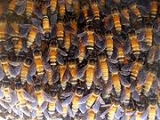
Apis dorsata

Encyclopedia
Apis dorsata, the giant honey bee, is a honey bee
of southern and southeastern Asia
mainly in forested areas like the Terai
of Nepal
. The subspecies with the largest individuals is the Himalayan cliff honey bee - Apis dorsata laboriosa
- but typical Apis dorsata workers from other subspecies are around 17–20 mm (0.669291338582677–0.78740157480315 ) long.
_on_tribulus_terrestris_w_img_1020.jpg)
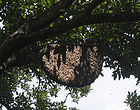 Nest
Nest
s are mainly built in exposed places far off the ground, on tree limbs and under cliff overhangs, and sometimes on building
s. Apis dorsata is an aggressive bee and has never been domesticated (as it does not use enclosed cavities for nesting). It can be extremely dangerous if the colony
is provoked. Each colony consists of a single vertical comb
(sometimes approaching a square metre) suspended from above, and the comb is typically covered by a dense mass of bees in several layers. When disturbed, the workers may exhibit a defensive behavior known as defense waving. Bees in the outer layer thrust their abdomens ninety degrees in an upward direction and shake them in a synchronous way. This may be accompanied by stroking of the wings. The signal is transmitted to nearby workers that also adopt the posture, thus creating a visible (and audible) "ripple" effect defer across the face of the comb, in an almost identical manner to an audience wave at a crowded stadium.
These bees are tropical and in most places they migrate seasonally. Some recent evidence indicates that the bees return to the same nest site, even though most, if not all, the original workers might be replaced in the process. The mechanism of memory retention remains a mystery.
Despite its aggressive nature, indigenous peoples have traditionally used this species as a source of honey
and beeswax
, a practice known as honey hunting
.
recognized the following subspecies
:
The latter is not distinct morphologically
from the nominate, but has different housekeeping and swarming behavior, allowing it to survive at high altitudes. In addition, there has been little gene flow
between it and A. dorsata for millions of years; accordingly, some argue that it should be classified as a species. Likewise, the southeastern taxon
binghami seems also to be distinct. The limits of their ranges in Indochina
and the possible distinctness of the geographically distant Philippines population require more study. However, the use of the taxonomic rank of "subspecies" is typical for geographically discrete populations, so the difference in opinion here is whether or not to recognize the rank of subspecies or not (i.e., no one is disputing that they are distinct lineages, the dispute is over whether to call them "species").
Honey bee
Honey bees are a subset of bees in the genus Apis, primarily distinguished by the production and storage of honey and the construction of perennial, colonial nests out of wax. Honey bees are the only extant members of the tribe Apini, all in the genus Apis...
of southern and southeastern Asia
Asia
Asia is the world's largest and most populous continent, located primarily in the eastern and northern hemispheres. It covers 8.7% of the Earth's total surface area and with approximately 3.879 billion people, it hosts 60% of the world's current human population...
mainly in forested areas like the Terai
Terai
The Terai is a belt of marshy grasslands, savannas, and forests located south of the outer foothills of the Himalaya, the Siwalik Hills, and north of the Indo-Gangetic Plain of the Ganges, Brahmaputra and their tributaries. The Terai belongs to the Terai-Duar savanna and grasslands ecoregion...
of Nepal
Nepal
Nepal , officially the Federal Democratic Republic of Nepal, is a landlocked sovereign state located in South Asia. It is located in the Himalayas and bordered to the north by the People's Republic of China, and to the south, east, and west by the Republic of India...
. The subspecies with the largest individuals is the Himalayan cliff honey bee - Apis dorsata laboriosa
Apis dorsata laboriosa
Apis dorsata laboriosa, the Himalayan honey bee, is the world’s largest honey bee; single adults can measure up to in length. Before 1980, Apis dorsata laboriosa was considered to be a subspecies of the widespread Apis dorsata, the giant honey bee, but in 1980 and for almost 20 years thereafter...
- but typical Apis dorsata workers from other subspecies are around 17–20 mm (0.669291338582677–0.78740157480315 ) long.
Nest
A nest is a place of refuge to hold an animal's eggs or provide a place to live or raise offspring. They are usually made of some organic material such as twigs, grass, and leaves; or may simply be a depression in the ground, or a hole in a tree, rock or building...
s are mainly built in exposed places far off the ground, on tree limbs and under cliff overhangs, and sometimes on building
Building
In architecture, construction, engineering, real estate development and technology the word building may refer to one of the following:...
s. Apis dorsata is an aggressive bee and has never been domesticated (as it does not use enclosed cavities for nesting). It can be extremely dangerous if the colony
Colony
In politics and history, a colony is a territory under the immediate political control of a state. For colonies in antiquity, city-states would often found their own colonies. Some colonies were historically countries, while others were territories without definite statehood from their inception....
is provoked. Each colony consists of a single vertical comb
Honeycomb
A honeycomb is a mass of hexagonal waxcells built by honey bees in their nests to contain their larvae and stores of honey and pollen.Beekeepers may remove the entire honeycomb to harvest honey...
(sometimes approaching a square metre) suspended from above, and the comb is typically covered by a dense mass of bees in several layers. When disturbed, the workers may exhibit a defensive behavior known as defense waving. Bees in the outer layer thrust their abdomens ninety degrees in an upward direction and shake them in a synchronous way. This may be accompanied by stroking of the wings. The signal is transmitted to nearby workers that also adopt the posture, thus creating a visible (and audible) "ripple" effect defer across the face of the comb, in an almost identical manner to an audience wave at a crowded stadium.
These bees are tropical and in most places they migrate seasonally. Some recent evidence indicates that the bees return to the same nest site, even though most, if not all, the original workers might be replaced in the process. The mechanism of memory retention remains a mystery.
Despite its aggressive nature, indigenous peoples have traditionally used this species as a source of honey
Honey
Honey is a sweet food made by bees using nectar from flowers. The variety produced by honey bees is the one most commonly referred to and is the type of honey collected by beekeepers and consumed by humans...
and beeswax
Beeswax
Beeswax is a natural wax produced in the bee hive of honey bees of the genus Apis. It is mainly esters of fatty acids and various long chain alcohols...
, a practice known as honey hunting
Honey hunting
Honey hunting or honey harvesting which involves robbing honey from wild bee colonies is one of the most ancient human activities and is still practiced by aboriginal societies in parts of Africa, Asia, Australia and South America. Some of the earliest evidence of gathering honey from wild colonies...
.
Subspecies
Michael S. EngelMichael S. Engel
Michael S. Engel is an American paleontologist and entomologist. He has undertaken field work in Central Asia, Asia Minor, and the Western Hemisphere, and published more than 300 papers in scientific journals. He was trained at the University of Kansas where in 1993 he received a B.S. in Cellular...
recognized the following subspecies
Subspecies
Subspecies in biological classification, is either a taxonomic rank subordinate to species, ora taxonomic unit in that rank . A subspecies cannot be recognized in isolation: a species will either be recognized as having no subspecies at all or two or more, never just one...
:
- Apis dorsata dorsata; primarily from IndiaIndiaIndia , officially the Republic of India , is a country in South Asia. It is the seventh-largest country by geographical area, the second-most populous country with over 1.2 billion people, and the most populous democracy in the world...
- Apis dorsata binghami Cockerell; (Indonesian honey bee) from Malaysia and IndonesiaIndonesiaIndonesia , officially the Republic of Indonesia , is a country in Southeast Asia and Oceania. Indonesia is an archipelago comprising approximately 13,000 islands. It has 33 provinces with over 238 million people, and is the world's fourth most populous country. Indonesia is a republic, with an...
- Apis dorsata breviligula Maa; from the PhilippinesPhilippinesThe Philippines , officially known as the Republic of the Philippines , is a country in Southeast Asia in the western Pacific Ocean. To its north across the Luzon Strait lies Taiwan. West across the South China Sea sits Vietnam...
- Apis dorsata laboriosaApis dorsata laboriosaApis dorsata laboriosa, the Himalayan honey bee, is the world’s largest honey bee; single adults can measure up to in length. Before 1980, Apis dorsata laboriosa was considered to be a subspecies of the widespread Apis dorsata, the giant honey bee, but in 1980 and for almost 20 years thereafter...
FabriciusFabriciusFabricius may refer to:*people from the Ancient Roman gens Fabricia:*Gaius Fabricius Luscinus, the first of the Fabricii to move to Rome* Carel Fabricius , painter...
; (Himalayan cliff honey bee), also in MyanmarMyanmarBurma , officially the Republic of the Union of Myanmar , is a country in Southeast Asia. Burma is bordered by China on the northeast, Laos on the east, Thailand on the southeast, Bangladesh on the west, India on the northwest, the Bay of Bengal to the southwest, and the Andaman Sea on the south....
, LaosLaosLaos Lao: ສາທາລະນະລັດ ປະຊາທິປະໄຕ ປະຊາຊົນລາວ Sathalanalat Paxathipatai Paxaxon Lao, officially the Lao People's Democratic Republic, is a landlocked country in Southeast Asia, bordered by Burma and China to the northwest, Vietnam to the east, Cambodia to the south and Thailand to the west...
, and southern ChinaChinaChinese civilization may refer to:* China for more general discussion of the country.* Chinese culture* Greater China, the transnational community of ethnic Chinese.* History of China* Sinosphere, the area historically affected by Chinese culture...
The latter is not distinct morphologically
Morphology (biology)
In biology, morphology is a branch of bioscience dealing with the study of the form and structure of organisms and their specific structural features....
from the nominate, but has different housekeeping and swarming behavior, allowing it to survive at high altitudes. In addition, there has been little gene flow
Gene flow
In population genetics, gene flow is the transfer of alleles of genes from one population to another.Migration into or out of a population may be responsible for a marked change in allele frequencies...
between it and A. dorsata for millions of years; accordingly, some argue that it should be classified as a species. Likewise, the southeastern taxon
Taxon
|thumb|270px|[[African elephants]] form a widely-accepted taxon, the [[genus]] LoxodontaA taxon is a group of organisms, which a taxonomist adjudges to be a unit. Usually a taxon is given a name and a rank, although neither is a requirement...
binghami seems also to be distinct. The limits of their ranges in Indochina
Indochina
The Indochinese peninsula, is a region in Southeast Asia. It lies roughly southwest of China, and east of India. The name has its origins in the French, Indochine, as a combination of the names of "China" and "India", and was adopted when French colonizers in Vietnam began expanding their territory...
and the possible distinctness of the geographically distant Philippines population require more study. However, the use of the taxonomic rank of "subspecies" is typical for geographically discrete populations, so the difference in opinion here is whether or not to recognize the rank of subspecies or not (i.e., no one is disputing that they are distinct lineages, the dispute is over whether to call them "species").