


Apiary

Encyclopedia
Beehive (beekeeping)
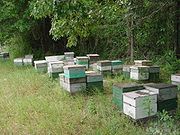
A beehive is an enclosed structure in which some honey bee species of the subgenus Apis live and raise their young. Natural beehives are naturally occurring structures occupied by honeybee colonies, while domesticated honeybees live in man-made beehives, often in an apiary. These man-made...
of honey bee
Honey bee
Honey bees are a subset of bees in the genus Apis, primarily distinguished by the production and storage of honey and the construction of perennial, colonial nests out of wax. Honey bees are the only extant members of the tribe Apini, all in the genus Apis...
s are kept. Traditionally beekeeper
Beekeeper
A beekeeper is a person who keeps honey bees for the purposes of securing commodities such as honey, beeswax, pollen, royal jelly; pollinating fruits and vegetables; raising queens and bees for sale to other farmers; and/or for purposes satisfying natural scientific curiosity...
s (also known as apiarists) paid land rent in honey
Honey
Honey is a sweet food made by bees using nectar from flowers. The variety produced by honey bees is the one most commonly referred to and is the type of honey collected by beekeepers and consumed by humans...
for the use of small parcels. Some farmer
Farmer
A farmer is a person engaged in agriculture, who raises living organisms for food or raw materials, generally including livestock husbandry and growing crops, such as produce and grain...
s will provide free apiary sites, because they need pollination
Pollination
Pollination is the process by which pollen is transferred in plants, thereby enabling fertilisation and sexual reproduction. Pollen grains transport the male gametes to where the female gamete are contained within the carpel; in gymnosperms the pollen is directly applied to the ovule itself...
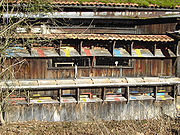
, and farmers who need many hives often pay for them to be moved to the crops when they bloom. Can also be a wall-less, roofed structure, similar to a gazebo.
Location
Pollination management
Pollination Management is the label for horticultural practices that accomplish or enhance pollination of a crop, to improve yield or quality, by understanding of the particular crop's pollination needs, and by knowledgeable management of pollenizers, pollinators, and pollination...
, apiaries are rarely set up; the bees are only present during the bloom period of the crop. But in a few cases, such as for organic farms, long term apiaries are established, with the rule of thumb
Rule of thumb
A rule of thumb is a principle with broad application that is not intended to be strictly accurate or reliable for every situation. It is an easily learned and easily applied procedure for approximately calculating or recalling some value, or for making some determination...
being one hive per acre (4,000 m²) of the crop that needs pollination.
In the USA there are beekeepers - from hobbyists to commercial - in every state. The most lucrative areas for American honey production are Florida, Texas, California, and the Upper Midwest. For paid pollination, the main areas are California, the Pacific Northwest, the Great Lakes States, and the Northeast. An apiary may have other hive management
Hive management
Hive management is a term used in beekeeping. The term describes all the intervention techniques a beekeeper may perform to ensure hive survival and to maximize hive production. Hive management techniques vary widely depending on the objectives...
objectives including queen rearing and mating. In the northern hemisphere
Northern Hemisphere
The Northern Hemisphere is the half of a planet that is north of its equator—the word hemisphere literally means “half sphere”. It is also that half of the celestial sphere north of the celestial equator...
, east and south facing locations with full morning sun are preferred. In hot climates shade is needed and may have to be artificially provided if trees are not present. Other factors include air and water drainage and accessibility by truck, distance from phobic people, and protection from vandalism.
Size
Depending on the nectarNorthern Nectar Sources for Honeybees
The nectar source in a given area depends on the type of vegetation present and the length of their bloom period. What type of vegetation will grow in an area depends on soil texture, soil pH, soil drainage, daily maximum and minimum temperatures, precipitation, extreme minimum winter temperature,...
and pollen source
Pollen source
The term pollen source is often used in the context of beekeeping and refers to flowering plants as a source of pollen for bees or other insects. Bees collect pollen as a protein source to raise their brood. For the plant, the pollinizer, this can be an important mechanism for sexual reproduction,...
s in a given area, the maximum number of hives that can be placed in one apiary can vary. If too many hives are placed into an apiary the hives compete with each other for scarce resources. This can lead to lower honey
Honey
Honey is a sweet food made by bees using nectar from flowers. The variety produced by honey bees is the one most commonly referred to and is the type of honey collected by beekeepers and consumed by humans...
and pollen
Pollen
Pollen is a fine to coarse powder containing the microgametophytes of seed plants, which produce the male gametes . Pollen grains have a hard coat that protects the sperm cells during the process of their movement from the stamens to the pistil of flowering plants or from the male cone to the...
yields, higher transmission of disease and robbing
Robbing
Robbing is a term used in beekeeping. Bees from one beehive will try to rob honey from another hive. Robbing behavior is especially strong when there is little nectar in the field. Strong colonies with the largest stores are the most apt to prey upon weaker colonies. Some robbing is carried out...
. The maximum size of a permanent apiary or bee yard may depend on the type of bee as well. Some honey bee species or races fly farther than others. A circle around an apiary with a three-mile (5 km) foraging radius covers 28 square miles (72.5 km²). A good rule of thumb is to have no more than 25–40 hives in a permanent apiary. Although, migrating beekeepers may temporarily place one hundred hives into a location with a good nectar flow.
External links
- The River Wey and Wey Navigations Community Site — a non-commercial site of over 200,000 words all about the Wey Valley and includes a photo-essay about honey bees and apiary
- National Honey Board Press Release June 2005