
Apheresis is a
medical technologyMedical Technology encompasses a wide range of healthcare products and is used to diagnose, monitor or treat diseases or medical conditions affecting humans. Such technologies are intended to improve the quality of healthcare delivered through earlier diagnosis, less invasive treatment options and...
in which the
bloodBlood is a specialized bodily fluid in animals that delivers necessary substances such as nutrients and oxygen to the cells and transports metabolic waste products away from those same cells....
of a donor or patient is passed through an apparatus that separates out one particular constituent and returns the remainder to the circulation. It is thus an
extracorporealAn extracorporeal medical procedure is a medical procedure which is performed outside the body.-Circulatory procedures:A procedure in which blood is taken from a patient's circulation to have a process applied to it before it is returned to the circulation...
therapy.
Method
Depending on the substance that is being removed, different processes are employed in apheresis. If separation by
DensityThe mass density or density of a material is defined as its mass per unit volume. The symbol most often used for density is ρ . In some cases , density is also defined as its weight per unit volume; although, this quantity is more properly called specific weight...
is required,
centrifugationCentrifugation is a process that involves the use of the centrifugal force for the sedimentation of mixtures with a centrifuge, used in industry and in laboratory settings. More-dense components of the mixture migrate away from the axis of the centrifuge, while less-dense components of the mixture...
is the most common method. Other methods involve absorption onto beads coated with an absorbent material and filtration.
The centrifugation method can be divided into two basic categories:
Continuous flow centrifugation (CFC)
Continuous flow centrifugation (CFC) historically required two venipunctures as the "continuous" means the blood is collected, spun, and returned simultaneously. Newer systems can use a single venipuncture. The main advantage of this system is the low extracorporeal volume (calculated by volume of the apheresis chamber, the donor's
hematocritThe hematocrit or packed cell volume or erythrocyte volume fraction is the percentage of the concentration of red blood cells in blood. It is normally about 45% for men and 40% for women...
, and total blood volume of the donor) used in the procedure, which may be advantageous in the elderly and for children.
Intermittent flow centrifugation
Intermittent flow centrifugation works in cycles, taking blood, spinning/processing it and then giving back the necessary parts to the donor in a
bolusIn medicine, a bolus is the administration of a medication, drug or other compound that is given to raise its concentration in blood to an effective level...
. The main advantage is a single venipuncture site. To stop the blood from coagulating, anticoagulant is automatically mixed with the blood as it is pumped from the body into the apheresis machine.
Centrifugation Variables
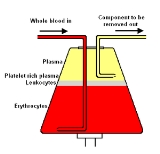
The centrifugation process itself has four variables that can be controlled to selectively remove desired components. The first is spin speed and bowl diameter, the second is "sit time" in centrifuge, the third is solutes added, and the fourth is not as easily controllable: plasma volume and cellular content of the donor. The end product in most cases is the classic sedimented blood sample with the RBC's at the bottom, the "buffy coat" of platelets and WBC's (lymphocytes/granulocytes (PMN's, basophils, eosinophils/monocytes) in the middle and the plasma on top.
Types of apheresis
There are numerous types of apheresis.
Donation
Blood taken from a healthy donor can be separated into its component parts during
blood donationA blood donation occurs when a person voluntarily has blood drawn and used for transfusions or made into medications by a process called fractionation....
, where the needed component is collected and the "unused" components are returned to the donor. Fluid replacement is usually not needed in this type of collections. There are large categories of component collections:
- Plasmapheresis
Plasmapheresis is the removal, treatment, and return of blood plasma from blood circulation. It is thus an extracorporeal therapy...
- blood plasmaBlood plasma is the straw-colored liquid component of blood in which the blood cells in whole blood are normally suspended. It makes up about 55% of the total blood volume. It is the intravascular fluid part of extracellular fluid...
. Plasmapheresis is useful in collecting FFP (fresh frozen plasma) of a particular ABO group. Commercial uses aside from FFP for this procedure include immune globulin products, plasma derivatives, and collection of rare WBC and RBC antibodies.
- Erythrocytapheresis
Erythrocytapheresis is an apheresis procedure by which erythrocytes are separated from whole blood. It is an extracorporeal blood separation method whereby whole blood is extracted from a donor or patient, the red blood cells are separated, and the remaining blood is returned to circulation.-...
- red blood cells. Erythrocytapheresis is the separation of erythrocytes from whole blood. It is most commonly accomplished using the method of centrifugal sedimentation. This process is used for red blood cell diseases such as sickle cell crises or severe malaria. The automated red blood cell collection procedure for donating erythrocytes is referred to as 'Double Reds' or 'Double Red Cell Apheresis.'
- Plateletpheresis
Plateletpheresis is the process of collecting thrombocytes, more commonly called platelets, a component of blood involved in blood clotting...
(thrombapheresis, thrombocytapheresis) - blood plateletsPlatelets, or thrombocytes , are small,irregularly shaped clear cell fragments , 2–3 µm in diameter, which are derived from fragmentation of precursor megakaryocytes. The average lifespan of a platelet is normally just 5 to 9 days...
. Plateletpheresis, like it sounds, is the collection of platelets by apheresis; while returning the RBC's, WBC's, and component plasma. The yield is normally the equivalent of between six and ten random platelet concentrates. Quality control demands the platelets from apheresis be equal to or greater than 3.0 × 10¹¹ in number and have a pH of equal to or greater than 6.2 in 90% of the products tested and must be used within five days.
- Leukapheresis
Leukapheresis is a laboratory procedure in which white blood cells are separated from a sample of blood. It is a specific type of apheresis, the more general term for separating out one particular constituent of blood and returning the remainder to the circulation.Leukapheresis may be performed to...
- leukocytes (white blood cells). Leukopheresis is the removal of PMN's, basophils, eosinophils for transfusion into patients whose PMN's are ineffective or traditional therapy has failed. There is limited data to suggest the benefit of granulocyte infusion. The complications of this procedure are the difficulty in collection and short shelf life (24 hours at 20 to 24°C). Since the "buffy coat" layer sits directly atop the RBC layer, HES, a sedimenting agent, is employed to improve yield while minimizing RBC collection. Quality control demands the resultant concentrate be 1.0 × 10¹⁰ granulocytes in 75% of the units tested and that the product be irradiated to avoid graft-versus-host disease (inactivate lymphocytes). Irradiation does not affect PMN function. Since there is usually a small amount of RBC's collected, ABO compatibility should be employed when feasible.
- Stem cell harvesting - circulating bone marrow
Bone marrow is the flexible tissue found in the interior of bones. In humans, bone marrow in large bones produces new blood cells. On average, bone marrow constitutes 4% of the total body mass of humans; in adults weighing 65 kg , bone marrow accounts for approximately 2.6 kg...
cells are harvested to use in bone marrow transplantation.
Donor Safety
- Single use kits - Apheresis is done using single-use kits, so there is no risk of infection from blood-contaminated tubing or centrifuge.
- Immune system effects - "the immediate decreases in blood lymphocyte counts and serum immunoglobulin concentrations are of slight to moderate degree and are without known adverse effects. Less information is available regarding long-term alterations of the immune system"
Kit Problems
Two apheresis kit recalls were:
- Baxter Healthcare Corporation (2005) in which "pinhole leaks were observed at the two-omega end of the umbilicus (multilumen tubing), causing a blood leak. "
- Fenwal Incorporated (2007) in which there were "two instances where the anticoagulant citrate dextrose (ACD) and saline lines were reversed in the assembly process. The reversed line connections may not be visually apparent in the monitor box, and could result in excessive ACD infusion and severe injury, including death, to the donor."
PlasticizerPlasticizers or dispersants are additives that increase the plasticity or fluidity of the material to which they are added; these include plastics, cement, concrete, wallboard, and clay. Although the same compounds are often used for both plastics and concretes the desired effects and results are...
exposure
Apheresis uses plastics and tubing, which come into contact with the blood. The plastics are made of
PVCPolyvinyl chloride is a plastic.PVC may also refer to:*Param Vir Chakra, India's highest military honor*Peripheral venous catheter, a small, flexible tube placed into a peripheral vein in order to administer medication or fluids...
in addition to additives such as a plasticizer, often DEHP. DEHP leaches from the plastic into the blood, and people have begun to study the possible effects of this leached DEHP on donors as well as transfusion recipients.
- "current risk or preventive limit values for DEHP such as the RfD of the US EPA (20 μg/kg/day) and the TDI of the European Union (20-48 μg/kg/day) can be exceeded on the day of the plateletpheresis. . . . Especially women in their reproductive age need to be protected from DEHP exposures exceeding the above mentioned preventive limit values."
- "Commercial plateletpheresis disposables release considerable amounts of DEHP during the apheresis procedure, but the total dose of DEHP retained by the donor is within the normal range of DEHP exposure of the general population."
- The Baxter company manufactured blood bags without DEHP, but there was little demand for the product in the marketplace
- "Mean DEHP doses for both plateletpheresis techniques (18.1 and 32.3 μg/kg/day) were close to or exceeded the reference dose (RfD) of the US EPA and tolerable daily intake (TDI) value of the EU on the day of the apheresis. Therefore, margins of safety might be insufficient to protect especially young men and women in their reproductive age from effects on reproductivity. At present, discontinuous-flow devices should be preferred to avert conceivable health risks from plateletpheresis donors. Strategies to avoid DEHP exposure of donors during apheresis need to be developed."
Therapy
The various apheresis techniques may be used whenever the removed constituent is causing severe symptoms of disease. Generally, apheresis has to be performed fairly often, and is an invasive process. It is therefore only employed if other means to control a particular disease have failed, or the symptoms are of such a nature that waiting for medication to become effective would cause suffering or risk of complications.
- Plasma exchange - removal of the liquid portion of blood to remove harmful substances. The plasma is replaced with a replacement solution.
- LDL apheresis
In medicine, LDL apheresis is a form of apheresis, resembling dialysis, to eliminate the cholesterol-containing particle low-density lipoprotein from the bloodstream.-Uses:...
- removal of low density lipoproteinLow-density lipoprotein is one of the five major groups of lipoproteins, which in order of size, largest to smallest, are chylomicrons, VLDL, IDL, LDL, and HDL, that enable transport of cholesterol within the water-based bloodstream...
in patients with familial hypercholesterolemiaFamilial hypercholesterolemia is a genetic disorder characterized by high cholesterol levels, specifically very high levels of low-density lipoprotein , in the blood and early cardiovascular disease...
.
- Photopheresis
In medicine, photopheresis or extracorporeal photopheresis is a form of apheresis and photodynamic therapy in which blood is treated with photoactivable drugs which are then activated with ultraviolet light....
- used to treat graft-versus-host diseaseGraft-versus-host disease is a common complication after a stem cell transplant or bone marrow transplant from another person . Immune cells in the donated marrow or stem cells recognize the recipient as "foreign". The transplanted immune cells then attack the host's body cells...
, cutaneous T-cell lymphoma, and rejection in heart transplantationTransplant rejection occurs when transplanted tissue is rejected by the recipient's immune system, which destroys the transplanted tissue. Transplant rejection can be lessened by determining the molecular similitude between donor and recipient and by use of immunosuppressant drugs after...
.
- Immunoadsorbtion with Staphylococcal protein A-agarose column - removal of allo- and autoantibodies (in autoimmune diseases, transplant rejection, hemophilia) by directing plasma through protein A-agarose columns. Protein A is a cell wall component produced by several strains of Staphylococcus aureus which binds to the Fc region of IgG.
- Leukocytapheresis
Leukoreduction is the removal of white blood cells from the blood or blood components supplied for blood transfusion. After the removal of the leukocytes, the blood product is said to be leukoreduced.- Benefits and costs :...
- removal of malignant white blood cells in people with leukemia and very high white blood cell counts causing symptoms.
- Thrombocytapheresis - removal of platelets in people with symptoms from extreme elevations in platelet count such as those with Essential Thrombasthenia or Polycythemia vera
Polycythemia vera is a blood disorder in which the bone marrow makes too many red blood cells. It may also result in the overproduction of white blood cells and platelets. Most of the health concerns associated with polycythemia vera are caused by the blood being thicker as a result of the...
Evidence Based Guidelines for Therapeutic Apheresis
In 2010, the
American Society for ApheresisThe American Society for Apheresis is an organization of physicians, scientists, nurses, and allied health professionals whose mission is to advance apheresis medicine for patients, donors and practitioners through education, evidence-based practice, research and advocacy...
published the 5th Special Edition(1) of
evidence based guidelinesEvidence-based medicine or evidence-based practice aims to apply the best available evidence gained from the scientific method to clinical decision making. It seeks to assess the strength of evidence of the risks and benefits of treatments and diagnostic tests...
for the practice of Apheresis Medicine. These guidelines are based upon a systematic review of available scientific literature. Clinical utility for a given disease is denoted by assignment of an
ASFA Category (I – IV). The quality and strength of evidence are denoted by standard GRADE recommendations. ASFA Categories are defined as follows:
Category I for disorders where therapeutic apheresis is accepted as a first line treatment,
Category II for disorders where therapeutic apheresis is accepted as a second-line treatment,
Category III for disorders where the optimal role of therapeutic apheresis is not clearly established and
Category IV for disorders where therapeutic apheresis is considered ineffective or harmful.
Fluid replacement during apheresis
It is important to remember that when the apheresis system is used for therapy the system is removing relatively small amounts of fluid (not more than 10.5 mL/kg body weight). That fluid must be replaced to keep correct intravascular volume. The fluid replaced is different at different institutions. If a crystalloid like normal saline is used, the infusion amount should be triple what is removed as the three to one ratio of NS for plasma is needed to keep up oncotic pressure. Some institutions use normal serum albumin, but it is costly and can be difficult to find. Some advocate using
FFPThe term fresh frozen plasma refers to the liquid portion of human blood that has been frozen and preserved after a blood donation and will be used for blood transfusion...
or a similar blood product, but there are dangers including citrate toxicity (from the anticoagulant), ABO incompatibility, infection, and cellular antigens.
External links