

Aphasia

Encyclopedia
Aphasia is an impairment of language ability. This class of language disorder
ranges from having difficulty remembering words to being completely unable to speak, read, or write.
Aphasia disorders usually develop quickly as a result of head injury
or stroke
, but can develop slowly from a brain tumor
, infection
, or dementia
, or can be a learning disability such as dysnomia.
The area and extent of brain damage determine the type of aphasia and its symptoms. Aphasia types include Broca's aphasia, non-fluent aphasia, motor aphasia, expressive aphasia
, receptive aphasia
, global aphasia
and many others (see :Category:Aphasias).
Medical evaluations for the disorder range from clinical screenings by a neurologist
to extensive tests by a language pathologist
.
To understand recovery processes in the brain, some researchers are using functional magnetic resonance imaging (fMRI) to better understand the human brain regions involved in speaking and understanding language. .
Most aphasia patients can recover some or most skills by working with a speech and language therapist. This rehabilitation can take two or more years and is most effective when begun quickly. Only a small minority will recover without therapy, such as those suffering a mini-stroke
. Patients with a learning-disorder aphasia such as dysnomia can learn coping skills, but cannot recover abilities that are congenitally limited
.
Improvement varies widely, depending on the aphasia's cause, type, and severity. Recovery also depends on the patient's age, health, motivation, handedness
, and educational level.
No classification of patients in subtypes and groups of subtypes is adequate. Only about 60% of patients will fit in a classification scheme such as fluent/nonfluent/pure aphasias. There is a huge variation among patients with the same diagnosis, and aphasias can be highly selective. For instance, patients with naming deficits (anomic aphasia) might show an inability only for naming buildings, or people, or colors.
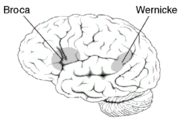 The localizationist model attempts to classify the aphasia by major characteristics and then link these to areas of the brain in which the damage has been caused. The initial two categories here were devised by early neurologists working in the field, namely Paul Broca
and Carl Wernicke. Other researchers have added to the model, resulting in it often being referred to as the "Boston-Neoclassical Model". The most prominent writers on this topic have been Harold Goodglass and Edith Kaplan
.
Receptive aphasias can be subdivided into
A - pure word deafness (patient can hear but not understand words)
B - alexia (patient can read but not understand words)
C - visual asymbolia (written words are disorganized and can not be recognized).
Intermediate - also called nominal amnestic aphasia.
Expressive aphasia also known as Broca's aphasia or cortical motor aphasia (patient has difficulty in putting his thoughts into words)
. It assumes that language processing can be broken down into a number of modules, each of which has a specific function.
Hence there is a module which recognises phonemes as they are spoken and a module which stores formulated phonemes before they are spoken. Use of this model clinically involves conducting a battery of assessments (usually from the PALPA, the "psycholinguistic assessment of language processing in adult acquired aphasia ... that can be tailored to the investigation of an individual patient's impaired and intact abilities" http://www.psypress.com/palpa-9780863771668, last visited 1/21/2011), each of which tests one or a number of these modules. Once a diagnosis is reached as to where the impairment lies, therapy can proceed to treat the individual module.
is usually defined as from infancy until but not including adolescence
.
ACA should be distinguished from developmental aphasia or developmental dysphasia, which is a primary delay or failure in language acquisition
. An important difference between ACA and developmental childhood aphasia is that in the latter there is no apparent neurological basis for the language deficit.
ACA is one of the more rare language problems in children and is notable because of its contribution to theories on language and the brain. Because there are so few children with ACA, not much is known about what types of linguistic problems these children have. However, many authors report a marked decrease in the use of all expressive language. Children can just stop talking for a period of weeks or even years, and when they start to talk again, they need a lot of encouragement. Problems with language comprehension are less common in ACA, and don't last as long.
The following table summarizes some major characteristics of different types of aphasia:
Jargon aphasia is a fluent or receptive aphasia in which the patient's
speech is incomprehensible, but appears to make sense to them. Speech is fluent and effortless with intact syntax
and grammar
, but the patient has problems with the selection of noun
s. They will either replace the desired word with another that sounds or looks like the original one, or has some other connection, or they will replace it with sound
s. Accordingly, patients with jargon aphasia often use neologisms, and may perseverate
if they try to replace the words they can't find with sounds.
Commonly, substitutions involve picking another (actual) word starting with the same sound (e.g. clocktower - colander), picking another semantically related to the first (e.g. letter - scroll), or picking one phonetically similar to the intended one (e.g. lane - late).
Research on understanding the nature, causes and treatment of aphasia is typically categorized into different components of language including phonological processing, lexical-semantic processing, syntactic processing, orthographic processing. There are two associations dedicated to the study of aphasia, the Academy of Aphasia and Clinical Aphasiology.
s to the language-relevant areas of the frontal, temporal and parietal lobes of the brain, such as Broca's area
, Wernicke's area
, and the neural pathways between them. These areas are almost always located in the left hemisphere, and in most people this is where the ability to produce and comprehend language is found. However, in a very small number of people, language ability is found in the right hemisphere. In either case, damage to these language areas can be caused by a stroke
, traumatic brain injury
, or other brain injury
. Aphasia may also develop slowly, as in the case of a brain tumor
or progressive neurological disease, e.g., Alzheimer's or Parkinson's disease. It may also be caused by a sudden hemorrhagic event within the brain. Certain chronic neurological disorders, such as epilepsy
or migraine
, can also include transient aphasia as a prodromal or episodic symptom. Aphasia is also listed as a rare side effect of the fentanyl patch, an opioid used to control chronic pain.
A multi-disciplinary team, including doctors (often a physician is involved, but more likely a clinical neuropsychologist will head the treatment team), physiotherapist, occupational therapist, speech-language pathologist, and social worker, works together in treating aphasia. For the most part, treatment relies heavily on repetition and aims to address language performance by working on task-specific skills. The primary goal is to help the individual and those closest to them adjust to changes and limitations in communication.
Treatment techniques mostly fall under two approaches:
Several treatment techniques include the following:
More recently, computer technology has been incorporated into treatment options. A key indication for good prognosis is treatment intensity. A minimum of 2-3 hours per week has been specified to produce positive results. The main advantage of using computers is that it can greatly increase intensity of therapy. These programs consist of a large variety of exercises and can be done at home in addition to face-to-face treatment with a therapist. However, since aphasia presents differently among individuals, these programs must be dynamic and flexible in order to adapt to the variability in impairments. Another barrier is the capability of computer programs to imitate normal speech and keep up with the speed of regular conversation. Therefore, computer technology seems to be limited in a communicative setting, however is effective in producing improvements in communication training.
Several examples of programs used are StepByStep, Linguagraphica, Computer-Based Visual Communication (C-VIC), TouchSpeak (TS), and Sentence Shaper.
Melodic intonation therapy
is often used to treat non-fluent aphasia and has proved to be very effective in some cases.
Zolpidem
, a drug with the trade name of Ambien, may provide short-lasting but effective improvement in symptoms of aphasia present in some survivors of stroke. The mechanism for improvement in these cases remains unexplained and is the focus of current research by several groups, to explain how a drug which acts as a hypnotic-sedative in people with normal brain function, can paradoxically increase speech ability in people recovering from severe brain injury. Use of zolpidem for this application remains experimental at this time, and is not officially approved by any pharmaceutical manufacturers of zolpidem or medical regulatory agencies worldwide.
, the Edwin Smith Papyrus
, which details speech problems in a person with a traumatic brain injury
to the temporal lobe
.
Language disorder
Language disorders or language impairments are disorders that involve the processing of linguistic information. Problems that may be experienced can involve grammar , semantics , or other aspects of language...
ranges from having difficulty remembering words to being completely unable to speak, read, or write.
Aphasia disorders usually develop quickly as a result of head injury
Head injury
Head injury refers to trauma of the head. This may or may not include injury to the brain. However, the terms traumatic brain injury and head injury are often used interchangeably in medical literature....
or stroke
Stroke
A stroke, previously known medically as a cerebrovascular accident , is the rapidly developing loss of brain function due to disturbance in the blood supply to the brain. This can be due to ischemia caused by blockage , or a hemorrhage...
, but can develop slowly from a brain tumor
Brain tumor
A brain tumor is an intracranial solid neoplasm, a tumor within the brain or the central spinal canal.Brain tumors include all tumors inside the cranium or in the central spinal canal...
, infection
Infection
An infection is the colonization of a host organism by parasite species. Infecting parasites seek to use the host's resources to reproduce, often resulting in disease...
, or dementia
Dementia
Dementia is a serious loss of cognitive ability in a previously unimpaired person, beyond what might be expected from normal aging...
, or can be a learning disability such as dysnomia.
The area and extent of brain damage determine the type of aphasia and its symptoms. Aphasia types include Broca's aphasia, non-fluent aphasia, motor aphasia, expressive aphasia
Expressive aphasia
Expressive aphasia , also known as Broca's aphasia in clinical neuropsychology and agrammatic aphasia in cognitive neuropsychology, is caused by damage to or developmental issues in anterior regions of the brain, including the left posterior inferior frontal gyrus known as Broca's area...
, receptive aphasia
Receptive aphasia
Receptive aphasia, also known as Wernicke’s aphasia, fluent aphasia, or sensory aphasia, is a type of aphasia traditionally associated with neurological damage to Wernicke’s area in the brain,...
, global aphasia
Global aphasia
Global aphasia is a type of aphasia that is commonly associated with a large lesion in the perisylvian area of the frontal, temporal and parietal lobes of the brain causing an almost total reduction of all aspects of spoken and written language. It involves a "left side blowout" which includes...
and many others (see :Category:Aphasias).
Medical evaluations for the disorder range from clinical screenings by a neurologist
Neurologist
A neurologist is a physician who specializes in neurology, and is trained to investigate, or diagnose and treat neurological disorders.Neurology is the medical specialty related to the human nervous system. The nervous system encompasses the brain, spinal cord, and peripheral nerves. A specialist...
to extensive tests by a language pathologist
Speech and language pathology
Speech-Language Pathology specializes in communication disorders.The main components of speech production include: phonation, the process of sound production; resonance, opening and closing of the vocal folds; intonation, the variation of pitch; and voice, including aeromechanical components of...
.
To understand recovery processes in the brain, some researchers are using functional magnetic resonance imaging (fMRI) to better understand the human brain regions involved in speaking and understanding language. .
Most aphasia patients can recover some or most skills by working with a speech and language therapist. This rehabilitation can take two or more years and is most effective when begun quickly. Only a small minority will recover without therapy, such as those suffering a mini-stroke
Transient ischemic attack
A transient ischemic attack is a transient episode of neurologic dysfunction caused by ischemia – either focal brain, spinal cord or retinal – without acute infarction...
. Patients with a learning-disorder aphasia such as dysnomia can learn coping skills, but cannot recover abilities that are congenitally limited
Congenital disorder
A congenital disorder, or congenital disease, is a condition existing at birth and often before birth, or that develops during the first month of life , regardless of causation...
.
Improvement varies widely, depending on the aphasia's cause, type, and severity. Recovery also depends on the patient's age, health, motivation, handedness
Handedness
Handedness is a human attribute defined by unequal distribution of fine motor skills between the left and right hands. An individual who is more dexterous with the right hand is called right-handed and one who is more skilled with the left is said to be left-handed...
, and educational level.
Event Drawing Task
Findings of the Event Drawing Task showed that "conceptualisation problems may be an additional source of deficit in aphasia"Classification
Classifying the different subtypes of aphasia is difficult and has led to disagreements among experts. The localizationist model is the original model, but modern anatomical techniques and analyses have shown that precise connections between brain regions and symptom classification don't exist. The neural organization of language is complicated; language is a comprehensive and complex behavior and it makes sense that it isn't the product of some small, circumscribed region of the brain.No classification of patients in subtypes and groups of subtypes is adequate. Only about 60% of patients will fit in a classification scheme such as fluent/nonfluent/pure aphasias. There is a huge variation among patients with the same diagnosis, and aphasias can be highly selective. For instance, patients with naming deficits (anomic aphasia) might show an inability only for naming buildings, or people, or colors.
Localizationist model
Paul Broca
Pierre Paul Broca was a French physician, surgeon, anatomist, and anthropologist. He was born in Sainte-Foy-la-Grande, Gironde. He is best known for his research on Broca's area, a region of the frontal lobe that has been named after him. Broca’s Area is responsible for articulated language...
and Carl Wernicke. Other researchers have added to the model, resulting in it often being referred to as the "Boston-Neoclassical Model". The most prominent writers on this topic have been Harold Goodglass and Edith Kaplan
Edith Kaplan
Edith F. Kaplan was an American psychologist. She was a pioneer of neuropsychological tests and did most of her work at the Boston VA Hospital....
.
- Individuals with Broca's aphasia (also termed expressive aphasiaExpressive aphasiaExpressive aphasia , also known as Broca's aphasia in clinical neuropsychology and agrammatic aphasia in cognitive neuropsychology, is caused by damage to or developmental issues in anterior regions of the brain, including the left posterior inferior frontal gyrus known as Broca's area...
) were once thought to have ventral temporal damage, though more recent work by Dr. Nina Dronkers using imaging and 'lesion analysis' has revealed that patients with Broca's aphasia have lesions to the medial insular cortex. Broca missed these lesions because his studies did not dissect the brains of diseased patients, so only the more temporal damage was visible. Dronkers and Dr. Odile Plaisant scanned Broca's original patients' brains using a non-invasive MRI scanner to take a closer look. Individuals with Broca's aphasia often have right-sided weaknessHemiplegiaHemiplegia /he.mə.pliː.dʒiə/ is total paralysis of the arm, leg, and trunk on the same side of the body. Hemiplegia is more severe than hemiparesis, wherein one half of the body has less marked weakness....
or paralysis of the arm and leg, because the frontal lobe is also important for body movement. Video clips showing patients with Broca-type aphasia can be found here.
- In contrast to Broca's aphasia, damage to the temporal lobeTemporal lobeThe temporal lobe is a region of the cerebral cortex that is located beneath the Sylvian fissure on both cerebral hemispheres of the mammalian brain....
may result in a fluent aphasia that is called Wernicke's aphasia (also termed sensory aphasia). These individuals usually have no body weakness, because their brain injury is not near the parts of the brain that control movement. A video clip with a patient exhibiting Wernicke's aphasia can be found here
- Working from Wernicke's model of aphasia, Ludwig LichtheimLudwig LichtheimLudwig Lichtheim was a German physician. He was educated at the gymnasium in Breslau, and studied medicine at the universities of Berlin, Zurich, and Breslau, graduating in 1868...
proposed five other types of aphasia, but these were not tested against real patients until modern imaging made more in-depth studies available. The other five types of aphasia in the localizationist model are:
- Pure word deafnessPure word deafnessPure Word Deafness is caused by bilateral damage to the posterior superior temporal lobes or disruption of connections between these areas. It exhibits itself as inability to comprehend the meaning of speech, but still being able to hear, speak, read, and write.-Presentation:The underlying...
- Conduction aphasiaConduction aphasiaConduction aphasia, also called associative aphasia, is a relatively rare form of aphasia. An acquired language disorder, it is characterized by intact auditory comprehension, fluent speech production, but poor speech repetition. Patients will display frequent errors during spontaneous speech,...
- Apraxia of speechApraxia of speechApraxia of Speech is a motor speech disorder affecting an individual's ability to translate conscious speech plans into motor plans and is caused by illness or injury in adults. Like other apraxias, it only affects volitional movement patterns...
(now considered a separate disorder in itself) - Transcortical motor aphasiaTranscortical motor aphasiaTranscortical Motor Aphasia , also known as adynamic aphasia and extrasylvian motor aphasia, results from an injury to the anterior superior frontal lobe. The injury is typically caused by a cerebrovascular accident , commonly referred to as a stroke. The area of insult is sometimes referred to as...
- Transcortical sensory aphasiaTranscortical sensory aphasiaTranscortical sensory aphasia is caused by lesions in the inferior left temporal lobe of the brain located near Wernicke's area, and is usually due to minor hemorrhage or contusion in the temporal lobe, or infarcts of the left posterior cerebral artery...
- Anomia is another type of aphasia proposed under what is commonly known as the Boston-Neoclassical model, which is essentially a difficulty with naming. A final type of aphasia, global aphasiaGlobal aphasiaGlobal aphasia is a type of aphasia that is commonly associated with a large lesion in the perisylvian area of the frontal, temporal and parietal lobes of the brain causing an almost total reduction of all aspects of spoken and written language. It involves a "left side blowout" which includes...
, results from damage to extensive portions of the perisylvian region of the brain. An individual with global aphasiaGlobal aphasiaGlobal aphasia is a type of aphasia that is commonly associated with a large lesion in the perisylvian area of the frontal, temporal and parietal lobes of the brain causing an almost total reduction of all aspects of spoken and written language. It involves a "left side blowout" which includes...
will have difficulty understanding both spoken and written language and will also have difficulty speaking. This is a severe type of aphasia which makes it quite difficult when communicating with the individual.
Intention
The study seeks to thoroughly identify similarities and differences between the event drawing performance of two aphasic participants and a group of 12 non-brain-damaged controls.Other ways to classify aphasia
Aphasia can also be classified as- Receptive
- Intermediate
- Expressive
Receptive aphasias can be subdivided into
A - pure word deafness (patient can hear but not understand words)
B - alexia (patient can read but not understand words)
C - visual asymbolia (written words are disorganized and can not be recognized).
Intermediate - also called nominal amnestic aphasia.
Expressive aphasia also known as Broca's aphasia or cortical motor aphasia (patient has difficulty in putting his thoughts into words)
Fluent, non-fluent and "pure" aphasias
The different types of aphasia can be divided into three categories: fluent, non-fluent and "pure" aphasias.- Fluent aphasias, also called receptive aphasias, are impairments related mostly to the input or reception of language, with difficulties either in auditory verbal comprehension or in the repetition of words, phrases, or sentences spoken by others. Speech is easy and fluent, but there are difficulties related to the output of language as well, such as paraphasiaParaphasiaParaphasia is a feature of aphasia in which one loses the ability of speaking correctly, substitutes one word for another, and changes words and sentences in an inappropriate way. It often develops after a stroke or brain injury. The patient's speech is fluent but is error-prone, e.g...
. Examples of fluent aphasias are: Wernicke's aphasia, Transcortical sensory aphasiaTranscortical sensory aphasiaTranscortical sensory aphasia is caused by lesions in the inferior left temporal lobe of the brain located near Wernicke's area, and is usually due to minor hemorrhage or contusion in the temporal lobe, or infarcts of the left posterior cerebral artery...
, Conduction aphasiaConduction aphasiaConduction aphasia, also called associative aphasia, is a relatively rare form of aphasia. An acquired language disorder, it is characterized by intact auditory comprehension, fluent speech production, but poor speech repetition. Patients will display frequent errors during spontaneous speech,...
, Anomic aphasia
- Nonfluent aphasias, also called expressive aphasias are difficulties in articulating, but in most cases there is relatively good auditory verbal comprehension. Examples of nonfluent aphasias are: Broca's aphasia, Transcortical motor aphasiaTranscortical motor aphasiaTranscortical Motor Aphasia , also known as adynamic aphasia and extrasylvian motor aphasia, results from an injury to the anterior superior frontal lobe. The injury is typically caused by a cerebrovascular accident , commonly referred to as a stroke. The area of insult is sometimes referred to as...
, Global aphasiaGlobal aphasiaGlobal aphasia is a type of aphasia that is commonly associated with a large lesion in the perisylvian area of the frontal, temporal and parietal lobes of the brain causing an almost total reduction of all aspects of spoken and written language. It involves a "left side blowout" which includes...
- "Pure" aphasias are selective impairments in reading, writing, or the recognition of words. These disorders may be quite selective. For example, a person is able to read but not write, or is able to write but not read. Examples of pure aphasias are: Pure alexia, Agraphia, Pure word deafnessPure word deafnessPure Word Deafness is caused by bilateral damage to the posterior superior temporal lobes or disruption of connections between these areas. It exhibits itself as inability to comprehend the meaning of speech, but still being able to hear, speak, read, and write.-Presentation:The underlying...
Primary and secondary aphasia
Aphasia can be divided into primary and secondary aphasia.- Primary aphasia is due to problems with language-processing mechanisms.
- Secondary aphasia is the result of other problems, like memory impairments, attention disorders, or perceptual problems.
Cognitive neuropsychological model
The cognitive neuropsychological model builds on cognitive neuropsychologyCognitive neuropsychology
Cognitive neuropsychology is a branch of cognitive psychology that aims to understand how the structure and function of the brain relates to specific psychological processes. It places a particular emphasis on studying the cognitive effects of brain injury or neurological illness with a view to...
. It assumes that language processing can be broken down into a number of modules, each of which has a specific function.
Hence there is a module which recognises phonemes as they are spoken and a module which stores formulated phonemes before they are spoken. Use of this model clinically involves conducting a battery of assessments (usually from the PALPA, the "psycholinguistic assessment of language processing in adult acquired aphasia ... that can be tailored to the investigation of an individual patient's impaired and intact abilities" http://www.psypress.com/palpa-9780863771668, last visited 1/21/2011), each of which tests one or a number of these modules. Once a diagnosis is reached as to where the impairment lies, therapy can proceed to treat the individual module.
Acquired childhood aphasia
Acquired childhood aphasia (ACA) is a language impairment resulting from some kind of brain damage. This brain damage can have different causes, such as head trauma, tumors, cerebrovascular accidents, or seizure disorders. Most, but not all authors state that ACA is preceded by a period of normal language development. Age of onsetAge of onset
The age of onset is a medical term referring to the age at which an individual acquires, develops, or first experiences a condition or symptoms of a disease or disorder...
is usually defined as from infancy until but not including adolescence
Adolescence
Adolescence is a transitional stage of physical and mental human development generally occurring between puberty and legal adulthood , but largely characterized as beginning and ending with the teenage stage...
.
ACA should be distinguished from developmental aphasia or developmental dysphasia, which is a primary delay or failure in language acquisition
Language acquisition
Language acquisition is the process by which humans acquire the capacity to perceive, produce and use words to understand and communicate. This capacity involves the picking up of diverse capacities including syntax, phonetics, and an extensive vocabulary. This language might be vocal as with...
. An important difference between ACA and developmental childhood aphasia is that in the latter there is no apparent neurological basis for the language deficit.
ACA is one of the more rare language problems in children and is notable because of its contribution to theories on language and the brain. Because there are so few children with ACA, not much is known about what types of linguistic problems these children have. However, many authors report a marked decrease in the use of all expressive language. Children can just stop talking for a period of weeks or even years, and when they start to talk again, they need a lot of encouragement. Problems with language comprehension are less common in ACA, and don't last as long.
Signs and symptoms
People with aphasia may experience any of the following behaviors due to an acquired brain injury, although some of these symptoms may be due to related or concomitant problems such as dysarthria or apraxia and not primarily due to aphasia.- inability to comprehend language
- inability to pronounce, not due to muscle paralysis or weakness
- inability to speak spontaneously
- inability to form words
- inability to name objects
- poor enunciationEnunciationIn phonetics, enunciation is the act of speaking. Good enunciation is the act of speaking clearly and concisely. The opposite of good enunciation is mumbling or slurring. See also pronunciation which is a component of enunciation. Pronunciation is to pronounce sounds of words correctly....
- excessive creation and use of personal neologisms
- inability to repeat a phrase
- persistent repetition of phrases
- paraphasiaParaphasiaParaphasia is a feature of aphasia in which one loses the ability of speaking correctly, substitutes one word for another, and changes words and sentences in an inappropriate way. It often develops after a stroke or brain injury. The patient's speech is fluent but is error-prone, e.g...
(substituting letters, syllables or words) - agrammatismAgrammatismAgrammatism is a form of expressive aphasia that refers to the inability to speak in a grammatically correct fashion. People with agrammatism may have telegraphic speech, a unique speech pattern with simplified formation of sentences , akin to that found in telegraph messages...
(inability to speak in a grammatically correct fashion) - dysprosodyDysprosodyDysprosody, which is also known as pseudo-foreign dialect syndrome, refers to a disorder in which one or more of the prosodic functions are either compromised or eliminated completely....
(alterations in inflexion, stress, and rhythm) - incomplete sentences
- inability to readReading (process)Reading is a complex cognitive process of decoding symbols for the intention of constructing or deriving meaning . It is a means of language acquisition, of communication, and of sharing information and ideas...
- inability to writeWritingWriting is the representation of language in a textual medium through the use of a set of signs or symbols . It is distinguished from illustration, such as cave drawing and painting, and non-symbolic preservation of language via non-textual media, such as magnetic tape audio.Writing most likely...
- limited verbal output
- difficulty in naming
The following table summarizes some major characteristics of different types of aphasia:
| Type of aphasia | Repetition Speech repetition thumb|250px|right|[[Children]] copy with their own [[mouth]]s the words spoken by the mouths of those around them. This enables them to learn the [[pronunciation]] of words not already in their [[vocabulary]].... |
Naming | Auditory comprehension | Fluency | Presentation |
|---|---|---|---|---|---|
| Wernicke's aphasia | mild–mod | mild–severe | defective | fluent paraphasic | Individuals with Wernicke's aphasia may speak in long sentences that have no meaning, add unnecessary words, and even create new "words" (neologisms). For example, someone with Wernicke's aphasia may say, "You know that smoodle pinkered and that I want to get him round and take care of him like you want before", meaning "The dog needs to go out so I will take him for a walk". They have poor auditory and reading comprehension, and fluent, but nonsensical, oral and written expression. Individuals with Wernicke's aphasia usually have great difficulty understanding the speech of both themselves and others and are therefore often unaware of their mistakes. |
| Transcortical sensory aphasia Transcortical sensory aphasia Transcortical sensory aphasia is caused by lesions in the inferior left temporal lobe of the brain located near Wernicke's area, and is usually due to minor hemorrhage or contusion in the temporal lobe, or infarcts of the left posterior cerebral artery... |
good | mod–severe | poor | fluent | Similar deficits as in Wernicke's aphasia, but repetition ability remains intact. |
| Conduction aphasia Conduction aphasia Conduction aphasia, also called associative aphasia, is a relatively rare form of aphasia. An acquired language disorder, it is characterized by intact auditory comprehension, fluent speech production, but poor speech repetition. Patients will display frequent errors during spontaneous speech,... |
poor | poor | relatively good | fluent | Conduction aphasia is caused by deficits in the connections between the speech-comprehension and speech-production areas. This might be caused by damage to the arcuate fasciculus, the structure that transmits information between Wernicke's area and Broca's area. Similar symptoms, however, can be present after damage to the insula Insular cortex In each hemisphere of the mammalian brain the insular cortex is a portion of the cerebral cortex folded deep within the lateral sulcus between the temporal lobe and the frontal lobe. The cortical area overlying it towards the lateral surface of the brain is the operculum... or to the auditory cortex. Auditory comprehension is near normal, and oral expression is fluent with occasional paraphasic errors. Repetition ability is poor. |
| Nominal or Anomic aphasia Nominal aphasia Nominal aphasia is a severe problem with recalling words or names.Dysnomia refers to a less severe form of this word-recall dysfunction. Learning disabilities caused by name-recall problems are usually diagnosed as dysnomia rather than anomia.- Overview :Anomic aphasia is a type of aphasia... |
mild | mod–severe | mild | fluent | Anomic aphasia is essentially a difficulty with naming. The patient may have difficulties naming certain words, linked by their grammatical type (e.g. difficulty naming verbs and not nouns) or by their semantic category (e.g. difficulty naming words relating to photography but nothing else) or a more general naming difficulty. Patients tend to produce grammatic, yet empty, speech. Auditory comprehension tends to be preserved. |
| Broca's aphasia | mod–severe | mod–severe | mild difficulty | non-fluent, effortful, slow | Individuals with Broca's aphasia frequently speak short, meaningful phrases that are produced with great effort. Broca's aphasia is thus characterized as a nonfluent aphasia. Affected people often omit small words such as "is", "and", and "the". For example, a person with Broca's aphasia may say, "Walk dog" which could mean "I will take the dog for a walk", "You take the dog for a walk" or even "The dog walked out of the yard". Individuals with Broca's aphasia are able to understand the speech of others to varying degrees. Because of this, they are often aware of their difficulties and can become easily frustrated by their speaking problems. It is associated with right hemiparesis Hemiparesis Hemiparesis is weakness on one side of the body. It is less severe than hemiplegia - the total paralysis of the arm, leg, and trunk on one side of the body. Thus, the patient can move the impaired side of his body, but with reduced muscular strength.... , meaning that there can be paralysis of the patient's right face and arm. |
| Transcortical motor aphasia Transcortical motor aphasia Transcortical Motor Aphasia , also known as adynamic aphasia and extrasylvian motor aphasia, results from an injury to the anterior superior frontal lobe. The injury is typically caused by a cerebrovascular accident , commonly referred to as a stroke. The area of insult is sometimes referred to as... |
good | mild–severe | mild | non-fluent | Similar deficits as Broca's aphasia, except repetition ability remains intact. Auditory comprehension is generally fine for simple conversations, but declines rapidly for more complex conversations. It is associated with right hemiparesis, meaning that there can be paralysis of the patient's right face and arm. |
| Global aphasia Global aphasia Global aphasia is a type of aphasia that is commonly associated with a large lesion in the perisylvian area of the frontal, temporal and parietal lobes of the brain causing an almost total reduction of all aspects of spoken and written language. It involves a "left side blowout" which includes... |
poor | poor | poor | non-fluent | Individuals with global aphasia have severe communication difficulties and will be extremely limited in their ability to speak or comprehend language. They may be totally nonverbal, and/or only use facial expressions and gestures to communicate. It is associated with right hemiparesis, meaning that there can be paralysis of the patient's right face and arm. |
| Mixed transcortical aphasia Mixed transcortical aphasia Mixed transcortical aphasia is the least common of the three transcortical aphasias . Mixed transcortical aphasia is characterized by severe speaking and comprehension impairment, but with preserved repetition... |
moderate | poor | poor | non-fluent | Similar deficits as in global aphasia, but repetition ability remains intact. |
| Subcortical aphasias | Characteristics and symptoms depend upon the site and size of subcortical lesion. Possible sites of lesions include the thalamus Thalamus The thalamus is a midline paired symmetrical structure within the brains of vertebrates, including humans. It is situated between the cerebral cortex and midbrain, both in terms of location and neurological connections... , internal capsule, and basal ganglia. |
||||
Jargon aphasia is a fluent or receptive aphasia in which the patient's
Patient
A patient is any recipient of healthcare services. The patient is most often ill or injured and in need of treatment by a physician, advanced practice registered nurse, veterinarian, or other health care provider....
speech is incomprehensible, but appears to make sense to them. Speech is fluent and effortless with intact syntax
Syntax
In linguistics, syntax is the study of the principles and rules for constructing phrases and sentences in natural languages....
and grammar
Grammar
In linguistics, grammar is the set of structural rules that govern the composition of clauses, phrases, and words in any given natural language. The term refers also to the study of such rules, and this field includes morphology, syntax, and phonology, often complemented by phonetics, semantics,...
, but the patient has problems with the selection of noun
Noun
In linguistics, a noun is a member of a large, open lexical category whose members can occur as the main word in the subject of a clause, the object of a verb, or the object of a preposition .Lexical categories are defined in terms of how their members combine with other kinds of...
s. They will either replace the desired word with another that sounds or looks like the original one, or has some other connection, or they will replace it with sound
Sound
Sound is a mechanical wave that is an oscillation of pressure transmitted through a solid, liquid, or gas, composed of frequencies within the range of hearing and of a level sufficiently strong to be heard, or the sensation stimulated in organs of hearing by such vibrations.-Propagation of...
s. Accordingly, patients with jargon aphasia often use neologisms, and may perseverate
Perseveration
Perseveration is the repetition of a particular response, such as a word, phrase, or gesture, despite the absence or cessation of a stimulus, usually caused by brain injury or other organic disorder. If an issue has been fully explored and discussed to a point of resolution, it is not uncommon for...
if they try to replace the words they can't find with sounds.
Commonly, substitutions involve picking another (actual) word starting with the same sound (e.g. clocktower - colander), picking another semantically related to the first (e.g. letter - scroll), or picking one phonetically similar to the intended one (e.g. lane - late).
Research on understanding the nature, causes and treatment of aphasia is typically categorized into different components of language including phonological processing, lexical-semantic processing, syntactic processing, orthographic processing. There are two associations dedicated to the study of aphasia, the Academy of Aphasia and Clinical Aphasiology.
Causes
Aphasia usually results from lesionLesion
A lesion is any abnormality in the tissue of an organism , usually caused by disease or trauma. Lesion is derived from the Latin word laesio which means injury.- Types :...
s to the language-relevant areas of the frontal, temporal and parietal lobes of the brain, such as Broca's area
Broca's area
Broca's area is a region of the hominid brain with functions linked to speech production.The production of language has been linked to the Broca’s area since Pierre Paul Broca reported impairments in two patients. They had lost the ability to speak after injury to the posterior inferior frontal...
, Wernicke's area
Wernicke's area
Wernicke's area is one of the two parts of the cerebral cortex linked since the late nineteenth century to speech . It is involved in the understanding of written and spoken language...
, and the neural pathways between them. These areas are almost always located in the left hemisphere, and in most people this is where the ability to produce and comprehend language is found. However, in a very small number of people, language ability is found in the right hemisphere. In either case, damage to these language areas can be caused by a stroke
Stroke
A stroke, previously known medically as a cerebrovascular accident , is the rapidly developing loss of brain function due to disturbance in the blood supply to the brain. This can be due to ischemia caused by blockage , or a hemorrhage...
, traumatic brain injury
Traumatic brain injury
Traumatic brain injury , also known as intracranial injury, occurs when an external force traumatically injures the brain. TBI can be classified based on severity, mechanism , or other features...
, or other brain injury
Brain damage
"Brain damage" or "brain injury" is the destruction or degeneration of brain cells. Brain injuries occur due to a wide range of internal and external factors...
. Aphasia may also develop slowly, as in the case of a brain tumor
Brain tumor
A brain tumor is an intracranial solid neoplasm, a tumor within the brain or the central spinal canal.Brain tumors include all tumors inside the cranium or in the central spinal canal...
or progressive neurological disease, e.g., Alzheimer's or Parkinson's disease. It may also be caused by a sudden hemorrhagic event within the brain. Certain chronic neurological disorders, such as epilepsy
Epilepsy
Epilepsy is a common chronic neurological disorder characterized by seizures. These seizures are transient signs and/or symptoms of abnormal, excessive or hypersynchronous neuronal activity in the brain.About 50 million people worldwide have epilepsy, and nearly two out of every three new cases...
or migraine
Migraine
Migraine is a chronic neurological disorder characterized by moderate to severe headaches, and nausea...
, can also include transient aphasia as a prodromal or episodic symptom. Aphasia is also listed as a rare side effect of the fentanyl patch, an opioid used to control chronic pain.
Treatment
There is no one treatment proven to be effective for all types of aphasias. The reason that there is no universal treatment for aphasia is because of the nature of the disorder and the various ways it is presented, as explained in the above sections. Aphasia is rarely exhibited identically, implying that treatment needs to be catered specifically to the individual. Studies have shown that although there isn't consistency on treatment methodology in literature, there is a strong indication that treatment in general has positive outcomes.A multi-disciplinary team, including doctors (often a physician is involved, but more likely a clinical neuropsychologist will head the treatment team), physiotherapist, occupational therapist, speech-language pathologist, and social worker, works together in treating aphasia. For the most part, treatment relies heavily on repetition and aims to address language performance by working on task-specific skills. The primary goal is to help the individual and those closest to them adjust to changes and limitations in communication.
Treatment techniques mostly fall under two approaches:
- Substitute Skill Model - an approach that uses an aid to help with spoken language, i.e. a writing board
- Direct Treatment Model - an approach which targets deficits with specific exercises
Several treatment techniques include the following:
- Visual Communication Therapy (VIC) - the use of index cards with symbols to represent various components of speech
- Visual Action Therapy (VAT) - involves training individuals to assign specific gestures for certain objects
- Functional Communication Treatment (FCT) - focuses on improving activities specific to functional tasks, social interaction, and self-expression
- Promoting Aphasic's Communicative Effectiveness (PACE) - a means of encouraging normal interaction between patients and clinicians.
- Other - i.e. drawing as a way of communicating, trained conversation partners
More recently, computer technology has been incorporated into treatment options. A key indication for good prognosis is treatment intensity. A minimum of 2-3 hours per week has been specified to produce positive results. The main advantage of using computers is that it can greatly increase intensity of therapy. These programs consist of a large variety of exercises and can be done at home in addition to face-to-face treatment with a therapist. However, since aphasia presents differently among individuals, these programs must be dynamic and flexible in order to adapt to the variability in impairments. Another barrier is the capability of computer programs to imitate normal speech and keep up with the speed of regular conversation. Therefore, computer technology seems to be limited in a communicative setting, however is effective in producing improvements in communication training.
Several examples of programs used are StepByStep, Linguagraphica, Computer-Based Visual Communication (C-VIC), TouchSpeak (TS), and Sentence Shaper.
Melodic intonation therapy
Melodic intonation therapy
Melodic Intonation Therapy is a therapeutic process used by music therapists and speech pathologists to help patients with communication disorders caused by brain damage...
is often used to treat non-fluent aphasia and has proved to be very effective in some cases.
Zolpidem
Zolpidem
Zolpidem is a prescription medication used for the short-term treatment of insomnia, as well as some brain disorders. It is a short-acting nonbenzodiazepine hypnotic of the imidazopyridine class that potentiates gamma-aminobutyric acid , an inhibitory neurotransmitter, by binding to GABAA...
, a drug with the trade name of Ambien, may provide short-lasting but effective improvement in symptoms of aphasia present in some survivors of stroke. The mechanism for improvement in these cases remains unexplained and is the focus of current research by several groups, to explain how a drug which acts as a hypnotic-sedative in people with normal brain function, can paradoxically increase speech ability in people recovering from severe brain injury. Use of zolpidem for this application remains experimental at this time, and is not officially approved by any pharmaceutical manufacturers of zolpidem or medical regulatory agencies worldwide.
History
The first recorded case of aphasia is from an Egyptian papyrusPapyrus
Papyrus is a thick paper-like material produced from the pith of the papyrus plant, Cyperus papyrus, a wetland sedge that was once abundant in the Nile Delta of Egypt....
, the Edwin Smith Papyrus
Edwin Smith papyrus
The Edwin Smith Papyrus is an Ancient Egyptian medical text and the oldest known surgical treatise on trauma. It dates to Dynasties 16-17 of the Second Intermediate Period in Ancient Egypt, ca. 1500 BCE. The Edwin Smith papyrus is unique among the four principal medical papyri in existencethat...
, which details speech problems in a person with a traumatic brain injury
Traumatic brain injury
Traumatic brain injury , also known as intracranial injury, occurs when an external force traumatically injures the brain. TBI can be classified based on severity, mechanism , or other features...
to the temporal lobe
Temporal lobe
The temporal lobe is a region of the cerebral cortex that is located beneath the Sylvian fissure on both cerebral hemispheres of the mammalian brain....
.
Notable cases
- Ralph Waldo EmersonRalph Waldo EmersonRalph Waldo Emerson was an American essayist, lecturer, and poet, who led the Transcendentalist movement of the mid-19th century...
- Maurice RavelMaurice RavelJoseph-Maurice Ravel was a French composer known especially for his melodies, orchestral and instrumental textures and effects...
- Jan Berry of Jan and DeanJan and DeanJan and Dean were a rock and roll duo, popular from the late 1950s through the mid 1960s, consisting of William Jan Berry and Dean Ormsby Torrence...
- Sven NykvistSven NykvistSven Vilhem Nykvist was a Swedish cinematographer. He worked on over 120 films, but is known especially for his work with director Ingmar Bergman...
- Robert E. LeeRobert E. LeeRobert Edward Lee was a career military officer who is best known for having commanded the Confederate Army of Northern Virginia in the American Civil War....
- Edwyn CollinsEdwyn CollinsEdwyn Stephen Collins is an Ivor Novello Award winning Scottish musician, playing mostly electric guitar-driven pop. Collins formed the musical group Nu-Sonics in 1976, which later became Orange Juice...
- Paul David WilsonPaul David WilsonPaul David Wilson is a songwriter, composer, conductor, and music producer. Most of his professional life has been devoted to music, including composing for radio and TV commercials, he was became the president of a start-up record label begun by Frank Thomas, who was then the starring player on...
- Joseph ChaikinJoseph ChaikinJoseph Chaikin was an American theatre director, playwright, and pedagogue.-Early years:The youngest of five children, Chaikin was born to a poor Jewish family living in the Borough Park residential area of Brooklyn. At the age of six, he was struck with rheumatic fever, and he continued to...
- Ralph Klein
See also
- AphasiologyAphasiologyAphasiology is the study of linguistic problems resulting from brain damage. It is also the name of a scientific journal covering the area.These specific deficits, termed aphasias, may be defined as impairments of language production or comprehension that cannot be attributed to trivial causes...
- Speech disorderSpeech disorderSpeech disorders or speech impediments are a type of communication disorders where 'normal' speech is disrupted. This can mean stuttering, lisps, etc. Someone who is unable to speak due to a speech disorder is considered mute.-Classification:...
- Dysnomia disorder
- AprosodiaAprosodiaAprosodia is a neurological condition characterized by the inability of a person to properly convey or interpret emotional prosody. Prosody in language refers to the ranges of rhythm, pitch, stress, intonation, etc. These neurological deficits can be the result of damage of some form to the...
- DysprosodyDysprosodyDysprosody, which is also known as pseudo-foreign dialect syndrome, refers to a disorder in which one or more of the prosodic functions are either compromised or eliminated completely....
- GlossolaliaGlossolaliaGlossolalia or speaking in tongues is the fluid vocalizing of speech-like syllables, often as part of religious practice. The significance of glossolalia has varied with time and place, with some considering it a part of a sacred language...
- ParagrammatismParagrammatismParagrammatism is the inability to form grammatically correct sentences. It is characteristic of fluent aphasia, most commonly Wernicke's aphasia.Paragrammatism is sometimes called "extended paraphasia," although it is different from paraphasia...
External links
- Luria's Areas of the Human Cortex Involved in Language Illustrated summary of Luria's book Traumatic Aphasia