


Antorbital fenestra

Encyclopedia
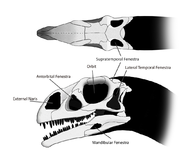
Skull
The skull is a bony structure in the head of many animals that supports the structures of the face and forms a cavity for the brain.The skull is composed of two parts: the cranium and the mandible. A skull without a mandible is only a cranium. Animals that have skulls are called craniates...
, in front of the eye sockets. This skull formation first appeared in archosaur
Archosaur
Archosaurs are a group of diapsid amniotes whose living representatives consist of modern birds and crocodilians. This group also includes all extinct non-avian dinosaurs, many extinct crocodilian relatives, and pterosaurs. Archosauria, the archosaur clade, is a crown group that includes the most...
s during the Triassic Period. Living birds today possess antorbital fenestrae, but the feature has been lost in modern crocodilians. In some archosaur species, the opening has closed but its location is still marked by a depression, or fossa
Fossa (anatomy)
In anatomical terminology, fossa has come to mean a depression or hollow, in general, in a bone. Other parts of the body may be involved, for example, the antecubital fossa...
, on the surface of the skull. This is called an antorbital fossa.