
In
mathematicsMathematics is the study of quantity, space, structure, and change. Mathematicians seek out patterns and formulate new conjectures. Mathematicians resolve the truth or falsity of conjectures by mathematical proofs, which are arguments sufficient to convince other mathematicians of their validity...
and
physicsPhysics is a natural science that involves the study of matter and its motion through spacetime, along with related concepts such as energy and force. More broadly, it is the general analysis of nature, conducted in order to understand how the universe behaves.Physics is one of the oldest academic...
,
n-dimensional
anti de Sitter space, sometimes written

, is a maximally symmetric Lorentzian manifold with constant negative
scalar curvatureIn Riemannian geometry, the scalar curvature is the simplest curvature invariant of a Riemannian manifold. To each point on a Riemannian manifold, it assigns a single real number determined by the intrinsic geometry of the manifold near that point...
. It is the Lorentzian analogue of
n-dimensional
hyperbolic spaceIn mathematics, hyperbolic space is a type of non-Euclidean geometry. Whereas spherical geometry has a constant positive curvature, hyperbolic geometry has a negative curvature: every point in hyperbolic space is a saddle point...
, just as
Minkowski spaceIn physics and mathematics, Minkowski space or Minkowski spacetime is the mathematical setting in which Einstein's theory of special relativity is most conveniently formulated...
and
de Sitter spaceIn mathematics and physics, a de Sitter space is the analog in Minkowski space, or spacetime, of a sphere in ordinary, Euclidean space. The n-dimensional de Sitter space , denoted dS_n, is the Lorentzian manifold analog of an n-sphere ; it is maximally symmetric, has constant positive curvature,...
are the analogues of
EuclideanIn mathematics, Euclidean space is the Euclidean plane and three-dimensional space of Euclidean geometry, as well as the generalizations of these notions to higher dimensions...
and elliptical spaces respectively.
It is best known for its role in the
AdS/CFT correspondenceIn physics, the AdS/CFT correspondence , sometimes called the Maldacena duality, is the conjectured equivalence between a string theory and gravity defined on one space, and a quantum field theory without gravity defined on the conformal boundary of this space, whose dimension is lower by one or more...
.
In the language of
general relativityGeneral relativity or the general theory of relativity is the geometric theory of gravitation published by Albert Einstein in 1916. It is the current description of gravitation in modern physics...
, anti de Sitter space is a maximally symmetric,
vacuum solutionA vacuum solution is a solution of a field equation in which the sources of the field are taken to be identically zero. That is, such field equations are written without matter interaction .-Examples:...
of Einstein's field equation with a negative (attractive)
cosmological constantIn physical cosmology, the cosmological constant was proposed by Albert Einstein as a modification of his original theory of general relativity to achieve a stationary universe...

(corresponding to a negative vacuum energy density and positive pressure).
In mathematics, anti de Sitter space is sometimes defined more generally as a space of arbitrary
signatureThe signature of a metric tensor is the number of positive and negative eigenvalues of the metric. That is, the corresponding real symmetric matrix is diagonalised, and the diagonal entries of each sign counted...
(
p,
q). Generally in physics only the case of one timelike dimension is relevant. Because of differing sign conventions, this may correspond to a signature of either (
n−1, 1) or (1,
n−1).
Non-technical explanation of anti de Sitter space
This non-technical explanation first defines the terms used in the introductory material of this entry. Then, it briefly sets forth the underlying idea of a general relativity-like spacetime. Then it discusses how de Sitter space describes a distinct variant of the ordinary spacetime of general relativity (called Minkowski space) related to the cosmological constant, and how anti de Sitter space differs from de Sitter space. It also explains that Minkowski space, de Sitter space and anti-de Sitter space, as applied to general relativity, can all be thought of as five dimensional versions of spacetime. Finally, it offers some caveats that describe in general terms how this non-technical explanation fails to capture the full detail of the concept that is found in the mathematics.
Technical terms translated
A maximally symmetric Lorentzian manifold corresponds to a general relativity-like spacetime in which time and space in all directions are mathematically equivalent.
A
constant scalar curvatureIn mathematics, constant curvature in differential geometry is a concept most commonly applied to surfaces. For those the scalar curvature is a single number determining the local geometry, and its constancy has the obvious meaning that it is the same at all points...
means a general relativity gravity-like bending of spacetime that has a curvature described by a single number that is the same everywhere in spacetime in the absence of matter or energy.
Negative curvature means curved hyperbolically (like a
saddleA saddle is a supportive structure for a rider or other load, fastened to an animal's back by a girth. The most common type is the equestrian saddle designed for a horse, but specialized saddles have been created for camels and other creatures...
or the bell of a
trumpetThe trumpet is the musical instrument with the highest register in the brass family. Trumpets are among the oldest musical instruments, dating back to at least 1500 BCE. They are played by blowing air through closed lips, producing a "buzzing" sound which starts a standing wave vibration in the air...
, rather than like the surface of a sphere, which has positive curvature). A negative curvature corresponds to an attractive force; a positive curvature corresponds to a repulsive force.
The AdS/CFT (anti de Sitter space/conformal field theory) correspondence is an idea originally proposed by Juan Maldacena in late 1997. The AdS/CFT correspondence is the idea that it is possible in general to describe a force in quantum mechanics (like electromagnetism, the weak force or the strong force) in a certain number of dimensions (for example four) with a string theory where the strings exist in an anti de Sitter space, with one additional dimension.
A quantum field theory is a set of equations and rules for using them of the kind used in quantum mechanics to describe forces (such as
electromagnetismQuantum electrodynamics is the relativistic quantum field theory of electrodynamics. In essence, it describes how light and matter interact and is the first theory where full agreement between quantum mechanics and special relativity is achieved...
, the weak force and the strong force) in a way that is not mathematically unstable.
A
conformal field theoryA conformal field theory is a quantum field theory that is invariant under conformal transformations...
is basically a
quantum field theoryQuantum field theory provides a theoretical framework for constructing quantum mechanical models of systems classically parametrized by an infinite number of dynamical degrees of freedom, that is, fields and many-body systems. It is the natural and quantitative language of particle physics and...
that is scale invariant. Thus, the equations work the same way if you put inputs with consistent units into them, even if you don't know what the unit in question happens to be. In contrast, in a scale variant quantum field theory, the force would behave in a qualitatively different way at short distances than at long distances.
The AdS/CFT correspondence is notable because it is not obvious that quantum field theories can be represented geometrically. Quantum field theories involve quantities that when explained to non-experts are commonly described as representing intangible ideas like probabilities and possible paths that a quantum could take to get from one place to another. The connection of quantum field theories to a physical geometric description is less obvious than the connection between the
classical equationsWhat "classical physics" refers to depends on the context. When discussing special relativity, it refers to the Newtonian physics which preceded relativity, i.e. the branches of physics based on principles developed before the rise of relativity and quantum mechanics...
(i.e. non-quantum mechanical descriptions of gravity and electromagnetism) and geometry. There are no non-quantum mechanical equations for the weak nuclear force and the strong nuclear force, the other two fundamental forces.
Spacetime in general relativity
General relativity is a theory of the nature of time, space and gravity in which gravity is a curvature of space and time that results from the presence of matter or energy.
Energy and matter are equivalentIn physics, mass–energy equivalence is the concept that the mass of a body is a measure of its energy content. In this concept, mass is a property of all energy, and energy is a property of all mass, and the two properties are connected by a constant...
(as expressed in the equation
E =
mc2), and space and time can be translated into equivalent units based on the speed of light (
c in the
E =
mc2 equation).
A common analogy involves the way that a dip in a flat sheet of rubber, caused by a heavy object sitting on it, influences the path taken by small objects rolling nearby, causing them to deviate inward from the path they would have followed had the heavy object been absent. Of course, in general relativity, both the small and large objects mutually influence the curvature of spacetime, with the larger object simply having a bigger effect than the smaller one.
The attractive force of gravity created by matter is due to a negative curvature of spacetime, represented in the rubber sheet analogy by the negatively-curved (trumpet-bell-like) dip in the sheet.
A key feature of general relativity is that it describes gravity not as a conventional force like electromagnetism, but as a change in the geometry of spacetime that results from the presence of matter or energy.
The analogy used above describes the curvature of a two dimensional space caused by gravity in general relativity in a three dimensional
superspace"Superspace" has had two meanings in physics. The word was first used by John Wheeler to describe the configuration space of general relativity; for example, this usage may be seen in his famous 1973 textbook Gravitation....
in which the third dimension corresponds to the effect of gravity. A geometrical way of thinking about general relativity describes the effects of the gravity in the real world four dimensional space geometrically by projecting that space into a five dimensional superspace with the fifth dimension corresponding to the curvature in spacetime that is produced by gravity and gravity-like effects in general relativity.
As a result, in general relativity, the familiar
Newtonian equation of gravityNewton's law of universal gravitation states that every point mass in the universe attracts every other point mass with a force that is directly proportional to the product of their masses and inversely proportional to the square of the distance between them...

(i.e. gravitation pull between two objects equals the
gravitational constantThe gravitational constant, denoted G, is an empirical physical constant involved in the calculation of the gravitational attraction between objects with mass. It appears in Newton's law of universal gravitation and in Einstein's theory of general relativity. It is also known as the universal...
times the product of their masses divided by the square of the distance between them) is merely an approximation of the gravity-like effects seen in general relativity. However this approximation becomes inaccurate in extreme physical situations. For example, in general relativity, objects in motion have a slightly different gravitation effect than objects at rest.
Some of the differences between the familiar Newtonian equation of gravity and the predictions of general relativity flow from the fact that gravity in general relativity bends both time and space, not just space. In normal circumstances, gravity bends time so slightly that the differences between Newtonian gravity and general relativity are impossible to detect without scientific instruments.
de Sitter Space distinguished from spacetime in general relativity
Fundamentally, the key concept behind the idea of de Sitter space is that it involves a variation on the spacetime of general relativity in which spacetime is itself slightly curved even in the absence of matter or energy.
The relationship of the normal idea of the spacetime in which general relativity operates to the de Sitter space is analogous to the relationship between Euclidian geometry (i.e. in two dimensions, the geometry of flat surfaces) and non-Euclidian geometry (i.e. in two dimensions, the geometries of surfaces that are not flat).
An inherent curvature of spacetime even in the absence of matter or energy is another way of thinking about the idea of the cosmological constant in general relativity. An inherent curvature of spacetime and the cosmological constant are also equivalent to the idea that a vacuum (i.e. empty space without any matter or energy in it) has a fundamental energy of its own.
In the common analogy of an object causing a dip in a flat cloth, normal de Sitter space has a curvature analogous to a flat cloth sitting atop a sphere with a very slight curvature because it is so large. Empty de Sitter space is slightly repulsive; it has a slight natural curvature in the opposite direction of the curvature in spacetime created by a massive object. It is a way of saying that gravity plays out against the background of a slightly anti-gravitational empty space.
Normal de Sitter space corresponds to the positive cosmological constant that is observed in reality, with the size of the cosmological constant being equivalent to the curvature of the de Sitter space.
de Sitter space can also be thought of as a general relativity-like spacetime in which empty space itself has some energy, which causes this spacetime (i.e. the universe) to expand at an ever greater rate.
anti de Sitter space distinguished from de Sitter space
An anti de Sitter space, in contrast, is a general relativity-like spacetime, where in the absence of matter or energy, the curvature of spacetime is naturally hyperbolic.
In the common analogy of an object causing a dip in a flat cloth, anti de Sitter space has a curvature analogous to a flat cloth sitting on the inside of a sphere with a very slight curvature because it is so large. This would correspond to a negative cosmological constant (something not observed in the real life cosmos). Anti de Sitter space can also be thought of as a general relativity like spacetime in which empty space itself has negative energy, which causes this spacetime (i.e. the universe) to collapse in on itself at an ever greater rate.
In an anti de Sitter space, as in a de Sitter space, the extent of inherent spacetime curvature corresponds to the magnitude of the negative cosmological constant to which it is equivalent.
de Sitter space and anti de Sitter space as five dimensional geometries
As noted above, the analogy used above describes curvature of a two dimensional space caused by gravity in general relativity in a three dimensional superspace in which the third dimension corresponds to the effect of gravity. More generally, a geometrical approach to general relativity describes the effect of gravity as a curvature of the four dimensions of spacetime in a fifth dimension that corresponds to gravity and gravity-like effects in general relativity. When this five dimensional superspace describes a version of general relativity without a cosmological constant, it is called Minkowski space.
The concepts of de Sitter space and anti de Sitter space describe the effects of the cosmological constant in the real world four dimensional space geometrically by projecting that space into a five dimensional superspace with the fifth dimension corresponding to the curvature in time space that is produced by gravity and gravity-like effects in general relativity such as the cosmological constant.
While anti de Sitter space does not correspond to gravity in general relativity with the observed cosmological constant, an anti de Sitter space is believed to correspond to other forces in quantum mechanics (like electromagnetism, the weak nuclear force and the strong nuclear force) described via
string theoryString theory is an active research framework in particle physics that attempts to reconcile quantum mechanics and general relativity. It is a contender for a theory of everything , a manner of describing the known fundamental forces and matter in a mathematically complete system...
. This is called the AdS/CFT correspondence.
Note also that while an anti de Sitter space would describe general relativity with a negative cosmological constant in five dimensions (four for spacetime and one for the effect of the cosmological constant), the idea is actually more general. One can have an anti de Sitter space (or a de Sitter space) in an arbitrary number of dimensions. The generality of the concepts of de Sitter space and anti de Sitter space make them useful in theoretical physics, particularly in string theory, that often assume a world with more than four dimensions.
Caveats
Naturally, as the remainder of this article explains in technical detail, the general concepts described in this non-technical explanation of anti de Sitter space have a much more rigorous and precise mathematical and physical description. People are ill suited to visualizing things in five or more dimensions, but mathematical equations are not similarly challenged and can represent five dimensional concepts in a way just as appropriate as the methods that mathematical equations use to describe easier to visualize three and four dimensional concepts.
There is a particularly important implication of the more precise mathematical description that differs from the analogy based heuristic description of de Sitter space and anti de Sitter space above. The mathematical description of anti de Sitter space generalizes the idea of curvature. In the mathematical description, curvature is a property of a particular point and can be divorced from some invisible surface that to which curved points in spacetime meld themselves. So, for example, concepts like singularities (the most widely known of which in general relativity is the
black holeA black hole is a region of spacetime from which nothing, not even light, can escape. The theory of general relativity predicts that a sufficiently compact mass will deform spacetime to form a black hole. Around a black hole there is a mathematically defined surface called an event horizon that...
) which can not be expressed completely in a real world geometry, can correspond to particular states of a mathematical equation.
The full mathematical description also captures some subtle distinctions made in general relativity between space-like dimensions and time-like dimensions.
Definition and properties
Much as elliptical and hyperbolic spaces can be visualized by an isometric embedding in a flat space of one higher dimension (as the
sphereA sphere is a perfectly round geometrical object in three-dimensional space, such as the shape of a round ball. Like a circle in two dimensions, a perfect sphere is completely symmetrical around its center, with all points on the surface lying the same distance r from the center point...
and
pseudosphereIn geometry, the term pseudosphere is used to describe various surfaces with constant negative gaussian curvature. Depending on context, it can refer to either a theoretical surface of constant negative curvature, to a tractricoid, or to a hyperboloid....
respectively), anti de Sitter space can be visualized as the Lorentzian analogue of a sphere in a space of one additional dimension. To a physicist the extra dimension is timelike, while to a mathematician it is negative; in this article we adopt the convention that timelike dimensions are negative so that these notions coincide.
The anti de Sitter space of signature (
p,
q) can then be isometrically embedded in the space

with coordinates (
x1, ...,
xp,
t1, ...,
tq+1) and the
pseudometricIn the mathematical field of differential geometry, a metric tensor is a type of function defined on a manifold which takes as input a pair of tangent vectors v and w and produces a real number g in a way that generalizes many of the familiar properties of the dot product of vectors in Euclidean...

as the sphere

where

is a nonzero constant with dimensions of length (the
radius of curvatureIn geometry, the radius of curvature, R, of a curve at a point is a measure of the radius of the circular arc which best approximates the curve at that point. If this value taken to be positive when the curve turns anticlockwise and negative when the curve turns clockwise...
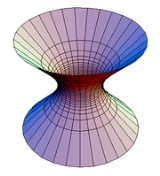
). Note that this is a sphere in the sense that it is a collection of points at constant metric distance from the origin, but visually it is a
hyperboloid, as in the image shown.
The
metricIn the mathematical field of differential geometry, a metric tensor is a type of function defined on a manifold which takes as input a pair of tangent vectors v and w and produces a real number g in a way that generalizes many of the familiar properties of the dot product of vectors in Euclidean...
on anti de Sitter space is the metric induced from the ambient metric. One can check that the induced metric is nondegenerate and has Lorentzian signature.
When
q = 0, this construction gives ordinary hyperbolic space. The remainder of the discussion applies when
q ≥ 1.
Closed timelike curves and the universal cover
When
q ≥ 1, the embedding above has
closed timelike curveIn mathematical physics, a closed timelike curve is a worldline in a Lorentzian manifold, of a material particle in spacetime that is "closed," returning to its starting point...
s; for example, the path parameterized by

and all other coordinates zero is such a curve. When
q ≥ 2 these curves are inherent to the geometry (unsurprisingly, as any space with more than one temporal dimension will contain closed timelike curves), but when
q = 1, they can be eliminated by passing to the universal covering space, effectively "unrolling" the embedding. A similar situation occurs with the pseudosphere, which curls around on itself although the hyperbolic plane does not; as a result it contains self-intersecting straight lines (geodesics) while the hyperbolic plane does not. Some authors define anti de Sitter space as equivalent to the embedded sphere itself, while others define it as equivalent to the universal cover of the embedding. Generally the latter definition is the one of interest in physics.
Symmetries
If the universal cover is not taken, (
p,
q) anti de Sitter space has
OIn mathematics, the indefinite orthogonal group, O is the Lie group of all linear transformations of a n = p + q dimensional real vector space which leave invariant a nondegenerate, symmetric bilinear form of signature...
(
p,
q+1) as its isometry group. If the universal cover is taken the isometry group is a cover of O(
p,
q+1).
Coordinate patches
A coordinate patch covering part of the space gives the half-space coordinatization of anti de Sitter space. The
metricRiemannian geometry is the branch of differential geometry that studies Riemannian manifolds, smooth manifolds with a Riemannian metric, i.e. with an inner product on the tangent space at each point which varies smoothly from point to point. This gives, in particular, local notions of angle, length...
for this patch is
We easily see that this metric is conformally equivalent to a flat half-space Minkowski spacetime.
The constant time slices of this coordinate patch are
hyperbolic spaceIn mathematics, hyperbolic space is a type of non-Euclidean geometry. Whereas spherical geometry has a constant positive curvature, hyperbolic geometry has a negative curvature: every point in hyperbolic space is a saddle point...
s in the Poincaré half-plane metric. In the limit as
y = 0, this half-space metric reduces to a Minkowski metric

; thus, the anti-de Sitter space contains a conformal Minkowski space at infinity ("infinity" having y-coordinate zero in this patch).
In AdS space time is periodic, and the universal cover has non-periodic time. The coordinate patch above covers half of a single period of the spacetime.
Because the conformal infinity of AdS is timelike, specifying the initial data on a spacelike hypersurface would not determine the future evolution uniquely (i.e. deterministically) unless there are boundary conditions associated with the conformal infinity.
Another commonly used coordinate system which covers the entire space is given by the coordinates t,

and the hyperpolar coordinates α, θ and φ.
The image on the right represents the "half-space" region of anti deSitter space and its boundary. The interior of the cylinder corresponds to anti-de Sitter spacetime, while its cylindrical boundary corresponds to its conformal boundary. The green shaded region in the interior corresponds to the region of AdS covered by the half-space coordinates and it is bounded by two null,
aka lightlike, geodesic hyperplanes; the green shaded area on the surface corresponds to the region of conformal space covered by Minkowski space.
The green shaded region covers half of the AdS space and half of the conformal spacetime; the left ends of the green discs will touch in the same fashion as the right ends.
Anti de Sitter as homogeneous and symmetric space
In the same way that the sphere

, anti de Sitter with
parityIn physics, a parity transformation is the flip in the sign of one spatial coordinate. In three dimensions, it is also commonly described by the simultaneous flip in the sign of all three spatial coordinates:...
aka reflectional symmetry and
time reversalTime reversal may refer to:* In physics, T-symmetry - the study of thermodynamics and the symmetry of certain physical laws where the concept of time is reversed — ie...
symmetry can be seen as a quotient of two groups

whereas AdS without P or C can be seen as
This quotient formulation gives to

a
homogeneous spaceIn mathematics, particularly in the theories of Lie groups, algebraic groups and topological groups, a homogeneous space for a group G is a non-empty manifold or topological space X on which G acts continuously by symmetry in a transitive way. A special case of this is when the topological group,...
structure. The Lie algebra of

is given by matrices

,
where

is a
skew-symmetric matrixIn mathematics, and in particular linear algebra, a skew-symmetric matrix is a square matrix A whose transpose is also its negative; that is, it satisfies the equation If the entry in the and is aij, i.e...
. A complementary in the Lie algebra of

is

These two fulfil

. Then explicit matrix computation shows that

. So anti de Sitter is a reductive
homogeneous spaceIn mathematics, particularly in the theories of Lie groups, algebraic groups and topological groups, a homogeneous space for a group G is a non-empty manifold or topological space X on which G acts continuously by symmetry in a transitive way. A special case of this is when the topological group,...
, and a non-Riemannian symmetric space.