

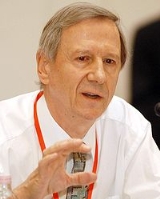
Anthony Giddens

Encyclopedia
Anthony Giddens, Baron Giddens (born 8 January 1938) is a British sociologist
who is known for his theory of structuration and his holistic
view of modern societies. He is considered to be one of the most prominent modern contributors in the field of sociology, the author of at least 34 books, published in at least 29 languages, issuing on average more than one book every year. In 2007, Giddens was listed as the fifth most-referenced author of books in the humanities.
Three notable stages can be identified in his academic life. The first one involved outlining a new vision of what sociology is, presenting a theoretical and methodological understanding of that field, based on a critical reinterpretation of the classics. His major publications of that era include Capitalism and Modern Social Theory (1971) and New Rules of Sociological Method (1976). In the second stage Giddens developed the theory of structuration, an analysis of agency and structure
, in which primacy is granted to neither. His works of that period, such as Central Problems in Social Theory (1979) and The Constitution of Society (1984), brought him international fame on the sociological arena.
The most recent stage concerns modernity
, globalization
and politics, especially the impact of modernity on social and personal life. This stage is reflected by his critique of postmodernity
, and discussions of a new "utopia
n-realist" third way
in politics, visible in the Consequence of Modernity (1990), Modernity and Self-Identity (1991), The Transformation of Intimacy (1992), Beyond Left and Right (1994) and The Third Way: The Renewal of Social Democracy (1998). Giddens's ambition is both to recast social theory and to re-examine our understanding of the development and trajectory of modernity.
Giddens served as Director of the London School of Economics
1997–2003, where he is now Emeritus Professor.
He is also a member of the Advisory Board of the Institute for Cultural Diplomacy
.
, and grew up in a lower middle-class family, son of a clerk with London Transport
, and attended Minchenden School. He was the first member of his family to go to university. Giddens received his undergraduate academic degree (in joint sociology and psychology) at Hull University in 1959, followed by a Master's degree at the London School of Economics
. He later gained a PhD at King's College, Cambridge
. In 1961, he started working at the University of Leicester
where he taught social psychology
. At Leicester - considered to be one of the seedbeds of British sociology - he met Norbert Elias
and began to work on his own theoretical position. In 1969, he was appointed to a position at the University of Cambridge
, where he later helped create the Social and Political Sciences Committee (SPS - now PPSIS
), a sub-unit of the Faculty of Economics.
Giddens worked for many years at Cambridge as a fellow of King's College
and was eventually promoted to a full professorship in 1987. He is cofounder of Polity Press
(1985). From 1997 to 2003, he was director of the London School of Economics
and a member of the Advisory Council of the Institute for Public Policy Research
. He was also an adviser to former British Prime Minister Tony Blair
; it was Giddens whose "third way
" political approach has been Tony Blair's guiding political idea. He has been a vocal participant in British political debates, supporting the center-left Labour Party
with media appearances and articles (many of which are published in New Statesman
). He was given a life peerage in June 2004, as Baron Giddens, of Southgate
in the London Borough of Enfield
and sits in the House of Lords
for Labour
. Giddens also holds 15 honorary degrees from various universities.
and methods. He has written commentaries on most leading schools and figures and has used most sociological paradigms in both micro
and macrosociology
. His writings range from abstract, metatheoretical problems to very direct and 'down-to-earth' textbooks for students. Finally, he is also known for his interdisciplinary approach: he has commented not only on the developments in sociology, but also in anthropology
, archaeology
, psychology
, philosophy, history, linguistics
, economics
, social work and most recently, political science
. In view of his knowledge and works, one may view much of his life's work as a form of 'grand synthesis' of sociological theory.
, exponent of Max Weber
), as well as criticizing evolutionism
and historical materialism
. In Capitalism and Modern Social Theory (1971), he examined the work of Weber, Durkheim
and Marx
, arguing that despite their different approaches each was concerned with the link between capitalism
and social life
. Giddens emphasised the social constructs of power
, modernity and institutions, defining sociology as:
In New Rules of Sociological Method (1976) (the title of which alludes to Durkheim's Rules of the Sociological Method of 1895) Giddens attempted to explain 'how sociology should be done' and addressed a long-standing divide between those theorists who prioritise 'macro level
' studies of social life - looking at the 'big picture' of society - and those who emphasise the 'micro level
' - what everyday life means to individuals. In New Rules... he noted that the functionalist approach, invented by Durkheim, treated society as a reality unto itself, not reducible to individuals. He rejected Durkheim's sociological positivism paradigm
, which attempted to predict how societies operate, ignoring the meanings as understood by individuals. Giddens noted:
He contrasted Durkheim with Weber's approach - interpretative sociology - focused on understanding agency
and motives of individuals. Giddens is closer to Weber than Durkheim, but in his analysis he rejects both of those approaches, stating that while society is not a collective reality, nor should the individual be treated as the central unit of analysis.
Rather he uses the logic of hermeneutic tradition (from interpretative sociology) to argue for the importance of agency in sociological theory, claiming that human social actors are always to some degree knowledgeable about what they are doing. Social order is therefore a result of some pre-planned social actions, not automatic evolutionary response. Sociologists, unlike natural scientists
, have to interpret a social world which is already interpreted by the actors that inhabit it. According to Giddens there is a "Duality of structure
" by which social practice, which is the principal unit of investigation, has both a structural and an agency-component. The structural environment constrains individual behaviour, but also makes it possible. He also noted the existence of a specific form of a social cycle: once sociological concepts are formed, they filter back into everyday world and change the way people think. Because social actors are reflexive and monitor the ongoing flow of activities and structural conditions, they adapt their actions to their evolving understandings. As a result, social scientific knowledge of society will actually change human activities. Giddens calls this two-tiered, interpretive and dialectical relationship between social scientific knowledge and human practices the "double hermeneutic
".
Giddens also stressed the importance of power, which is means to ends, and hence is directly involved in the actions of every person. Power, the transformative capacity of people to change the social and material world, is closely shaped by knowledge and space-time.
In New Rules... Giddens specifically wrote that:
who suggests that we live in the tension between the shapes we take as the world acts upon us, and the ideas of order that our imagination imposes upon the world. Giddens writes that the connection between structure and action is a fundamental element of social theory, structure and agency
are a duality that cannot be conceived of apart from one another and his main argument is contained in his expression "duality of structure
". At a basic level, this means that people make society, but are at the same time constrained by it. Action and structure cannot be analysed separately, as structures are created, maintained and changed through actions, while actions are given meaningful form only through the background of the structure: the line of causality runs in both directions making it impossible to determine what is changing what. In Giddens own words (from New rules...) :
In this regard he defines structures as consisting of rules and resources involving human action: the rules constrain the actions, the resources make it possible. He also differentiates between systems and structures. Systems display structural properties but are not structures themselves. He notes in his article Functionalism: après la lutte (1976) that:
This process of structures (re)producing systems is called structuration. Systems here mean to Giddens "the situated activities of human agents" (The Constitution of Society.) and "the patterning of social relations across space-time" (ibid
.). Structures are then "...sets of rules and resources that individual actors draw upon in the practices that reproduce social systems’" (Politics, Sociology and Social Theory) and "systems of generative rules and sets, implicated in the articulation of social systems" (The Constitution of Society.), existing virtually "out of time and out of space" (New rules....). Structuration therefore means that relations that took shape in the structure, can exist "out of time and place": in other words, independent of the context in which they are created. An example is the relationship between a teacher and a student: when they come across each other in another context, say on the street, the hierarchy between them is still preserved.
Structure can act as a constraint on action, but it also enables action by providing common frames of meaning. Consider the example of language: structure of language is represented by the rules of syntax
that rule out certain combinations of words. But the structure also provides rules that allow new actions to occur, enabling us to create new, meaningful sentences
. Structures should not be conceived as "simply placing constrains upon human agency, but as enabling." (New rules....) Giddens suggests that structures (traditions, institutions, moral codes, and other sets of expectations - established ways of doing things) are generally quite stable, but can be changed, especially through the unintended consequence
s of action, when people start to ignore them, replace them, or reproduce them differently.
Thus, actors (agents) employ the social rules appropriate to their culture, ones that they have learned through socialisation and experience. These rules together with the resources at their disposal are used in social interactions. Rules and resources employed in this manner are not deterministic, but are applied reflexively by knowledgeable actors, albeit that actors’ awareness may be limited to the specifics of their activities at any given time. Thus, the outcome of action is not totally predictable.
and macro
issues. On a micro scale, one of individuals' internal sense of self and identity
, consider the example of a family
: we are increasingly free to choose our own mates and how to relate with them, which creates new opportunities but also more work, as the relationship becomes a reflexive project that has to be interpreted and maintained. Yet this micro-level change cannot be explained only by looking at the individual level as people did not spontaneously change their minds about how to live; neither can we assume they were directed to do so by social institutions and the state.
On a macro scale, one of the state
and social organizations like multinational
capitalist corporations, consider the example of globalization, which offers vast new opportunities for investment and development, but crises - like the Asian financial crisis - can affect the entire world, spreading far outside the local setting in which they first developed, and last but not least directly influences individuals. A serious explanation of such issues must lie somewhere within the network of macro and micro forces. These levels should not be treated as unconnected; in fact they have significant relation to one another.
In order to illustrate this relationship, Giddens discusses changing attitudes towards marriage in developed countries. He claims that any effort to explain this phenomenon solely in terms of micro or macro level causes will result in a circular cause and consequence logical fallacy. Social relationships and visible sexuality (micro-level change) are related to the decline of religion and the rise of rationality
(macro-level change), but also with changes in the laws relating to marriage and sexuality (macro), change caused by different practices and changing attitudes on the level of everyday lives (micro). Practices and attitudes in turn can be affected by social movements (for example, women's liberation and egalitarianism
), a macro-scale phenomena; but the movements usually grow out of everyday life grievances - a micro-scale phenomena.
All of this is increasingly tied in with mass media, one of our main providers of information. The media do not merely reflect the social world but also actively shape it, being central to modern reflexivity. David Gauntlett
writes in Media, Gender and Identity that:
Another example explored by Giddens is the emergence of romantic love, which Giddens (The Transformation of Intimacy) links with the rise of the 'narrative of the self' type of self-identity: "Romantic love introduced the idea of a narrative into an individual's life." Although history of sex clearly demonstrates that passion and sex are not modern phenomena, the discourse of romantic love is said to have developed from the late eighteenth century. Romanticism
, the 18th and 19th century European macro-level cultural movement is responsible for the emergence of the novel - a relatively early form of mass media. The growing literacy and popularity of novels fed back into the mainstream lifestyle and the romance novel proliferated the stories of ideal romantic life narratives on a micro-level, giving the romantic love an important and recognised role in the marriage-type relationship.
Consider also the transformation of intimacy. Giddens asserts that intimate social relationships have become 'democratised
', so that the bond between partners – even within a marriage – has little to do with external laws, regulations or social expectations, but is based on the internal understanding between two people – a trusting
bond based on emotional communication. Where such a bond ceases to exist, modern society is generally happy for the relationship to be dissolved. Thus we have 'a democracy of the emotions in everyday life' (Runaway World, 1999).
Inevitably, Giddens concludes that all social change
stems from a mixture of micro- and macro-level forces.
More than ever before we have access to information that allows us to reflect on the causes and consequences of our actions. At the same time we are faced with dangers related to unintended consequences of our actions and by our reliance on the knowledge of experts. We create, maintain and revise a set of biographical narratives, social roles and lifestyles – the story of who we are, and how we came to be where we are now. We are increasingly free to choose what we want to do and who we want to be (although Giddens contends that wealth gives access to more options). But increased choice can be both liberating and troubling. Liberating in the sense of increasing the likelihood of one's self-fulfillment, and troubling in form of increased emotional stress and time needed to analyse the available choices and minimise risk of which we are increasingly aware (what Giddens sums up as "manufacturing uncertainty"). While in earlier, traditional societies we would be provided with that narrative and social role, in the post-traditional society we are usually forced to create one ourselves. As Giddens (Modernity and Self-Identity: 70) puts it:
's concept of liquid modernity), produced by the extension of the same social forces that shaped the previous age. Giddens nonetheless differentiates between pre-modern, modern and late (high) modern societies and doesn't dispute that important changes have occurred but takes a neutral stance towards those changes, saying that it offers both unprecedented opportunities and unparalleled dangers. He also stresses that we haven't really gone beyond modernity. It's just a developed, detraditionalized, radicalised, 'late' modernity. Thus the phenomena that some have called 'postmodern' are to Giddens nothing more than the most extreme instances of a developed modernity. Along with Ulrich Beck
and Scott Lash
, he endorses the term reflexive modernization
as a more accurate description of the processes associated with the second modernity, since it opposes itself (in its earlier version) instead of opposing traditionalism, endangering the very institutions it created (such as the national state, the political parties or the nuclear family).
Giddens concentrates on a contrast between traditional (pre-modern) culture and post-traditional (modern) culture. In traditional societies, individual actions need not to be extensively thought about, because available choices are already predetermined (by the customs, traditions, etc.). In contrast, in post-traditional society people (actors, agents) are much less concerned with the precedents set by earlier generations, and they have more choices, due to flexibility of law and public opinion
. This however means that individual actions now require more analysis and thought before they are taken. Society is more reflexive
and aware, something Giddens is fascinated with, illustrating it with examples ranging from state governance to intimate relationships. Giddens examines three realms in particular: the experience of identity, connections of intimacy and political institutions.
The most defining property of modernity, according to Giddens, is that we are disembedded from time and space. In pre-modern societies, space was the area in which one moved, time was the experience one had while moving. In modern societies, however, the social space is no longer confined by the boundaries set by the space in which one moves. One can now imagine what other spaces look like, even if he has never been there. In this regard, Giddens talks about virtual space and virtual time.
Another distinctive property of modernity lies in the field of knowledge.
In pre-modern societies, it was the elders who possessed the knowledge: they were definable in time and space. In modern societies we must rely on expert systems. These are not present in time and space, but we must trust them. Even if we trust them, we know that something could go wrong: there's always a risk we have to take. Also the technologies which we use, and which transform constraints into means, hold risks. Consequently, there is always a heightened sense of uncertainty in contemporary societies. It is also in this regard that Giddens uses the image of a 'juggernaut': modernity is said to be like an unsteerable juggernaut traveling through space.
Humanity tries to steer it, but as long as the modern institutions, with all their uncertainty, endure, we will never be able to influence its course. The uncertainty can however be managed, by 'reembedding' the expert-systems into the structures which we are accustomed to.
Another characteristic is enhanced reflexivity, both at the level of individuals and at the level of institutions. The latter requires an explanation: in modern institutions there is always a component which studies the institutions themselves for the purpose of enhancing its effectiveness. This enhanced reflexivity was enabled as language became increasingly abstract with the transition from pre-modern to modern societies, becoming institutionalised into universities. It is also in this regard that Giddens talks about "double hermeneutica": every action has two interpretations. The one is from the actor himself, the other of the investigator who tries to give meaning to the action he is observing. The actor who performs the action, however, can get to know the interpretation of the investigator, and therefore change his own interpretation, or his further line of action.
This is the reason that positive science, according to Giddens, is never possible in the social sciences: every time an investigator tries to identify causal sequences of action, the actors can change their further line of action. The problem is, however, that conflicting viewpoints in social science result in a disinterest of the people. For example, when scientist don't agree about the greenhouse-effect, people will withdraw from that arena, and negate that there is a problem. Therefore, the more the sciences expand, the more incertitude there is in the modern society. In this regard, the juggernaut even gets more steerless.
In A Contemporary Critique of Historical Materialism, Giddens concludes that:
economy the political science is being transformed. Giddens notes that there is a possibility that "life politics" (the politics of self-actualisation) may become more visible than "emancipatory politics" (the politics of inequality); that new social movements may lead to more social change than political parties; and that the reflexive project of the self and changes in gender and sexual relations may lead the way, via the "democratisation of democracy", to a new era of Habermasian
"dialogic democracy" in which differences are settled, and practices ordered, through discourse rather than violence or the commands of authority.
Giddens, relying on his past familiar themes of reflexivity and system integration, which places people into new relations of trust and dependency with each other and their governments, argues that the political concepts of 'left' and 'right' are now breaking down, as a result of many factors, most centrally the absence of a clear alternative to capitalism and the eclipse of political opportunities based on the social class in favour of those based on lifestyle choices.
In his most recent works, Giddens moves away from explaining how things are to the more demanding attempt of advocacy about how they ought to be. In "Beyond Left and Right" (1994) Giddens criticizes the market socialism
, and constructs a six point framework for a reconstituted radical politics
:
The "The Third Way" (1998) provides not only the framework within which the 'third way' is justified, but a broad set of policy proposals aimed at what Giddens refers to as the 'progressive centre-left' in British politics. According to Giddens himself:
Giddens remains fairly optimistic about the future of humanity:
Giddens discards the possibility of a single, comprehensive, all-connecting ideology
or political programme. Instead he advocates going after the 'small pictures', ones people can directly affect at their home, workplace or local community. This, to Giddens, is a difference between pointless utopianism and useful utopian realism, which he defines as envisaging "alternative futures whose very propagation might help them be realised". (The Consequences of Modernity). By 'utopian' he means that this is something new and extraordinary, and by 'realistic' he stresses that this idea is rooted in the existing social processes and can be viewed as their simple extrapolation. Such a future has at its centre a more socialized, demilitarised and planetary-caring global world order variously articulated within green, women's and peace movements, and within the wider democratic movement.
, Giddens met with Muammar al-Gaddafi
. Giddens has declined to comment on the financial compensation he received. The Guardian reported in March 2011, that Libya's government engaged Monitor Group
as advisor on matters of public relations. Monitor Group
allegedly received 2 million pounds in return for undertaking a "cleansing campaign" in order to improve Libya's image. In a letter to Abdullah Senussi
, a high-ranking Libyan official in July 2006, Monitor Group reported that:
Giddens' first visit to Libya resulted in articles in the New Statesman
, El País and La Repubblica
, where he argued that the country had been dramatically transformed. In the New Statesman he wrote: "Gaddafi's 'conversion' may have been driven partly by the wish to escape sanctions, but I get the strong sense it is authentic and there is a lot of motive power behind it. Saif Gaddafi is a driving force behind the rehabilitation and potential modernisation of Libya. Gaddafi Sr, however, is authorising these processes." During the second visit, Monitor Group organized a panel of "three thinkers" – Giddens, Gaddafi, and Benjamin Barber, author of Jihad vs. McWorld – chaired by Sir David Frost
.
Giddens remarked of his meetings with Gaddafi, “You usually get about half an hour with a political leader,” he recalls. “My conversation lasts for more than three. Gaddafi is relaxed and clearly enjoys intellectual conversation. He likes the term 'third way’ because his own political philosophy is a version of this idea. He makes many intelligent and perceptive points. I leave enlivened and encouraged.”
Sociology
Sociology is the study of society. It is a social science—a term with which it is sometimes synonymous—which uses various methods of empirical investigation and critical analysis to develop a body of knowledge about human social activity...
who is known for his theory of structuration and his holistic
Holism
Holism is the idea that all the properties of a given system cannot be determined or explained by its component parts alone...
view of modern societies. He is considered to be one of the most prominent modern contributors in the field of sociology, the author of at least 34 books, published in at least 29 languages, issuing on average more than one book every year. In 2007, Giddens was listed as the fifth most-referenced author of books in the humanities.
Three notable stages can be identified in his academic life. The first one involved outlining a new vision of what sociology is, presenting a theoretical and methodological understanding of that field, based on a critical reinterpretation of the classics. His major publications of that era include Capitalism and Modern Social Theory (1971) and New Rules of Sociological Method (1976). In the second stage Giddens developed the theory of structuration, an analysis of agency and structure
Social structure
Social structure is a term used in the social sciences to refer to patterned social arrangements in society that are both emergent from and determinant of the actions of the individuals. The usage of the term "social structure" has changed over time and may reflect the various levels of analysis...
, in which primacy is granted to neither. His works of that period, such as Central Problems in Social Theory (1979) and The Constitution of Society (1984), brought him international fame on the sociological arena.
The most recent stage concerns modernity
Modernity
Modernity typically refers to a post-traditional, post-medieval historical period, one marked by the move from feudalism toward capitalism, industrialization, secularization, rationalization, the nation-state and its constituent institutions and forms of surveillance...
, globalization
Globalization
Globalization refers to the increasingly global relationships of culture, people and economic activity. Most often, it refers to economics: the global distribution of the production of goods and services, through reduction of barriers to international trade such as tariffs, export fees, and import...
and politics, especially the impact of modernity on social and personal life. This stage is reflected by his critique of postmodernity
Postmodernity
Postmodernity is generally used to describe the economic or cultural state or condition of society which is said to exist after modernity...
, and discussions of a new "utopia
Utopia
Utopia is an ideal community or society possessing a perfect socio-politico-legal system. The word was imported from Greek by Sir Thomas More for his 1516 book Utopia, describing a fictional island in the Atlantic Ocean. The term has been used to describe both intentional communities that attempt...
n-realist" third way
Third way (centrism)
The Third Way refers to various political positions which try to reconcile right-wing and left-wing politics by advocating a varying synthesis of right-wing economic and left-wing social policies. Third Way approaches are commonly viewed from within the first- and second-way perspectives as...
in politics, visible in the Consequence of Modernity (1990), Modernity and Self-Identity (1991), The Transformation of Intimacy (1992), Beyond Left and Right (1994) and The Third Way: The Renewal of Social Democracy (1998). Giddens's ambition is both to recast social theory and to re-examine our understanding of the development and trajectory of modernity.
Giddens served as Director of the London School of Economics
London School of Economics
The London School of Economics and Political Science is a public research university specialised in the social sciences located in London, United Kingdom, and a constituent college of the federal University of London...
1997–2003, where he is now Emeritus Professor.
He is also a member of the Advisory Board of the Institute for Cultural Diplomacy
Institute for Cultural Diplomacy
The Institute for Cultural Diplomacy is an international, not-for-profit, non-governmental organisation based in Berlin. Founded in 1999 by Mark Donfried, its activities focus on promoting and developing the field of cultural diplomacy by conducting research, initiatives and programs, holding...
.
Biography
Giddens was born and raised in Edmonton, LondonEdmonton, London
Edmonton is an area in the east of the London Borough of Enfield, England, north-north-east of Charing Cross. It has a long history as a settlement distinct from Enfield.-Location:...
, and grew up in a lower middle-class family, son of a clerk with London Transport
London Passenger Transport Board
The London Passenger Transport Board was the organisation responsible for public transport in London, UK, and its environs from 1933 to 1948...
, and attended Minchenden School. He was the first member of his family to go to university. Giddens received his undergraduate academic degree (in joint sociology and psychology) at Hull University in 1959, followed by a Master's degree at the London School of Economics
London School of Economics
The London School of Economics and Political Science is a public research university specialised in the social sciences located in London, United Kingdom, and a constituent college of the federal University of London...
. He later gained a PhD at King's College, Cambridge
King's College, Cambridge
King's College is a constituent college of the University of Cambridge, England. The college's full name is "The King's College of our Lady and Saint Nicholas in Cambridge", but it is usually referred to simply as "King's" within the University....
. In 1961, he started working at the University of Leicester
University of Leicester
The University of Leicester is a research-led university based in Leicester, England. The main campus is a mile south of the city centre, adjacent to Victoria Park and Wyggeston and Queen Elizabeth I College....
where he taught social psychology
Social psychology
Social psychology is the scientific study of how people's thoughts, feelings, and behaviors are influenced by the actual, imagined, or implied presence of others. By this definition, scientific refers to the empirical method of investigation. The terms thoughts, feelings, and behaviors include all...
. At Leicester - considered to be one of the seedbeds of British sociology - he met Norbert Elias
Norbert Elias
Norbert Elias was a German sociologist of Jewish descent, who later became a British citizen.-Biography:...
and began to work on his own theoretical position. In 1969, he was appointed to a position at the University of Cambridge
University of Cambridge
The University of Cambridge is a public research university located in Cambridge, United Kingdom. It is the second-oldest university in both the United Kingdom and the English-speaking world , and the seventh-oldest globally...
, where he later helped create the Social and Political Sciences Committee (SPS - now PPSIS
Faculty of Politics, Psychology, Sociology and International Studies
The Faculty of Politics, Psychology, Sociology and International Studies at the University of Cambridge was created in January 2009 out of a merger of the Faculty of Social and Political Sciences and the Centre of International Studies....
), a sub-unit of the Faculty of Economics.
Giddens worked for many years at Cambridge as a fellow of King's College
King's College, Cambridge
King's College is a constituent college of the University of Cambridge, England. The college's full name is "The King's College of our Lady and Saint Nicholas in Cambridge", but it is usually referred to simply as "King's" within the University....
and was eventually promoted to a full professorship in 1987. He is cofounder of Polity Press
Polity (publisher)
Polity is an international publisher in the social sciences and humanities. It publishes around 100 books a year in sociology, politics, philosophy, media and cultural studies, health studies, literary studies, history, anthropology and related subjects. Its books range from core textbooks for...
(1985). From 1997 to 2003, he was director of the London School of Economics
London School of Economics
The London School of Economics and Political Science is a public research university specialised in the social sciences located in London, United Kingdom, and a constituent college of the federal University of London...
and a member of the Advisory Council of the Institute for Public Policy Research
Institute for Public Policy Research
The IPPR is the leading progressive think-tank in the UK. It produces research and policy ideas committed to upholding values of social justice, democratic reform and environmental sustainability. IPPR is based in London and IPPR North has branches in Newcastle and Manchester.It was founded in...
. He was also an adviser to former British Prime Minister Tony Blair
Tony Blair
Anthony Charles Lynton Blair is a former British Labour Party politician who served as the Prime Minister of the United Kingdom from 2 May 1997 to 27 June 2007. He was the Member of Parliament for Sedgefield from 1983 to 2007 and Leader of the Labour Party from 1994 to 2007...
; it was Giddens whose "third way
Third way (centrism)
The Third Way refers to various political positions which try to reconcile right-wing and left-wing politics by advocating a varying synthesis of right-wing economic and left-wing social policies. Third Way approaches are commonly viewed from within the first- and second-way perspectives as...
" political approach has been Tony Blair's guiding political idea. He has been a vocal participant in British political debates, supporting the center-left Labour Party
Labour Party (UK)
The Labour Party is a centre-left democratic socialist party in the United Kingdom. It surpassed the Liberal Party in general elections during the early 1920s, forming minority governments under Ramsay MacDonald in 1924 and 1929-1931. The party was in a wartime coalition from 1940 to 1945, after...
with media appearances and articles (many of which are published in New Statesman
New Statesman
New Statesman is a British centre-left political and cultural magazine published weekly in London. Founded in 1913, and connected with leading members of the Fabian Society, the magazine reached a circulation peak in the late 1960s....
). He was given a life peerage in June 2004, as Baron Giddens, of Southgate
Southgate, London
Southgate is an area of north London, England, primarily within the London Borough of Enfield, although parts of its western fringes lie within the London Borough of Barnet. It is located around north of Charing Cross. The name is derived from being the south gate to Enfield Chase...
in the London Borough of Enfield
London Borough of Enfield
The London Borough of Enfield is the most northerly London borough and forms part of Outer London. It borders the London Boroughs of Barnet, Haringey and Waltham Forest...
and sits in the House of Lords
House of Lords
The House of Lords is the upper house of the Parliament of the United Kingdom. Like the House of Commons, it meets in the Palace of Westminster....
for Labour
Labour Party (UK)
The Labour Party is a centre-left democratic socialist party in the United Kingdom. It surpassed the Liberal Party in general elections during the early 1920s, forming minority governments under Ramsay MacDonald in 1924 and 1929-1931. The party was in a wartime coalition from 1940 to 1945, after...
. Giddens also holds 15 honorary degrees from various universities.
Overview
Giddens, the author of over 34 books and 200 articles, essays and reviews has contributed and written about most notable developments in the area of social sciences, with the exception of research designResearch design
Research designs are concerned with turning the research question into a testing project. The best design depends on your research questions. Every design has its positive and negative sides...
and methods. He has written commentaries on most leading schools and figures and has used most sociological paradigms in both micro
Microsociology
Microsociology is one of the main branches of sociology, concerning the nature of everyday human social interactions and agency on a small scale. Microsociology is based on interpretative analysis rather than statistical or empirical observation, and shares close association with the philosophy of...
and macrosociology
Macrosociology
Macrosociology is an approach to the discipline which emphasizes the analysis of social systems and populations on a large scale, at the level of social structure, and often at a necessarily high level of theoretical abstraction. Microsociology, by contrast, focuses on the individual social agency...
. His writings range from abstract, metatheoretical problems to very direct and 'down-to-earth' textbooks for students. Finally, he is also known for his interdisciplinary approach: he has commented not only on the developments in sociology, but also in anthropology
Anthropology
Anthropology is the study of humanity. It has origins in the humanities, the natural sciences, and the social sciences. The term "anthropology" is from the Greek anthrōpos , "man", understood to mean mankind or humanity, and -logia , "discourse" or "study", and was first used in 1501 by German...
, archaeology
Archaeology
Archaeology, or archeology , is the study of human society, primarily through the recovery and analysis of the material culture and environmental data that they have left behind, which includes artifacts, architecture, biofacts and cultural landscapes...
, psychology
Psychology
Psychology is the study of the mind and behavior. Its immediate goal is to understand individuals and groups by both establishing general principles and researching specific cases. For many, the ultimate goal of psychology is to benefit society...
, philosophy, history, linguistics
Linguistics
Linguistics is the scientific study of human language. Linguistics can be broadly broken into three categories or subfields of study: language form, language meaning, and language in context....
, economics
Economics
Economics is the social science that analyzes the production, distribution, and consumption of goods and services. The term economics comes from the Ancient Greek from + , hence "rules of the house"...
, social work and most recently, political science
Political science
Political Science is a social science discipline concerned with the study of the state, government and politics. Aristotle defined it as the study of the state. It deals extensively with the theory and practice of politics, and the analysis of political systems and political behavior...
. In view of his knowledge and works, one may view much of his life's work as a form of 'grand synthesis' of sociological theory.
The nature of sociology
Before 1976, most of Giddens's writings offered critical commentary on a wide range of writers, schools and traditions. Giddens took a stance against the then-dominant functionalism (represented by Talcott ParsonsTalcott Parsons
Talcott Parsons was an American sociologist who served on the faculty of Harvard University from 1927 to 1973....
, exponent of Max Weber
Max Weber
Karl Emil Maximilian "Max" Weber was a German sociologist and political economist who profoundly influenced social theory, social research, and the discipline of sociology itself...
), as well as criticizing evolutionism
Evolutionism
Evolutionism refers to the biological concept of evolution, specifically to a widely held 19th century belief that organisms are intrinsically bound to increase in complexity. The belief was extended to include cultural evolution and social evolution...
and historical materialism
Historical materialism
Historical materialism is a methodological approach to the study of society, economics, and history, first articulated by Karl Marx as "the materialist conception of history". Historical materialism looks for the causes of developments and changes in human society in the means by which humans...
. In Capitalism and Modern Social Theory (1971), he examined the work of Weber, Durkheim
Émile Durkheim
David Émile Durkheim was a French sociologist. He formally established the academic discipline and, with Karl Marx and Max Weber, is commonly cited as the principal architect of modern social science and father of sociology.Much of Durkheim's work was concerned with how societies could maintain...
and Marx
Karl Marx
Karl Heinrich Marx was a German philosopher, economist, sociologist, historian, journalist, and revolutionary socialist. His ideas played a significant role in the development of social science and the socialist political movement...
, arguing that despite their different approaches each was concerned with the link between capitalism
Capitalism
Capitalism is an economic system that became dominant in the Western world following the demise of feudalism. There is no consensus on the precise definition nor on how the term should be used as a historical category...
and social life
Social relation
In social science, a social relation or social interaction refers to a relationship between two , three or more individuals . Social relations, derived from individual agency, form the basis of the social structure. To this extent social relations are always the basic object of analysis for social...
. Giddens emphasised the social constructs of power
Power (sociology)
Power is a measurement of an entity's ability to control its environment, including the behavior of other entities. The term authority is often used for power perceived as legitimate by the social structure. Power can be seen as evil or unjust, but the exercise of power is accepted as endemic to...
, modernity and institutions, defining sociology as:
In New Rules of Sociological Method (1976) (the title of which alludes to Durkheim's Rules of the Sociological Method of 1895) Giddens attempted to explain 'how sociology should be done' and addressed a long-standing divide between those theorists who prioritise 'macro level
Macrosociology
Macrosociology is an approach to the discipline which emphasizes the analysis of social systems and populations on a large scale, at the level of social structure, and often at a necessarily high level of theoretical abstraction. Microsociology, by contrast, focuses on the individual social agency...
' studies of social life - looking at the 'big picture' of society - and those who emphasise the 'micro level
Microsociology
Microsociology is one of the main branches of sociology, concerning the nature of everyday human social interactions and agency on a small scale. Microsociology is based on interpretative analysis rather than statistical or empirical observation, and shares close association with the philosophy of...
' - what everyday life means to individuals. In New Rules... he noted that the functionalist approach, invented by Durkheim, treated society as a reality unto itself, not reducible to individuals. He rejected Durkheim's sociological positivism paradigm
Paradigm
The word paradigm has been used in science to describe distinct concepts. It comes from Greek "παράδειγμα" , "pattern, example, sample" from the verb "παραδείκνυμι" , "exhibit, represent, expose" and that from "παρά" , "beside, beyond" + "δείκνυμι" , "to show, to point out".The original Greek...
, which attempted to predict how societies operate, ignoring the meanings as understood by individuals. Giddens noted:
He contrasted Durkheim with Weber's approach - interpretative sociology - focused on understanding agency
Human agency
In philosophy and sociology, agency is the capacity of an agent to act in a world. In philosophy, the agency is considered as belonging to that agent even if that agent represents a fictitious character, or some other non-existent entity...
and motives of individuals. Giddens is closer to Weber than Durkheim, but in his analysis he rejects both of those approaches, stating that while society is not a collective reality, nor should the individual be treated as the central unit of analysis.
Rather he uses the logic of hermeneutic tradition (from interpretative sociology) to argue for the importance of agency in sociological theory, claiming that human social actors are always to some degree knowledgeable about what they are doing. Social order is therefore a result of some pre-planned social actions, not automatic evolutionary response. Sociologists, unlike natural scientists
Natural science
The natural sciences are branches of science that seek to elucidate the rules that govern the natural world by using empirical and scientific methods...
, have to interpret a social world which is already interpreted by the actors that inhabit it. According to Giddens there is a "Duality of structure
Duality of structure
Duality of structure is one of Anthony Giddens' coined phrases and main propositions in his explanation of structuration theory. The basis of the duality lies in the relationship the Agency has with the Structure. In the duality, the Agency has much more influence on its lived environment than...
" by which social practice, which is the principal unit of investigation, has both a structural and an agency-component. The structural environment constrains individual behaviour, but also makes it possible. He also noted the existence of a specific form of a social cycle: once sociological concepts are formed, they filter back into everyday world and change the way people think. Because social actors are reflexive and monitor the ongoing flow of activities and structural conditions, they adapt their actions to their evolving understandings. As a result, social scientific knowledge of society will actually change human activities. Giddens calls this two-tiered, interpretive and dialectical relationship between social scientific knowledge and human practices the "double hermeneutic
Double hermeneutic
Double hermeneutic is the theory, expounded by sociologist Anthony Giddens, that everyday "lay" concepts and those from the social sciences have a two-way relationship. A common example is the idea of social class, a social-scientific category that has entered into wide use in society...
".
Giddens also stressed the importance of power, which is means to ends, and hence is directly involved in the actions of every person. Power, the transformative capacity of people to change the social and material world, is closely shaped by knowledge and space-time.
In New Rules... Giddens specifically wrote that:
- Sociology is not about a 'pre-given' universe of objects, the universe is being constituted -or produced by- the active doings of subjects.
- The production and reproduction of society thus has to be treated as a skilled performance on the part of its members.
- The realm of human agency is bounded. Individuals produce society, but they do so as historically located actors, and not under conditions of their own choosing.
- Structures must be conceptualized not only as constraints upon human agency, but also as enablers.
- Processes of structuration involve an interplay of meanings, norms and power.
- The sociological observer cannot make social life available as 'phenomenon' for observation independently of drawing upon his knowledge of it as a resource whereby he constitutes it as a 'topic for investigation'.
- Immersion in a form of life is the necessary and only means whereby an observer is able to generate such characterizations.
- Sociological concepts thus obey a double hermeneutic.
- In sum, the primary tasks of sociological analysis are the following: (1) The hermeneutic explication and mediation of divergent forms of life within descriptive metalanguageMetalanguageBroadly, any metalanguage is language or symbols used when language itself is being discussed or examined. In logic and linguistics, a metalanguage is a language used to make statements about statements in another language...
s of social science; (2) Explication of the production and reproduction of society as the accomplished outcome of human agency.
Structuration
Giddens's theory of structuration explores the question of whether it is individuals or social forces that shape our social reality. He eschews extreme positions, arguing that although people are not entirely free to choose their own actions, and their knowledge is limited, they nonetheless are the agency which reproduces the social structure and leads to social change. His ideas find an echo in the philosophy of the modernist poet Wallace StevensWallace Stevens
Wallace Stevens was an American Modernist poet. He was born in Reading, Pennsylvania, educated at Harvard and then New York Law School, and spent most of his life working as a lawyer for the Hartford insurance company in Connecticut.His best-known poems include "Anecdote of the Jar",...
who suggests that we live in the tension between the shapes we take as the world acts upon us, and the ideas of order that our imagination imposes upon the world. Giddens writes that the connection between structure and action is a fundamental element of social theory, structure and agency
Structure and agency
The question over the primacy of either structure or agency in human behavior is a central debate in the social sciences. In this context, "agency" refers to the capacity of individuals to act independently and to make their own free choices. "Structure", by contrast, refers to the recurrent...
are a duality that cannot be conceived of apart from one another and his main argument is contained in his expression "duality of structure
Duality of structure
Duality of structure is one of Anthony Giddens' coined phrases and main propositions in his explanation of structuration theory. The basis of the duality lies in the relationship the Agency has with the Structure. In the duality, the Agency has much more influence on its lived environment than...
". At a basic level, this means that people make society, but are at the same time constrained by it. Action and structure cannot be analysed separately, as structures are created, maintained and changed through actions, while actions are given meaningful form only through the background of the structure: the line of causality runs in both directions making it impossible to determine what is changing what. In Giddens own words (from New rules...) :
In this regard he defines structures as consisting of rules and resources involving human action: the rules constrain the actions, the resources make it possible. He also differentiates between systems and structures. Systems display structural properties but are not structures themselves. He notes in his article Functionalism: après la lutte (1976) that:
This process of structures (re)producing systems is called structuration. Systems here mean to Giddens "the situated activities of human agents" (The Constitution of Society.) and "the patterning of social relations across space-time" (ibid
Ibid
Ibid. is the term used to provide an endnote or footnote citation or reference for a source that was cited in the preceding endnote or footnote. It is similar in meaning to idem , abbreviated Id., which is commonly used in legal citation. To find the ibid...
.). Structures are then "...sets of rules and resources that individual actors draw upon in the practices that reproduce social systems’" (Politics, Sociology and Social Theory) and "systems of generative rules and sets, implicated in the articulation of social systems" (The Constitution of Society.), existing virtually "out of time and out of space" (New rules....). Structuration therefore means that relations that took shape in the structure, can exist "out of time and place": in other words, independent of the context in which they are created. An example is the relationship between a teacher and a student: when they come across each other in another context, say on the street, the hierarchy between them is still preserved.
Structure can act as a constraint on action, but it also enables action by providing common frames of meaning. Consider the example of language: structure of language is represented by the rules of syntax
Syntax
In linguistics, syntax is the study of the principles and rules for constructing phrases and sentences in natural languages....
that rule out certain combinations of words. But the structure also provides rules that allow new actions to occur, enabling us to create new, meaningful sentences
Sentence (linguistics)
In the field of linguistics, a sentence is an expression in natural language, and often defined to indicate a grammatical unit consisting of one or more words that generally bear minimal syntactic relation to the words that precede or follow it...
. Structures should not be conceived as "simply placing constrains upon human agency, but as enabling." (New rules....) Giddens suggests that structures (traditions, institutions, moral codes, and other sets of expectations - established ways of doing things) are generally quite stable, but can be changed, especially through the unintended consequence
Unintended consequence
In the social sciences, unintended consequences are outcomes that are not the outcomes intended by a purposeful action. The concept has long existed but was named and popularised in the 20th century by American sociologist Robert K. Merton...
s of action, when people start to ignore them, replace them, or reproduce them differently.
Thus, actors (agents) employ the social rules appropriate to their culture, ones that they have learned through socialisation and experience. These rules together with the resources at their disposal are used in social interactions. Rules and resources employed in this manner are not deterministic, but are applied reflexively by knowledgeable actors, albeit that actors’ awareness may be limited to the specifics of their activities at any given time. Thus, the outcome of action is not totally predictable.
Connections between micro and macro
Structuration is very useful in synthesizing microMicrosociology
Microsociology is one of the main branches of sociology, concerning the nature of everyday human social interactions and agency on a small scale. Microsociology is based on interpretative analysis rather than statistical or empirical observation, and shares close association with the philosophy of...
and macro
Macrosociology
Macrosociology is an approach to the discipline which emphasizes the analysis of social systems and populations on a large scale, at the level of social structure, and often at a necessarily high level of theoretical abstraction. Microsociology, by contrast, focuses on the individual social agency...
issues. On a micro scale, one of individuals' internal sense of self and identity
Identity (social science)
Identity is a term used to describe a person's conception and expression of their individuality or group affiliations . The term is used more specifically in psychology and sociology, and is given a great deal of attention in social psychology...
, consider the example of a family
Family
In human context, a family is a group of people affiliated by consanguinity, affinity, or co-residence. In most societies it is the principal institution for the socialization of children...
: we are increasingly free to choose our own mates and how to relate with them, which creates new opportunities but also more work, as the relationship becomes a reflexive project that has to be interpreted and maintained. Yet this micro-level change cannot be explained only by looking at the individual level as people did not spontaneously change their minds about how to live; neither can we assume they were directed to do so by social institutions and the state.
On a macro scale, one of the state
Sovereign state
A sovereign state, or simply, state, is a state with a defined territory on which it exercises internal and external sovereignty, a permanent population, a government, and the capacity to enter into relations with other sovereign states. It is also normally understood to be a state which is neither...
and social organizations like multinational
Multinational corporation
A multi national corporation or enterprise , is a corporation or an enterprise that manages production or delivers services in more than one country. It can also be referred to as an international corporation...
capitalist corporations, consider the example of globalization, which offers vast new opportunities for investment and development, but crises - like the Asian financial crisis - can affect the entire world, spreading far outside the local setting in which they first developed, and last but not least directly influences individuals. A serious explanation of such issues must lie somewhere within the network of macro and micro forces. These levels should not be treated as unconnected; in fact they have significant relation to one another.
In order to illustrate this relationship, Giddens discusses changing attitudes towards marriage in developed countries. He claims that any effort to explain this phenomenon solely in terms of micro or macro level causes will result in a circular cause and consequence logical fallacy. Social relationships and visible sexuality (micro-level change) are related to the decline of religion and the rise of rationality
Rationality
In philosophy, rationality is the exercise of reason. It is the manner in which people derive conclusions when considering things deliberately. It also refers to the conformity of one's beliefs with one's reasons for belief, or with one's actions with one's reasons for action...
(macro-level change), but also with changes in the laws relating to marriage and sexuality (macro), change caused by different practices and changing attitudes on the level of everyday lives (micro). Practices and attitudes in turn can be affected by social movements (for example, women's liberation and egalitarianism
Egalitarianism
Egalitarianism is a trend of thought that favors equality of some sort among moral agents, whether persons or animals. Emphasis is placed upon the fact that equality contains the idea of equity of quality...
), a macro-scale phenomena; but the movements usually grow out of everyday life grievances - a micro-scale phenomena.
All of this is increasingly tied in with mass media, one of our main providers of information. The media do not merely reflect the social world but also actively shape it, being central to modern reflexivity. David Gauntlett
David Gauntlett
David Gauntlett is a British sociologist and media theorist. He specialises in the study of contemporary media audiences, the everyday making and sharing of digital media, and the role of such media in self-identity and self-expression....
writes in Media, Gender and Identity that:
Another example explored by Giddens is the emergence of romantic love, which Giddens (The Transformation of Intimacy) links with the rise of the 'narrative of the self' type of self-identity: "Romantic love introduced the idea of a narrative into an individual's life." Although history of sex clearly demonstrates that passion and sex are not modern phenomena, the discourse of romantic love is said to have developed from the late eighteenth century. Romanticism
Romanticism
Romanticism was an artistic, literary and intellectual movement that originated in the second half of the 18th century in Europe, and gained strength in reaction to the Industrial Revolution...
, the 18th and 19th century European macro-level cultural movement is responsible for the emergence of the novel - a relatively early form of mass media. The growing literacy and popularity of novels fed back into the mainstream lifestyle and the romance novel proliferated the stories of ideal romantic life narratives on a micro-level, giving the romantic love an important and recognised role in the marriage-type relationship.
Consider also the transformation of intimacy. Giddens asserts that intimate social relationships have become 'democratised
Democratization
Democratization is the transition to a more democratic political regime. It may be the transition from an authoritarian regime to a full democracy, a transition from an authoritarian political system to a semi-democracy or transition from a semi-authoritarian political system to a democratic...
', so that the bond between partners – even within a marriage – has little to do with external laws, regulations or social expectations, but is based on the internal understanding between two people – a trusting
Trust (sociology)
In a social context, trust has several connotations. Definitions of trust typically refer to a situation characterised by the following aspects: One party is willing to rely on the actions of another party ; the situation is directed to the future. In addition, the trustor abandons control over...
bond based on emotional communication. Where such a bond ceases to exist, modern society is generally happy for the relationship to be dissolved. Thus we have 'a democracy of the emotions in everyday life' (Runaway World, 1999).
Inevitably, Giddens concludes that all social change
Social change
Social change refers to an alteration in the social order of a society. It may refer to the notion of social progress or sociocultural evolution, the philosophical idea that society moves forward by dialectical or evolutionary means. It may refer to a paradigmatic change in the socio-economic...
stems from a mixture of micro- and macro-level forces.
Self-identity
Giddens says that in the post-traditional order, self-identity is reflexive. It is not a quality of a moment, but an account of a person's life. Giddens writes (Modernity and Self-Identity: 54) thatMore than ever before we have access to information that allows us to reflect on the causes and consequences of our actions. At the same time we are faced with dangers related to unintended consequences of our actions and by our reliance on the knowledge of experts. We create, maintain and revise a set of biographical narratives, social roles and lifestyles – the story of who we are, and how we came to be where we are now. We are increasingly free to choose what we want to do and who we want to be (although Giddens contends that wealth gives access to more options). But increased choice can be both liberating and troubling. Liberating in the sense of increasing the likelihood of one's self-fulfillment, and troubling in form of increased emotional stress and time needed to analyse the available choices and minimise risk of which we are increasingly aware (what Giddens sums up as "manufacturing uncertainty"). While in earlier, traditional societies we would be provided with that narrative and social role, in the post-traditional society we are usually forced to create one ourselves. As Giddens (Modernity and Self-Identity: 70) puts it:
Modernity
Giddens's recent work has been concerned with the question of what is characteristic about social institutions in various points of history. Giddens agrees that there are very specific changes that mark our current era, but argues that it is not a "post-modern era", but just a "radicalised modernity era" (similar to Zygmunt BaumanZygmunt Bauman
Zygmunt Bauman is a Polish sociologist who, since 1971, has resided in England after being driven out of Poland by an anti-Semitic campaign, engineered by the Communist government which he had previously supported...
's concept of liquid modernity), produced by the extension of the same social forces that shaped the previous age. Giddens nonetheless differentiates between pre-modern, modern and late (high) modern societies and doesn't dispute that important changes have occurred but takes a neutral stance towards those changes, saying that it offers both unprecedented opportunities and unparalleled dangers. He also stresses that we haven't really gone beyond modernity. It's just a developed, detraditionalized, radicalised, 'late' modernity. Thus the phenomena that some have called 'postmodern' are to Giddens nothing more than the most extreme instances of a developed modernity. Along with Ulrich Beck
Ulrich Beck
Ulrich Beck is a German sociologist who holds a professorship at Munich University and at the London School of Economics.-Life:...
and Scott Lash
Scott Lash
Scott Lash is a professor of sociology and cultural studies at Goldsmiths College, University of London.He took a BSc as in Psychology from the University of Michigan, an MA in Sociology from Northwestern University, and a PhD from the London School of Economics . Lash began his teaching career as...
, he endorses the term reflexive modernization
Reflexive modernization
The concept of reflexive modernization was launched by a joint effort of three of the leading European sociologists - Anthony Giddens, Ulrich Beck and Scott Lash...
as a more accurate description of the processes associated with the second modernity, since it opposes itself (in its earlier version) instead of opposing traditionalism, endangering the very institutions it created (such as the national state, the political parties or the nuclear family).
Giddens concentrates on a contrast between traditional (pre-modern) culture and post-traditional (modern) culture. In traditional societies, individual actions need not to be extensively thought about, because available choices are already predetermined (by the customs, traditions, etc.). In contrast, in post-traditional society people (actors, agents) are much less concerned with the precedents set by earlier generations, and they have more choices, due to flexibility of law and public opinion
Public opinion
Public opinion is the aggregate of individual attitudes or beliefs held by the adult population. Public opinion can also be defined as the complex collection of opinions of many different people and the sum of all their views....
. This however means that individual actions now require more analysis and thought before they are taken. Society is more reflexive
Reflexivity (social theory)
Reflexivity refers to circular relationships between cause and effect. A reflexive relationship is bidirectional with both the cause and the effect affecting one another in a situation that does not render both functions causes and effects...
and aware, something Giddens is fascinated with, illustrating it with examples ranging from state governance to intimate relationships. Giddens examines three realms in particular: the experience of identity, connections of intimacy and political institutions.
The most defining property of modernity, according to Giddens, is that we are disembedded from time and space. In pre-modern societies, space was the area in which one moved, time was the experience one had while moving. In modern societies, however, the social space is no longer confined by the boundaries set by the space in which one moves. One can now imagine what other spaces look like, even if he has never been there. In this regard, Giddens talks about virtual space and virtual time.
Another distinctive property of modernity lies in the field of knowledge.
In pre-modern societies, it was the elders who possessed the knowledge: they were definable in time and space. In modern societies we must rely on expert systems. These are not present in time and space, but we must trust them. Even if we trust them, we know that something could go wrong: there's always a risk we have to take. Also the technologies which we use, and which transform constraints into means, hold risks. Consequently, there is always a heightened sense of uncertainty in contemporary societies. It is also in this regard that Giddens uses the image of a 'juggernaut': modernity is said to be like an unsteerable juggernaut traveling through space.
Humanity tries to steer it, but as long as the modern institutions, with all their uncertainty, endure, we will never be able to influence its course. The uncertainty can however be managed, by 'reembedding' the expert-systems into the structures which we are accustomed to.
Another characteristic is enhanced reflexivity, both at the level of individuals and at the level of institutions. The latter requires an explanation: in modern institutions there is always a component which studies the institutions themselves for the purpose of enhancing its effectiveness. This enhanced reflexivity was enabled as language became increasingly abstract with the transition from pre-modern to modern societies, becoming institutionalised into universities. It is also in this regard that Giddens talks about "double hermeneutica": every action has two interpretations. The one is from the actor himself, the other of the investigator who tries to give meaning to the action he is observing. The actor who performs the action, however, can get to know the interpretation of the investigator, and therefore change his own interpretation, or his further line of action.
This is the reason that positive science, according to Giddens, is never possible in the social sciences: every time an investigator tries to identify causal sequences of action, the actors can change their further line of action. The problem is, however, that conflicting viewpoints in social science result in a disinterest of the people. For example, when scientist don't agree about the greenhouse-effect, people will withdraw from that arena, and negate that there is a problem. Therefore, the more the sciences expand, the more incertitude there is in the modern society. In this regard, the juggernaut even gets more steerless.
In A Contemporary Critique of Historical Materialism, Giddens concludes that:
- There exists no necessary overall mechanism of social change, no universal motor of history such as class conflict;
- There are no universal stages, or periodization, of social development, these being ruled out by intersocietal systems and "time-space edges" (the ever-presence of exogenousExogenousExogenous refers to an action or object coming from outside a system. It is the opposite of endogenous, something generated from within the system....
variables), as well as by human agency and the inherent "historicityHistoricityHistoricity may mean:*the quality of being part of recorded history, as opposed to prehistory*the quality of being part of history as opposed to being a historical myth or legend, for example:** Historicity of the Iliad**Historicity...
" of societies; - Societies do not have needs other than those of individuals, so notions such as adaptation cannot properly be applied to them;
- Pre-capitalism societies are class-divided, but only with capitalism are there class societies in which there is endemicEndemic (ecology)Endemism is the ecological state of being unique to a defined geographic location, such as an island, nation or other defined zone, or habitat type; organisms that are indigenous to a place are not endemic to it if they are also found elsewhere. For example, all species of lemur are endemic to the...
class conflict, the separation of the political and economic spheres, property freely alienable as capital, and "free" labour and labour markets; - While class conflict is integral to capitalist society, there is no teleologyTeleologyA teleology is any philosophical account which holds that final causes exist in nature, meaning that design and purpose analogous to that found in human actions are inherent also in the rest of nature. The word comes from the Greek τέλος, telos; root: τελε-, "end, purpose...
that guarantees the emergence of the working class as the universal class and no ontologyOntologyOntology is the philosophical study of the nature of being, existence or reality as such, as well as the basic categories of being and their relations...
that justifies denial of the multiple bases of modern society represented by capitalism, industrialism, bureaucratisation, surveillanceSurveillanceSurveillance is the monitoring of the behavior, activities, or other changing information, usually of people. It is sometimes done in a surreptitious manner...
and industrialization of warfare; - Sociology, as a subject concerned pre-eminently with modernity, addresses a reflexiveReflexivity (social theory)Reflexivity refers to circular relationships between cause and effect. A reflexive relationship is bidirectional with both the cause and the effect affecting one another in a situation that does not render both functions causes and effects...
reality.
The Third Way
In the age of late and reflexive modernity and post scarcityPost scarcity
Post scarcity is a hypothetical form of economy or society, in which things such as goods, services and information are free, or practically free...
economy the political science is being transformed. Giddens notes that there is a possibility that "life politics" (the politics of self-actualisation) may become more visible than "emancipatory politics" (the politics of inequality); that new social movements may lead to more social change than political parties; and that the reflexive project of the self and changes in gender and sexual relations may lead the way, via the "democratisation of democracy", to a new era of Habermasian
Jürgen Habermas
Jürgen Habermas is a German sociologist and philosopher in the tradition of critical theory and pragmatism. He is perhaps best known for his theory on the concepts of 'communicative rationality' and the 'public sphere'...
"dialogic democracy" in which differences are settled, and practices ordered, through discourse rather than violence or the commands of authority.
Giddens, relying on his past familiar themes of reflexivity and system integration, which places people into new relations of trust and dependency with each other and their governments, argues that the political concepts of 'left' and 'right' are now breaking down, as a result of many factors, most centrally the absence of a clear alternative to capitalism and the eclipse of political opportunities based on the social class in favour of those based on lifestyle choices.
In his most recent works, Giddens moves away from explaining how things are to the more demanding attempt of advocacy about how they ought to be. In "Beyond Left and Right" (1994) Giddens criticizes the market socialism
Market socialism
Market socialism refers to various economic systems where the means of production are either publicly owned or cooperatively owned and operated for a profit in a market economy. The profit generated by the firms system would be used to directly remunerate employees or would be the source of public...
, and constructs a six point framework for a reconstituted radical politics
Radicalization
Radicalization is the process in which an individual changes from passiveness or activism to become more revolutionary, militant or extremist. Radicalization is often associated with youth, adversity, alienation, social exclusion, poverty, or the perception of injustice to self or others.-...
:
- repair damaged solidaritiesSolidarity (sociology)Solidarity is the integration, and degree and type of integration, shown by a society or group with people and their neighbors. It refers to the ties in a society - social relations - that bind people to one another. The term is generally employed in sociology and the other social sciences.What...
- recognize the centrality of life politics
- accept that active trust implies generative politics
- embrace dialogic democracy
- rethink the welfare state
- confront violence
The "The Third Way" (1998) provides not only the framework within which the 'third way' is justified, but a broad set of policy proposals aimed at what Giddens refers to as the 'progressive centre-left' in British politics. According to Giddens himself:
Giddens remains fairly optimistic about the future of humanity:
Giddens discards the possibility of a single, comprehensive, all-connecting ideology
Ideology
An ideology is a set of ideas that constitutes one's goals, expectations, and actions. An ideology can be thought of as a comprehensive vision, as a way of looking at things , as in common sense and several philosophical tendencies , or a set of ideas proposed by the dominant class of a society to...
or political programme. Instead he advocates going after the 'small pictures', ones people can directly affect at their home, workplace or local community. This, to Giddens, is a difference between pointless utopianism and useful utopian realism, which he defines as envisaging "alternative futures whose very propagation might help them be realised". (The Consequences of Modernity). By 'utopian' he means that this is something new and extraordinary, and by 'realistic' he stresses that this idea is rooted in the existing social processes and can be viewed as their simple extrapolation. Such a future has at its centre a more socialized, demilitarised and planetary-caring global world order variously articulated within green, women's and peace movements, and within the wider democratic movement.
Outside consultancies
On two visits to Libya in 2006 and 2007, organized by the Boston-based consultancy firm, Monitor GroupMonitor Group
Monitor Group is a global management consulting firm headquartered in Cambridge, Massachusetts, United States and with 27 offices in 26 major cities around the world. It provides strategy consultation services to the senior management of organizations and governments...
, Giddens met with Muammar al-Gaddafi
Muammar al-Gaddafi
Muammar Muhammad Abu Minyar Gaddafi or "September 1942" 20 October 2011), commonly known as Muammar Gaddafi or Colonel Gaddafi, was the official ruler of the Libyan Arab Republic from 1969 to 1977 and then the "Brother Leader" of the Libyan Arab Jamahiriya from 1977 to 2011.He seized power in a...
. Giddens has declined to comment on the financial compensation he received. The Guardian reported in March 2011, that Libya's government engaged Monitor Group
Monitor Group
Monitor Group is a global management consulting firm headquartered in Cambridge, Massachusetts, United States and with 27 offices in 26 major cities around the world. It provides strategy consultation services to the senior management of organizations and governments...
as advisor on matters of public relations. Monitor Group
Monitor Group
Monitor Group is a global management consulting firm headquartered in Cambridge, Massachusetts, United States and with 27 offices in 26 major cities around the world. It provides strategy consultation services to the senior management of organizations and governments...
allegedly received 2 million pounds in return for undertaking a "cleansing campaign" in order to improve Libya's image. In a letter to Abdullah Senussi
Abdullah Senussi
Abdullah Senussi is a Libyan national who was the intelligence chief and brother-in-law of Colonel Muammar Gaddafi. He was married to Gaddafi's sister-in-law....
, a high-ranking Libyan official in July 2006, Monitor Group reported that:
We will create a network map to identify significant figures engaged or interested in Libya today ... We will identify and encourage journalists, academics and contemporary thinkers who will have interest in publishing papers and articles on Libya, ... We are delighted that after a number of conversations, Lord Giddens has now accepted our invitation to visit Libya in July.
Giddens' first visit to Libya resulted in articles in the New Statesman
New Statesman
New Statesman is a British centre-left political and cultural magazine published weekly in London. Founded in 1913, and connected with leading members of the Fabian Society, the magazine reached a circulation peak in the late 1960s....
, El País and La Repubblica
La Repubblica
la Repubblica is an Italian daily general-interest newspaper. Founded in 1976 in Rome by the journalist Eugenio Scalfari, as of 2008 is the second largest circulation newspaper, behind the Corriere della Sera.-Foundation:...
, where he argued that the country had been dramatically transformed. In the New Statesman he wrote: "Gaddafi's 'conversion' may have been driven partly by the wish to escape sanctions, but I get the strong sense it is authentic and there is a lot of motive power behind it. Saif Gaddafi is a driving force behind the rehabilitation and potential modernisation of Libya. Gaddafi Sr, however, is authorising these processes." During the second visit, Monitor Group organized a panel of "three thinkers" – Giddens, Gaddafi, and Benjamin Barber, author of Jihad vs. McWorld – chaired by Sir David Frost
David Frost
Sir David Frost is a British broadcaster.David Frost may also refer to:*David Frost , South African golfer*David Frost , classical record producer*David Frost *Dave Frost, baseball pitcher...
.
Giddens remarked of his meetings with Gaddafi, “You usually get about half an hour with a political leader,” he recalls. “My conversation lasts for more than three. Gaddafi is relaxed and clearly enjoys intellectual conversation. He likes the term 'third way’ because his own political philosophy is a version of this idea. He makes many intelligent and perceptive points. I leave enlivened and encouraged.”
Select bibliography
Anthony Giddens is the author of over 34 books and 200 articles. This is a selection of some of the most important of his works:- Giddens, Anthony (1971) Capitalism and Modern Social Theory. An Analysis of the writings of Marx, Durkheim and Max Weber. Cambridge : Cambridge University Press.
- Giddens, Anthony (1973) The Class Structure of the Advanced Societies. London : Hutchinson.
- Giddens, Anthony (1976) Functionalism: apres la lutte, Social ResearchSocial ResearchSocial Research is a quarterly academic journal of the social sciences, published by The New School for Social Research, the graduate social science division of The New School. The journal has been published continuously since 1934. It has featured over 2,000 authors, including Hannah Arendt, Leo...
, 43, 325-66 - Giddens, Anthony (1976) New Rules of Sociological Method: a Positive Critique of interpretative Sociologies. London : Hutchinson.
- Giddens, Anthony (1977) Studies in Social and Political Theory. London : Hutchinson.
- Giddens, Anthony (1978) Durkheim. London : Fontana Modern MastersFontana Modern MastersThe Fontana Modern Masters was a series of pocket guides on the writers, philosophers, and other thinkers and theorists whose ideas were shaping the intellectual landscape of the twentieth century. The first five titles were published on 12 January 1970 by Fontana Books, the paperback imprint of...
. - Giddens, Anthony (1979) Central problems in Social Theory : Action, Structure and Contradiction in Social Analysis. London : Macmillan.
- Giddens, Anthony (1981) A Contemporary Critique of Historical Materialism. Vol. 1. Power, Property and the State. London : Macmillan.
- Giddens, Anthony (1982) Sociology: a Brief but Critical Introduction. London : Macmillan.
- Giddens, Anthony (1982) Profiles and Critiques in Social Theory. London : Macmillan.
- Giddens, Anthony & Mackenzie, Gavin (Eds.) (1982) Social Class and the Division of Labour. Essays in Honour of Ilya Neustadt. Cambridge : Cambridge University Press.
- Giddens, Anthony (1984) The Constitution of Society. Outline of the Theory of Structuration. Cambridge : Polity (publisher)Polity (publisher)Polity is an international publisher in the social sciences and humanities. It publishes around 100 books a year in sociology, politics, philosophy, media and cultural studies, health studies, literary studies, history, anthropology and related subjects. Its books range from core textbooks for...
. - Giddens, Anthony (1985) A Contemporary Critique of Historical Materialism. Vol. 2. The Nation State and Violence. Cambridge : Polity (publisher)Polity (publisher)Polity is an international publisher in the social sciences and humanities. It publishes around 100 books a year in sociology, politics, philosophy, media and cultural studies, health studies, literary studies, history, anthropology and related subjects. Its books range from core textbooks for...
. - Giddens, Anthony (1990) The Consequences of Modernity. Cambridge: Polity (publisher)Polity (publisher)Polity is an international publisher in the social sciences and humanities. It publishes around 100 books a year in sociology, politics, philosophy, media and cultural studies, health studies, literary studies, history, anthropology and related subjects. Its books range from core textbooks for...
. - Giddens, Anthony (1991) Modernity and Self-Identity. Self and Society in the Late Modern Age. Cambridge: Polity (publisher)Polity (publisher)Polity is an international publisher in the social sciences and humanities. It publishes around 100 books a year in sociology, politics, philosophy, media and cultural studies, health studies, literary studies, history, anthropology and related subjects. Its books range from core textbooks for...
. - Giddens, Anthony (1992) The Transformation of Intimacy: Sexuality, Love and Eroticism in Modern Societies. Cambridge: Polity (publisher)Polity (publisher)Polity is an international publisher in the social sciences and humanities. It publishes around 100 books a year in sociology, politics, philosophy, media and cultural studies, health studies, literary studies, history, anthropology and related subjects. Its books range from core textbooks for...
. - Beck, Ulrich & Giddens, Anthony & Lash, Scott (1994) Reflexive Modernization. Politics, Tradition and Aesthetics in the Modern Social Order. Cambridge : Polity (publisher)Polity (publisher)Polity is an international publisher in the social sciences and humanities. It publishes around 100 books a year in sociology, politics, philosophy, media and cultural studies, health studies, literary studies, history, anthropology and related subjects. Its books range from core textbooks for...
. - Giddens, Anthony (1994) Beyond Left and Right — the Future of Radical Politics. Cambridge : Polity (publisher)Polity (publisher)Polity is an international publisher in the social sciences and humanities. It publishes around 100 books a year in sociology, politics, philosophy, media and cultural studies, health studies, literary studies, history, anthropology and related subjects. Its books range from core textbooks for...
. - Giddens, Anthony (1995) Politics, Sociology and Social Theory: Encounters with Classical and Contemporary Social Thought. Cambridge : Polity (publisher)Polity (publisher)Polity is an international publisher in the social sciences and humanities. It publishes around 100 books a year in sociology, politics, philosophy, media and cultural studies, health studies, literary studies, history, anthropology and related subjects. Its books range from core textbooks for...
. - Giddens, Anthony (1996) In Defence of Sociology. Cambridge : Polity (publisher)Polity (publisher)Polity is an international publisher in the social sciences and humanities. It publishes around 100 books a year in sociology, politics, philosophy, media and cultural studies, health studies, literary studies, history, anthropology and related subjects. Its books range from core textbooks for...
. - Giddens, Anthony (1996) Durkheim on Politics and the State. Cambridge : Polity (publisher)Polity (publisher)Polity is an international publisher in the social sciences and humanities. It publishes around 100 books a year in sociology, politics, philosophy, media and cultural studies, health studies, literary studies, history, anthropology and related subjects. Its books range from core textbooks for...
. - Giddens, Anthony (1998) The Third Way. The Renewal of Social Democracy. Cambridge : Polity (publisher)Polity (publisher)Polity is an international publisher in the social sciences and humanities. It publishes around 100 books a year in sociology, politics, philosophy, media and cultural studies, health studies, literary studies, history, anthropology and related subjects. Its books range from core textbooks for...
. - Giddens, Anthony (1999) Runaway World: How Globalization is Reshaping Our Lives. London : Profile.
- Hutton, Will & Giddens, Anthony (Eds.) (2000) On The Edge. Living with Global Capitalism. London : Vintage.
- Giddens, Anthony (2000) The Third Way and Its Critics. Cambridge : Polity (publisher)Polity (publisher)Polity is an international publisher in the social sciences and humanities. It publishes around 100 books a year in sociology, politics, philosophy, media and cultural studies, health studies, literary studies, history, anthropology and related subjects. Its books range from core textbooks for...
. - Giddens, Anthony (2000) Runaway World. London : Routledge.
- Giddens, Anthony (Ed.) (2001) The Global Third Way Debate. Cambridge : Polity (publisher)Polity (publisher)Polity is an international publisher in the social sciences and humanities. It publishes around 100 books a year in sociology, politics, philosophy, media and cultural studies, health studies, literary studies, history, anthropology and related subjects. Its books range from core textbooks for...
. - Giddens, Anthony (2002) Where Now for New Labour? Cambridge : Polity (publisher)Polity (publisher)Polity is an international publisher in the social sciences and humanities. It publishes around 100 books a year in sociology, politics, philosophy, media and cultural studies, health studies, literary studies, history, anthropology and related subjects. Its books range from core textbooks for...
. - Giddens, Anthony (Ed.) (2003) The Progressive Manifesto. New Ideas for the Centre-Left. Cambridge : Polity (publisher)Polity (publisher)Polity is an international publisher in the social sciences and humanities. It publishes around 100 books a year in sociology, politics, philosophy, media and cultural studies, health studies, literary studies, history, anthropology and related subjects. Its books range from core textbooks for...
. - Giddens, Anthony (Ed.) (2005) The New Egalitarianism Cambridge : Polity (publisher)Polity (publisher)Polity is an international publisher in the social sciences and humanities. It publishes around 100 books a year in sociology, politics, philosophy, media and cultural studies, health studies, literary studies, history, anthropology and related subjects. Its books range from core textbooks for...
. - Giddens, Anthony (2006) Sociology (Fifth Edition). Cambridge : Polity (publisher)Polity (publisher)Polity is an international publisher in the social sciences and humanities. It publishes around 100 books a year in sociology, politics, philosophy, media and cultural studies, health studies, literary studies, history, anthropology and related subjects. Its books range from core textbooks for...
. - Giddens, Anthony (2007) Europe In The Global Age. Cambridge : Polity (publisher)Polity (publisher)Polity is an international publisher in the social sciences and humanities. It publishes around 100 books a year in sociology, politics, philosophy, media and cultural studies, health studies, literary studies, history, anthropology and related subjects. Its books range from core textbooks for...
- Giddens, Anthony (2007) Over to You, Mr Brown - How Labour Can Win Again. Cambridge : Polity (publisher)Polity (publisher)Polity is an international publisher in the social sciences and humanities. It publishes around 100 books a year in sociology, politics, philosophy, media and cultural studies, health studies, literary studies, history, anthropology and related subjects. Its books range from core textbooks for...
. - Giddens, Anthony (2009) The Politics of Climate Change. Cambridge : Polity (publisher)Polity (publisher)Polity is an international publisher in the social sciences and humanities. It publishes around 100 books a year in sociology, politics, philosophy, media and cultural studies, health studies, literary studies, history, anthropology and related subjects. Its books range from core textbooks for...
- Giddens, Anthony (2009) Sociology (Sixth Edition). Cambridge : Polity (publisher)Polity (publisher)Polity is an international publisher in the social sciences and humanities. It publishes around 100 books a year in sociology, politics, philosophy, media and cultural studies, health studies, literary studies, history, anthropology and related subjects. Its books range from core textbooks for...
.
Further reading
- Christopher G. A. Bryant, David Jary,The Contemporary Giddens : Social Theory in a Globalizing Age, Palgrave Macmillan, 2001, ISBN 0-333-77904-5
- David HeldDavid HeldDavid Held is a British political theorist active in the field of international relations. He will be chair of politics and international relations at Durham University from January 2012 and is currently Graham Wallas Professor of Political Science and co-director of the Centre for the Study of...
, John B. ThompsonJohn Thompson (sociologist)John Brookshire Thompson is a Sociology professor at the University of Cambridge and a fellow of Jesus College. He has studied the influence of the media in the formation of modern societies, a subject on which he is one of the few social theorists to focus...
, Social Theory of Modern Societies : Anthony Giddens and his Critics, Cambridge University Press, 1989, ISBN 0-521-27855-4 - Lars Bo Kaspersen, Anthony Giddens - an introduction to a social theorists, Blackwell, 2000
- Anthony Giddens, Christopher Pierson, Conversations with Anthony Giddens, Stanford University Press, 1999, ISBN 0-8047-3569-7. A starting-point in which Giddens explains his work and the sociological principles which underpin it in clear, elegant language.
External links
- Current LSE profile
- Giddens - Archived LSE page
- Constitution of Society. Chapter 1
- Selection of Giddens quotes
Selected interviews
- Interview with Al Jazeera English's Riz Khan (1 May 2007)
- BBC Interview with Giddens. 1999 BBCBBCThe British Broadcasting Corporation is a British public service broadcaster. Its headquarters is at Broadcasting House in the City of Westminster, London. It is the largest broadcaster in the world, with about 23,000 staff...
Reith Lectures interview with Giddens on the topic of "The Runaway World" and reflections on globalisation. - "The Second Globalization Debate: A Talk With Anthony Giddens" (a video is also available)
- Giddens in conversation on the BBC World Service discussion show The ForumThe Forum (BBC World Service)The Forum is the BBC World Service's flagship discussion programme. It brings together prominent thinkers from different disciplines and different parts of the world to try and create stimulating discussion, informed by highly distinct academic, artistic and cultural backgrounds.-Format:Each...
(audio). On Climate Change (audio)