
| |
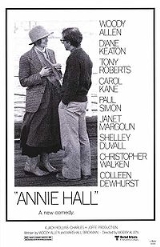
Annie Hall (1977) is an American romantic comedy film directed by Woody Allen from a script co-written with Marshall Brickman. One of Allen's most popular films, it won numerous awards at the time of its release, including four Academy Awards, and in 2002 Roger Ebert referred to it as "just about everyone's favorite Woody Allen movie".
Allen had previously been known as a maker of zany comedies; the director has described Annie Hall as "a major turning point", as it brought a new level of seriousness to his work, in addition to consolidating his signature cinematic style, which includes long, realistically written scenes of conversation, often shot in uninterrupted takes, and an equal thematic investment in both hilarity and heartbreak.
film is set in New York City and Los Angeles.
Alvy Singer (Woody Allen) is a neurotic comedian, attempting to maintain a relationship with the seemingly ditzy but exuberant Annie (Diane Keaton).

Discussion
Ask a question about 'Annie Hall'
Start a new discussion about 'Annie Hall'
Answer questions from other users
|
Quotations
Honey, there's a spider in your bathroom the size of a Buick.
I can't get with any religion that advertises in Popular Mechanics.
I don't use any major hallucinogenics...Five years ago at a party, I tried to take my pants off over my head.
I don't want to live in a city where the only cultural advantage is that you can make a right turn on a red light.
I'm making excellent progress. Pretty soon, when I lie down on his couch, I won't have to wear the lobster bib.
Lacey Party Guest: This is Davis ... I forgot my mantra.

Encyclopedia
Annie Hall (1977) is an American romantic comedy film directed by Woody Allen from a script co-written with Marshall Brickman. One of Allen's most popular films, it won numerous awards at the time of its release, including four Academy Awards, and in 2002 Roger Ebert referred to it as "just about everyone's favorite Woody Allen movie".
Allen had previously been known as a maker of zany comedies; the director has described Annie Hall as "a major turning point", as it brought a new level of seriousness to his work, in addition to consolidating his signature cinematic style, which includes long, realistically written scenes of conversation, often shot in uninterrupted takes, and an equal thematic investment in both hilarity and heartbreak.
Plot
The film is set in New York City and Los Angeles.
Alvy Singer (Woody Allen) is a neurotic comedian, attempting to maintain a relationship with the seemingly ditzy but exuberant Annie (Diane Keaton). The film chronicles their relationship over several years, intercut with various imaginary trips into each other's history (Annie is able to "see" Alvy's family when he was only a child, and likewise Alvy observes Annie's past sexual relationships). In the first flashback showing Alvy as a child, we learn he was raised in Brooklyn; his father's occupation was operating a bumper cars concession and the family home was located below the Thunderbolt roller coaster on Coney Island.
After many arguments and reconciliations, the two realize they are fundamentally different and split up. Annie moves in with Hollywood record company executive Tony Lacey (Paul Simon); Annie likes California, but Alvy hates it. Alvy soon realizes he still loves her after seeing Children of Paradise (Les Enfants du Paradis) and tries to convince her to return with him to New York. He fails and, resignedly, returns home to write a play about their relationship, recycling the conversation just exchanged, but ending with him winning Annie back.
Later, with Annie back in New York, the two are able to meet on good terms as friends, now with different lovers. Alvy ends the film by musing about how love and relationships are something we all require despite their often painful and complex nature.
Cast
Production
Allen's working title for the film was Anhedonia (a psychoanalytic term for the inability to experience pleasure from normally pleasurable life events), but this was considered unmarketable, as were Brickman's suggested alternatives, It Had to Be Jew, Rollercoaster Named Desire and Me and My Goy. Ultimately Annie Hall was decided on as the release title. Because of biographical similarities between the character Alvy and Woody Allen (including Allen's previous relationship with co-star Diane Keaton, whose real name is Diane Hall, and who portrays the character Annie Hall), Annie Hall has been widely assumed to be semi-autobiographical. Allen has denied this.
The film was originally intended to be a drama centered on a murder mystery with a comic and romantic subplot, and was filmed that way. According to Allen, the murder occurred after a scene that remains in the film, the sequence in which Annie and Alvy miss the Ingmar Bergman film Face to Face. After shooting had completed, the film's editor persuaded Woody Allen to cut the mystery plot and make the film a romantic comedy. (Allen would make a murder mystery film many years later, with 1993's Manhattan Murder Mystery, also starring Diane Keaton.)
Similarly, the production of the film was semi-improvisational. For example, in the original script, Alvy didn't grow up under a roller coaster, but while Allen was driving around Brooklyn with his crew, looking for locations, "I saw this roller-coaster, and I saw the house under it. And I thought, we have to use this." The 'house' in question is in fact the Kensington Hotel, which really was located underneath the Thunderbolt roller coaster. Another example is the scene in which Alvy sneezes into cocaine, which was purely accidental, but Allen decided to keep it in the movie; when they tested it with audiences they laughed so much that Allen had to add more footage after the scene so they wouldn't laugh through important conversations afterwards.
Style and technique
Allen has said that Annie Hall was "a major turning point" both thematically and technically. "I had the courage to abandon... just clowning around and the safety of complete broad comedy. I said to myself, 'I think I will try and make some deeper film and not be as funny in the same way. And maybe there will be other values that will emerge, that will be interesting or nourishing for the audience.' And it worked out very very well."
Allen has also stated that working with cinematographer Gordon Willis for the first time on Annie Hall helped improve his technical skills, calling Willis "a very important teacher" and a "technical wizard." Annie Hall was the first of Allen's films to utilize long takes, where sometimes one shot will continue, unabridged, for an entire scene. Allen has commented, "It just seems more fun and quicker and less boring for me to do long scenes." Film critic Roger Ebert cites a study that calculated the average shot length of Annie Hall to be 14.5 seconds, while other films made in 1977 had an average shot length of 4-7 seconds. Ebert adds that the long takes add to the dramatic power of the film, saying, "Few viewers probably notice how much of Annie Hall consists of people talking, simply talking. They walk and talk, sit and talk, go to shrinks, go to lunch, make love and talk, talk to the camera, or launch into inspired monologues like Annie's free-association as she describes her family to Alvy. This speech by Diane Keaton is as close to perfect as such a speech can likely be... all done in one take of brilliant brinkmanship." As detailed in the book When the Shooting Stops... The Cutting Begins, written by the film's editor, Ralph Rosenblum, with Robert Karen, the trick to editing Annie Hall was paring the film down to its essential. The first rough cut was two hours and twenty minutes long; various subplots, background scenes and flashbacks-within-flashbacks were deleted to focus on the love story.
The film also breaks with conventional realism: characters frequently break the "fourth wall" by addressing the camera directly, and Allen makes use of split-screen imagery, double exposure, and subtitles expounding the characters' real thoughts (in contrast to the dialogue). In one scene, Allen's character, standing in a cinema queue with Annie and listening to someone behind him expound on Marshall McLuhan's work, leaves the line to speak to the camera directly. The man then speaks to the camera in his defense, and Allen resolves the dispute by pulling McLuhan himself from behind a free-standing movie posterboard to tell the man that his interpretation is wrong. Another scene is animated, featuring a cartoon Allen and the Wicked Queen from Snow White. In another scene Allen's character again addresses the audience, and then stops several passers-by to ask questions about love. Woody Allen chose to have Alvy break the fourth wall, he explained, "because I felt many of the people in the audience had the same feelings and the same problems. I wanted to talk to them directly and confront them."
Another notable scene is where Alvy, Annie, and Rob visit Alvy’s childhood as adults, a narrative technique that Allen’s idol, Ingmar Bergman, used in Wild Strawberries, one of Bergman’s most famous and most acclaimed films, and a technique he would use again in Crimes and Misdemeanors, where the main character, Judah (Martin Landau) would visit his childhood and ask his father, a rabbi, ethical questions about a crime he’d just committed. Similarly the school scenes in the beginning of the film were influenced by another idol of Allen’s, Federico Fellini, whose Amarcord Annie Hall owes a great debt to.
The film has no score and very little background music; Allen has said that this was also the (temporary) influence of Bergman, who had described the usage of music in films as 'barbaric'. The few instances of music include a boy's choir Christmas melody played while the characters drive through Los Angeles, the Molto allegro from the Jupiter Symphony by Mozart heard as Annie and Alvy drive through the countryside, Annie's two performances at the jazz club; Annie's song is also reprised in the film's final scene; and there is a muzak version of the Savoy Brown song "A Hard Way to Go" playing in the Paul Simon character's mansion during a party.
Awards and honors
| Academy Awards record |
|---|
| 1. Best Actress, Diane Keaton | | 2. Best Director, Woody Allen | | 3. Best Picture, Charles H. Joffe | | 4. Best Original Screenplay, Woody Allen, Marshall Brickman | | Golden Globe Awards record |
|---|
| 1. Best Actress - Musical/Comedy, Diane Keaton | | BAFTA Awards record |
|---|
| 1. Best Actress, Diane Keaton | | 2. Best Direction, Woody Allen | | 3. Best Editing, Ralph Rosenblum, Wendy Greene Bricmont | | 4. Best Film | | 5. Best Screenplay, Woody Allen, Marshall Brickman | |
1977 Academy Awards (Oscars)
- Woody Allen, however, did not attend the Academy Awards ceremony for Annie Hall, saying the awards meant nothing to him.
1978 Golden Globes
- Annie Hall won one Golden Globe Award, for Best Actress in Musical or Comedy (Diane Keaton). It was nominated for three more: Best Motion Picture (Musical or Comedy), Best Director (Woody Allen), and Best Actor in Musical or Comedy (Woody Allen).
1978 BAFTA Awards
Other awards 1977 RAK Awards
- Most Undeserved Best Picture Oscar winner ever.
- Biggest Oscar Robbery Ever (Tie: Star Wars losing to Annie Hall for 1977 Best Picture Oscar and Judy Garland losing Best Actress Oscar in 1954 to Grace Kelly).
- In 1992, this film was selected for preservation in the United States National Film Registry by the Library of Congress as being "culturally, historically, or aesthetically significant".
- Zagat Survey Movie Guide (2002) ranks Annie Hall one of the top ten comedies of all time, one of the top ten movies of the 1970s and as Allen's best film as a director.
- In 2000, readers of Total Film magazine voted it the forty-second greatest comedy film of all time.
- The film is number 28 on Bravo's 100 Funniest Movies.
- In June 2008, AFI revealed its "Ten top Ten"—the best ten films in ten "classic" American film genres—after polling over 1,500 people from the creative community. Annie Hall was acknowledged as the second best film in the romantic comedy genre.
American Film Institute recognition
Considered sequel
Allen says he gets approached "all the time" about making a sequel to Annie Hall, but has repeatedly declined. However, he admitted in a 1995 interview that for a time he considered it, saying,
Influence
- Annie Halls mix of relatively realistic scenes and surreal flights of fancy was highly influential on later films including Ferris Bueller's Day Off, Cheech & Chong's Next Movie, and High Fidelity. The late-1980s TV series thirtysomething was one of many shows that would break away from more realistic, dramatic scenes for comic trips into the imagination of the characters, while Malcolm in the Middle, The Fresh Prince of Bel-Air and many others also featured the main character looking into the camera and speaking directly to the audience, breaking the "fourth wall".
- Influential alternative rock band Jawbreaker used a sample of Duane telling Alvy about his disturbing visions of crashing his car in their song, "Jet Black" on their final album, Dear You.
- Rock/ska/swing band the Cherry Poppin' Daddies reference the film in their song "Diamond Light Boogie" on their 2000 album Soul Caddy. Done in a 1970s glam rock style, the narrator, reflecting on the innocence of the 20th century, references several pop culture items from the era, including the line "God knows I miss cross-dressin' Annie".
- In the That 70's Show episode, "Kitty and Eric's Night Out", they go and see the movie, and discuss the amounts of adult material within the film. Later, Eric and Donna have a moment where they act like Alvy and Annie.
- London based anti-folk singer Emmy the Great mentions Annie Hall in her song "Canopies and Grapes" in the lines 'Wish I could tell you all the things that Woody Allen helps me see / How Annie Hall is starting to seem quite a lot like you and me'.
Influence on fashion
The film also had an influence on the fashion world during the late-70s, with countless women adopting Keaton's distinctive "look" in the film, layering oversized, mannish blazers over vests, billowy trousers or long skirts, and boots. Keaton's wardrobe also included a tie by Ralph Lauren. The look was often referred to as the "Annie Hall look".
Allen recalled that Keaton's natural fashion sense almost did not end up in the film. "She came in," he recalled in 1995, "and the costume lady on Annie Hall said, 'Tell her not to wear that. She can't wear that. It's so crazy.' And I said, 'Leave her. She's a genius. Let's just leave her alone, let her wear what she wants.'
External links
- (Unofficial Woodypedia and blog)
|