

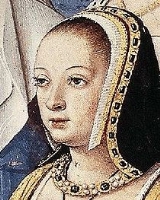
Anne of Brittany

Encyclopedia
Anne, Duchess of Brittany (25 January 1476 – 9 January 1514), also known as Anna of Brittany , was a Breton ruler, who was to become queen to two successive French kings. She was born in Nantes
, Brittany
, and was the daughter of Francis II, Duke of Brittany and Margaret of Foix
. Her maternal grandparents were Queen Eleanor of Navarre
and Gaston IV, Count of Foix
. Upon her father's death, she became sovereign Duchess of Brittany, Countess of Nantes, Montfort and Richmont and Viscountess of Limoges. In her time, she was the richest European woman.
, who died in 1490). Accordingly, she was brought up as the heiress to the Duchy. She was given a good education under the guidance of Françoise de Dinan, Lady of Laval and Chateaubriant, and the poet Jean Meschinot.
Since the Breton War of Succession
, Brittany had been understood to operate according to semi-Salic Law
–women could only inherit if the male line had died out. By the time Anne was born, her father was the only male left of the Breton House of Montfort. The War of Succession had ended with an agreement that, in the absence of a male heir, the heirs of Joanna of Penthièvre would succeed. After a century, however, this agreement had been forgotten. Thus, in 1486 Anne's father had her recognised as heiress by the Breton estates; however, the question of her marriage remained a diplomatic issue. Francis had no intention of allowing Brittany to be absorbed by France. Therefore, he sought for his daughter a marriage with a figure capable of withstanding French power.
Brittany being an attractive prize, Anne had no shortage of suitors. She was officially promised in marriage to Edward, Prince of Wales
, son of Edward IV of England
in 1483; however, the boy disappeared, and was presumed dead, soon after the death of Edward IV. Others who bid for her hand included Maximilian of Austria
(the widower of Mary of Burgundy
, another heiress), Alain d'Albret, Jean de Châlons
(Prince of Orange) and even the married Louis, Duke of Orléans
.
In 1488, however, the armies of Francis II were defeated at the Battle of Saint-Aubin-du-Cormier
, ending the Guerre folle
between Brittany and France. In the Treaty of Sablé
, which concluded the peace settlement, the Duke was forced to accept clauses stipulating that his daughters were not to marry without the approval of the King of France. Francis died soon afterward, on 9 September 1488, as a result of a fall from his horse. Anne became Duchess
, and Brittany was plunged into fresh crisis, leading to the last Franco-Breton war.
was considered to be the most suitable candidate. Her marriage with Maximilian, which took place at Rennes by proxy
on 19 December 1490, conferred upon Anne the title Queen of the Romans
, but proved to have serious consequences. The French regarded it as a serious provocation—it not only violated the Treaty of Verger (the King of France not having consented to the marriage), but also placed the rule of Brittany in the hands of an enemy of France. The marriage also proved ill-timed: the Habsburgs were too busy in Hungary to pay any serious attention to Brittany, and the Castilians were busy fighting in Granada. Although both Castile and England sent small numbers of troops to supplement the Ducal army, neither wished for open warfare with France. The spring of 1491 brought new successes by the French general La Trémoille
, and Charles VIII of France
came to lay siege to Rennes.
After Maximilian failed to come to his bride's assistance, Rennes fell. Anne became engaged to Charles in the vault of the Jacobins in Rennes. Then, escorted by her army (ostensibly to show that she had willingly consented to the marriage), Anne went to Langeais
to be married. Although Austria made diplomatic protests, claiming that the marriage was illegal because the bride was unwilling, that she was already legally married to Maximilian, and that Charles was legally betrothed to Margaret of Austria
, Maximilian's daughter, Anne celebrated her second wedding to Charles VIII at the castle of Langeais on 6 December 1491.
The marriage was subsequently validated by Pope Innocent VIII
on 15 February 1492. The marriage contract provided that whichever spouse outlived the other would retain possession of Brittany; however, it also stipulated that if Charles died without male heirs, Anne would marry his successor, thus ensuring the French kings a second chance to permanently annex Brittany.
 Anne's second marriage began badly: she brought two beds with her when she came to marry Charles, and the King and Queen often lived apart. She was anointed and crowned Queen of France
at Saint-Denis on 8 February 1492; she was forbidden by her husband to use the title "Duchess of Brittany", which became a bone of contention between the two. When her husband fought in the wars in Italy, the regency powers were exercised by his sister Anne of Beaujeu
. Pregnant for most of her married life, Anne lived primarily in the royal castles of Amboise, Loches and Plessis or in the towns of Lyon, Grenoble or Moulins (when the king was in Italy). She became Queen of Sicily and titular Queen of Jerusalem with the conquest of Naples by Charles VIII.
The marriage produced four living children, none of whom survived early childhood. Only the first, Charles Orland
(11 October 1492 – 16 December 1495), survived infancy. A healthy and intelligent child, he was doted on by his parents, who both suffered terrible grief when he died suddenly of the measles. After him was born Charles, who lived for less than a month; and Francis and Anne, who each died almost immediately after being born. These tragedies caused a great deal of pain to Anne, who prayed openly for a son after the death of Francis.
Around her, there was a famous circle of court poets: among them the Italian humanist Publio Fausto Andrelini
from Forlì
, who spread the New Learning
in France.
 When Charles VIII died in 1498, Anne was 21 years old and childless. Legally, she was now obliged to marry the new king, Louis XII
; however, he was already married, to Joan
, daughter of Louis XI
and sister to Charles VIII. On 19 August 1498, at Étampes, she agreed to marry Louis if he obtained an annulment from Joan within a year. If she was gambling that the annulment would be denied, she lost: Louis's first marriage was dissolved by the Pope before the end of the year.
In the interim, in October 1498, Anne returned to rule Brittany. She restored the faithful Philippe de Montauban to the chancellery of Brittany, named the Prince of Orange as Hereditary Lieutenant General of Brittany, convened the Estates of Brittany, and ordered production of a coin bearing her name. She took the opportunity to tour the Duchy, visiting many places she had never been able to see as a child. She made triumphal entries into the cities of the duchy, where her vassals received her sumptuously.
Anne's third marriage ceremony, on 8 January 1499 (she wore white, setting a precedent for future brides), was concluded under conditions radically different from those of the second. She was no longer a child, but was a dowager queen, and was determined to ensure the recognition of her rights as sovereign duchess from now on. Although her new husband exercised the ruler's powers in Brittany, he formally recognized her right to the title "Duchess of Brittany" and issuing decisions in her name.
As Duchess, Anne fiercely defended the independence of her Duchy. She arranged the marriage of her daughter, Claude, to Charles of Luxembourg
in 1501, to reinforce the Franco-Spanish alliance and ensure French success in the Italian Wars; however, Louis broke off the marriage when it became likely that Anne would not produce a male heir. Instead, Louis arranged a marriage between Claude and the heir to the French throne, Francis of Angoulême
. Anne, determined to maintain Breton independence, refused until death to sanction the marriage, pushing instead for Claude to marry Charles, or for the Duchy to be inherited by her other daughter, Renee. The marriage of Claude and Francis eventually took place in the year following Anne's death.
.
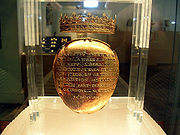 According to her will, her heart was placed in a raised enamel gold reliquary
, then transported to Nantes to be deposited, on 19 March 1514, in the vault of the Carmelite friars, in the tomb made for her parents, later being transferred to the Saint-Pierre cathedral. The reliquary of the heart of the Anne, Duchess of Brittany is a box oval, bivalvular, made of a sheet of gold pushed back and guilloché
d, articulated by a hinge, broadside of a gold cordelière and topped by a crown of lily and clover. It is inscribed as follows:
It was made by an anonymous goldsmith of the court of Blois, perhaps drawn by Jean Perréal. In 1792, by order of the National Convention, the reliquary was exhumed, emptied, and seized as part of a collection of precious metals pertaining to churches, and sent to Nantes to be melted down. However, it was instead kept in the National Library, and was returned to Nantes in 1819, being kept in various museums, and in the Dobrée Museum since 1896.
Anne's will also conferred the succession of Brittany upon her second daughter, Renee. This was ignored by her husband, who confirmed Claude as Duchess and married her to Francis.
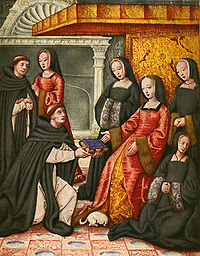 Anne was a highly intelligent woman who spent much of her time on the administration of Brittany. She was described as shrewd, proud and haughty in manner. She made the safeguarding of Breton autonomy, and the preservation of the Duchy outside the French crown, her life's work, although that goal would prove failed shortly after her death.
Anne was also a patron of the arts and enjoyed music. A prolific collector of tapestries, it is very likely that the unicorn tapestries
now on view at The Cloisters
museum in New York City were commissioned by her in celebration of her wedding to Louis XII. She also commissioned a book of French manuscripts (a Book of Hours
), known as The Great Hours of Anne of Brittany. She also instituted the Queen's Maids of Honour
at the court.
She was a devoted mother, spending as much time as possible with her children. For her son, Charles-Orland, she commissioned a book of prayers, intended to be used in teaching him how to pray, and as a guidance to him as the future King of France; unfortunately, Charles-Orland died in 1495, and no other son lived more than a few weeks.
At her marriage to Charles VIII, aged 14, Anne was described as a young and rosy-cheeked girl; by the time of her marriage to Louis, aged 22, after seven pregnancies with no surviving children, she was described as pale-faced and wan. By the end of her life, at 36, she had been pregnant 14 times, with seven of the children stillborn. Of the remaining seven, only two survived childhood.
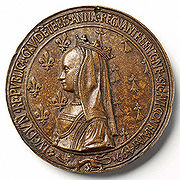 Anne's first marriage ceremony, on 19 December 1490, was a marriage by proxy to Maximilian of Habsburg
. It was dissolved by the Pope in the following year; because it was only by proxy (rather than in person), it is not generally considered a 'real' marriage.
Her second husband was Charles VIII of France
, whom she married at Chateau Langeais on 6 December 1491. She was pregnant by him seven times:
Her third husband was Louis XII of France
. She was at least seven times pregnant by him:
In 1991, the five-hundredth anniversary of the marriage of Anne of Brittany and Charles VIII of France was celebrated in Langeais. In Rennes, which had paid the price of this marriage by siege, food shortage, and an occupation, it was hardly mentioned.
 Anne of Brittany is one of Brittany's most renowned historical figures, second perhaps only to Saint Yves
. In testimony exist a large number of trades, hotels and street names bearing her name. Anne is also referred to by:
There are several explanations for this: the destiny of this duchess who married three kings, including two kings of France, and who was only a child when she had to marry the first (even if early engagements were normal at that time); the historical role of Anne in the union of the duchy to the kingdom of France; the fact that very little of the history of Brittany is taught in Breton schools (the official school syllabus being written in Paris for all the French territory -territories of overseas included - those retain only Anne as a notable Breton). This established fact leads some to experience the History of Brittany starting and finishing with Anne.
|-
|-
|-
|-
|-
|-
|-
Nantes
Nantes is a city in western France, located on the Loire River, from the Atlantic coast. The city is the 6th largest in France, while its metropolitan area ranks 8th with over 800,000 inhabitants....
, Brittany
Brittany
Brittany is a cultural and administrative region in the north-west of France. Previously a kingdom and then a duchy, Brittany was united to the Kingdom of France in 1532 as a province. Brittany has also been referred to as Less, Lesser or Little Britain...
, and was the daughter of Francis II, Duke of Brittany and Margaret of Foix
Margaret of Foix
Margaret of Foix, , was, by marriage, Duchess of Brittany from 1474 to 1486.She was the daughter of Queen Eleanor of Navarre and of Gaston IV, Count of Foix ....
. Her maternal grandparents were Queen Eleanor of Navarre
Eleanor of Navarre
Eleanor of Aragon , Regent and the queen regnant of Navarre in 1479...
and Gaston IV, Count of Foix
Gaston IV, Count of Foix
Gaston IV, Count of Foix, Viscount of Béarn was a French nobleman from Bearn, who founded a brief-ruling dynastic house of the Kingdom of Navarre.He was a son of John I, Count of Foix and Jeanne d'Albret...
. Upon her father's death, she became sovereign Duchess of Brittany, Countess of Nantes, Montfort and Richmont and Viscountess of Limoges. In her time, she was the richest European woman.
Early life
Anne was the only child of Francis and Margaret to survive childhood (she had a younger sister, IsabeauIsabeau of Brittany
Isabeau of Brittany , was the younger daughter of Francis II, Duke of Brittany and Margaret of Foix and her sister Anne of Brittany's heir to the dukedom.- Biography :...
, who died in 1490). Accordingly, she was brought up as the heiress to the Duchy. She was given a good education under the guidance of Françoise de Dinan, Lady of Laval and Chateaubriant, and the poet Jean Meschinot.
Since the Breton War of Succession
Breton War of Succession
The Breton War of Succession was a conflict between the Houses of Blois and Montfort for control of the Duchy of Brittany. It was fought between 1341 and 1364. It formed an integral part of the early Hundred Years War due to the involvement of the French and English governments in the conflict; the...
, Brittany had been understood to operate according to semi-Salic Law
Salic law
Salic law was a body of traditional law codified for governing the Salian Franks in the early Middle Ages during the reign of King Clovis I in the 6th century...
–women could only inherit if the male line had died out. By the time Anne was born, her father was the only male left of the Breton House of Montfort. The War of Succession had ended with an agreement that, in the absence of a male heir, the heirs of Joanna of Penthièvre would succeed. After a century, however, this agreement had been forgotten. Thus, in 1486 Anne's father had her recognised as heiress by the Breton estates; however, the question of her marriage remained a diplomatic issue. Francis had no intention of allowing Brittany to be absorbed by France. Therefore, he sought for his daughter a marriage with a figure capable of withstanding French power.
Brittany being an attractive prize, Anne had no shortage of suitors. She was officially promised in marriage to Edward, Prince of Wales
Edward V of England
Edward V was King of England from 9 April 1483 until his deposition two months later. His reign was dominated by the influence of his uncle Richard, Duke of Gloucester, who succeeded him as Richard III...
, son of Edward IV of England
Edward IV of England
Edward IV was King of England from 4 March 1461 until 3 October 1470, and again from 11 April 1471 until his death. He was the first Yorkist King of England...
in 1483; however, the boy disappeared, and was presumed dead, soon after the death of Edward IV. Others who bid for her hand included Maximilian of Austria
Maximilian I, Holy Roman Emperor
Maximilian I , the son of Frederick III, Holy Roman Emperor and Eleanor of Portugal, was King of the Romans from 1486 and Holy Roman Emperor from 1493 until his death, though he was never in fact crowned by the Pope, the journey to Rome always being too risky...
(the widower of Mary of Burgundy
Mary of Burgundy
Mary of Burgundy ruled the Burgundian territories in Low Countries and was suo jure Duchess of Burgundy from 1477 until her death...
, another heiress), Alain d'Albret, Jean de Châlons
John IV of Chalon-Arlay
John IV of Chalon-Arlay or John of Chalon was a prince of Orange and lord of Chalon-Arlay. He was the son of William VII of Chalon and the father of Philibert of Châlon and Claudia of Châlon....
(Prince of Orange) and even the married Louis, Duke of Orléans
Louis XII of France
Louis proved to be a popular king. At the end of his reign the crown deficit was no greater than it had been when he succeeded Charles VIII in 1498, despite several expensive military campaigns in Italy. His fiscal reforms of 1504 and 1508 tightened and improved procedures for the collection of taxes...
.
In 1488, however, the armies of Francis II were defeated at the Battle of Saint-Aubin-du-Cormier
Battle of Saint-Aubin-du-Cormier (1488)
The Battle of Saint-Aubin-du-Cormier took place on July 28, 1488, between the forces of king Charles VIII of France, and those of Francis II, Duke of Brittany and his allies. The defeat of the latter signalled the end to the "guerre folle" , a feudal conflict in which French aristocrats revolted...
, ending the Guerre folle
Mad War
The Mad War , also known as the War of the Public Weal, was a late Medieval conflict between a coalition of feudal lords and the French monarchy. It occurred during the regency of Anne of Beaujeu in the period after the death of Louis XI and before the majority of the young king Charles VIII...
between Brittany and France. In the Treaty of Sablé
Treaty of Sablé
The Treaty of Sablé was signed on August 20, 1488 in Sablé between Duke Francis II of Brittany and Charles VIII of France. Based on the terms of the accord, the Duke of Brittany acknowledged himself as a vassal of the King of France...
, which concluded the peace settlement, the Duke was forced to accept clauses stipulating that his daughters were not to marry without the approval of the King of France. Francis died soon afterward, on 9 September 1488, as a result of a fall from his horse. Anne became Duchess
Duke of Brittany
The Duchy of Brittany was a medieval tribal and feudal state covering the northwestern peninsula of Europe,bordered by the Alantic Ocean on the west and the English Channel to the north with less definitive borders of the Loire River to the south and Normandy to the east...
, and Brittany was plunged into fresh crisis, leading to the last Franco-Breton war.
Duchess of Brittany
The first necessary move for Anne was to secure a husband, preferably anti-France and powerful enough to maintain Breton independence. Maximilian I of AustriaMaximilian I, Holy Roman Emperor
Maximilian I , the son of Frederick III, Holy Roman Emperor and Eleanor of Portugal, was King of the Romans from 1486 and Holy Roman Emperor from 1493 until his death, though he was never in fact crowned by the Pope, the journey to Rome always being too risky...
was considered to be the most suitable candidate. Her marriage with Maximilian, which took place at Rennes by proxy
Proxy marriage
A proxy wedding or is a wedding in which the bride or groom is not physically present, usually being represented instead by another person...
on 19 December 1490, conferred upon Anne the title Queen of the Romans
King of the Romans
King of the Romans was the title used by the ruler of the Holy Roman Empire following his election to the office by the princes of the Kingdom of Germany...
, but proved to have serious consequences. The French regarded it as a serious provocation—it not only violated the Treaty of Verger (the King of France not having consented to the marriage), but also placed the rule of Brittany in the hands of an enemy of France. The marriage also proved ill-timed: the Habsburgs were too busy in Hungary to pay any serious attention to Brittany, and the Castilians were busy fighting in Granada. Although both Castile and England sent small numbers of troops to supplement the Ducal army, neither wished for open warfare with France. The spring of 1491 brought new successes by the French general La Trémoille
Louis II de la Trémoille
thumb|Portrait of Louis II de la Trémoille by [[Domenico Ghirlandaio]] or one of his assistants.Louis II de la Trémoille was a French general. He served under three kings: Charles VIII, Louis XII, and Francis I...
, and Charles VIII of France
Charles VIII of France
Charles VIII, called the Affable, , was King of France from 1483 to his death in 1498. Charles was a member of the House of Valois...
came to lay siege to Rennes.
After Maximilian failed to come to his bride's assistance, Rennes fell. Anne became engaged to Charles in the vault of the Jacobins in Rennes. Then, escorted by her army (ostensibly to show that she had willingly consented to the marriage), Anne went to Langeais
Château de Langeais
The Château de Langeais is a castle in Indre-et-Loire, France, built on a promontory created by the small valley of the Roumer River at the opening to the Val de Loire...
to be married. Although Austria made diplomatic protests, claiming that the marriage was illegal because the bride was unwilling, that she was already legally married to Maximilian, and that Charles was legally betrothed to Margaret of Austria
Margarete of Austria
Margaret of Austria was, by her two marriages, Princess of Asturias and Duchess of Savoy, and was appointed Governor of the Habsburg Netherlands from 1507 to 1515 and again from 1519 to 1530.-Early life:...
, Maximilian's daughter, Anne celebrated her second wedding to Charles VIII at the castle of Langeais on 6 December 1491.
The marriage was subsequently validated by Pope Innocent VIII
Pope Innocent VIII
Pope Innocent VIII , born Giovanni Battista Cybo , was Pope from 1484 until his death.-Early years:Giovanni Battista Cybo was born at Genoa of Greek extraction...
on 15 February 1492. The marriage contract provided that whichever spouse outlived the other would retain possession of Brittany; however, it also stipulated that if Charles died without male heirs, Anne would marry his successor, thus ensuring the French kings a second chance to permanently annex Brittany.
Queen of France
Coronation of the French monarch
The accession of the King of France was legitimated by coronation ceremony performed with the Crown of Charlemagne at Notre-Dame de Reims. However, the person did not need to be crowned in order to be recognized as French monarch; the new king ascended the throne when the coffin of the previous...
at Saint-Denis on 8 February 1492; she was forbidden by her husband to use the title "Duchess of Brittany", which became a bone of contention between the two. When her husband fought in the wars in Italy, the regency powers were exercised by his sister Anne of Beaujeu
Anne of France
Anne of France was the eldest daughter of Louis XI of France and his second wife, Charlotte of Savoy. Anne was the sister of King Charles VIII of France, for whom she acted as regent during his minority; and of Joan of France, who was briefly queen consort to Louis XII...
. Pregnant for most of her married life, Anne lived primarily in the royal castles of Amboise, Loches and Plessis or in the towns of Lyon, Grenoble or Moulins (when the king was in Italy). She became Queen of Sicily and titular Queen of Jerusalem with the conquest of Naples by Charles VIII.
The marriage produced four living children, none of whom survived early childhood. Only the first, Charles Orland
Charles Orlando, Dauphin of France
Charles Orlando, Dauphin of France was the eldest son and heir of Charles VIII of France and Anne of Brittany....
(11 October 1492 – 16 December 1495), survived infancy. A healthy and intelligent child, he was doted on by his parents, who both suffered terrible grief when he died suddenly of the measles. After him was born Charles, who lived for less than a month; and Francis and Anne, who each died almost immediately after being born. These tragedies caused a great deal of pain to Anne, who prayed openly for a son after the death of Francis.
Around her, there was a famous circle of court poets: among them the Italian humanist Publio Fausto Andrelini
Publio Fausto Andrelini
[Publio] Fausto Andrelini was an Italian humanist poet, an intimate friend of Erasmus in the 1490s, who spread the New Learning in France...
from Forlì
Forlì
Forlì is a comune and city in Emilia-Romagna, Italy, and is the capital of the province of Forlì-Cesena. The city is situated along the Via Emilia, to the right of the Montone river, and is an important agricultural centre...
, who spread the New Learning
New Learning
In the history of ideas the New Learning in Europe is a term for Renaissance humanism, developed in the later fifteenth century. Newly retrieved classical texts sparked philological study of a refined and classical Latin style in prose and poetry....
in France.
Widowhood and remarriage
Louis XII of France
Louis proved to be a popular king. At the end of his reign the crown deficit was no greater than it had been when he succeeded Charles VIII in 1498, despite several expensive military campaigns in Italy. His fiscal reforms of 1504 and 1508 tightened and improved procedures for the collection of taxes...
; however, he was already married, to Joan
Joan of France, Duchess of Berry
Joan of France was briefly Queen consort of France as wife of King Louis XII of France, in between the death of her brother, Charles VIII, and the annulment of her marriage....
, daughter of Louis XI
Louis XI of France
Louis XI , called the Prudent , was the King of France from 1461 to 1483. He was the son of Charles VII of France and Mary of Anjou, a member of the House of Valois....
and sister to Charles VIII. On 19 August 1498, at Étampes, she agreed to marry Louis if he obtained an annulment from Joan within a year. If she was gambling that the annulment would be denied, she lost: Louis's first marriage was dissolved by the Pope before the end of the year.
In the interim, in October 1498, Anne returned to rule Brittany. She restored the faithful Philippe de Montauban to the chancellery of Brittany, named the Prince of Orange as Hereditary Lieutenant General of Brittany, convened the Estates of Brittany, and ordered production of a coin bearing her name. She took the opportunity to tour the Duchy, visiting many places she had never been able to see as a child. She made triumphal entries into the cities of the duchy, where her vassals received her sumptuously.
Anne's third marriage ceremony, on 8 January 1499 (she wore white, setting a precedent for future brides), was concluded under conditions radically different from those of the second. She was no longer a child, but was a dowager queen, and was determined to ensure the recognition of her rights as sovereign duchess from now on. Although her new husband exercised the ruler's powers in Brittany, he formally recognized her right to the title "Duchess of Brittany" and issuing decisions in her name.
As Duchess, Anne fiercely defended the independence of her Duchy. She arranged the marriage of her daughter, Claude, to Charles of Luxembourg
Charles V, Holy Roman Emperor
Charles V was ruler of the Holy Roman Empire from 1519 and, as Charles I, of the Spanish Empire from 1516 until his voluntary retirement and abdication in favor of his younger brother Ferdinand I and his son Philip II in 1556.As...
in 1501, to reinforce the Franco-Spanish alliance and ensure French success in the Italian Wars; however, Louis broke off the marriage when it became likely that Anne would not produce a male heir. Instead, Louis arranged a marriage between Claude and the heir to the French throne, Francis of Angoulême
Francis I of France
Francis I was King of France from 1515 until his death. During his reign, huge cultural changes took place in France and he has been called France's original Renaissance monarch...
. Anne, determined to maintain Breton independence, refused until death to sanction the marriage, pushing instead for Claude to marry Charles, or for the Duchy to be inherited by her other daughter, Renee. The marriage of Claude and Francis eventually took place in the year following Anne's death.
Death
Anne failed to survive the winter of 1513-1514, dying of a kidney-stone attack at the Chateau of Blois. She was buried in the necropolis of Saint Denis. Her funeral was of exceptional length, lasting 40 days, and inspiring all future French royal funerals until the 18th century. The Requiem for Anne was probably composed by the famous composer Johannes PriorisJohannes Prioris
Johannes Prioris was a Franco-Flemish composer of the Renaissance. He was one of the first composers to write a polyphonic setting of the Requiem mass....
.
Reliquary
A reliquary is a container for relics. These may be the physical remains of saints, such as bones, pieces of clothing, or some object associated with saints or other religious figures...
, then transported to Nantes to be deposited, on 19 March 1514, in the vault of the Carmelite friars, in the tomb made for her parents, later being transferred to the Saint-Pierre cathedral. The reliquary of the heart of the Anne, Duchess of Brittany is a box oval, bivalvular, made of a sheet of gold pushed back and guilloché
Guilloché
Guilloché is a decorative engraving technique in which a very precise intricate repetitive pattern or design is mechanically engraved into an underlying material with fine detail...
d, articulated by a hinge, broadside of a gold cordelière and topped by a crown of lily and clover. It is inscribed as follows:
- En ce petit vaisseau
- De fin or pur et munde
- Repose ung plus grand cueur
- Que oncque dame eut au munde
- Anne fut le nom delle
- En France deux fois royne
- Duchesse des Bretons
- Royale et Souveraine.
It was made by an anonymous goldsmith of the court of Blois, perhaps drawn by Jean Perréal. In 1792, by order of the National Convention, the reliquary was exhumed, emptied, and seized as part of a collection of precious metals pertaining to churches, and sent to Nantes to be melted down. However, it was instead kept in the National Library, and was returned to Nantes in 1819, being kept in various museums, and in the Dobrée Museum since 1896.
Anne's will also conferred the succession of Brittany upon her second daughter, Renee. This was ignored by her husband, who confirmed Claude as Duchess and married her to Francis.
Personal characteristics
Anne was also a patron of the arts and enjoyed music. A prolific collector of tapestries, it is very likely that the unicorn tapestries
The Hunt of the Unicorn
The Hunt of the Unicorn, often referred to as the Unicorn Tapestries, is a series of seven tapestries dating from 1495–1505. The tapestries show a group of noblemen and hunters in pursuit of a unicorn. It is believed the tapestries were made in the Southern Netherlands.-Production:The...
now on view at The Cloisters
The Cloisters
The Cloisters is a museum located in Fort Tryon Park, New York City. The building, which is a branch of the Metropolitan Museum of Art, was reconstructed in the 1930s from the architectural elements of several European medieval abbeys...
museum in New York City were commissioned by her in celebration of her wedding to Louis XII. She also commissioned a book of French manuscripts (a Book of Hours
Book of Hours
The book of hours was a devotional book popular in the later Middle Ages. It is the most common type of surviving medieval illuminated manuscript. Like every manuscript, each manuscript book of hours is unique in one way or another, but most contain a similar collection of texts, prayers and...
), known as The Great Hours of Anne of Brittany. She also instituted the Queen's Maids of Honour
Maids of Honour
Maids of honour were the junior attendants of a queen in the royal households of England and later of the United Kingdom. Anne of Brittany is said to have instituted the queen's maids of honour at the court.-Role:...
at the court.
She was a devoted mother, spending as much time as possible with her children. For her son, Charles-Orland, she commissioned a book of prayers, intended to be used in teaching him how to pray, and as a guidance to him as the future King of France; unfortunately, Charles-Orland died in 1495, and no other son lived more than a few weeks.
At her marriage to Charles VIII, aged 14, Anne was described as a young and rosy-cheeked girl; by the time of her marriage to Louis, aged 22, after seven pregnancies with no surviving children, she was described as pale-faced and wan. By the end of her life, at 36, she had been pregnant 14 times, with seven of the children stillborn. Of the remaining seven, only two survived childhood.
Marriages and Issue
Maximilian I, Holy Roman Emperor
Maximilian I , the son of Frederick III, Holy Roman Emperor and Eleanor of Portugal, was King of the Romans from 1486 and Holy Roman Emperor from 1493 until his death, though he was never in fact crowned by the Pope, the journey to Rome always being too risky...
. It was dissolved by the Pope in the following year; because it was only by proxy (rather than in person), it is not generally considered a 'real' marriage.
Her second husband was Charles VIII of France
Charles VIII of France
Charles VIII, called the Affable, , was King of France from 1483 to his death in 1498. Charles was a member of the House of Valois...
, whom she married at Chateau Langeais on 6 December 1491. She was pregnant by him seven times:
- Charles Orlando, Dauphin of FranceCharles Orlando, Dauphin of FranceCharles Orlando, Dauphin of France was the eldest son and heir of Charles VIII of France and Anne of Brittany....
. Her only healthy son, he lived 1492-1495, but died of the measles. - A still-born son. She became pregnant in late 1492/early 1493, but travelled with her husband from castle to castle; she went into labour during a drive in the forest of Courcelles, and the child was premature and stillborn (August 1493).
- A still-born girl. Anne became pregnant again five months after her miscarriage, and avoided travel (instead residing in Amboise near the Dauphin). However, in February 1494, she accompanied the King to Lyons, where he was preparing to depart for the Italian Wars, and after arriving on 15 March, attended all the ceremonies; the stress of the occasion caused her to go into premature labour, and she gave birth to a still-born girl.
- A still-born child. She became pregnant again in August 1494, but lost the baby soon after.
- Charles, Dauphin of France. He lived from 8 September to 2 October 1496. His death prompted Anne to withdraw to Moulins temporarily in despair.
- Francis, Dauphin of France. He died several hours after his birth in 1497.
- Anne of France. She died on the day of her birth, 20 March 1498 at Plessis les Tours.
Her third husband was Louis XII of France
Louis XII of France
Louis proved to be a popular king. At the end of his reign the crown deficit was no greater than it had been when he succeeded Charles VIII in 1498, despite several expensive military campaigns in Italy. His fiscal reforms of 1504 and 1508 tightened and improved procedures for the collection of taxes...
. She was at least seven times pregnant by him:
- Claude of FranceClaude of FranceClaude of France was a princess and queen consort of France and ruling Duchess of Brittany. She was the eldest daughter of Louis XII of France and Anne, Duchess of Brittany....
(1499–1524) became her heir and also Queen Consort of Francis IFrancis I of FranceFrancis I was King of France from 1515 until his death. During his reign, huge cultural changes took place in France and he has been called France's original Renaissance monarch...
. - Stillborn son (1500).
- Stillborn son (21 January 1503).
- Some sources cited a miscarriage by the end of 1503.
- In 1505 she suffered a miscarriage.
- Stillborn son (1508) -some sources cited this was a miscarriage-.
- Some sources cited a miscarriage in 1509.
- Renée of FranceRenée of FranceRenée de France was the younger daughter of Louis XII of France and Anne, Duchess of Brittany. Her elder sister was Queen Claude of France. She was the Duchess of Ferrara due to her marriage to Ercole II d'Este, grandson of Pope Alexander VI...
(1510–1575) married Ercole II d'EsteErcole II d'EsteErcole II d'Este was Duke of Ferrara, Modena and Reggio from 1534 to 1559. He was a member of the house of Este and the eldest son of Alfonso I d'Este and Lucrezia Borgia....
, the Duke of Ferrara, and became the Duchess of ChartresChartresChartres is a commune and capital of the Eure-et-Loir department in northern France. It is located southwest of Paris.-Geography:Chartres is built on the left bank of the Eure River, on a hill crowned by its famous cathedral, the spires of which are a landmark in the surrounding country...
. - Stillborn son (January 1512).
Cultural symbolism of Anne
Even while she was alive, the royal propaganda of Charles VIII and of Louis XII introduced Anne of Brittany as a perfect queen, a symbol of union and peace between the kingdom of France and the duchy of Brittany. In the following centuries, historians and popular culture sometimes presented Anne of Brittany in differing fashions, ascribing to her physical and psychological characteristics that are not necessarily supported by historical evidence.In 1991, the five-hundredth anniversary of the marriage of Anne of Brittany and Charles VIII of France was celebrated in Langeais. In Rennes, which had paid the price of this marriage by siege, food shortage, and an occupation, it was hardly mentioned.
Depictions in fiction
- Anne of Brittany is the subject of Eleanor Fairburn's historical novel, Crowned Ermine, pub. 1968
Anne in Breton culture
Ivo of Kermartin
Saint Ivo of Kermartin , also known Yvo or Ives, as Erwann and as Yves Hélory , was a parish priest among the poor of Louannec, the only one of his station to be canonized in the Middle Ages. He is the patron of Brittany, lawyers, and abandoned children. His feast day is May 19...
. In testimony exist a large number of trades, hotels and street names bearing her name. Anne is also referred to by:
- The folksong "Anne de Bretagne: duchesse en sabots" which imagines her wearing rustic clogs at her first meeting with the king.
- a song of Gilles Servat which evokes her life: Koc'h ki gwenn ha koc'h ki du
- Duchesse Anne, name of a beer produced in Brittany
- the square three-masted ship Duchesse Anne, currently moored in the Port of Dunkirk.
- Anne de Bretagne, an opera composed by Louis-Albert Bourgault-DucoudrayLouis-Albert Bourgault-DucoudrayLouis-Albert Bourgault-Ducoudray was a French Breton composer, pianist, and professor of music history/theory at the Conservatoire de Paris as well as a Prix de Rome laureate. He was born at Nantes and died at Vernouillet, near Dreux...
in the 1870s. Bourgault, himself distantly descended from Anne, was also born in Nantes and aimed to promote Breton culture throughout much of his music. - Anne de Bretagne, an opera by Breton composer Pierick Houdy, libretto by M. Fournereau, first performed in Rennes 2001, featuring Agnès Bove in the title role.
- Anne de Bretagne, a rock opera by Alan SimonAlan Simon (musician)Alan Simon is a French folk-rock musician and composer best known for his rock operas which are performed with collaboration from other noted rock musicians. Simon is associated with Breton Celticism, and his most ambitious works are typically on themes linked to Celtic myth and history...
, first performed in Nantes in June 2009 starring James WoodJames WoodJames Wood was an officer of the U.S. Continental Army during the American Revolution and the 11th Governor of Virginia.-Personal life:...
, Cécile CorbelCécile CorbelCécile Corbel is a French-Brettone singer and harper. She has released four albums of original music and worked for Studio Ghibli as a composer for their 2010 film, The Borrower Arrietty...
, Fairport ConventionFairport ConventionFairport Convention are an English folk rock and later electric folk band, formed in 1967 who are still recording and touring today. They are widely regarded as the most important single group in the English folk rock movement...
, Nilda FernandezNilda FernandezNilda Fernández is a French-Spanish singer-songwriter.-1991 - Nilda Fernández:1. Entre Lyon et Barcelone2. Mes Yeux Dans Ton Regard3. Croisière Sur Le Nil4. Rendez-Vous Manqués5. L'invitation A Venise6. Nos Fiançailles7. Luisita...
, Tri YannTri YannTri Yann is a French band from Nantes , who play folk rock music drawing on traditional Breton folk ballads.The band was founded in 1970 by Jean Chocun, Jean-Paul Corbineau and Jean-Louis Jossic – all of whom remain members – hence the suggested name of Tri Yann an Naoned , Jean and Yann being...
, Les HolroydLes HolroydThis derivative of the band featured Les Holroyd and Mel Pritchard after the schism in the original band. Pritchard remained with the group until his death in February 2004...
. - If dead bit (Si mort a mors), an anonymous poem going back to her funeral, and now performed by the popular Breton folk musicians Tri Yann. Another song of their repertory refers to the Duchess.
There are several explanations for this: the destiny of this duchess who married three kings, including two kings of France, and who was only a child when she had to marry the first (even if early engagements were normal at that time); the historical role of Anne in the union of the duchy to the kingdom of France; the fact that very little of the history of Brittany is taught in Breton schools (the official school syllabus being written in Paris for all the French territory -territories of overseas included - those retain only Anne as a notable Breton). This established fact leads some to experience the History of Brittany starting and finishing with Anne.
Ancestry
External links
- LebrelBlanco.com, Anne de Bretagne in Medieval History of Navarre
- Jean-Luc Deuffic: Les manuscrits d'Anne de Bretagne
- Faksimile.ch
|-
|-
|-
|-
|-
|-
|-