
| |
Anne Hutchinson was the unauthorized Puritan minister of a dissident church discussion group and a pioneer settler in Massachusetts, Rhode Island and New Netherlands. Her brilliant mind and kindness won admiration and a following. Hutchinson held Bible meetings for women that soon had great appeal to men as well. Eventually, she went beyond Bible study to proclaiming boldly facets of her own theological interpretations, some of which offended colony leadership. Great controversy ensued, and after an arduous trial before a jury of officials from both government and clergy, eventually she was banished from her colony.
She is a key figure in the study of the development of religious freedom in England's American colonies and the history of women in ministry.

Discussion
Ask a question about 'Anne Hutchinson'
Start a new discussion about 'Anne Hutchinson'
Answer questions from other users
|
Timeline
Quotations
I shall I not equivocate, there is a meeting of men and women and there is a meeting only for women.
One may preach a covenant of grace more clearly than another, so I said. . . But when they preach a covenant of works for salvation, that is not truth.

Encyclopedia
Anne Hutchinson was the unauthorized Puritan minister of a dissident church discussion group and a pioneer settler in Massachusetts, Rhode Island and New Netherlands. Her brilliant mind and kindness won admiration and a following. Hutchinson held Bible meetings for women that soon had great appeal to men as well. Eventually, she went beyond Bible study to proclaiming boldly facets of her own theological interpretations, some of which offended colony leadership. Great controversy ensued, and after an arduous trial before a jury of officials from both government and clergy, eventually she was banished from her colony.
She is a key figure in the study of the development of religious freedom in England's American colonies and the history of women in ministry. The state of Massachusetts honors her with a State House monument calling her a "courageous exponent of civil liberty and religious toleration."
Early yearsAnne Hutchinson was born Anne Marbury in Alford, Lincolnshire, England, on July 20, 1591, the daughter of Francis Marbury, a Deacon at Christ Church, Cambridge, and wife Bridget Dryden, and a descendant among others of Edward I of England. Anne's father believed that most of the ministers in the Church of England were incompetent and lacked proper training. He was jailed for a year because of his words of dissent.
Anne was educated at home and read from her father's library. She had grown to admire her father's ideals and assertiveness, and she boldly questioned the principles of faith and the authority of the Church.
At the age of 21, Anne married William (Will) Hutchinson (d. Boston, Massachusetts, 1642). She and her family followed the sermons of John Cotton, a Protestant minister whose teachings echoed those of her father's, but were now more commonly accepted under the increasingly popular banner of Puritanism.
Many Protestants had grown increasingly concerned with what they saw as corruption within the Church of England, which was the main Religion (and in most cases the only religion) of England since it was created by the royal house of Tudor by King Henry VIII. A new reformist movement known as Puritanism evolved, thus named because its main objective was to "purify" the Church of England.
The Reverend Cotton left England because of his persecution by the bishops. In the hope of finding religious freedom in America, she and her family likewise emigrated from England to Massachusetts in 1634, together with other colonists.
Religious activitiesThe majority of colonial European settlers who came to America for religious reasons came for the freedom to practice their own religion, and in some cases to impose it on others. In their early years, most colonies enforced a uniformity at least as strict as had occurred in the country they had left. There was considerable Puritan intolerance in Massachusetts and Connecticut. Her particular "heresy" was to maintain that it was a blessing and not a curse to be a woman.
Role of women in Puritan societyHutchinson may have been brought down because of her gender. Many commentators have suggested that she fell victim to contemporary mores surrounding the role of women in Puritan society. Hutchinson spoke her mind freely within the context of a male hierarchy unaccustomed to outspoken women. Alternatively, she may have been persecuted mainly because she spoke up against the established church and state government, as even Roger Williams, who had been a Puritan church minister, had been exiled by the colony not long before. The extent to which she was persecuted was perhaps proportional to the threat the established rulers saw in her, considering the many people who were willing to listen to and follow her and the threat that posed.
Religious and social activist viewsAgainst that background, Anne was extremely outspoken about some of her most controversial views. She was an avid student of the Bible which she freely interpreted in the light of what she termed her "divine inspiration." She generally adhered to the principles of Puritan orthodoxy. Notably, however, she held enormously progressive, ahead-of-her-times notions about the equality and rights of women, in contradiction of both Puritan and prevailing cultural attitudes.
She was forthright and compelling in proclaiming these beliefs. Doing so put her in considerable tension not only with the Massachusetts Bay Colony's government, who were accountable to the established Church of England (Anglican), but also with other Puritans, especially the clergy.
Home Bible study/discussion groupShe began conducting informal Bible studies and discussion groups in her home, something that gave scope to Puritan intellects. Hutchinson invited her friends and neighbors, at first, all of them women. Participants felt free to question religious beliefs and to decry racial prejudice, including enslavement of Native Americans. Hutchinson explored Scripture much in the way of a minister. Rather than teach traditional Puritan interpretations of Scripture, she studied the Bible in great depth for herself. Often her spiritual interpretation differed widely from the learned but legalistic reading offered from the Puritan Sunday pulpit. In particular, Hutchinson constantly challenged the standard interpretation of the story of Adam and Eve. This was a vital text for the Puritans, key to the doctrine of original sin. But it was regularly cited to assign special blame to women as the source of sin and to justify the extremely patriarchal structure of Puritan society.
Since she had a strong personal concern for women's lack of rights and racial prejudice against the Native Americans, she also applied her personal interpretation of the principles of the Bible to those social concerns. Further, she openly challenged some of the moral and legal codes of the Puritans, as well as the authority of the clergy, something that would weigh against her later on.
As word of her teachings spread, she attracted new followers, including many men. Among them were men like Sir Henry Vane, who would become the governor of the Massachusetts Bay Colony in 1636. Attendance at her home study group grew to upwards of eighty people and had to be moved to the local church.
Increasingly, the ministers opposed Hutchinson’s meetings, ostensibly on the grounds that such “unauthorized” religious gatherings might confuse the faithful. But gradually the opposition was expressed in openly misogynistic terms. Anne paid no attention to her critics. When they cited the biblical texts on the need for women to keep silent in church, she rejoined with a verse from Titus permitting that “the elder women should instruct the younger.”
Heretic labelTo the chagrin of clergy and colony officials, she began espousing the "covenant by grace" instead of the "covenant by works," a theological position that during the later Protestant Reformation was also taught by John Calvin and others. She tended to believe that faith alone was necessary to salvation. She also claimed that she could identify "the elect" (see article on Predestination) among the colonists. These positions caused John Cotton, John Winthrop, and other former friends to view her as an antinomian heretic.
The chargesBy 1637, Puritan ministers in the colony had labeled Hutchinson a modern "Jezebel" who was infecting women with perverse and "abominable" ideas regarding their dignity and rights. That year, Sir Henry Vane lost the governorship to John Winthrop, who did not share Vane's favorable opinion of Hutchinson. He instead "considered her a threat to his 'city set on a hill'" (a distinctive of Puritan theology) and criticized her meetings as being a "thing not tolerable nor comely in the sight of God, nor fitting for [her] sex." Governor Winthrop and the established religious hierarchy considered many of her comments in her discussion groups to be heretical, in particular, specifically, her "unfounded criticism of the clergy from an unauthorized source".
She told the governor that the Lord had revealed himself to her: "…upon a Throne of Justice, and all the world appearing before him, and though I must come to New England, yet I must not fear nor be dismayed." Governor Winthrop's retort came swiftly: "I am persuaded that the revelation she brings forth is delusion."
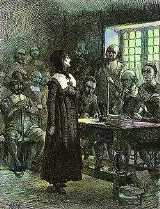
TrialsShe was brought to civil trial in 1638 by the General Court of Massachusetts, presided over by Winthrop, on the charge of “traducing the ministers.” The Court included both government officials and Puritan clergy. She was forty-six at the time and advanced in her fifteenth pregnancy. Nevertheless, she was forced to stand for several days before a board of male interrogators as they tried desperately to get her to admit her secret blasphemies. They accused her of violating the fifth commandment – to “honor the father and mother” – accusing her of encouraging dissent against the fathers of the commonwealth. It was charged that by attending her gatherings women were being tempted to neglect the care of their own families.
Anne skillfully defended herself until it was clear that there was no escape from the court’s predetermined judgment. Cornered, she addressed the court with her own judgment:
This outburst brought forth angry jeers. She was called a heretic and an instrument of the devil. In the words of one minister, “You have stepped out of your place, you have rather been a husband than a wife, a preacher than a hearer, and a magistrate than a subject.” In August 1637 she was condemned by the Court that included John Eliot, famous missionary to Massachusetts Bay Colony Indians, and translator of the first complete Bible printed in America. They voted to banish her from the colony "as being a woman not fit for our society." She was put under house arrest to await her religious trial.
In March 1638, the First Church in Boston conducted a religious trial. They accused Hutchinson of blasphemy. They also accused her of "lewd and lascivious conduct" for having men and women in her house at the same time during her Sunday meetings. This religious court found her guilty and voted to excommunicate her from the Puritan Church for dissenting from Puritan orthodoxy.
PortsmouthDuring her imprisonment, some of the leaders of the Hutchinsonian movement prepared to leave the colony and settle elsewhere. Nineteen men, including William Hutchinson, met on March 7, 1638 at the home of the wealthy Boston merchant William Coddington. The men formed themselves into a "Bodie Politick" and elected Coddington their judge. They initially planned to move to Jersey or Long Island, but Roger Williams convinced them to settle in the area of Rhode Island, near Williams' Providence Plantations settlement. Coddington purchased Aquidneck island from the Indians and the settlement of Pocasset (now Portsmouth) was founded. Anne Hutchinson followed in April, after the conclusion of her trial.
After enduring months of persecution and suffering while pregnant, Mrs. Hutchinson suffered a miscarriage. The Puritan leaders of the Massachusetts Bay Colony gloated in her suffering and that of Mary Dyer, one of her followers who also suffered a miscarriage, labelling their misfortunes as the judgment of God. Massachusetts Bay continued to persecute Hutchinson's followers in who had not followed her, and sent church leaders from Boston to Aquidneck in an attempt to persuade her of the correctness of their doctrine. Anne expelled the delegates from her home, denouncing the Boston church as a "whore and a strumpet".
Meanwhile, judge Coddington began to instigate theocratic policies in the government of the Pocasset colony. Coddington declared that he was permitted to exercise his interpretations of the "word of God" on the settlers and to see himself as a feudal lord ruling the island, with the settlers as his tenants. Anne successfully led a movement to amend the Pocasset constitution to allow the freemen the power to veto the governor's actions and established the positions of three "elders" to be elected by the freemen to share the powers of the governor and thus check his power. Hutchinson and the freemen demanded an election for a government to replace Coddington, who was forced to concede. William Hutchinson was elected governor and Coddington left the colony along with some of his followers, who established the settlement of Newport at the south end of the island. The freemen of Pocasset changed the name of their town to Portsmouth and adopted a new government which provided for trial by jury and separation of church and state. William Hutchinson was chosen as governor.
Coddington returned with an armed force, which was initially repelled, but soon he arrested William Hutchinson and ordered his disenfrancisement. On March 12, 1640, a year after the attack, the towns of Portsmouth and Newport agreed to re-unite peacefully. Coddington was to be governor and William Hutchinson was chosen as one of his assistants. The towns were to remain autonomous with laws made by the citizens.
Soon after, Anne Hutchinson realized a result of her philosophy which she had until then overlooked. Deciding that the office of magistracy was unlawful, she persuaded her husband to resign from his position, as Roger Williams put it, "because of the opinion, which she had newly taken up, of the unlawfulness of magistry." Anne Hutchinson had been led by her conscience and by meditation on the Scripture and logic to the conclusion of individualist anarchism.
DeathWilliam Hutchinson died in 1643, soon after his resignation, and the widow Anne decided to leave Portsmouth, along with some of her family and some followers. The group went to Pelham Bay, then part of New Netherland, the Dutch possession which now is the New York City area. During this time the local Indians were fighting with the Dutch, and in 1643 she and all of her family who followed her except her youngest daughter were killed there by a group of Indians who came calling in a friendly manner, and then suddenly turned on their unsuspecting victims. The Hutchinsons had been friendly to them but the native Americans had been subject to much mistreatment by the ruling Dutch and had begun a war against settlers. They killed the Hutchinson residents, put all their possessions in the house including animals and set the house afire. The youngest Hutchinson, Susanna, was taken captive and lived with the Indians until ransomed by her family members who stayed in The Bay Colony. It is said that she did not want to leave her captors. In 1651 she married John Cole and they started a farm in Rhode Island beginning a long line of descendents.
Modern interpretation of eventsUpheld equally as a symbol of religious freedom, liberal thinking and Christian feminism, Anne Hutchinson is a contentious figure, having been lionized, mythologized and demonized by various writers. In particular, historians and other observers have interpreted and re-interpreted her life within the following frameworks: the status of women, power struggles within the church, and a similar struggle within the secular political structure. She is the only woman to have co-founded an American colony, Rhode Island, together with Roger Williams.
Church and secular politicsHistorians who interpret Hutchinson's life events through the lens of the power politic have drawn the conclusion that Hutchinson suffered more because of her growing influence among local believers than because of her radical teachings.
In his article on Hutchinson in Forerunner magazine, Rogers articulates this view, writing that her interpretations were not "antithetical to what the Puritans believed at all. What began as the quibbling over fine points of Christian doctrine ended as a confrontation over the role of authority in the colony." Hutchinson may have criticized the established religious authorities, as did others, but she did so while cultivating an energetic following. That religious following was large enough to be a significant force in secular politics. Hutchinson may have doomed herself by her strong support of Vane, who was replaced by Winthrop who presided at her civil trial—as much as for the specific content of her religious views.
Hutchinson's memorialsIn front of the State House in Boston, Massachusetts, a statue stands of Anne Hutchinson with her daughter Susanna, sole survivor of the attack by Siwanoy Native Americans who killed her mother and siblings in 1643. Susannah Hutchinson was spared because of her red hair, which the Siwanoy had never seen; she was taken hostage, named "Autumn Leaf" and raised among them until ransomed back years later.
The statue was erected in 1922. The inscription on the marble pediment of the statue reads:
Some literary critics trace the character of Hester Prynne in The Scarlet Letter to Hutchinson's persecution in the Massachusetts Bay Colony. Hawthorne linked his heroine to Anne Hutchinson in his novel, according to Hutchinson's recent biographer Eve LaPlante, in "American Jezebel" (Harper, 2004).
Anne Hutchinson and her political struggle with Governor Winthrop are depicted in the 1980 play "Goodly Creatures" by William Gibson. Other notable historical characters who appear in the play are Rev. John Cotton, Governor Harry Vane, and future Quaker martyr Mary Dyer.
In southern New York, the Hutchinson River, one of the very few rivers named after a woman, and the Hutchinson River Parkway are her most prominent namesakes. Co-incidentally, another female river namesake, Sacagawea, is her neighbor at table in Judy Chicago's art installation The Dinner Party in the Brooklyn Museum. Elementary schools, such as in the town of Portsmouth, Rhode Island, and in the Westchester County towns of Pelham and Eastchester are other examples.
DescendantsAmong her notable descendants are Presidents of the United States Franklin Delano Roosevelt, George H. W. Bush and George W. Bush, First Lady Lucretia Garfield, actors Chevy Chase and Ted Danson, actresses Marilyn Monroe (possibly) and Jane Wyatt, writers Louis Stanton Auchincloss, Dubose Heyward, Eve LaPlante, Robert Lowell and John P. Marquand, Attorney General Elliot Richardson, Justice Oliver Wendell Holmes, Jr. and Chief Justice Melville Weston Fuller, commodore Oliver Hazard Perry, Senator Stephen Arnold Douglas, Ambassador Pamela Harriman, Numismatist Q. David Bowers, Mormon Evangelists Parley P. Pratt and Helaman Pratt, former Michigan governor George W. Romney and former Massachusetts governor and 2008 U.S. presidential candidate Mitt Romney.
PardonIn 1987, Massachusetts Governor Michael Dukakis pardoned Anne Hutchinson, revoking the order of banishment by Governor Winthrop 350 years earlier.
See also
Main sources- Hall, David D., ed. The Antinomian Controversy, 1636–1638: A Documentary History. Second Edition. Duke University Press, 1990
- Bremer, Francis J., ed. Anne Hutchinson, Troubler of the Puritan Zion. 1980. 152 pp.
Sources online
|