

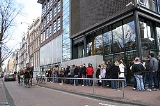
Anne Frank House

Encyclopedia
The Anne Frank House on Prinsengracht canal in Amsterdam
, the Netherlands
, is a museum
dedicated to Jewish
wartime diarist Anne Frank
, who hid from Nazi
persecution with her family and four other people in hidden rooms at the rear of the building. As well as the preservation of the hiding place — known in Dutch as the Achterhuis — and an exhibition on the life and times of Anne Frank, the museum acts as an exhibition space to highlight all forms of persecution and discrimination
.
It opened on 3 May 1960 with the aid of public subscription, three years after a foundation was established to protect the property from developers who wanted to demolish the block.
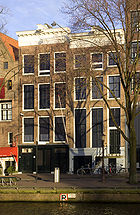 The house — and the one next door at number 265, which was later purchased by the museum — was built by Dirk van Delft in 1635. The canal-side facade dates from a renovation of 1739 when the rear annex was demolished and the taller one which now stands in its place was built. It was originally a private residence, then a warehouse, and in the nineteenth century, the front warehouse with its wide stable-like doors was used to house horses. At the start of the 20th century a manufacturer of household appliances occupied the building, succeeded in 1930 by a producer of piano rolls, who vacated the property by 1939. On 1 December 1940 Anne's father Otto Frank
moved the offices of the spice and gelling companies he worked for, Opekta
and Pectacon, from an address on Singel
canal to Prinsengracht 263.
The ground floor consisted of three sections; the front was the goods and dispatch entrance, behind it in the middle section were the spice mills, and at the rear, which was the ground floor of the annex, was the warehouse where the goods were packed for distribution. On the first floor above were the offices of Frank's employees; Miep Gies
, Bep Voskuijl
and Johannes Kleiman
in the front office; Victor Kugler
in the middle; with Otto Frank in the rear office above the warehouse and below the floors which would later hide him and his family for two years until their betrayal to the Nazi authorities.
The Achterhuis (Dutch
for "back house") or Secret Annex — as it was called in The Diary of a Young Girl
, an English translation of the diary — is the rear extension of the building. It was concealed from view by houses on all four sides of a quadrangle. Its secluded position made it an ideal hiding place for Otto Frank
, his wife Edith
, two daughters (of whom Anne was the younger), and four other Jewish people seeking refuge from Nazi persecution. Though the total amount of floor space in the inhabited rooms came to only about 500 square feet (46.5 m²), Anne Frank wrote in her diary that it was relatively luxurious compared to other hiding places they had heard about. They remained hidden here for two years and one month until they were anonymously betrayed to the Nazi authorities, arrested, and deported to their deaths in concentration camps. Of the hidden group, only Otto Frank survived the war.
After those in hiding were arrested, the hiding place was cleared by order of the arresting officers and all the remaining contents (clothes, furniture, and personal belongings) of the Frank family and their friends were seized as Government property and distributed to bombed-out families in Germany
. Before the building was cleared Miep Gies and Bep Voskuijl, who had helped hide the families, returned to the hiding place against the orders of the Dutch police and rescued some personal effects. Amongst the items they retrieved was The Diary of Anne Frank.
After Otto Frank returned to Amsterdam he was given Anne's diaries and papers, and subsequently compiled selections into a book published in Dutch in 1947 under the title Het Achterhuis, which Anne had chosen as the name of a future memoir or novel based on her experiences in hiding. Achterhuis is a Dutch architectural term referring to a Back-house (used comparatively with Voorhuis meaning Front-house), however when the English translation began production it was realised that many English speaking readers might not be familiar with the term and it was decided that a more evocative term (the 'Secret Annexe') would better convey the building's hidden position.
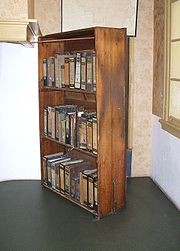 Visitors who wanted to see the secret rooms started coming to the house shortly after the book was published and many were informally shown around by the employees who had hidden the families. But by 1955 the company had moved to new premises and the entire block to which the building belonged was sold to a single estate agent who served a demolition order with the intention of building a factory on the space. A campaign to save the building and have it listed as a protected property was started by the Dutch paper Het Vrije Volk
on 23 November 1955. Campaigners staged a protest outside the building on the day of demolition and the property received a stay of execution. The Anne Frank Foundation was set up by Otto Frank and Johannes Kleiman on 3 May 1957 with the primary aim of collecting enough funds to purchase and restore the building. In October of that year the company who owned it donated the building to the Foundation as a goodwill gesture. The collected funds were then used to purchase the house next door, Number 265, shortly before the remaining buildings on the block were pulled down as planned and the building was opened to the public in 1960.
From the outset the former hiding place of Anne Frank attracted a huge amount of interest, especially as translations and dramatisations of the Diary had made her a figure known throughout the world. Over 9,000 visitors came in its first year. In a decade there were twice as many. Over the years the building has had to be renovated to protect it from such large visitor numbers, and as a result it closed temporarily in 1970 and in 1999.
On 28 September 1999 Queen Beatrix of the Netherlands reopened the museum, which now incorporated the entire building between exhibition spaces, a bookshop, and a cafe, and featured the offices in the front house reconstructed to their state in the 1940s. In 2007, over one million people visited the museum.
On display at the museum is the Academy Award that Shelley Winters
won, and later donated to the museum, for her performance as Petronella van Daan in The Diary of Anne Frank.
In 1998 the Anne Frank Zentrum
in Berlin was opened, after the completion of a cooperation agreement with the Anne Frank House.
Amsterdam
Amsterdam is the largest city and the capital of the Netherlands. The current position of Amsterdam as capital city of the Kingdom of the Netherlands is governed by the constitution of August 24, 1815 and its successors. Amsterdam has a population of 783,364 within city limits, an urban population...
, the Netherlands
Netherlands
The Netherlands is a constituent country of the Kingdom of the Netherlands, located mainly in North-West Europe and with several islands in the Caribbean. Mainland Netherlands borders the North Sea to the north and west, Belgium to the south, and Germany to the east, and shares maritime borders...
, is a museum
Museum
A museum is an institution that cares for a collection of artifacts and other objects of scientific, artistic, cultural, or historical importance and makes them available for public viewing through exhibits that may be permanent or temporary. Most large museums are located in major cities...
dedicated to Jewish
Judaism
Judaism ) is the "religion, philosophy, and way of life" of the Jewish people...
wartime diarist Anne Frank
Anne Frank
Annelies Marie "Anne" Frank is one of the most renowned and most discussed Jewish victims of the Holocaust. Acknowledged for the quality of her writing, her diary has become one of the world's most widely read books, and has been the basis for several plays and films.Born in the city of Frankfurt...
, who hid from Nazi
Nazism
Nazism, the common short form name of National Socialism was the ideology and practice of the Nazi Party and of Nazi Germany...
persecution with her family and four other people in hidden rooms at the rear of the building. As well as the preservation of the hiding place — known in Dutch as the Achterhuis — and an exhibition on the life and times of Anne Frank, the museum acts as an exhibition space to highlight all forms of persecution and discrimination
Discrimination
Discrimination is the prejudicial treatment of an individual based on their membership in a certain group or category. It involves the actual behaviors towards groups such as excluding or restricting members of one group from opportunities that are available to another group. The term began to be...
.
It opened on 3 May 1960 with the aid of public subscription, three years after a foundation was established to protect the property from developers who wanted to demolish the block.
History of the house
Otto Frank
Otto Heinrich "Pim" Frank was a German-born businessman and the father of Anne Frank and Margot Frank...
moved the offices of the spice and gelling companies he worked for, Opekta
Opekta
Opekta was a business run from 1933 to 1995, founded by Anne Frank's father Otto Frank, which distributed a pectin-based gelling preparation, to be used in jam making...
and Pectacon, from an address on Singel
Singel (Amsterdam)
The Singel is a canal in Amsterdam which encircled the city in the Middle Ages. It served as a moat around the city until 1585, when Amsterdam expanded beyond the Singel. The canal runs from the IJ bay, near Central Station, to the Muntplein square, where it meets the Amstel river...
canal to Prinsengracht 263.
The ground floor consisted of three sections; the front was the goods and dispatch entrance, behind it in the middle section were the spice mills, and at the rear, which was the ground floor of the annex, was the warehouse where the goods were packed for distribution. On the first floor above were the offices of Frank's employees; Miep Gies
Miep Gies
Miep Gies was one of the Dutch citizens who hid Anne Frank, her family and several family friends in an attic annex above Anne's father's place of business from the Nazis during World War II...
, Bep Voskuijl
Bep Voskuijl
Elisabeth "Bep" Voskuijl helped conceal Anne Frank and her family from Nazi persecution during the occupation of the Netherlands.Bep was born in :Amsterdam...
and Johannes Kleiman
Johannes Kleiman
Johannes Kleiman was one of the Dutch citizens who helped hide Anne Frank and her family during the Nazi occupation of the Netherlands. In the published version of Anne's diary, The Diary of a Young Girl, he is given the pseudonym Mr. Koophuis...
in the front office; Victor Kugler
Victor Kugler
Victor Kugler was one of the people who helped hide Anne Frank and her family and friends during the Nazi occupation of the Netherlands. In Anne Frank's posthumously published diary, The Diary of a Young Girl, he was referred to under the name Mr...
in the middle; with Otto Frank in the rear office above the warehouse and below the floors which would later hide him and his family for two years until their betrayal to the Nazi authorities.
The Achterhuis (Dutch
Dutch language
Dutch is a West Germanic language and the native language of the majority of the population of the Netherlands, Belgium, and Suriname, the three member states of the Dutch Language Union. Most speakers live in the European Union, where it is a first language for about 23 million and a second...
for "back house") or Secret Annex — as it was called in The Diary of a Young Girl
The Diary of a Young Girl
The Diary of a Young Girl is a book of the writings from the Dutch language diary kept by Anne Frank while she was in hiding for two years with her family during the Nazi occupation of the Netherlands. The family was apprehended in 1944 and Anne Frank ultimately died of typhus in the Bergen-Belsen...
, an English translation of the diary — is the rear extension of the building. It was concealed from view by houses on all four sides of a quadrangle. Its secluded position made it an ideal hiding place for Otto Frank
Otto Frank
Otto Heinrich "Pim" Frank was a German-born businessman and the father of Anne Frank and Margot Frank...
, his wife Edith
Edith Frank-Holländer
Edith Frank was the mother of Holocaust diarist Anne Frank.-Early life:Edith was the youngest of four children, having been born into a German-Jewish family in Aachen, Germany...
, two daughters (of whom Anne was the younger), and four other Jewish people seeking refuge from Nazi persecution. Though the total amount of floor space in the inhabited rooms came to only about 500 square feet (46.5 m²), Anne Frank wrote in her diary that it was relatively luxurious compared to other hiding places they had heard about. They remained hidden here for two years and one month until they were anonymously betrayed to the Nazi authorities, arrested, and deported to their deaths in concentration camps. Of the hidden group, only Otto Frank survived the war.
After those in hiding were arrested, the hiding place was cleared by order of the arresting officers and all the remaining contents (clothes, furniture, and personal belongings) of the Frank family and their friends were seized as Government property and distributed to bombed-out families in Germany
Germany
Germany , officially the Federal Republic of Germany , is a federal parliamentary republic in Europe. The country consists of 16 states while the capital and largest city is Berlin. Germany covers an area of 357,021 km2 and has a largely temperate seasonal climate...
. Before the building was cleared Miep Gies and Bep Voskuijl, who had helped hide the families, returned to the hiding place against the orders of the Dutch police and rescued some personal effects. Amongst the items they retrieved was The Diary of Anne Frank.
After Otto Frank returned to Amsterdam he was given Anne's diaries and papers, and subsequently compiled selections into a book published in Dutch in 1947 under the title Het Achterhuis, which Anne had chosen as the name of a future memoir or novel based on her experiences in hiding. Achterhuis is a Dutch architectural term referring to a Back-house (used comparatively with Voorhuis meaning Front-house), however when the English translation began production it was realised that many English speaking readers might not be familiar with the term and it was decided that a more evocative term (the 'Secret Annexe') would better convey the building's hidden position.
Museum
Het Vrije Volk
Het Vrije Volk was a Dutch social-democratic daily newspaper. It was the successor, after World War II, of the socialist daily Het Volk.After World War II, it appeared legally 1 March 1945 in Eindhoven...
on 23 November 1955. Campaigners staged a protest outside the building on the day of demolition and the property received a stay of execution. The Anne Frank Foundation was set up by Otto Frank and Johannes Kleiman on 3 May 1957 with the primary aim of collecting enough funds to purchase and restore the building. In October of that year the company who owned it donated the building to the Foundation as a goodwill gesture. The collected funds were then used to purchase the house next door, Number 265, shortly before the remaining buildings on the block were pulled down as planned and the building was opened to the public in 1960.
From the outset the former hiding place of Anne Frank attracted a huge amount of interest, especially as translations and dramatisations of the Diary had made her a figure known throughout the world. Over 9,000 visitors came in its first year. In a decade there were twice as many. Over the years the building has had to be renovated to protect it from such large visitor numbers, and as a result it closed temporarily in 1970 and in 1999.
On 28 September 1999 Queen Beatrix of the Netherlands reopened the museum, which now incorporated the entire building between exhibition spaces, a bookshop, and a cafe, and featured the offices in the front house reconstructed to their state in the 1940s. In 2007, over one million people visited the museum.
On display at the museum is the Academy Award that Shelley Winters
Shelley Winters
Shelley Winters was an American actress who appeared in dozens of films, as well as on stage and television; her career spanned over 50 years until her death in 2006...
won, and later donated to the museum, for her performance as Petronella van Daan in The Diary of Anne Frank.
In 1998 the Anne Frank Zentrum
Anne Frank Zentrum
The Anne Frank Zentrum is a facility located in Berlin, which is committed to promoting a varied and lively society and to working against anti-Semitism, prejudice and any kind of discrimination against people.- History :...
in Berlin was opened, after the completion of a cooperation agreement with the Anne Frank House.