


Animal communication

Encyclopedia

Behavior
Behavior or behaviour refers to the actions and mannerisms made by organisms, systems, or artificial entities in conjunction with its environment, which includes the other systems or organisms around as well as the physical environment...
on the part of one animal
Animal
Animals are a major group of multicellular, eukaryotic organisms of the kingdom Animalia or Metazoa. Their body plan eventually becomes fixed as they develop, although some undergo a process of metamorphosis later on in their life. Most animals are motile, meaning they can move spontaneously and...
that has an effect on the current or future behaviour of another animal. The study of animal communication, is sometimes called Zoosemiotics (defined as the study of sign
Sign (semiotics)
A sign is understood as a discrete unit of meaning in semiotics. It is defined as "something that stands for something, to someone in some capacity" It includes words, images, gestures, scents, tastes, textures, sounds – essentially all of the ways in which information can be...
communication or semiosis
Semiosis
Semiosis is any form of activity, conduct, or process that involves signs, including the production of meaning. Briefly – semiosis is sign process...
in animals; distinguishable from anthroposemiotics
Human communication
Human communication, or Anthroposemiotics, is the field dedicated to understanding how people communicate:* with themselves: intrapersonal communication** expression: body language* another person: interpersonal communication...
, the study of human communication) has played an important part in the methodology of ethology
Ethology
Ethology is the scientific study of animal behavior, and a sub-topic of zoology....
, sociobiology
Sociobiology
Sociobiology is a field of scientific study which is based on the assumption that social behavior has resulted from evolution and attempts to explain and examine social behavior within that context. Often considered a branch of biology and sociology, it also draws from ethology, anthropology,...
, and the study of animal cognition
Animal cognition
Animal cognition is the title given to the study of the mental capacities of non-human animals. It has developed out of comparative psychology, but has also been strongly influenced by the approach of ethology, behavioral ecology, and evolutionary psychology...
.
Animal communication, and the understanding of the animal world in general, is a rapidly growing field. Even in the 21st century, many prior understandings related to diverse fields such as personal symbolic name
Name
A name is a word or term used for identification. Names can identify a class or category of things, or a single thing, either uniquely, or within a given context. A personal name identifies a specific unique and identifiable individual person, and may or may not include a middle name...
use, animal emotions
Emotion in animals
There is no scientific consensus on emotion in animals, that is, what emotions certain species of animals, including humans, feel. The debate concerns primarily mammals and birds, although emotions have also been postulated for other vertebrates and even for some invertebrates.Animal lovers,...
, animal culture
Animal culture
Animal culture describes the current theory of cultural learning in non-human animals through socially transmitted behaviors. The question as to the existence of culture in non-human societies has been a contentious subject for decades, much due to the inexistence of a concise definition for culture...
and learning
Ethology
Ethology is the scientific study of animal behavior, and a sub-topic of zoology....
, and even sexual conduct, long thought to be well understood, have been revolutionized.
Validation

Forms of communication
- GestureGestureA gesture is a form of non-verbal communication in which visible bodily actions communicate particular messages, either in place of speech or together and in parallel with spoken words. Gestures include movement of the hands, face, or other parts of the body...
s: The best known form of communication involves the display of distinctive body parts, or distinctive bodily movements; often these occur in combination, so a distinctive movement acts to reveal or emphasize a distinctive body part. For example, the presentation of a parent Herring Gull’s bill to its chick signals feeding time. Like many gulls, the Herring Gull has a brightly coloured bill, yellow with a red spot on the lower mandible near the tip. When it returns to the nest with food, the parent stands over its chick and taps the bill on the ground in front of it; this elicits a begging response from a hungry chick (pecking at the red spot), which stimulates the parent to regurgitate food in front of it. The complete signal therefore involves a distinctive morphological feature (body part), the red-spotted bill, and a distinctive movement (tapping towards the ground) which makes the red spot highly visible to the chick. Congruently, some cephalopods, such as the octopus, have specialized skin cells that can change the apparent colour, opacity, and reflectiveness of their skin. In addition to being used for camouflageCamouflageCamouflage is a method of concealment that allows an otherwise visible animal, military vehicle, or other object to remain unnoticed, by blending with its environment. Examples include a leopard's spotted coat, the battledress of a modern soldier and a leaf-mimic butterfly...
, rapid changes in skin colour are used while hunting and in courtship rituals. While all primates use some form of gesture, Frans de WaalFrans de WaalFransiscus Bernardus Maria de Waal, PhD , is a Dutch primatologist and ethologist. He is the Charles Howard Candler professor of Primate Behavior in the Emory University psychology department in Atlanta, Georgia, and director of the Living Links Center at the Yerkes National Primate Research...
came to the conclusion that apes and humans are unique in that only they are able use intentional gestures to communicate. He tested the hypothesis of gesture evolving into language by studying the gestures of bonobos and chimps.
- Facial expressionFacial expressionA facial expression one or more motions or positions of the muscles in the skin. These movements convey the emotional state of the individual to observers. Facial expressions are a form of nonverbal communication. They are a primary means of conveying social information among humans, but also occur...
: Facial gestures play an important role in animal communication. Dogs for example express anger through a snarling and showing their teeth. In alarm their ears will perk up. When fearful a dog will pull back their ears, expose teeth slightly and squint eyes. Jeffrey Mogil studied the facial expressions of mice during increments of increasing pain. What they found were five recognizable facial expressions; orbital tightening, nose and check bulge, and changes in ear and whisker carriage.
- GazeGazeGaze is a psychoanalytical term brought into popular usage by Jacques Lacan to describe the anxious state that comes with the awareness that one can be viewed. The psychological effect, Lacan argues, is that the subject loses some sense of autonomy upon realizing that he or she is a visible object...
following: Coordination among social animals is facilitated by monitoring of each others' head and eye orientation. Long recognized in human developmental studies as an important component of communication, there has recently begun to be much more attention on the abilities of animals to follow the gaze of those they interact with, whether members of their own species or humans. Studies have been conducted on apes, monkeys, dogs, birds, and tortoises, and have focused on two different tasks: "follow[ing] another’s gaze into distant space" and "follow[ing] another’s gaze geometrically around a visual barrier e.g. by repositioning themselves to follow a gaze cue when faced with a barrier blocking their view". The first ability has been found among a broad range of animals, while the second has been demonstrated only for apes, dogs (and wolves), and corvids (ravens), and attempts to demonstrate this "geometric gaze following" in marmosets and ibis gave negative results. Researchers do not yet have a clear picture of the cognitive basis of gaze following abilities, but developmental evidence indicates that "simple" gaze following and "geometric" gaze following are likely to rely on distinct cognitive foundations.
- Vocalization: Many animals communicate through vocalizations. Communication through vocalization is essential for many tasks including mating rituals, warning calls, conveying location of food sources, and social learning. Male mating calls are used to signal the female and to beat competitors in species such as hammer-headed bats, red deers, humpback whales and elephant seals . In whale species Whale songWhale songWhale sounds are the sounds made by whales and which are used for different kinds of communication.The word "song" is used to describe the pattern of regular and predictable sounds made by some species of whales, notably the Humpback Whale...
has been found to have different dialects based on location. Other instances of communication include the warning cries of the Campbell monkey , the territorial calls of gibbonGibbonGibbons are apes in the family Hylobatidae . The family is divided into four genera based on their diploid chromosome number: Hylobates , Hoolock , Nomascus , and Symphalangus . The extinct Bunopithecus sericus is a gibbon or gibbon-like ape which, until recently, was thought to be closely related...
s, the use of frequency in Greater Spear-nosed bats to distinguish between groups .
- Olfactory communication: Less obvious (except in a few cases) is olfactoryOlfactionOlfaction is the sense of smell. This sense is mediated by specialized sensory cells of the nasal cavity of vertebrates, and, by analogy, sensory cells of the antennae of invertebrates...
communication. Many mammals, in particular, have glands that generate distinctive and long-lasting smells, and have corresponding behaviours that leave these smells in places where they have been. Often the scented substance is introduced into urineUrineUrine is a typically sterile liquid by-product of the body that is secreted by the kidneys through a process called urination and excreted through the urethra. Cellular metabolism generates numerous by-products, many rich in nitrogen, that require elimination from the bloodstream...
or fecesFecesFeces, faeces, or fæces is a waste product from an animal's digestive tract expelled through the anus or cloaca during defecation.-Etymology:...
. Sometimes it is distributed through sweat, though this does not leave a semi-permanent mark as scents deposited on the ground do. Some animals have glands on their bodies whose sole function appears to be to deposit scent marks: for example Mongolian gerbils have a scent gland on their stomachs, and a characteristic ventral rubbing action that deposits scent from it. Golden hamsterGolden HamsterThe golden hamster or Syrian hamster, Mesocricetus auratus, is a very well known member of the rodent subfamily Cricetinae, the hamsters. In the wild they are now considered vulnerable. Their numbers have been declining due to loss of habitat and deliberate destruction by humans. However, they are...
s and catCatThe cat , also known as the domestic cat or housecat to distinguish it from other felids and felines, is a small, usually furry, domesticated, carnivorous mammal that is valued by humans for its companionship and for its ability to hunt vermin and household pests...
s have scent glands on their flanks, and deposit scent by rubbing their sides against objects; cats also have scent glands on their foreheads. Bees carry with them a pouch of material from the hive which they release as they reenter, the smell of which indicates that they are a part of the hive and grants their safe entry. Ants use pheromones to create scent trails to food as well as for alarm calls, mate attraction and to distinguish between colonies. Additionally, they have pheromones that are used to confuse an enemy and manipulate them into fighting with themselves .
- BioluminescenceBioluminescenceBioluminescence is the production and emission of light by a living organism. Its name is a hybrid word, originating from the Greek bios for "living" and the Latin lumen "light". Bioluminescence is a naturally occurring form of chemiluminescence where energy is released by a chemical reaction in...
, common in the oceans deeps and with fireflies.
- Electrocommunication: A rarer form of animal communication is electrocommunication. It is seen primarily in aquatic life, though some mammals, notably the platypusPlatypusThe platypus is a semi-aquatic mammal endemic to eastern Australia, including Tasmania. Together with the four species of echidna, it is one of the five extant species of monotremes, the only mammals that lay eggs instead of giving birth to live young...
and echidnaEchidnaEchidnas , also known as spiny anteaters, belong to the family Tachyglossidae in the monotreme order of egg-laying mammals. There are four extant species, which, together with the platypus, are the only surviving members of that order and are the only extant mammals that lay eggs...
s are capable of electroreceptionElectroreceptionElectroreception is the biological ability to perceive natural electrical stimuli. It has been observed only in aquatic or amphibious animals, since water is a much better conductor than air. Electroreception is used in electrolocation and for electrocommunication.- Overview :Electroreception is...
and thus theoretically of electrocommunication.
Functions of communication
While there are as many kinds of communication as there are kinds of social behaviour, a number of functions have been studied in particular detail. They include:- agonistic interaction: everything to do with contests and aggression between individuals. Many species have distinctive threat displays that are made during competition over food, mates or territoryTerritory (animal)In ethology the term territory refers to any sociographical area that an animal of a particular species consistently defends against conspecifics...
; much bird song functions in this way. Often there is a matched submission display, which the threatened individual will make if it is acknowledging the social dominance of the threatener; this has the effect of terminating the aggressive episode and allowing the dominant animal unrestricted access to the resource in dispute. Some species also have affiliative displays which are made to indicate that a dominant animal accepts the presence of another. - MatingMatingIn biology, mating is the pairing of opposite-sex or hermaphroditic organisms for copulation. In social animals, it also includes the raising of their offspring. Copulation is the union of the sex organs of two sexually reproducing animals for insemination and subsequent internal fertilization...
rituals: signals made by members of one sex to attract or maintain the attention of potential mate, or to cement a pair bondPair bondIn biology, a pair bond is the strong affinity that develops in some species between the males and females in a pair, potentially leading to breeding. Pair-bonding is a term coined in the 1940s that is frequently used in sociobiology and evolutionary psychology circles...
. These frequently involve the display of body parts, body postures (gazelles assume characteristic poses as a signal to initiate matingMatingIn biology, mating is the pairing of opposite-sex or hermaphroditic organisms for copulation. In social animals, it also includes the raising of their offspring. Copulation is the union of the sex organs of two sexually reproducing animals for insemination and subsequent internal fertilization...
), or the emission of scents or calls, that are unique to the speciesSpeciesIn biology, a species is one of the basic units of biological classification and a taxonomic rank. A species is often defined as a group of organisms capable of interbreeding and producing fertile offspring. While in many cases this definition is adequate, more precise or differing measures are...
, thus allowing the individuals to avoid mating with members of another species which would be infertile. Animals that form lasting pair bonds often have symmetrical displays that they make to each other: famous examples are the mutual presentation of reeds by Great Crested GrebeGreat Crested GrebeThe Great Crested Grebe is a member of the grebe family of water birds.- Description :The Great Crested Grebe is long with a wingspan. It is an excellent swimmer and diver, and pursues its fish prey underwater. The adults are unmistakable in summer with head and neck decorations...
s, studied by Julian HuxleyJulian HuxleySir Julian Sorell Huxley FRS was an English evolutionary biologist, humanist and internationalist. He was a proponent of natural selection, and a leading figure in the mid-twentieth century evolutionary synthesis...
, the triumph displays shown by many species of geeseGooseThe word goose is the English name for a group of waterfowl, belonging to the family Anatidae. This family also includes swans, most of which are larger than true geese, and ducks, which are smaller....
and penguinPenguinPenguins are a group of aquatic, flightless birds living almost exclusively in the southern hemisphere, especially in Antarctica. Highly adapted for life in the water, penguins have countershaded dark and white plumage, and their wings have become flippers...
s on their nest sites and the spectacular courtship displays by birds of paradise and manakinManakinThe manakins are a family, Pipridae, of unique small suboscine passerine birds. The family contains some 60 species. They are distributed through the American tropics...
s. - ownership/territorialTerritory (animal)In ethology the term territory refers to any sociographical area that an animal of a particular species consistently defends against conspecifics...
: signals used to claim or defend a territory, food, or a mate. - FoodFoodFood is any substance consumed to provide nutritional support for the body. It is usually of plant or animal origin, and contains essential nutrients, such as carbohydrates, fats, proteins, vitamins, or minerals...
-related signals: many animals make "food calls" that attract a mate, or offspring, or members of a social group generally to a food source. When parents are feeding offspring, the offspring often have begging responses (particularly when there are many offspring in a clutch or litter - this is well known in altricialAltricialAltricial, meaning "requiring nourishment", refers to a pattern of growth and development in organisms which are incapable of moving around on their own soon after hatching or being born...
songbirds, for example). Perhaps the most elaborate food-related signal is the dance languageWaggle danceWaggle dance is a term used in beekeeping and ethology for a particular figure-eight dance of the honey bee. By performing this dance, successful foragers can share with their hive mates information about the direction and distance to patches of flowers yielding nectar and pollen, to water...
of honeybees studied by Karl von FrischKarl von FrischKarl Ritter von Frisch was an Austrian ethologist who received the Nobel Prize in Physiology or Medicine in 1973, along with Nikolaas Tinbergen and Konrad Lorenz....
. Young ravens signal to older, more experienced ravens when they come across new or untested food. - Alarm callAlarm callIn the field of animal communication, an alarm signal is an antipredator adaptation referring to various signals emitted by social animals in response to danger. Many primates and birds have elaborate alarm calls for warning conspecifics of approaching predators. For example, the characteristic...
s: signals made in the presence of a threat from a predator, allowing all members of a social group (and often members of other species) to run for cover, become immobile, or gather into a group to reduce the risk of attack. - Meta-communicationMeta-communicationMetacommunication [-kəmyo̅o̅′nikā′shən] is communication that indicates how verbal information should be interpreted and concerns stimuli surrounding the verbal communication that also have meaning, and which may or may not be congruent, supportive or contradictory of that verbal communication...
s: signals that modify the meaning of subsequent signals. The best known example is the play face in dogDogThe domestic dog is a domesticated form of the gray wolf, a member of the Canidae family of the order Carnivora. The term is used for both feral and pet varieties. The dog may have been the first animal to be domesticated, and has been the most widely kept working, hunting, and companion animal in...
s, which signals that a subsequent aggressive signal is part of a play fight rather than a serious aggressive episode.
Interpretation of animal communication
It is important to note that whilst many gestures and actions have common, stereotypicalStereotype
A stereotype is a popular belief about specific social groups or types of individuals. The concepts of "stereotype" and "prejudice" are often confused with many other different meanings...
meanings, researchers regularly seem to find that animal communication is often more complex and subtle than previously believed, and that the same gesture may have multiple distinct meanings depending on context and other behaviors. So generalizations such as "X means Y" are often, but not always accurate. For example, even a simple domestic dog's
Dog
The domestic dog is a domesticated form of the gray wolf, a member of the Canidae family of the order Carnivora. The term is used for both feral and pet varieties. The dog may have been the first animal to be domesticated, and has been the most widely kept working, hunting, and companion animal in...
tail wag may be used in subtly different ways to convey many meanings including:
- Excitement
- AnticipationAnticipation (emotion)Anticipation, or being enthusiastic, is an emotion involving pleasure, excitement, and sometimes anxiety in considering some expected or longed-for good event.-As defence mechanism:...
- Playfulness
- ContentmentContentment"Contentment" seems realistically defined as "enjoyment of whatever may be desired". That definition is realistic because the more contented an individual or community becomes the less extreme so more acceptable their desires will be...
/enjoyment - RelaxationRelaxationRelaxation stands quite generally for a release of tension, a return to equilibrium.In the sciences, the term is used in the following ways:*Relaxation , and more in particular:...
or anxietyAnxietyAnxiety is a psychological and physiological state characterized by somatic, emotional, cognitive, and behavioral components. The root meaning of the word anxiety is 'to vex or trouble'; in either presence or absence of psychological stress, anxiety can create feelings of fear, worry, uneasiness,... - Questioning another animal or a human as to intentions
- Tentative role assessment on meeting another animal
- Reassurance ("I'm hoping to be friendly, are you?")
- Brief acknowledgement ("I hear you", or "I'm aware and responsive if you want my attention")
- Statement of interest ("I want that (foodFoodFood is any substance consumed to provide nutritional support for the body. It is usually of plant or animal origin, and contains essential nutrients, such as carbohydrates, fats, proteins, vitamins, or minerals...
/toyToyA toy is any object that can be used for play. Toys are associated commonly with children and pets. Playing with toys is often thought to be an enjoyable means of training the young for life in human society. Different materials are used to make toys enjoyable and cuddly to both young and old...
/activity), if you're willing") - UncertaintyUncertaintyUncertainty is a term used in subtly different ways in a number of fields, including physics, philosophy, statistics, economics, finance, insurance, psychology, sociology, engineering, and information science...
/apprehension - Submissive placation (if worried by a more dominant animal)
Combined with other body language, in a specific context, many gestures such as yawns, direction of vision, and so on all convey meaning. Thus statements that a particular action "means" something should always be interpreted to mean "often means" something. As with human beings, who may smile or hug or stand a particular way for multiple reasons, many animals reuse gestures too.
Intraspecies vs. interspecies communication
The sender and receiver of a communication may be of the same speciesSpecies
In biology, a species is one of the basic units of biological classification and a taxonomic rank. A species is often defined as a group of organisms capable of interbreeding and producing fertile offspring. While in many cases this definition is adequate, more precise or differing measures are...
or of different species. The majority of animal communication is intraspecific (between two or more individuals of the same species). However, there are some important instances of interspecific communication. Also, the possibility of interspecific communication, and the form it takes, is an important test of some theoretical models of animal communication.
Intraspecies communication
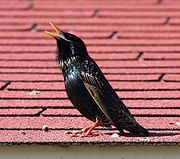
The majority of animal communication occurs within a single species, and this is the context in which it has been most intensively studied.Most of the forms and functions of communication described above are relevant to intra-species communication.
Interspecies communication
Many examples of communication take place between members of different species. Animals communicate to other animals with various signs: visual, sound, echolocation, body language, and smell.Prey to predator
If a prey animal moves or makes a noise in such a way that a predator can detect and capture it, that fits the definition of "communication" given above. This type of communication is known as interceptive eavesdropping, where a predator intercepts the message being conveyed to conspecifics.
Wasp
The term wasp is typically defined as any insect of the order Hymenoptera and suborder Apocrita that is neither a bee nor an ant. Almost every pest insect species has at least one wasp species that preys upon it or parasitizes it, making wasps critically important in natural control of their...
s that are capable of harming potential predators are often brightly coloured, and this modifies the behaviour of the predator, who either instinctively or as the result of experience will avoid attacking such an animal. Some forms of mimicry fall in the same category: for example hoverflies
Hoverfly
Hoverflies, sometimes called flower flies or syrphid flies, make up the insect family Syrphidae. As their common name suggests, they are often seen hovering or nectaring at flowers; the adults of many species feed mainly on nectar and pollen, while the larvae eat a wide range of foods...
are coloured in the same way as wasps, and although they are unable to sting, the strong avoidance of wasps by predators gives the hoverfly some protection. There are also behavioral changes that act in a similar way to warning colouration. For example, canines such as wolves and coyote
Coyote
The coyote , also known as the American jackal or the prairie wolf, is a species of canine found throughout North and Central America, ranging from Panama in the south, north through Mexico, the United States and Canada...
s may adopt an aggressive posture, such as growling with their teeth bared, to indicate they will fight if necessary, and rattlesnake
Rattlesnake
Rattlesnakes are a group of venomous snakes of the genera Crotalus and Sistrurus of the subfamily Crotalinae . There are 32 known species of rattlesnake, with between 65-70 subspecies, all native to the Americas, ranging from southern Alberta and southern British Columbia in Canada to Central...
s use their well-known rattle to warn potential predators of their poisonous bite. Sometimes, a behavioral change and warning colouration will be combined, as in certain species of amphibians which have a brightly coloured belly, but on which the rest of their body is coloured to blend in with their surroundings. When confronted with a potential threat, they show their belly, indicating that they are poisonous in some way.
Another example of prey to predator communication, is referred to as a pursuit-deterrent signal. Pursuit-deterrent signals occur when prey indicates to a predator that pursuit would be unprofitable because the signaler is prepared to escape. Pursuit-deterrent signals provide a benefit to both the signaler and receiver; they prevent the sender from wasting time and energy fleeing, and they prevent the receiver from investing in a costly pursuit that is unlikely to result in capture. Such signals can advertise prey’s ability to escape, and reflect phenotypic condition (quality advertisement), or can advertise that the prey has detected the predator (perception advertisement). Pursuit-deterrent signals have been reported for a wide variety of taxa, including fish (Godin and Davis 1995), lizards (Cooper et al. 2004), ungulates (Caro 1995), rabbits (Holley 1993), primates (Zuberbuhler et al. 1997), rodents (Shelley and Blumstein 2005, Clark 2005), and birds (Alvarez 1993, Murphy 2006, 2007). The most familiar example of quality advertisement pursuit-deterrent signal is stotting, a pronounced combination of running while simultaneously hopping shown by some antelope
Antelope
Antelope is a term referring to many even-toed ungulate species indigenous to various regions in Africa and Eurasia. Antelopes comprise a miscellaneous group within the family Bovidae, encompassing those old-world species that are neither cattle, sheep, buffalo, bison, nor goats...
s such as Thomson's gazelle
Thomson's Gazelle
The Thomson's gazelle is one of the best-known gazelles. It is named after explorer Joseph Thomson and, as a result, is sometimes referred to as a "tommie"...
in the presence of a predator. At least 11 hypothesis for stotting have been proposed. A leading theory today is that it alerts predators that the element of surprise has been lost. Predators like cheetahs rely on surprise attacks, proven by the fact that chases are rarely successful when they stot. Predators know not to waste energy on a chase that will likely be unsuccessful (optimal foraging behavior).
Predator to prey
Some predators communicate to prey in ways that change their behaviour and make them easier to catch, in effect deceiving them. A well-known example is the angler fish, which has a fleshy growth protruding from its forehead and dangling in front of its jaws; smaller fish try to take the lure, and in so doing are perfectly placed for the angler fish to eat them.Human/animal communication
Various ways in which humans interpret the behavior of domestic animals, or give commands to them, fit the definition of interspecies communication. Depending on the context, they might be considered to be predator to prey communication, or to reflect forms of commensalism. The recent experiments on animal languageAnimal language
Animal language is the modeling of human language in non human animal systems. While the term is widely used, researchers agree that animal languages are not as complex or expressive as human language....
are perhaps the most sophisticated attempt yet to establish human/animal communication, though their relation to natural animal communication is uncertain.
Lacking in the study of human-animal communication is a focus on expressive communication from animal to human specifically. Other than a few natural expressions animals (especially dogs) use to communicate to humans, scientists in general do not pursue expanding the expressive/productive communication of domesticated animals. Horses are taught to not communicate (for safety). Dogs and horses are generally not encouraged to communicate expressively, but are encouraged to develop receptive language (understanding). One scientist, Sean Senechal
Sean Senechal
Sean C. Senechal is a college instructor and an animal language educator , specializing in studying and developing domesticated animal communication...
has pursued (since the late 1990's) developing, studying, and using the learned visible, expressive language in dogs and horses. By teaching these animals a gestural (human made) ASL-like language animals have been found to learn and use the new signs on their own to get what they need. Senechal's book Dogs Can Sign, Too documents this process.
Evolution of communication
The importance of communication is clear from the fact that animals have evolved elaborate body parts to facilitate it. They include some of the most striking structures in the animal kingdom, such as the peacock's tail. Birdsong appears to have brain structures entirely devoted to its production. But even the red spot on a herring gull's bill, and the modest but characteristic bowing behaviour that displays it, require evolutionary explanation.There are two aspects to the required explanation:
- identifying a route by which an animal that lacked the relevant feature or behaviour could acquire it;
- identifying the selective pressure that makes it adaptive for animals to develop structures that facilitate communication, emit communications, and respond to them.
Significant contributions to the first of these problems were made by Konrad Lorenz
Konrad Lorenz
Konrad Zacharias Lorenz was an Austrian zoologist, ethologist, and ornithologist. He shared the 1973 Nobel Prize with Nikolaas Tinbergen and Karl von Frisch...
and other early ethologists. By comparing related species within groups, they showed that movements and body parts that in the primitive forms had no communicative function could be "captured" in a context where communication would be functional for one or both partners, and could evolve into a more elaborate, specialised form. For example, Desmond Morris
Desmond Morris
Desmond John Morris, born 24 January 1928 in Purton, north Wiltshire, is a British zoologist and ethologist, as well as a popular anthropologist. He is also known as a painter, television presenter and popular author.-Life:...
showed in a study of grass finch
Finch
The true finches are passerine birds in the family Fringillidae. They are predominantly seed-eating songbirds. Most are native to the Northern Hemisphere, but one subfamily is endemic to the Neotropics, one to the Hawaiian Islands, and one subfamily – monotypic at genus level – is found...
es that a beak-wiping response occurred in a range of species, serving a preening
Personal grooming
Personal grooming is the art of cleaning, grooming, and maintaining parts of the body. It is a species-typical behavior that is controlled by neural circuits in the brain.- In humans :...
function, but that in some species this had been elaborated into a courtship
Courtship
Courtship is the period in a couple's relationship which precedes their engagement and marriage, or establishment of an agreed relationship of a more enduring kind. In courtship, a couple get to know each other and decide if there will be an engagement or other such agreement...
signal.
The second problem has been more controversial. The early ethologists assumed that communication occurred for the good of the species as a whole, but this would require a process of group selection
Group selection
In evolutionary biology, group selection refers to the idea that alleles can become fixed or spread in a population because of the benefits they bestow on groups, regardless of the alleles' effect on the fitness of individuals within that group....
which is believed to be mathematically impossible in the evolution
Evolution
Evolution is any change across successive generations in the heritable characteristics of biological populations. Evolutionary processes give rise to diversity at every level of biological organisation, including species, individual organisms and molecules such as DNA and proteins.Life on Earth...
of sexually reproducing animals. Altruism towards an unrelated group is not widely accepted in the scientific community, but rather can be seen as a sort of reciprocal altruism, expecting the same behavior from others, a benefit of living in a group. Sociobiologists
Sociobiology
Sociobiology is a field of scientific study which is based on the assumption that social behavior has resulted from evolution and attempts to explain and examine social behavior within that context. Often considered a branch of biology and sociology, it also draws from ethology, anthropology,...
argued that behaviours that benefited a whole group of animals might emerge as a result of selection pressures acting solely on the individual. A gene-centered view of evolution
Gene-centered view of evolution
The gene-centered view of evolution, gene selection theory or selfish gene theory holds that evolution occurs through the differential survival of competing genes, increasing the frequency of those alleles whose phenotypic effects successfully promote their own propagation, with gene defined as...
proposes that behaviors that enabled a gene
Gene
A gene is a molecular unit of heredity of a living organism. It is a name given to some stretches of DNA and RNA that code for a type of protein or for an RNA chain that has a function in the organism. Living beings depend on genes, as they specify all proteins and functional RNA chains...
to become wider established within a population would become positively selected for, even if their effect on individuals or the species as a whole was detrimental.
In the case of communication, an important discussion by John Krebs
John Krebs
John Richard Krebs, Baron Krebs FRS is a world leader in zoology and more specifically bird behaviour. He is currently the Principal of Jesus College, Oxford University...
and Richard Dawkins
Richard Dawkins
Clinton Richard Dawkins, FRS, FRSL , known as Richard Dawkins, is a British ethologist, evolutionary biologist and author...
established hypotheses for the evolution of such apparently altruistic
Altruism
Altruism is a concern for the welfare of others. It is a traditional virtue in many cultures, and a core aspect of various religious traditions, though the concept of 'others' toward whom concern should be directed can vary among cultures and religions. Altruism is the opposite of...
or mutualistic communications as alarm calls and courtship signals to emerge under individual selection. This led to the realisation that communication might not always be "honest" (indeed, there are some obvious examples where it is not, as in mimic
Mimic
In evolutionary biology, mimicry is the similarity of one species to another which protects one or both. This similarity can be in appearance, behaviour, sound, scent and even location, with the mimics found in similar places to their models....
ry). The possibility of evolutionarily stable dishonest communication has been the subject of much controversy, with Amotz Zahavi
Amotz Zahavi
Amotz Zahavi is an Israeli evolutionary biologist, a Professor Emeritus at the Zoology Department of Tel Aviv University, and one of the founders of the Society for the Protection of Nature in Israel...
in particular arguing that it cannot exist in the long term. Sociobiologists have also been concerned with the evolution of apparently excessive signalling structures such as the peacock's tail; it is widely thought that these can only emerge as a result of sexual selection
Sexual selection
Sexual selection, a concept introduced by Charles Darwin in his 1859 book On the Origin of Species, is a significant element of his theory of natural selection...
, which can create a positive feedback
Positive feedback
Positive feedback is a process in which the effects of a small disturbance on a system include an increase in the magnitude of the perturbation. That is, A produces more of B which in turn produces more of A. In contrast, a system that responds to a perturbation in a way that reduces its effect is...
process that leads to the rapid exaggeration of a characteristic that confers an advantage in a competitive mate-selection situation.
One theory to explain the evolution of traits like a peacock's tail is 'runaway selection'. This requires two traits-a trait that exists, like the bright tail, and a prexisting bias in the female to select for that trait. Females prefer the more elaborate tails, and thus those males are able to mate successfully. Exploiting the psychology of the female, a positive feedback loop is enacted and the tail becomes bigger and brighter. Eventually, the evolution will level off because the survival costs to the male do not allow for the trait to be elaborated any further. Two theories exist to explain runaway selection. The first is the good genes hypothesis. This theory states that an elaborate display is an honest signal of fitness and truly is a better mate. The second is the handicap hypothesis. This explains that the peacock's tail is a handicap, requiring energy to keep and makes it more visible to predators. Regardless, the individual is able to survive, even though its genes are not as good per se.
Cognitive aspects
Ethologists and sociobiologists have characteristically analysed animal communication in terms of more or less automatic responses to stimuli, without raising the question of whether the animals concerned understand the meaning of the signals they emit and receive. That is a key question in animal cognitionAnimal cognition
Animal cognition is the title given to the study of the mental capacities of non-human animals. It has developed out of comparative psychology, but has also been strongly influenced by the approach of ethology, behavioral ecology, and evolutionary psychology...
. There are some signalling systems that seem to demand a more advanced understanding. A much discussed example is the use of alarm calls by vervet monkey
Vervet Monkey
The vervet monkey , or simply vervet, is an Old World monkey of the family Cercopithecidae native to Africa. The term "vervet" is also used to refer to all the members of the genus Chlorocebus....
s. Robert Seyfarth and Dorothy Cheney showed that these animals emit different alarm calls in the presence of different predators (leopard
Leopard
The leopard , Panthera pardus, is a member of the Felidae family and the smallest of the four "big cats" in the genus Panthera, the other three being the tiger, lion, and jaguar. The leopard was once distributed across eastern and southern Asia and Africa, from Siberia to South Africa, but its...
s, eagle
Eagle
Eagles are members of the bird family Accipitridae, and belong to several genera which are not necessarily closely related to each other. Most of the more than 60 species occur in Eurasia and Africa. Outside this area, just two species can be found in the United States and Canada, nine more in...
s, and snake
Snake
Snakes are elongate, legless, carnivorous reptiles of the suborder Serpentes that can be distinguished from legless lizards by their lack of eyelids and external ears. Like all squamates, snakes are ectothermic, amniote vertebrates covered in overlapping scales...
s), and the monkeys that hear the calls respond appropriately - but that this ability develops over time, and also takes into account the experience of the individual emitting the call. Metacommunication, discussed above, also seems to require a more sophisticated cognitive process.
A recently published paper demonstrated that bottlenose dolphins can recognize identity information from whistles even when otherwise stripped of the characteristics of the whistle; making dolphins the only animals other than humans that have been shown to transmit identity information independent of the caller’s voice or location. The paper concludes that:
Animal communication and human behaviour
Another controversial issue is the extent to which humans have behaviours that resemble animal communication, or whether all such communication has disappeared as a result of our linguistic capacity. Some of our bodily features - eyebrows, beards and moustaches, deep adult male voices, perhaps female breasts - strongly resemble adaptations to producing signals. Ethologists such as Irenäus Eibl-Eibesfeldt have argued that facial gestures such as smiling, grimacing, and the eyebrow flash on greeting are universal human communicative signals that can be related to corresponding signals in other primatePrimate
A primate is a mammal of the order Primates , which contains prosimians and simians. Primates arose from ancestors that lived in the trees of tropical forests; many primate characteristics represent adaptations to life in this challenging three-dimensional environment...
s. Given the recency with which spoken language has emerged, it is very likely that human body language
Body language
Body language is a form of non-verbal communication, which consists of body posture, gestures, facial expressions, and eye movements. Humans send and interpret such signals almost entirely subconsciously....
does include some more or less involuntary responses that have a similar origin to the communication we see in other animals.
Humans also often seek to mimic animals' communicative signals in order to interact with the animals. For example, cats have a mild affiliative response involving closing their eyes; humans often close their eyes towards a pet
Pet
A pet is a household animal kept for companionship and a person's enjoyment, as opposed to wild animals or to livestock, laboratory animals, working animals or sport animals, which are kept for economic or productive reasons. The most popular pets are noted for their loyal or playful...
cat to establish a tolerant relationship. Stroking, petting and rubbing pet animals are all actions that probably work through their natural patterns of interspecific communication.
Dogs have shown an ability to understand communication from a species other than their own. They were able to use human communicative gestures such as pointing and looking to find hidden food and toys.
A new approach in the 21 century of studying animal communication uses applied behavioral analysis (ABA), specifically Functional Communication Training (FCT). This FCT previously has been used in schools and clinics with humans with special needs, such as children with autism, to help them develop language. Sean Senechal
Sean Senechal
Sean C. Senechal is a college instructor and an animal language educator , specializing in studying and developing domesticated animal communication...
, at the AnimalSign Center has been using an approach similar to this FCT with domesticated animals, such as dogs (since 2004) and horses (since 2000) with encouraging results and benefits to the animals and people. Functional communication training for animals, Senechal calls AnimalSign Language. This includes teaching communication through gestures (like simplified ASL
ASL
ASL is a common initialism for American Sign Language, and may also refer to:*Above sea level, altitude measurement*Adobe Source Libraries, a set of open source software libraries by Adobe...
), pictures (PECS), tapping, and vocalization. The process for animals includes simplified and modified techniques.
Animal communication and linguistics
For linguisticsLinguistics
Linguistics is the scientific study of human language. Linguistics can be broadly broken into three categories or subfields of study: language form, language meaning, and language in context....
, the interest of animal communication systems lies in their similarities to and differences from human language:
- Human languages are characterized for having a double articulation (in the characterization of French linguist André MartinetAndré MartinetAndré Martinet was a French linguist, influential by his work on structural linguistics....
). It means that complex linguistic expressions can be broken down in meaningful elements (such as morphemeMorphemeIn linguistics, a morpheme is the smallest semantically meaningful unit in a language. The field of study dedicated to morphemes is called morphology. A morpheme is not identical to a word, and the principal difference between the two is that a morpheme may or may not stand alone, whereas a word,...
s and wordWordIn language, a word is the smallest free form that may be uttered in isolation with semantic or pragmatic content . This contrasts with a morpheme, which is the smallest unit of meaning but will not necessarily stand on its own...
s), which in turn are composed of smallest phonetic elements that affect meaning, called phonemePhonemeIn a language or dialect, a phoneme is the smallest segmental unit of sound employed to form meaningful contrasts between utterances....
s. Animal signals, however, do not exhibit this dual structure. - In general, animal utterances are responses to external stimuli, and do not refer to matters removed in time and space. Matters of relevance at a distance, such as distant food sources, tend to be indicated to other individuals by body languageBody languageBody language is a form of non-verbal communication, which consists of body posture, gestures, facial expressions, and eye movements. Humans send and interpret such signals almost entirely subconsciously....
instead, for example wolf activity before a hunt, or the information conveyed in honeybee dance languageBee learning and communicationHoney bees learn and communicate in order to find food sources and for other means.-Learning:Learning is essential for efficient foraging. Honey bees are unlikely to make many repeat visits if a plant provides little in the way of reward...
. It is therefore unclear to what extent utterances are automatic responses and to what extent deliberate intent plays a part. - Human language is largely learned culturallyCultural learningCultural learning, also called cultural transmission, is the way a group of people or animals within a society or culture tend to learn and pass on new information...
, while animal communication systems are known largely by instinctInstinctInstinct or innate behavior is the inherent inclination of a living organism toward a particular behavior.The simplest example of an instinctive behavior is a fixed action pattern, in which a very short to medium length sequence of actions, without variation, are carried out in response to a...
. - In contrast to human language, animal communication systems are usually not able to express conceptual generalizations. (Cetaceans and some primatePrimateA primate is a mammal of the order Primates , which contains prosimians and simians. Primates arose from ancestors that lived in the trees of tropical forests; many primate characteristics represent adaptations to life in this challenging three-dimensional environment...
s may be notable exceptions). - Human languages combine elements to produce new messages (a property known as creativity). One factor in this is that much human language growth is based upon conceptual ideas and hypothetical structures, both being far greater capabilities in humans than animals. This appears far less common in animal communication systems, although current research into animal cultureAnimal cultureAnimal culture describes the current theory of cultural learning in non-human animals through socially transmitted behaviors. The question as to the existence of culture in non-human societies has been a contentious subject for decades, much due to the inexistence of a concise definition for culture...
is still an ongoing process with many new discoveries.
A recent and interesting area of development is the discovery that the use of syntax
Syntax
In linguistics, syntax is the study of the principles and rules for constructing phrases and sentences in natural languages....
in language, and the ability to produce "sentence
Sentence (linguistics)
In the field of linguistics, a sentence is an expression in natural language, and often defined to indicate a grammatical unit consisting of one or more words that generally bear minimal syntactic relation to the words that precede or follow it...
s", is not limited to humans either. The first good evidence of syntax in non-humans, reported in 2006, is from the greater spot-nosed monkey (Cercopithecus nictitans) of Nigeria
Nigeria
Nigeria , officially the Federal Republic of Nigeria, is a federal constitutional republic comprising 36 states and its Federal Capital Territory, Abuja. The country is located in West Africa and shares land borders with the Republic of Benin in the west, Chad and Cameroon in the east, and Niger in...
. This is the first evidence that some animals can take discrete units of communication, and build them up into a sequence which then carries a different meaning from the individual "words":
- The putty-nosed monkeys have two main alarm sounds. A sound known onomatopoeiacally as the "pyow" warns against a lurking leopardLeopardThe leopard , Panthera pardus, is a member of the Felidae family and the smallest of the four "big cats" in the genus Panthera, the other three being the tiger, lion, and jaguar. The leopard was once distributed across eastern and southern Asia and Africa, from Siberia to South Africa, but its...
, and a coughing sound that scientists call a "hack" is used when an eagleEagleEagles are members of the bird family Accipitridae, and belong to several genera which are not necessarily closely related to each other. Most of the more than 60 species occur in Eurasia and Africa. Outside this area, just two species can be found in the United States and Canada, nine more in...
is hovering nearby.
- "Observationally and experimentally we have demonstrated that this sequence [of up to three 'pyows' followed by up to four 'hacks'] serves to elicit group movement... the 'pyow-hack' sequence means something like 'let's go!' [a command telling others to move]... The implications are that primates at least may be able to ignore the usual relationship between an individual alarm call, and the meaning it might convey under certain circumstances... To our knowledge this is the first good evidence of a syntax-like natural communication system in a non-human species."
Similar results have also recently been reported in the Campbell's Mona Monkey
Campbell's Mona Monkey
Campbell's mona monkey , also known as Campbell's guenon and Campbell's monkey, is a species of primate in the Cercopithecidae family...
.
See also
- Animal behavior
- Animal languageAnimal languageAnimal language is the modeling of human language in non human animal systems. While the term is widely used, researchers agree that animal languages are not as complex or expressive as human language....
- BiocommunicationBiocommunication (science)In the study of the biological sciences the general term biocommunication is used to describe more specific types of communication within or between species of plants, animals, fungi and bacteria. Communication means sign-mediated interactions following syntactic, pragmatic and semantic rules....
- BiosemioticsBiosemioticsBiosemiotics is a growing field that studies the production, action and interpretation of signs in the biological realm...
- Emotion in animalsEmotion in animalsThere is no scientific consensus on emotion in animals, that is, what emotions certain species of animals, including humans, feel. The debate concerns primarily mammals and birds, although emotions have also been postulated for other vertebrates and even for some invertebrates.Animal lovers,...
- Forms of activity and interpersonal relations
- International Society for Biosemiotic StudiesInternational Society for Biosemiotic StudiesThe International Society for Biosemiotic Studies is an academic society for the researchers in semiotic biology. The Society was established in 2005...
- Sir Philip Sidney gameSir Philip Sidney gameIn biology and game theory, the Sir Philip Sidney game is used as a model for the evolution and maintenance of informative communication between relatives...
- ZoomusicologyZoomusicologyZoomusicology is a field of musicology and zoology or more specifically, zoosemiotics. Zoomusicology is the study of the music of animals, or rather the musical aspects of sound or communication produced and received by animals....
External links
- The Elgin Center for Zoosemiotic Research
- Zoosemiotics: animal communication on the web
- The Animal Communication Project
- International Bioacoustics Council research on animal language.
- Animal Sounds different animal sounds to listen and download.
- The British Library Sound Archive contains over 150,000 recordings of animal sounds and natural atmospheres from all over the world.