
All Topics  
Animal Farm


   Email Print
   Bookmark   Link


Animal Farm


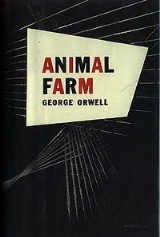
Animal Farm is a novella
A novella is a narrative work of prose fiction somewhat longer than a short story but shorter than a novel....
 by George Orwell
Eric Arthur Blair , better known by the pen name George Orwell, was an English author and journalist....
, and is the most famous satirical
Satire is a technique of writing or art which exposes the follies of its subject to ridicule, often as an intended means of...
 allegory
An allegory is a figurative mode of representation conveying a meaning other than the literal....
 of Soviet
The Union of Soviet Socialist Republics , more commonly known as the Soviet Union, was a Communist state that existed...
 totalitarianism
Totalitarianism is a term employed by political scientists, especially those in the field of comparative politics, to descri...
. Published in 1945, the book reflects events leading up to and during the Stalin era. Orwell, a democratic socialist
Democratic socialism is a broad political movement propagating the ideals of socialism within the context of a democratic sy...
, and a member of the Independent Labour Party
The Independent Labour Party is a former political party in the United Kingdom....
 for many years, was a critic of Joseph Stalin
Joseph Vissarionovich Stalin , alternatively transliterated Josef Stalin, was the de facto leader and dictator of ...
, and was suspicious of Moscow
Moscow is the capital of Russia and the country's principal political, economic, financial, educational, and transportation...
-directed Stalinism
Stalinism is the political and economic system named after Joseph Stalin, who implemented it in the Soviet Union....
 after his experiences with the NKVD
The NKVD or People's Commisariat for Internal Affairs was a government department which handled a number of the Soviet ...
 during the Spanish Civil War
The Spanish Civil War, which lasted from July 17, 1936 to April 1, 1939, was a conflict in which the Nationalists, led by Ge...
.

The book was chosen by Time
Time is a weekly American newsmagazine, similar to Newsweek and U.S....
Magazine as one of the 100 best English-language novels (1923 to 2005) and was number 31 on the Modern Library List of Best 20th Century Novels and won a Retrospective Hugo in 1996.
OverviewThe short novel is an allegory
An allegory is a figurative mode of representation conveying a meaning other than the literal....
 in which animals play the roles of the Bolshevik
Bolsheviks were members of the Bolshevik faction of the Marxist Russian Social-Democratic Labour Party....
 revolutionaries and overthrow and oust the human owners of the farm, setting it up as a commune in which, at first, all animals are equal; however, class and status disparities soon emerge between the different animal species.


Discussion
Ask a question about 'Animal Farm'
Start a new discussion about 'Animal Farm'
Answer questions from other users
Full Discussion Forum


Recent Posts


Encyclopedia


Animal Farm is a novella
A novella is a narrative work of prose fiction somewhat longer than a short story but shorter than a novel....
 by George Orwell
Eric Arthur Blair , better known by the pen name George Orwell, was an English author and journalist....
, and is the most famous satirical
Satire is a technique of writing or art which exposes the follies of its subject to ridicule, often as an intended means of...
 allegory
An allegory is a figurative mode of representation conveying a meaning other than the literal....
 of Soviet
The Union of Soviet Socialist Republics , more commonly known as the Soviet Union, was a Communist state that existed...
 totalitarianism
Totalitarianism is a term employed by political scientists, especially those in the field of comparative politics, to descri...
. Published in 1945, the book reflects events leading up to and during the Stalin era. Orwell, a democratic socialist
Democratic socialism is a broad political movement propagating the ideals of socialism within the context of a democratic sy...
, and a member of the Independent Labour Party
The Independent Labour Party is a former political party in the United Kingdom....
 for many years, was a critic of Joseph Stalin
Joseph Vissarionovich Stalin , alternatively transliterated Josef Stalin, was the de facto leader and dictator of ...
, and was suspicious of Moscow
Moscow is the capital of Russia and the country's principal political, economic, financial, educational, and transportation...
-directed Stalinism
Stalinism is the political and economic system named after Joseph Stalin, who implemented it in the Soviet Union....
 after his experiences with the NKVD
The NKVD or People's Commisariat for Internal Affairs was a government department which handled a number of the Soviet ...
 during the Spanish Civil War
The Spanish Civil War, which lasted from July 17, 1936 to April 1, 1939, was a conflict in which the Nationalists, led by Ge...
.

The book was chosen by Time
Time is a weekly American newsmagazine, similar to Newsweek and U.S....
Magazine as one of the 100 best English-language novels (1923 to 2005) and was number 31 on the Modern Library List of Best 20th Century Novels and won a Retrospective Hugo in 1996.

Overview

The short novel is an allegory
An allegory is a figurative mode of representation conveying a meaning other than the literal....
 in which animals play the roles of the Bolshevik
Bolsheviks were members of the Bolshevik faction of the Marxist Russian Social-Democratic Labour Party....
 revolutionaries and overthrow and oust the human owners of the farm, setting it up as a commune in which, at first, all animals are equal; however, class and status disparities soon emerge between the different animal species. The novel
A novel is an extended, generally fictional narrative in prose....
 describes how a society's ideologies can be manipulated and twisted by those in positions of social and political power, including how a utopia
'Utopia', in its most common and general positive meaning, refers to an imaginary, ideal civilization, which may range f...
n society is made impossible by the corrupting nature of the very power necessary to create it.

Characters and their possible real-life counterparts

The events and characters in Animal Farm parallel the early history of the Soviet Union; Orwell makes this explicit in the case of the head pig, Napoleon, whom he directly connects to Stalin in this 17 March 1945 letter to the publisher:

The dogs are also important characters in this novel that enabled Orwell to discover and express more of what had happened in Russia. The other characters have their parallels in the real world, but care should be taken with these comparisons, as Orwell's intent was not always explicit and they often simply represent generalised concepts.

Pigs

Old Major
Old Major is the first major character described by Orwell in Animal Farm....
is the inspiration which fuels the Revolution and the book. According to one interpretation, he could be based upon both Karl Marx
Karl Heinrich Marx was an immensely influential German philosopher, political economist, and socialist revolutionary....
 and Vladimir Lenin
Vladimir Ilyich Ulyanov, better known to the world as Vladimir Lenin , was the founder of Russian Communism and the fi...
. As a socialist, George Orwell may have agreed with much of Marx, and even respected aspects of Lenin. According to this interpretation, the satire in Animal Farm is not of Marxism
Marxism refers to the philosophy and social theory based on Karl Marx's work on one hand, and to the political practice base...
, or of Lenin's revolution, but of the corruption that occurred later. However, according to Christopher Hitchens
Christopher Eric Hitchens is an author, journalist and literary critic....
:
in the book, "the aims and principles of the Russian Revolution are given face-value credit throughout; this is a revolution betrayed, not a revolution that is monstrous from its inception." Though Old Major is presented positively, Orwell does slip in some flaws, such as his admission that he has largely been free of the abuse the rest of the animals have had to suffer. Old Major introduces the animals to the song Beasts of England
"Beasts Of England" is a parody of the famous socialist anthem "The Internationale"....
.

Napoleon
Napoleon is a fictional pig from George Orwell's Animal Farm....
, a Berkshire boar
Berkshire Pigs are a rare breed of pig originating from Britain....
, is the main tyrant
A tyrant possesses absolute power through the people in a state or in an organization: one refers to this mode of rule as a...
 and villain
A villain is an "evil" character in a story, whether an historical narrative or, especially, a work of fiction....
 of Animal Farm and is based upon Joseph Stalin
Joseph Vissarionovich Stalin , alternatively transliterated Josef Stalin, was the de facto leader and dictator of ...
. Napoleon begins to gradually build up his power, using puppies he took from mother dogs Jessie and Bluebell, which he raises to be vicious dogs as his secret police
Secret police are a police organization which operates in secrecy for the national purpose of maintaining national security ...
. After driving Snowball off the farm, Napoleon usurps full power, using false propaganda from Squealer he said "hmmm, what have we started?"and threats and intimidation from the dogs to keep the other animals in line. Among other things, he gradually changes the Commandments to allow himself privileges and justify his dictatorial rule such as eating at a table. By the end of the book, Napoleon and his fellow pigs have learned to walk upright and started to behave similarly to the humans they originally revolted against. Orwell modeled him after Joseph Stalin
Joseph Vissarionovich Stalin , alternatively transliterated Josef Stalin, was the de facto leader and dictator of ...
, who set up a dictatorship whose repression and despotism was far worse than that of the Imperial Russian government supplanted by the Bolsheviks. (In the French version of Animal Farm, Napoleon is called César, the French spelling of Caesar
Caesar may refer to the following:...
.)

Snowball
Snowball is a fictional pig in the book Animal Farm written by George Orwell....
is Napoleon's rival. He is an allusion to Leon Trotsky
Leon Davidovich Trotsky , born Lev Davidovich Bronstein , was a Bolshevik revolutionary and Marxist theorist....
. He wins over most animals, but is driven out of the farm in the end by Napoleon. Snowball genuinely works for the good of the farm and devises plans to help the animals achieve their vision of an egalitarian utopia but is chased from the farm by Napoleon and his dogs, and rumours are spread about him (by Napoleon) to make him seem evil and corrupt and that he is secretly sabotaging the animals' efforts to improve the farm. It is possible that Snowball's virtues would have been overcome by a lust for power with time as Napoleon was. In his biography of Orwell, Bernard Crick suggests that Snowball was as much inspired by POUM leader Andrés Nin
Andrs Nin Prez, was a Spanish Communist revolutionary. ...
 as by Trotsky. Nin was a similarly adept orator and also fell victim to the Communist purges of the Left during the Spanish Civil War.

Squealer
Squealer is a fictional pig from George Orwell's Animal Farm, primarily inspired by Joseph Stalin's aide Vyacheslav Molo...
, a small fat porker, serves as Napoleon's right hand man and minister of propaganda. Inspired by Vyacheslav Molotov
Vyacheslav Mikhailovich Molotov, Soviet politician and diplomat, was a leading figure in the Soviet government from the 1920...
 and the Soviet paper Pravda
Pravda was a leading newspaper of the Soviet Union and an official organ of the Central Committee of the Communist Party...
, Squealer manipulates the language to excuse, justify, and extol all of Napoleon's actions. He represents all the propaganda Stalin used to justify his own heinous acts. In all of his work, George Orwell made it a point to show how politicians used language. Squealer limits debate by complicating it and he confuses and disorients, making claims that the pigs need the extra luxury they are taking in order to function properly, for example. However, when questions persist, he usually uses the threat of Mr. Jones's return as justification for the pigs' privileges. Squealer uses statistics to convince the animals that life is getting better and better. Most of the animals have only dim memories of life before the revolution; therefore, they are convinced.

Minimus is a poetic pig who writes the second and third national anthems of Animal Farm after the singing of "Beasts of England" is banned, representing admirers of Stalin both inside and outside the USSR such as Maxim Gorky
Aleksei Maksimovich Peshkov, better known as Maxim Gorky, was a Soviet/Russian author, a founder of the socialist real...
. As Minimus composed the replacement of "Beasts of England", he may equate to the three main composers of the National Anthem of the Soviet Union
The National Anthem of the Soviet Union replaced the Internationale as the national anthem on March 15, 1944....
which replaced The Internationale
The Internationale is the most famous socialist song and one of the most widely recognized songs in the world....
– Gabriel El-Registan, Alexander Vasilyevich Alexandrov
Alexander Vasilyevich Alexandrov, 1883 - July 8, 1946) was a Russian composer, the founder of the Red Army Choir, who wrote ...
, and Sergey Mikhalkov
Sergey Vladimirovich Mikhalkov is a Russian author of children's books and satirical fables who had the opportunity to write...
.

The Piglets are hinted to be the children of Napoleon (albeit not truly noted in the novel), and are the first generation of animals to actually be subjugated to his idea of animal inequality.

The Rebel Pigs are three pigs who complain about Napoleon's takeover of the farm but are quickly silenced and later executed. This is based on the Great Purge
The Great Purge is the name given to campaigns of political repression and persecution in the Soviet Union orchestrated by J...
 during Stalin's regime. The closest parallels to the Rebel Pigs may be Nikolai Bukharin
Nikolai Ivanovich Bukharin , was a Bolshevik revolutionary and intellectual, and later a Soviet politician....
, Alexei Rykov
Alexey Ivanovich Rykov was a Russian Marxist revolutionary and Soviet politician....
, Grigory Zinoviev
Grigory Yevseevich Zinoviev , was a Bolshevik revolutionary and a Soviet Communist politician....
, and Lev Kamenev
Lev Borisovich Kamenev was a Bolshevik revolutionary and a prominent Soviet politician....
.

Horses

There are three horses: Clover, Mollie, and Boxer

Boxer
Boxer is a fictional horse from George Orwell's Animal Farm....
is one of the main characters. He is the tragic avatar
In Hindu philosophy, an avatar, avatara or avatarim, most commonly refers to the incarnation of a higher being, ...
 of the working class, or proletariat
The proletariat is a term used to identify a lower social class; a member of such a class is proletarian....
: loyal, kind, dedicated, and physically the strongest animal on the farm, but naïve and slow. His ignorance
Ignorance 1) is a lack of knowledge. Ignorance is also a "state of being ignorant" or unaware/uninformed....
 and blind trust towards his leaders leads to his death and their profit. In particular, his heroic physical work represents the Stakhanovite
In Soviet history and iconography, a Stakhanovite follows the example of Aleksei Grigorievich Stakhanov, employing hard work...
 movement. His maxim of "I will work harder" is reminiscent of Jurgis Rudkus from the Upton Sinclair
Upton Beall Sinclair Jr. was a prolific American author who wrote over 90 books in many genres, often advocating socialist v...
 novel The Jungle
The Jungle is the magnum opus written by the American author Upton Sinclair....
. His second maxim, "Napoleon is always right" is an example of the propaganda used by Squealer to control the animals. It was not adopted until later in the book. Boxer's work ethic is often praised by the pigs, and he is set as a prime example to the other animals. When Boxer is injured, and can no longer work, Napoleon sends him off to the knacker's and deceives the other animals, saying that Boxer died peacefully in the hospital. When the animals cannot work, Napoleon tosses them aside, for they mean nothing to him.

Clover is Boxer's friend and a fellow draft horse. She helps and cares for Boxer when he splits his hoof
[Image:HoofRearHooves.jpg|thumb|200px|right|Rear hooves of a horse]]...
. She blames herself for forgetting the original Seven Commandments
Seven Commandments in the novel Animal Farm by George Orwell were a list of rules or laws that were supposed to keep ord...
 when Squealer had actually revised them. Clover is compassionate, as is shown when she protects the baby ducklings during Major's speech; albeit made out to be somewhat vain in the opening of the novel by the narrator, who remarks that she never "recovered" her figure after giving birth to her fourth foal. She is also upset when animals are executed by the dogs, and is held in great respect
Respect is an attitude of acknowledging the feelings and interests of another party in a relationship, and of treating as co...
 by three younger horses who ultimately replace Boxer.

Mollie is a self-centred and vain white mare who likes wearing ribbons in her mane, eating sugar
In general use, non-scientists take "sugar" to mean sucrose, also called "table sugar" or saccharose, a white crystalline solid di...
 cubes (which represent luxury) and being pampered and groomed by humans. She represents upper-class people, the bourgeoisie
Bourgeoisie in modern use refers to the ruling class in a capitalist society. ...
 and nobility
The Russian nobility arose in the 12th century and 13th centuries as the lowest part of the feudal military class, which com...
 who fled to the West after the Russian Revolution
The Russian Revolution of 1917 was a series of political events in Russia, which, after the elimination of the Russian autoc...
 and effectively dominated the Russian diaspora
The term Russian diaspora refers to the global community of ethnic Russians, usually more specifically those who maintain so...
. Accordingly, she quickly leaves for another farm and is only once mentioned again.

Other animals

Benjamin
In George Orwell's novel Animal Farm, Benjamin is a donkey that represents the aged population of Russia....
is a wise, old donkey that shows slight emotion. The animals often query him about his lack of expression but always answers with: 'Donkeys live a long life. None of you have ever seen a dead donkey.' He is dedicated to Boxer and is sorely upset when Boxer is taken away. Benjamin has known about the pigs' wrongdoing the entire time, though he says nothing to the other animals. He represents the cynics in society. It has also been speculated that Benjamin could also represent the role of Jews in society, although this is unlikely since so many of the early supporters of the Russian Revolution were Jews. Another possibility is that Benjamin is an allegory for intellectuals who have the wisdom to stay clear of the purges.

The Puppies, who were raised by Napoleon to be his security force may be a reference to the fact that a major factor in Stalin's rise to power was his appointment as General Secretary of the Communist Party by Lenin in 1922, in which role he used his powers of appointment, promotion and demotion to quietly pack the party with his own supporters. He did this with such effectiveness that Lenin's Testament
Lenin's Testament is the name given to a document written by Vladimir Lenin in the last weeks of 1922 and the first week of ...
 eventually called for Stalin's removal from this post. Lenin's request was ignored by the leading members of the Politburo - most notably Trotsky, represented in the novel by Snowball. The puppies represent Stalin's secret police.

Moses the raven is an old bird that occasionally visits the farm with tales of Sugarcandy Mountain, where he says animals go when they die, but only if they work hard. He represents religion, which is banned when the pigs come to power. He represents the Russian Orthodox Church
The Russian Orthodox Church , also known as the Orthodox Catholic Church of Russia, is that body of Christians who are ...
. He leaves after the rebellion, for all animals are supposed to be equal, and religion is not part of equality, but returns later in the novel because he convinces the animals to work harder.

The Sheep represented the masses, manipulated to support Stalin in spite of his treachery.

The Rats may have represented some of the nomadic people in the far north of the USSR.

Significance

The allegory
An allegory is a figurative mode of representation conveying a meaning other than the literal....
 that the book employs allows for reader interpretation on a number of levels:

George Orwell
Eric Arthur Blair , better known by the pen name George Orwell, was an English author and journalist....
 wrote the book following his experiences during the Spanish Civil War
The Spanish Civil War, which lasted from July 17, 1936 to April 1, 1939, was a conflict in which the Nationalists, led by Ge...
, which are described in another one of his books, Homage to Catalonia
Homage to Catalonia is George Orwell's personal account of the Spanish Civil War, written in the first person....
. He intended it to be a strong condemnation of what he saw as the Stalinist corruption of the original socialist
Socialism refers to a broad array of doctrines or political movements that envisage a socio-economic system in which propert...
 ideals. For the preface of a Ukrainian edition he prepared in 1947, Orwell described what gave him the idea of setting the book on a farm:

This Ukrainian edition was an early propaganda use of the book. It was printed to be distributed among the Soviet citizens of Ukraine who were some of the many millions of displaced persons throughout Europe at the end of the Second World War. The American occupation forces considered the edition to be propaganda printed on illegal presses, and handed 1,500 confiscated copies of Animal Farm over to the Soviet authorities. The politics in the book also affected the UK, with Orwell reporting that Ernest Bevin
Ernest Bevin was a British labour leader, politician, and statesman best known for his time as Minister of Labour in the war...
 was "terrified" that it may cause embarrassment if published before the 1945 general election
The United Kingdom General Election of 1945 was one of the most significant general elections of the 20th century....
.

In recent years, the book has been used to compare new movements that overthrow heads of a corrupt and undemocratic government or organisation, only to eventually become corrupt and oppressive themselves as they succumb to the trappings of power and begin using violent and dictatorial methods to keep it. Such analogies have been used for many former African colonies such as Zimbabwe
Zimbabwe , officially the Republic of Zimbabwe, and formerly known as the Republic of Rhodesia, is a landlocked ...
 and the Democratic Republic of Congo, whose succeeding African-born rulers were accused of being as corrupt as, or worse than, the European colonists they supplanted.

The book also clearly ponders whether a focus of power in one person is healthy for a society. The book leaves the ending slightly ambiguous in this regard.

Allusions to history, geography and current science

  • The refusal of the Humans to refer to Animal Farm by its new name (still calling it Manor Farm) may be indicative of the diplomatic limbo in which the Soviets existed following their early history.
  • Mr. Jones' last-ditch effort to retake the farm (The Battle of the Cowshed) is analogous to the Russian Civil War
    The Russian Civil War was fought from 1917 to 1922....
     in which the western capitalist governments sent soldiers to try to remove the Bolsheviks from power.
  • The Battle of Cowshed is fought with similar tactics to the Battle of Cowpens
    The Battle of Cowpens was an overwhelming victory by American revolutionary forces under Brigadier General Daniel Morgan. ...
     in the American Revolution.
  • When Napoleon and Snowball argue about how Animal Farm should be ruled, Napoleon favours acquiring weapons to defend the farm while Snowball favoured getting other farms (countries) to rebel. This is similar to Stalin wanting "Socialism in one country" and Trotsky's theory of "Permanent Revolution."
  • Squealer constantly changing the commandments on Napoleon's orders may refer to the constant line of adjustments to the Communist theory by the people in power. In addition, his lies to animals of past events they cannot remember, refers to the revision of history texts to glorify Stalin during his regime.
  • After Old Major dies, his skull is placed on display on a tree stump. Similarly, Lenin's embalmed body was put on display in Lenin's Tomb
    Lenin's Mausoleum, also known as Lenin's Tomb, situated in Red Square in Moscow, is the mausoleum that serves as the f...
     in Red Square
    Red Square is the most famous city square in Moscow....
     after death, where it remains. It should also be noted that the tomb of Karl Marx
    Karl Heinrich Marx was an immensely influential German philosopher, political economist, and socialist revolutionary....
     is adorned by an extremely large bust of his likeness, which lends more credibility to Old Major being a closer reference to Karl Marx
    Karl Heinrich Marx was an immensely influential German philosopher, political economist, and socialist revolutionary....
     than to Lenin. Marx's tomb is located in Highgate Cemetery
    Highgate Cemetery is a famous cemetery located in Highgate, London, England....
    , London. However Old Major's skull is eventually buried by Napoleon, unlike Lenin.


  • The flag of Animal Farm consists of a green field with a hoof
    [Image:HoofRearHooves.jpg|thumb|200px|right|Rear hooves of a horse]]...
     and a horn
    A horn is a hollow, pointed projection of the skin of various animals, consisting mainly of keratin as well as other protein...
    . According to the book, the green represents the fields of England, with the hoof and horn being an analogy to the hammer and sickle
    The hammer and sickle is a symbol used to represent communism and communist political parties....
    . It also bears resemblance to the Communist Russia flag.
  • When Napoleon steals Snowball’s idea for a windmill, the windmill can be considered a symbol of the Soviet Five-Year Plans, a concept developed by Trotsky and adopted by Stalin, who, after banning Trotsky from the Soviet Union, claimed them to be his idea. The failure of the windmill to generate the expected comforts and subsequent search for saboteurs is probably a reference to accusations and a show trial against British engineers who were working on electrification projects in the USSR.
  • Moses the raven leaving the farm for a while and then returning is similar to the Russian Orthodox Church going underground and then being brought back to give the workers hope.
  • Boxer's motto, "Napoleon is always right" is synonymous with «Il Duce ha sempre ragione» ("Mussolini is always right"), a chant used to hail Benito Mussolini
    Benito Amilcare Andrea Mussolini was the Prime-Minister and fascist dictator of Italy from 1922 until his overthrow in 1943...
     during his rule of Italy
    Italy, officially the Italian Republic , is a Southern European country....
     from 1922 to 1943.
  • During the rise of Napoleon, he ordered the collection of all the hens' eggs. In an act of defiance, the hens destroyed their eggs rather than give them to Napoleon. During Stalin's collectivisation
    Collective farming is an organizational unit in agriculture in which peasants are not paid wages, but rather receive a share...
     period in the early 1930s, many Ukrainian peasants burned their crops and farms rather than handing them over to the government.
  • Napoleon's mass executions, of which many were unfair for the alleged crimes, is similar to Stalin executing his political enemies for various crimes after they were tortured and forced to falsify confessions.
  • Napoleon replaces the farm anthem "Beasts of England
    "Beasts Of England" is a parody of the famous socialist anthem "The Internationale"....
    " with an inane composition by the pig poet Minimus ("Animal Farm, Animal Farm / Never through me / Shall thou come to harm"). In 1943, Stalin replaced the old national anthem "The Internationale
    The Internationale is the most famous socialist song and one of the most widely recognized songs in the world....
    " with "the Hymn of the Soviet Union
    The National Anthem of the Soviet Union replaced the Internationale as the national anthem on March 15, 1944....
    ." The old Internationale glorified the revolution and "the people." The original version of the Hymn of the Soviet Union glorified Stalin so heavily that after his death in 1953, entire sections of the anthem had to be replaced or removed. Orwell could have also been referring to Napoleon Bonaparte's
    Napoleon I Bonaparte, Emperor of the French, King of Italy, Mediator of the Swiss Confederation and Protector of the Confede...
     banning of the French national hymn, La Marseillaise
    "La Marseillaise" is the national anthem of France. ...
     in 1799.
  • Napoleon works with Mr. Frederick, who eventually betrays Animal Farm and destroys the windmill. Though Animal Farm repels the human attack, many animals are wounded and killed. This is similar to Stalin’s Molotov-Ribbentrop Pact
    The Molotov-Ribbentrop Pact, also known as the Hitler-Stalin Pact or Ribbentrop-Molotov Pact or Nazi-Soviet P...
     with Nazi Germany
    Nazi Germany, or the Third Reich, refers to Germany in the years 1933 to 1945, when it was governed by the National So...
     in 1939, which was later betrayed in 1941 when Hitler invaded the Soviet Union
    Operation Barbarossa was the codename for Nazi Germany's invasion of the Soviet Union during World War II that commenced on...
    . Though the Soviet Union won the war, it came at a tremendous price of roughly 8.5-15 million Soviet soldiers (unconfirmed) and many civilians, resulting in an estimated 20 million dead, as well as the utter destruction of the Western Soviet Union and its prized collective farms that Stalin had created in the 1930s. The demolition of the windmill and the battle that ensued there could also be a reference to the Battle of Stalingrad
    The Battle of Stalingrad was a turning point in World War II and is considered the bloodiest battle in human history, with m...
    . The selling of the farm's excess timber supply could represent the offering of raw materials to the United States
    The United States of America, also known as the United States, the U.S., the U.S.A., and America, is...
     in exchange for weapons of war under the Lend-Lease
    ----Lend-Lease was the major United States program 1941-1945 which enabled the United States to supply Britain, the Soviet ...
     or could be the Stalin-Hitler treaty.
  • Napoleon changing Animal Farm back to Manor Farm echoes the Red Army
    The short forms Red Army and RKKA refer to the Workers' and Peasants' Red Army, , the armed forces first organiz...
    ’s name change from the "Workers' and Peasants' Red Army" to the "Soviet Army" to appear as a more appealing and professional organisation rather than an army of the common people.
  • The dogs may be an allegory to the NKVD
    The NKVD or People's Commisariat for Internal Affairs was a government department which handled a number of the Soviet ...
    , the elite police force who ruled by terror under Stalin's hand.
  • The character of Boxer could be an allusion to the financial state of Russia at the time of publication.
  • The term "four legs good, two legs bad" could be symbolic for the simplification of the April Theses, for workers to understand it better.
  • Napoleon once creates and awards himself with the Order of the Green Banner, a reference to the Soviet Union's Order of the Red Banner
    "190"|'|-|*Order of the Red Banner of Labour...
    .
  • Napoleon receives titles such as Father of all animals, and Terror of humankind. This is a reference to Stalin's many grandiloquent titles.
  • "All animals are equal, but some animals are more equal than others". A proclamation by the pigs who control the government. The sentence is a comment on the hypocrisy of governments that proclaim the absolute equality of their citizens but give power and privileges to a small elite.

British censorship and suppressed preface

During World War II
World War II, or the Second World War, was a worldwide conflict fought between the Allied Powers and the Axis Powers ,...
 it became apparent to Orwell that anti-Russian literature was not something which most major publishing houses would touch — including his regular publisher Gollancz
*A.J. Cronin with The Citadel in 1937...
. One publisher he sought rejected his book on the grounds of government advice — although the assumed civil servant who gave the order was later found to be a Soviet
The Union of Soviet Socialist Republics , more commonly known as the Soviet Union, was a Communist state that existed...
 spy
SPY may refer to: * SPY , ticker symbol for Standard & Poor's Depositary Receipts...
.

Orwell originally prepared a preface which complains about British government suppression of his book, self-imposed British self-censorship and how the British people were suppressing criticism of the USSR, their World War II ally. "The sinister fact about literary censorship
Censorship is the control of speech and other forms of human expression....
 in England is that it is largely voluntary. ... [Things are] kept right out of the British press, not because the Government intervened but because of a general tacit agreement that 'it wouldn't do' to mention that particular fact." Somewhat ironically
Irony is a literary or rhetorical device in which there is a gap or incongruity between what a speaker or a writer says, and...
, the preface itself was censored and is not published with most editions of the book.

Controversies

  • The estate of Orwell declared itself "hostile" to the publication of Snowball's Chance
    Snowball's Chance , was a controversial update of George Orwell's Animal Farm written by John Reed in which Snowball...
    , a 2002 parody of Animal Farm by U.S. author John Reed
    John Reed is an American author and novelist....
    .

Adaptations


  • 1954 animated film
    Animal Farm is a 1954 British animated feature based on the popular book by George Orwell....
    — The book was the basis of an animated feature film
    Film is a term that encompasses motion pictures as individual projects, as well as the field in general....
     in 1954 (the UK's first full-length animated movie), directed by John Halas
    John Halas was a Hungarian animator....
     and Joy Batchelor
    Joy Batchelor was born on May 22, 1914 in Watford, Hertfordshire, England, UK....
     and quietly commissioned by the American CIA. This version softened the theme of the story slightly by reducing the role of Moses, the character representing religion. It also added an epilogue where the other animals successfully revolt against the pigs immediately after the novel's iconic concluding imagery is depicted.
  • 1996 stage adaptation — Popular stage adaptation by renowned British theatre director and playwright Ian Wooldridge. "Ian Wooldridge's adaptation makes the text as engagingly relevant as ever", London Evening Standard. Originally performed in 1996 by Newcastle Playhouse and first published in 2003 by Nick Hern Books, London. The production has seen recent performances in 2003 by The Wild Rice Theatre Company at The Jubilee Hall, Raffles Hotel, Singapore, on 2004 by Northern Stage at the Courtyard Theatre, West Yorkshire Playhouse and in 2006 by Eglesfield Players at Queen's College, Oxford.
  • 1999 live-action film
    Animal Farm is a made for TV film version of the 1945 George Orwell novel of the same name....
    — A live action film directed by John Stephenson, with voices by Kelsey Grammer
    Allen Kelsey Grammer is an Emmy-winning American actor best known for his 20-year portrayal of psychiatrist Dr....
     as Snowball, Patrick Stewart
    Patrick Stewart, OBE, is an English film, television, and stage actor and Chancellor of Huddersfield University....
     as Napoleon, and Ian Holm
    Sir Ian Holm CBE, is a Tony Award-winning English actor known for his stage work and for film roles in The Lord of the Ri...
     as Squealer. Despite a few differences (such as completely different songs), the plot generally resembles that of the book. In the film, Jessie, one of the dogs, is now the main character, protagonist, and narrator. The film also diverges from the book with an additional epilogue in which Jessie the dog and several animals escape and return years later to a post-Napoleon era Animal Farm. This update could be seen as an analogy to the fall of the Soviet Union, or it may be an effort to create a 'happy ending' that would be more audience-friendly.

Editions

  • ISBN 0-582-02173-1
  • ISBN 0-15-107255-8
  • ISBN 0-582-06010-9 (paper text, 1991)
  • ISBN 0-679-42039-8 (hardcover, 1993)
  • ISBN 0-606-00102-6
  • ISBN 0-15-100217-7 (hardcover, 1996, Anniversary Edition)
  • ISBN 0-452-27750-7
  • ISBN 0-451-52634-1
  • ISBN 0-582-53008-3 (1996)
  • ISBN 1-56000-520-3
  • ISBN 0-7910-4774-1 (hardcover, 1999)
  • ISBN 0-451-52536-1 (paperback, 1999)
  • ISBN 0-7641-0819-0 (paperback, 1999)
  • ISBN 0-8220-7009-X
  • ISBN 0-7587-7843-0 (hardcover, 2002)
  • ISBN 0-15-101026-9 (hardcover, 2003, with Nineteen Eighty-Four
    Nineteen Eighty-Four is a dystopian novel written by the English writer Eric Blair, under the pen-name of George Orwell,...
    )
  • ISBN 0-452-28424-4 (paperback, 2003, Centennial Edition)
  • ISBN 0-8488-0120-2 (hardcover)
  • ISBN 0-03-055434-9 (hardcover) Animal Farm with Connections
  • ISBN 0-395-79677-6 (hardcover) Animal Farm & Related Readings, 1997

See also

  • Snowball's Chance
    Snowball's Chance , was a controversial update of George Orwell's Animal Farm written by John Reed in which Snowball...
    , a send-up of Animal Farm by John Reed
    John Reed is an American author and novelist....
  • Bunt
    Wladyslaw Stanislaw Reymont was a Polish writer who won the Nobel Prize for Literature in 1924....
    , published in 1924, is a book with a theme similar to Animal Farm by Wladyslaw Reymon.