

Anglo-Zanzibar War

Encyclopedia
The Anglo-Zanzibar War was fought between the United Kingdom
and Zanzibar
on 27 August 1896. The conflict lasted 38 minutes and is the shortest war in history. The immediate cause of the war was the death of the pro-British Sultan
Hamad bin Thuwaini
on 25 August 1896 and the subsequent succession of Sultan Khalid bin Barghash
. The British authorities preferred Hamud bin Muhammed, who was more favourable to British interests, as sultan. In accordance with a treaty signed in 1886, a condition for accession
to the sultanate was that the candidate obtain the permission of the British consul
, and Khalid had not fulfilled this requirement. The British considered this a casus belli
and sent an ultimatum
to Khalid demanding that he order his forces to stand down and leave the palace. In response, Khalid called up his palace guard and barricaded himself inside the palace.
The ultimatum expired at 09:00 East Africa Time
(EAT) on 27 August, by which time the British had gathered three cruisers, two gunships, 150 marines
and sailors, and 900 Zanzibaris in the harbour area. The Royal Navy contingent were under the command of Rear Admiral
Harry Rawson
whilst their Zanzibaris were commanded by Brigadier-General Lloyd Mathews
of the Zanzibar army. Around 2,800 Zanzibaris defended the palace; most were recruited from the civilian population, but they also included the sultan's palace guard and several hundred of his servants and slaves. The defenders had several artillery pieces and machine guns which were set in front of the palace sighted at the British ships. A bombardment which was opened at 09:02 set the palace on fire and disabled the defending artillery. A small naval action took place with the British sinking a Zanzibari royal yacht
and two smaller vessels, and some shots were fired ineffectually at the pro-British Zanzibari troops as they approached the palace. The flag at the palace was shot down and fire ceased at 09:40.
The sultan's forces sustained roughly 500 casualties, while only one British sailor was injured. Sultan Khalid received asylum in the German consulate before escaping to German East Africa
(in the mainland part of present Tanzania
). The British quickly placed Sultan Hamud in power at the head of a puppet government. The war marked the end of Zanzibar as a sovereign state
and the start of a period of heavy British influence.
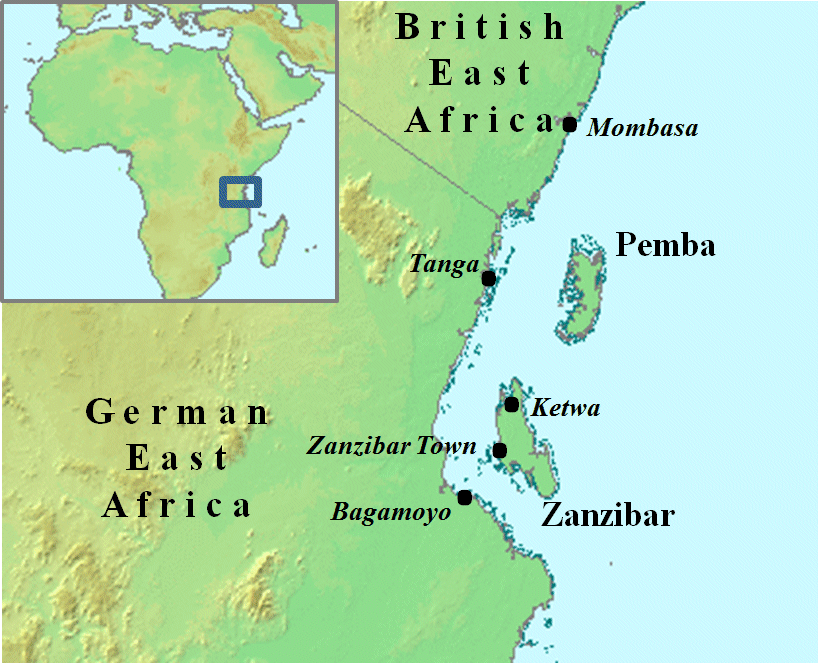 Zanzibar was an island country in the Indian Ocean
, off the coast of Tanganyika; today it forms part of Tanzania
. The island had been under the nominal control of the Sultans of Oman
since 1698 when they expelled the Portuguese
settlers who had claimed it in 1499. Sultan Majid bin Said
declared the island independent of Oman in 1858, which was recognised by Great Britain, and split the sultanate from that of Oman. The subsequent sultans established their capital and seat of government at Zanzibar Town where a palace complex was built on the sea front. By 1896, this consisted of the palace itself; the Beit al-Hukm, an attached harem
; and the Beit al-Ajaib or "House of Wonders"—a ceremonial palace said to be the first building in East Africa to be provided with electricity. The complex was mostly constructed of local timber and was not designed as a defensive structure. All three main buildings were adjacent to one another in a line, and linked by wooden covered bridges above street height.
Britain had had a long period of interaction with Zanzibar and had recognised the island's sovereignty
and its sultanate in 1886. As a result Britain generally maintained friendly relations with the country and its sultans. However, Germany
was also interested in East Africa and the two powers vied for control of trade rights and territory in the area throughout the late 19th century. Sultan Khalifah
had granted rights to the land of Kenya
to Britain and that of Tanganyika to Germany, a process resulting in the prohibition of slavery in those lands. Many of the Arab
ruling classes were upset by this interruption of a valuable trade, which resulted in some unrest
. In addition, the German authorities in Tanganyika refused to fly the flag of the Zanzibar sultanate, which led to armed clashes between German troops and the local population. One such conflict in Tanga
claimed the lives of 20 Arabs.
Sultan Khalifah sent Zanzibari troops led by General Lloyd Mathews, a former Lieutenant
of the Royal Navy
, to restore order in Tanganyika. The operation was largely successful, but anti-German feeling amongst the Zanzibari people remained strong. Further conflicts erupted at Bagamoyo
where 150 natives were killed by German military forces and at Ketwa where German officials and their servants were murdered. Khalifah then granted extensive trade rights to the Imperial British East Africa Company
(IBEAC) who, with German assistance, ran a naval blockade to halt the continuing domestic slave trade. Upon Khalifah's death in 1890 Ali bin Said
ascended to the sultanate. Sultan Ali banned the domestic slave trade (but not slave ownership), declared Zanzibar a British protectorate and appointed a British First Minister
to lead his cabinet
. The British were also guaranteed a veto over the future appointment of sultans.
The year of Ali's ascension also saw the signing of the Heligoland-Zanzibar Treaty
between Britain and Germany. This treaty officially demarcated
the spheres of interest in East Africa and ceded Germany's rights in Zanzibar to the United Kingdom. This granted the British government more influence in Zanzibar which they intended to use to eradicate slavery there, an objective they had held as early as 1804.
Sultan Ali's successor was Hamad bin Thuwaini
, who became sultan in 1893. Hamad maintained a close relationship with the British but there was dissent amongst his subjects over the increasing British control over the country, the British-led army and the abolition of the valuable slave trade. In order to control this dissent, the British authorities authorised the sultan to raise a Zanzibari palace bodyguard of 1,000 men, but these troops were soon involved in clashes with the British-led police. Complaints about the bodyguards' activities were also received from the European residents in Zanzibar Town.
 Sultan Hamad died suddenly at 11:40 EAT (08:40 UTC
) on 25 August 1896. His 29 year-old nephew Khalid bin Bargash
, who was suspected by some of his assassination, moved into the palace complex at Zanzibar Town without British approval, in contravention of the treaty agreed with Ali. The British government preferred an alternative candidate, Hamud bin Muhammed, who was more favourably disposed towards them. Khalid was warned by the consul and diplomatic agent to Zanzibar, Basil Cave
, and General Mathews to think carefully about his actions. This course of action had proved successful three years earlier when Khalid had tried to claim the sultanate after the death of Ali and the British consul-general, Rennell Rodd, had persuaded him of the dangers of such an action.
Khalid ignored Cave's warning and his forces began mustering in the Palace Square under the command of Captain Saleh of the palace bodyguard. By the end of the day, they numbered 2,800 men armed with rifles and muskets. The majority were civilians but the force included 700 Zanzibari Askari
soldiers who had sided with Khalid. The sultan's artillery, which consisted of several Maxim machine guns, a Gatling gun
, a 17th century bronze cannon and two 12 pounder field guns, was aimed at the British ships in the harbour. The 12 pounders had been presented to the sultan by Wilhelm II, the German emperor. The sultan's troops also took possession of the Zanzibari Navy which consisted of one wooden sloop, the HHS Glasgow
, built as a royal yacht
for the sultan in 1878 based on the British frigate HMS Glasgow
.
Mathews and Cave also began to muster their forces, already commanding 900 Zanzibari askari
s under Lieutenant Arthur Edward Harington Raikes of the Wiltshire Regiment
who was seconded to the Zanzibar Army and held the rank of Brigadier-General. 150 sailors and marines were landed from the Pearl-class
protected cruiser
HMS Philomel
and the gunboat
HMS Thrush
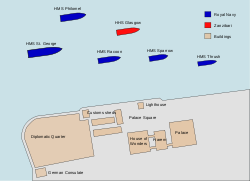
which were anchored in the harbour. The naval contingent, under the command of Captain O'Callaghan, came ashore within fifteen minutes of being requested to deal with any rioting caused by the general population. A smaller contingent of sailors under Lieutenant Watson of Thrush were put ashore to guard the British consulate, where British citizens were requested to gather for protection. HMS Sparrow, another gunboat, entered the harbour and was anchored opposite the palace next to Thrush.
Some concerns were raised among the British diplomats as to the reliability of Raikes' askaris, but they proved to be steady and professional troops hardened by military drill and several expeditions to East Africa. They would later become the only land troops to be fired upon by the defenders. Raikes' troops were armed with two Maxim guns and a nine pounder cannon, and were stationed at the nearby customs house. The sultan attempted to have the US consul, Richard Dorsey Mohun, recognise his accession but the messenger was told that "as his accession had not been verified by Her Majesty's government, it is impossible to reply."
Cave continued to send messages to Khalid requesting that he stand down his troops, leave the palace and return home but these were ignored and Khalid replied that he would proclaim himself sultan at 15:00. Cave stated that this would constitute an act of rebellion and that Khalid's sultancy would not be recognised by the British government. At 14:30, Sultan Hamad was buried and exactly 30 minutes later a royal salute from the palace guns proclaimed Khalid's succession. Cave could not open hostilities without government approval and telegraphed the following message to the Foreign Office of Lord Salisbury's administration in London: "Are we authorised in the event of all attempts at a peaceful solution proving useless, to fire on the Palace from the men-of-war?" Meanwhile, Cave informed all other foreign consuls that all flags were to remain at half mast in honour of the late Hamad. The only one that did not was a large red flag flying from Khalid's palace. Cave also informed the consuls not to recognise Khalid as sultan, to which they agreed.
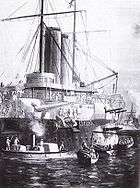 At 10:00 on 26 August, the Archer-class protected cruiser HMS Racoon
arrived at Zanzibar Town and was anchored in line with Thrush and Sparrow. At 14:00, the Edgar-class
protected cruiser HMS St George
, flagship
of the Cape and East Africa Station, steamed into the harbour. Onboard were Rear-Admiral Harry Rawson
and further British marines and sailors. At around the same time Lord Salisbury's reply arrived authorising Cave and Rawson to use the resources at their disposal to remove Khalid from power. The telegraph read: "You are authorised to adopt whatever measures you may consider necessary, and will be supported in your action by Her Majesty's Government. Do not, however, attempt to take any action which you are not certain of being able to accomplish successfully."
Cave attempted further negotiations with Khalid but these failed and Rawson sent an ultimatum
, requiring him to haul down his flag and leave the palace by 09:00 on 27 August or he would open fire. During the afternoon, all merchant vessels were cleared from the harbour and the British women and children removed to St. George and a British-India Steam Navigation Company
vessel for their safety. That night, Consul Mohun noted that: "The silence which hung over Zanzibar was appalling. Usually drums were beating or babies cried but that night there was absolutely not a sound."
 At 08:00 on the morning of 27 August, after a messenger sent by Khalid requested parley
from Cave, the consul replied that he would only have salvation if he agreed to the terms of the ultimatum. At 08.30 a further messenger from Khalid declared that "We have no intention of hauling down our flag and we do not believe you would open fire on us"; Cave replied that "We do not want to open fire, but unless you do as you are told we shall certainly do so." At 08:55, having received no further word from the palace, aboard St George Rawson hoisted the signal "prepare for action".
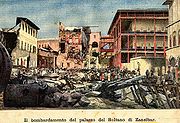
At exactly 09:00, General Lloyd Mathews ordered the British ships to commence the bombardment. At 09:02 Her Majesty's Ships Racoon, Thrush and Sparrow opened fire at the palace simultaneously, Thrush's first shot immediately dismounted an Arab 12-pounder cannon. 3,000 defenders, servants and slaves were present in the largely wooden palace and even with barricades of crates, bales and rubber, there were many casualties from the high explosive shells. Despite initial reports that he had been captured and was to be exiled to India
, Sultan Khalid escaped from the palace. A Reuters
news correspondent reported that the sultan had "fled at the first shot with all the leading Arabs, who left their slaves and followers to carry on the fighting", but other sources state that he remained in the palace for longer. The shelling ceased at around 09:40, by which time the palace and attached harem had caught fire, the enemy artillery had been silenced and the Sultan's flag cut down.
 During the bombardment a small naval engagement occurred when, at 09:05, the obsolete Glasgow fired upon the St George using her armament of 7 nine-pounder guns and a Gatling gun which had been a present from Queen Victoria to the sultan. The return fire caused Glasgow to sink, though the shallow harbour meant that her masts remained out of the water. Glasgow
' s crew hoisted a British flag as a token of their surrender and they were all rescued by British sailors in launches
. Thrush also sank two steam launches whose Zanzibari crews shot at her with rifles. Some land fighting occurred when Khalid's men fired on Raikes' askaris, with little effect, as they approached the palace. The fighting ceased with the end of the shelling. The British controlled the town and the palace and by the afternoon Hamud bin Muhammed, an Arab favourable to the British, had been installed as sultan with much reduced powers. The British ships and crews had fired around 500 shells, 4,100 machine gun rounds and 1,000 rifle rounds during the engagement.
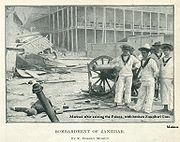 Around 500 Zanzibari men and women were killed or wounded during the bombardment, most of the dead a result of the fire that engulfed the palace. It is unknown how many of these casualties were combatants, but Khalid's gun crews were said to have been "decimated". British casualties amounted to one Petty Officer
severely wounded aboard Thrush who later recovered. Although the majority of the Zanzibari townspeople sided with the British, the town's India
n quarter suffered from opportunistic looting and around twenty inhabitants lost their lives in the chaos. To restore order 150 British Sikh
troops were transferred from Mombasa
to patrol the streets. Sailors from St George and Philomel were landed to form a fire brigade to contain the fire which had spread from the palace to the nearby customs sheds. There was some concern about the fire at the customs sheds as they contained a sizeable store of explosives, but fortunately no explosion occurred.
Sultan Khalid, Captain Saleh and around forty followers sought refuge in the German consulate following their flight from the palace, where they were guarded by ten armed German sailors and marines whilst Mathews stationed men outside to arrest them if they tried to leave. Despite extradition
requests the German consul refused to surrender Khalid to the British as his country's extradition treaty with Britain specifically excluded political prisoners. Instead, the German consul promised to remove Khalid to German East Africa
without him "setting foot on the soil of Zanzibar". At 10:00 on 2 October, SMS Seeadler
of the German Navy
arrived in port; at high tide, one of Seeadler's boats made it up to the consulate's garden gate and Khalid stepped directly from consular grounds to a German war vessel and hence was free from arrest. He was transferred from the boat onto the Seeadler and was then taken to Dar es Salaam
in German East Africa. Khalid was captured by British forces in 1916, during the East African Campaign
of World War I
, and exiled to Seychelles
and Saint Helena
before being allowed to return to East Africa, where he died at Mombasa
in 1927. Khalid's supporters were punished by being forced to pay reparations to cover the cost of shells fired against them and for damages caused by the looting which amounted to 300,000 rupees
.
Sultan Hamud was loyal to the British and acted as a figurehead
for an essentially British-run government, the sultanate only being retained to avoid the costs involved with running Zanzibar directly as a crown colony
. Several months after the war, Hamud, with British prompting, abolished slavery in all its forms. The emancipation of slaves required them to present themselves to a government office and proved a slow process—within ten years only 17,293 slaves had been freed, from an estimated population of 60,000 in 1891.
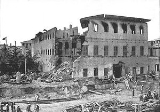
The badly damaged palace complex was completely changed by the war. The harem, lighthouse and palace were demolished as the bombardment had left them unsafe. The palace site became an area of gardens whilst a new palace was erected on the site of the harem. The House of Wonders was almost undamaged and would later become the main secretariat for the British governing authorities. During renovation work on the House of Wonders in 1897 a clocktower was added to its frontage to replace the lighthouse lost to the shelling. The wreck of the Glasgow remained in the harbour in front of the palace where the shallow waters ensured that her masts would remain visible for several years to come; it was eventually broken up for scrap in 1912.
The British protagonists were highly regarded by the governments in London and Zanzibar for their actions leading up to and during the war, and many were rewarded with appointments and honours. General Raikes, leader of the askaris, was appointed a First Class (Second Grade) member of the Order of the Brilliant Star of Zanzibar
on 24 September 1896, a First Class member of the Zanzibari Order of Hamondieh
on 25 August 1897 and later promoted to Commander of the Zanzibar armies. General Mathews, the Zanzibari army commander, was appointed a member of the Grand Order of Hamondieh on 25 August 1897 and became First Minister and Treasurer to the Zanzibari government. Basil Cave, the consul, was appointed a Companion of the Order of the Bath on 1 January 1897 and promoted to Consul-General on 9 July 1903. Harry Rawson was appointed a Knight Commander of the Order of the Bath for his work in Zanzibar and would later be Governor of New South Wales
in Australia
and receive promotion to Admiral. Rawson was also appointed a first class member of the Order of the Brilliant Star of Zanzibar on 8 February 1897 and the Order of Hamondieh on 18 June 1898.
Perhaps due to the effectiveness shown by the Royal Navy during the bombardment, there were no further rebellions against British influence during the remaining 67 years of the protectorate. The war, lasting around 40 minutes, is considered the shortest in recorded history.
United Kingdom of Great Britain and Ireland
The United Kingdom of Great Britain and Ireland was the formal name of the United Kingdom during the period when what is now the Republic of Ireland formed a part of it....
and Zanzibar
Zanzibar
Zanzibar ,Persian: زنگبار, from suffix bār: "coast" and Zangi: "bruin" ; is a semi-autonomous part of Tanzania, in East Africa. It comprises the Zanzibar Archipelago in the Indian Ocean, off the coast of the mainland, and consists of numerous small islands and two large ones: Unguja , and Pemba...
on 27 August 1896. The conflict lasted 38 minutes and is the shortest war in history. The immediate cause of the war was the death of the pro-British Sultan
Sultan
Sultan is a title with several historical meanings. Originally, it was an Arabic language abstract noun meaning "strength", "authority", "rulership", and "dictatorship", derived from the masdar سلطة , meaning "authority" or "power". Later, it came to be used as the title of certain rulers who...
Hamad bin Thuwaini
Hamad bin Thuwaini of Zanzibar
Sayyid Hamad bin Thuwaini Al-Busaid, GCSI, was the fifth Sultan of Zanzibar. He ruled Zanzibar from March 5, 1893 to August 25, 1896....
on 25 August 1896 and the subsequent succession of Sultan Khalid bin Barghash
Khalid bin Barghash of Zanzibar
Sayyid Khalid bin Barghash Al-Busaid was the sixth Sultan of Zanzibar and the eldest son of the second Sultan of Zanzibar, Sayyid Barghash bin Said Al-Busaid. Khalid briefly ruled Zanzibar , seizing power after the sudden death of his cousin Hamad bin Thuwaini of Zanzibar who many suspect was...
. The British authorities preferred Hamud bin Muhammed, who was more favourable to British interests, as sultan. In accordance with a treaty signed in 1886, a condition for accession
Enthronement
An enthronement is a ceremony of inauguration, involving a person—usually a monarch or religious leader—being formally seated for the first time upon their throne. This ritual is generally distinguished from a coronation because there is no crown or other regalia that is physically...
to the sultanate was that the candidate obtain the permission of the British consul
Consul (representative)
The political title Consul is used for the official representatives of the government of one state in the territory of another, normally acting to assist and protect the citizens of the consul's own country, and to facilitate trade and friendship between the peoples of the two countries...
, and Khalid had not fulfilled this requirement. The British considered this a casus belli
Casus belli
is a Latin expression meaning the justification for acts of war. means "incident", "rupture" or indeed "case", while means bellic...
and sent an ultimatum
Ultimatum
An ultimatum is a demand whose fulfillment is requested in a specified period of time and which is backed up by a threat to be followed through in case of noncompliance. An ultimatum is generally the final demand in a series of requests...
to Khalid demanding that he order his forces to stand down and leave the palace. In response, Khalid called up his palace guard and barricaded himself inside the palace.
The ultimatum expired at 09:00 East Africa Time
East Africa Time
East Africa Time, or EAT, is a time zone used in eastern Africa. The zone is three hours ahead of UTC , which is the same as Arabia Standard Time, and also the same as Eastern European Summer Time....
(EAT) on 27 August, by which time the British had gathered three cruisers, two gunships, 150 marines
Royal Marines
The Corps of Her Majesty's Royal Marines, commonly just referred to as the Royal Marines , are the marine corps and amphibious infantry of the United Kingdom and, along with the Royal Navy and Royal Fleet Auxiliary, form the Naval Service...
and sailors, and 900 Zanzibaris in the harbour area. The Royal Navy contingent were under the command of Rear Admiral
Rear Admiral
Rear admiral is a naval commissioned officer rank above that of a commodore and captain, and below that of a vice admiral. It is generally regarded as the lowest of the "admiral" ranks, which are also sometimes referred to as "flag officers" or "flag ranks"...
Harry Rawson
Harry Rawson
Admiral Sir Harry Holdsworth Rawson, GCB, GCMG RN , is chiefly remembered for overseeing the British Benin Expedition of 1897 that burned and looted the city of the Kingdom of Benin, now in Nigeria...
whilst their Zanzibaris were commanded by Brigadier-General Lloyd Mathews
Lloyd Mathews
Sir Lloyd William Mathews KCMG, CB was a British naval officer, politician and abolitionist. Mathews joined the Royal Navy as a cadet at the age of 13 and progressed through the ranks to lieutenant. He was involved with the Third Anglo-Ashanti War of 1873–4, afterwards being stationed in...
of the Zanzibar army. Around 2,800 Zanzibaris defended the palace; most were recruited from the civilian population, but they also included the sultan's palace guard and several hundred of his servants and slaves. The defenders had several artillery pieces and machine guns which were set in front of the palace sighted at the British ships. A bombardment which was opened at 09:02 set the palace on fire and disabled the defending artillery. A small naval action took place with the British sinking a Zanzibari royal yacht
Royal Yacht
A royal yacht is a ship used by a monarch or a royal family. If the monarch is an emperor the proper term is imperial yacht. Most of them are financed by the government of the country of which the monarch is head...
and two smaller vessels, and some shots were fired ineffectually at the pro-British Zanzibari troops as they approached the palace. The flag at the palace was shot down and fire ceased at 09:40.
The sultan's forces sustained roughly 500 casualties, while only one British sailor was injured. Sultan Khalid received asylum in the German consulate before escaping to German East Africa
German East Africa
German East Africa was a German colony in East Africa, which included what are now :Burundi, :Rwanda and Tanganyika . Its area was , nearly three times the size of Germany today....
(in the mainland part of present Tanzania
Tanzania
The United Republic of Tanzania is a country in East Africa bordered by Kenya and Uganda to the north, Rwanda, Burundi, and the Democratic Republic of the Congo to the west, and Zambia, Malawi, and Mozambique to the south. The country's eastern borders lie on the Indian Ocean.Tanzania is a state...
). The British quickly placed Sultan Hamud in power at the head of a puppet government. The war marked the end of Zanzibar as a sovereign state
Sovereign state
A sovereign state, or simply, state, is a state with a defined territory on which it exercises internal and external sovereignty, a permanent population, a government, and the capacity to enter into relations with other sovereign states. It is also normally understood to be a state which is neither...
and the start of a period of heavy British influence.
Origins
Indian Ocean
The Indian Ocean is the third largest of the world's oceanic divisions, covering approximately 20% of the water on the Earth's surface. It is bounded on the north by the Indian Subcontinent and Arabian Peninsula ; on the west by eastern Africa; on the east by Indochina, the Sunda Islands, and...
, off the coast of Tanganyika; today it forms part of Tanzania
Tanzania
The United Republic of Tanzania is a country in East Africa bordered by Kenya and Uganda to the north, Rwanda, Burundi, and the Democratic Republic of the Congo to the west, and Zambia, Malawi, and Mozambique to the south. The country's eastern borders lie on the Indian Ocean.Tanzania is a state...
. The island had been under the nominal control of the Sultans of Oman
Sultan of Oman
-List of Imams :-Nabhan Dynasty :-Ya'ariba Dynasty :-Banu Ghafir Dynasty :-Ya'ariba Dynasty :-Al Said Dynasty :-See also:...
since 1698 when they expelled the Portuguese
Portugal
Portugal , officially the Portuguese Republic is a country situated in southwestern Europe on the Iberian Peninsula. Portugal is the westernmost country of Europe, and is bordered by the Atlantic Ocean to the West and South and by Spain to the North and East. The Atlantic archipelagos of the...
settlers who had claimed it in 1499. Sultan Majid bin Said
Majid bin Said of Zanzibar
Sayyid Majid bin Said Al-Busaid was the first Sultan of Zanzibar. He ruled Zanzibar from October 19, 1856 to October 7, 1870....
declared the island independent of Oman in 1858, which was recognised by Great Britain, and split the sultanate from that of Oman. The subsequent sultans established their capital and seat of government at Zanzibar Town where a palace complex was built on the sea front. By 1896, this consisted of the palace itself; the Beit al-Hukm, an attached harem
Harem
Harem refers to the sphere of women in what is usually a polygynous household and their enclosed quarters which are forbidden to men...
; and the Beit al-Ajaib or "House of Wonders"—a ceremonial palace said to be the first building in East Africa to be provided with electricity. The complex was mostly constructed of local timber and was not designed as a defensive structure. All three main buildings were adjacent to one another in a line, and linked by wooden covered bridges above street height.
Britain had had a long period of interaction with Zanzibar and had recognised the island's sovereignty
Sovereignty
Sovereignty is the quality of having supreme, independent authority over a geographic area, such as a territory. It can be found in a power to rule and make law that rests on a political fact for which no purely legal explanation can be provided...
and its sultanate in 1886. As a result Britain generally maintained friendly relations with the country and its sultans. However, Germany
Germany
Germany , officially the Federal Republic of Germany , is a federal parliamentary republic in Europe. The country consists of 16 states while the capital and largest city is Berlin. Germany covers an area of 357,021 km2 and has a largely temperate seasonal climate...
was also interested in East Africa and the two powers vied for control of trade rights and territory in the area throughout the late 19th century. Sultan Khalifah
Khalifah bin Said of Zanzibar
Sayyid Khalifa I bin Said Al-Busaid, GCMG, was the third Sultan of Zanzibar. He ruled Zanzibar from March 26, 1888 to February 13, 1890 and was succeeded by his brother, Ali bin Said Al-Busaid....
had granted rights to the land of Kenya
Kenya
Kenya , officially known as the Republic of Kenya, is a country in East Africa that lies on the equator, with the Indian Ocean to its south-east...
to Britain and that of Tanganyika to Germany, a process resulting in the prohibition of slavery in those lands. Many of the Arab
Arab
Arab people, also known as Arabs , are a panethnicity primarily living in the Arab world, which is located in Western Asia and North Africa. They are identified as such on one or more of genealogical, linguistic, or cultural grounds, with tribal affiliations, and intra-tribal relationships playing...
ruling classes were upset by this interruption of a valuable trade, which resulted in some unrest
Abushiri Revolt
The Abushiri Revolt was a so-called insurrection in 1888-1889 by the Arab and Swahili population of the areas of the East African coast which were granted to Germany by the Sultan of Zanzibar in 1888...
. In addition, the German authorities in Tanganyika refused to fly the flag of the Zanzibar sultanate, which led to armed clashes between German troops and the local population. One such conflict in Tanga
Tanga, Tanzania
Tanga is both the name of the most northerly seaport city of Tanzania, and the surrounding Tanga Region. It is the Regional Headquarters of the region.With a population of 243,580 in 2002, Tanga is one of the largest cities in the country...
claimed the lives of 20 Arabs.
Sultan Khalifah sent Zanzibari troops led by General Lloyd Mathews, a former Lieutenant
Lieutenant
A lieutenant is a junior commissioned officer in many nations' armed forces. Typically, the rank of lieutenant in naval usage, while still a junior officer rank, is senior to the army rank...
of the Royal Navy
Royal Navy
The Royal Navy is the naval warfare service branch of the British Armed Forces. Founded in the 16th century, it is the oldest service branch and is known as the Senior Service...
, to restore order in Tanganyika. The operation was largely successful, but anti-German feeling amongst the Zanzibari people remained strong. Further conflicts erupted at Bagamoyo
Bagamoyo
The town of Bagamoyo, Tanzania, was founded at the end of the 18th century. It was the original capital of German East Africa and was one of the most important trading ports along the East African coast...
where 150 natives were killed by German military forces and at Ketwa where German officials and their servants were murdered. Khalifah then granted extensive trade rights to the Imperial British East Africa Company
Imperial British East Africa Company
The Imperial British East Africa Company was the administrator of British East Africa, which was the forerunner of the East Africa Protectorate, later Kenya. The IBEAC was a commercial association founded to develop African trade in the areas controlled by the British colonial power...
(IBEAC) who, with German assistance, ran a naval blockade to halt the continuing domestic slave trade. Upon Khalifah's death in 1890 Ali bin Said
Ali bin Said of Zanzibar
Sayyid Ali bin Said Al-Busaid, GCSI, was the fourth Sultan of Zanzibar. He ruled Zanzibar from February 13, 1890 to March 5, 1893, and was succeeded by his nephew, Hamad bin Thuwaini Al-Busaid.-Titles:...
ascended to the sultanate. Sultan Ali banned the domestic slave trade (but not slave ownership), declared Zanzibar a British protectorate and appointed a British First Minister
First Minister
A First Minister is the leader of a government cabinet.-Canada:In Canada, "First Ministers" is a collective term that refers to all Canadian first ministers of the Crown, otherwise known as heads of government, including the Prime Minister of Canada and the provincial and territorial premiers...
to lead his cabinet
Cabinet (government)
A Cabinet is a body of high ranking government officials, typically representing the executive branch. It can also sometimes be referred to as the Council of Ministers, an Executive Council, or an Executive Committee.- Overview :...
. The British were also guaranteed a veto over the future appointment of sultans.
The year of Ali's ascension also saw the signing of the Heligoland-Zanzibar Treaty
Heligoland-Zanzibar Treaty
The Heligoland-Zanzibar Treaty of 1 July 1890 was an agreement between the United Kingdom and the German Empire concerning mainly territorial interests in Africa.-Terms:...
between Britain and Germany. This treaty officially demarcated
Demarcation
Demarcation is the act of creating a boundary around a place or thing.Demarcation may also refer to:*Demarcation line, a temporary border between the countries...
the spheres of interest in East Africa and ceded Germany's rights in Zanzibar to the United Kingdom. This granted the British government more influence in Zanzibar which they intended to use to eradicate slavery there, an objective they had held as early as 1804.
Sultan Ali's successor was Hamad bin Thuwaini
Hamad bin Thuwaini of Zanzibar
Sayyid Hamad bin Thuwaini Al-Busaid, GCSI, was the fifth Sultan of Zanzibar. He ruled Zanzibar from March 5, 1893 to August 25, 1896....
, who became sultan in 1893. Hamad maintained a close relationship with the British but there was dissent amongst his subjects over the increasing British control over the country, the British-led army and the abolition of the valuable slave trade. In order to control this dissent, the British authorities authorised the sultan to raise a Zanzibari palace bodyguard of 1,000 men, but these troops were soon involved in clashes with the British-led police. Complaints about the bodyguards' activities were also received from the European residents in Zanzibar Town.
25 August
Coordinated Universal Time
Coordinated Universal Time is the primary time standard by which the world regulates clocks and time. It is one of several closely related successors to Greenwich Mean Time. Computer servers, online services and other entities that rely on having a universally accepted time use UTC for that purpose...
) on 25 August 1896. His 29 year-old nephew Khalid bin Bargash
Khalid bin Barghash of Zanzibar
Sayyid Khalid bin Barghash Al-Busaid was the sixth Sultan of Zanzibar and the eldest son of the second Sultan of Zanzibar, Sayyid Barghash bin Said Al-Busaid. Khalid briefly ruled Zanzibar , seizing power after the sudden death of his cousin Hamad bin Thuwaini of Zanzibar who many suspect was...
, who was suspected by some of his assassination, moved into the palace complex at Zanzibar Town without British approval, in contravention of the treaty agreed with Ali. The British government preferred an alternative candidate, Hamud bin Muhammed, who was more favourably disposed towards them. Khalid was warned by the consul and diplomatic agent to Zanzibar, Basil Cave
Basil Cave
The British government's approval came the next day and Cave received reinforcements in the form of a small flotilla of Royal Navy vessels led by Rear-Admiral Harry Rawson. Cave entered further negotiations with Khalid but these proved unsuccessful and he was forced to issue an ultimatum to leave...
, and General Mathews to think carefully about his actions. This course of action had proved successful three years earlier when Khalid had tried to claim the sultanate after the death of Ali and the British consul-general, Rennell Rodd, had persuaded him of the dangers of such an action.
Khalid ignored Cave's warning and his forces began mustering in the Palace Square under the command of Captain Saleh of the palace bodyguard. By the end of the day, they numbered 2,800 men armed with rifles and muskets. The majority were civilians but the force included 700 Zanzibari Askari
Askari
Askari is an Arabic, Bosnian, Urdu, Turkish, Somali, Persian, Amharic and Swahili word meaning "soldier" . It was normally used to describe local troops in East Africa, Northeast Africa, and Central Africa serving in the armies of European colonial powers...
soldiers who had sided with Khalid. The sultan's artillery, which consisted of several Maxim machine guns, a Gatling gun
Gatling gun
The Gatling gun is one of the best known early rapid-fire weapons and a forerunner of the modern machine gun. It is well known for its use by the Union forces during the American Civil War in the 1860s, which was the first time it was employed in combat...
, a 17th century bronze cannon and two 12 pounder field guns, was aimed at the British ships in the harbour. The 12 pounders had been presented to the sultan by Wilhelm II, the German emperor. The sultan's troops also took possession of the Zanzibari Navy which consisted of one wooden sloop, the HHS Glasgow
HHS Glasgow
His Highness' Ship Glasgow was a royal yacht belonging to the Sultan of Zanzibar. She was built in the style of the British frigate HMS Glasgow which had visited the Sultan in 1873. The Glasgow cost the Sultan £32,735 and contained several luxury features but failed to impress the Sultan and she...
, built as a royal yacht
Royal Yacht
A royal yacht is a ship used by a monarch or a royal family. If the monarch is an emperor the proper term is imperial yacht. Most of them are financed by the government of the country of which the monarch is head...
for the sultan in 1878 based on the British frigate HMS Glasgow
HMS Glasgow (1861)
HMS Glasgow was a wooden screw frigate, the fifth ship of the name to serve in the Royal Navy.Glasgow was launched at Portsmouth Dockyard on 28 March 1861. Despite ironclad ships being introduced in 1858 and effectively rendering wooden hulls obsolete the Glasgow was built of wood to use up some...
.
Mathews and Cave also began to muster their forces, already commanding 900 Zanzibari askari
Askari
Askari is an Arabic, Bosnian, Urdu, Turkish, Somali, Persian, Amharic and Swahili word meaning "soldier" . It was normally used to describe local troops in East Africa, Northeast Africa, and Central Africa serving in the armies of European colonial powers...
s under Lieutenant Arthur Edward Harington Raikes of the Wiltshire Regiment
Wiltshire Regiment
The Wiltshire Regiment was an infantry regiment of the line in the British Army, formed in 1881 by the amalgamation of the 62nd Regiment of Foot and the 99th Duke of Edinburgh's Regiment of Foot....
who was seconded to the Zanzibar Army and held the rank of Brigadier-General. 150 sailors and marines were landed from the Pearl-class
Pearl class cruiser
The Pearl-class cruiser was a class of nine third-class cruisers designed by Sir William White, five of which were paid for by Australia under the terms of the Imperial Defence Act of 1887 to serve in Australian waters.-Design:...
protected cruiser
Protected cruiser
The protected cruiser is a type of naval cruiser of the late 19th century, so known because its armoured deck offered protection for vital machine spaces from shrapnel caused by exploding shells above...
HMS Philomel
HMS Philomel (1890)
HMS Philomel was a Pearl-class cruiser. She was the sixth ship of that name and served with the Royal Navy from her commissioning in 1890 until 1914, when she was transferred to the New Zealand Navy with whom she served until 1947...
and the gunboat
Gunboat
A gunboat is a naval watercraft designed for the express purpose of carrying one or more guns to bombard coastal targets, as opposed to those military craft designed for naval warfare, or for ferrying troops or supplies.-History:...
HMS Thrush
HMS Thrush (1889)
HMS Thrush was a Redbreast-class composite gunboat, the third ship of the name to serve in the Royal Navy.-Design:The Redbreast-class were designed by Sir William Henry White, the Royal Navy Director of Naval Construction in 1888....
which were anchored in the harbour. The naval contingent, under the command of Captain O'Callaghan, came ashore within fifteen minutes of being requested to deal with any rioting caused by the general population. A smaller contingent of sailors under Lieutenant Watson of Thrush were put ashore to guard the British consulate, where British citizens were requested to gather for protection. HMS Sparrow, another gunboat, entered the harbour and was anchored opposite the palace next to Thrush.
Some concerns were raised among the British diplomats as to the reliability of Raikes' askaris, but they proved to be steady and professional troops hardened by military drill and several expeditions to East Africa. They would later become the only land troops to be fired upon by the defenders. Raikes' troops were armed with two Maxim guns and a nine pounder cannon, and were stationed at the nearby customs house. The sultan attempted to have the US consul, Richard Dorsey Mohun, recognise his accession but the messenger was told that "as his accession had not been verified by Her Majesty's government, it is impossible to reply."
Cave continued to send messages to Khalid requesting that he stand down his troops, leave the palace and return home but these were ignored and Khalid replied that he would proclaim himself sultan at 15:00. Cave stated that this would constitute an act of rebellion and that Khalid's sultancy would not be recognised by the British government. At 14:30, Sultan Hamad was buried and exactly 30 minutes later a royal salute from the palace guns proclaimed Khalid's succession. Cave could not open hostilities without government approval and telegraphed the following message to the Foreign Office of Lord Salisbury's administration in London: "Are we authorised in the event of all attempts at a peaceful solution proving useless, to fire on the Palace from the men-of-war?" Meanwhile, Cave informed all other foreign consuls that all flags were to remain at half mast in honour of the late Hamad. The only one that did not was a large red flag flying from Khalid's palace. Cave also informed the consuls not to recognise Khalid as sultan, to which they agreed.
26 August
HMS Racoon (1887)
HMS Racoon, sometimes spelled HMS Raccoon, was an Archer-class torpedo cruiser of the Royal Navy. Racoon was laid down on 1 February 1886 and came into service on 1 March 1888. On 27 August 1896 Racoon was involved in the bombardment of Sultan Khalid's palace during the 40 minute Anglo–Zanzibar War...
arrived at Zanzibar Town and was anchored in line with Thrush and Sparrow. At 14:00, the Edgar-class
Edgar class cruiser
The Edgar-class was a nine-ship class of protected cruiser built around 1891 for the Royal Navy.-Design:Crescent and Royal Arthur were built to a slightly modified design with a raised forecastle and a pair of 6 inch guns replacing the forward 9.2 inch gun, and are sometimes considered a...
protected cruiser HMS St George
HMS St George (1892)
HMS St George was a first class cruiser of the Edgar class. She was launched on June 23, 1892.She took part in the 40 minute long Anglo-Zanzibar War and served in the First World War. She was designated as a depot ship in 1909, and sold for breaking up at Plymouth on July 1, 1920.-References:*...
, flagship
Flagship
A flagship is a vessel used by the commanding officer of a group of naval ships, reflecting the custom of its commander, characteristically a flag officer, flying a distinguishing flag...
of the Cape and East Africa Station, steamed into the harbour. Onboard were Rear-Admiral Harry Rawson
Harry Rawson
Admiral Sir Harry Holdsworth Rawson, GCB, GCMG RN , is chiefly remembered for overseeing the British Benin Expedition of 1897 that burned and looted the city of the Kingdom of Benin, now in Nigeria...
and further British marines and sailors. At around the same time Lord Salisbury's reply arrived authorising Cave and Rawson to use the resources at their disposal to remove Khalid from power. The telegraph read: "You are authorised to adopt whatever measures you may consider necessary, and will be supported in your action by Her Majesty's Government. Do not, however, attempt to take any action which you are not certain of being able to accomplish successfully."
Cave attempted further negotiations with Khalid but these failed and Rawson sent an ultimatum
Ultimatum
An ultimatum is a demand whose fulfillment is requested in a specified period of time and which is backed up by a threat to be followed through in case of noncompliance. An ultimatum is generally the final demand in a series of requests...
, requiring him to haul down his flag and leave the palace by 09:00 on 27 August or he would open fire. During the afternoon, all merchant vessels were cleared from the harbour and the British women and children removed to St. George and a British-India Steam Navigation Company
British-India Steam Navigation Company
British India Steam Navigation Company was formed in 1856 as the Calcutta and Burmah Steam Navigation Company. The company had been formed out of Mackinnon, Mackenzie & Co, a trading partnership of the Scots William Mackinnon and Robert Mackenzie, to carry mail between Calcutta and Rangoon. It...
vessel for their safety. That night, Consul Mohun noted that: "The silence which hung over Zanzibar was appalling. Usually drums were beating or babies cried but that night there was absolutely not a sound."
27 August
Parley
Parley is a discussion or conference, especially one between enemies over terms of a truce or other matters. The root of the word parley is parler, which is the French verb "to speak"; specifically the conjugation parlez "you speak", whether as imperative or indicative.Beginning in the High Middle...
from Cave, the consul replied that he would only have salvation if he agreed to the terms of the ultimatum. At 08.30 a further messenger from Khalid declared that "We have no intention of hauling down our flag and we do not believe you would open fire on us"; Cave replied that "We do not want to open fire, but unless you do as you are told we shall certainly do so." At 08:55, having received no further word from the palace, aboard St George Rawson hoisted the signal "prepare for action".
At exactly 09:00, General Lloyd Mathews ordered the British ships to commence the bombardment. At 09:02 Her Majesty's Ships Racoon, Thrush and Sparrow opened fire at the palace simultaneously, Thrush's first shot immediately dismounted an Arab 12-pounder cannon. 3,000 defenders, servants and slaves were present in the largely wooden palace and even with barricades of crates, bales and rubber, there were many casualties from the high explosive shells. Despite initial reports that he had been captured and was to be exiled to India
India
India , officially the Republic of India , is a country in South Asia. It is the seventh-largest country by geographical area, the second-most populous country with over 1.2 billion people, and the most populous democracy in the world...
, Sultan Khalid escaped from the palace. A Reuters
Reuters
Reuters is a news agency headquartered in New York City. Until 2008 the Reuters news agency formed part of a British independent company, Reuters Group plc, which was also a provider of financial market data...
news correspondent reported that the sultan had "fled at the first shot with all the leading Arabs, who left their slaves and followers to carry on the fighting", but other sources state that he remained in the palace for longer. The shelling ceased at around 09:40, by which time the palace and attached harem had caught fire, the enemy artillery had been silenced and the Sultan's flag cut down.
Launch (boat)
A launch in contemporary usage refers to a large motorboat. The name originally referred to the largest boat carried by a warship. The etymology of the word is given as Portuguese lancha "barge", from Malay lancha, lancharan, "boat," from lanchar "velocity without effort," "action of gliding...
. Thrush also sank two steam launches whose Zanzibari crews shot at her with rifles. Some land fighting occurred when Khalid's men fired on Raikes' askaris, with little effect, as they approached the palace. The fighting ceased with the end of the shelling. The British controlled the town and the palace and by the afternoon Hamud bin Muhammed, an Arab favourable to the British, had been installed as sultan with much reduced powers. The British ships and crews had fired around 500 shells, 4,100 machine gun rounds and 1,000 rifle rounds during the engagement.
Aftermath
Petty Officer
A petty officer is a non-commissioned officer in many navies and is given the NATO rank denotion OR-6. They are equal in rank to sergeant, British Army and Royal Air Force. A Petty Officer is superior in rank to Leading Rate and subordinate to Chief Petty Officer, in the case of the British Armed...
severely wounded aboard Thrush who later recovered. Although the majority of the Zanzibari townspeople sided with the British, the town's India
India
India , officially the Republic of India , is a country in South Asia. It is the seventh-largest country by geographical area, the second-most populous country with over 1.2 billion people, and the most populous democracy in the world...
n quarter suffered from opportunistic looting and around twenty inhabitants lost their lives in the chaos. To restore order 150 British Sikh
Sikh
A Sikh is a follower of Sikhism. It primarily originated in the 15th century in the Punjab region of South Asia. The term "Sikh" has its origin in Sanskrit term शिष्य , meaning "disciple, student" or शिक्ष , meaning "instruction"...
troops were transferred from Mombasa
Mombasa
Mombasa is the second-largest city in Kenya. Lying next to the Indian Ocean, it has a major port and an international airport. The city also serves as the centre of the coastal tourism industry....
to patrol the streets. Sailors from St George and Philomel were landed to form a fire brigade to contain the fire which had spread from the palace to the nearby customs sheds. There was some concern about the fire at the customs sheds as they contained a sizeable store of explosives, but fortunately no explosion occurred.
Sultan Khalid, Captain Saleh and around forty followers sought refuge in the German consulate following their flight from the palace, where they were guarded by ten armed German sailors and marines whilst Mathews stationed men outside to arrest them if they tried to leave. Despite extradition
Extradition
Extradition is the official process whereby one nation or state surrenders a suspected or convicted criminal to another nation or state. Between nation states, extradition is regulated by treaties...
requests the German consul refused to surrender Khalid to the British as his country's extradition treaty with Britain specifically excluded political prisoners. Instead, the German consul promised to remove Khalid to German East Africa
German East Africa
German East Africa was a German colony in East Africa, which included what are now :Burundi, :Rwanda and Tanganyika . Its area was , nearly three times the size of Germany today....
without him "setting foot on the soil of Zanzibar". At 10:00 on 2 October, SMS Seeadler
SMS Seeadler
SMS Seeadler was a German cruiser, part of a new breed of warships created by the new Imperial Navy. To protect the Empire's growing overseas possessions and colonies, the navy needed ships seaworthy enough to venture out into far off oceans and have the coal supply to reach far off destinations...
of the German Navy
Kaiserliche Marine
The Imperial German Navy was the German Navy created at the time of the formation of the German Empire. It existed between 1871 and 1919, growing out of the small Prussian Navy and Norddeutsche Bundesmarine, which primarily had the mission of coastal defense. Kaiser Wilhelm II greatly expanded...
arrived in port; at high tide, one of Seeadler's boats made it up to the consulate's garden gate and Khalid stepped directly from consular grounds to a German war vessel and hence was free from arrest. He was transferred from the boat onto the Seeadler and was then taken to Dar es Salaam
Dar es Salaam
Dar es Salaam , formerly Mzizima, is the largest city in Tanzania. It is also the country's richest city and a regionally important economic centre. Dar es Salaam is actually an administrative province within Tanzania, and consists of three local government areas or administrative districts: ...
in German East Africa. Khalid was captured by British forces in 1916, during the East African Campaign
East African Campaign (World War I)
The East African Campaign was a series of battles and guerrilla actions which started in German East Africa and ultimately affected portions of Mozambique, Northern Rhodesia, British East Africa, Uganda, and the Belgian Congo. The campaign was effectively ended in November 1917...
of World War I
World War I
World War I , which was predominantly called the World War or the Great War from its occurrence until 1939, and the First World War or World War I thereafter, was a major war centred in Europe that began on 28 July 1914 and lasted until 11 November 1918...
, and exiled to Seychelles
Seychelles
Seychelles , officially the Republic of Seychelles , is an island country spanning an archipelago of 115 islands in the Indian Ocean, some east of mainland Africa, northeast of the island of Madagascar....
and Saint Helena
Saint Helena
Saint Helena , named after St Helena of Constantinople, is an island of volcanic origin in the South Atlantic Ocean. It is part of the British overseas territory of Saint Helena, Ascension and Tristan da Cunha which also includes Ascension Island and the islands of Tristan da Cunha...
before being allowed to return to East Africa, where he died at Mombasa
Mombasa
Mombasa is the second-largest city in Kenya. Lying next to the Indian Ocean, it has a major port and an international airport. The city also serves as the centre of the coastal tourism industry....
in 1927. Khalid's supporters were punished by being forced to pay reparations to cover the cost of shells fired against them and for damages caused by the looting which amounted to 300,000 rupees
Indian rupee
The Indian rupee is the official currency of the Republic of India. The issuance of the currency is controlled by the Reserve Bank of India....
.
Sultan Hamud was loyal to the British and acted as a figurehead
Puppet ruler
A puppet ruler is a person who has a title indicating possession of political power, but who, in reality, is controlled by outside individuals or forces. Such outside power can be exercised by a foreign government, in which case the puppet ruler's domain is called a puppet state...
for an essentially British-run government, the sultanate only being retained to avoid the costs involved with running Zanzibar directly as a crown colony
Crown colony
A Crown colony, also known in the 17th century as royal colony, was a type of colonial administration of the English and later British Empire....
. Several months after the war, Hamud, with British prompting, abolished slavery in all its forms. The emancipation of slaves required them to present themselves to a government office and proved a slow process—within ten years only 17,293 slaves had been freed, from an estimated population of 60,000 in 1891.
The badly damaged palace complex was completely changed by the war. The harem, lighthouse and palace were demolished as the bombardment had left them unsafe. The palace site became an area of gardens whilst a new palace was erected on the site of the harem. The House of Wonders was almost undamaged and would later become the main secretariat for the British governing authorities. During renovation work on the House of Wonders in 1897 a clocktower was added to its frontage to replace the lighthouse lost to the shelling. The wreck of the Glasgow remained in the harbour in front of the palace where the shallow waters ensured that her masts would remain visible for several years to come; it was eventually broken up for scrap in 1912.
The British protagonists were highly regarded by the governments in London and Zanzibar for their actions leading up to and during the war, and many were rewarded with appointments and honours. General Raikes, leader of the askaris, was appointed a First Class (Second Grade) member of the Order of the Brilliant Star of Zanzibar
Order of the Brilliant Star of Zanzibar
The Order of the Brilliant Star of Zanzibar was a decoration awarded by the Sultan of Zanzibar. It was in use from its inception on 22 December 1875 to the overthrow of the Sultanate on 12 January 1964. The decoration had two grades, the first of which was usually awarded to foreign heads of...
on 24 September 1896, a First Class member of the Zanzibari Order of Hamondieh
Order of Hamondieh
The Order of Hamondieh was a decoration of the Sultanate of Zanzibar. The award was usually made in recognition of services rendered to the Sultan or state of Zanzibar.It was awarded in the following order of precedence:*Grand Order*First Class...
on 25 August 1897 and later promoted to Commander of the Zanzibar armies. General Mathews, the Zanzibari army commander, was appointed a member of the Grand Order of Hamondieh on 25 August 1897 and became First Minister and Treasurer to the Zanzibari government. Basil Cave, the consul, was appointed a Companion of the Order of the Bath on 1 January 1897 and promoted to Consul-General on 9 July 1903. Harry Rawson was appointed a Knight Commander of the Order of the Bath for his work in Zanzibar and would later be Governor of New South Wales
New South Wales
New South Wales is a state of :Australia, located in the east of the country. It is bordered by Queensland, Victoria and South Australia to the north, south and west respectively. To the east, the state is bordered by the Tasman Sea, which forms part of the Pacific Ocean. New South Wales...
in Australia
Australia
Australia , officially the Commonwealth of Australia, is a country in the Southern Hemisphere comprising the mainland of the Australian continent, the island of Tasmania, and numerous smaller islands in the Indian and Pacific Oceans. It is the world's sixth-largest country by total area...
and receive promotion to Admiral. Rawson was also appointed a first class member of the Order of the Brilliant Star of Zanzibar on 8 February 1897 and the Order of Hamondieh on 18 June 1898.
Perhaps due to the effectiveness shown by the Royal Navy during the bombardment, there were no further rebellions against British influence during the remaining 67 years of the protectorate. The war, lasting around 40 minutes, is considered the shortest in recorded history.
Further reading
....- A machinimaMachinimaMachinima is the use of real-time 3D computer graphics rendering engines to create a cinematic production. Most often, video games are used to generate the computer animation...
film depicting the war: http://vimeo.com/7697035