

Anemone quinquefolia

Encyclopedia
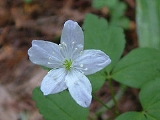
Anemone quinquefolia is an early-spring flowering plant
in the genus Anemone
, native to North America
. It is commonly called Wood Anemone
, like Anemone nemorosa
, a closely related Europe
an species. The American species has been treated as a subspecies of Anemone nemorosa.
It is a perennial herbaceous
plant, growing in early spring to 10-30 cm tall, and dying back down to the root-like rhizome
s by mid summer. The rhizomes, that spread just below the earth surface, grow quickly, contributing to its rapid spread in woodland conditions, where it can carpet large areas. The flower
is 1-2.5 cm diameter, with five (occasionally four, or six to nine) petal
-like segments (actually tepal
s). The flowers are white, commonly flushed pinkish.
Leaves are deeply lobed with toothed margins.
There are three varieties.
Anemone quinquefolia is part of a species complex that includes A. grayi, A. lancifolia, A. lyalliaa, A. oregana and A. piperi.
Flowering plant
The flowering plants , also known as Angiospermae or Magnoliophyta, are the most diverse group of land plants. Angiosperms are seed-producing plants like the gymnosperms and can be distinguished from the gymnosperms by a series of synapomorphies...
in the genus Anemone
Anemone
Anemone , is a genus of about 120 species of flowering plants in the buttercup family Ranunculaceae in the north and south temperate zones...
, native to North America
North America
North America is a continent wholly within the Northern Hemisphere and almost wholly within the Western Hemisphere. It is also considered a northern subcontinent of the Americas...
. It is commonly called Wood Anemone
Wood Anemone
Wood anemone is a common name for three closely related species of woodland anemone.In Europe: Anemone nemorosaIn North America: Anemone quinquefoliaThe Yellow wood anemone is Anemone ranunculoides....
, like Anemone nemorosa
Anemone nemorosa
Anemone nemorosa is an early-spring flowering plant in the genus Anemone in the family Ranunculaceae, native to Europe. Common names include wood anemone, windflower, thimbleweed and smell fox, an allusion to the musky smell of the leaves...
, a closely related Europe
Europe
Europe is, by convention, one of the world's seven continents. Comprising the westernmost peninsula of Eurasia, Europe is generally 'divided' from Asia to its east by the watershed divides of the Ural and Caucasus Mountains, the Ural River, the Caspian and Black Seas, and the waterways connecting...
an species. The American species has been treated as a subspecies of Anemone nemorosa.
It is a perennial herbaceous
Herbaceous
A herbaceous plant is a plant that has leaves and stems that die down at the end of the growing season to the soil level. They have no persistent woody stem above ground...
plant, growing in early spring to 10-30 cm tall, and dying back down to the root-like rhizome
Rhizome
In botany and dendrology, a rhizome is a characteristically horizontal stem of a plant that is usually found underground, often sending out roots and shoots from its nodes...
s by mid summer. The rhizomes, that spread just below the earth surface, grow quickly, contributing to its rapid spread in woodland conditions, where it can carpet large areas. The flower
Flower
A flower, sometimes known as a bloom or blossom, is the reproductive structure found in flowering plants . The biological function of a flower is to effect reproduction, usually by providing a mechanism for the union of sperm with eggs...
is 1-2.5 cm diameter, with five (occasionally four, or six to nine) petal
Petal
Petals are modified leaves that surround the reproductive parts of flowers. They often are brightly colored or unusually shaped to attract pollinators. Together, all of the petals of a flower are called a corolla. Petals are usually accompanied by another set of special leaves called sepals lying...
-like segments (actually tepal
Tepal
Tepals are elements of the perianth, or outer part of a flower, which include the petals or sepals. The term tepal is more often applied specifically when all segments of the perianth are of similar shape and color, or undifferentiated, which is called perigone...
s). The flowers are white, commonly flushed pinkish.
Leaves are deeply lobed with toothed margins.
There are three varieties.
- Anemone quinquefolia var. bifolia that grows in the Midwest.
- Anemone quinquefolia var. quinquefolia that grows over the entire species range.
- Anemone quinquefolia var. minima that grows in North Carolina, Tennessee and Virginia.
Anemone quinquefolia is part of a species complex that includes A. grayi, A. lancifolia, A. lyalliaa, A. oregana and A. piperi.