


Andries de Graeff

Encyclopedia
Free Imperial Knight Andries de Graeff (Amsterdam
, February 19, 1611 – November 30, 1678) was a very powerful member of the Amsterdam
branch of the De Graeff
- family during the Dutch Golden Age
. He became a mayor
of Amsterdam and a powerful Amsterdam regent
after the death of his older brother Cornelis de Graeff
. Like him and their father Jacob Dircksz de Graeff
he opposed the house of Orange. In the mid 17th century he controlled the finances and politics.
Andries de Graeff followed in his father and brothers footsteps and, between 1657 and 1672, was appointed mayor some seven times. De Graeff was a member of a family of regents who belonged to the republican
political movement also referred to as the ‘state oriented’, as opposed to the Royalist
s. Andries was called the last regent and mayor from the dynastie of the "Graven", who was powerful and able enough to ruled the city of Amsterdam.
De Graeff was also an Ambachtsheer (Lord of the manor
) from Urk
en Emmeloord
, during the late 1650s chiefcouncillor
of the Admiralty of Amsterdam
, chieflandholder of the Watergraafsmeer and dijkgraaf van Nieuwer-Amstel.
Together with his broether Cornelis De Graeff became an illustrious Patron
and Art collector
.
and Aaltje Boelens Loen. His older sister Agneta who married Johan Bicker, was the mother of Johan de Witt
s wife Wendela Bicker. After he has been finished his study in Poitiers
he was married to his nice Elisabeth Bicker van Swieten, daughter of the Amsterdam Mayor Cornelis Bicker van Swieten.
Both his brother Cornelis and Andries were very critical of the Orange family’s influence. Together with the Republican political leader Grand Pensionary
Johan de Witt
, the De Graeff brothers strived for the abolition of stadtholder
ship. They desired the full sovereignty of the individual regions in a form in which the Republic of the United Seven Netherlands
was not ruled by a single person. Instead of a sovereign (or stadtholder) the political and military power was lodged with the States General and with the regents of the cities in Holland.
During the two decades the De Graeff family had a leading role in the Amsterdam administration, the city was at the peak of its political power. This period was also referred to by Republicans as the ‘Ware Vrijheid’ (True Freedom). It was the First Stadtholderless Period
which lasted from 1650 to 1672. During these twenty years, the regents from Holland and in particular those of Amsterdam, controlled the republic. The city was flush with self confidence and liked to compare itself to the famous Republic of Rome. Even without a stadtholder, things seemed to be going well for the Republic and its regents both politically and economically.
and from 1657-71 mayor seven times in the difficult times of the First Stadtholderless Period
. Between 1650 and 1657 he was advisor of finances and finace minister of Holland at Den Haag.
Like his brother Cornelis, their cousin Andries Bicker
and Joan Huydecoper van Maarsseveen
De Graeff became one of the main figures behind the building of a new city hall on the Dam
, which was inaugurated in 1655.
In 1650 he started his career as advisor in the ministerium of finances in Den Haag. After he became a minister he went back to Amsterdam, and took place as a sort of chairing mayor of this city. After the death of his brother Cornelis, De Graeff became the strong leader of the republicans. He held this position until the rampjaar
.
He also became an advisor of the Admiralty of Amsterdam and in 1661 he was made an advisor of the States of Holland and West Friesland.
was organized by the regents, especially Andries and his brother Cornelis. The sculptures for the gift were selected by the pre-eminent sculptor in the Netherlands, Artus Quellinus
, and Gerrit van Uylenburgh
, the son of Rembrandt's dealer Hendrick van Uylenburgh
, advised the States-General on the purchase. The Dutch Gift was a collection of 28 mostly Italian Renaissance paintings and 12 classical sculptures, along with a yacht, the Mary, and furniture, which was presented to King Charles II of England by the States-General of the Netherlands in 1660.
Most of the paintings and all the Roman sculptures were from the Reynst collection
, the most important seventeenth-century Dutch collection of paintings of the Italian sixteenth century, formed in Venice
by Jan Reynst
(1601–1646) and extended by his brother, Gerrit Reynst
(1599–1658).
The collection was given to Charles II to mark his return to power in the English Restoration
, before which Charles had spent many years in exile in the Dutch Republic during the rule of the English Commonwealth. It was intended to strengthen diplomatic relations between England and the Republic, but only a few years after the gift the two nations would be at war again in the Second Anglo-Dutch War
of 1665–67.
.jpg) In 1667 De Graeff was one of the "sponsors" (the other signers where De Witt, Gillis Valckenier
In 1667 De Graeff was one of the "sponsors" (the other signers where De Witt, Gillis Valckenier
and Gaspar Fagel
) of the Perpetual Edict
, that was a resolution of the States of Holland in which they abolished the office of Stadtholder
in the province of Holland. At approximately the same time a majority of provinces in the States-General of the Netherlands
agreed to declare the office of stadtholder (in any of the provinces) incompatible with the office of Captain general
of the Dutch Republic.
The Republic was in a dangerous position and war with France
and England
seemed imminent. The call for the return of a strong military leader from the Orange family was gaining momentum, particularly among commoners. A number of Amsterdam regents had started to realise that they needed to seek rapprochement with the Orangists. This put increasing pressure on Grand Pensionary Johan de Witt
s position. In 1670, the Amsterdamse Vroedschap
(Amsterdam City Council) led by Mayors Valckenier and Coenraad van Beuningen
decided to enter into an alliance with the Orangists and to offer the young prince William III of Orange
a seat on the Council of State
. This caused a definitive split between De Witt and the Orangist Amsterdam Group of regents around Mayor Valckenier. However, De Witt managed to push the turncoats into the Amsterdam city administration and they were sidelined during the vroedschap elections of February 1671.
Andries de Graeff was once again put forward as mayor and managed to gain control with his Republican faction. During the winter of 1671 it seemed as if – at least in Amsterdam – the Republicans were winning. It was an exceptionally opportune moment to commission a monumental ceiling painting on Amsterdam’s independent position for the ‘Sael’ of his mayor’s residence. De Graeff had a clear message in mind for the ceiling painting: the ‘Ware Vrijheid’ of the Republic was only protected by the Republican regents of Amsterdam. The paintings by Gerard de Lairesse
glorify the de Graeff family’s role as the protector of the Republican state, defender of ‘Freedom’. The work of art can be viewed as a visual statement opposing the return of House of Orange.
In 1672, when the Orangists took power again, de Graeff lost his position as one of the key States party figure together with his nephews Pieter
and Jacob de Graeff
and his brother-in-law Lambert Reynst. In that year, De Graeff was also attacked by the Amsterdam mob crowd at the Haarlemmerpoort.
, Govaert Flinck, Artus Quellinus
and Joost van den Vondel
.
Van den Vondel wrote a book about De Graeffs descent and family, which was called Afbeeldingen der stamheeren en zommige telgen van de Graven, Boelensen, Bickeren en Witsens, toegewyt den edelen en gestrengen Heere Andries de Graeff, enz. met hunne portretten. Het vers Op den edelen en gestrengen Heer Andries de Graeff, Ouden Raet en Rekenmeester der Graeflijckheit van Hollant, en West-Vrieslant, nu Out-Burgermeester, en Zeeraedt t'Amsterdam
At his City Palace in the Gouden Bocht
("Golden Bend"), the most prestigious part of Herengracht, he assembled a big art collection, including Jacob Blessing the Sons of Joseph of Rembrandt.
In 1674 Andries de Graeff owned 700.000 Guilder. About that he was one of the richest persons from the Dutch Golden Age
.
, became knights of the Holy Roman Empire
. They said, that they descent from Wolfgang von Graben
, member of the austria
n noble family House of Graben von Stein
, which was an apparent (or illegitimate
) branch of the House of Meinhardin. That diplome dadet from 19 July 1677. His tomb chapel is to be found of at the Oude Kerk in Amsterdam.
Amsterdam
Amsterdam is the largest city and the capital of the Netherlands. The current position of Amsterdam as capital city of the Kingdom of the Netherlands is governed by the constitution of August 24, 1815 and its successors. Amsterdam has a population of 783,364 within city limits, an urban population...
, February 19, 1611 – November 30, 1678) was a very powerful member of the Amsterdam
Amsterdam
Amsterdam is the largest city and the capital of the Netherlands. The current position of Amsterdam as capital city of the Kingdom of the Netherlands is governed by the constitution of August 24, 1815 and its successors. Amsterdam has a population of 783,364 within city limits, an urban population...
branch of the De Graeff
De Graeff
De Graeff is an old Dutch patrician family. The family have played an important role during the Dutch Golden Age. They were at the centre of Amsterdam public life and oligarchy from 1578 until 1672...
- family during the Dutch Golden Age
Dutch Golden Age
The Golden Age was a period in Dutch history, roughly spanning the 17th century, in which Dutch trade, science, military and art were among the most acclaimed in the world. The first half is characterised by the Eighty Years' War till 1648...
. He became a mayor
Mayor
In many countries, a Mayor is the highest ranking officer in the municipal government of a town or a large urban city....
of Amsterdam and a powerful Amsterdam regent
Regent
A regent, from the Latin regens "one who reigns", is a person selected to act as head of state because the ruler is a minor, not present, or debilitated. Currently there are only two ruling Regencies in the world, sovereign Liechtenstein and the Malaysian constitutive state of Terengganu...
after the death of his older brother Cornelis de Graeff
Cornelis de Graeff
Cornelis de Graeff, also Cornelis de Graeff van Polsbroek was the most illustrious member of the De Graeff family. He was a mayor of Amsterdam from the Dutch Golden Age and a powerful Amsterdam regent after the sudden death of stadholder William II of Orange...
. Like him and their father Jacob Dircksz de Graeff
Jacob Dircksz de Graeff
Jacob Dircksz de Graeff was one of the most illustrious members of the De Graeff family. He was a powerful member of the States Faction, regent and mayor of Amsterdam after the political collapse of Reinier Pauw in 1627.In the mid 17th century, during the Dutch Golden Age, De Graeff controlled...
he opposed the house of Orange. In the mid 17th century he controlled the finances and politics.
Andries de Graeff followed in his father and brothers footsteps and, between 1657 and 1672, was appointed mayor some seven times. De Graeff was a member of a family of regents who belonged to the republican
Republicanism
Republicanism is the ideology of governing a nation as a republic, where the head of state is appointed by means other than heredity, often elections. The exact meaning of republicanism varies depending on the cultural and historical context...
political movement also referred to as the ‘state oriented’, as opposed to the Royalist
Royalist
A royalist supports a particular monarch as head of state for a particular kingdom, or of a particular dynastic claim. In the abstract, this position is royalism. It is distinct from monarchism, which advocates a monarchical system of government, but not necessarily a particular monarch...
s. Andries was called the last regent and mayor from the dynastie of the "Graven", who was powerful and able enough to ruled the city of Amsterdam.
De Graeff was also an Ambachtsheer (Lord of the manor
Lord of the Manor
The Lordship of a Manor is recognised today in England and Wales as a form of property and one of three elements of a manor that may exist separately or be combined and may be held in moieties...
) from Urk
Urk
Urk is a municipality and a town in the Flevoland province in the central Netherlands.Urk is first mentioned in historical records dating to the 10th century, when it was still an island in the Almere, a lake that would become part of the Zuiderzee in the 13th century after a series of incursions...
en Emmeloord
Emmeloord
Emmeloord is the administrative center of the municipality of Noordoostpolder, Flevoland, Netherlands.At the heart of the Noordoostpolder, where the three main drainage canals intersect, is the city of Emmeloord . Emmeloord is in a polder: land reclaimed from the IJsselmeer, which earlier was part...
, during the late 1650s chiefcouncillor
Councillor
A councillor or councilor is a member of a local government council, such as a city council.Often in the United States, the title is councilman or councilwoman.-United Kingdom:...
of the Admiralty of Amsterdam
Admiralty of Amsterdam
The Admiralty of Amsterdam was the largest of the five Dutch admiralties at the time of the Dutch Republic. The administration of the various Admiralties was strongly influenced by provincial interests...
, chieflandholder of the Watergraafsmeer and dijkgraaf van Nieuwer-Amstel.
Together with his broether Cornelis De Graeff became an illustrious Patron
Patronage
Patronage is the support, encouragement, privilege, or financial aid that an organization or individual bestows to another. In the history of art, arts patronage refers to the support that kings or popes have provided to musicians, painters, and sculptors...
and Art collector
Private collection
A private collection is a privately owned collection of works, usually a collection of art. If seen in a museum alongside a work or describing said work, it signifies that piece of art in a museum is not actually owned by that museum, but is on loan from an independent source. This source will...
.
Family De Graeff
Andries de Graeff was the third son of Jacob Dircksz de GraeffJacob Dircksz de Graeff
Jacob Dircksz de Graeff was one of the most illustrious members of the De Graeff family. He was a powerful member of the States Faction, regent and mayor of Amsterdam after the political collapse of Reinier Pauw in 1627.In the mid 17th century, during the Dutch Golden Age, De Graeff controlled...
and Aaltje Boelens Loen. His older sister Agneta who married Johan Bicker, was the mother of Johan de Witt
Johan de Witt
Johan de Witt, heer van Zuid- en Noord-Linschoten, Snelrewaard, Hekendorp and IJsselveere was a key figure in Dutch politics in the mid 17th century, when its flourishing sea trade in a period of globalization made the United Provinces a leading European power during the Dutch Golden Age...
s wife Wendela Bicker. After he has been finished his study in Poitiers
Poitiers
Poitiers is a city on the Clain river in west central France. It is a commune and the capital of the Vienne department and of the Poitou-Charentes region. The centre is picturesque and its streets are interesting for predominant remains of historical architecture, especially from the Romanesque...
he was married to his nice Elisabeth Bicker van Swieten, daughter of the Amsterdam Mayor Cornelis Bicker van Swieten.
Both his brother Cornelis and Andries were very critical of the Orange family’s influence. Together with the Republican political leader Grand Pensionary
Grand Pensionary
The Grand Pensionary was the most important Dutch official during the time of the United Provinces. In theory he was only a civil servant of the Estates of the dominant province among the Seven United Provinces: the county of Holland...
Johan de Witt
Johan de Witt
Johan de Witt, heer van Zuid- en Noord-Linschoten, Snelrewaard, Hekendorp and IJsselveere was a key figure in Dutch politics in the mid 17th century, when its flourishing sea trade in a period of globalization made the United Provinces a leading European power during the Dutch Golden Age...
, the De Graeff brothers strived for the abolition of stadtholder
Stadtholder
A Stadtholder A Stadtholder A Stadtholder (Dutch: stadhouder [], "steward" or "lieutenant", literally place holder, holding someones place, possibly a calque of German Statthalter, French lieutenant, or Middle Latin locum tenens...
ship. They desired the full sovereignty of the individual regions in a form in which the Republic of the United Seven Netherlands
Dutch Republic
The Dutch Republic — officially known as the Republic of the Seven United Netherlands , the Republic of the United Netherlands, or the Republic of the Seven United Provinces — was a republic in Europe existing from 1581 to 1795, preceding the Batavian Republic and ultimately...
was not ruled by a single person. Instead of a sovereign (or stadtholder) the political and military power was lodged with the States General and with the regents of the cities in Holland.
During the two decades the De Graeff family had a leading role in the Amsterdam administration, the city was at the peak of its political power. This period was also referred to by Republicans as the ‘Ware Vrijheid’ (True Freedom). It was the First Stadtholderless Period
First Stadtholderless Period
The First Stadtholderless Period or Era is the period in the history of the Dutch Republic in which the office of a Stadtholder was absent in five of the seven Dutch provinces...
which lasted from 1650 to 1672. During these twenty years, the regents from Holland and in particular those of Amsterdam, controlled the republic. The city was flush with self confidence and liked to compare itself to the famous Republic of Rome. Even without a stadtholder, things seemed to be going well for the Republic and its regents both politically and economically.
Political Career
Andries de Graeff was from 1646 a member of the vroedschapVroedschap
The vroedschap was the name for the city council in the early modern Netherlands; the member of such a council was called a vroedman, literally a "wise man"...
and from 1657-71 mayor seven times in the difficult times of the First Stadtholderless Period
First Stadtholderless Period
The First Stadtholderless Period or Era is the period in the history of the Dutch Republic in which the office of a Stadtholder was absent in five of the seven Dutch provinces...
. Between 1650 and 1657 he was advisor of finances and finace minister of Holland at Den Haag.
Like his brother Cornelis, their cousin Andries Bicker
Andries Bicker
Andries Bicker was a wealthy merchant on Moscovia, a member of the vroedschap, the leader of the Arminians, an administrator of the VOC, representative of the States-General of the Netherlands and colonel in the Civic guard...
and Joan Huydecoper van Maarsseveen
Joan Huydecoper I
Joan Huydecoper van Maarsseveen took over the family tannery business and the trade in pelts and armaments. The name Huydecoper means literally 'buyer of pelts'. Huydecoper had a prosperous political career: first he was elected to the vroedschap of Amsterdam...
De Graeff became one of the main figures behind the building of a new city hall on the Dam
Royal Palace (Amsterdam)
The Royal Palace in Amsterdam is one of three palaces in the Netherlands which is at the disposal of Queen Beatrix by Act of Parliament. The palace was built as city hall during the Dutch Golden Age in the seventeenth century. The building became the royal palace of king Louis Napoleon and later...
, which was inaugurated in 1655.
In 1650 he started his career as advisor in the ministerium of finances in Den Haag. After he became a minister he went back to Amsterdam, and took place as a sort of chairing mayor of this city. After the death of his brother Cornelis, De Graeff became the strong leader of the republicans. He held this position until the rampjaar
Rampjaar
The rampjaar was the year 1672 in Dutch history. In that year,the Republic of the Seven United Provinces was after the outbreak of the Franco-Dutch War and the Third Anglo-Dutch War attacked by England, France, and the prince-electors Bernhard von Galen, bishop of Münster and Maximilian Henry of...
.
He also became an advisor of the Admiralty of Amsterdam and in 1661 he was made an advisor of the States of Holland and West Friesland.
The Dutch Gift
In 1660 the Dutch GiftDutch Gift
The Dutch Gift of 1660 was a collection of 28 mostly Italian Renaissance paintings and 12 classical sculptures, along with a yacht, the Mary, and furniture, which was presented to King Charles II of England by the States-General of the Netherlands in 1660...
was organized by the regents, especially Andries and his brother Cornelis. The sculptures for the gift were selected by the pre-eminent sculptor in the Netherlands, Artus Quellinus
Artus Quellinus
Artus Quellinus also known as Artus Quellijn, Artus I Quellinus or Artus Quellinus the Elder , was a Flemish sculptor.-Life:...
, and Gerrit van Uylenburgh
Gerrit van Uylenburgh
Gerrit van Uylenburgh , or Gerrit Uylenburgh, was a Dutch Golden Age painter and art-dealer. He was the eldest son of Hendrick van Uylenburgh and took over the family art-dealing business after Hendrick's death and burial in the Westerkerk church in 1661...
, the son of Rembrandt's dealer Hendrick van Uylenburgh
Hendrick van Uylenburgh
Hendrick van Uylenburgh was an influential Dutch Golden Age art dealer who helped launch the careers of Rembrandt, Govert Flinck, Ferdinand Bol and other painters....
, advised the States-General on the purchase. The Dutch Gift was a collection of 28 mostly Italian Renaissance paintings and 12 classical sculptures, along with a yacht, the Mary, and furniture, which was presented to King Charles II of England by the States-General of the Netherlands in 1660.
Most of the paintings and all the Roman sculptures were from the Reynst collection
Reynst Collection
The Reynst Collection, probably the most extensive 17th century collection of art and artefacts, was owned by the Dutch merchants Gerrit Reynst and Jan Reynst. The collection was put on display in their house at the sign of Hope on the Keizersgracht in Amsterdam...
, the most important seventeenth-century Dutch collection of paintings of the Italian sixteenth century, formed in Venice
Venice
Venice is a city in northern Italy which is renowned for the beauty of its setting, its architecture and its artworks. It is the capital of the Veneto region...
by Jan Reynst
Jan Reynst
Jan Reynst was a Protestant Dutch merchant in Amsterdam and, with his elder brother Gerrit, an art collector. In 1625 he went to Venice...
(1601–1646) and extended by his brother, Gerrit Reynst
Gerrit Reynst
Gerrit Reynst was, like his younger brother Jan , a Dutch merchant and art collector from Amsterdam. He was an alderman and member of the town council, entering it in 1646.-The Collection:Gerrit's collection included Italian old-master paintings and antiquities, such as by Johann Liss...
(1599–1658).
The collection was given to Charles II to mark his return to power in the English Restoration
English Restoration
The Restoration of the English monarchy began in 1660 when the English, Scottish and Irish monarchies were all restored under Charles II after the Interregnum that followed the Wars of the Three Kingdoms...
, before which Charles had spent many years in exile in the Dutch Republic during the rule of the English Commonwealth. It was intended to strengthen diplomatic relations between England and the Republic, but only a few years after the gift the two nations would be at war again in the Second Anglo-Dutch War
Second Anglo-Dutch War
The Second Anglo–Dutch War was part of a series of four Anglo–Dutch Wars fought between the English and the Dutch in the 17th and 18th centuries for control over the seas and trade routes....
of 1665–67.
Perpetual Edict (1667) and the Rampjaar 1672
Gillis Valckenier
Gillis Valckenier was nine years burgomaster of Amsterdam: in 1665, 1666, 1668, 1670, 1673, 1674, 1676, 1678, 1679. He was a strong personality, but changing allies as a real opportunist....
and Gaspar Fagel
Gaspar Fagel
Gaspar Fagel was a Dutch statesman, writer and quasi-diplomat who authored correspondence from and on behalf of William III, Prince of Orange during the English Revolution of 1688.-Biography:...
) of the Perpetual Edict
Perpetual Edict (1667)
The Perpetual Edict of August 5, 1667 was a resolution of the States of Holland in which they abolished the office of Stadtholder in the province of Holland...
, that was a resolution of the States of Holland in which they abolished the office of Stadtholder
Stadtholder
A Stadtholder A Stadtholder A Stadtholder (Dutch: stadhouder [], "steward" or "lieutenant", literally place holder, holding someones place, possibly a calque of German Statthalter, French lieutenant, or Middle Latin locum tenens...
in the province of Holland. At approximately the same time a majority of provinces in the States-General of the Netherlands
States-General of the Netherlands
The States-General of the Netherlands is the bicameral legislature of the Netherlands, consisting of the Senate and the House of Representatives. The parliament meets in at the Binnenhof in The Hague. The archaic Dutch word "staten" originally related to the feudal classes in which medieval...
agreed to declare the office of stadtholder (in any of the provinces) incompatible with the office of Captain general
Captain General
Captain general is a high military rank and a gubernatorial title.-History:This term Captain General started to appear in the 14th century, with the meaning of commander in chief of an army in the field, probably the first usage of the term General in military settings...
of the Dutch Republic.
The Republic was in a dangerous position and war with France
France
The French Republic , The French Republic , The French Republic , (commonly known as France , is a unitary semi-presidential republic in Western Europe with several overseas territories and islands located on other continents and in the Indian, Pacific, and Atlantic oceans. Metropolitan France...
and England
England
England is a country that is part of the United Kingdom. It shares land borders with Scotland to the north and Wales to the west; the Irish Sea is to the north west, the Celtic Sea to the south west, with the North Sea to the east and the English Channel to the south separating it from continental...
seemed imminent. The call for the return of a strong military leader from the Orange family was gaining momentum, particularly among commoners. A number of Amsterdam regents had started to realise that they needed to seek rapprochement with the Orangists. This put increasing pressure on Grand Pensionary Johan de Witt
Johan de Witt
Johan de Witt, heer van Zuid- en Noord-Linschoten, Snelrewaard, Hekendorp and IJsselveere was a key figure in Dutch politics in the mid 17th century, when its flourishing sea trade in a period of globalization made the United Provinces a leading European power during the Dutch Golden Age...
s position. In 1670, the Amsterdamse Vroedschap
Vroedschap
The vroedschap was the name for the city council in the early modern Netherlands; the member of such a council was called a vroedman, literally a "wise man"...
(Amsterdam City Council) led by Mayors Valckenier and Coenraad van Beuningen
Coenraad van Beuningen
Coenraad van Beuningen was the Dutch Republic's most experienced diplomat, burgemeester of Amsterdam in 1669, 1672, 1680, 1681, 1683 and 1684, and from 1681 a VOC director...
decided to enter into an alliance with the Orangists and to offer the young prince William III of Orange
William III of England
William III & II was a sovereign Prince of Orange of the House of Orange-Nassau by birth. From 1672 he governed as Stadtholder William III of Orange over Holland, Zeeland, Utrecht, Guelders, and Overijssel of the Dutch Republic. From 1689 he reigned as William III over England and Ireland...
a seat on the Council of State
Council of State
The Council of State is a unique governmental body in a country or subdivision thereoff, though its nature may range from the formal name for the cabinet to a non-executive advisory body surrounding a head of state. It is sometimes regarded as the equivalent of a privy council.-Modern:*Belgian...
. This caused a definitive split between De Witt and the Orangist Amsterdam Group of regents around Mayor Valckenier. However, De Witt managed to push the turncoats into the Amsterdam city administration and they were sidelined during the vroedschap elections of February 1671.
Andries de Graeff was once again put forward as mayor and managed to gain control with his Republican faction. During the winter of 1671 it seemed as if – at least in Amsterdam – the Republicans were winning. It was an exceptionally opportune moment to commission a monumental ceiling painting on Amsterdam’s independent position for the ‘Sael’ of his mayor’s residence. De Graeff had a clear message in mind for the ceiling painting: the ‘Ware Vrijheid’ of the Republic was only protected by the Republican regents of Amsterdam. The paintings by Gerard de Lairesse
Gerard de Lairesse
Gerard or Gérard de Lairesse was a Dutch Golden Age painter and art theorist.Lairesse was born in Liège. His broad range of talent included music, poetry, and the theatre. He was perhaps the most celebrated Dutch painter in the period following the death of Rembrandt...
glorify the de Graeff family’s role as the protector of the Republican state, defender of ‘Freedom’. The work of art can be viewed as a visual statement opposing the return of House of Orange.
In 1672, when the Orangists took power again, de Graeff lost his position as one of the key States party figure together with his nephews Pieter
Pieter de Graeff
Pieter de Graeff , was a member of the De Graeff-family from the Dutch Golden Age. He was an Amsterdam Regent during the late 1660s and the early 1670s, and held the titles as Lord of the semi-sovereign Fief Zuid-Polsbroek and 19.th Lord of the Free and high Fief Ilpendam and Purmerland...
and Jacob de Graeff
Jacob de Graeff
Jacob de Graeff , was a member of the De Graeff-family from the Dutch Golden Age. He was an Amsterdam Regent and held the titles as 20.th Lord of the Free and high Fief Ilpendam and Purmerland...
and his brother-in-law Lambert Reynst. In that year, De Graeff was also attacked by the Amsterdam mob crowd at the Haarlemmerpoort.
Art and Lifestyle
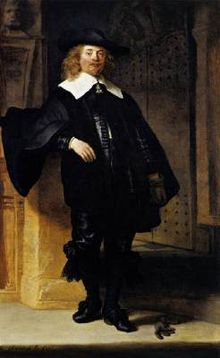
De Graeff was a man, who surrounding himself with art and beauty. He was an art-collector and patron of such artists and poets like Rembrandt van Rijn, who painted his portrait, Gerard ter BorchGerard ter Borch
Gerard ter Borch was a Dutch genre painter, who lived in the Dutch Golden Age.-Biography:Gerard ter Borch was born in December 1617 in Zwolle in the province of Overijssel in the Dutch Republic....
, Govaert Flinck, Artus Quellinus
Artus Quellinus
Artus Quellinus also known as Artus Quellijn, Artus I Quellinus or Artus Quellinus the Elder , was a Flemish sculptor.-Life:...
and Joost van den Vondel
Joost van den Vondel
Joost van den Vondel was a Dutch writer and playwright. He is considered the most prominent Dutch poet and playwright of the 17th century. His plays are the ones from that period that are still most frequently performed, and his epic Joannes de Boetgezant , on the life of John the Baptist, has...
.
Van den Vondel wrote a book about De Graeffs descent and family, which was called Afbeeldingen der stamheeren en zommige telgen van de Graven, Boelensen, Bickeren en Witsens, toegewyt den edelen en gestrengen Heere Andries de Graeff, enz. met hunne portretten. Het vers Op den edelen en gestrengen Heer Andries de Graeff, Ouden Raet en Rekenmeester der Graeflijckheit van Hollant, en West-Vrieslant, nu Out-Burgermeester, en Zeeraedt t'Amsterdam
At his City Palace in the Gouden Bocht
Gouden Bocht
The Gouden Bocht is the most prestigious part of Herengracht in Amsterdam, between Leidsestraat and Vijzelstraat.Until 1663 Herengracht reached as far as the present Leidsegracht. From that year on, the fortifications around Amsterdam were expanded, within Herengracht, Keizersgracht and...
("Golden Bend"), the most prestigious part of Herengracht, he assembled a big art collection, including Jacob Blessing the Sons of Joseph of Rembrandt.
In 1674 Andries de Graeff owned 700.000 Guilder. About that he was one of the richest persons from the Dutch Golden Age
Dutch Golden Age
The Golden Age was a period in Dutch history, roughly spanning the 17th century, in which Dutch trade, science, military and art were among the most acclaimed in the world. The first half is characterised by the Eighty Years' War till 1648...
.
Death
Before De Graeff died, he and his only son, CornelisCornelis HrR Ridder de Graeff
Cornelis de Graeff, also Andriesz Cornelis de Graeff was a Dutch nobleman and chieflandholder of the Zijpe and Haze Polder....
, became knights of the Holy Roman Empire
Holy Roman Empire
The Holy Roman Empire was a realm that existed from 962 to 1806 in Central Europe.It was ruled by the Holy Roman Emperor. Its character changed during the Middle Ages and the Early Modern period, when the power of the emperor gradually weakened in favour of the princes...
. They said, that they descent from Wolfgang von Graben
Wolfgang von Graben
Wolfgang von Graben, also Wolfgang de Groben , was a member of the Austrian nobility.- Biography :...
, member of the austria
Austria
Austria , officially the Republic of Austria , is a landlocked country of roughly 8.4 million people in Central Europe. It is bordered by the Czech Republic and Germany to the north, Slovakia and Hungary to the east, Slovenia and Italy to the south, and Switzerland and Liechtenstein to the...
n noble family House of Graben von Stein
House of Graben von Stein
Von Graben von Stein, also named, Ab dem Graben, Von Graben and Vom Graben, is the name of an old Austrian noble family...
, which was an apparent (or illegitimate
Legitimacy (law)
At common law, legitimacy is the status of a child who is born to parents who are legally married to one another; and of a child who is born shortly after the parents' divorce. In canon and in civil law, the offspring of putative marriages have been considered legitimate children...
) branch of the House of Meinhardin. That diplome dadet from 19 July 1677. His tomb chapel is to be found of at the Oude Kerk in Amsterdam.
Trivia and Commons
Literature
- Israel, Jonathan I. (1995) The Dutch Republic - It's Rise, Greatness, and Fall - 1477-1806, Clarendon Press, Oxford, ISBN 978-0-19-820734-4
- Zandvliet, Kees (2006) De 250 rijksten van de Gouden Eeuw: kapitaal, macht, familie en levensstijl blz. 93 t/m 94, uitg. Nieuw Amsterdam, Amsterdam, ISBN 90-8689-006-7
- Dudok van Heel, S.A.C.(1995) Op zoek naar Romulus & Remus. Een zeventiende-eeuws onderzoek naar de oudste magistraten van Amsterdam. Jaarboek Amstelodamum, p. 43-70.
- Burke, P. (1994) Venice and Amsterdam. A study of seventeenth-century élites.
- Graeff, P. de (P. de Graeff Gerritsz en Dirk de Graeff van PolsbroekDirk de Graeff van PolsbroekDirk de Graeff van Polsbroek was a successful Dutch diplomat in Japan. From July 1863, he held the post of Consul General and Political Agent in Japan. He played a major part in the many negotiations between various Western countries and Japan...
) Genealogie van de familie De Graeff van Polsbroek, Amsterdam 1882. - Bruijn, J. H. de Genealogie van het geslacht De Graeff van Polsbroek 1529/1827, met bijlagen. De Bilt 1962-63.