


Ancient Iranian Medicine

Encyclopedia

Medicine
Medicine is the science and art of healing. It encompasses a variety of health care practices evolved to maintain and restore health by the prevention and treatment of illness....
in Persia has a long and prolific history. The Iranian academic centers like Jundishapur University (3rd century AD) were a breeding ground for the union among great scientists from different civilizations. These centers successfully followed their predecessors’ theories and greatly extended their scientific research through history.
In recent years, some experimental studies have indeed evaluated Medieval Iranian medical remedies using modern scientific methods. These studies raised the possibility of revival of traditional treatments on the basis of evidence-based medicine.
Pre-Islamic
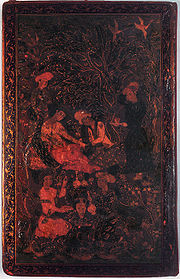
Zend
Zend can mean:*Zend, commentaries on the Avesta, the sacred texts of the Zoroastrian religion.**In older texts, Zend can refer to the Avestan language*Salla Zend, a character in Star Wars*Zend Technologies, a PHP-focused company...
-Avesta
Avesta
The Avesta is the primary collection of sacred texts of Zoroastrianism, composed in the Avestan language.-Early transmission:The texts of the Avesta — which are all in the Avestan language — were composed over the course of several hundred years. The most important portion, the Gathas,...
contains some of the earliest records of history of ancient Iranian medicine. The Vendidad
Vendidad
The Vendidad or Videvdat is a collection of texts within the greater compendium of the Avesta. However, unlike the other texts of the Avesta, the Vendidad is an ecclesiastical code, not a liturgical manual.-Name:...
in fact devotes most of the last chapters to medicine.
In a passage of the Vendidad
Vendidad
The Vendidad or Videvdat is a collection of texts within the greater compendium of the Avesta. However, unlike the other texts of the Avesta, the Vendidad is an ecclesiastical code, not a liturgical manual.-Name:...
, one of the surviving texts of the Zandavesta, three kinds of medicine were distinguished: medicine by the knife (surgery), medicine by herbs, and medicine by divine words; and the best medicine was, according to the Vendidad, healing by divine words:
- "Of all the healers O Spitama Zarathustra, namely those who heal with the knife, with herbs, and with sacred incantations, the last one is the most potent as he heals from the very source of diseases." (Ardibesht Yasht)
Although the Avesta mentions several notable physicians, the most notable of Persia's ancient physicians were to emerge later on, namely: Mani
Mani (prophet)
Mani , of Iranian origin was the prophet and the founder of Manichaeism, a gnostic religion of Late Antiquity which was once widespread but is now extinct...
, Roozbeh, and Bozorgmehr
Bozorgmehr
Bozorgmehr-e Bokhtagan is the name of a vizier of Khusro I Anōšīravān attested in the literature and legend of Iran. According to Persian and Arabic sources, he was a man of "exceptional wisdom and sage counsels" and later became a characterisation of the expression...
.
The second epoch covers the era of what is known as Pahlavi literature, where the entire subject of medicine was systematically treated in an interesting tractate incorporated in the encyclopedic work of Dinkart
Denkard
The Dēnkard or Dēnkart is a 10th century compendium of the Mazdaen Zoroastrian beliefs and customs. The Denkard is to a great extent an "Encyclopedia of Mazdaism" and is a most valuable source of information on the religion...
, which listed in altered form some 4333 diseases.
The third era begins with the Achaemenid dynasty, and covers the period of Darius I of Persia
Darius I of Persia
Darius I , also known as Darius the Great, was the third king of kings of the Achaemenid Empire...
, whose interest in medicine was said to be so great that he re-established the school of medicine in Sais, Egypt
Sais, Egypt
Sais or Sa el-Hagar was an ancient Egyptian town in the Western Nile Delta on the Canopic branch of the Nile. It was the provincial capital of Sap-Meh, the fifth nome of Lower Egypt and became the seat of power during the Twenty-fourth dynasty of Egypt and the Saite Twenty-sixth dynasty of Egypt ...
, which previously had been destroyed, restoring its books and equipment.
The first teaching hospital where medical students methodically practiced on patients under the supervision of physicians was the Academy of Gundishapur
Academy of Gundishapur
The Academy of Gondishapur , also Jondishapur , was a renowned academy of learning in the city of Gundeshapur during late antiquity, the intellectual center of the Sassanid empire. It offered training in medicine, philosophy, theology and science. The faculty were versed in the Zoroastrian and...
in the Persian Empire. Some experts go so far as to claim that: "to a very large extent, the credit for the whole hospital system must be given to Persia".
According to the Vendidad
Vendidad
The Vendidad or Videvdat is a collection of texts within the greater compendium of the Avesta. However, unlike the other texts of the Avesta, the Vendidad is an ecclesiastical code, not a liturgical manual.-Name:...
physicians for the proof of proficiency had to cure three patients from the followers of Divyasnan and if they failed they could not practice medicine. At the first glance this recommendation may appear discriminative and based on human experimentation. But some authors have construed that from the beginning physicians were taught to remove the mental barrier and treat adversaries as well as friends. Interestingly, physician’s fee for service was based on the patient’s income.
Islamic conquest of Persia
The Muslim conquest of Persia led to the end of the Sassanid Empire in 644, the fall of Sassanid dynasty in 651 and the eventual decline of the Zoroastrian religion in Persia...
(630 A.D.). Many schools, universities and libraries were destroyed, books were burned and scholars killed. Nevertheless, the Iranian scientists carried on and the science of Persia resurfaced during the Islamic period. To save the books from the Arab carnage, many Pahlavi scripts
Pahlavi scripts
Pahlavi or Pahlevi denotes a particular and exclusively written form of various Middle Iranian languages. The essential characteristics of Pahlavi are*the use of a specific Aramaic-derived script, the Pahlavi script;...
were translated into the Arabic, and Iran produced physicians and scientists as Abū ʿAlī al-Ḥusayn ibn ʿAbd Allāh ibn Sīnā, Muhammad ibn Zakariya al-Razi and mathematicians as Kharazmi and Omar Khayyám
Omar Khayyám
Omar Khayyám was aPersian polymath: philosopher, mathematician, astronomer and poet. He also wrote treatises on mechanics, geography, mineralogy, music, climatology and theology....
. They collected and systematically expanded the Greek, Indian, and Persian ancient medical heritage and made further discoveries.
Medieval Islamic Period
One of the main roles played by medieval Iranian scholars in the scientific field was the conservation, consolidation, coordination and development of ideas and knowledge in ancient civilizations. Some Iranian HakimHakim (title)
' and ' are two Arabic titles derived from the same triliteral ḤKM "appoint, choose, judge". Compare the Hebrew title hakham.-Hakīm :...
(practitioners) such as
Fakhr al-Din al-Razi
Fakhr al-Din al-Razi
Abu Abdullah Muhammad ibn Umar ibn al-Husayn al-Taymi al-Bakri al-Tabaristani Fakhr al-Din al-Razi , most commonly known as Fakhruddin Razi was a well-known Persian Sunni Muslim theologian and philosopher....
, Muhammad ibn Zakariya ar-Razi, known to the West as Rhazes, and Ibn Sina
Avicenna
Abū ʿAlī al-Ḥusayn ibn ʿAbd Allāh ibn Sīnā , commonly known as Ibn Sīnā or by his Latinized name Avicenna, was a Persian polymath, who wrote almost 450 treatises on a wide range of subjects, of which around 240 have survived...
, better known as Avicenna, were not only responsible for accumulating all the existing information on medicine of the time, but adding to this knowledge by their own astute observations, experimentation and skills. "Qanoon fel teb of Avicenna" ("The Canon") and "Kitab al-hawi of Razi" ("Continens") were among the central texts in Western medical education from the 13th to the 18th centuries.
In the 14th century, the Persian language
Persian language
Persian is an Iranian language within the Indo-Iranian branch of the Indo-European languages. It is primarily spoken in Iran, Afghanistan, Tajikistan and countries which historically came under Persian influence...
medical work Tashrih al-badan (Anatomy of the body), by Mansur ibn Ilyas (c. 1390), contained comprehensive diagrams of the body's structural, nervous
Nervous system
The nervous system is an organ system containing a network of specialized cells called neurons that coordinate the actions of an animal and transmit signals between different parts of its body. In most animals the nervous system consists of two parts, central and peripheral. The central nervous...
and circulatory system
Circulatory system
The circulatory system is an organ system that passes nutrients , gases, hormones, blood cells, etc...
s.
Cranial surgery and mental health
Evidence of surgery dates to the 3rd century BC, when the first cranial surgery was performed in the Shahr-e-Sukhteh (Burnt City) in south-eastern Iran. The archaeological studies on the skull of a 13-year-old girl suffering from hydrocephaly indicated that she had undergone cranial surgery to take a part of her skull bone and the girl lived for at least about 6 months after the surgery.Several documents still exist from which the definitions and treatments of the headache
Headache
A headache or cephalalgia is pain anywhere in the region of the head or neck. It can be a symptom of a number of different conditions of the head and neck. The brain tissue itself is not sensitive to pain because it lacks pain receptors. Rather, the pain is caused by disturbance of the...
in medieval Persia can be ascertained. These documents give detailed and precise clinical information on the different types of headaches. The medieval physicians listed various signs and symptoms, apparent causes, and hygienic and dietary rules for prevention of headaches. The medieval writings are both accurate and vivid, and they provide long lists of substances used in the treatment of headaches. Many of the approaches of physicians in medieval Persia are accepted today; however, still more of them could be of use to modern medicine.
Antiepileptic drug therapy plan in Medieval Iranian medicine is individualized, given different single and combined drug-therapy with a dosing schedule for each of those. Physicians stress the importance of dose, and route of administration and define a schedule for drug administration. Recent animal experiments confirm the anticonvulsant potency of some of the compounds which are recommended by Medieval Iranian practitioners in epilepsy treatment.
In The Canon of Medicine
The Canon of Medicine
The Canon of Medicine is an encyclopedia of Galenic medicine in five books compiled by Ibn Sīnā and completed in 1025. It presents a clear and organized summary of all the medical knowledge of the time...
(c. 1025), Avicenna described numerous mental conditions, including hallucination
Hallucination
A hallucination, in the broadest sense of the word, is a perception in the absence of a stimulus. In a stricter sense, hallucinations are defined as perceptions in a conscious and awake state in the absence of external stimuli which have qualities of real perception, in that they are vivid,...
, insomnia
Insomnia
Insomnia is most often defined by an individual's report of sleeping difficulties. While the term is sometimes used in sleep literature to describe a disorder demonstrated by polysomnographic evidence of disturbed sleep, insomnia is often defined as a positive response to either of two questions:...
, mania
Mania
Mania, the presence of which is a criterion for certain psychiatric diagnoses, is a state of abnormally elevated or irritable mood, arousal, and/ or energy levels. In a sense, it is the opposite of depression...
, nightmare
Nightmare
A nightmare is an unpleasant dream that can cause a strong negative emotional response from the mind, typically fear or horror, but also despair, anxiety and great sadness. The dream may contain situations of danger, discomfort, psychological or physical terror...
, melancholia
Melancholia
Melancholia , also lugubriousness, from the Latin lugere, to mourn; moroseness, from the Latin morosus, self-willed, fastidious habit; wistfulness, from old English wist: intent, or saturnine, , in contemporary usage, is a mood disorder of non-specific depression,...
, dementia
Dementia
Dementia is a serious loss of cognitive ability in a previously unimpaired person, beyond what might be expected from normal aging...
, epilepsy
Epilepsy
Epilepsy is a common chronic neurological disorder characterized by seizures. These seizures are transient signs and/or symptoms of abnormal, excessive or hypersynchronous neuronal activity in the brain.About 50 million people worldwide have epilepsy, and nearly two out of every three new cases...
, paralysis
Paralysis
Paralysis is loss of muscle function for one or more muscles. Paralysis can be accompanied by a loss of feeling in the affected area if there is sensory damage as well as motor. A study conducted by the Christopher & Dana Reeve Foundation, suggests that about 1 in 50 people have been diagnosed...
, stroke
Stroke
A stroke, previously known medically as a cerebrovascular accident , is the rapidly developing loss of brain function due to disturbance in the blood supply to the brain. This can be due to ischemia caused by blockage , or a hemorrhage...
, vertigo
Vertigo (medical)
Vertigo is a type of dizziness, where there is a feeling of motion when one is stationary. The symptoms are due to a dysfunction of the vestibular system in the inner ear...
and tremor
Tremor
A tremor is an involuntary, somewhat rhythmic, muscle contraction and relaxation involving to-and-fro movements of one or more body parts. It is the most common of all involuntary movements and can affect the hands, arms, eyes, face, head, vocal folds, trunk, and legs. Most tremors occur in the...
.
Obstetrics and Gynecology
In the 10th century work of ShahnamaShahnameh
The Shahnameh or Shah-nama is a long epic poem written by the Persian poet Ferdowsi between c.977 and 1010 AD and is the national epic of Iran and related societies...
, Ferdowsi
Ferdowsi
Ferdowsi was a highly revered Persian poet. He was the author of the Shahnameh, the national epic of Iran and related societies.The Shahnameh was originally composed by Ferdowsi for the princes of the Samanid dynasty, who were responsible for a revival of Persian cultural traditions after the...
describes a Caesarean section
Caesarean section
A Caesarean section, is a surgical procedure in which one or more incisions are made through a mother's abdomen and uterus to deliver one or more babies, or, rarely, to remove a dead fetus...
performed on Rudaba
Rudaba
Rūdāba or Roodabeh is a Persian mythological female figure in Ferdowsi's epic Shahnameh. She is the princess of Kabul, daughter of Mehrab Kaboli, and later she becomes married to Zal, as they become lovers. They had two children, including Rostam, the main hero of the Shahnama.-Etymology:The word...
, during which a special wine
Wine
Wine is an alcoholic beverage, made of fermented fruit juice, usually from grapes. The natural chemical balance of grapes lets them ferment without the addition of sugars, acids, enzymes, or other nutrients. Grape wine is produced by fermenting crushed grapes using various types of yeast. Yeast...
agent was prepared by a Zoroastrian
Zoroastrianism
Zoroastrianism is a religion and philosophy based on the teachings of prophet Zoroaster and was formerly among the world's largest religions. It was probably founded some time before the 6th century BCE in Greater Iran.In Zoroastrianism, the Creator Ahura Mazda is all good, and no evil...
priest and used as an anesthetic to produce unconsciousness for the operation. Although largely mythical in content, the passage illustrates working knowledge of anesthesia
Anesthesia
Anesthesia, or anaesthesia , traditionally meant the condition of having sensation blocked or temporarily taken away...
in ancient Persia.