
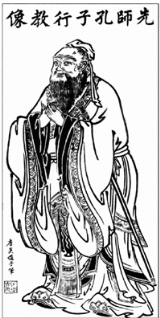
The
Analects, or
Lunyu , also known as the
Analects of Confucius, are considered a record of the words and acts of the central
ChineseChinese civilization may refer to:* China for more general discussion of the country.* Chinese culture* Greater China, the transnational community of ethnic Chinese.* History of China* Sinosphere, the area historically affected by Chinese culture...
thinker and philosopher
ConfuciusConfucius , literally "Master Kong", was a Chinese thinker and social philosopher of the Spring and Autumn Period....
and his
discipleSima Qian has Confucius saying: The disciples who received my instructions, and could themselves comprehend them, were seventy-seven individuals. They were all scholars of extraordinary ability. The common saying is, that the disciples of the sage were three thousand, while among them there were...
s, as well as the discussions they held.
Written during the
Spring and Autumn Period through the
Warring States PeriodThe Warring States Period , also known as the Era of Warring States, or the Warring Kingdoms period, covers the Iron Age period from about 475 BC to the reunification of China under the Qin Dynasty in 221 BC...
(ca. 475 BC - 221 BC), the
Analects is the representative work of
ConfucianismConfucianism is a Chinese ethical and philosophical system developed from the teachings of the Chinese philosopher Confucius . Confucianism originated as an "ethical-sociopolitical teaching" during the Spring and Autumn Period, but later developed metaphysical and cosmological elements in the Han...
and continues to have a substantial influence on Chinese and
East AsiaEast Asia or Eastern Asia is a subregion of Asia that can be defined in either geographical or cultural terms...
n thought and values today.
History and versions
The
Analects was traditionally attributed to Confucius and was written approximately around 500 BC. Most of the text however were written by Confucius' pupils during the period 30 to 50 years after his death. Begun some time during the
Spring and Autumn Period, the work was probably finished during the
Warring States PeriodThe Warring States Period , also known as the Era of Warring States, or the Warring Kingdoms period, covers the Iron Age period from about 475 BC to the reunification of China under the Qin Dynasty in 221 BC...
, though the exact publication date of the first complete
Analects cannot be pinpointed. Much as the
RepublicThe Republic is a Socratic dialogue written by Plato around 380 BC concerning the definition of justice and the order and character of the just city-state and the just man...
purports to be a collection of
Socrates Socrates was a classical Greek Athenian philosopher. Credited as one of the founders of Western philosophy, he is an enigmatic figure known chiefly through the accounts of later classical writers, especially the writings of his students Plato and Xenophon, and the plays of his contemporary ...
' discussions but actually contains original material from his disciple
PlatoPlato , was a Classical Greek philosopher, mathematician, student of Socrates, writer of philosophical dialogues, and founder of the Academy in Athens, the first institution of higher learning in the Western world. Along with his mentor, Socrates, and his student, Aristotle, Plato helped to lay the...
, the
Analects were almost certainly penned and compiled by disciples and second-generation disciples of
ConfuciusConfucius , literally "Master Kong", was a Chinese thinker and social philosopher of the Spring and Autumn Period....
, albeit being mostly about Confucius himself and his thought.
Chapters in the
Analects are grouped by individual themes. However, the chapters are not arranged in any sort of way so as to carry a continuous stream of thought or idea. In fact, the sequence of the chapters could be said to be completely random, with the themes of adjacent chapters completely unrelated to each other.
Moreover, central themes recur repeatedly in different chapters, sometimes in exactly the same wording and sometimes with small variations. This has led some to believe that the book was not written by a single individual, but was the collective effort of many. However, the final editors of the
Analects were likely disciples of
ZengziZengzi , born Zeng Shen , courtesy name Ziyu , was a Chinese philosopher and student of Confucius.He is credited with having authored a large portion of the Great Learning, including its foreword. Zengzi's disciples are believed to have been among the most important compilers of the Analects of...
, who was one of the most established students of Confucius.
A version of the analects, written on bamboo strips from before 55 BC, was discovered in a tomb at
DingzhouDingzhou |subdistricts]], 13 towns, 8 townships, and 1 autonomous township. Dingzhou is southwest of Beijing, northeast of Shijiazhuang.-History:...
/Dingxian in
Hebei' is a province of the People's Republic of China in the North China region. Its one-character abbreviation is "" , named after Ji Province, a Han Dynasty province that included what is now southern Hebei...
province in 1973 and published in 1997. Although fragmentary, the version could shed considerable light on the textual tradition of the Analects if its readings were ever fully employed in a critical edition.
Towards the late Western Han Dynasty, Zhang Yu, a teacher of
Emperor ChengEmperor Cheng of Han was an emperor of the Chinese Han Dynasty ruling from 33 BC until 7 BC.Under Emperor Cheng, the Han dynasty continued its slide into disintegration while the Wang clan continued its slow grip on power and on governmental affairs as promoted by the previous emperor...
, combined the
Lu and
Qi versions of
Analects but kept to the number of chapters in the
Lu Analects. Zhang's version then came to be known as the
Marquis Zhang Analects, which is largely the version we know today.
E. Bruce Brooks and Taeko Brooks, in their work
The Original Analects, suggest an alternative interpretation of the chapters' organization, based on language usage patterns within the text. This work suggests that the text of the Analects as we have received them is heavily accreted, and represents the additions of many generations of school heads. Due to the changing political, social, and cultural environments, different heads of the Confucian school chose to praise or denigrate different of their predecessors, and even described very different social practices and ritual environments. Brooks and Brooks view a subset of Analects 4 as representing the ideas of the original Confucius, who lived during a time when the traditional bonds of a warrior-based, personality-based society were breaking down to change to a more mediated society with a broader nobility from the old military elite and with less direct access to the king: these early chapters represent the old military ethic of extreme faithfulness to superiors and paternal care for inferiors, with almost no emphasis on mannered ritual, as chronologically later chapters might suggest.
Influence and significance
Since Confucius' time, the
Analects has heavily influenced the philosophy and moral values of
ChinaChinese civilization may refer to:* China for more general discussion of the country.* Chinese culture* Greater China, the transnational community of ethnic Chinese.* History of China* Sinosphere, the area historically affected by Chinese culture...
and later other
East AsiaEast Asia or Eastern Asia is a subregion of Asia that can be defined in either geographical or cultural terms...
n countries as well. Together with the other three volumes of the Four Books, it taught the basic Confucian values including social and ritual propriety (禮/礼), righteousness, loyalty, and
filial pietyIn Confucian ideals, filial piety is one of the virtues to be held above all else: a respect for the parents and ancestors. The Confucian classic Xiao Jing or Classic of Xiào, thought to be written around 470 BCE, has historically been the authoritative source on the Confucian tenet of xiào /...
, all centered about the central thought of Confucius – humanity and the "
proper manJunzi or nobleman, was a term used by Confucius , to describe his ideal human. To Confucius, the functions of government and social stratification were facts of life to be sustained by ethical values; thus his ideal human was the junzi...
" or "gentleman" (君子).
For almost two thousand years, the
Analects had also been the fundamental course of study for any Chinese scholar, for a man was not considered morally upright or enlightened if he did not study Confucius' works. The
imperial examinationThe Imperial examination was an examination system in Imperial China designed to select the best administrative officials for the state's bureaucracy. This system had a huge influence on both society and culture in Imperial China and was directly responsible for the creation of a class of...
, started in the
Jin DynastyThe Jìn Dynasty , was a dynasty in Chinese history, lasting between the years 265 and 420 AD. There are two main divisions in the history of the Dynasty, the first being Western Jin and the second Eastern Jin...
and eventually abolished in late
Qing DynastyThe Qing Dynasty was the last dynasty of China, ruling from 1644 to 1912 with a brief, abortive restoration in 1917. It was preceded by the Ming Dynasty and followed by the Republic of China....
(early 20th century), emphasized Confucian studies and expected candidates to quote and apply the words of Confucius in their essays.
Portions were translated into
LatinLatin is an Italic language originally spoken in Latium and Ancient Rome. It, along with most European languages, is a descendant of the ancient Proto-Indo-European language. Although it is considered a dead language, a number of scholars and members of the Christian clergy speak it fluently, and...
by
Western Christian missionariesThe history of the missions of the Jesuits in China is part of the history of relations between China and the Western world. The missionary efforts and other work of the Society of Jesus, or Jesuits, between the 16th and 17th century played a significant role in continuing the transmission of...
in the late 16th century. The
Analects has also been
translatedTranslation is the communication of the meaning of a source-language text by means of an equivalent target-language text. Whereas interpreting undoubtedly antedates writing, translation began only after the appearance of written literature; there exist partial translations of the Sumerian Epic of...
into many languages, most notably into English by
James LeggeJames Legge was a noted Scottish sinologist, a Scottish Congregationalist, representative of the London Missionary Society in Malacca and Hong Kong , and first professor of Chinese at Oxford University...
,
Arthur WaleyArthur David Waley CH, CBE was an English orientalist and sinologist.-Life:Waley was born in Tunbridge Wells, Kent, England, as Arthur David Schloss, son of the economist David Frederick Schloss...
,
Charles MullerA. Charles Muller is an academic specializing in Korean Buddhism and East Asian Yogacara, having published numerous books and articles on these topics. He is a resident of Japan, currently teaching at the University of Tokyo...
, and
William Edward SoothillWilliam Edward Soothill was a Methodist missionary to China who later became Professor of Chinese at Oxford University and a leading British sinologist.Born in Halifax, Yorkshire in January 1861, Soothill matriculated at London University...
.
A particular point of interest lies in Chapter 10 of the book, which contains detailed descriptions of Confucius' behaviors in various daily activities. This has been pointed to by
VoltaireFrançois-Marie Arouet , better known by the pen name Voltaire , was a French Enlightenment writer, historian and philosopher famous for his wit and for his advocacy of civil liberties, including freedom of religion, free trade and separation of church and state...
and
Ezra PoundEzra Weston Loomis Pound was an American expatriate poet and critic and a major figure in the early modernist movement in poetry...
to show how much Confucius was a mere human. Simon Leys, who recently translated the
Analects into English and French, said that the book may have been the first in human history to describe the life of an individual, historic personage. Similarly,
Elias CanettiElias Canetti was a Bulgarian-born modernist novelist, playwright, memoirist, and non-fiction writer. He wrote in German and won the Nobel Prize in Literature in 1981, "for writings marked by a broad outlook, a wealth of ideas and artistic power".-Life:...
writes: "Confucius'
Conversations are the oldest complete intellectual and spiritual portrait of a man. It strikes one as a modern book; everything it contains and indeed everything it lacks is important." (
Conscience of Words, p. 173.)
Contents
The traditional titles given to each chapter are mostly the initial two or three characters (
incipitIncipit is a Latin word meaning "it begins". The incipit of a text, such as a poem, song, or book, is the first few words of its opening line. In music, it can also refer to the opening notes of a composition. Before the development of titles, texts were often referred to by their incipits...
s). For instance, the first chapter of Book 1, "Xue er," started with a Confucian teaching "The Master said, Is it not pleasant to learn with a constant perseverance and application? (子曰:“學而時習之,不亦說乎? Zǐ yuē: Xué ér shí xí zhī, bù yì yuè hū?)." In some cases, they may indicate, as the Brooks propose, a central theme of the chapter. However, it is inappropriate to regard the title as a capture or a generalization of the content of the chapter.
| Bk | Title | Translation | Notes |
| 1. |
Xue Er 學而 |
Studying |
|
| 2. |
Wei Zheng 為政 |
The practice of government |
|
| 3. |
Ba Yi 八佾 |
Eight lines of eight dancers apiece |
Ba Yi is a kind of ritual dance practiced in the court of Zhou Dynasty. |
| 4. |
Li Ren 里仁 |
Living in brotherliness |
|
| 5. |
Gongye Chang 公冶長 |
Gongye Chang |
A student of Confucius. |
| 6. |
Yong Ye 雍也 |
There is Yong |
Yong is Ran Yong (冉雍), called Zhou Gong (仲弓), a student of Confucius. |
| 7. |
Shu Er 述而 |
Transmission |
Transmission, not invention [of learning] |
| 8. |
Taibo 泰伯 |
Taibo (“Count Tai”) |
Wu Taibo Wu Taibo is the name of eldest son of King Tai of the Zhou dynasty and the ancestor of King Wu of Zhou. His birth and death dates are still unknown due to lack of historical records.-Biography:... , the oldest son of King Tai (周太王), the great-grandfather of Wu (周武王) of the Zhou DynastyThe Zhou Dynasty was a Chinese dynasty that followed the Shang Dynasty and preceded the Qin Dynasty. Although the Zhou Dynasty lasted longer than any other dynasty in Chinese history, the actual political and military control of China by the Ji family lasted only until 771 BC, a period known as... . |
| 9. |
Zi Han 子罕 |
The Master shunned |
Confucius spoke seldom of advantage |
| 10. |
Xiang Dang 鄉黨 |
Among the Xiang and the Dang |
'Xiang' was a group of 12,500 families; a 'dang' of 500 families. |
| 11. |
Xian Jin 先進 |
Those of former eras |
The former generations |
| 12. |
Yan Yuan 顏淵 |
Yan Yuan |
Yan Hui (顏回), common name Zi Yuan (子淵), was a favorite among the Disciples of Confucius Sima Qian has Confucius saying: The disciples who received my instructions, and could themselves comprehend them, were seventy-seven individuals. They were all scholars of extraordinary ability. The common saying is, that the disciples of the sage were three thousand, while among them there were... . |
| 13. |
Zilu 子路 |
Zilu |
A student of Confucius. |
| 14. |
Xian Wen 憲問 |
Xian asked |
Yuan Xian (原憲), also called Yuan Si (原思), common name Zisi (子思), was a student of Confucius. |
| 15. |
Wei Linggong 衛靈公 |
Duke Ling of Wei |
Ruled 534–493 BCE in WeiThe State of Wei was a Zhou Dynasty vassal state during the Warring States Period of Chinese history. Its territory lay between the states of Qin and Qi and included parts of modern day Henan, Hebei, Shanxi and Shandong... . |
| 16. |
Ji Shi 季氏 |
Chief of the Ji Clan |
Ji Sun (季孫), an official from one of the most important families in Lu. |
| 17. |
Yang Huo 陽貨 |
Yang Huo |
An official of the Ji (季) clan, an important family in Lu. |
| 18. |
Wei Zi 微子 |
The “viscount” of Wei |
Wei Zi -Education:He graduated from the Ningxia College of Art in 1978 and was assigned to the Ningxia Repertory Theatre the same year.In 1985, he was accepted to the Central Theatre Academy... was the older half-brother, son of a concubine, of ZhouEmperor Xin of Shang was the last king of the Shang Dynasty. He was later given the pejorative posthumous name Zhòu . He is also called Zhou Xin or King Zhou . He may also be referred to by adding "Shang" in front of any of his names... (紂), the last king of the Shang DynastyThe Shang Dynasty or Yin Dynasty was, according to traditional sources, the second Chinese dynasty, after the Xia. They ruled in the northeastern regions of the area known as "China proper" in the Yellow River valley... . |
| 19. |
Zizhang 子張 |
Zizhang |
Student of Confucius. |
| 20. |
Yao Yue 堯曰 |
Yao spoke |
YaoYao , was a legendary Chinese ruler, one of the Three Sovereigns and the Five Emperors. His ancestral name (姓)is Yi Qi (伊祁) or Qi(祁),clan name (氏)is Taotang , given name is Fangxun , as the second son to Emperor Ku and Qingdu... was one of the traditional Three Sovereigns and Five Emperors of ancient China. |
External links