
Home      Discussion      Topics      Dictionary      Almanac
Signup       Login
Amur Leopard

Amur Leopard

Overview
The Amur Leopard (Panthera pardus orientalis) is a wild feline predator native to the Russian Far East
Russian Far East
Russian Far East is a term that refers to the Russian part of the Far East, i.e., extreme east parts of Russia, between Siberia and the Pacific Ocean...

, and also the mountainous areas of the taiga
Taiga
Taiga is a biome characterized by coniferous forests. Covering most of inland Alaska, Canada, Sweden, Finland, inland Norway, Highland Scotland and Russia , as well as parts of the extreme northern continental United States , northern...

 as well as other temperate
Temperate
In geography, temperate or tepid latitudes of the globe lie between the tropics and the polar circles. The changes in these regions between summer and winter are generally mild, rather than extreme hot or cold. But in continental areas, such as central North America the variations between summer...

 forests. It is one of the rarest felids
Felidae
Felidae is the biological family of the cats; a member of this family is called a felid. Felids are the strictest carnivores of the sixteen mammal families in the order Carnivora...

 in the world with an estimated 35 to 45 individuals remaining in the wild. The International Union for the Conservation of Nature has deemed the Amur leopard critically endangered, meaning that it is considered to be facing an extremely high risk of extinction
Extinction
In biology and ecology, extinction is the end of an organism or group of taxa. The moment of extinction is generally considered to be the death of the last individual of that species...

 in the wild.

Of the nine subspecies, the Amur, or Far Eastern leopard (Panthera pardus orientalis) shows the strongest divergence in coat pattern.
Discussion
Ask a question about 'Amur Leopard'
Start a new discussion about 'Amur Leopard'
Answer questions from other users
Full Discussion Forum
 
Encyclopedia
The Amur Leopard (Panthera pardus orientalis) is a wild feline predator native to the Russian Far East
Russian Far East
Russian Far East is a term that refers to the Russian part of the Far East, i.e., extreme east parts of Russia, between Siberia and the Pacific Ocean...

, and also the mountainous areas of the taiga
Taiga
Taiga is a biome characterized by coniferous forests. Covering most of inland Alaska, Canada, Sweden, Finland, inland Norway, Highland Scotland and Russia , as well as parts of the extreme northern continental United States , northern...

 as well as other temperate
Temperate
In geography, temperate or tepid latitudes of the globe lie between the tropics and the polar circles. The changes in these regions between summer and winter are generally mild, rather than extreme hot or cold. But in continental areas, such as central North America the variations between summer...

 forests. It is one of the rarest felids
Felidae
Felidae is the biological family of the cats; a member of this family is called a felid. Felids are the strictest carnivores of the sixteen mammal families in the order Carnivora...

 in the world with an estimated 35 to 45 individuals remaining in the wild. The International Union for the Conservation of Nature has deemed the Amur leopard critically endangered, meaning that it is considered to be facing an extremely high risk of extinction
Extinction
In biology and ecology, extinction is the end of an organism or group of taxa. The moment of extinction is generally considered to be the death of the last individual of that species...

 in the wild.

Appearance


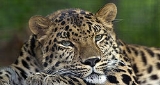
Of the nine subspecies, the Amur, or Far Eastern leopard (Panthera pardus orientalis) shows the strongest divergence in coat pattern. The coat is yellowish (especially in winter) and has widely spaced rosettes with thick, black rings and darkened centers. The length of the coat varies between in summer and in winter. They have light, blue-green eyes.

Ecology


Male Amur leopards weigh , with exceptionally large males up to . Females are smaller than the males at .
The main prey species of the Amur leopard are roe
Roe Deer
The European Roe Deer is a deer species of Europe, Asia Minor, and Caspian coastal regions. There is a separate species known as the Siberian Roe Deer that is found from the Ural Mountains to as far east as China and Siberia...

 and elk
Elk
-Various species of deer:** European Elk , also known as Moose** North American Elk , also known as Wapiti** Indian Elk , also known as Sambar...

 and sika deer
Sika Deer
The Sika Deer is a member of the deer family Cervidae that inhabits much of East Asia. It is found in mixed deciduous forests to the north, and mixed subtropical deciduous and evergreen forests to the south. The Sika Deer are closely related to Red Deer, Central Asian Red Deer and elk...

, along with hare
Hare
Hares and jackrabbits are leporidaes belonging to the genus Lepus. Hares less than one year old are called leverets.Hares are very fast-moving...

s and badger
Badger
Badgers, occasionally referred to as brocks, are short-legged, heavy-set carnivores in the weasel family, Mustelidae. There are some eight species of badger, in three subfamilies : Melinae , Mellivorinae , and Taxideinae...

s.

The Amur typically faces difficulty in areas where it must share territory with tigers, but this is seldom the case in Russia. Studies have indicated that an increased tiger population in the Southwest Primary area has not adversely affected the leopard population.

Amur leopards in zoos show some evidence of seasonal breeding with a peak in births in late spring/early summer. After a gestation period of around 12 weeks cubs are born in litters of 1–4 individuals, with an average litter size of just over 2. The cubs will stay with their mother for up to two years before becoming fully independent. Females first breed at an age of 3–4 years.

In the wild, leopards live for 10–15 years and they may reach 25 years in captivity.

Poaching


There appears to be poaching of leopards as well as their prey species. Poachers include both poor local villagers and newly rich Russians, mainly from the city of Vladivostok, as well as Chinese nationals who illegally cross the border into Russia. Russian hunters kill many more deer than is officially allowed and Amur leopards are sometimes caught in snares as well. Since 2002, skins or corpses of nine Amur leopards killed by poachers have been found in Russia and at least two leopards have been killed in China.

Deforestation


The forests on which Amur leopards depend have slowly disappeared as a result of frequent fires. Local villagers start fires for various reasons, but mainly to stimulate the growth of ferns that are a very popular ingredient in Russian and Chinese dishes.

Inbreeding


Loss of genetic diversity in the small and isolated Amur leopard population may cause inbreeding depression (reduced numbers due to reduced reproduction and lifespan and increased vulnerability to diseases). However, the results of research so far are inconclusive and additional information on the effects of inbreeding is needed before conclusions can be drawn.They have young every two years.

Development projects


Southwest Primary is located close to the Russian borders with China and North Korea, making it an attractive area for infrastructure projects such as new railways, gas and oil pipelines and ports. In 2005 and 2006 the Zoological Society of London and other ALTA partners led a successful international campaign against a plan to build an oil pipeline terminal on the coast of the Sea of Japan in the leopard’s range.

Conservation


Although not much attention has been paid to the situation, significant progress in conserving Amur leopards and tigers has been made over the last decade. A coalition of 13 international and Russian NGOs have pooled resources by creating ALTA (The Amur Leopard and Tiger Alliance). Inside the Russian Far East, Phoenix Fund
Phoenix fund
Phoenix Fund is a Russian wildlife and forest conservation organization serving regions of the Russian Far East, especially Primorski Krai and Khabarovsk Krai...

 conducts anti-poaching and habitat protection activities, while other ALTA members conduct public outreach, policy development, and scientific research to forward Amur leopard conservation. Collectively, ALTA members have been co-operating for many years in developing, financing and implementing conservation projects in Russia and China.

ALTA members have developed a comprehensive conservation program for the Amur leopard’s range in Russia and NE China that includes:
  1. Anti-poaching
  2. Forest fire-fighting
  3. Compensation for livestock killed by tigers and leopards
  4. A comprehensive education and public awareness program
  5. Population monitoring (Snow-track counts and camera trapping)
  6. Ecological and biomedical research
  7. Support for protected areas and hunting leases
  8. Lobbying for improved conservation policies and regulations
  9. Amur leopard conservation in China


In addition, the World Wide Fund for Nature (WWF) is also a major contributor.

In recent years wildlife in Russia has suffered from a lack of political interest in conservation. Negative developments since 2000 include the abolition of the State Committee for Nature Conservation, revoking the law enforcement rights of Inspection Tiger (an anti-poaching brigade for protection of tigers and leopards), and a reduction of approximately 80% in the number of field inspectors for protection of forests and animals.

Government Conservation Programs


In March 2009 the Minister of Natural Resources of Russia
Russia
Russia , officially known as both Russia and the Russian Federation , is a country in northern Eurasia . It is a semi-presidential republic, comprising 83 federal subjects...

 during his meeting with Vladimir Putin
Vladimir Putin
Vladimir Vladimirovich Putin was the second President of Russia and is the current Prime Minister of Russia as well as chairman of United Russia and Chairman of the Council of Ministers of the Union of Russia and Belarus...

 reassured the President that the ministry is planning to restore Amur Leopard population by introducing new "imported" Amur Leopards into the area and creating suitable and safe habitat for them. Mr. Trutnev did not explain where the ministry is planning to get additional leopards and how. (It is assumed that Ministry is planning to re-introduce captive animals (cubs) into the wild). He has also said that the job is going according to the plan, and that specialists are already working on the project and that the government already allocated all required funds for the project.

In media


A female Amur Leopard and her cub were featured on Planet Earth
Planet Earth (TV series)
Planet Earth is a 2006 television series produced by the BBC Natural History Unit. Four years in the making, it was the most expensive nature documentary series ever commissioned by the BBC, and also the first to be filmed in high definition...

's episodes "From Pole to Pole" and "Seasonal Forests".

The Animal Planet
Animal Planet
Animal Planet is an American satellite and cable television channel , that launched on October 1, 1996. It is distributed by Discovery Communications...

 documentary, The Last Leopard (2008) is about the plight of Amur leopards in Russia
Russia
Russia , officially known as both Russia and the Russian Federation , is a country in northern Eurasia . It is a semi-presidential republic, comprising 83 federal subjects...

.

External links