

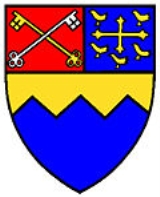
Ampleforth College

Encyclopedia
Ampleforth College in North Yorkshire, England, is the largest Roman Catholic co-educational boarding independent school in the United Kingdom
. It opened in 1802, as a boys' school, and is run by the Benedictine
monk
s and lay staff of Ampleforth Abbey
. The current headmaster is Father Gabriel Everitt OSB.
(mainly brown
and rainbow
, although the occasional blue back has been seen).
The Good Schools Guide called the school an "Unfailingly civilised and understanding top co-educational boarding Catholic school that has suffered from time to time as a result of its long liberal tradition." The Guide adds also that there is "A refreshing openness and honesty about the place these days."
It is notable that its academic admissions policy isn't as exacting as that exercised by some other English public schools
. As a result, the school is typically between 150 - 200 in the annual league tables of public examination results, although it was ranked 6th nationally in the 2004 "value added" table.
It maintains a scholarship set, with about 5% of pupils gaining the offer of a place at Oxford or Cambridge. Over 90% go on to university.
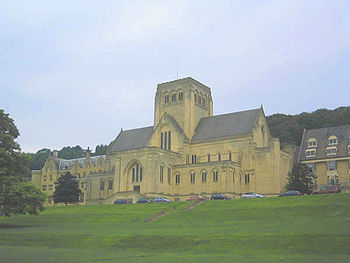 The monks at the Abbey belong to the Community of St Laurence (a House of the English Benedictine Congregation
), who trace their origins back nearly 1000 years to medieval Westminster. Although there are 81 monks at Ampleforth, only about 12 are in contact with the students, with another 2 in St Martin's Ampleforth. As a result of the school's association with the monks, religion is central to the life of the school. All pupils are expected to take religious education all the way through school. Mass
is attended by all pupils twice a week, once on a weekday in the house, and once on Sunday in the Abbey Church. In addition, each house has prayers each morning and evening.
The school has a boys' choir, the Schola Cantorum, which sings at High Mass on Sunday and also at a choral Mass on Friday nights during term time. The choir has made various recordings, broadcasts and tours throughout the world. There is also now a girls' choir, Schola Puellarum, which was recently noted in both newspaper and magazine. They sing a service every Thursday, and they sing on Holy Days of Obligation
in High Mass
each Sunday. They have been on a tour to Dublin, and sang in many of the well-known churches there.
, with students living in the separate houses, eating together as a house and playing sport together as a house in inter-house competitions. Each House is named after a British saint:
Some of the houses are paired into buildings named after people who have been instrumental in the school's history:
St Martin's Ampleforth
is the Prep School
for Ampleforth, situated a few miles across the valley in Gilling Castle
.
The school has a sporting history, mostly regarding arch rivals Sedbergh School and Stonyhurst College both of whom play Ampleforth in about twenty (boys and girls) sports annually. The highlight of the sporting year however, is the annual rugby matches between Sedbergh and Ampleforth. Sedbergh has in recent years proven to be superior, not having lost a 1st XV game against "the old enemy" since 1998.
Ampleforth has produced some top class sportsmen, especially in rugby, such as Lawrence Dallaglio
and Simon
and Guy Easterby
.
 Several monks and three members of the lay teaching staff molested children in their care over several decades. In 2005 Father Piers Grant-Ferris admitted 20 incidents of child abuse
. This was not an isolated incident. The Yorkshire Post
reported in 2005; "Pupils at a leading Roman Catholic school suffered decades of abuse from at least six paedophiles following a decision by former Abbot Basil Hume not to call in police at the beginning of the scandal."
In September 2005, Ampleforth was one of fifty of the country's leading independent schools (including Tonbridge
, Charterhouse
, Eton
, Radley
, Gresham's
, Harrow
, Haileybury, Lancing
, Marlborough
, Rugby
, Sedbergh School
, Shrewsbury
, Stowe
, Wellington
, Winchester
and Worth
) which were found by the Office of Fair Trading
to be operating a fee-fixing cartel in breach of the Competition Act of 1998. All of the schools were ordered to abandon this practice, pay a nominal penalty of £10,000 and make ex-gratia payments totalling three million pounds into a trust designed to benefit pupils who attended the schools during the period in respect of which fee information was shared. However, Mrs Jean Scott, the head of the Independent Schools Council, said that independent schools had always been exempt from anti-cartel rules applied to business, were following a long-established procedure in sharing the information with each other, and that they were unaware of the change to the law (on which they had not been consulted). She wrote to John Vickers, the OFT director-general, saying, "They are not a group of businessmen meeting behind closed doors to fix the price of their products to the disadvantage of the consumer. They are schools that have quite openly continued to follow a long-established practice because they were unaware that the law had changed."
in Saint Louis. The Priory became independent from Ampleforth in 1973, and was elevated to abbey status, becoming the Saint Louis Abbey
in 1989.
United Kingdom
The United Kingdom of Great Britain and Northern IrelandIn the United Kingdom and Dependencies, other languages have been officially recognised as legitimate autochthonous languages under the European Charter for Regional or Minority Languages...
. It opened in 1802, as a boys' school, and is run by the Benedictine
Benedictine
Benedictine refers to the spirituality and consecrated life in accordance with the Rule of St Benedict, written by Benedict of Nursia in the sixth century for the cenobitic communities he founded in central Italy. The most notable of these is Monte Cassino, the first monastery founded by Benedict...
monk
Monk
A monk is a person who practices religious asceticism, living either alone or with any number of monks, while always maintaining some degree of physical separation from those not sharing the same purpose...
s and lay staff of Ampleforth Abbey
Ampleforth Abbey
Ampleforth Abbey is a monastery of Benedictine Monks in North Yorkshire, England, part of the English Benedictine Congregation. It claims descent from the pre-Reformation community at Westminster Abbey through the last surviving monk from Westminster Sigebert Buckley.The current Abbot is Fr...
. The current headmaster is Father Gabriel Everitt OSB.
Situation
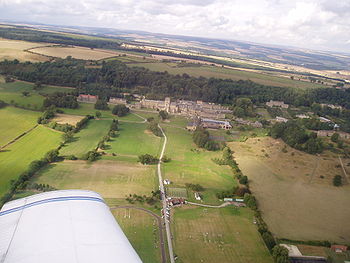
The school is situated in a valley with sports pitches, wooded areas and lakes. There are three lakes remaining of the original five constructed by the Fairfax family centuries ago. The middle lake is stocked with troutTrout
Trout is the name for a number of species of freshwater and saltwater fish belonging to the Salmoninae subfamily of the family Salmonidae. Salmon belong to the same family as trout. Most salmon species spend almost all their lives in salt water...
(mainly brown
Brown trout
The brown trout and the sea trout are fish of the same species....
and rainbow
Rainbow trout
The rainbow trout is a species of salmonid native to tributaries of the Pacific Ocean in Asia and North America. The steelhead is a sea run rainbow trout usually returning to freshwater to spawn after 2 to 3 years at sea. In other words, rainbow trout and steelhead trout are the same species....
, although the occasional blue back has been seen).
Education
The school's primary concern is to provide pupils with not just academic, sporting and other achievements, but also "a spiritual compass for life": moral principles to give guidance in a secular world; within a context where the "Benedictine ethos permeates pupils’ experience".The Good Schools Guide called the school an "Unfailingly civilised and understanding top co-educational boarding Catholic school that has suffered from time to time as a result of its long liberal tradition." The Guide adds also that there is "A refreshing openness and honesty about the place these days."
It is notable that its academic admissions policy isn't as exacting as that exercised by some other English public schools
Public School (UK)
A public school, in common British usage, is a school that is neither administered nor financed by the state or from taxpayer contributions, and is instead funded by a combination of endowments, tuition fees and charitable contributions, usually existing as a non profit-making charitable trust...
. As a result, the school is typically between 150 - 200 in the annual league tables of public examination results, although it was ranked 6th nationally in the 2004 "value added" table.
It maintains a scholarship set, with about 5% of pupils gaining the offer of a place at Oxford or Cambridge. Over 90% go on to university.
School life
Though originally only a boys' school the college is now fully co-educational. In 2009 an OFSTED Social Care report said that the overall quality of care was outstanding.Religious life
English Benedictine Congregation
The English Benedictine Congregation comprises autonomous Roman Catholic Benedictine communities of monks and nuns and is technically the oldest of the 21 congregations that are affiliated in the Benedictine Confederation....
), who trace their origins back nearly 1000 years to medieval Westminster. Although there are 81 monks at Ampleforth, only about 12 are in contact with the students, with another 2 in St Martin's Ampleforth. As a result of the school's association with the monks, religion is central to the life of the school. All pupils are expected to take religious education all the way through school. Mass
Mass (liturgy)
"Mass" is one of the names by which the sacrament of the Eucharist is called in the Roman Catholic Church: others are "Eucharist", the "Lord's Supper", the "Breaking of Bread", the "Eucharistic assembly ", the "memorial of the Lord's Passion and Resurrection", the "Holy Sacrifice", the "Holy and...
is attended by all pupils twice a week, once on a weekday in the house, and once on Sunday in the Abbey Church. In addition, each house has prayers each morning and evening.
The school has a boys' choir, the Schola Cantorum, which sings at High Mass on Sunday and also at a choral Mass on Friday nights during term time. The choir has made various recordings, broadcasts and tours throughout the world. There is also now a girls' choir, Schola Puellarum, which was recently noted in both newspaper and magazine. They sing a service every Thursday, and they sing on Holy Days of Obligation
Holy Day of Obligation
In the Catholic Church, Holy Days of Obligation or Holidays of Obligation, less commonly called Feasts of Precept, are the days on which, as of the Code of Canon Law states,-Eastern Catholic Churches:...
in High Mass
Solemn Mass
Solemn Mass , sometimes also referred to as Solemn High Mass or simply High Mass, is, when used not merely as a description, the full ceremonial form of the Tridentine Mass, celebrated by a priest with a deacon and a subdeacon, requiring most of the parts of the Mass to be sung, and the use of...
each Sunday. They have been on a tour to Dublin, and sang in many of the well-known churches there.
Houses
The school is arranged into ten housesBoarding house
A boarding house, is a house in which lodgers rent one or more rooms for one or more nights, and sometimes for extended periods of weeks, months and years. The common parts of the house are maintained, and some services, such as laundry and cleaning, may be supplied. They normally provide "bed...
, with students living in the separate houses, eating together as a house and playing sport together as a house in inter-house competitions. Each House is named after a British saint:
- St Aidan's (Girls) Housemistress: Dr. Victoria Fogg
- St Bede's (Girls) Housemistress: Mr Brendan & Victoria Anglim
- St Cuthbert's (Boys) Housemaster: Mr David Willis
- St Dunstan's (Boys) Housemaster: Mr Ben Pennington
- St Edward-WilfridWilfridWilfrid was an English bishop and saint. Born a Northumbrian noble, he entered religious life as a teenager and studied at Lindisfarne, at Canterbury, in Gaul, and at Rome; he returned to Northumbria in about 660, and became the abbot of a newly founded monastery at Ripon...
's (Boys), originally two houses, Housemaster: Mr Adrian Smerdon - St Hugh's (Boys) Housemaster: Mr Hugh Codrington
- St John's (Boys), Housemaster: Dr David Moses Phd
- St Oswald's (Boys) Housemaster: Mr Patrick McBeath
- St Margaret's (Girls) Housemistress: Mrs Gaelle McGovern
- St ThomasThomas MoreSir Thomas More , also known by Catholics as Saint Thomas More, was an English lawyer, social philosopher, author, statesman and noted Renaissance humanist. He was an important councillor to Henry VIII of England and, for three years toward the end of his life, Lord Chancellor...
' (Boys) Housemaster: Mr Paul Brenan
Some of the houses are paired into buildings named after people who have been instrumental in the school's history:
- Hume House - St Cuthbert's and St Edward-Wilfrid's - Named after Cardinal Basil Hume (although originally Saint Edward's house on one side and Saint Wilfrid's house on the other)
- Nevill House - St Dunstan's and St Oswald's
- Bolton House - formerly St Edward's and St Wilfrid's before their merger in 2001
- Fairfax House - St Margaret's and St Hugh's
St Martin's Ampleforth
St Martin's Ampleforth
St Martin's Ampleforth is the Preparatory School for Ampleforth College. It is situated in the village of Gilling East, at Gilling Castle, North Yorkshire, England...
is the Prep School
Preparatory school (UK)
In English language usage in the former British Empire, the present-day Commonwealth, a preparatory school is an independent school preparing children up to the age of eleven or thirteen for entry into fee-paying, secondary independent schools, some of which are known as public schools...
for Ampleforth, situated a few miles across the valley in Gilling Castle
Gilling Castle
Gilling Castle is a castle near Gilling East, North Yorkshire, England . The castle was originally the home of the Etton family, who appeared there at the end of the 12th century...
.
Sport
Sport is a large part of school life, with pupils participating in a wide variety of sports including rugby, shooting, tennis, cricket and football. As well as many rugby and cricket pitches set in the 2000 acres (8 km²) of the valley, the school runs the St Alban's Centre (SAC), a sports centre with a large hall (also used for school assemblies and official ceremonies), a 25 metre swimming pool, three squash courts, and a fitness suite. SAC is also open to the general public for a fee.The school has a sporting history, mostly regarding arch rivals Sedbergh School and Stonyhurst College both of whom play Ampleforth in about twenty (boys and girls) sports annually. The highlight of the sporting year however, is the annual rugby matches between Sedbergh and Ampleforth. Sedbergh has in recent years proven to be superior, not having lost a 1st XV game against "the old enemy" since 1998.
Ampleforth has produced some top class sportsmen, especially in rugby, such as Lawrence Dallaglio
Lawrence Dallaglio
Lorenzo Bruno Nero "Lawrence" Dallaglio, OBE is a retired English rugby union player and former captain of the English national team. He played as a flanker or number eight for London Wasps and never played for another club, having arrived at Sudbury as a teenager...
and Simon
Simon Easterby
Simon Easterby is an English-born Irish rugby union footballer. He plays for Scarlets, for whom he is a player-coach, and is a recently retired Ireland international. His regular position is at blindside flanker, but he is equally adept on the openside.-Early life:Easterby's father is English and...
and Guy Easterby
Guy Easterby
Guy Easterby is a former rugby union player for Ireland. He is currently team manager of Leinster alongside head coach Josef Schmidt.His father is English and his mother Irish...
.
Sexual abuse
Sexual abuse scandal in the English Benedictine Congregation
The sexual abuse scandal in the English Benedictine Congregation is a significant episode in the series of Catholic sex abuse cases in the United Kingdom.-Ealing Abbey:...
. This was not an isolated incident. The Yorkshire Post
Yorkshire Post
The Yorkshire Post is a daily broadsheet newspaper, published in Leeds, West Yorkshire, England by Yorkshire Post Newspapers, a company owned by Johnston Press...
reported in 2005; "Pupils at a leading Roman Catholic school suffered decades of abuse from at least six paedophiles following a decision by former Abbot Basil Hume not to call in police at the beginning of the scandal."
Press coverage
The school has periodically experienced a drugs problem. A 2003 TV documentary made by director Dan Barraclough highlighted large-scale breaking of the school rules on smoking and some abuse of alcohol.In September 2005, Ampleforth was one of fifty of the country's leading independent schools (including Tonbridge
Tonbridge School
Tonbridge School is a British boys' independent school for both boarding and day pupils in Tonbridge, Kent, founded in 1553 by Sir Andrew Judd . It is a member of the Eton Group, and has close links with the Worshipful Company of Skinners, one of the oldest London livery companies...
, Charterhouse
Charterhouse School
Charterhouse School, originally The Hospital of King James and Thomas Sutton in Charterhouse, or more simply Charterhouse or House, is an English collegiate independent boarding school situated at Godalming in Surrey.Founded by Thomas Sutton in London in 1611 on the site of the old Carthusian...
, Eton
Eton College
Eton College, often referred to simply as Eton, is a British independent school for boys aged 13 to 18. It was founded in 1440 by King Henry VI as "The King's College of Our Lady of Eton besides Wyndsor"....
, Radley
Radley College
Radley College , founded in 1847, is a British independent school for boys on the edge of the English village of Radley, near to the market town of Abingdon in Oxfordshire, and has become a well-established boarding school...
, Gresham's
Gresham's School
Gresham’s School is an independent coeducational boarding school in Holt in North Norfolk, England, a member of the HMC.The school was founded in 1555 by Sir John Gresham as a free grammar school for forty boys, following King Henry VIII's dissolution of the Augustinian priory at Beeston Regis...
, Harrow
Harrow School
Harrow School, commonly known simply as "Harrow", is an English independent school for boys situated in the town of Harrow, in north-west London.. The school is of worldwide renown. There is some evidence that there has been a school on the site since 1243 but the Harrow School we know today was...
, Haileybury, Lancing
Lancing College
Lancing College is a co-educational English independent school in the British public school tradition, founded in 1848 by Nathaniel Woodard. Woodard's aim was to provide education "based on sound principle and sound knowledge, firmly grounded in the Christian faith." Lancing was the first of a...
, Marlborough
Marlborough College
Marlborough College is a British co-educational independent school for day and boarding pupils, located in Marlborough, Wiltshire.Founded in 1843 for the education of the sons of Church of England clergy, the school now accepts both boys and girls of all beliefs. Currently there are just over 800...
, Rugby
Rugby School
Rugby School is a co-educational day and boarding school located in the town of Rugby, Warwickshire, England. It is one of the oldest independent schools in Britain.-History:...
, Sedbergh School
Sedbergh School
Sedbergh School is a boarding school in Sedbergh, Cumbria, for boys and girls aged 13 to 18. Nestled in the Howgill Fells, it is known for sporting sides, such as its Rugby Union 1st XV.-Background:...
, Shrewsbury
Shrewsbury School
Shrewsbury School is a co-educational independent school for pupils aged 13 to 18, founded by Royal Charter in 1552. The present campus to which the school moved in 1882 is located on the banks of the River Severn in Shrewsbury, Shropshire, England...
, Stowe
Stowe School
Stowe School is an independent school in Stowe, Buckinghamshire. It was founded on 11 May 1923 by J. F. Roxburgh, initially with 99 male pupils. It is a member of the Rugby Group and Headmasters' and Headmistresses' Conference. The school is also a member of the G20 Schools Group...
, Wellington
Wellington College, Berkshire
-Former pupils:Notable former pupils include historian P. J. Marshall, architect Sir Nicholas Grimshaw, impressionist Rory Bremner, Adolphus Cambridge, 1st Marquess of Cambridge, author Sebastian Faulks, language school pioneer John Haycraft, political journalist Robin Oakley, actor Sir Christopher...
, Winchester
Winchester College
Winchester College is an independent school for boys in the British public school tradition, situated in Winchester, Hampshire, the former capital of England. It has existed in its present location for over 600 years and claims the longest unbroken history of any school in England...
and Worth
Worth School
Worth School, near the village of Turners Hill, Crawley, West Sussex, England, is a co-educational Roman Catholic boarding and day independent school for pupils aged between 11–18 years. The school is located with Worth Abbey, a Benedictine monastery, in of Sussex countryside...
) which were found by the Office of Fair Trading
Office of Fair Trading
The Office of Fair Trading is a not-for-profit and non-ministerial government department of the United Kingdom, established by the Fair Trading Act 1973, which enforces both consumer protection and competition law, acting as the UK's economic regulator...
to be operating a fee-fixing cartel in breach of the Competition Act of 1998. All of the schools were ordered to abandon this practice, pay a nominal penalty of £10,000 and make ex-gratia payments totalling three million pounds into a trust designed to benefit pupils who attended the schools during the period in respect of which fee information was shared. However, Mrs Jean Scott, the head of the Independent Schools Council, said that independent schools had always been exempt from anti-cartel rules applied to business, were following a long-established procedure in sharing the information with each other, and that they were unaware of the change to the law (on which they had not been consulted). She wrote to John Vickers, the OFT director-general, saying, "They are not a group of businessmen meeting behind closed doors to fix the price of their products to the disadvantage of the consumer. They are schools that have quite openly continued to follow a long-established practice because they were unaware that the law had changed."
Daughter abbeys
In 1955, at the invitation of prominent Roman Catholic laypersons in Saint Louis, Missouri, a group of Benedictines from Ampleforth established the Priory of Saints Mary and Louis and the corresponding Saint Louis Priory SchoolSaint Louis Priory School
The Saint Louis Priory School, a Roman Catholic secondary day school for boys, is located in suburban St. Louis, Missouri, within the Archdiocese of Saint Louis. The school is run by the Benedictine monks of Saint Louis Abbey as part of their religious ministry.- History :The school was...
in Saint Louis. The Priory became independent from Ampleforth in 1973, and was elevated to abbey status, becoming the Saint Louis Abbey
Saint Louis Abbey
The Abbey of Saint Mary and Saint Louis is an abbey of the Roman Catholic English Benedictine Congregation located in St. Louis County, Missouri USA. The Abbey is an important presence in the spiritual life of the Archdiocese of St. Louis...
in 1989.
Religion
- Anthony Ainscough (1906–1986), Prior of Ampleforth Abbey, 1961–1963
- Athanasius AllansonAthanasius AllansonAthanasius Allanson was an English Benedictine monk and historian, and Abbot of Glastonbury from 1874 to 1876. His secular forename was Peter....
(1804–1876), BenedictineBenedictineBenedictine refers to the spirituality and consecrated life in accordance with the Rule of St Benedict, written by Benedict of Nursia in the sixth century for the cenobitic communities he founded in central Italy. The most notable of these is Monte Cassino, the first monastery founded by Benedict...
monk, and Abbot of Glastonbury, 1874–1876 - Thomas Burgess (1791–1854), Roman Catholic Bishop of CliftonBishop of CliftonThe Bishop of Clifton is the Ordinary of the Roman Catholic Diocese of Clifton in the Province of Birmingham, England.The see is in the suburb of Clifton in the city of Bristol where the bishop's seat is located at the Cathedral Church of SS. Peter and Paul...
, 1851–1854 - Columba Cary-ElwesColumba Cary-ElwesEvelyn Charles Cary-Elwes , professed a monk as Dom Columba Cary-Elwes, OSB, of Ampleforth Abbey in York, England. As a missionary he traveled to Uganda, Tanzania and Kenya and is the author of numerous books on Christianity...
(1903–1994), monastery founder, ecumenist and author - Abdur Raheem Green, Muslim convert and Chairman of the Islamic Education & Research Academy
- Ambrose GriffithsAmbrose GriffithsDom Ambrose Griffiths, OSB, KC*HS was a Roman Catholic bishop of the Catholic Church in England and Wales, and a Benedictine abbot....
(1928–2011), Bishop of Hexham and NewcastleBishop of Hexham and NewcastleThe Bishop of Hexham and Newcastle is the Ordinary of the Roman Catholic Diocese of Hexham and Newcastle in the Province of Liverpool, known also on occasion as the Northern Province.-History:... - John Cuthbert HedleyJohn Cuthbert HedleyJohn Cuthbert Hedley was a British Benedictine and writer who held high offices in the Roman Catholic Church....
(1837–1915), Roman Catholic Bishop of Newport, 1881–1915 - Basil, Cardinal Hume (1923–1999), AbbotAbbotThe word abbot, meaning father, is a title given to the head of a monastery in various traditions, including Christianity. The office may also be given as an honorary title to a clergyman who is not actually the head of a monastery...
of Ampleforth AbbeyAmpleforth AbbeyAmpleforth Abbey is a monastery of Benedictine Monks in North Yorkshire, England, part of the English Benedictine Congregation. It claims descent from the pre-Reformation community at Westminster Abbey through the last surviving monk from Westminster Sigebert Buckley.The current Abbot is Fr...
, 1963–1975, and Archbishop of WestminsterArchbishop of WestminsterThe Archbishop of Westminster heads the Roman Catholic Archdiocese of Westminster, in England. The incumbent is the Metropolitan of the Province of Westminster and, as a matter of custom, is elected President of the Catholic Bishops' Conference of England and Wales, and therefore de facto spokesman...
, 1975–1999
Politics, law and business
- Don Agustín Jerónimo de Iturbide y HuarteAgustín Jerónimo de Iturbide y HuarteDon Agustín Jerónimo de Iturbide y Huarte, Prince Imperial of Mexico, OG OME was the son of the first Mexican Emperor Agustín I of Mexico, the heir apparent to the First Mexican Empire and a member of the Imperial House of Iturbide; later in his life he served as a military officer in South...
(1807–1866), Prince Imperial of MexicoMexicoThe United Mexican States , commonly known as Mexico , is a federal constitutional republic in North America. It is bordered on the north by the United States; on the south and west by the Pacific Ocean; on the southeast by Guatemala, Belize, and the Caribbean Sea; and on the east by the Gulf of... - Julian Asquith, 2nd Earl of Oxford and AsquithJulian Asquith, 2nd Earl of Oxford and AsquithJulian Edward George Asquith, 2nd Earl of Oxford and Asquith KCMG , was a British colonial administrator.-Background and education:...
(1916–2011), diplomat - Sir Hugh FraserHugh Fraser (politician)Major Sir Hugh Charles Patrick Joseph Fraser MBE was a British Conservative politician and first husband of the author Lady Antonia Fraser.-Youth and military career:...
(1918–1984), Secretary of State for AirSecretary of State for AirThe Secretary of State for Air was a cabinet level British position. The person holding this position was in charge of the Air Ministry. It was created on 10 January 1919 to manage the Royal Air Force...
, 1962–1964 - Grand Duke Jean of Luxembourg (born 1921), Grand Duke of LuxembourgGrand Duke of LuxembourgThe Grand Duke of Luxembourg is the sovereign monarch and head of state of Luxembourg. Luxembourg has been a grand duchy since 15 March 1815, when it was elevated from a duchy when placed in personal union with the United Kingdom of the Netherlands...
, 1964–2000 - Auberon HerbertAuberon HerbertAuberon Edward William Molyneux Herbert was a writer, theorist, philosopher, and "19th-century individualist anarchist." A member of the Parliament of the United Kingdom, Herbert was the son of the 3rd Earl of Carnarvon, brother of Henry Herbert, the 4th Earl, and father of the 9th Baron Lucas...
(1922–1974), campaigner for Eastern European causes - Michael Nolan, Baron NolanMichael Nolan, Baron NolanMichael Patrick Nolan, Baron Nolan, was a judge in the United Kingdom, and the first chairman of the Committee on Standards in Public Life 1994 to 1997. In the words of his obituary in The Guardian, "Lord Nolan ....
(1928–2007), Law Lord and first chairman of the Committee on Standards in Public LifeCommittee on Standards in Public LifeThe Committee on Standards in Public Life is an advisory non-departmental public body of the United Kingdom Government.The Committee on Standards in Public Life is constituted as a standing body with its members appointed for up to three years.-History:... - Andrew Bertie (1929–2008), first British Grand Master of the Knights HospitallerKnights HospitallerThe Sovereign Military Hospitaller Order of Saint John of Jerusalem of Rhodes and of Malta , also known as the Sovereign Military Order of Malta , Order of Malta or Knights of Malta, is a Roman Catholic lay religious order, traditionally of military, chivalrous, noble nature. It is the world's...
, 1988–2008; - John GeorgeJohn George (officer of arms)John Charles Grossmith George is a Scottish officer of arms. He was appointed Kintyre Pursuivant of Arms in Ordinary in 1986. Following his retirement from this office he was appointed Linlithgow Pursuivant Extraordinary in 2001. In December 2005 he retired from this position also....
(born 1930), HM Kintyre Pursuivant of Arms,well known herald and author. - David Hennessy, 3rd Baron WindleshamDavid Hennessy, 3rd Baron WindleshamDavid James George Hennessy, 3rd Baron Windlesham and Baron Hennessy, CVO, PC, FBA was a Conservative Party politician in the United Kingdom who held visiting professorships at various universities....
(born 1932), Lord Privy SealLord Privy SealThe Lord Privy Seal is the fifth of the Great Officers of State in the United Kingdom, ranking beneath the Lord President of the Council and above the Lord Great Chamberlain. The office is one of the traditional sinecure offices of state...
and Leader of the House of LordsLeader of the House of LordsThe Leader of the House of Lords is a member of the Cabinet of the United Kingdom who is responsible for arranging government business in the House of Lords. The role is always held in combination with a formal Cabinet position, usually one of the sinecure offices of Lord President of the Council,...
, 1973–1974 - John Crichton-Stuart, 6th Marquess of ButeJohn Crichton-Stuart, 6th Marquess of ButeJohn Crichton-Stuart, 6th Marquess of Bute, KBE was the son of the 5th Marquess of Bute and the former Lady Eileen Forbes ....
(1933–1993), Chairman, Historic Buildings Council for Scotland, 1983–1988, and National Museums of ScotlandNational Museums of ScotlandNational Museums Scotland is the organization that runs several national museums of Scotland. It is one of the country's National Collections, and holds internationally important collections of natural sciences, decorative arts, world cultures, science and technology, and Scottish history and...
, 1985–1993 - King Moshoeshoe II of LesothoMoshoeshoe II of LesothoMoshoeshoe II , previously known as Constantine Bereng Seeiso, was the paramount chief of Lesotho, succeeding paramount chief Seeiso from 1960 until the country gained full independence from Britain in 1966...
(1938–1996), King of Lesotho (1966–1970, 1970–1990, 1995–96) - Michael AncramMichael AncramMichael Andrew Foster Jude Kerr, 13th Marquess of Lothian, PC, QC , known as Michael Ancram, is a United Kingdom Conservative Party politician. He is a member of the House of Lords, former Member of Parliament, and a former member of the Shadow Cabinet...
, 14th Marquess of Lothian (born 1945), Deputy Leader of the Conservative PartyConservative Party (UK)The Conservative Party, formally the Conservative and Unionist Party, is a centre-right political party in the United Kingdom that adheres to the philosophies of conservatism and British unionism. It is the largest political party in the UK, and is currently the largest single party in the House...
, 2001–2005 - Sir Anthony Bamford (born 1945), Chairman, J.C.Bamford (Excavators) Ltd.J. C. BamfordJCB is a global construction, demolition and agricultural equipment company headquartered in Rocester, United Kingdom. It is the world's third-largest construction equipment manufacturer. It produces over 300 types of machines, including diggers , excavators, tractors and diesel engines...
- John Burnett, Baron BurnettJohn Burnett, Baron BurnettJohn Patrick Aubone Burnett, Baron Burnett is a Liberal Democrat politician in the United Kingdom, and was a Member of Parliament for Torridge and West Devon between 1997 and 2005 general elections...
(born 1945), former Liberal DemocratLiberal DemocratsThe Liberal Democrats are a social liberal political party in the United Kingdom which supports constitutional and electoral reform, progressive taxation, wealth taxation, human rights laws, cultural liberalism, banking reform and civil liberties .The party was formed in 1988 by a merger of the...
MP for Torridge and West DevonTorridge and West DevonTorridge and West Devon is a county constituency represented in the House of Commons of the Parliament of the United Kingdom.It returns one Member of Parliament , elected by the first-past-the-post voting system.-Boundaries:...
, 1997–2001, 2001-5, Life Peer, 2006- - William Peel, 3rd Earl PeelWilliam Peel, 3rd Earl PeelWilliam James Robert Peel, 3rd Earl Peel GCVO, PC, DL , styled Viscount Clanfield until 1969, is a cross-bench member of the House of Lords and Lord Chamberlain of the Royal Household.-Background and education:...
(born 1947), Lord ChamberlainLord ChamberlainThe Lord Chamberlain or Lord Chamberlain of the Household is one of the chief officers of the Royal Household in the United Kingdom and is to be distinguished from the Lord Great Chamberlain, one of the Great Officers of State.... - John Home Robertson (born 1948), former Labour MP and currently Member of the Scottish ParliamentScottish ParliamentThe Scottish Parliament is the devolved national, unicameral legislature of Scotland, located in the Holyrood area of the capital, Edinburgh. The Parliament, informally referred to as "Holyrood", is a democratically elected body comprising 129 members known as Members of the Scottish Parliament...
- Matthew FestingMatthew Festing-Titles and style:The full title of Fra' Matthew is: His Most Eminent Highness Fra' Matthew Festing, Prince and Grand Master of the Sovereign Military Hospitaller Order of St...
(born 1949), second British Grand Master of the Knights HospitallerKnights HospitallerThe Sovereign Military Hospitaller Order of Saint John of Jerusalem of Rhodes and of Malta , also known as the Sovereign Military Order of Malta , Order of Malta or Knights of Malta, is a Roman Catholic lay religious order, traditionally of military, chivalrous, noble nature. It is the world's...
, 2008–present; - Raymond Asquith, 3rd Earl of Oxford and Asquith (born 1952), former diplomat and businessman
- Miles Fitzalan-Howard, 17th Duke of NorfolkMiles Fitzalan-Howard, 17th Duke of NorfolkMajor-General Miles Francis Stapleton Fitzalan-Howard, 17th Duke of Norfolk, , was the eldest son of Bernard Fitzalan-Howard, 3rd Baron Howard of Glossop and his wife Mona Stapleton, 11th Baroness Beaumont....
(1915-2002) - Edward Fitzalan-Howard, 18th Duke of NorfolkEdward Fitzalan-Howard, 18th Duke of NorfolkEdward William Fitzalan-Howard, 18th Duke of Norfolk, is the son of Miles Stapleton-Fitzalan-Howard, 17th Duke of Norfolk and his wife Anne Mary Teresa Constable-Maxwell. The principal seat of the Duke of Norfolk is Arundel Castle....
(born 1956) - Dominic AsquithDominic AsquithThe Honourable Dominic Anthony Gerard Asquith CMG is a British diplomat. He was British Ambassador to Iraq between 2006 and 2007 and has been British Ambassador to Egypt since 2007.-Background and education:...
(born 1957), AmbassadorAmbassadorAn ambassador is the highest ranking diplomat who represents a nation and is usually accredited to a foreign sovereign or government, or to an international organization....
to IraqIraqIraq ; officially the Republic of Iraq is a country in Western Asia spanning most of the northwestern end of the Zagros mountain range, the eastern part of the Syrian Desert and the northern part of the Arabian Desert....
, 2006—2007, Ambassador to EgyptEgyptEgypt , officially the Arab Republic of Egypt, Arabic: , is a country mainly in North Africa, with the Sinai Peninsula forming a land bridge in Southwest Asia. Egypt is thus a transcontinental country, and a major power in Africa, the Mediterranean Basin, the Middle East and the Muslim world...
, 2007–present. - King Letsie III of LesothoLetsie III of LesothoLetsie III is the reigning king of Lesotho. He succeeded his father, Moshoeshoe II, when the latter was forced into exile in 1990. His father was briefly restored in 1995 but soon died in a car crash in early 1996, and Letsie became king again...
(born 1963), King of LesothoLesothoLesotho , officially the Kingdom of Lesotho, is a landlocked country and enclave, surrounded by the Republic of South Africa. It is just over in size with a population of approximately 2,067,000. Its capital and largest city is Maseru. Lesotho is a member of the Commonwealth of Nations. The name...
(1990–95, 1996–present) - Paul MoorePaul Moore (banking manager)Paul Moore is a former manager at the bank HBOS, who came to public attention in late 2008 as a whistleblower after claiming that he had been fired for warning HBOS about its excessive risk-taking.-Biography:...
, whistleblowerWhistleblowerA whistleblower is a person who tells the public or someone in authority about alleged dishonest or illegal activities occurring in a government department, a public or private organization, or a company...
sacked from HBOSHBOSHBOS plc is a banking and insurance company in the United Kingdom, a wholly owned subsidiary of the Lloyds Banking Group having been taken over in January 2009...
Arts and entertainment
- Herbert RailtonHerbert RailtonHerbert Railton , was an English artist and leading black and white illustrator of books and magazines.-Life and work:...
(1857–1910), illustrator - Roderic O'ConorRoderic O'ConorRoderic O'Conor was an Irish painter.Born in Milltown, Castleplunket, Co. Roscommon, Ireland, O'Conor studied at Ampleforth College, then at Dublin and Antwerp before moving to Paris where he was deeply influenced by the Impressionists.O'Conor attended the Metropolitan School and Royal Hibernian...
(1860–1940), artist - Harman GrisewoodHarman GrisewoodHarman Joseph Gerard Grisewood was an English radio actor, radio and television executive, novelist and non-fiction writer. He acted as literary executor to the poet David Jones, a lifelong friend....
(1906–1997), Chief Assistant to the Director-General of the BBC, 1955–1964 - Vincent CroninVincent CroninVincent Archibald Patrick Cronin, FRSL was a British historical, cultural, and biographical writer, best-known for his biographies of Louis XIV, Louis XVI and Marie Antoinette, Catherine the Great, and Napoleon, as well as for his books on the Renaissance.Cronin was born in Tredegar, Monmouthshire...
(born 1924), historical writer and biographer - Patrick ReyntiensPatrick ReyntiensPatrick Reyntiens, OBE, is an English stained glass artist.He is notable for his work on Liverpool's Roman Catholic Cathedral and on the new Coventry Cathedral in collaboration with the artist John Piper...
(born 1925), stained glassStained glassThe term stained glass can refer to coloured glass as a material or to works produced from it. Throughout its thousand-year history, the term has been applied almost exclusively to the windows of churches and other significant buildings...
artist - Hugo YoungHugo YoungHugo John Smelter Young was a British journalist and columnist and senior political commentator at The Guardian.-Early life and education:...
(1938–2003), journalist - Andrew KnightAndrew KnightAndrew Stephen Bower Knight is a journalist, editor, and director of News Corporation.-Career:He joined The Economist Magazine in 1966 on the international business and investment sections...
(born 1939), journalist, editor, and media magnate - Mark BurnsMark BurnsMark Burns was an English film and television actor.Burns was born in Bromsgrove in the county of Worcestershire and educated at Ampleforth College, North Yorkshire...
(born 1936–2007), actor - Piers Paul ReadPiers Paul ReadPiers Paul Read, FRSL is a British novelist and non-fiction writer.-Background:Read was born in Beaconsfield, Buckinghamshire...
(born 1941), writer - Tom WallerTom WallerTom Waller is a film director and producer.Waller studied at Ampleforth College, Ravensbourne College of Design and Communication, and the Northern Film School in Leeds, England. Immediately upon graduating he founded production company De Warrenne Pictures Ltd...
(born 1974), film producer - Henry HudsonHenry Hudson (artist)-Life and work:Henry Hudson is from Yorkshire, England, and he attended Ampleforth College. He later graduated from Central Saint Martins College of Art and Design....
(born 1982), artist - James O'Brien (born 1972), radio presenter and journalist
- Edward Stourton (born 1957), journalist
- Julian WadhamJulian Wadham-Career:He has appeared on television as both Charles II and George V...
(born 1958), actor - Rupert EverettRupert EverettRupert James Hector Everett is an English actor. He first came to public attention in 1981, when he was cast in Julian Mitchell's play and subsequent film Another Country as an openly gay student at an English public school, set in the 1930s...
(born 1959), actor - Julian FellowesJulian FellowesJulian Alexander Kitchener-Fellowes, Baron Fellowes of West Stafford, DL , known as Julian Fellowes, is an English actor, novelist, film director and screenwriter, as well as a Conservative peer.-Early life:...
, Baron Fellowes of West Stafford (born 1949), actor and writer, Conservative peer of the House of Lords (2011-) - Antony GormleyAntony GormleyAntony Mark David Gormley OBE RA is a British sculptor. His best known works include the Angel of the North, a public sculpture in the North of England, commissioned in 1995 and erected in February 1998, Another Place on Crosby Beach near Liverpool, and Event Horizon, a multi-part site...
(born 1950), sculptor - Peter BergenPeter BergenPeter Bergen is a print and television journalist, author, and CNN's national security analyst. Bergen produced the first television interview with Osama Bin Laden in 1997. The interview, which aired on CNN, marked the first time that bin Laden declared war against the United States to a Western...
(born 1962), author, print and TV journalist, CNNCNNCable News Network is a U.S. cable news channel founded in 1980 by Ted Turner. Upon its launch, CNN was the first channel to provide 24-hour television news coverage, and the first all-news television channel in the United States...
, adjunct professor, Johns Hopkins UniversityJohns Hopkins UniversityThe Johns Hopkins University, commonly referred to as Johns Hopkins, JHU, or simply Hopkins, is a private research university based in Baltimore, Maryland, United States... - John MicklethwaitJohn MicklethwaitJohn Micklethwait is the editor-in-chief of The Economist.-Biography:Micklethwait was born in 1962 and educated at the independent school Ampleforth College and Magdalen College, Oxford, where he studied history. He worked for Chase Manhattan Bank for two years and joined The Economist in 1987...
(born 1962), editor-in-chief of The EconomistThe EconomistThe Economist is an English-language weekly news and international affairs publication owned by The Economist Newspaper Ltd. and edited in offices in the City of Westminster, London, England. Continuous publication began under founder James Wilson in September 1843... - Red Morris, 4th Baron KillaninRed Morris, 4th Baron KillaninGeorge Redmond Fitzpatrick Morris, 4th Baron Killanin is an Irish film producer.He is the son of the 3rd Baron Killanin, former President of the International Olympic Committee. He was educated at Gonzaga College Dublin, Ampleforth College and the University of Dublin...
(born 1947), film producer - Joe SimpsonJoe Simpson (mountaineer)Joe Simpson is an English mountaineer, author and motivational speaker. He is best known for his book Touching the Void and the 2003 film adaptation of his book.-Early life:...
(born 1960), mountaineer and autobiographer - Andrew FestingAndrew FestingAndrew Festing MBE PPRP is a well known portrait painter, and fellow and former president of the Royal Society of Portrait Painters.-Life:...
(born 1941), British Royal Portrait Painter
Military
- Major-General Sir Freddie de GuingandFreddie de GuingandMajor-General Sir Francis Wilfred de Guingand KBE, CB, DSO , better known as Freddie de Guingand, was a British Army officer who served with Montgomery from El Alamein to the surrender of the Wehrmacht in the West...
(1900–1979), Chief of Staff to Field Marshal Montgomery, 1942–1945 - Brigadier Simon Fraser, 15th Lord LovatSimon Fraser, 15th Lord LovatBrigadier Simon Christopher Joseph Fraser, 15th Lord Lovat and 4th Baron Lovat DSO, MC, TD was the 25th Chief of the Clan Fraser and a prominent British Commando during the Second World War...
(1911–1995), founder of the commandoCommandoIn English, the term commando means a specific kind of individual soldier or military unit. In contemporary usage, commando usually means elite light infantry and/or special operations forces units, specializing in amphibious landings, parachuting, rappelling and similar techniques, to conduct and...
s. - Colonel Sir David StirlingDavid StirlingColonel Sir Archibald David Stirling, DSO, DFC, OBE was a Scottish laird, mountaineer, World War II British Army officer, and the founder of the Special Air Service.-Life before the war:...
(1915–1990), founder of the SASSpecial Air ServiceSpecial Air Service or SAS is a corps of the British Army constituted on 31 May 1950. They are part of the United Kingdom Special Forces and have served as a model for the special forces of many other countries all over the world... - Major General Lord Michael Fitzalan-Howard (1916–2007), Marshal of the Diplomatic CorpsMarshal of the Diplomatic CorpsHer Majesty's Marshal of the Diplomatic Corps is a senior member of the Royal Household of the Sovereign of the United Kingdom. He is the Queen's link with the diplomatic community in London, arranges the annual Diplomatic Corps Reception by the Sovereign, organises the regular presentation of...
1972-1981 - Michael AllmandMichael AllmandMichael Allmand VC was an English recipient of the Victoria Cross, the highest and most prestigious award for gallantry in the face of the enemy that can be awarded to British and Commonwealth forces.-Early life:...
(1923–1944), Victoria CrossVictoria CrossThe Victoria Cross is the highest military decoration awarded for valour "in the face of the enemy" to members of the armed forces of various Commonwealth countries, and previous British Empire territories....
recipient (posthumous). Killed in action 24 June 1944, in Burma. - Brigadier Andrew Parker BowlesAndrew Parker BowlesBrigadier Andrew Henry Parker Bowles OBE is a retired British Army officer. He is the former husband of the Duchess of Cornwall , who is now married to the Prince of Wales....
(born 1939), soldier - Major General Sir Sebastian RobertsSebastian RobertsMajor-General Sir Sebastian John Lechmere Roberts KCVO OBE was the Senior Army Representative at the Royal College of Defence Studies.-Military career:...
(born 1954), GOCGeneral Officer CommandingGeneral Officer Commanding is the usual title given in the armies of Commonwealth nations to a general officer who holds a command appointment. Thus, a general might be the GOC II Corps or GOC 7th Armoured Division...
The Household Division 2003–2007 - Major-General Peter Grant PeterkinPeter Grant PeterkinMajor-General Anthony Peter Grant Peterkin CB OBE was the British House of Commons' Serjeant at Arms between 2004 and 2007.-Military career:...
(born c.1947), Sergeant at Arms of the House of CommonsBritish House of CommonsThe House of Commons is the lower house of the Parliament of the United Kingdom, which also comprises the Sovereign and the House of Lords . Both Commons and Lords meet in the Palace of Westminster. The Commons is a democratically elected body, consisting of 650 members , who are known as Members... - Captain Robert NairacRobert NairacCaptain Robert Laurence Nairac GC was a British Army officer who was abducted from a pub in south County Armagh during an undercover operation and killed by the Provisional Irish Republican Army on his fourth tour of duty in Northern Ireland as a Military Intelligence Liaison Officer...
(1948–1977), George CrossGeorge CrossThe George Cross is the highest civil decoration of the United Kingdom, and also holds, or has held, that status in many of the other countries of the Commonwealth of Nations...
, intelligence officer killed by the Provisional Irish Republican ArmyProvisional Irish Republican ArmyThe Provisional Irish Republican Army is an Irish republican paramilitary organisation whose aim was to remove Northern Ireland from the United Kingdom and bring about a socialist republic within a united Ireland by force of arms and political persuasion...
Philosophy and academe
- Gabriel Turville-PetreGabriel Turville-PetreEdward Oswald Gabriel Turville-Petre F.B.A. was Professor of Ancient Icelandic Literature and Antiquities at the University of Oxford...
(1908–1978), Professor of Ancient Icelandic Literature and Antiquities, University of OxfordUniversity of OxfordThe University of Oxford is a university located in Oxford, United Kingdom. It is the second-oldest surviving university in the world and the oldest in the English-speaking world. Although its exact date of foundation is unclear, there is evidence of teaching as far back as 1096...
, 1953–1975 - Henry WansbroughHenry WansbroughThe Very Reverend Dom Henry Wansbrough, OSB, MA , STL , LSS , is a biblical scholar and a monk of Ampleforth Abbey in North Yorkshire, England....
(1934), Master of St Benet's Hall, OxfordSt Benet's Hall, OxfordSt Benet's Hall is a Permanent Private Hall of the University of Oxford. It is located at the northern end of St Giles' on its western side, close to the junction with Woodstock Road.-Composition and status:...
, 1990–2004 - Fred HallidayFred HallidayFrederick Halliday, FBA was an Irish writer and academic specialising in International Relations and the Middle East, with particular reference to the Cold War, Iran, and the Arabian peninsula.-Biography:Born in Dublin, Ireland in 1946 to an English father, businessman Arthur Halliday, and an...
, (1946–2010), academic, Fellow of the British AcademyBritish AcademyThe British Academy is the United Kingdom's national body for the humanities and the social sciences. Its purpose is to inspire, recognise and support excellence in the humanities and social sciences, throughout the UK and internationally, and to champion their role and value.It receives an annual...
, Montague Burton Professor of International RelationsMontague Burton Professor of International RelationsThe Montague Burton Professorship of International Relations at the University of Oxford is one of the two main professorships of International Relations created by the endowment of Montague Burton in UK universities. The Oxford chair was established in 1930 and is associated with a Fellowship of...
at London School of EconomicsLondon School of EconomicsThe London School of Economics and Political Science is a public research university specialised in the social sciences located in London, United Kingdom, and a constituent college of the federal University of London... - Philip LawrencePhilip LawrencePhilip Ambrose Lawrence QGM, was a London-based headmaster who was stabbed to death outside the gates of his school when he went to the aid of a pupil who was being attacked by a gang.-Biography:...
(1947–1995), headmaster and murder victim - William Dalrymple (born 1965), historian
- Robert Maximilian de GaynesfordRobert Maximilian de GaynesfordMaximilian de Gaynesford is an English philosopher. He was educated at Ampleforth College and Balliol College, Oxford , after which he spent several years studying Theology, before turning to Philosophy in 1993. Before receiving his doctorate, he was elected Fellow and Tutor in Philosophy at...
(born 1968), philosopher
Science and medicine
- John PolidoriJohn PolidoriJohn William Polidori was an English writer and physician of Italian descent. He is known for his associations with the Romantic movement and credited by some as the creator of the vampire genre of fantasy fiction. His most successful work was the 1819 short story, The Vampyre, the first vampire...
(1795–1821), physician and writer - Thomas Cecil GrayThomas Cecil GrayThomas Cecil Gray CBE, KCSG , was a pioneering British anaesthetist.-Early life:Gray was born in Liverpool in 1913. The only son of Thomas and Ethel Gray of Thornton, he was educated at Ampleforth College in Yorkshire...
(1913–2008) pioneered modern anaesthetic techniques - Bill InmanBill InmanWilliam Howard Wallace "Bill" Inman, MRCP, FRCP, FFPHM , also known as WHW Inman, was a British doctor and pioneer of methods and systems to detect risks of treatment with drugs...
(1929–2005) pharmacovigilancePharmacovigilancePharmacovigilance is the pharmacological science relating to the detection, assessment, understanding and prevention of adverse effects, particularly long term and short term side effects of medicines...
pioneer
Sport
- Edward O'Donovan Crean (born 1887), English rugby unionRugby unionRugby union, often simply referred to as rugby, is a full contact team sport which originated in England in the early 19th century. One of the two codes of rugby football, it is based on running with the ball in hand...
player who was part of the first official British and Irish LionsBritish and Irish LionsThe British and Irish Lions is a rugby union team made up of players from England, Scotland, Ireland and Wales...
team that toured South Africa in 19101910 British Lions tour to South AfricaThe 1910 British Isles tour to South Africa was the eighth tour by a British Isles team and the fourth to South Africa. It is retrospectively classed as one of the British Lions tours, as the Lions naming convention was not adopted until 1950. As well as South Africa, the tour included a game in...
. - Charles GrieveCharles GrieveCharles Frederick Grieve was a rugby union player, who played for . He was also a notable cricketer for Guernsey and Oxford University...
(1913-2000), cricketer who played for Oxford UniversityOxford University Cricket ClubOxford University Cricket Club is a first-class cricket team, representing the University of Oxford. It plays its home games at the University Parks in Oxford, England...
and GuernseyGuernsey cricket teamThe Guernsey cricket team is the team that represents the Crown dependency of Guernsey in international cricket matches. They became an associate member of the International Cricket Council in 2008.-International Competition:... - John Crichton-Stuart, 7th Marquess of ButeJohn Crichton-Stuart, 7th Marquess of ButeJohn Colum Crichton-Stuart, 7th Marquess of Bute , styled Earl of Dumfries before 1993 and from this courtesy title usually known as Johnny Dumfries, is a Scottish peer and a former racing driver. He does not use his title and prefers to be known solely as John Bute...
(b. 1958), a Scottish peer and former racing driver ("Johnny Dumfries") - Guy EasterbyGuy EasterbyGuy Easterby is a former rugby union player for Ireland. He is currently team manager of Leinster alongside head coach Josef Schmidt.His father is English and his mother Irish...
(born 1971), Ireland international rugby scrum-halfRugby unionRugby union, often simply referred to as rugby, is a full contact team sport which originated in England in the early 19th century. One of the two codes of rugby football, it is based on running with the ball in hand... - Lawrence DallaglioLawrence DallaglioLorenzo Bruno Nero "Lawrence" Dallaglio, OBE is a retired English rugby union player and former captain of the English national team. He played as a flanker or number eight for London Wasps and never played for another club, having arrived at Sudbury as a teenager...
(born 1972), England rugby playerRugby unionRugby union, often simply referred to as rugby, is a full contact team sport which originated in England in the early 19th century. One of the two codes of rugby football, it is based on running with the ball in hand... - Simon EasterbySimon EasterbySimon Easterby is an English-born Irish rugby union footballer. He plays for Scarlets, for whom he is a player-coach, and is a recently retired Ireland international. His regular position is at blindside flanker, but he is equally adept on the openside.-Early life:Easterby's father is English and...
(born 1975), Ireland rugby playerRugby unionRugby union, often simply referred to as rugby, is a full contact team sport which originated in England in the early 19th century. One of the two codes of rugby football, it is based on running with the ball in hand... - Igor de la Sota (born 1981), rugby unionRugby unionRugby union, often simply referred to as rugby, is a full contact team sport which originated in England in the early 19th century. One of the two codes of rugby football, it is based on running with the ball in hand...
player who received a number of caps for Spain in the 2007 World Cup Qualifiers. - Peter Savill, former chairman of the British Horseracing BoardBritish Horseracing BoardFrom 10 June 1993 until 30 July 2007, the British Horseracing Board was the governing authority for horseracing in Great Britain. It was created in 1993, and took on responsibilities previously held by the Jockey Club...
.