
All Topics  
American sycamore

 
American Sycamore

   Email Print
   Bookmark   Link


American sycamore


Platanus occidentalis or the American Sycamore, also known as American plane, Occidental plane, and Buttonwood, is one of the species of Platanus
Platanus

Platanus is a small genus of trees native to the Northern Hemisphere. They are the sole members of the family Platanaceae.They are all large trees to 30?50 m tall, deciduous , and are mostly found in riparian or other wetland habitat in the wild, though proving drought tolerant in cultivation away from streams....
 native to North America. It is usually called Sycamore
Sycamore

Sycamore is a name which is applied at various times and places to three very different types of trees, but with somewhat similar leaf forms.* Ficus sycomorus, the sycamore of the Bible; a species of fig, also called the "sycamore fig" or "fig-mulberry", native to the Middle East and eastern Africa...
 in North America, a name which can refer to other types of tree in other parts of the world.

Description
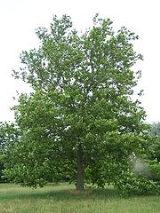
A sycamore tree is easily recognized by its mottled exfoliating bark.


Discussion
Ask a question about 'American sycamore'
Start a new discussion about 'American sycamore'
Answer questions from other users
Full Discussion Forum


Recent Posts


Encyclopedia


Platanus occidentalis or the American Sycamore, also known as American plane, Occidental plane, and Buttonwood, is one of the species of Platanus
Platanus

Platanus is a small genus of trees native to the Northern Hemisphere. They are the sole members of the family Platanaceae.They are all large trees to 30?50 m tall, deciduous , and are mostly found in riparian or other wetland habitat in the wild, though proving drought tolerant in cultivation away from streams....
 native to North America. It is usually called Sycamore
Sycamore

Sycamore is a name which is applied at various times and places to three very different types of trees, but with somewhat similar leaf forms.* Ficus sycomorus, the sycamore of the Bible; a species of fig, also called the "sycamore fig" or "fig-mulberry", native to the Middle East and eastern Africa...
 in North America, a name which can refer to other types of tree in other parts of the world.

Description


A sycamore tree is easily recognized by its mottled exfoliating bark. The bark of all trees has to yield to a growing trunk; in the case of trees such as the Silver Maple
Silver Maple

Acer saccharinum, known as the silver maple , is a species of maple native to eastern North America in the eastern United States and adjacent parts of southeast Canada....
 and the Shagbark Hickory
Shagbark Hickory

The Shagbark Hickory is a common hickory in the Eastern United States and southeast Canada. It is a large deciduous tree, growing up to 27 m tall, and will live up to 200 years old....
 the process is not hidden, but the Sycamore shows the process of exfoliation more openly than any other tree. The bark of the trunk and larger limbs flakes off in great irregular masses, leaving the surface mottled, and greenish-white, gray and brown. Sometimes the smaller limbs look as if whitewashed. The explanation is found in the rigid texture of the bark tissue, which lacks the elasticity common to the bark of other trees, so it is incapable of stretching to accommodate the growth of the wood underneath and the tree sloughs it off.

A sycamore can grow to massive proportions. Typically reaching up to 30 to 40 meters (about 98' to 131') high and 1.5 to 2 meters (about 4'11" to 6'6") in diameter when left to grow in deep soils. At its tallest, the species has been measured to 51 meters (about 167'), and at its largest, it has been measured to nearly 4 meters (about 13'1") in diameter. Historical specimens over 5 meters (about 16'5") thick have been reported, but verifying the accuracy of these early accounts is seldom possible.

The sycamore tree is often divided near the ground into several secondary trunks, very free from branches. Spreading limbs at the top make an irregular, open head. Roots are fibrous. The trunks of large trees are often hollow.

Another peculiarity is the way the leaves grow sticky, green buds. In early August, most trees in general will have--nestled in the axils of their leaves--the tiny forming bud which will produce the leaves of the coming year. The sycamore branch apparently has no such buds. Instead there is an enlargement of the petiole which encloses the bud in a tight-fitting case at the base of the petiole.

Platanus Occidentalis Gs344
* Bark: Dark reddish brown, broken into oblong plate-like scales; higher on the tree, it is smooth and light gray; separates freely into thin plates which peel off and leave the surface pale yellow, or white, or greenish. Branchlets at first pale green, coated with thick pale tomentum, later dark green and smooth, finally become light gray or light reddish brown.
  • Wood: Light brown, tinged with red; heavy, weak, difficult to split. Largely used for furniture and interior finish of houses, butcher's blocks. Sp. gr., 0.5678; weight of cu. ft., 35.39 lbs.
  • Winter buds: Large, stinky, sticky, green, and three-scaled, they form in summer within the petiole of the full grown leaf. The inner scales enlarge with the growing shake. There is no medicinal bud.
  • Leaves: Alternate, palmately nerved, broadly-ovate or orbicular, four to nine inches long, truncate or cordate or wedge-shaped at base, decurrent on the petiole. Three to five-lobed by broad shallow sinuses rounded in the bottom; lobes acuminate, toothed, or entire, or undulate. They come out of the bud plicate, pale green coated with pale tomentum; when full grown are bright yellow green above, paler beneath. In autumn they turn brown and wither before falling. Petioles long, abruptly enlarged at base and inclosing the buds. Stipules with spreading, toothed borders, conspicuous on young shoots, caducous.
  • Flowers: May, with the leaves; monoecious, borne in dense heads. Staminate and pistillate heads on separate peduncles. Staminate heads dark red, on axillary peduncles; pistillate heads light green tinged with red, on longer terminal peduncles. Calyx of staminate flowers three to six tiny scale-like sepals, slightly united at the base, half as long as the pointed petals. Of pistillate flowers three to six, usually four, rounded sepals, much shorter than the acute petals. Corolla of three to six thin scale-like petals.
  • Stamens: In staminate flowers as many of the divisions of the calyx and opposite to them; filaments short; anthers elongated, two-celled; cells opening by lateral slits; connectives hairy.
  • Pistil: Ovary superior, one-celled, sessile, ovate-oblong, surrounded at base by long, jointed, pale hairs; styles long, incurved, red, stigmatic, ovules one or two.
  • Fruit: Brown heads, solitary or rarely clustered, an inch in diameter, hanging on slender stems three to six inches long; persistent through the winter. These heads are composed of akenes about two-thirds of an inch in length. October.


Distribution


In its native range, it is often found in riparian and wetland areas. The range extends from Iowa
Iowa

The State of Iowa is a U.S. state in the Midwestern region of the United States of America, an area often referred to as the "American Heartland." It is bordered by Minnesota to the north, Wisconsin and Illinois to the east, Nebraska and South Dakota to the west, and Missouri to the south....
 to Ontario
Ontario

Ontario is a Provinces and territories of Canada located in the Central Canada part of Canada, the largest by population and second largest, after Quebec, in total area....
 and Maine
Maine

The State of Maine is a U.S. state in the New England region of the northeastern United States of America, bordering the Atlantic Ocean to the southeast, New Hampshire to the southwest, the Canadian provinces of Quebec to the northwest and New Brunswick to the northeast....
 in the north, Nebraska
Nebraska

Nebraska is a U.S. state located on the Great Plains of the Midwestern United States and Western United States.Nebraska probably gets its name from the archaic Chiwere language words ?? Br?sge or the Omaha-Ponca language N? Bth?ska meaning "flat water," after the Platte River that flows through the state....
 in the west, and south to Texas
Texas

Texas is a U.S. state located in the South Central United States, nicknamed the Lone Star State. Texas is the second largest U.S. state in both area and population, spanning , and with a growing population of 24.3 million residents....
 and Florida
Florida

Florida is a U.S. state located in the Southeastern United States of the United States, bordering Alabama to the northwest and Georgia to the northeast....
. Closely related species (see Platanus
Platanus

Platanus is a small genus of trees native to the Northern Hemisphere. They are the sole members of the family Platanaceae.They are all large trees to 30?50 m tall, deciduous , and are mostly found in riparian or other wetland habitat in the wild, though proving drought tolerant in cultivation away from streams....
) occur in Mexico
Mexico

The United Mexican States , commonly known as Mexico , is a federalism constitutionalism republic in North America. It is bordered on the north by the United States; on the south and west by the Pacific Ocean; on the southeast by Guatemala, Belize, and the Caribbean Sea; and on the east by the Gulf of Mexico....
 and the southwestern states of the U.S.A. It is sometimes grown for timber
Timber

Timber may refer to:* Lumber, i.e. wood materials* Timber, Oregon, an unincorporated community in the U.S. state of Oregon* Timber , a 1984 arcade game by Bally Midway...
, and has become naturalised in some areas outside its native range. It has grown well in Bismarck, North Dakota
Bismarck, North Dakota

Bismarck is the Capital of the U.S. state of North Dakota, the county seat of Burleigh County, North Dakota, and the second most populous city in North Dakota after Fargo, North Dakota....
, and is sold as far south as Okeechobee
Okeechobee, Florida

Okeechobee is a city in Okeechobee County, Florida, Florida, United States. The population was 5,376 at the 2000 census. As of 2004, the population recorded by the U.S....
. The American Sycamore is also well adapted to life in Argentina
Argentina

Argentina, officially the Argentine Republic , is a country in South America, constituted as a federation of 23 provinces and an autonomous city....
 and Australia
Australia

Australia, officially the Commonwealth of Australia, is a country in the southern hemisphere comprising the Australia of the world's smallest continent, the major island of Tasmania, and numerous list of islands of Australia in the Indian Ocean and Pacific Oceans....
 and is quite widespread across the Australian continent especially in the cooler southern States eg. Victoria
Victoria (Australia)

File:Map Victoria Aboriginal tribes .jpgVictoria is a States and territories of Australia located in the southeastern corner of Australia. It is the smallest mainland state in area but the most Population density and urbanised....
 and New South Wales
New South Wales

New South Wales is Australia's oldest and most populous States and territories of Australia, located in the south-east of the country, north of Victoria and south of Queensland....
.

Cultivation

The sycamore is able to endure a big city environment and has been extensively planted as a shade tree. It bears transplanting well and grows rapidly. The second oldest tree in the City of Buffalo, New York is a Sycamore at 404 Franklin Street that has been dated to c. 1700.

Propagation and pests


The American sycamore is a favored food plant of the pest sycamore leaf beetle
Neochlamisus platani

Neochlamisus platani is a species in the leaf beetle genus Neochlamisus. This beetle feeds, mates, and oviposits on their host plant American sycamore ....
.

Diseases


American sycamore is susceptible to Plane anthracnose disease (Apiognomonia veneta, syn. Gnomonia platani), an introduced fungus naturally found on the Oriental plane P. orientalis, which has evolved considerable resistance to the disease. Although rarely killed or even seriously harmed, American sycamore is commonly partially defoliated by the disease, rendering it unsightly as a specimen tree.

The disease makes its appearance soon after the leaves have expanded, appearing in the form of small black spots which lie close to the veins. As a result, the half grown leaves turn brown, shrivel, and fall. It is very common in early July to see these trees putting forth their second crop of leaves while the first hang brown, dead, and unsighly on the ends of the branches. This greatly shortens the effective growing season for the plant.

As a result of the fungus' damage, American sycamore is not often planted; the more resistant London plane
London Plane

The 'London Plane' or 'Hybrid Plane' is a tree in the genus Platanus. It is usually thought to be a Hybrid of the Platanus orientalis, P....
 (P. x hispanica; hybrid P. occidentalis x P. orientalis) being preferred instead.

History


The terms under which the New York Stock Exchange
New York Stock Exchange

New York Stock Exchange is a stock exchange based in New York City, New York. It is the largest stock exchange in the world by United States dollar market capitalization of its listed companies' Security ....
 was formed is called the Buttonwood Agreement
Buttonwood Agreement

The Buttonwood Agreement, which took place on May 17, 1792, started the New York Stock & Exchange Board . This agreement was signed by twenty-four stock brokers outside of 68 Wall Street in New York under a buttonwood tree....
, because it was signed under a Buttonwood tree.

Sycamore made up a large part of the forests of Greenland and Arctic America during the Cretaceous and Tertiary periods. It once grew abundantly in central Europe, from where it has now disappeared.

See also

  • Pinchot Sycamore
    Pinchot Sycamore

    The Pinchot Sycamore is a large American sycamore in Simsbury, Connecticut. It is the largest tree in Connecticut. When measured by the Connecticut Botanical Society in 1998, the Pinchot Sycamore was 26 feet around and 95 feet tall, with an average canopy diameter of 140 feet....
     - An American sycamore that is the largest tree in Connecticut
    Connecticut

    Connecticut is a U.S. state located in the New England region of the northeastern United States. The state borders New York to the west and south , Massachusetts to the north, and Rhode Island to the east....


External links

  • Diagnostic photographs and information