

American Paint Horse

Encyclopedia
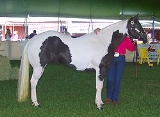
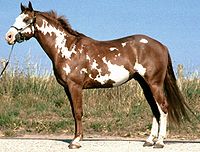
The American Paint Horse is a breed of horse
that combines both the conformational characteristics of a western
stock horse with a pinto
spotting pattern of white and dark coat colors
. Developed from a base of spotted horses with Quarter Horse
and Thoroughbred
bloodlines, the American Paint Horse Association
(APHA) breed registry
is now one of the fastest-growing in North America
. The registry allows some non-spotted animals to be registered as "breeding stock Paints," and considers the American Paint Horse to be a horse breed
with distinct characteristics, not merely a color breed
.
(APHA) the second-largest breed registry in the United States. While the colorful coat pattern is essential to the identity of the breed, American Paint Horses have strict bloodline requirements and a distinctive stock-horse body type. To be eligible for registry, a Paint's sire and dam must be registered with the American Paint Horse Association, the American Quarter Horse Association
, or the Jockey Club (Thoroughbred
s). At least one of the parents must be a registered American Paint Horse. There are two categories of registration, regular, for horses with color, and solid Paint-bred, for those without color.
 In addition to bloodlines, to be eligible for the Regular Registry of the American Paint Horse Association
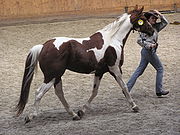
(APHA), the horse must also exhibit a "natural paint marking", meaning either a predominant hair coat color with at least one contrasting area of solid white hair of the required size with some underlying unpigmented skin present on the horse at the time of its birth. Or, in the case of a predominantly white hair coat, at least one contrasting area of the required size of colored hair with some underlying pigmented skin present on the horse. Natural Paint markings usually must cover more than two inches and be located in certain designated areas of the body.
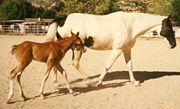 Solid colored offspring of two registered Paint parents, called "Solid Paint-Breds" or "Breeding Stock Paints," are also eligible for registration, with certain restrictions. They are able to participate in some recognized Paint breed shows, and there are alternative programs offered, and many incentive programs within the registry are available to Solid Paint-bred horses. If a solid-colored horse is bred to a regular registry Paint horse, it is possible to produce a spotted foal. In some cases, such as the recessive sabino patterns, described below, even a solid colored horse may still carry genes for color. However, in the case of the dominant tobiano pattern, a Breeding Stock Paint will not carry these color genes, though it may retain other desirable traits.
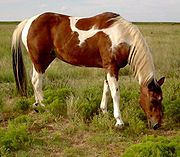 Each Paint Horse has a particular combination of white and another color of the equine spectrum. Most common are horses with white spots combined with black
, bay, brown
, and chestnut
or sorrel
. Less common are horses with spot colors influenced by dilution gene
s such as palomino
, buckskin
, cremello
, perlino
, pearl or "Barlink factor"
, and champagne
, various shades of roan
, or various shades of dun, including grullo
. Paints may also carry the gray
gene and have spots that eventually fade to white hair, though retaining pigmented skin underneath the areas that were once dark.
Spots can be any shape or size, except leopard complex
patterning, which is characteristic of the Appaloosa
, and located virtually anywhere on the Paint's body. Although Paints come in a variety of colors with different markings and different underlying genetics, these are grouped into only four defined coat patterns: overo
(includes frame
, splash
and sabino), tobiano
and tovero
and solid.
Breeding Stock Paints can sometimes showcase small color traits, particularly if they carry sabino genetics. Such traits include blue eyes, pink skin on lips and nostrils, roan spots, and minimal roaning.
differs from a Paint solely due to bloodlines. A pinto may be of any breed or combination of breeds, though some Pinto registries may have additional restrictions. (Some do not register draft horses or mules, for example.) For a horse to be registered as an American Paint Horse however, it must have registered American Quarter Horse
, American Paint Horse, or Thoroughbred
parents. Therefore, all Paint horses (except for the small number of "solids" allowed into the Paint registry) could be registered as pintos, but not all pintos qualify to be registered as Paints.
and the Thoroughbred
. A registered Paint horse should conform to the same "stock horse" body type desired in Quarter Horses: a muscular animal that is heavy but not too tall, with a low center of gravity for maneuverability, and powerful hindquarters suitable for rapid acceleration and sprinting.
When the American Quarter Horse Association emerged in 1940 to preserve horses of the "stock" type, it excluded those with pinto
coat patterns and "crop out" horses, those born with white body spots or white above the knees and hocks. Undeterred, fans of colorful stock horses formed a variety of organizations to preserve and promote Paint horses. In 1965 some of these groups merged to form the American Paint Horse Association.
(LWS). Also called Overo Lethal White Syndrome (OLWS) or, less often, White Foal Syndrome (WFS), it is linked to a recessive gene
associated with the frame overo
pattern. Horses that are heterozygous carriers of the gene do not develop the condition and are physically healthy. However, when a foal is born that is homozygous for the LWS gene, it will be humanely euthanized
shortly after birth, or else will die within a few days from complications involving an underdeveloped intestinal tract. A DNA
test is available for this condition so that horses who are carriers of this gene are not bred to one another. Horses can carry the LWS gene and not visibly exhibit overo coloring; cases have appeared in the offspring of both tobiano
and solid-colored parents, though all cases to date are horses that had overo ancestors. LWS is also not unique to Paint Horses; it can occur in any equine breed where the frame overo coat pattern is found.
Due to the heavy influx of American Quarter Horse
breeding, some Paints may also carry genes for HYPP and HERDA. The influence of Thoroughbred breeding puts some bloodlines at higher risk for Wobbler's syndrome.
Horse
The horse is one of two extant subspecies of Equus ferus, or the wild horse. It is a single-hooved mammal belonging to the taxonomic family Equidae. The horse has evolved over the past 45 to 55 million years from a small multi-toed creature into the large, single-toed animal of today...
that combines both the conformational characteristics of a western
Western riding
Western riding is a style of horseback riding which evolved from the ranching and warfare traditions brought to the Americas by the Spanish Conquistadors, and both equipment and riding style evolved to meet the working needs of the cowboy in the American West...
stock horse with a pinto
Pinto horse
A pinto horse has a coat color that consists of large patches of white and any other color. The distinction between "pinto" and "solid" can be tenuous, as so-called "solid" horses frequently have areas of white hair. Various cultures throughout history appear to have selectively bred for pinto...
spotting pattern of white and dark coat colors
Equine coat color
Horses exhibit a diverse array of coat colors and distinctive markings. A specialized vocabulary has evolved to describe them.While most horses remain the same color throughout life, a few, over the course of several years, will develop a different coat color from that with which they were born...
. Developed from a base of spotted horses with Quarter Horse
American Quarter Horse
The American Quarter Horse is an American breed of horse that excels at sprinting short distances. Its name came from its ability to outdistance other breeds of horses in races of a quarter mile or less; some individuals have been clocked at speeds up to 55 mph...
and Thoroughbred
Thoroughbred
The Thoroughbred is a horse breed best known for its use in horse racing. Although the word thoroughbred is sometimes used to refer to any breed of purebred horse, it technically refers only to the Thoroughbred breed...
bloodlines, the American Paint Horse Association
American Paint Horse Association
The American Paint Horse Association is a breed registry for the American Paint Horse. It is currently headquartered in Fort Worth, Texas. It was founded in 1965 with the merging of two different color breed registries that had been formed to register pinto-colored horses of Quarter Horse bloodlines...
(APHA) breed registry
Breed registry
A breed registry, also known as a stud book or register, in animal husbandry and the hobby of animal fancy, is an official list of animals within a specific breed whose parents are known. Animals are usually registered by their breeders when they are still young...
is now one of the fastest-growing in North America
North America
North America is a continent wholly within the Northern Hemisphere and almost wholly within the Western Hemisphere. It is also considered a northern subcontinent of the Americas...
. The registry allows some non-spotted animals to be registered as "breeding stock Paints," and considers the American Paint Horse to be a horse breed
Horse breed
Horse breed is a broad term with no clear consensus as to definition, but most commonly refers to selectively bred populations of domesticated horses, often with pedigrees recorded in a breed registry. However, the term is sometimes used in a very broad sense to define landrace animals, or...
with distinct characteristics, not merely a color breed
Color breed
A color breed is a term that refers to horses that are registered based primarily on their coat color, regardless of the horse's actual breed or breed type....
.
Registration
The American Paint Horse's combination of color and conformation has made the American Paint Horse AssociationAmerican Paint Horse Association
The American Paint Horse Association is a breed registry for the American Paint Horse. It is currently headquartered in Fort Worth, Texas. It was founded in 1965 with the merging of two different color breed registries that had been formed to register pinto-colored horses of Quarter Horse bloodlines...
(APHA) the second-largest breed registry in the United States. While the colorful coat pattern is essential to the identity of the breed, American Paint Horses have strict bloodline requirements and a distinctive stock-horse body type. To be eligible for registry, a Paint's sire and dam must be registered with the American Paint Horse Association, the American Quarter Horse Association
American Quarter Horse Association
The American Quarter Horse Association , based in Amarillo, Texas, is an international organization dedicated to the preservation, improvement and record-keeping of the American Quarter Horse. The association sanctions many competitive events and maintains the official registry...
, or the Jockey Club (Thoroughbred
Thoroughbred
The Thoroughbred is a horse breed best known for its use in horse racing. Although the word thoroughbred is sometimes used to refer to any breed of purebred horse, it technically refers only to the Thoroughbred breed...
s). At least one of the parents must be a registered American Paint Horse. There are two categories of registration, regular, for horses with color, and solid Paint-bred, for those without color.
Regular APHA registration
American Paint Horse Association
The American Paint Horse Association is a breed registry for the American Paint Horse. It is currently headquartered in Fort Worth, Texas. It was founded in 1965 with the merging of two different color breed registries that had been formed to register pinto-colored horses of Quarter Horse bloodlines...
(APHA), the horse must also exhibit a "natural paint marking", meaning either a predominant hair coat color with at least one contrasting area of solid white hair of the required size with some underlying unpigmented skin present on the horse at the time of its birth. Or, in the case of a predominantly white hair coat, at least one contrasting area of the required size of colored hair with some underlying pigmented skin present on the horse. Natural Paint markings usually must cover more than two inches and be located in certain designated areas of the body.
Solid Paint-Bred
Color
Black (horse)
Black is a hair coat color of horses in which the entire hair coat is black. Black is a relatively uncommon coat color, and novices frequently mistake dark chestnuts or bays for black. However, some breeds of horses, such as the Friesian horse, Murgese and Ariegeois are almost exclusively black...
, bay, brown
Seal brown (horse)
Seal brown is a hair coat color of horses characterized by a near-black body color; with black points, the mane, tail and legs; but also reddish or tan areas around the eyes, muzzle, behind the elbow and in front of the stifle...
, and chestnut
Chestnut (coat)
Chestnut is a hair coat color of horses consisting of a reddish-to-brown coat with a mane and tail the same or lighter in color than the coat. Genetically and visually, chestnut is characterized by the absolute absence of true black hairs...
or sorrel
Sorrel (horse)
Sorrel is an alternative word for one of the most common equine coat colors in horses. While the term is usually used to refer to a copper-red shade of chestnut, in some places it is used generically in place of "chestnut" to refer to any reddish horse with a same-color or lighter mane and tail,...
. Less common are horses with spot colors influenced by dilution gene
Dilution gene
Dilution gene is a popular term for any one of a number of genes that act to create a lighter coat color in living creatures. There are many examples of such genes:-General:...
s such as palomino
Palomino
Palomino is a coat color in horses, consisting of a gold coat and white mane and tail. Genetically, the palomino color is created by a single allele of a dilution gene called the cream gene working on a "red" base coat...
, buckskin
Buckskin (color)
Buckskin is a hair coat color of horses; referring to a color that resembles certain shades of tanned deerskin. Similar colors in some breeds of dogs are also called buckskin. The horse has a tan or gold colored coat with black points . Buckskin occurs as a result of the cream dilution gene acting...
, cremello
Cream gene
The cream gene is responsible for a number of horse coat colors. Horses that have the cream gene in addition to a base coat color that is chestnut will become palomino if they are heterozygous, having one copy of the cream gene, or cremello, if they are homozygous. Similarly, horses with a bay...
, perlino
Cream gene
The cream gene is responsible for a number of horse coat colors. Horses that have the cream gene in addition to a base coat color that is chestnut will become palomino if they are heterozygous, having one copy of the cream gene, or cremello, if they are homozygous. Similarly, horses with a bay...
, pearl or "Barlink factor"
Pearl gene
The Pearl gene, also known as the "Barlink factor," is a dilution gene that somewhat resembles the cream gene and the champagne gene, but is neither. It is a somewhat rare dilution gene found in the American Quarter Horse, American Paint Horse, and Peruvian Paso. The same mutation appears in...
, and champagne
Champagne gene
The champagne gene is a simple dominant allele responsible for a number of rare horse coat colors. The most distinctive traits of horses with the champagne gene are the hazel eyes and pinkish, freckled skin, which are bright blue and bright pink at birth, respectively...
, various shades of roan
Roan (horse)
Roan is a horse coat color pattern characterized by an even mixture of colored and white hairs on the body, while the head and "points"—lower legs, mane and tail—are more solid-colored. The roan pattern is dominantly-inherited, and is found in many horse breeds...
, or various shades of dun, including grullo
Grullo
Grullo is a color of horses in the dun family, characterized by tan-gray or mouse-colored hairs on the body, often with shoulder and dorsal stripes and black barring on the lower legs. In this coloration each individual hair is mouse-colored, unlike a roan which is composed of a mixture of dark and...
. Paints may also carry the gray
Gray (horse)
Gray or grey is a coat color of horses characterized by progressive silvering of the colored hairs of the coat. Most gray horses have black skin and dark eyes; unlike many depigmentation genes, gray does not affect skin or eye color Their adult hair coat is white, dappled, or white intermingled...
gene and have spots that eventually fade to white hair, though retaining pigmented skin underneath the areas that were once dark.
Spots can be any shape or size, except leopard complex
Leopard complex
The leopard complex is a group of genetically-related coat patterns in horses. These patterns range from progressive increases in interspersed white hair similar to graying or roan to distinctive, Dalmatian-like leopard spots on a white coat. Secondary characteristics associated with the leopard...
patterning, which is characteristic of the Appaloosa
Appaloosa
The Appaloosa is a horse breed best known for its colorful leopard-spotted coat pattern. There is a wide range of body types within the breed, stemming from the influence of multiple breeds of horses throughout its history. Each horse's color pattern is genetically the result of various spotting...
, and located virtually anywhere on the Paint's body. Although Paints come in a variety of colors with different markings and different underlying genetics, these are grouped into only four defined coat patterns: overo
Overo
Overo refers to several genetically unrelated pinto coloration patterns of white-over-dark body markings in horses, and is a term used by the American Paint Horse Association to classify a set of pinto patterns that are not Tobiano...
(includes frame
Lethal white syndrome
Lethal white syndrome , also called overo lethal white syndrome , lethal white overo , and overo lethal white foal syndrome , is an autosomal genetic disorder most prevalent in the American Paint Horse...
, splash
Splashed white
Splashed white or splash is a horse coat color pattern that produces pink-skinned, white markings. Many splashed whites have very modest markings, while others have the distinctive "dipped in white paint" pattern. Blue eyes are a hallmark of the pattern, and splash may account for otherwise "solid"...
and sabino), tobiano
Tobiano
Tobiano is a spotted color pattern commonly seen in Pinto horses, produced by a dominant gene. The tobiano gene produces white-haired, pink-skinned patches on a base coat color. The coloration is present from birth and does not change throughout the horse's lifetime, unless the horse also carries...
and tovero
Tovero
The Tovero coloration is a mix of tobiano and overo colorations in Pinto horses and American Paint Horses. The genetics of pinto coloration are not always fully understood, and some horses have a combination of patterns that does not fit cleanly in either category.Some characteristics of a Tovero...
and solid.
Breeding Stock Paints can sometimes showcase small color traits, particularly if they carry sabino genetics. Such traits include blue eyes, pink skin on lips and nostrils, roan spots, and minimal roaning.
Terms for color patterns defined
- TobianoTobianoTobiano is a spotted color pattern commonly seen in Pinto horses, produced by a dominant gene. The tobiano gene produces white-haired, pink-skinned patches on a base coat color. The coloration is present from birth and does not change throughout the horse's lifetime, unless the horse also carries...
: The most common spotting pattern, characterized by rounded markings with white legs and white across the back between the withers and the dock of the tail, usually arranged in a roughly vertical pattern and more white than dark, with the head usually dark and with markings like that of a normal horse. i.e. star, snip, strip, or blaze. - OveroOveroOvero refers to several genetically unrelated pinto coloration patterns of white-over-dark body markings in horses, and is a term used by the American Paint Horse Association to classify a set of pinto patterns that are not Tobiano...
: A group of spotting patterns characterized by sharp, irregular markings with a horizontal orientation, usually more dark than white, though the face is usually white, sometimes with blue eyes. The white rarely crosses the back, and the lower legs are normally dark. The APHA recognizes three overo patterns:- FrameLethal white syndromeLethal white syndrome , also called overo lethal white syndrome , lethal white overo , and overo lethal white foal syndrome , is an autosomal genetic disorder most prevalent in the American Paint Horse...
: The most familiar overo pattern, the gene for frame has been genetically mapped and in the homozygous form, results in Lethal White Foal Syndrome (LWFS). Visually identified frames have no health defects connected to their color, and are characterized by ragged, sharp white patches on the sides of the body, leaving a "frame" of non-white color that typically includes the topline. - SabinoSabino horseSabino is a group of white spotting patterns in horses that affect the skin and hair. A wide variety of irregular color patterns are accepted as sabino. In the strictest sense, "sabino" refers to the white patterns produced by the Sabino 1 gene, for which there is a DNA test...
: Often confused with roanRoan (horse)Roan is a horse coat color pattern characterized by an even mixture of colored and white hairs on the body, while the head and "points"—lower legs, mane and tail—are more solid-colored. The roan pattern is dominantly-inherited, and is found in many horse breeds...
or rabicanoRabicanoRabicano, also called white ticking, is a horse coat color characterized by limited roaning in a specific pattern: interspersed white hairs most dense and originating from the flank and the tailhead...
, sabino is a slight spotting pattern characterized by high white on legs, belly spots, white markings on the face extending past the eyes and/or patches of roaning patterns standing alone or on the edges of white markings. - Splashed whiteSplashed whiteSplashed white or splash is a horse coat color pattern that produces pink-skinned, white markings. Many splashed whites have very modest markings, while others have the distinctive "dipped in white paint" pattern. Blue eyes are a hallmark of the pattern, and splash may account for otherwise "solid"...
: The least common spotting pattern, splashed whites typically have blue eyes and crisp, smooth, blocky white markings that almost always include the head and legs. The tail is often white or white-tipped, and body markings originate under the belly and extend "upwards".
- Frame
- ToveroToveroThe Tovero coloration is a mix of tobiano and overo colorations in Pinto horses and American Paint Horses. The genetics of pinto coloration are not always fully understood, and some horses have a combination of patterns that does not fit cleanly in either category.Some characteristics of a Tovero...
: spotting pattern that is a mix of tobiano and overo coloration, such as blue eyes on a dark head. - Solid: A horse otherwise eligible for registration as a Paint that does not have any white that constitutes a recognized spotting pattern.
- "Color": An informal term meaning that the horse has a spotting pattern. (The opposite of "Solid.")
- "Chrome": An informal term of approval used in some geographic regions to describe a particularly flashy spotting pattern.
Paint or Pinto?
The terms "paint" and "pinto" are sometimes both used to describe spotted horses, but in modern use there is a clear difference between the two terms. A pintoPinto horse
A pinto horse has a coat color that consists of large patches of white and any other color. The distinction between "pinto" and "solid" can be tenuous, as so-called "solid" horses frequently have areas of white hair. Various cultures throughout history appear to have selectively bred for pinto...
differs from a Paint solely due to bloodlines. A pinto may be of any breed or combination of breeds, though some Pinto registries may have additional restrictions. (Some do not register draft horses or mules, for example.) For a horse to be registered as an American Paint Horse however, it must have registered American Quarter Horse
American Quarter Horse
The American Quarter Horse is an American breed of horse that excels at sprinting short distances. Its name came from its ability to outdistance other breeds of horses in races of a quarter mile or less; some individuals have been clocked at speeds up to 55 mph...
, American Paint Horse, or Thoroughbred
Thoroughbred
The Thoroughbred is a horse breed best known for its use in horse racing. Although the word thoroughbred is sometimes used to refer to any breed of purebred horse, it technically refers only to the Thoroughbred breed...
parents. Therefore, all Paint horses (except for the small number of "solids" allowed into the Paint registry) could be registered as pintos, but not all pintos qualify to be registered as Paints.
History
The American Paint Horse shares a common ancestry with the American Quarter HorseAmerican Quarter Horse
The American Quarter Horse is an American breed of horse that excels at sprinting short distances. Its name came from its ability to outdistance other breeds of horses in races of a quarter mile or less; some individuals have been clocked at speeds up to 55 mph...
and the Thoroughbred
Thoroughbred
The Thoroughbred is a horse breed best known for its use in horse racing. Although the word thoroughbred is sometimes used to refer to any breed of purebred horse, it technically refers only to the Thoroughbred breed...
. A registered Paint horse should conform to the same "stock horse" body type desired in Quarter Horses: a muscular animal that is heavy but not too tall, with a low center of gravity for maneuverability, and powerful hindquarters suitable for rapid acceleration and sprinting.
When the American Quarter Horse Association emerged in 1940 to preserve horses of the "stock" type, it excluded those with pinto
Pinto horse
A pinto horse has a coat color that consists of large patches of white and any other color. The distinction between "pinto" and "solid" can be tenuous, as so-called "solid" horses frequently have areas of white hair. Various cultures throughout history appear to have selectively bred for pinto...
coat patterns and "crop out" horses, those born with white body spots or white above the knees and hocks. Undeterred, fans of colorful stock horses formed a variety of organizations to preserve and promote Paint horses. In 1965 some of these groups merged to form the American Paint Horse Association.
Genetic Problems
One medical issue associated with the breed is the genetic disease lethal white syndromeLethal white syndrome
Lethal white syndrome , also called overo lethal white syndrome , lethal white overo , and overo lethal white foal syndrome , is an autosomal genetic disorder most prevalent in the American Paint Horse...
(LWS). Also called Overo Lethal White Syndrome (OLWS) or, less often, White Foal Syndrome (WFS), it is linked to a recessive gene
Dominance relationship
Dominance in genetics is a relationship between two variant forms of a single gene, in which one allele masks the effect of the other in influencing some trait. In the simplest case, if a gene exists in two allelic forms , three combinations of alleles are possible: AA, AB, and BB...
associated with the frame overo
Overo
Overo refers to several genetically unrelated pinto coloration patterns of white-over-dark body markings in horses, and is a term used by the American Paint Horse Association to classify a set of pinto patterns that are not Tobiano...
pattern. Horses that are heterozygous carriers of the gene do not develop the condition and are physically healthy. However, when a foal is born that is homozygous for the LWS gene, it will be humanely euthanized
Animal euthanasia
Animal euthanasia is the act of putting to death painlessly or allowing to die, as by withholding extreme medical measures, an animal suffering from an incurable, especially a painful, disease or condition. Euthanasia methods are designed to cause minimal pain and distress...
shortly after birth, or else will die within a few days from complications involving an underdeveloped intestinal tract. A DNA
DNA
Deoxyribonucleic acid is a nucleic acid that contains the genetic instructions used in the development and functioning of all known living organisms . The DNA segments that carry this genetic information are called genes, but other DNA sequences have structural purposes, or are involved in...
test is available for this condition so that horses who are carriers of this gene are not bred to one another. Horses can carry the LWS gene and not visibly exhibit overo coloring; cases have appeared in the offspring of both tobiano
Tobiano
Tobiano is a spotted color pattern commonly seen in Pinto horses, produced by a dominant gene. The tobiano gene produces white-haired, pink-skinned patches on a base coat color. The coloration is present from birth and does not change throughout the horse's lifetime, unless the horse also carries...
and solid-colored parents, though all cases to date are horses that had overo ancestors. LWS is also not unique to Paint Horses; it can occur in any equine breed where the frame overo coat pattern is found.
Due to the heavy influx of American Quarter Horse
American Quarter Horse
The American Quarter Horse is an American breed of horse that excels at sprinting short distances. Its name came from its ability to outdistance other breeds of horses in races of a quarter mile or less; some individuals have been clocked at speeds up to 55 mph...
breeding, some Paints may also carry genes for HYPP and HERDA. The influence of Thoroughbred breeding puts some bloodlines at higher risk for Wobbler's syndrome.