


American Enterprise Institute

Encyclopedia
The American Enterprise Institute for Public Policy Research (AEI) is a conservative think tank
founded in 1943. Its stated mission is "to defend the principles and improve the institutions of American freedom and democratic capitalism
—limited government
, private enterprise, individual liberty and responsibility, vigilant and effective defense and foreign policies, political accountability, and open debate." AEI is an independent nonprofit organization supported primarily by grants and contributions from foundations
, corporations, and individuals. It is headquartered in Washington, D.C.
Some AEI scholars are considered to be some of the leading architects of the second Bush administration's public policy.
More than twenty AEI scholars and fellows served either in a Bush administration policy post or on one of the government's many panels and commissions. Among the prominent former government officials now affiliated with AEI are former U.S. ambassador to the U.N.
John Bolton
, now an AEI senior fellow; former chairman of the National Endowment for the Humanities
; Lynne Cheney
, a longtime AEI senior fellow; former House Speaker
Newt Gingrich
, now an AEI senior fellow; former Dutch member of parliament Ayaan Hirsi Ali
, an AEI visiting fellow; and former deputy secretary of defense
Paul Wolfowitz
, now an AEI visiting scholar. Other prominent individuals affiliated with AEI include Kevin Hassett
, Frederick W. Kagan, Leon Kass
, Charles Murray
, Michael Novak
, Norman J. Ornstein
, Richard Perle
, Radek Sikorski, Christina Hoff Sommers
, and Peter J. Wallison
.
, but practically highly partisan, and its website includes a statement on political advocacy: "Legal requirements aside, AEI has important reasons of its own for abstaining from any form of policy advocacy as an institution. . . . AEI takes no institutional positions on policy issues (whether or not they are currently before legislative, executive, or judicial bodies) or on any other issues." This distinguishes AEI from other think tanks, such as the Heritage Foundation
and the Center for American Progress
. The institute is often cited as a right-leaning
counterpart to the left-leaning
Brookings Institution
. The two entities have often collaborated: from 1998 to 2008, they co-sponsored the AEI-Brookings Joint Center for Regulatory Studies (now housed solely at AEI), and in 2006, they launched the AEI-Brookings Election Reform Project.
AEI is the most prominent think tank associated with American neoconservatism
, in both the domestic and international policy arenas. Irving Kristol
, widely considered a father of neoconservatism, was a senior fellow at AEI (arriving from the Congress for Cultural Freedom following the widespread revelation of the group's CIA
funding) and many prominent neoconservatives—including Jeane Kirkpatrick
, Ben Wattenberg, and Joshua Muravchik
—spent the bulk of their careers at AEI. However, AEI is not officially neoconservative. AEI resident scholar Norman J. Ornstein
, a centrist liberal, criticizes commentators who label him a "neocon" and says that "the intellectual openness and lack of orthodoxy at AEI exceeds what I have seen on any college campus. . . . [E]ven though my writings have frequently ticked off conservative ideologues and business interests—especially my deep involvement in campaign finance reform—I have never once been told, 'You can't say that' or 'You better be careful.'"
AEI has taken strong stances against the farm bill and agricultural subsidies; a 2007 document authored by Bruce Gardner claimed that "There is no need for farm subsidies, and it would not really hurt anyone if we eliminated them."
. AEI’s original mission was to promote a "greater public knowledge and understanding of the social and economic advantages accruing to the American people through the maintenance of the system of free, competitive enterprise." AEI’s founders included executives from Eli Lilly
, General Mills
, Bristol-Myers, Chemical Bank, Chrysler
, and Paine Webber
. To this day, AEI’s board is composed of top leaders from major business and financial firms.
In 1943, AEI’s main offices were moved from New York City
to Washington in order to capitalize on Congress’s need for help in making sense of its vastly increased wartime and New Deal
portfolio. AEI’s leaders aimed not merely to assess policy but to propound classical liberal
arguments for a free society and limited government, thus setting it apart from think tanks founded around the same time, like the RAND Corporation. In 1944, AEI convened an Economic Advisory Board to set a high standard for research; this eventually became the Council of Academic Advisers, which, over the decades, included notable economists and social scientists like Ronald Coase
, Martin Feldstein
, Milton Friedman
, Roscoe Pound
, and James Q. Wilson
.
AEA’s early work in Washington involved commissioning and distributing legislative analyses to Congress, which developed AEA’s relationships with Melvin Laird and Gerald Ford
. Brown eventually shifted AEI’s focus to commissioning studies of government policies. These subjects ranged from fiscal to monetary policy and from health care to energy, and authors included Earl Butz
, John Lintner
, former New Dealer Raymond Moley
, and Felix Morley
. Brown died in 1951, and AEI languished. In 1952, a group of young policymakers and public intellectuals—including Laird, William Baroody Sr., Paul McCracken
, and Murray Weidenbaum—met to discuss resurrecting AEI. In 1954, Baroody became executive vice president of the association.
s by James M. Buchanan
, Gottfried Haberler
, Edward Banfield, Rose Friedman
, and P. T. Bauer.
The American Enterprise Institute—which had been renamed in 1962—remained a marginal operation with little practical influence in the national politics until the 1970s. Baroody recruited a resident research faculty; Harvard economist Haberler was the first to join in 1972. In 1977, former president Gerald Ford joined AEI as its "distinguished fellow." Ford brought several of his administration's officials with him, including Arthur Burns, Robert Bork
, David Gergen
, James C. Miller III
, Laurence Silberman, and Antonin Scalia
. Ford also founded the AEI World Forum
, which he hosted until 2005. Other resident scholars hired around this time included Herbert Stein
and Walter Berns
. Baroody's son, William J. Baroody Jr.
, had been an official in the Ford White House and now also joined AEI, taking over the presidency from his father in 1978.
The elder Baroody made a concerted effort to recruit neoconservatives
(Democrats and urban liberals who had supported the New Deal and Great Society
but had become disaffected by what they perceived as the failure of the welfare state, as articulated in the pages of journals like The Public Interest
, and Cold War
hawks who rejected George McGovern
's peace agenda). He brought Irving Kristol
, Jeane Kirkpatrick
, Michael Novak
, and Ben Wattenberg to AEI. While at AEI, Kirkpatrick authored "Dictatorships and Double Standards
"; it brought her to the attention of Ronald Reagan
, and she was later named U.S. permanent representative to the United Nations
. AEI also became a home for supply-side economists
during the late 1970s and early 1980s. By 1980, AEI had grown from a budget of $1 million and a staff of ten to a budget of $8 million and a staff of 125.
and the Smith Richardson Foundation
withdrew funding for the institute, pushing AEI to the brink of bankruptcy. The board of trustees fired Baroody Jr. and, after an interregnum under interim president Paul McCracken, hired Christopher DeMuth
as president in December 1986. DeMuth stayed on for twenty-two years.
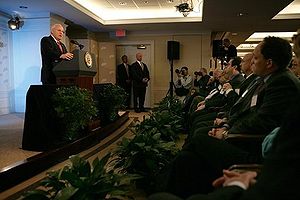 DeMuth cut AEI's programs and faculty dramatically, reorganizing the institute into three primary research areas: economic policy, foreign policy, and social and political studies. He also began fundraising prodigiously, successfully regaining the confidence of conservative foundations. In 1990, AEI hired Charles Murray
(and received his Bradley Foundation
support for The Bell Curve
) after the Manhattan Institute
dropped him. Murray's work on welfare in Losing Ground was very influential in debates over welfare reform
in the 1990s. Others brought to AEI by DeMuth included John Bolton
, Dinesh D'Souza
, Richard Cheney, Lynne Cheney
, Michael Barone
, James K. Glassman
, Newt Gingrich
, John Lott
, and Ayaan Hirsi Ali
. The George H. W. Bush
and Bill Clinton
administrations were good years for AEI. From 1988 to 2000, AEI's revenues grew from $10 million to $18.9 million. The institute's publications achieved a higher profile. Public Opinion and The AEI Economist were merged into The American Enterprise
, edited by Karlyn Bowman
from 1990 to 1995 and by Karl Zinsmeister
from 1995 to 2006, when Glassman created The American
. DeMuth presided over AEI as it moved into the digital age.
AEI enjoyed close ties to the George W. Bush administration
. More than twenty AEI scholars served in the administration, and Bush addressed the institute on three occasions. "I admire AEI a lot--I'm sure you know that," Bush said. "After all, I have been consistently borrowing some of your best people." Cabinet officials also frequented AEI. In 2002, Danielle Pletka
joined AEI to raise the profile of the foreign policy department, especially its Middle East studies program. AEI and several of its scholars—including Michael Ledeen
and Richard Perle
--became associated with the origins of the Iraq war. In 2006-2007, AEI scholars, including Frederick W. Kagan, provided a strategic framework for the "surge
" in Iraq. The Bush administration also drew on AEI work in other areas, such as Leon Kass
's appointment as the first chairman of the President's Council on Bioethics and Norman J. Ornstein
's work drafting the Bipartisan Campaign Reform Act
that Bush signed in 2002. However, some AEI scholars have been critical of the Bush administration's handling of the Iraq War and the economy.
When DeMuth retired as president at the end of 2008, AEI's staff numbered 185, with 70 scholars and several dozen adjuncts, and revenues of $31.3 million. Arthur C. Brooks
succeeded him as president and soon faced harsh financial headwinds associated with the recession that began in 2008. With a 2009 op-ed in the Wall Street Journal, Brooks positioned AEI to be much more aggressive in responding to the policies of the Barack Obama administration.
, president; David Gerson, executive vice president; Jason Bertsch, vice president for marketing; Henry Olsen
, vice president and director of the National Research Initiative; and Danielle Pletka
, vice president for foreign and defense policy studies.
Its board is chaired by Kevin Rollins
. Current notable trustees include Brooks, Gordon Binder
, former chairman and CEO of Amgen
; former vice president Dick Cheney
; Daniel D'Aniello, cofounder of The Carlyle Group; John V. Faraci
, chairman and CEO of International Paper
; Harlan Crow
, chairman and CEO of Crow Holdings, the Trammell Crow
family's investment company; Christopher Galvin
, former CEO and chairman of Motorola
; Raymond Gilmartin
, retired chairman and CEO of Merck & Co.
; Harvey Golub
, retired chairman and CEO of the American Express Company; Roger Hertog
, former president of Sanford C. Bernstein and Company
and vice chairman emeritus of AllianceBernstein
; Bruce Kovner
, chairman of Caxton Associates (and a former chairman of AEI); Robert Pritzker
; Edward B. Rust Jr.
, chairman and CEO of State Farm
(and also a former AEI chairman); and James Q. Wilson
.
AEI has a Council of Academic Advisers, chaired by James Q. Wilson
, which includes Eliot A. Cohen
, Martin Feldstein
, Gertrude Himmelfarb
, R. Glenn Hubbard
, William M. Landes, Sam Peltzman, John L. Palmer, George L. Priest
, Jeremy A. Rabkin
, and Richard J. Zeckhauser
. The Council of Academic Advisers selects the annual winner of the Irving Kristol Award
.
A list of notable people affiliated with AEI, both past and present, is available at List of American Enterprise Institute scholars and fellows.
Scholars at AEI working on the U.S. and world economies include Desmond Lachman, Adam Lerrick, John H. Makin
, Allan H. Meltzer, and Vincent Reinhart
. These scholars examine the federal budget
, monetary policy
, and international financial markets.
Throughout the beginning of the twenty-first century, scholars at The American Enterprise Institute have pushed for a more conservative approach to aiding the recession that includes major tax-cuts. AEI supported President Bush’s tax cuts in 2002 and claimed that the cuts “played a large role in helping to save the economy from a recession”. AEI also suggested that further taxes were necessary in order to attain recovery of the economy. John H. Makin, a scholar at AEI, stated that the Democrats in congress who opposed the Bush stimulus plan were foolish for doing so as he saw the plan as a major success for the administration. < http://www.aei.org/outlook/26286>
warned that Fannie Mae and Freddie Mac's public-private status put taxpayers on the line for increased risk. "Because of the agencies' dual public and private form, various efforts to force Fannie Mae and Freddie Mac to fulfill their public mission at the cost of their profitability have failed--and will likely continue to fail," he wrote in 2001. "The only viable solution would seem to be full privatization or the adoption of policies that would force the agencies to adopt this course themselves." Wallison ramped up his criticism of the GSEs throughout the 2000s. In 2006 and 2007, he moderated conferences featuring James B. Lockhart III
, the chief regulator of Fannie and Freddie In August 2008, after Fannie and Freddie had been backstopped by the US Treasury Department, Wallison outlined several ways of dealing with the GSEs, including "nationalization through a receivership," outright "privatization," and "privatization through a receivership." The following month, Lockhart and Treasury Secretary Henry Paulson
took the former path by putting Fannie and Freddie into federal "conservatorship
".
As the housing crisis unfolded, AEI sponsored a series of conferences featuring bearish commentators, including Lachman, Makin, and Nouriel Roubini
. Makin had been warning about the effects of a housing downturn on the broader economy for months. Amid charges that many homebuyers did not understand their complex mortgages
, Alex J. Pollock gained recognition for crafting a prototype of a one-page mortgage disclosure form.
Research in AEI's Financial Markets Program also includes banking, insurance
and securities regulation, accounting reform, corporate governance
, and consumer finance.
, globalization
, and international financial and regulatory bodies (such as the World Trade Organization
, World Bank
, and the International Monetary Fund
). Scholars in the Program on International Economics, including Claude Barfield, Philip I. Levy, Desmond Lachman, and Allan H. Meltzer, strongly favor free trade
. Much of AEI's recent work on trade focuses on the Doha Development Round and why it has failed to gain traction. The AEI Press has published several volumes on trade in services negotiations.
The Program also includes work on multilateral financial institutions. Meltzer—who chaired the International Financial Institution Advisory Commission
that recommended changes in IMF lending goals and procedures—has called for revisiting the Bretton Woods system
and suggested that U.S. leadership in the international economic order may be drawing to an end. Levy and Barfield have launched a conference series to address fundamental reform in international economic organizations.
also work on the subject. Specific subjects include "income distribution, transition costs, marginal tax rates, and international taxation of corporate income. . . . the Pension Protection Act of 2006
; dynamic scoring and the effects of taxation on investment, savings, and entrepreneurial activity; and options to fix the alternative minimum tax
." Hassett has coedited several volumes on tax reform. Viard has edited a book on tax policy lessons from the Bush administration
. AEI's working paper
series includes developing academic works on economic issues. One paper by Hassett and Mathur on the responsiveness of wages to corporate tax
ation
was cited by The Economist
; figures from another paper by Hassett and Brill on maximizing corporate income tax revenue was cited by the Wall Street Journal.
Joint Center for Regulatory Studies, directed by Robert W. Hahn. The Center, now housed entirely at AEI, sponsors conferences, papers, and books on regulatory decision-making and the impact of federal regulation on consumers, businesses, and governments. It covers a range of disciplines. The Center maintains a separate website at www.reg-markets.org. It also sponsors an annual Distinguished Lecture series. Past lecturers in the series have included William Baumol
, Supreme Court Justice Stephen Breyer
, Alfred Kahn
, Sam Peltzman, Richard Posner
, and Cass Sunstein
.
has been subject to controversy (see below). According to AEI, it "emphasizes the need to design environmental policies that protect not only nature but also democratic institutions and human liberty."When the Kyoto Protocol was approaching, AEI was hesitant to encourage the U.S. to join. joining. In an essay from written by AEI economic policy directors and scholars from the AEI outlook series of 2007, the authors discuss the Kyoto Protocol and state that the United States “should be wary of joining an international emissions-trading regime”. To back this statement, they point out that committing to the Kyoto emissions goal would be a significant and unrealistic obligation for the United States. In addition, they state that the Kyoto regulations would have an impact not only on governmental policies, but also the private sector through expanding government control over investment decisions. Scholars from AEI believed that “dilution of sovereignty” would be the result if the U.S. signed the treaty. AEI scholars have strongly promoted carbon tax
ation as an alternative to cap-and-trade regimes. "Most economists believe a carbon tax (a tax on the quantity of CO2 emitted when using energy) would be a superior policy alternative to an emissions-trading regime," wrote Kenneth P. Green
, Kevin Hassett, and Steven F. Hayward
. "In fact, the irony is that there is a broad consensus in favor of a carbon tax everywhere except on Capitol Hill, where the 'T word' is anathema." Other AEI scholars, including Samuel Thernstrom and Lee Lane, have argued for similar policies. Thernstrom and Lane are codirecting a project on whether geoengineering
would be a feasible way to "buy us time to make [the] transition [from fossil fuels] while protecting us from the worst potential effects of warming."
Green is expanding AEI's work on energy
policy. He has hosted conferences on nuclear power
and ethanol
With Aparna Mathur, he has also evaluated Americans' indirect energy use to discover unexpected areas in which energy efficiencies
can be achieved.
during the Cold War
, Saddam Hussein
's Iraq
, the People's Republic of China
, North Korea
, Iran
, Syria
, Venezuela
, Russia
, and terrorist or militant groups like al Qaeda and Hezbollah. Likewise, AEI scholars have promoted closer U.S. ties with countries whose interests or values (i.e., democracy) they view as aligned with America's, such as Israel
, the Republic of China
, India
, Australia
, Japan
, Mexico
, Colombia
, the United Kingdom
, and emerging post-Communist states such as Poland
and Georgia
.
AEI's foreign and defense policy studies department, directed by Danielle Pletka
, is the part of the institute most commonly associated with neoconservatism, especially by its critics. Prominent foreign-policy neoconservatives at AEI include Richard Perle
, Gary Schmitt
, and Paul Wolfowitz
. John Bolton
, often said to be a neoconservative, has said that he is not one, as his primary focus is on American interests, not democracy promotion. Joshua Muravchik
and Michael Ledeen
spent many years at AEI, although they departed at around the same time as Reuel Marc Gerecht
in 2008 in what was rumored to be a "purge" of neoconservatives at the institute, possibly "signal[ing] the end of [neoconservatism's] domination over the think tank over the past several decades," although Muravchik later said it was the result of personality and management conflicts.
proposed a phased withdrawal of U.S. troops and further engagement of Iraq's neighbors. Consulting with AEI's Iraq Planning Group, Frederick W. Kagan published an AEI report entitled Choosing Victory: A Plan for Success in Iraq calling for "phase one" of a change in strategy to focus on "clearing and holding" neighborhoods and securing the population; a troop escalation of seven Army brigades and Marine regiments; and a renewed emphasis on reconstruction, economic development, and jobs. As the report was being drafted, Kagan and Keane were briefing President Bush, Vice President Cheney, and othe senior Bush administration officials behind the scenes. According to Bob Woodward
, "[Peter J.] Schoomaker
was outraged when he saw news coverage that retired Gen. Jack Keane
, the former Army vice chief of staff, had briefed the president Dec. 11 about a new Iraq strategy being proposed by the American Enterprise Institute, the conservative think tank. 'When does AEI start trumping the Joint Chiefs of Staff
on this stuff?' Schoomaker asked at the next chiefs' meeting."
Kagan, Keane, and Senators John McCain
and Joseph Lieberman presented the plan at a January 5, 2007, event at AEI. Bush announced the change of strategy
on January 10 the idea having "won additional support among some officials as a result of a detailed study by Gen. Jack Keane, the former vice chief of staff at the Army, and Frederick W. Kagan, a military specialist, that was published by the American Enterprise Institute." Kagan authored three subsequent reports monitoring the progress of the surge.
AEI's defense policy researchers, who also include Schmitt and Thomas Donnelly, also work on issues related to the U.S. military forces' size and structure and military partnerships with allies (both bilaterally and through institutions such as NATO). Schmitt directs AEI's Program on Advanced Strategic Studies, which "analyzes the long-term issues that will impact America’s security and its ability to lead internationally."
China, enabling policymakers to better understand the internal forces and pressures that are shaping China's future."
AEI's Europe program was previously housed under the auspices of the New Atlantic Initiative, which was directed by Radek Sikorski before his return to Polish politics in 2005. Leon Aron's work forms the core of the institute's program on Russia. AEI scholars tend to view Russia as posing "strategic challenges for the West."
Mark Falcoff
, now retired, was previously AEI's resident Latinamericanist, focusing on the Southern Cone
, Panama
, and Cuba
. He has warned that the road for Cuba after Fidel Castro
's rule or the lifting of the U.S. trade embargo
would be difficult for an island scarred by a half-century of poverty and civil turmoil. Roger Noriega
's focuses at AEI are on Venezuela, Brazil
, the Mérida Initiative
with Mexico and Central America
, and hemispheric relations.
AEI has historically devoted significant attention to the Middle East, especially through the work of former resident scholars Ledeen and Muravchik. Pletka's research focus also includes the Middle East, and she coordinated a conference series on empowering democratic dissidents and advocates in the Arab World. In 2009, AEI launched the Critical Threats Project, led by Kagan, to "highlight the complexity of the global challenges the United States faces with a primary focus on Iran and al Qaeda's global influence." The project includes IranTracker.org, with contributions from Ali Alfoneh, Ahmad Majidyar and Michael Rubin, among others.
cosponsored NGOWatch
, which was later subsumed into Global Governance Watch, "a web-based resource that addresses issues of transparency and accountability in the United Nations
, NGOs, and related international organizations." NGOWatch returned as a subsite of Global Governance Watch, led by Jon Entine
. AEI scholars focusing on international organizations includes John Bolton
, the former U.S. ambassador to the United Nations, and John Yoo
, who researches international law
and sovereignty.
AEI's research on economic development
dates back to the early days of the institute. P. T. Bauer authored a monograph on development in India
in 1959, and Edward Banfield
published a booklet on the theory behind foreign aid in 1970. Since 2001, AEI has sponsored the Henry Wendt Lecture in International Development, named after Henry Wendt, an AEI trustee emeritus and former CEO of SmithKline Beckman. Notable lecturers include Angus Maddison
and Deepak Lal
.
Today, development remains a core research area at AEI, with "nearly a dozen scholars" at work on the subject.
Mauro De Lorenzo edits AEI's Development Policy Outlook series; his research objective is "to move U.S. development policy toward enhancing the business competitiveness of developing countries, rather than funding and managing their social spending." His research focuses on El Salvador
, Georgia, Rwanda
, and Vietnam
, four countries he says are making it easier to do business there.
Nicholas Eberstadt
holds the Henry Wendt Chair, focusing on demographics
, population growth
and human capital development; he served on the federal HELP Commission.
Paul Wolfowitz
, the former president of the World Bank
, researches development policy in Africa.
Roger Bate
focuses his research on malaria
, HIV/AIDS, counterfeit and substandard drugs
, access to water, and other problems endemic in the developing world.
, Medicare
, Medicaid
, pharmaceutical innovation, health care competition, and cost control. The Center was replaced in the mid-1980s with the Health Policy Studies Program, which continues to this day. The AEI Press has published dozens of books on health policy since the 1970s. Since 2003, AEI has published the Health Policy Outlook series on new developments in U.S. and international health policy. In addition, AEI also published “A Better Prescription” to outline their ideal plan to healthcare reform. In the report, a great amount of emphasis is placed on placing the money and control in the hands of the consumers and continuing the market-based system of healthcare. They also acknowledge that this form of healthcare “relies on financial incentives rather than central direction and control, and it recognizes that a one-size-fits-all approach will not work in a country as diverse as ours”.
In 2009, AEI researchers, including Joseph Antos and Thomas P. Miller, were active in assessing the Obama administration's health care proposals. Paul Ryan
, a minority point man for health care in the House of Representatives, delivered the keynote address at an AEI conference on five key elements of health reform: mandated universal coverage, insurance exchanges, the public plan option, medical practice and treatment, and revenue to cover federal health care costs. AEI scholars have long argued against the tax break for employer-sponsored health insurance, arguing that it distorts insurance markets and limits consumer choices. In the 2008 U.S. presidential election, John McCain
advocated this plan while Barack Obama
disparaged it; in 2009, however, members of the Obama administration indicated that lifting the exemption was "on the table." Scott Gottlieb has expressed concern about relatively unreliable comparative effectiveness research being used to restrict treatment options under a public plan. AEI also publishes a series of monographs on Medicare reform, edited by Helms and Antos.
Roger Bate
's work includes international health policy, especially pharmaceutical quality, HIV/AIDS, malaria, and multilateral health organizations. In 2008, Dora Akunyili
, then Nigeria's top drug safety official, spoke at an AEI event coinciding with the launch of Bate's book Making a Killing. After undergoing a kidney transplant in 2006, Sally Satel
expanded her work from drug addiction treatment and mental health
to include studies of compensation systems that she argues would increase the supply of organs for transplant. In addition to their work on pharmaceutical innovation and FDA
regulation, Gottlieb and John E. Calfee have examined vaccine
and antiviral drug
supplies in the wake of the 2009 flu pandemic
.
, formed in 2007 from the merger of the National Legal Center for the Public Interest, houses all legal and constitutional research at AEI. Legal studies have a long pedigree at AEI; the institute was in the vanguard of the law and economics
movement in the 1970s and 1980s with the publication of Regulation
magazine and AEI Press books. Robert Bork
published The Antitrust Paradox
with AEI support. Other jurists, legal scholars, and constitutional scholars who have conducted research at AEI include Walter Berns
, Richard Epstein, Bruce Fein
, Robert Goldwin
, Antonin Scalia
, Laurence Silberman, and Daniel Troy. Goldwin, assisted by Art Kaufman, William Schambra, and Robert A. Licht, edited the ten-volume "A Decade of Study of the Constitution" series from 1980 to 1990.
The AEI Legal Center sponsors the annual Gauer Distinguished Lecture in Law and Public Policy. Past lecturers include Stephen G. Breyer, George H. W. Bush
, Christopher Cox, Douglas Ginsburg, Anthony M. Kennedy, Sandra Day O'Connor
, Colin Powell
, Ronald W. Reagan, William H. Rehnquist, Condoleezza Rice
, Margaret Thatcher
, and William H. Webster.
Ted Frank
, the director of the AEI Legal Center, focuses on liability
law and tort reform
. Michael S. Greve focuses on constitutional law and federalism
, including federal preemption
. Greve is a fixture in the conservative legal movement. According to Jonathan Rauch
, in 2005, Greve convened "a handful of free-market activists and litigators met in a windowless 11th-floor conference room at the American Enterprise Institute in Washington" in opposition to the legality of the Public Company Accounting Oversight Board
. "By the time the meeting finished, the participants had decided to join forces and file suit. . . . No one paid much attention. But the yawning stopped on May 18, [2009,] when the Supreme Court announced it will hear the case."
to the conservative Michael Barone
. The Political Corner sponsors the biannual Election Watch series, the "longest-running election program in Washington," featuring Barone, Ornstein, Karlyn Bowman
, John C. Fortier, and—formerly--Ben Wattenberg and Bill Schneider
. Ornstein and Fortier (an expert on absentee and early voting) collaborate on a number of election- and governance-related projects, including the AEI-Brookings Election Reform Project and the Continuity of Government Commission, also jointly sponsored by AEI and Brookings, with Jimmy Carter
and Alan Simpson
as honorary co-chairmen. AEI and Brookings are sponsoring a project on election demographics called "The Future of Red, Blue, and Purple America," co-directed by Bowman and Ruy Teixeira
.
AEI's work on political processes and institutions has been a central part of the institute's research programs since the 1970s. The AEI Press published a series of several dozen volumes in the 1970s and 1980s called "At the Polls"; in each volume, scholars would assess a country's recent presidential or parliamentary election. AEI scholars have been called upon to observe and assess constitutional convention
s and elections worldwide. In the early 1980s, AEI scholars were commissioned by the U.S. government to monitor plebiscites in Palau
, the Federated States of Micronesia
, and the Marshall Islands
. Another landmark in AEI's political studies is After the People Vote. AEI's work on election reform continued into the 1990s and 2000s; Ornstein led a working group that drafted the Bipartisan Campaign Reform Act of 2002.
AEI published Public Opinion magazine from 1978 to 1990 under the editorship of Seymour Martin Lipset
and Ben Wattenberg, assisted by Karlyn Bowman. The institute's work on polling continues with public opinion features in The American Enterprise
and The American
and Bowman's AEI Studies in Public Opinion.
and Michael Novak
to take up residence at AEI. Since then, AEI has sponsored research on a wide variety of issues, including education, religion, race and gender, and social welfare. AEI's current president, Arthur C. Brooks
, rose to prominence with survey analysis on philanthropy
and happiness
.
Supported by the Bradley Foundation
, AEI has hosted since 1989 the Bradley Lecture Series, which "which aims to enrich debate in the Washington policy community through exploration of the philosophical and historical underpinnings of current controversies." Notable speakers in the series have included Kristol, Novak, Anne Applebaum
, Allan Bloom
, Robert Bork
, David Brooks
, Lynne Cheney
, Ron Chernow
, Tyler Cowen
, Niall Ferguson
, Francis Fukuyama
, Eugene Genovese, Robert P. George
, Dana Gioia
, Gertrude Himmelfarb
, Samuel P. Huntington
(giving the first public presentation of his "clash of civilizations
" theory in 1992), Paul Johnson, Leon Kass
, Charles Krauthammer
, Bernard Lewis
, Seymour Martin Lipset
, Harvey C. Mansfield, Michael Medved
, Allan H. Meltzer, Edmund Morris, Charles Murray
, Stephen Pinker, Norman Podhoretz
, Richard Posner
, Jonathan Rauch
, Andrew Sullivan
, Cass Sunstein
, Sam Tanenhaus
, James Q. Wilson
, John Yoo
, and Fareed Zakaria
.
, No Child Left Behind, teacher qualification, "educational entrepreneurship," student loans, and education research. Hess also codirects AEI's Future of American Education Project, whose working group includes Washington, D.C. schools chancellor Michelle Rhee
and Michael Feinberg, the cofounder of KIPP
. Hess is close to Rhee: she has spoken at AEI on several occasions and appointed Hess to be one of two independent reform evaluators for the District of Columbia Public Schools
. Hess also coauthored Diplomas and Dropouts, a report on university graduation rates that was widely publicized in 2009. The report, along with other education-related projects, was supported by the Bill & Melinda Gates Foundation
.
AEI is often identified as a supporter of vouchers, but Hess has been critical of school vouchers: "[I]t is by now clear that aggressive reforms to bring market principles to American education have failed to live up to their billing. . . . In the school choice debate, many reformers have gotten so invested in the language of 'choice' that they seem to forget choice is only half of the market equation. Markets are about both supply and demand—and, while 'choice' is concerned with emboldening consumer demand, the real action when it comes to prosperity, productivity, and progress is typically on the supply side."
, moonlighted as policy advisers and speechwriters for Republican presidential nominee Barry Goldwater
. "Even though Baroody and his staff sought to support Goldwater on their own time—without using the institution's resources—AEI came under close scrutiny from the IRS
in the years following the campaign," Andrew Rich writes. Representative Wright Patman
subpoenaed the institute's tax papers, and the IRS investigated for two years. After this, AEI's officers scrupulously attempted to avoid even the appearance of political advocacy.
(IPCC), the international scientific body tasked to evaluate the risk of climate change caused by human activity. In February 2007, a number of sources, including the British newspaper The Guardian
, reported that the AEI had sent letters to scientists offering $10,000 plus travel expenses and additional payments, asking them to critique the IPCC Fourth Assessment Report
. This offer has been criticized as bribery
. The letters alleged that the IPCC was "resistant to reasonable criticism and dissent, and prone to summary conclusions that are poorly supported by the analytical work" and asked for essays that "thoughtfully explore the limitations of climate model outputs".
According to the Guardian article, the AEI received $1.6 million in funding from ExxonMobil
. The article further notes that former ExxonMobil CEO Lee R. Raymond is the vice-chairman of AEI's board of trustees. This story was repeated by Newsweek
, which drew criticism from its contributing editor Robert J. Samuelson
because "this accusation was long ago discredited, and Newsweek shouldn't have lent it respectability. (The company says it knew nothing of the global-warming grant, which involved issues of climate modeling. And its 2006 contribution to the think tank, the American Enterprise Institute, was small: $240,000 out of a $28 million budget.)" The Guardian article was disputed both by AEI
and in an editorial in the Wall Street Journal.
The rebuttals claimed factual errors and distortions, noting the ExxonMobil funding was spread out over a ten-year period and totaled less than 1% of AEI's budget. The Wall Street Journal editorial stated: "AEI doesn't lobby, didn't offer money to scientists to question global warming, and the money it did pay for climate research didn't come from Exxon."
AEI denies that the organization is skeptical about global warming. Criticizing the story as part of a "climate inquisition" published in "the left-wing press", the AEI's Steven Hayward and Kenneth Green wrote in The Weekly Standard
:
He also has stated that "even though the leading scientific journals are thoroughly imbued with environmental correctness and reject out of hand many articles that don't conform to the party line, a study that confounds the conventional wisdom is published almost every week".
Kenneth Green has referred to efforts to reduce greenhouse gas emissions as "the positively silly idea of establishing global-weather control by actively managing the atmosphere's greenhouse-gas emissions", and endorsed Michael Crichton
's novel State of Fear
for having "educated millions of readers about climate science".
Christopher DeMuth
, former AEI president, accepted that the earth has warmed in recent decades, but he stated that "it's not clear why this happened" and charged as well that the IPCC "has tended to ignore many distinguished physicists and meteorologists whose work casts doubt on the influence of greenhouse gases on global temperature trends". Fellow James Glassman also disputes the prevailing scientific opinion on climate change
, having written numerous articles criticizing the Kyoto accords and climate science more generally for Tech Central Station.
He has supported the views of U.S. Senator Jim Inhofe
, an outspoken skeptic of human-caused climate change,
and, like Green, cites Crichton's novel State of Fear
, which "casts serious doubt on global warming and extremists who espouse it".
Joel Schwartz, an AEI visiting fellow, stated: "The Earth has indeed warmed during the last few decades and may warm further in the future. But the pattern of climate change is not consistent with the greenhouse effect being the main cause."
After Energy Secretary
Steven Chu
recommended painting roofs and roads white in order to reflect sunlight back into space and therefore reduce global warming, AEI's magazine The American endorsed the idea. It also stated that "ultimately we need to look more broadly at creative ways of reducing the harmful effects of climate change in the long run." The American editor-in-chief and fellow Nick Schulz endorsed a carbon tax
over a cap and trade program in the Christian Science Monitor on February 13, 2009. He stated that it "would create a market price for carbon emissions and lead to emissions reductions or new technologies that cut greenhouse gases."
In October 2007, resident scholar and executive director of the AEI-Brookings Joint Center for Regulatory Studies Robert W. Hahn commented:
AEI visiting scholar N. Gregory Mankiw
wrote in The New York Times
in support of a carbon tax
on September 16, 2007. He remarked that "there is a broad consensus. The scientists tell us that world temperatures are rising because humans are emitting carbon into the atmosphere. Basic economics tells us that when you tax something, you normally get less of it.".
announced that his position at the organization had been "terminated." Following this announcement, media outlets speculated that Frum had been "forced out" for writing an editorial called "Waterloo," in which he criticized the Republican Party
's unwillingness to bargain with Democrats
on the Patient Protection and Affordable Care Act
. In the editorial, Frum claimed that his party's failure to reach a deal "led us to abject and irreversible defeat."
After his termination, Frum clarified that his article had been "welcomed and celebrated" by AEI President Arthur Brooks, and that he'd had been asked to leave because "these are hard times." Brooks had offered Frum the opportunity to write for AEI on a nonsalaried basis, but Frum declined. The following day, journalist Mike Allen
published a conversation with Frum, in which Frum expressed a belief that his termination was the result of pressure from donors. According to Frum, "AEI represents the best of the conservative world...But the elite isn’t leading anymore...I think Arthur [Brooks] took no pleasure in this. I think he was embarrassed."
Think tank
A think tank is an organization that conducts research and engages in advocacy in areas such as social policy, political strategy, economics, military, and technology issues. Most think tanks are non-profit organizations, which some countries such as the United States and Canada provide with tax...
founded in 1943. Its stated mission is "to defend the principles and improve the institutions of American freedom and democratic capitalism
Democratic capitalism
Democratic capitalism, also known as capitalist democracy, is a political, economic, and social system and ideology based on a tripartite arrangement of a market-based economy based predominantly on a democratic polity, economic incentives through free markets, fiscal responsibility and a liberal...
—limited government
Limited government
Limited government is a government which anything more than minimal governmental intervention in personal liberties and the economy is generally disallowed by law, usually in a written constitution. It is written in the United States Constitution in Article 1, Section 8...
, private enterprise, individual liberty and responsibility, vigilant and effective defense and foreign policies, political accountability, and open debate." AEI is an independent nonprofit organization supported primarily by grants and contributions from foundations
Foundation (charity)
A foundation is a legal categorization of nonprofit organizations that will typically either donate funds and support to other organizations, or provide the source of funding for its own charitable purposes....
, corporations, and individuals. It is headquartered in Washington, D.C.
Some AEI scholars are considered to be some of the leading architects of the second Bush administration's public policy.
More than twenty AEI scholars and fellows served either in a Bush administration policy post or on one of the government's many panels and commissions. Among the prominent former government officials now affiliated with AEI are former U.S. ambassador to the U.N.
United States Ambassador to the United Nations
The United States Ambassador to the United Nations is the leader of the U.S. delegation, the U.S. Mission to the United Nations. The position is more formally known as the "Permanent Representative of the United States of America to the United Nations, with the rank and status of Ambassador...
John Bolton
John R. Bolton
John Robert Bolton is an American lawyer and diplomat who has served in several Republican presidential administrations. He served as the U.S. Permanent Representative to the United Nations from August 2005 until December 2006 on a recess appointment...
, now an AEI senior fellow; former chairman of the National Endowment for the Humanities
National Endowment for the Humanities
The National Endowment for the Humanities is an independent federal agency of the United States established by the National Foundation on the Arts and the Humanities Act of 1965 dedicated to supporting research, education, preservation, and public programs in the humanities. The NEH is located at...
; Lynne Cheney
Lynne Cheney
Lynne Ann Cheney is the wife of former United States Vice President Dick Cheney and served as the Second Lady of the United States from 2001 to 2009...
, a longtime AEI senior fellow; former House Speaker
Speaker of the United States House of Representatives
The Speaker of the United States House of Representatives, or Speaker of the House, is the presiding officer of the United States House of Representatives...
Newt Gingrich
Newt Gingrich
Newton Leroy "Newt" Gingrich is a U.S. Republican Party politician who served as the House Minority Whip from 1989 to 1995 and as the 58th Speaker of the U.S. House of Representatives from 1995 to 1999....
, now an AEI senior fellow; former Dutch member of parliament Ayaan Hirsi Ali
Ayaan Hirsi Ali
Ayaan Hirsi Magan Ali is a Somali-Dutch feminist and atheist activist, writer, politician who strongly opposes circumcision and female genital cutting. She is the daughter of the Somali politician and opposition leader Hirsi Magan Isse and is a founder of the women's rights organisation the AHA...
, an AEI visiting fellow; and former deputy secretary of defense
United States Deputy Secretary of Defense
The Deputy Secretary of Defense is the second-highest ranking official in the Department of Defense of the United States of America. The Deputy Secretary of Defense is appointed by the President, with the advice and consent of the Senate...
Paul Wolfowitz
Paul Wolfowitz
Paul Dundes Wolfowitz is a former United States Ambassador to Indonesia, U.S. Deputy Secretary of Defense, President of the World Bank, and former dean of the Paul H. Nitze School of Advanced International Studies at Johns Hopkins University...
, now an AEI visiting scholar. Other prominent individuals affiliated with AEI include Kevin Hassett
Kevin Hassett
Kevin Allen Hassett is an American economist. He is best known for his work in macroeconomics and tax policy and for coauthoring Dow 36,000, published in 1999. Hassett is currently a senior fellow and director of economic policy studies at the American Enterprise Institute...
, Frederick W. Kagan, Leon Kass
Leon Kass
Leon Richard Kass is an American physician, scientist, educator, and public intellectual, best known as proponent of liberal education via the "Great Books," as an opponent of human cloning and euthanasia, as a critic of certain areas of technological progress and embryo research, and for his...
, Charles Murray
Charles Murray (author)
Charles Alan Murray is an American libertarian political scientist, author, columnist, and pundit working as a fellow at the American Enterprise Institute, a conservative think tank in Washington, DC...
, Michael Novak
Michael Novak
Michael Novak is an American Catholic philosopher, journalist, novelist, and diplomat. The author of more than twenty-five books on the philosophy and theology of culture, Novak is most widely known for his book The Spirit of Democratic Capitalism...
, Norman J. Ornstein
Norman J. Ornstein
Norman J. Ornstein is a political scientist and resident scholar at the American Enterprise Institute , a conservative-leaning Washington D.C. think tank. Ornstein was born in Grand Rapids, Minnesota in 1948 and received his Ph.D. from the University of Michigan in 1974. He is married to Judith L...
, Richard Perle
Richard Perle
Richard Norman Perle is an American political advisor, consultant, and lobbyist who began his career in government, a senior staff member to Senator Henry “Scoop” Jackson on the Senate Armed Services Committee in the 1970’s...
, Radek Sikorski, Christina Hoff Sommers
Christina Hoff Sommers
Christina Hoff Sommers is an American author and former philosophy professor who is known for her critique of late 20th century feminism, and her writings about feminism in contemporary American culture...
, and Peter J. Wallison
Peter J. Wallison
Peter J. Wallison is a lawyer and the Arthur F. Burns Fellow in Financial Policy Studies at the American Enterprise Institute. He specializes in financial markets deregulation. He was White House Counsel during the Tower Commission's inquiry into the Iran Contra Affair...
.
Political stance
AEI is officially nonpartisanNonpartisan (American organizations)
A nonpartisan organization, in American politics, is a non-profit organization organized under United States Internal Revenue Code that qualifies for tax-exempt status because it refrains from engaging in certain prohibited political activities...
, but practically highly partisan, and its website includes a statement on political advocacy: "Legal requirements aside, AEI has important reasons of its own for abstaining from any form of policy advocacy as an institution. . . . AEI takes no institutional positions on policy issues (whether or not they are currently before legislative, executive, or judicial bodies) or on any other issues." This distinguishes AEI from other think tanks, such as the Heritage Foundation
Heritage Foundation
The Heritage Foundation is a conservative American think tank based in Washington, D.C. Heritage's stated mission is to "formulate and promote conservative public policies based on the principles of free enterprise, limited government, individual freedom, traditional American values, and a strong...
and the Center for American Progress
Center for American Progress
The Center for American Progress is a progressive public policy research and advocacy organization. Its website states that the organization is "dedicated to improving the lives of Americans through progressive ideas and action." It has its headquarters in Washington D.C.Its President and Chief...
. The institute is often cited as a right-leaning
Centre-right
The centre-right or center-right is a political term commonly used to describe or denote individuals, political parties, or organizations whose views stretch from the centre to the right on the left-right spectrum, excluding far right stances. Centre-right can also describe a coalition of centrist...
counterpart to the left-leaning
Centre-left
Centre-left is a political term that describes individuals, political parties or organisations such as think tanks whose ideology lies between the centre and the left on the left-right spectrum...
Brookings Institution
Brookings Institution
The Brookings Institution is a nonprofit public policy organization based in Washington, D.C., in the United States. One of Washington's oldest think tanks, Brookings conducts research and education in the social sciences, primarily in economics, metropolitan policy, governance, foreign policy, and...
. The two entities have often collaborated: from 1998 to 2008, they co-sponsored the AEI-Brookings Joint Center for Regulatory Studies (now housed solely at AEI), and in 2006, they launched the AEI-Brookings Election Reform Project.
AEI is the most prominent think tank associated with American neoconservatism
Neoconservatism
Neoconservatism in the United States is a branch of American conservatism. Since 2001, neoconservatism has been associated with democracy promotion, that is with assisting movements for democracy, in some cases by economic sanctions or military action....
, in both the domestic and international policy arenas. Irving Kristol
Irving Kristol
Irving Kristol was an American columnist, journalist, and writer who was dubbed the "godfather of neoconservatism"...
, widely considered a father of neoconservatism, was a senior fellow at AEI (arriving from the Congress for Cultural Freedom following the widespread revelation of the group's CIA
Central Intelligence Agency
The Central Intelligence Agency is a civilian intelligence agency of the United States government. It is an executive agency and reports directly to the Director of National Intelligence, responsible for providing national security intelligence assessment to senior United States policymakers...
funding) and many prominent neoconservatives—including Jeane Kirkpatrick
Jeane Kirkpatrick
Jeane Jordan Kirkpatrick was an American ambassador and an ardent anticommunist. After serving as Ronald Reagan's foreign policy adviser in his 1980 campaign and later in his Cabinet, the longtime Democrat-turned-Republican was nominated as the U.S...
, Ben Wattenberg, and Joshua Muravchik
Joshua Muravchik
Joshua Muravchik is a scholar formerly at the American Enterprise Institute for Public Policy Research and now a fellow at the School of Advanced International Studies of Johns Hopkins University....
—spent the bulk of their careers at AEI. However, AEI is not officially neoconservative. AEI resident scholar Norman J. Ornstein
Norman J. Ornstein
Norman J. Ornstein is a political scientist and resident scholar at the American Enterprise Institute , a conservative-leaning Washington D.C. think tank. Ornstein was born in Grand Rapids, Minnesota in 1948 and received his Ph.D. from the University of Michigan in 1974. He is married to Judith L...
, a centrist liberal, criticizes commentators who label him a "neocon" and says that "the intellectual openness and lack of orthodoxy at AEI exceeds what I have seen on any college campus. . . . [E]ven though my writings have frequently ticked off conservative ideologues and business interests—especially my deep involvement in campaign finance reform—I have never once been told, 'You can't say that' or 'You better be careful.'"
AEI has taken strong stances against the farm bill and agricultural subsidies; a 2007 document authored by Bruce Gardner claimed that "There is no need for farm subsidies, and it would not really hurt anyone if we eliminated them."
Beginnings (1938 - 1954)
AEI grew out of the American Enterprise Association, which was founded in 1938 by a group of New York businessmen led by Lewis H. BrownLewis H. Brown
Lewis Herold Brown was an industrialist.-Early life and career:Born in Creston, Iowa on February 13, 1894, he attended the University of Iowa in 1915. Brown served in France as an infantry captain during World War I. After the war, Brown was employed by Montgomery Ward and was promoted to...
. AEI’s original mission was to promote a "greater public knowledge and understanding of the social and economic advantages accruing to the American people through the maintenance of the system of free, competitive enterprise." AEI’s founders included executives from Eli Lilly
Eli Lilly and Company
Eli Lilly and Company is a global pharmaceutical company. Eli Lilly's global headquarters is located in Indianapolis, Indiana, in the United States...
, General Mills
General Mills
General Mills, Inc. is an American Fortune 500 corporation, primarily concerned with food products, which is headquartered in Golden Valley, Minnesota, a suburb of Minneapolis. The company markets many well-known brands, such as Betty Crocker, Yoplait, Colombo, Totinos, Jeno's, Pillsbury, Green...
, Bristol-Myers, Chemical Bank, Chrysler
Chrysler
Chrysler Group LLC is a multinational automaker headquartered in Auburn Hills, Michigan, USA. Chrysler was first organized as the Chrysler Corporation in 1925....
, and Paine Webber
Paine Webber
Paine Webber and Company was an American stock brokerage and asset management firm that was acquired by the Swiss bank UBS AG in 2000. The company was founded in 1880 in Boston, Massachusetts, by William Alfred Paine and Wallace G. Webber. Operating with two employees, they leased premises at 48...
. To this day, AEI’s board is composed of top leaders from major business and financial firms.
In 1943, AEI’s main offices were moved from New York City
New York City
New York is the most populous city in the United States and the center of the New York Metropolitan Area, one of the most populous metropolitan areas in the world. New York exerts a significant impact upon global commerce, finance, media, art, fashion, research, technology, education, and...
to Washington in order to capitalize on Congress’s need for help in making sense of its vastly increased wartime and New Deal
New Deal
The New Deal was a series of economic programs implemented in the United States between 1933 and 1936. They were passed by the U.S. Congress during the first term of President Franklin D. Roosevelt. The programs were Roosevelt's responses to the Great Depression, and focused on what historians call...
portfolio. AEI’s leaders aimed not merely to assess policy but to propound classical liberal
Classical liberalism
Classical liberalism is the philosophy committed to the ideal of limited government, constitutionalism, rule of law, due process, and liberty of individuals including freedom of religion, speech, press, assembly, and free markets....
arguments for a free society and limited government, thus setting it apart from think tanks founded around the same time, like the RAND Corporation. In 1944, AEI convened an Economic Advisory Board to set a high standard for research; this eventually became the Council of Academic Advisers, which, over the decades, included notable economists and social scientists like Ronald Coase
Ronald Coase
Ronald Harry Coase is a British-born, American-based economist and the Clifton R. Musser Professor Emeritus of Economics at the University of Chicago Law School. After studying with the University of London External Programme in 1927–29, Coase entered the London School of Economics, where he took...
, Martin Feldstein
Martin Feldstein
Martin Stuart "Marty" Feldstein is an economist. He is currently the George F. Baker Professor of Economics at Harvard University, and the president emeritus of the National Bureau of Economic Research . He served as President and Chief Executive Officer of the NBER from 1978 through 2008...
, Milton Friedman
Milton Friedman
Milton Friedman was an American economist, statistician, academic, and author who taught at the University of Chicago for more than three decades...
, Roscoe Pound
Roscoe Pound
Nathan Roscoe Pound was a distinguished American legal scholar and educator. He was Dean of Harvard Law School from 1916 to 1936...
, and James Q. Wilson
James Q. Wilson
James Q. Wilson is an American academic political scientist and an authority on public administration. He is a professor and senior fellow at the Clough Center for the Study of Constitutional Democracy at Boston College....
.
AEA’s early work in Washington involved commissioning and distributing legislative analyses to Congress, which developed AEA’s relationships with Melvin Laird and Gerald Ford
Gerald Ford
Gerald Rudolph "Jerry" Ford, Jr. was the 38th President of the United States, serving from 1974 to 1977, and the 40th Vice President of the United States serving from 1973 to 1974...
. Brown eventually shifted AEI’s focus to commissioning studies of government policies. These subjects ranged from fiscal to monetary policy and from health care to energy, and authors included Earl Butz
Earl Butz
Earl Lauer "Rusty" Butz was a United States government official who served as Secretary of Agriculture under Presidents Richard Nixon and Gerald Ford.- Background :...
, John Lintner
John Lintner
John Virgil Lintner, Jr. was a professor at the Harvard Business School in the 1960s and one of the co-creators of the Capital Asset Pricing Model....
, former New Dealer Raymond Moley
Raymond Moley
Raymond Charles Moley was a leading New Dealer who became its bitter opponent before the end of the Great Depression....
, and Felix Morley
Felix Morley
Felix Muskett Morley was a Pulitzer Prize-winning journalist from the United States.-Biography:Morley was born in Haverford, Pennsylvania, his father being the mathematician Frank Morley. Like his brothers, Christopher and Frank, Felix was educated at Haverford College and enjoyed a Rhodes...
. Brown died in 1951, and AEI languished. In 1952, a group of young policymakers and public intellectuals—including Laird, William Baroody Sr., Paul McCracken
Paul McCracken
Paul W. McCracken is an American economist born in Richland, Iowa. He is currently the Edmund Ezra Day Distinguished University Professor Emeritus of Business Administration, Economics, and Public Policy at the University of Michigan. McCracken was chairman of the President's Council of Economic...
, and Murray Weidenbaum—met to discuss resurrecting AEI. In 1954, Baroody became executive vice president of the association.
Growing influence (1954 - 1980)
Under Baroody’s leadership (as executive vice president from 1954 to 1962 and as president from 1962 to 1978), AEI developed as a prototypical Washington think tank, took the institutional shape it has today, and expanded its influence and intellectual heft. Baroody began to publicize and distribute AEI’s publications effectively. He also raised money for AEA, expanding its financial base beyond the business leaders on the board. During the 1950s and 1960s, AEI’s work became described as more pointed and focused, including monographMonograph
A monograph is a work of writing upon a single subject, usually by a single author.It is often a scholarly essay or learned treatise, and may be released in the manner of a book or journal article. It is by definition a single document that forms a complete text in itself...
s by James M. Buchanan
James M. Buchanan
James McGill Buchanan, Jr. is an American economist known for his work on public choice theory, for which he received the 1986 Nobel Memorial Prize in Economic Sciences. Buchanan's work initiated research on how politicians' self-interest and non-economic forces affect government economic policy...
, Gottfried Haberler
Gottfried Haberler
Gottfried von Haberler was an economist. He worked in particular on international trade....
, Edward Banfield, Rose Friedman
Rose Friedman
Rose Director Friedman , also known as Rose D. Friedman and Rose Director was a professor at the University of Chicago Law School. She was the wife of Milton Friedman , the winner of the 1976 Nobel Prize in Economics, and sister of Aaron Director...
, and P. T. Bauer.
The American Enterprise Institute—which had been renamed in 1962—remained a marginal operation with little practical influence in the national politics until the 1970s. Baroody recruited a resident research faculty; Harvard economist Haberler was the first to join in 1972. In 1977, former president Gerald Ford joined AEI as its "distinguished fellow." Ford brought several of his administration's officials with him, including Arthur Burns, Robert Bork
Robert Bork
Robert Heron Bork is an American legal scholar who has advocated the judicial philosophy of originalism. Bork formerly served as Solicitor General, Acting Attorney General, and judge for the United States Court of Appeals for the District of Columbia Circuit...
, David Gergen
David Gergen
David Richmond Gergen is an American political consultant and former presidential advisor who served during the administrations of Nixon, Ford, Reagan, and Clinton. He is currently Director of the Center for Public Leadership and a professor of public service at Harvard Kennedy School. Gergen is...
, James C. Miller III
James C. Miller III
James C. Miller III is a former U.S. government official and economist who served as chairman of the Federal Trade Commission between 1981 and 1985 and as Budget Director for President Ronald Reagan between 1985 and 1988...
, Laurence Silberman, and Antonin Scalia
Antonin Scalia
Antonin Gregory Scalia is an American jurist who serves as an Associate Justice of the Supreme Court of the United States. As the longest-serving justice on the Court, Scalia is the Senior Associate Justice...
. Ford also founded the AEI World Forum
AEI World Forum
The AEI World Forum is an annual meeting of business and financial executives, heads of government, government officials, and intellectuals. Held every summer in Beaver Creek, Colorado, it is sponsored by the American Enterprise Institute and the Vail Valley Foundation, and it features a number of...
, which he hosted until 2005. Other resident scholars hired around this time included Herbert Stein
Herbert Stein
Herbert Stein was a senior fellow at the American Enterprise Institute and was on the board of contributors of The Wall Street Journal. He was chairman of the Council of Economic Advisers under President Nixon and President Ford. From 1974 until 1984, he was the A...
and Walter Berns
Walter Berns
Walter Berns is an American constitutional law and political philosophy professor. He is currently a resident scholar at the American Enterprise Institute and a professor emeritus at Georgetown University.- Early life and career :...
. Baroody's son, William J. Baroody Jr.
William J. Baroody Jr.
William J. Baroody Jr. was an American government official best known for running the White House Office of Public Liaison under President Gerald Ford and, later, the American Enterprise Institute...
, had been an official in the Ford White House and now also joined AEI, taking over the presidency from his father in 1978.
The elder Baroody made a concerted effort to recruit neoconservatives
Neoconservatism
Neoconservatism in the United States is a branch of American conservatism. Since 2001, neoconservatism has been associated with democracy promotion, that is with assisting movements for democracy, in some cases by economic sanctions or military action....
(Democrats and urban liberals who had supported the New Deal and Great Society
Great Society
The Great Society was a set of domestic programs in the United States promoted by President Lyndon B. Johnson and fellow Democrats in Congress in the 1960s. Two main goals of the Great Society social reforms were the elimination of poverty and racial injustice...
but had become disaffected by what they perceived as the failure of the welfare state, as articulated in the pages of journals like The Public Interest
The Public Interest
The Public Interest was a quarterly public policy journal founded by established New York intellectuals Daniel Bell and Irving Kristol in 1965. It was a leading neoconservative journal on political economy and culture, aimed at a readership of journalists, scholars, and policy makers...
, and Cold War
Cold War
The Cold War was the continuing state from roughly 1946 to 1991 of political conflict, military tension, proxy wars, and economic competition between the Communist World—primarily the Soviet Union and its satellite states and allies—and the powers of the Western world, primarily the United States...
hawks who rejected George McGovern
George McGovern
George Stanley McGovern is an historian, author, and former U.S. Representative, U.S. Senator, and the Democratic Party nominee in the 1972 presidential election....
's peace agenda). He brought Irving Kristol
Irving Kristol
Irving Kristol was an American columnist, journalist, and writer who was dubbed the "godfather of neoconservatism"...
, Jeane Kirkpatrick
Jeane Kirkpatrick
Jeane Jordan Kirkpatrick was an American ambassador and an ardent anticommunist. After serving as Ronald Reagan's foreign policy adviser in his 1980 campaign and later in his Cabinet, the longtime Democrat-turned-Republican was nominated as the U.S...
, Michael Novak
Michael Novak
Michael Novak is an American Catholic philosopher, journalist, novelist, and diplomat. The author of more than twenty-five books on the philosophy and theology of culture, Novak is most widely known for his book The Spirit of Democratic Capitalism...
, and Ben Wattenberg to AEI. While at AEI, Kirkpatrick authored "Dictatorships and Double Standards
Dictatorships and Double Standards
"Dictatorships and Double Standards" is an essay by Jeane Kirkpatrick, published in the November 1979 issue of Commentary Magazine, which criticized the foreign policy of the Carter administration...
"; it brought her to the attention of Ronald Reagan
Ronald Reagan
Ronald Wilson Reagan was the 40th President of the United States , the 33rd Governor of California and, prior to that, a radio, film and television actor....
, and she was later named U.S. permanent representative to the United Nations
United States Ambassador to the United Nations
The United States Ambassador to the United Nations is the leader of the U.S. delegation, the U.S. Mission to the United Nations. The position is more formally known as the "Permanent Representative of the United States of America to the United Nations, with the rank and status of Ambassador...
. AEI also became a home for supply-side economists
Supply-side economics
Supply-side economics is a school of macroeconomic thought that argues that economic growth can be most effectively created by lowering barriers for people to produce goods and services, such as lowering income tax and capital gains tax rates, and by allowing greater flexibility by reducing...
during the late 1970s and early 1980s. By 1980, AEI had grown from a budget of $1 million and a staff of ten to a budget of $8 million and a staff of 125.
The conservative ascendancy (1980 - )
The Reagan years illustrated the successes of the conservative and classical liberal intellectual community, but they were troubled years for AEI. Several AEI scholars decamped for the administration. That, combined with prodigious growth, diffusion of research activities, and managerial problems, proved costly. Moreover, some foundations then supporting AEI perceived a drift toward the center politically. Centrists like Ford, Burns, and Stein clashed with rising movement conservatives. In 1986, the John M. Olin FoundationJohn M. Olin Foundation
John M. Olin Foundation was a grant-making foundation established in 1953 by John M. Olin, president of the Olin Industries chemical and munitions manufacturing businesses. Unlike most non-profit foundations, the John M. Olin Foundation was charged to spend all of its assets within a generation of...
and the Smith Richardson Foundation
Smith Richardson Foundation
The Smith Richardson Foundation is a private foundation based in Westport, Connecticut, that supports policy research in the realms of foreign and domestic public policy....
withdrew funding for the institute, pushing AEI to the brink of bankruptcy. The board of trustees fired Baroody Jr. and, after an interregnum under interim president Paul McCracken, hired Christopher DeMuth
Christopher DeMuth
Christopher C. DeMuth is an American lawyer. He was the president of the American Enterprise Institute , a conservative think tank, from 1986 to 2008. DeMuth is widely credited with reviving AEI's fortunes after its near-bankruptcy in 1986 and leading the institute to new levels of influence and...
as president in December 1986. DeMuth stayed on for twenty-two years.
Charles Murray (author)
Charles Alan Murray is an American libertarian political scientist, author, columnist, and pundit working as a fellow at the American Enterprise Institute, a conservative think tank in Washington, DC...
(and received his Bradley Foundation
Bradley Foundation
The Lynde and Harry Bradley Foundation, based in Milwaukee, Wisconsin, is a conservative foundation with about half a billion US dollars in assets. According to the Bradley Foundation 1998 Annual Report, it gives away more than $30 million per year...
support for The Bell Curve
The Bell Curve
The Bell Curve is a best-selling and controversial 1994 book by the Harvard psychologist Richard J. Herrnstein and political scientist Charles Murray...
) after the Manhattan Institute
Manhattan Institute
The Manhattan Institute for Policy Research is a conservative, market-oriented think tank established in New York City in 1978 by Antony Fisher and William J...
dropped him. Murray's work on welfare in Losing Ground was very influential in debates over welfare reform
Personal Responsibility and Work Opportunity Act
The Personal Responsibility and Work Opportunity Reconciliation Act of 1996 is a United States federal law considered to be a fundamental shift in both the method and goal of federal cash assistance to the poor. The bill added a workforce development component to welfare legislation, encouraging...
in the 1990s. Others brought to AEI by DeMuth included John Bolton
John R. Bolton
John Robert Bolton is an American lawyer and diplomat who has served in several Republican presidential administrations. He served as the U.S. Permanent Representative to the United Nations from August 2005 until December 2006 on a recess appointment...
, Dinesh D'Souza
Dinesh D'Souza
Dinesh D'Souza is an author and public speaker and a former Robert and Karen Rishwain Research Fellow at the Hoover Institution at Stanford University. He is currently the President of The King's College in New York City. D'Souza is a noted Christian apologist and conservative writer and speaker....
, Richard Cheney, Lynne Cheney
Lynne Cheney
Lynne Ann Cheney is the wife of former United States Vice President Dick Cheney and served as the Second Lady of the United States from 2001 to 2009...
, Michael Barone
Michael Barone (pundit)
Michael Barone is a conservative American political analyst, pundit and journalist. He is best known for being the principal author of The Almanac of American Politics, a reference work concerning US governors and federal politicians, and published biennially by National Journal...
, James K. Glassman
James K. Glassman
James K. Glassman is an American conservative editorialist, journalist, diplomat and author. He is currently the host of the television program Ideas in Action, which airs on PBS member stations across the country. On December 11, 2007 Glassman was nominated by President George W...
, Newt Gingrich
Newt Gingrich
Newton Leroy "Newt" Gingrich is a U.S. Republican Party politician who served as the House Minority Whip from 1989 to 1995 and as the 58th Speaker of the U.S. House of Representatives from 1995 to 1999....
, John Lott
John Lott
John Richard Lott Jr. is an American academic and political commentator. He has previously held research positions at academic institutions including the University of Chicago, Yale University, the Wharton School at the University of Pennsylvania, and the University of Maryland, College Park,...
, and Ayaan Hirsi Ali
Ayaan Hirsi Ali
Ayaan Hirsi Magan Ali is a Somali-Dutch feminist and atheist activist, writer, politician who strongly opposes circumcision and female genital cutting. She is the daughter of the Somali politician and opposition leader Hirsi Magan Isse and is a founder of the women's rights organisation the AHA...
. The George H. W. Bush
George H. W. Bush
George Herbert Walker Bush is an American politician who served as the 41st President of the United States . He had previously served as the 43rd Vice President of the United States , a congressman, an ambassador, and Director of Central Intelligence.Bush was born in Milton, Massachusetts, to...
and Bill Clinton
Bill Clinton
William Jefferson "Bill" Clinton is an American politician who served as the 42nd President of the United States from 1993 to 2001. Inaugurated at age 46, he was the third-youngest president. He took office at the end of the Cold War, and was the first president of the baby boomer generation...
administrations were good years for AEI. From 1988 to 2000, AEI's revenues grew from $10 million to $18.9 million. The institute's publications achieved a higher profile. Public Opinion and The AEI Economist were merged into The American Enterprise
The American Enterprise
The American Enterprise was a public policy magazine published by the American Enterprise Institute in Washington, D.C. Its editorial stance was politically conservative, generally advocating free-market economics and a neoconservative U.S. foreign policy.The magazine was published approximately...
, edited by Karlyn Bowman
Karlyn Bowman
Karlyn H. Bowman, formerly known as Karlyn H. Keene, is an American editor and public opinion analyst. She is currently a senior fellow at the American Enterprise Institute. She was the managing editor of Public Opinion from 1979 to 1990 and the founding editor of The American Enterprise from 1990...
from 1990 to 1995 and by Karl Zinsmeister
Karl Zinsmeister
Karl Zinsmeister is an executive, researcher, and writer. From 2006 to 2009 he served in the White House as President George W. Bush's chief domestic policy adviser, and Director of the White House Domestic Policy Council.-Biography:...
from 1995 to 2006, when Glassman created The American
The American (magazine)
The American is an online magazine published by the American Enterprise Institute , a conservative think tank in Washington, D.C. The magazine's primary focus is the intersection of economics and politics...
. DeMuth presided over AEI as it moved into the digital age.
AEI enjoyed close ties to the George W. Bush administration
George W. Bush administration
The presidency of George W. Bush began on January 20, 2001, when he was inaugurated as the 43rd President of the United States of America. The oldest son of former president George H. W. Bush, George W...
. More than twenty AEI scholars served in the administration, and Bush addressed the institute on three occasions. "I admire AEI a lot--I'm sure you know that," Bush said. "After all, I have been consistently borrowing some of your best people." Cabinet officials also frequented AEI. In 2002, Danielle Pletka
Danielle Pletka
Danielle Pletka is the vice-president for foreign and defense policy studies at the American Enterprise Institute .- Biography :...
joined AEI to raise the profile of the foreign policy department, especially its Middle East studies program. AEI and several of its scholars—including Michael Ledeen
Michael Ledeen
Michael Arthur Ledeen is an American specialist on foreign policy. His research areas have included state sponsors of terrorism, Iran, the Middle East, Europe , U.S.-China relations, intelligence, and Africa and is a leading neoconservative...
and Richard Perle
Richard Perle
Richard Norman Perle is an American political advisor, consultant, and lobbyist who began his career in government, a senior staff member to Senator Henry “Scoop” Jackson on the Senate Armed Services Committee in the 1970’s...
--became associated with the origins of the Iraq war. In 2006-2007, AEI scholars, including Frederick W. Kagan, provided a strategic framework for the "surge
Iraq War troop surge of 2007
In the context of the Iraq War, the surge refers to United States President George W. Bush's 2007 increase in the number of American troops in order to provide security to Baghdad and Al Anbar Province....
" in Iraq. The Bush administration also drew on AEI work in other areas, such as Leon Kass
Leon Kass
Leon Richard Kass is an American physician, scientist, educator, and public intellectual, best known as proponent of liberal education via the "Great Books," as an opponent of human cloning and euthanasia, as a critic of certain areas of technological progress and embryo research, and for his...
's appointment as the first chairman of the President's Council on Bioethics and Norman J. Ornstein
Norman J. Ornstein
Norman J. Ornstein is a political scientist and resident scholar at the American Enterprise Institute , a conservative-leaning Washington D.C. think tank. Ornstein was born in Grand Rapids, Minnesota in 1948 and received his Ph.D. from the University of Michigan in 1974. He is married to Judith L...
's work drafting the Bipartisan Campaign Reform Act
Bipartisan Campaign Reform Act
The Bipartisan Campaign Reform Act of 2002 is a United States federal law that amended the Federal Election Campaign Act of 1971, which regulates the financing of political campaigns. Its chief sponsors were Senators Russell Feingold and John McCain...
that Bush signed in 2002. However, some AEI scholars have been critical of the Bush administration's handling of the Iraq War and the economy.
When DeMuth retired as president at the end of 2008, AEI's staff numbered 185, with 70 scholars and several dozen adjuncts, and revenues of $31.3 million. Arthur C. Brooks
Arthur C. Brooks
Arthur C. Brooks is an American social scientist and musician. He is the president of the American Enterprise Institute, a conservative think tank. Brooks is best known for his work on the junctions between culture, economics, and politics...
succeeded him as president and soon faced harsh financial headwinds associated with the recession that began in 2008. With a 2009 op-ed in the Wall Street Journal, Brooks positioned AEI to be much more aggressive in responding to the policies of the Barack Obama administration.
Officers and trustees
AEI's officers are Arthur C. BrooksArthur C. Brooks
Arthur C. Brooks is an American social scientist and musician. He is the president of the American Enterprise Institute, a conservative think tank. Brooks is best known for his work on the junctions between culture, economics, and politics...
, president; David Gerson, executive vice president; Jason Bertsch, vice president for marketing; Henry Olsen
Henry Olsen
Henry Martinus Olsen was a Norwegian track and field athlete who specialized in the jumping events. He represented Kristiania IF....
, vice president and director of the National Research Initiative; and Danielle Pletka
Danielle Pletka
Danielle Pletka is the vice-president for foreign and defense policy studies at the American Enterprise Institute .- Biography :...
, vice president for foreign and defense policy studies.
Its board is chaired by Kevin Rollins
Kevin Rollins
Kevin B. Rollins is an American businessman and philanthropist. The former President and CEO of Dell Computers, in 2006 Rollins was named by London's CBR as the 9th Most Influential person in the Enterprise IT sector....
. Current notable trustees include Brooks, Gordon Binder
Gordon Binder
Gordon M. Binder is an American corporate executive. He is managing director of Coastview Capital, LLC, and previously was chairman and CEO of Amgen. He joined Amgen in 1982, and previously had executive roles at the United Geophysical Corporation and the System Development Corporation. Binder is...
, former chairman and CEO of Amgen
Amgen
Amgen Inc. is an international biotechnology company headquartered in Thousand Oaks, California. Located in the Conejo Valley, Amgen is the world's largest independent biotech firm. The company employs approximately 17,000 staff members. Its products include Epogen, Aranesp, Enbrel, Kineret,...
; former vice president Dick Cheney
Dick Cheney
Richard Bruce "Dick" Cheney served as the 46th Vice President of the United States , under George W. Bush....
; Daniel D'Aniello, cofounder of The Carlyle Group; John V. Faraci
John V. Faraci
John V. Faraci is the chairman and chief executive officer of International Paper since November 2003. Earlier in 2003, he was elected president of International Paper, and he previously served as executive vice president and chief financial officer from 2000 to 2003. From 1999 to 2000, he was...
, chairman and CEO of International Paper
International Paper
International Paper Company is an American pulp and paper company, the largest such company in the world. It has approximately 59,500 employees, and it is headquartered in Memphis, Tennessee.-History:...
; Harlan Crow
Harlan Crow
Harlan R. Crow is an American real estate magnate from Dallas, Texas. He is the third son of Trammell Crow and the head of Crow Holdings.Crow was born in Dallas the third son of Margaret and Trammel Crow and has four brothers and one sister. Unlike his siblings, he attended high school at the...
, chairman and CEO of Crow Holdings, the Trammell Crow
Trammell Crow
F. Trammell Crow was an American real estate developer. Crow is credited for creating several famous real estate projects, including Dallas Market Center, Peachtree Center , and San Francisco's Embarcadero Center.-Biography:Crow was born in Dallas, Texas...
family's investment company; Christopher Galvin
Christopher Galvin
Christopher B. Galvin is the grandson of Paul Galvin and the son of Robert Galvin , and is chairman, CEO and co-founder of Harrison Street Capital LLC....
, former CEO and chairman of Motorola
Motorola
Motorola, Inc. was an American multinational telecommunications company based in Schaumburg, Illinois, which was eventually divided into two independent public companies, Motorola Mobility and Motorola Solutions on January 4, 2011, after losing $4.3 billion from 2007 to 2009...
; Raymond Gilmartin
Raymond Gilmartin
Raymond V. Gilmartin is a professor at Harvard Business School and a member of the board of directors at Microsoft and at General Mills. He was the President and CEO of Merck & Co, Inc. from 1994 until 2005 and was director of the company during the Vioxx scandal.Gilmartin received his B.S...
, retired chairman and CEO of Merck & Co.
Merck & Co.
Merck & Co., Inc. , also known as Merck Sharp & Dohme or MSD outside the United States and Canada, is one of the largest pharmaceutical companies in the world. The Merck headquarters is located in Whitehouse Station, New Jersey, an unincorporated area in Readington Township...
; Harvey Golub
Harvey Golub
Harvey Golub is a business executive, most recently the Chairman of the Board at American International Group . His resignation as AIG chair was announced on July 16, 2010...
, retired chairman and CEO of the American Express Company; Roger Hertog
Roger Hertog
Roger Hertog is an American businessman, financier and conservative philanthropist. Born and raised in the Bronx borough of New York City, New York, Hertog pursued a career in business....
, former president of Sanford C. Bernstein and Company
Sanford Bernstein
Sanford C. Bernstein & Co., also known as Bernstein, is the sell-side research unit of AllianceBernstein L.P.Sanford C. Bernstein was founded in 1967 as an investment-management firm for private clients. In October 2000, Alliance Capital acquired Sanford C...
and vice chairman emeritus of AllianceBernstein
AllianceBernstein
AllianceBernstein LP is a US-based, global asset management firm, owned by the French insurance conglomerate, AXA, with approximately $402 billion in assets under management, as of September 30, 2011....
; Bruce Kovner
Bruce Kovner
Bruce Stanley Kovner is an American businessman. He is the founder and Chairman of Caxton Associates, a hedge fund that trades a global macro strategy and is considered amongst the worlds top and largest 10 hedge funds with an estimated $14 billion under management...
, chairman of Caxton Associates (and a former chairman of AEI); Robert Pritzker
Robert Pritzker
Robert Alan Pritzker was a member of the wealthy Pritzker family.-Biography:His parents were Fanny and A. N. Pritzker, and his brothers were Jay and Donald. Robert Pritzker received a bachelor's degree in industrial engineering from the Illinois Institute of Technology in 1946 and an honorary...
; Edward B. Rust Jr.
Edward B. Rust Jr.
Edward B. Rust Jr. is chairman of the board and chief executive officer of State Farm Mutual Automobile Insurance Company, Bloomington, Illinois...
, chairman and CEO of State Farm
State farm
State farm can refer to:*Sovkhoz, a type of state-owned farm in the Soviet Union*Volkseigenes Gut, a type of state-owned farm in East Germany*Państwowe Gospodarstwo Rolne, a type of state-owned farm in People's Republic of Poland...
(and also a former AEI chairman); and James Q. Wilson
James Q. Wilson
James Q. Wilson is an American academic political scientist and an authority on public administration. He is a professor and senior fellow at the Clough Center for the Study of Constitutional Democracy at Boston College....
.
AEI has a Council of Academic Advisers, chaired by James Q. Wilson
James Q. Wilson
James Q. Wilson is an American academic political scientist and an authority on public administration. He is a professor and senior fellow at the Clough Center for the Study of Constitutional Democracy at Boston College....
, which includes Eliot A. Cohen
Eliot A. Cohen
Eliot A. Cohen is the Robert E. Osgood Professor of Strategic Studies at the Paul H. Nitze School of Advanced International Studies at the Johns Hopkins University. Cohen is the Director of the Strategic Studies Program at SAIS and has specialized in the Middle East, Persian Gulf, Iraq, arms...
, Martin Feldstein
Martin Feldstein
Martin Stuart "Marty" Feldstein is an economist. He is currently the George F. Baker Professor of Economics at Harvard University, and the president emeritus of the National Bureau of Economic Research . He served as President and Chief Executive Officer of the NBER from 1978 through 2008...
, Gertrude Himmelfarb
Gertrude Himmelfarb
Gertrude Himmelfarb , also known as Bea Kristol, is an American historian. She has written extensively on intellectual history, with a focus on Britain and the Victorian era, as well as on contemporary society and culture....
, R. Glenn Hubbard
Glenn Hubbard (economics)
R. Glenn Hubbard is an American economist. He is Dean of the Columbia University Graduate School of Business, where he is also Russell L. Carson Professor of Finance and Economics. Hubbard was Deputy Assistant Secretary at the U.S...
, William M. Landes, Sam Peltzman, John L. Palmer, George L. Priest
George L. Priest
George L. Priest is the John M. Olin Professor of Law and Economics and Director of the John M. Olin Center for Law, Economics, and Public Policy at Yale Law School. One of the nation's foremost antitrust scholars, he is also the author of a wide number of articles and monographs on the subjects of...
, Jeremy A. Rabkin
Jeremy A. Rabkin
Jeremy A. Rabkin is a professor of law at George Mason University School of Law, where he teaches constitutional law and international law. Prior to joining the George Mason faculty in 2007, he spent 27 years as a professor of government at Cornell University. He holds a Ph.D. in government from...
, and Richard J. Zeckhauser
Richard Zeckhauser
Richard Jay Zeckhauser is an American economist and the Frank P. Ramsey Professor of Political Economy at the Kennedy School of Government at Harvard University....
. The Council of Academic Advisers selects the annual winner of the Irving Kristol Award
Irving Kristol Award
The Irving Kristol Award is the highest honor conferred by the American Enterprise Institute for Public Policy Research.The award is given for "notable intellectual or practical contributions to improved public policy and social welfare" and named in honor of Irving Kristol. It replaced the Francis...
.
Scholars and fellows
AEI lists its current scholars and fellows on its web site.A list of notable people affiliated with AEI, both past and present, is available at List of American Enterprise Institute scholars and fellows.
Research programs
AEI's research is divided into six broad categories: economic policy studies, foreign and defense policy studies, health policy studies, political and public opinion studies, social and cultural studies, and legal and constitutional studies. Until 2008, AEI's work was divided into economics, foreign policy, and politics and social policy. AEI scholars' research is presented at conferences and meetings, in peer-reviewed journals and publications on the institute's website, and through testimony before and consultations with government panels.Economic policy studies
Economic policy was the original focus of the American Enterprise Association, and "the Institute still keeps economic policy studies at its core." According to AEI's annual report, "The principal goal is to better understand free economies--how they function, how to capitalize on their strengths, how to keep private enterprise robust, and how to address problems when they arise." Kevin A. Hassett directs economic policy studies at AEI.Scholars at AEI working on the U.S. and world economies include Desmond Lachman, Adam Lerrick, John H. Makin
John H. Makin
John H. Makin is an American economist and visiting scholar with the American Enterprise Institute. He was formerly a consultant to the U.S. Treasury Department, the Congressional Budget Office, and the International Monetary Fund. He specializes in international finance and financial markets, with...
, Allan H. Meltzer, and Vincent Reinhart
Vincent Reinhart
Vincent Raymond Reinhart is currently Resident Scholar at American Enterprise Institute in Washington DC.-Early career:Reinhart received a B.S. from Fordham University, a M.Phil. and M.A. from Columbia University...
. These scholars examine the federal budget
United States federal budget
The Budget of the United States Government is the President's proposal to the U.S. Congress which recommends funding levels for the next fiscal year, beginning October 1. Congressional decisions are governed by rules and legislation regarding the federal budget process...
, monetary policy
Monetary policy
Monetary policy is the process by which the monetary authority of a country controls the supply of money, often targeting a rate of interest for the purpose of promoting economic growth and stability. The official goals usually include relatively stable prices and low unemployment...
, and international financial markets.
Throughout the beginning of the twenty-first century, scholars at The American Enterprise Institute have pushed for a more conservative approach to aiding the recession that includes major tax-cuts. AEI supported President Bush’s tax cuts in 2002 and claimed that the cuts “played a large role in helping to save the economy from a recession”. AEI also suggested that further taxes were necessary in order to attain recovery of the economy. John H. Makin, a scholar at AEI, stated that the Democrats in congress who opposed the Bush stimulus plan were foolish for doing so as he saw the plan as a major success for the administration. < http://www.aei.org/outlook/26286>
The 2008 financial crisis
As the 2008 economic crisis unfolded, major media outlets noted that predictions by AEI scholars about the involvement of housing GSEs had come true. In the late 1990s, Fannie Mae eased credit requirements on the mortgages it purchased and exposed itself to more risk. Peter J. WallisonPeter J. Wallison
Peter J. Wallison is a lawyer and the Arthur F. Burns Fellow in Financial Policy Studies at the American Enterprise Institute. He specializes in financial markets deregulation. He was White House Counsel during the Tower Commission's inquiry into the Iran Contra Affair...
warned that Fannie Mae and Freddie Mac's public-private status put taxpayers on the line for increased risk. "Because of the agencies' dual public and private form, various efforts to force Fannie Mae and Freddie Mac to fulfill their public mission at the cost of their profitability have failed--and will likely continue to fail," he wrote in 2001. "The only viable solution would seem to be full privatization or the adoption of policies that would force the agencies to adopt this course themselves." Wallison ramped up his criticism of the GSEs throughout the 2000s. In 2006 and 2007, he moderated conferences featuring James B. Lockhart III
James B. Lockhart III
James B. Lockhart III assumed the position of Vice Chairman of WL Ross & Co. LLC in September 2009. WL Ross manages $9 billion of private equity investments, a hedge fund and a Mortgage Recovery Fund. It is a subsidiary of Invesco, a Fortune 500 investment management firm...
, the chief regulator of Fannie and Freddie In August 2008, after Fannie and Freddie had been backstopped by the US Treasury Department, Wallison outlined several ways of dealing with the GSEs, including "nationalization through a receivership," outright "privatization," and "privatization through a receivership." The following month, Lockhart and Treasury Secretary Henry Paulson
Henry Paulson
Henry Merritt "Hank" Paulson, Jr. is an American banker who served as the 74th United States Secretary of the Treasury. He previously served as the Chairman and Chief Executive Officer of Goldman Sachs.-Early life and family:...
took the former path by putting Fannie and Freddie into federal "conservatorship
Federal takeover of Fannie Mae and Freddie Mac
The federal takeover of Fannie Mae and Freddie Mac refers to the placing into conservatorship of government sponsored enterprises Fannie Mae and Freddie Mac by the U.S. Treasury in September 2008. It was one financial event among many in the ongoing subprime mortgage crisis.On September 6, 2008,...
".
As the housing crisis unfolded, AEI sponsored a series of conferences featuring bearish commentators, including Lachman, Makin, and Nouriel Roubini
Nouriel Roubini
Nouriel Roubini is an American economist. He claims to have predicted both the collapse of the United States housing market and the worldwide recession which started in 2008. He teaches at New York University's Stern School of Business and is the chairman of Roubini Global Economics, an economic...
. Makin had been warning about the effects of a housing downturn on the broader economy for months. Amid charges that many homebuyers did not understand their complex mortgages
Mortgage loan
A mortgage loan is a loan secured by real property through the use of a mortgage note which evidences the existence of the loan and the encumbrance of that realty through the granting of a mortgage which secures the loan...
, Alex J. Pollock gained recognition for crafting a prototype of a one-page mortgage disclosure form.
Research in AEI's Financial Markets Program also includes banking, insurance
Insurance
In law and economics, insurance is a form of risk management primarily used to hedge against the risk of a contingent, uncertain loss. Insurance is defined as the equitable transfer of the risk of a loss, from one entity to another, in exchange for payment. An insurer is a company selling the...
and securities regulation, accounting reform, corporate governance
Corporate governance
Corporate governance is a number of processes, customs, policies, laws, and institutions which have impact on the way a company is controlled...
, and consumer finance.
Program on International Economics
AEI's Program on International Economics encompasses international tradeInternational trade
International trade is the exchange of capital, goods, and services across international borders or territories. In most countries, such trade represents a significant share of gross domestic product...
, globalization
Globalization
Globalization refers to the increasingly global relationships of culture, people and economic activity. Most often, it refers to economics: the global distribution of the production of goods and services, through reduction of barriers to international trade such as tariffs, export fees, and import...
, and international financial and regulatory bodies (such as the World Trade Organization
World Trade Organization
The World Trade Organization is an organization that intends to supervise and liberalize international trade. The organization officially commenced on January 1, 1995 under the Marrakech Agreement, replacing the General Agreement on Tariffs and Trade , which commenced in 1948...
, World Bank
World Bank
The World Bank is an international financial institution that provides loans to developing countries for capital programmes.The World Bank's official goal is the reduction of poverty...
, and the International Monetary Fund
International Monetary Fund
The International Monetary Fund is an organization of 187 countries, working to foster global monetary cooperation, secure financial stability, facilitate international trade, promote high employment and sustainable economic growth, and reduce poverty around the world...
). Scholars in the Program on International Economics, including Claude Barfield, Philip I. Levy, Desmond Lachman, and Allan H. Meltzer, strongly favor free trade
Free trade
Under a free trade policy, prices emerge from supply and demand, and are the sole determinant of resource allocation. 'Free' trade differs from other forms of trade policy where the allocation of goods and services among trading countries are determined by price strategies that may differ from...
. Much of AEI's recent work on trade focuses on the Doha Development Round and why it has failed to gain traction. The AEI Press has published several volumes on trade in services negotiations.
The Program also includes work on multilateral financial institutions. Meltzer—who chaired the International Financial Institution Advisory Commission
International Financial Institution Advisory Commission
The International Financial Institution Advisory Commission, also known as the Meltzer Commission — named for its chair, Professor Allan Meltzer — was established by the United States Congress in November 1998 "to recommend future US policy toward several multilateral institutions: the IMF, the...
that recommended changes in IMF lending goals and procedures—has called for revisiting the Bretton Woods system
Bretton Woods system
The Bretton Woods system of monetary management established the rules for commercial and financial relations among the world's major industrial states in the mid 20th century...
and suggested that U.S. leadership in the international economic order may be drawing to an end. Levy and Barfield have launched a conference series to address fundamental reform in international economic organizations.
Tax and fiscal policy
AEI is currently associated with supply-side economics. Kevin Hassett and Alan D. Viard are AEI's principal tax policy experts, although Alex Brill, R. Glenn Hubbard, Aparna Mathur, and Bill ThomasBill Thomas
William Marshall Thomas , commonly known as Bill Thomas, is an American politician, and a Republican member of the United States House of Representatives from 1979–2007, finishing his tenure representing California's 22nd congressional district and as the Chairman of the House Ways and Means...
also work on the subject. Specific subjects include "income distribution, transition costs, marginal tax rates, and international taxation of corporate income. . . . the Pension Protection Act of 2006
Pension Protection Act of 2006
The Pension Protection Act of 2006 , 120 Stat. 780, was signed into law by U.S. President George W. Bush on August 17, 2006.-Pension reform:...
; dynamic scoring and the effects of taxation on investment, savings, and entrepreneurial activity; and options to fix the alternative minimum tax
Alternative Minimum Tax
The Alternative Minimum Tax is an income tax imposed by the United States federal government on individuals, corporations, estates, and trusts. AMT is imposed at a nearly flat rate on an adjusted amount of taxable income above a certain threshold . This exemption is substantially higher than the...
." Hassett has coedited several volumes on tax reform. Viard has edited a book on tax policy lessons from the Bush administration
George W. Bush administration
The presidency of George W. Bush began on January 20, 2001, when he was inaugurated as the 43rd President of the United States of America. The oldest son of former president George H. W. Bush, George W...
. AEI's working paper
Working paper
A working paper or work paper or workpaper may refer to:*A preliminary scientific or technical paper. Often, authors will release working papers to share ideas about a topic or to elicit feedback before submitting to a peer reviewed conference or academic journal.* Sometimes the term working paper...
series includes developing academic works on economic issues. One paper by Hassett and Mathur on the responsiveness of wages to corporate tax
Corporate tax
Many countries impose corporate tax or company tax on the income or capital of some types of legal entities. A similar tax may be imposed at state or lower levels. The taxes may also be referred to as income tax or capital tax. Entities treated as partnerships are generally not taxed at the...
ation
was cited by The Economist
The Economist
The Economist is an English-language weekly news and international affairs publication owned by The Economist Newspaper Ltd. and edited in offices in the City of Westminster, London, England. Continuous publication began under founder James Wilson in September 1843...
; figures from another paper by Hassett and Brill on maximizing corporate income tax revenue was cited by the Wall Street Journal.
Center for Regulatory and Market Studies
From 1998 to 2008, the Reg-Markets Center was the AEI-BrookingsBrookings Institution
The Brookings Institution is a nonprofit public policy organization based in Washington, D.C., in the United States. One of Washington's oldest think tanks, Brookings conducts research and education in the social sciences, primarily in economics, metropolitan policy, governance, foreign policy, and...
Joint Center for Regulatory Studies, directed by Robert W. Hahn. The Center, now housed entirely at AEI, sponsors conferences, papers, and books on regulatory decision-making and the impact of federal regulation on consumers, businesses, and governments. It covers a range of disciplines. The Center maintains a separate website at www.reg-markets.org. It also sponsors an annual Distinguished Lecture series. Past lecturers in the series have included William Baumol
William Baumol
William Jack Baumol is an American economist. He is a professor of economics at New York University and is also affiliated with Princeton University. Baumol has written extensively about labor market and other economic factors that affect the economy. He also made valuable contributions to the...
, Supreme Court Justice Stephen Breyer
Stephen Breyer
Stephen Gerald Breyer is an Associate Justice of the U.S. Supreme Court. Appointed by President Bill Clinton in 1994, and known for his pragmatic approach to constitutional law, Breyer is generally associated with the more liberal side of the Court....
, Alfred Kahn
Alfred E. Kahn
Alfred Edward Kahn was an American professor, an expert in regulation and deregulation, and an important influence in the deregulation of the airline and energy industries...
, Sam Peltzman, Richard Posner
Richard Posner
Richard Allen Posner is an American jurist, legal theorist, and economist who is currently a judge on the United States Court of Appeals for the Seventh Circuit in Chicago and a Senior Lecturer at the University of Chicago Law School...
, and Cass Sunstein
Cass Sunstein
Cass R. Sunstein is an American legal scholar, particularly in the fields of constitutional law, administrative law, environmental law, and law and behavioral economics, who currently is the Administrator of the White House Office of Information and Regulatory Affairs in the Obama administration...
.
Energy and environmental policy
AEI's work on climate changeClimate change
Climate change is a significant and lasting change in the statistical distribution of weather patterns over periods ranging from decades to millions of years. It may be a change in average weather conditions or the distribution of events around that average...
has been subject to controversy (see below). According to AEI, it "emphasizes the need to design environmental policies that protect not only nature but also democratic institutions and human liberty."When the Kyoto Protocol was approaching, AEI was hesitant to encourage the U.S. to join. joining. In an essay from written by AEI economic policy directors and scholars from the AEI outlook series of 2007, the authors discuss the Kyoto Protocol and state that the United States “should be wary of joining an international emissions-trading regime”. To back this statement, they point out that committing to the Kyoto emissions goal would be a significant and unrealistic obligation for the United States. In addition, they state that the Kyoto regulations would have an impact not only on governmental policies, but also the private sector through expanding government control over investment decisions. Scholars from AEI believed that “dilution of sovereignty” would be the result if the U.S. signed the treaty. AEI scholars have strongly promoted carbon tax
Carbon tax
A carbon tax is an environmental tax levied on the carbon content of fuels. It is a form of carbon pricing. Carbon is present in every hydrocarbon fuel and is released as carbon dioxide when they are burnt. In contrast, non-combustion energy sources—wind, sunlight, hydropower, and nuclear—do not...
ation as an alternative to cap-and-trade regimes. "Most economists believe a carbon tax (a tax on the quantity of CO2 emitted when using energy) would be a superior policy alternative to an emissions-trading regime," wrote Kenneth P. Green
Kenneth P. Green
Kenneth P. Green, an environmental scientist by training, studies public policy at the American Enterprise Institute , where his primary focus is on energy and climate policy.- Education and Career :...
, Kevin Hassett, and Steven F. Hayward
Steven F. Hayward
Steven F. Hayward is an American author, political commentator, and policy scholar. He argues for libertarian and conservative viewpoints in his writings. He writes frequently on the topics of environmentalism, law, economics, and public policy.-Career:...
. "In fact, the irony is that there is a broad consensus in favor of a carbon tax everywhere except on Capitol Hill, where the 'T word' is anathema." Other AEI scholars, including Samuel Thernstrom and Lee Lane, have argued for similar policies. Thernstrom and Lane are codirecting a project on whether geoengineering
Geoengineering
The concept of Geoengineering refers to the deliberate large-scale engineering and manipulation of the planetary environment to combat or counteract anthropogenic changes in atmospheric chemistry The Intergovernmental Panel on Climate Change concluded in 2007 that geoengineering options, such...
would be a feasible way to "buy us time to make [the] transition [from fossil fuels] while protecting us from the worst potential effects of warming."
Green is expanding AEI's work on energy
Energy
In physics, energy is an indirectly observed quantity. It is often understood as the ability a physical system has to do work on other physical systems...
policy. He has hosted conferences on nuclear power
Nuclear power
Nuclear power is the use of sustained nuclear fission to generate heat and electricity. Nuclear power plants provide about 6% of the world's energy and 13–14% of the world's electricity, with the U.S., France, and Japan together accounting for about 50% of nuclear generated electricity...
and ethanol
Ethanol
Ethanol, also called ethyl alcohol, pure alcohol, grain alcohol, or drinking alcohol, is a volatile, flammable, colorless liquid. It is a psychoactive drug and one of the oldest recreational drugs. Best known as the type of alcohol found in alcoholic beverages, it is also used in thermometers, as a...
With Aparna Mathur, he has also evaluated Americans' indirect energy use to discover unexpected areas in which energy efficiencies
Efficient energy use
Efficient energy use, sometimes simply called energy efficiency, is the goal of efforts to reduce the amount of energy required to provide products and services. For example, insulating a home allows a building to use less heating and cooling energy to achieve and maintain a comfortable temperature...
can be achieved.
Foreign and defense policy studies
AEI's foreign and defense policy studies researchers focus on "how political and economic freedom--as well as American interests--are best promoted around the world." AEI scholars have tended to be advocates of a hard U.S. line on threats or potential threats to the United States, including the Soviet UnionSoviet Union
The Soviet Union , officially the Union of Soviet Socialist Republics , was a constitutionally socialist state that existed in Eurasia between 1922 and 1991....
during the Cold War
Cold War
The Cold War was the continuing state from roughly 1946 to 1991 of political conflict, military tension, proxy wars, and economic competition between the Communist World—primarily the Soviet Union and its satellite states and allies—and the powers of the Western world, primarily the United States...
, Saddam Hussein
Saddam Hussein
Saddam Hussein Abd al-Majid al-Tikriti was the fifth President of Iraq, serving in this capacity from 16 July 1979 until 9 April 2003...
's Iraq
Iraq
Iraq ; officially the Republic of Iraq is a country in Western Asia spanning most of the northwestern end of the Zagros mountain range, the eastern part of the Syrian Desert and the northern part of the Arabian Desert....
, the People's Republic of China
People's Republic of China
China , officially the People's Republic of China , is the most populous country in the world, with over 1.3 billion citizens. Located in East Asia, the country covers approximately 9.6 million square kilometres...
, North Korea
North Korea
The Democratic People’s Republic of Korea , , is a country in East Asia, occupying the northern half of the Korean Peninsula. Its capital and largest city is Pyongyang. The Korean Demilitarized Zone serves as the buffer zone between North Korea and South Korea...
, Iran
Iran
Iran , officially the Islamic Republic of Iran , is a country in Southern and Western Asia. The name "Iran" has been in use natively since the Sassanian era and came into use internationally in 1935, before which the country was known to the Western world as Persia...
, Syria
Syria
Syria , officially the Syrian Arab Republic , is a country in Western Asia, bordering Lebanon and the Mediterranean Sea to the West, Turkey to the north, Iraq to the east, Jordan to the south, and Israel to the southwest....
, Venezuela
Venezuela
Venezuela , officially called the Bolivarian Republic of Venezuela , is a tropical country on the northern coast of South America. It borders Colombia to the west, Guyana to the east, and Brazil to the south...
, Russia
Russia
Russia or , officially known as both Russia and the Russian Federation , is a country in northern Eurasia. It is a federal semi-presidential republic, comprising 83 federal subjects...
, and terrorist or militant groups like al Qaeda and Hezbollah. Likewise, AEI scholars have promoted closer U.S. ties with countries whose interests or values (i.e., democracy) they view as aligned with America's, such as Israel
Israel
The State of Israel is a parliamentary republic located in the Middle East, along the eastern shore of the Mediterranean Sea...
, the Republic of China
Republic of China
The Republic of China , commonly known as Taiwan , is a unitary sovereign state located in East Asia. Originally based in mainland China, the Republic of China currently governs the island of Taiwan , which forms over 99% of its current territory, as well as Penghu, Kinmen, Matsu and other minor...
, India
India
India , officially the Republic of India , is a country in South Asia. It is the seventh-largest country by geographical area, the second-most populous country with over 1.2 billion people, and the most populous democracy in the world...
, Australia
Australia
Australia , officially the Commonwealth of Australia, is a country in the Southern Hemisphere comprising the mainland of the Australian continent, the island of Tasmania, and numerous smaller islands in the Indian and Pacific Oceans. It is the world's sixth-largest country by total area...
, Japan
Japan
Japan is an island nation in East Asia. Located in the Pacific Ocean, it lies to the east of the Sea of Japan, China, North Korea, South Korea and Russia, stretching from the Sea of Okhotsk in the north to the East China Sea and Taiwan in the south...
, Mexico
Mexico
The United Mexican States , commonly known as Mexico , is a federal constitutional republic in North America. It is bordered on the north by the United States; on the south and west by the Pacific Ocean; on the southeast by Guatemala, Belize, and the Caribbean Sea; and on the east by the Gulf of...
, Colombia
Colombia
Colombia, officially the Republic of Colombia , is a unitary constitutional republic comprising thirty-two departments. The country is located in northwestern South America, bordered to the east by Venezuela and Brazil; to the south by Ecuador and Peru; to the north by the Caribbean Sea; to the...
, the United Kingdom
United Kingdom
The United Kingdom of Great Britain and Northern IrelandIn the United Kingdom and Dependencies, other languages have been officially recognised as legitimate autochthonous languages under the European Charter for Regional or Minority Languages...
, and emerging post-Communist states such as Poland
Poland
Poland , officially the Republic of Poland , is a country in Central Europe bordered by Germany to the west; the Czech Republic and Slovakia to the south; Ukraine, Belarus and Lithuania to the east; and the Baltic Sea and Kaliningrad Oblast, a Russian exclave, to the north...
and Georgia
Georgia (country)
Georgia is a sovereign state in the Caucasus region of Eurasia. Located at the crossroads of Western Asia and Eastern Europe, it is bounded to the west by the Black Sea, to the north by Russia, to the southwest by Turkey, to the south by Armenia, and to the southeast by Azerbaijan. The capital of...
.
AEI's foreign and defense policy studies department, directed by Danielle Pletka
Danielle Pletka
Danielle Pletka is the vice-president for foreign and defense policy studies at the American Enterprise Institute .- Biography :...
, is the part of the institute most commonly associated with neoconservatism, especially by its critics. Prominent foreign-policy neoconservatives at AEI include Richard Perle
Richard Perle
Richard Norman Perle is an American political advisor, consultant, and lobbyist who began his career in government, a senior staff member to Senator Henry “Scoop” Jackson on the Senate Armed Services Committee in the 1970’s...
, Gary Schmitt
Gary Schmitt
Gary James Schmitt served as executive director and president of the New Citizenship Project. He was the executive director of the Project for the New American Century from 1998 to 2005...
, and Paul Wolfowitz
Paul Wolfowitz
Paul Dundes Wolfowitz is a former United States Ambassador to Indonesia, U.S. Deputy Secretary of Defense, President of the World Bank, and former dean of the Paul H. Nitze School of Advanced International Studies at Johns Hopkins University...
. John Bolton
John R. Bolton
John Robert Bolton is an American lawyer and diplomat who has served in several Republican presidential administrations. He served as the U.S. Permanent Representative to the United Nations from August 2005 until December 2006 on a recess appointment...
, often said to be a neoconservative, has said that he is not one, as his primary focus is on American interests, not democracy promotion. Joshua Muravchik
Joshua Muravchik
Joshua Muravchik is a scholar formerly at the American Enterprise Institute for Public Policy Research and now a fellow at the School of Advanced International Studies of Johns Hopkins University....
and Michael Ledeen
Michael Ledeen
Michael Arthur Ledeen is an American specialist on foreign policy. His research areas have included state sponsors of terrorism, Iran, the Middle East, Europe , U.S.-China relations, intelligence, and Africa and is a leading neoconservative...
spent many years at AEI, although they departed at around the same time as Reuel Marc Gerecht
Reuel Marc Gerecht
Reuel Marc Gerecht is a senior fellow at the Foundation for Defense of Democracies, focusing primarily on the Middle East, Islamic militancy, counterterrorism, and intelligence. He is a former director of the Project for the New American Century's Middle East Initiative and a former resident...
in 2008 in what was rumored to be a "purge" of neoconservatives at the institute, possibly "signal[ing] the end of [neoconservatism's] domination over the think tank over the past several decades," although Muravchik later said it was the result of personality and management conflicts.
U.S. national security strategy, defense policy, and the "surge"
In late 2006, the security situation in Iraq continued to deteriorate, and the Iraq Study GroupIraq Study Group
The Iraq Study group , was a ten-person bipartisan panel appointed on March 15, 2006, by the United States Congress, that was charged with assessing the situation in Iraq and the US-led Iraq War and making policy recommendations...
proposed a phased withdrawal of U.S. troops and further engagement of Iraq's neighbors. Consulting with AEI's Iraq Planning Group, Frederick W. Kagan published an AEI report entitled Choosing Victory: A Plan for Success in Iraq calling for "phase one" of a change in strategy to focus on "clearing and holding" neighborhoods and securing the population; a troop escalation of seven Army brigades and Marine regiments; and a renewed emphasis on reconstruction, economic development, and jobs. As the report was being drafted, Kagan and Keane were briefing President Bush, Vice President Cheney, and othe senior Bush administration officials behind the scenes. According to Bob Woodward
Bob Woodward
Robert Upshur Woodward is an American investigative journalist and non-fiction author. He has worked for The Washington Post since 1971 as a reporter, and is currently an associate editor of the Post....
, "[Peter J.] Schoomaker
Peter Schoomaker
Peter Jan Schoomaker is a retired four-star general of the United States Army and served as the 35th Chief of Staff of the United States Army from August 1, 2003 to April 10, 2007. Schoomaker's appointment as Chief of Staff was unique in that he was recalled and came out from retirement to assume...
was outraged when he saw news coverage that retired Gen. Jack Keane
Jack Keane
John Keane is a retired four-star general and former Vice Chief of Staff of the United States Army, and a defense analyst currently serving as Chairman of the Board for .-Biography:...
, the former Army vice chief of staff, had briefed the president Dec. 11 about a new Iraq strategy being proposed by the American Enterprise Institute, the conservative think tank. 'When does AEI start trumping the Joint Chiefs of Staff
Joint Chiefs of Staff
The Joint Chiefs of Staff is a body of senior uniformed leaders in the United States Department of Defense who advise the Secretary of Defense, the Homeland Security Council, the National Security Council and the President on military matters...
on this stuff?' Schoomaker asked at the next chiefs' meeting."
Kagan, Keane, and Senators John McCain
John McCain
John Sidney McCain III is the senior United States Senator from Arizona. He was the Republican nominee for president in the 2008 United States election....
and Joseph Lieberman presented the plan at a January 5, 2007, event at AEI. Bush announced the change of strategy
Iraq War troop surge of 2007
In the context of the Iraq War, the surge refers to United States President George W. Bush's 2007 increase in the number of American troops in order to provide security to Baghdad and Al Anbar Province....
on January 10 the idea having "won additional support among some officials as a result of a detailed study by Gen. Jack Keane, the former vice chief of staff at the Army, and Frederick W. Kagan, a military specialist, that was published by the American Enterprise Institute." Kagan authored three subsequent reports monitoring the progress of the surge.
AEI's defense policy researchers, who also include Schmitt and Thomas Donnelly, also work on issues related to the U.S. military forces' size and structure and military partnerships with allies (both bilaterally and through institutions such as NATO). Schmitt directs AEI's Program on Advanced Strategic Studies, which "analyzes the long-term issues that will impact America’s security and its ability to lead internationally."
Area studies
Asian studies at AEI covers "the rise of China as an economic and political power; Taiwan’s security and economic agenda; Japan’s military transformation; the threat of a nuclear North Korea; and the impact of regional alliances and rivalries on U.S. military and economic relationships in Asia." AEI has published several reports on Asia. Papers in AEI's Tocqueville on China series "elicit the underlying civic culture of post-MaoMao Zedong
Mao Zedong, also transliterated as Mao Tse-tung , and commonly referred to as Chairman Mao , was a Chinese Communist revolutionary, guerrilla warfare strategist, Marxist political philosopher, and leader of the Chinese Revolution...
China, enabling policymakers to better understand the internal forces and pressures that are shaping China's future."
AEI's Europe program was previously housed under the auspices of the New Atlantic Initiative, which was directed by Radek Sikorski before his return to Polish politics in 2005. Leon Aron's work forms the core of the institute's program on Russia. AEI scholars tend to view Russia as posing "strategic challenges for the West."
Mark Falcoff
Mark Falcoff
Mark Falcoff is an American scholar and policy consultant who has worked with a number of important think tanks, such as the American Enterprise Institute , the Hoover Institution, and the Council on Foreign Relations....
, now retired, was previously AEI's resident Latinamericanist, focusing on the Southern Cone
Southern Cone
Southern Cone is a geographic region composed of the southernmost areas of South America, south of the Tropic of Capricorn. Although geographically this includes part of Southern and Southeast of Brazil, in terms of political geography the Southern cone has traditionally comprised Argentina,...
, Panama
Panama
Panama , officially the Republic of Panama , is the southernmost country of Central America. Situated on the isthmus connecting North and South America, it is bordered by Costa Rica to the northwest, Colombia to the southeast, the Caribbean Sea to the north and the Pacific Ocean to the south. The...
, and Cuba
Cuba
The Republic of Cuba is an island nation in the Caribbean. The nation of Cuba consists of the main island of Cuba, the Isla de la Juventud, and several archipelagos. Havana is the largest city in Cuba and the country's capital. Santiago de Cuba is the second largest city...
. He has warned that the road for Cuba after Fidel Castro
Fidel Castro
Fidel Alejandro Castro Ruz is a Cuban revolutionary and politician, having held the position of Prime Minister of Cuba from 1959 to 1976, and then President from 1976 to 2008. He also served as the First Secretary of the Communist Party of Cuba from the party's foundation in 1961 until 2011...
's rule or the lifting of the U.S. trade embargo
United States embargo against Cuba
The United States embargo against Cuba is a commercial, economic, and financial embargo partially imposed on Cuba in October 1960...
would be difficult for an island scarred by a half-century of poverty and civil turmoil. Roger Noriega
Roger Noriega
Roger Francisco Noriega is currently a visiting fellow at the conservative think tank American Enterprise Institute. He has previously served as a U.S...
's focuses at AEI are on Venezuela, Brazil
Brazil
Brazil , officially the Federative Republic of Brazil , is the largest country in South America. It is the world's fifth largest country, both by geographical area and by population with over 192 million people...
, the Mérida Initiative
Mérida Initiative
The Mérida Initiative is a security cooperation agreement between the United States and the government of Mexico and the countries of Central America, with the declared aim of combating the threats of drug trafficking, transnational organized crime and money laundering...
with Mexico and Central America
Central America
Central America is the central geographic region of the Americas. It is the southernmost, isthmian portion of the North American continent, which connects with South America on the southeast. When considered part of the unified continental model, it is considered a subcontinent...
, and hemispheric relations.
AEI has historically devoted significant attention to the Middle East, especially through the work of former resident scholars Ledeen and Muravchik. Pletka's research focus also includes the Middle East, and she coordinated a conference series on empowering democratic dissidents and advocates in the Arab World. In 2009, AEI launched the Critical Threats Project, led by Kagan, to "highlight the complexity of the global challenges the United States faces with a primary focus on Iran and al Qaeda's global influence." The project includes IranTracker.org, with contributions from Ali Alfoneh, Ahmad Majidyar and Michael Rubin, among others.
International organizations and economic development
For several years, AEI and the Federalist SocietyFederalist Society
The Federalist Society for Law and Public Policy Studies, most frequently called simply the Federalist Society, is an organization of conservatives seeking reform of the current American legal system in accordance with a textualist and/or originalist interpretation of the U.S. Constitution...
cosponsored NGOWatch
NGOWatch
NGOWatch initially operated between 2003 and 2007 and was relaunched in May 2009. Its stated goal is to monitor the activities of non-governmental organizations and their impact on public policy...
, which was later subsumed into Global Governance Watch, "a web-based resource that addresses issues of transparency and accountability in the United Nations
United Nations
The United Nations is an international organization whose stated aims are facilitating cooperation in international law, international security, economic development, social progress, human rights, and achievement of world peace...
, NGOs, and related international organizations." NGOWatch returned as a subsite of Global Governance Watch, led by Jon Entine
Jon Entine
Jon Entine is an author, journalist, think tank scholar and business consultant. He is a founder/director of the Genetic Literacy Project, which is housed at STATS , where he is also a senior fellow. He has been a visiting fellow at the American Enterprise Institute for Public Policy Research in...
. AEI scholars focusing on international organizations includes John Bolton
John R. Bolton
John Robert Bolton is an American lawyer and diplomat who has served in several Republican presidential administrations. He served as the U.S. Permanent Representative to the United Nations from August 2005 until December 2006 on a recess appointment...
, the former U.S. ambassador to the United Nations, and John Yoo
John Yoo
John Choon Yoo is an American attorney, law professor, and author. As a former official in the United States Department of Justice during the George W...
, who researches international law
International law
Public international law concerns the structure and conduct of sovereign states; analogous entities, such as the Holy See; and intergovernmental organizations. To a lesser degree, international law also may affect multinational corporations and individuals, an impact increasingly evolving beyond...
and sovereignty.
AEI's research on economic development
Economic development
Economic development generally refers to the sustained, concerted actions of policymakers and communities that promote the standard of living and economic health of a specific area...
dates back to the early days of the institute. P. T. Bauer authored a monograph on development in India
India
India , officially the Republic of India , is a country in South Asia. It is the seventh-largest country by geographical area, the second-most populous country with over 1.2 billion people, and the most populous democracy in the world...
in 1959, and Edward Banfield
Edward C. Banfield
Edward Christie Banfield was an American political scientist, best known as the author of The Moral Basis of a Backward Society , and The Unheavenly City . One of the leading scholars of his generation, Banfield was an adviser to Republican presidents...
published a booklet on the theory behind foreign aid in 1970. Since 2001, AEI has sponsored the Henry Wendt Lecture in International Development, named after Henry Wendt, an AEI trustee emeritus and former CEO of SmithKline Beckman. Notable lecturers include Angus Maddison
Angus Maddison
Angus Maddison was a British economist and a world scholar on quantitative macroeconomic history, including the measurement and analysis of economic growth and development...
and Deepak Lal
Deepak Lal
Deepak Lal is a British development economist of Indian origin who was once a junior member of India's diplomatic corps. Lal was born in Lahore in 1940. He graduated in History from Delhi University's St. Stephens College in 1959; later at Jesus College, Oxford he received the B.A. degree in...
.
Today, development remains a core research area at AEI, with "nearly a dozen scholars" at work on the subject.
Mauro De Lorenzo edits AEI's Development Policy Outlook series; his research objective is "to move U.S. development policy toward enhancing the business competitiveness of developing countries, rather than funding and managing their social spending." His research focuses on El Salvador
El Salvador
El Salvador or simply Salvador is the smallest and the most densely populated country in Central America. The country's capital city and largest city is San Salvador; Santa Ana and San Miguel are also important cultural and commercial centers in the country and in all of Central America...
, Georgia, Rwanda
Rwanda
Rwanda or , officially the Republic of Rwanda , is a country in central and eastern Africa with a population of approximately 11.4 million . Rwanda is located a few degrees south of the Equator, and is bordered by Uganda, Tanzania, Burundi and the Democratic Republic of the Congo...
, and Vietnam
Vietnam
Vietnam – sometimes spelled Viet Nam , officially the Socialist Republic of Vietnam – is the easternmost country on the Indochina Peninsula in Southeast Asia. It is bordered by China to the north, Laos to the northwest, Cambodia to the southwest, and the South China Sea –...
, four countries he says are making it easier to do business there.
Nicholas Eberstadt
Nicholas Eberstadt
Nicholas Eberstadt is a political economist who holds the Henry Wendt Chair in Political Economy at the American Enterprise Institute and is Senior Adviser to the National Bureau of Asian Research . Eberstadt has written several books and articles on political and economic issues, including...
holds the Henry Wendt Chair, focusing on demographics
Demographics
Demographics are the most recent statistical characteristics of a population. These types of data are used widely in sociology , public policy, and marketing. Commonly examined demographics include gender, race, age, disabilities, mobility, home ownership, employment status, and even location...
, population growth
Population growth
Population growth is the change in a population over time, and can be quantified as the change in the number of individuals of any species in a population using "per unit time" for measurement....
and human capital development; he served on the federal HELP Commission.
Paul Wolfowitz
Paul Wolfowitz
Paul Dundes Wolfowitz is a former United States Ambassador to Indonesia, U.S. Deputy Secretary of Defense, President of the World Bank, and former dean of the Paul H. Nitze School of Advanced International Studies at Johns Hopkins University...
, the former president of the World Bank
World Bank
The World Bank is an international financial institution that provides loans to developing countries for capital programmes.The World Bank's official goal is the reduction of poverty...
, researches development policy in Africa.
Roger Bate
Roger Bate
Roger Bate is an economist who has held a variety of positions in free market, libertarian, and conservative think tanks and lobby groups promoting anti-regulatory, pro-business causes. His current work focuses on counterfeit and substandard medicines, particularly those in the developing world. ...
focuses his research on malaria
Malaria
Malaria is a mosquito-borne infectious disease of humans and other animals caused by eukaryotic protists of the genus Plasmodium. The disease results from the multiplication of Plasmodium parasites within red blood cells, causing symptoms that typically include fever and headache, in severe cases...
, HIV/AIDS, counterfeit and substandard drugs
Counterfeit medications
A counterfeit medication or a counterfeit drug is a medication or pharmaceutical product which is produced and sold with the intent to deceptively represent its origin, authenticity or effectiveness...
, access to water, and other problems endemic in the developing world.
Health policy studies
AEI scholars have engaged in health policy research since the institute's early days. A Center for Health Policy Research was established in 1974 For many years, Robert B. Helms led the health department. AEI's long-term focuses in health care have included national insuranceNational health insurance
National health insurance is health insurance that insures a national population for the costs of health care and usually is instituted as a program of healthcare reform. It is enforced by law. It may be administered by the public sector, the private sector, or a combination of both...
, Medicare
Medicare (United States)
Medicare is a social insurance program administered by the United States government, providing health insurance coverage to people who are aged 65 and over; to those who are under 65 and are permanently physically disabled or who have a congenital physical disability; or to those who meet other...
, Medicaid
Medicaid
Medicaid is the United States health program for certain people and families with low incomes and resources. It is a means-tested program that is jointly funded by the state and federal governments, and is managed by the states. People served by Medicaid are U.S. citizens or legal permanent...
, pharmaceutical innovation, health care competition, and cost control. The Center was replaced in the mid-1980s with the Health Policy Studies Program, which continues to this day. The AEI Press has published dozens of books on health policy since the 1970s. Since 2003, AEI has published the Health Policy Outlook series on new developments in U.S. and international health policy. In addition, AEI also published “A Better Prescription” to outline their ideal plan to healthcare reform. In the report, a great amount of emphasis is placed on placing the money and control in the hands of the consumers and continuing the market-based system of healthcare. They also acknowledge that this form of healthcare “relies on financial incentives rather than central direction and control, and it recognizes that a one-size-fits-all approach will not work in a country as diverse as ours”.
In 2009, AEI researchers, including Joseph Antos and Thomas P. Miller, were active in assessing the Obama administration's health care proposals. Paul Ryan
Paul Ryan (politician)
Paul Davis Ryan is the U.S. Representative for , serving since 1999. He is a member of the Republican Party and has been ranked among the party's most influential voices on economic policy....
, a minority point man for health care in the House of Representatives, delivered the keynote address at an AEI conference on five key elements of health reform: mandated universal coverage, insurance exchanges, the public plan option, medical practice and treatment, and revenue to cover federal health care costs. AEI scholars have long argued against the tax break for employer-sponsored health insurance, arguing that it distorts insurance markets and limits consumer choices. In the 2008 U.S. presidential election, John McCain
John McCain
John Sidney McCain III is the senior United States Senator from Arizona. He was the Republican nominee for president in the 2008 United States election....
advocated this plan while Barack Obama
Barack Obama
Barack Hussein Obama II is the 44th and current President of the United States. He is the first African American to hold the office. Obama previously served as a United States Senator from Illinois, from January 2005 until he resigned following his victory in the 2008 presidential election.Born in...
disparaged it; in 2009, however, members of the Obama administration indicated that lifting the exemption was "on the table." Scott Gottlieb has expressed concern about relatively unreliable comparative effectiveness research being used to restrict treatment options under a public plan. AEI also publishes a series of monographs on Medicare reform, edited by Helms and Antos.
Roger Bate
Roger Bate
Roger Bate is an economist who has held a variety of positions in free market, libertarian, and conservative think tanks and lobby groups promoting anti-regulatory, pro-business causes. His current work focuses on counterfeit and substandard medicines, particularly those in the developing world. ...
's work includes international health policy, especially pharmaceutical quality, HIV/AIDS, malaria, and multilateral health organizations. In 2008, Dora Akunyili
Dora Akunyili
Dora Nkem Akunyili is the former Director General of National Agency for Food and Drug Administration and Control of Nigeria and former Nigerian Minister of Information and Communications...
, then Nigeria's top drug safety official, spoke at an AEI event coinciding with the launch of Bate's book Making a Killing. After undergoing a kidney transplant in 2006, Sally Satel
Sally Satel
Sally Satel, is an American psychiatrist based in Washington, D.C. She is a lecturer at Yale University School of Medicine, the W.H. Brady Fellow at the American Enterprise Institute, and author. Books written by Satel include P.C. M.D.: How Political Correctness is Corrupting Medicine and Drug...
expanded her work from drug addiction treatment and mental health
Mental health
Mental health describes either a level of cognitive or emotional well-being or an absence of a mental disorder. From perspectives of the discipline of positive psychology or holism mental health may include an individual's ability to enjoy life and procure a balance between life activities and...
to include studies of compensation systems that she argues would increase the supply of organs for transplant. In addition to their work on pharmaceutical innovation and FDA
Food and Drug Administration
The Food and Drug Administration is an agency of the United States Department of Health and Human Services, one of the United States federal executive departments...
regulation, Gottlieb and John E. Calfee have examined vaccine
Vaccine
A vaccine is a biological preparation that improves immunity to a particular disease. A vaccine typically contains an agent that resembles a disease-causing microorganism, and is often made from weakened or killed forms of the microbe or its toxins...
and antiviral drug
Antiviral drug
Antiviral drugs are a class of medication used specifically for treating viral infections. Like antibiotics for bacteria, specific antivirals are used for specific viruses...
supplies in the wake of the 2009 flu pandemic
2009 flu pandemic
The 2009 flu pandemic was an influenza pandemic, and the second of the two pandemics involving H1N1 influenza virus , albeit in a new version...
.
Legal and constitutional studies
The AEI Legal Center for the Public InterestAEI Legal Center for the Public Interest
AEI Legal Center for the Public Interest was formed when the National Legal Center for the Public Interest was merged into the conservative think tank American Enterprise Institute in September 2007...
, formed in 2007 from the merger of the National Legal Center for the Public Interest, houses all legal and constitutional research at AEI. Legal studies have a long pedigree at AEI; the institute was in the vanguard of the law and economics
Law and economics
The economic analysis of law is an analysis of law applying methods of economics. Economic concepts are used to explain the effects of laws, to assess which legal rules are economically efficient, and to predict which legal rules will be promulgated.-Relationship to other disciplines and...
movement in the 1970s and 1980s with the publication of Regulation
Regulation (magazine)
Regulation is a quarterly periodical about policy published by the Cato Institute. It was started in 1977 by the American Enterprise Institute and acquired by Cato in 1989. Past editors have included current Supreme Court justice Antonin Scalia, Murray Weidenbaum, Christopher DeMuth, Walter...
magazine and AEI Press books. Robert Bork
Robert Bork
Robert Heron Bork is an American legal scholar who has advocated the judicial philosophy of originalism. Bork formerly served as Solicitor General, Acting Attorney General, and judge for the United States Court of Appeals for the District of Columbia Circuit...
published The Antitrust Paradox
The Antitrust Paradox
The Antitrust Paradox is a 1978 book by Robert Bork that criticized the state of United States antitrust law in the 1970s. A second edition, updated to reflect substantial changes in the law, was published in 1993....
with AEI support. Other jurists, legal scholars, and constitutional scholars who have conducted research at AEI include Walter Berns
Walter Berns
Walter Berns is an American constitutional law and political philosophy professor. He is currently a resident scholar at the American Enterprise Institute and a professor emeritus at Georgetown University.- Early life and career :...
, Richard Epstein, Bruce Fein
Bruce Fein
Bruce Fein is a lawyer in the United States who specializes in constitutional and international law. Fein has written numerous articles on constitutional issues for The Washington Times, Slate.com, The New York Times, Legal Times, and is active on the issues of civil liberties...
, Robert Goldwin
Robert Goldwin
Robert Allen Goldwin was an American political scientist specializing in the study of the Constitution, who left academia to enter government at the invitation of his friend Donald Rumsfeld, serving as adviser and "intellectual-in-residence" for the presidential administration of Gerald Ford...
, Antonin Scalia
Antonin Scalia
Antonin Gregory Scalia is an American jurist who serves as an Associate Justice of the Supreme Court of the United States. As the longest-serving justice on the Court, Scalia is the Senior Associate Justice...
, Laurence Silberman, and Daniel Troy. Goldwin, assisted by Art Kaufman, William Schambra, and Robert A. Licht, edited the ten-volume "A Decade of Study of the Constitution" series from 1980 to 1990.
The AEI Legal Center sponsors the annual Gauer Distinguished Lecture in Law and Public Policy. Past lecturers include Stephen G. Breyer, George H. W. Bush
George H. W. Bush
George Herbert Walker Bush is an American politician who served as the 41st President of the United States . He had previously served as the 43rd Vice President of the United States , a congressman, an ambassador, and Director of Central Intelligence.Bush was born in Milton, Massachusetts, to...
, Christopher Cox, Douglas Ginsburg, Anthony M. Kennedy, Sandra Day O'Connor
Sandra Day O'Connor
Sandra Day O'Connor is an American jurist who was the first female member of the Supreme Court of the United States. She served as an Associate Justice from 1981 until her retirement from the Court in 2006. O'Connor was appointed by President Ronald Reagan in 1981...
, Colin Powell
Colin Powell
Colin Luther Powell is an American statesman and a retired four-star general in the United States Army. He was the 65th United States Secretary of State, serving under President George W. Bush from 2001 to 2005. He was the first African American to serve in that position. During his military...
, Ronald W. Reagan, William H. Rehnquist, Condoleezza Rice
Condoleezza Rice
Condoleezza Rice is an American political scientist and diplomat. She served as the 66th United States Secretary of State, and was the second person to hold that office in the administration of President George W. Bush...
, Margaret Thatcher
Margaret Thatcher
Margaret Hilda Thatcher, Baroness Thatcher, was Prime Minister of the United Kingdom from 1979 to 1990...
, and William H. Webster.
Ted Frank
Ted Frank
Theodore H. Frank is an American lawyer, legal writer and blogger, based in Washington, D.C.. He is the founder and president of the Center for Class Action Fairness , established in 2009...
, the director of the AEI Legal Center, focuses on liability
Legal liability
Legal liability is the legal bound obligation to pay debts.* In law a person is said to be legally liable when they are financially and legally responsible for something. Legal liability concerns both civil law and criminal law. See Strict liability. Under English law, with the passing of the Theft...
law and tort reform
Tort reform
Tort reform refers to proposed changes in common law civil justice systems that would reduce tort litigation or damages. Tort actions are civil common law claims first created in the English commonwealth system as a non-legislative means for compensating wrongs and harm done by one party to...
. Michael S. Greve focuses on constitutional law and federalism
Federalism
Federalism is a political concept in which a group of members are bound together by covenant with a governing representative head. The term "federalism" is also used to describe a system of the government in which sovereignty is constitutionally divided between a central governing authority and...
, including federal preemption
Federal preemption
Federal preemption refers to the invalidation of US state law when it conflicts with Federal law.-Constitutional basis:According to the Supremacy Clause of the United States Constitution,...
. Greve is a fixture in the conservative legal movement. According to Jonathan Rauch
Jonathan Rauch
Jonathan Charles Rauch is an American author, journalist and activist. After graduating from Yale University, Rauch worked at the Winston-Salem Journal in North Carolina, for the National Journal magazine, and later for The Economist magazine and as a freelance writer.Currently a senior writer and...
, in 2005, Greve convened "a handful of free-market activists and litigators met in a windowless 11th-floor conference room at the American Enterprise Institute in Washington" in opposition to the legality of the Public Company Accounting Oversight Board
Public Company Accounting Oversight Board
The Public Company Accounting Oversight Board is a private-sector, non-profit corporation created by the Sarbanes–Oxley Act, a 2002 United States federal law, to oversee the auditors of public companies. Its stated purpose is to 'protect the interests of investors and further the public interest...
. "By the time the meeting finished, the participants had decided to join forces and file suit. . . . No one paid much attention. But the yawning stopped on May 18, [2009,] when the Supreme Court announced it will hear the case."
Political and public opinion studies
AEI's "Political Corner" includes a range of political viewpoints, from the center-left Norman J. OrnsteinNorman J. Ornstein
Norman J. Ornstein is a political scientist and resident scholar at the American Enterprise Institute , a conservative-leaning Washington D.C. think tank. Ornstein was born in Grand Rapids, Minnesota in 1948 and received his Ph.D. from the University of Michigan in 1974. He is married to Judith L...
to the conservative Michael Barone
Michael Barone (pundit)
Michael Barone is a conservative American political analyst, pundit and journalist. He is best known for being the principal author of The Almanac of American Politics, a reference work concerning US governors and federal politicians, and published biennially by National Journal...
. The Political Corner sponsors the biannual Election Watch series, the "longest-running election program in Washington," featuring Barone, Ornstein, Karlyn Bowman
Karlyn Bowman
Karlyn H. Bowman, formerly known as Karlyn H. Keene, is an American editor and public opinion analyst. She is currently a senior fellow at the American Enterprise Institute. She was the managing editor of Public Opinion from 1979 to 1990 and the founding editor of The American Enterprise from 1990...
, John C. Fortier, and—formerly--Ben Wattenberg and Bill Schneider
Bill Schneider (journalist)
William Schneider is an American journalist. Currently he serves as CNN's senior political analyst and Distinguished Senior Fellow & Resident Scholar at Third Way, a Washington think tank. Schneider is also serving as the Omer L...
. Ornstein and Fortier (an expert on absentee and early voting) collaborate on a number of election- and governance-related projects, including the AEI-Brookings Election Reform Project and the Continuity of Government Commission, also jointly sponsored by AEI and Brookings, with Jimmy Carter
Jimmy Carter
James Earl "Jimmy" Carter, Jr. is an American politician who served as the 39th President of the United States and was the recipient of the 2002 Nobel Peace Prize, the only U.S. President to have received the Prize after leaving office...
and Alan Simpson
Alan K. Simpson
Alan Kooi Simpson is an American politician who served from 1979 to 1997 as a United States Senator from Wyoming as a member of the Republican Party. His father, Milward L. Simpson, was also a member of the U.S...
as honorary co-chairmen. AEI and Brookings are sponsoring a project on election demographics called "The Future of Red, Blue, and Purple America," co-directed by Bowman and Ruy Teixeira
Ruy Teixeira
Ruy Teixeira is an American political scientist and commentator who has written several books on various topics in political science and political strategy. Most recently, he co-wrote with John Judis The Emerging Democratic Majority , a book arguing that Democrats in the United States are...
.
AEI's work on political processes and institutions has been a central part of the institute's research programs since the 1970s. The AEI Press published a series of several dozen volumes in the 1970s and 1980s called "At the Polls"; in each volume, scholars would assess a country's recent presidential or parliamentary election. AEI scholars have been called upon to observe and assess constitutional convention
Constitutional convention (political meeting)
A constitutional convention is now a gathering for the purpose of writing a new constitution or revising an existing constitution. A general constitutional convention is called to create the first constitution of a political unit or to entirely replace an existing constitution...
s and elections worldwide. In the early 1980s, AEI scholars were commissioned by the U.S. government to monitor plebiscites in Palau
Palau
Palau , officially the Republic of Palau , is an island nation in the Pacific Ocean, east of the Philippines and south of Tokyo. In 1978, after three decades as being part of the United Nations trusteeship, Palau chose independence instead of becoming part of the Federated States of Micronesia, a...
, the Federated States of Micronesia
Federated States of Micronesia
The Federated States of Micronesia or FSM is an independent, sovereign island nation, made up of four states from west to east: Yap, Chuuk, Pohnpei and Kosrae. It comprises approximately 607 islands with c...
, and the Marshall Islands
Marshall Islands
The Republic of the Marshall Islands , , is a Micronesian nation of atolls and islands in the middle of the Pacific Ocean, just west of the International Date Line and just north of the Equator. As of July 2011 the population was 67,182...
. Another landmark in AEI's political studies is After the People Vote. AEI's work on election reform continued into the 1990s and 2000s; Ornstein led a working group that drafted the Bipartisan Campaign Reform Act of 2002.
AEI published Public Opinion magazine from 1978 to 1990 under the editorship of Seymour Martin Lipset
Seymour Martin Lipset
Seymour Martin Lipset was an American political sociologist, senior fellow at the Hoover Institution, and the Hazel Professor of Public Policy at George Mason University. His major work was in the fields of political sociology, trade union organization, social stratification, public opinion, and...
and Ben Wattenberg, assisted by Karlyn Bowman. The institute's work on polling continues with public opinion features in The American Enterprise
The American Enterprise
The American Enterprise was a public policy magazine published by the American Enterprise Institute in Washington, D.C. Its editorial stance was politically conservative, generally advocating free-market economics and a neoconservative U.S. foreign policy.The magazine was published approximately...
and The American
The American (magazine)
The American is an online magazine published by the American Enterprise Institute , a conservative think tank in Washington, D.C. The magazine's primary focus is the intersection of economics and politics...
and Bowman's AEI Studies in Public Opinion.
Social and cultural studies
AEI's social and cultural studies program dates to the 1970s, when William Baroody Sr., perceiving the importance of the philosophical and cultural underpinnings of modern economics and politics, invited social and religious thinkers like Irving KristolIrving Kristol
Irving Kristol was an American columnist, journalist, and writer who was dubbed the "godfather of neoconservatism"...
and Michael Novak
Michael Novak
Michael Novak is an American Catholic philosopher, journalist, novelist, and diplomat. The author of more than twenty-five books on the philosophy and theology of culture, Novak is most widely known for his book The Spirit of Democratic Capitalism...
to take up residence at AEI. Since then, AEI has sponsored research on a wide variety of issues, including education, religion, race and gender, and social welfare. AEI's current president, Arthur C. Brooks
Arthur C. Brooks
Arthur C. Brooks is an American social scientist and musician. He is the president of the American Enterprise Institute, a conservative think tank. Brooks is best known for his work on the junctions between culture, economics, and politics...
, rose to prominence with survey analysis on philanthropy
Philanthropy
Philanthropy etymologically means "the love of humanity"—love in the sense of caring for, nourishing, developing, or enhancing; humanity in the sense of "what it is to be human," or "human potential." In modern practical terms, it is "private initiatives for public good, focusing on quality of...
and happiness
Happiness
Happiness is a mental state of well-being characterized by positive emotions ranging from contentment to intense joy. A variety of biological, psychological, religious, and philosophical approaches have striven to define happiness and identify its sources....
.
Supported by the Bradley Foundation
Bradley Foundation
The Lynde and Harry Bradley Foundation, based in Milwaukee, Wisconsin, is a conservative foundation with about half a billion US dollars in assets. According to the Bradley Foundation 1998 Annual Report, it gives away more than $30 million per year...
, AEI has hosted since 1989 the Bradley Lecture Series, which "which aims to enrich debate in the Washington policy community through exploration of the philosophical and historical underpinnings of current controversies." Notable speakers in the series have included Kristol, Novak, Anne Applebaum
Anne Applebaum
Anne Elizabeth Applebaum is a journalist and Pulitzer Prize-winning author who has written extensively about communism and the development of civil society in Central and Eastern Europe. She has been an editor at The Economist, and a member of the editorial board of The Washington Post...
, Allan Bloom
Allan Bloom
Allan David Bloom was an American philosopher, classicist, and academic. He studied under David Grene, Leo Strauss, Richard McKeon and Alexandre Kojève. He subsequently taught at Cornell University, the University of Toronto, Yale University, École Normale Supérieure of Paris, and the University...
, Robert Bork
Robert Bork
Robert Heron Bork is an American legal scholar who has advocated the judicial philosophy of originalism. Bork formerly served as Solicitor General, Acting Attorney General, and judge for the United States Court of Appeals for the District of Columbia Circuit...
, David Brooks
David Brooks (journalist)
David Brooks is a Canadian-born political and cultural commentator who considers himself a moderate and writes for the New York Times...
, Lynne Cheney
Lynne Cheney
Lynne Ann Cheney is the wife of former United States Vice President Dick Cheney and served as the Second Lady of the United States from 2001 to 2009...
, Ron Chernow
Ron Chernow
Ronald Chernow is an American biographer. He is the author of Washington: A Life, Alexander Hamilton, The House of Morgan, and Titan: The Life of John D. Rockefeller, Sr., among other works...
, Tyler Cowen
Tyler Cowen
Tyler Cowen is an American economist, academic, and writer. He occupies the Holbert C. Harris Chair of economics as a professor at George Mason University and is co-author, with Alex Tabarrok, of the popular economics blog Marginal Revolution...
, Niall Ferguson
Niall Ferguson
Niall Campbell Douglas Ferguson is a British historian. His specialty is financial and economic history, particularly hyperinflation and the bond markets, as well as the history of colonialism.....
, Francis Fukuyama
Francis Fukuyama
Yoshihiro Francis Fukuyama is an American political scientist, political economist, and author. He is a Senior Fellow at the Center on Democracy, Development and the Rule of Law at Stanford. Before that he served as a professor and director of the International Development program at the School of...
, Eugene Genovese, Robert P. George
Robert P. George
Robert P. George is McCormick Professor of Jurisprudence at Princeton University, where he lectures on constitutional interpretation, civil liberties and philosophy of law. He also serves as the director of the James Madison Program in American Ideals and Institutions...
, Dana Gioia
Dana Gioia
-Poetry:It was as a poet that Gioia first began to attract widespread attention in the early 1980s, with frequent appearances in The Hudson Review, Poetry, and The New Yorker. In the same period, he published a number of essays and book reviews...
, Gertrude Himmelfarb
Gertrude Himmelfarb
Gertrude Himmelfarb , also known as Bea Kristol, is an American historian. She has written extensively on intellectual history, with a focus on Britain and the Victorian era, as well as on contemporary society and culture....
, Samuel P. Huntington
Samuel P. Huntington
Samuel Phillips Huntington was an influential American political scientist who wrote highly-regarded books in a half-dozen sub-fields of political science, starting in 1957...
(giving the first public presentation of his "clash of civilizations
Clash of Civilizations
The Clash of Civilizations is a theory, proposed by political scientist Samuel P. Huntington, that people's cultural and religious identities will be the primary source of conflict in the post-Cold War world....
" theory in 1992), Paul Johnson, Leon Kass
Leon Kass
Leon Richard Kass is an American physician, scientist, educator, and public intellectual, best known as proponent of liberal education via the "Great Books," as an opponent of human cloning and euthanasia, as a critic of certain areas of technological progress and embryo research, and for his...
, Charles Krauthammer
Charles Krauthammer
Charles Krauthammer, MD is an American Pulitzer Prize–winning syndicated columnist, political commentator, and physician. His weekly column appears in The Washington Post and is syndicated to more than 275 newspapers and media outlets. He is a contributing editor to the Weekly Standard and The New...
, Bernard Lewis
Bernard Lewis
Bernard Lewis, FBA is a British-American historian, scholar in Oriental studies, and political commentator. He is the Cleveland E. Dodge Professor Emeritus of Near Eastern Studies at Princeton University...
, Seymour Martin Lipset
Seymour Martin Lipset
Seymour Martin Lipset was an American political sociologist, senior fellow at the Hoover Institution, and the Hazel Professor of Public Policy at George Mason University. His major work was in the fields of political sociology, trade union organization, social stratification, public opinion, and...
, Harvey C. Mansfield, Michael Medved
Michael Medved
Michael Medved is an American radio host, author, political commentator and film critic. His Seattle, Washington-based nationally syndicated talk show, The Michael Medved Show, airs throughout the U.S...
, Allan H. Meltzer, Edmund Morris, Charles Murray
Charles Murray (author)
Charles Alan Murray is an American libertarian political scientist, author, columnist, and pundit working as a fellow at the American Enterprise Institute, a conservative think tank in Washington, DC...
, Stephen Pinker, Norman Podhoretz
Norman Podhoretz
Norman B. Podhoretz is an American neoconservative pundit and writer for Commentary magazine.-Early life:The son of Julius and Helen Podhoretz, Jewish immigrants from the Central European region of Galicia, Podhoretz was born and raised in Brownsville, Brooklyn...
, Richard Posner
Richard Posner
Richard Allen Posner is an American jurist, legal theorist, and economist who is currently a judge on the United States Court of Appeals for the Seventh Circuit in Chicago and a Senior Lecturer at the University of Chicago Law School...
, Jonathan Rauch
Jonathan Rauch
Jonathan Charles Rauch is an American author, journalist and activist. After graduating from Yale University, Rauch worked at the Winston-Salem Journal in North Carolina, for the National Journal magazine, and later for The Economist magazine and as a freelance writer.Currently a senior writer and...
, Andrew Sullivan
Andrew Sullivan
Andrew Michael Sullivan is an English author, editor, political commentator and blogger. He describes himself as a political conservative. He has focused on American political life....
, Cass Sunstein
Cass Sunstein
Cass R. Sunstein is an American legal scholar, particularly in the fields of constitutional law, administrative law, environmental law, and law and behavioral economics, who currently is the Administrator of the White House Office of Information and Regulatory Affairs in the Obama administration...
, Sam Tanenhaus
Sam Tanenhaus
Sam Tanenhaus is an American historian, biographer, and journalist.-Biography:Tanenhaus received his B.A. in English from Grinnell College in 1977 and a M.A. in English Literature from Yale University in 1978. He is currently the editor of The New York Times Book Review and Week in Review...
, James Q. Wilson
James Q. Wilson
James Q. Wilson is an American academic political scientist and an authority on public administration. He is a professor and senior fellow at the Clough Center for the Study of Constitutional Democracy at Boston College....
, John Yoo
John Yoo
John Choon Yoo is an American attorney, law professor, and author. As a former official in the United States Department of Justice during the George W...
, and Fareed Zakaria
Fareed Zakaria
Fareed Rafiq Zakaria is an Indian-American journalist and author. From 2000 to 2010, he was a columnist for Newsweek and editor of Newsweek International. In 2010 he became Editor-At-Large of Time magazine...
.
Education
Education policy studies at AEI are directed by Frederick M. Hess. Hess has authored, coauthored, or edited a number of volumes based on major conferences held at AEI on subjects like urban school reform, school choiceSchool choice
School choice is a term used to describe a wide array of programs aimed at giving families the opportunity to choose the school their children will attend. As a matter of form, school choice does not give preference to one form of schooling or another, rather manifests itself whenever a student...
, No Child Left Behind, teacher qualification, "educational entrepreneurship," student loans, and education research. Hess also codirects AEI's Future of American Education Project, whose working group includes Washington, D.C. schools chancellor Michelle Rhee
Michelle Rhee
Michelle A. Rhee is a public figure involved in the American education system. She was chancellor of the Washington, D.C. public schools from 2007 to 2010...
and Michael Feinberg, the cofounder of KIPP
Kipp
-People:*Annika Kipp , German radio and television presenter*George Washington Kipp , U.S. politician*Karl-Heinz Kipp , German entrepreneur*Kipp Lennon , American musician*Lyman Kipp , U.S...
. Hess is close to Rhee: she has spoken at AEI on several occasions and appointed Hess to be one of two independent reform evaluators for the District of Columbia Public Schools
District of Columbia Public Schools
District of Columbia Public Schools is the traditional public school system of Washington, D.C. in the United States.- Composition and enrollment :...
. Hess also coauthored Diplomas and Dropouts, a report on university graduation rates that was widely publicized in 2009. The report, along with other education-related projects, was supported by the Bill & Melinda Gates Foundation
Bill & Melinda Gates Foundation
The Bill & Melinda Gates Foundation is the largest transparently operated private foundation in the world, founded by Bill and Melinda Gates. It is "driven by the interests and passions of the Gates family"...
.
AEI is often identified as a supporter of vouchers, but Hess has been critical of school vouchers: "[I]t is by now clear that aggressive reforms to bring market principles to American education have failed to live up to their billing. . . . In the school choice debate, many reformers have gotten so invested in the language of 'choice' that they seem to forget choice is only half of the market equation. Markets are about both supply and demand—and, while 'choice' is concerned with emboldening consumer demand, the real action when it comes to prosperity, productivity, and progress is typically on the supply side."
Goldwater campaign
In 1964, William J. Baroody, Sr., and several of his top staff at AEI, including Karl HessKarl Hess
Karl Hess was an American national-level speechwriter and author. He was also a political philosopher, editor, welder, motorcycle racer, tax resister, atheist, and libertarian activist...
, moonlighted as policy advisers and speechwriters for Republican presidential nominee Barry Goldwater
Barry Goldwater
Barry Morris Goldwater was a five-term United States Senator from Arizona and the Republican Party's nominee for President in the 1964 election. An articulate and charismatic figure during the first half of the 1960s, he was known as "Mr...
. "Even though Baroody and his staff sought to support Goldwater on their own time—without using the institution's resources—AEI came under close scrutiny from the IRS
Internal Revenue Service
The Internal Revenue Service is the revenue service of the United States federal government. The agency is a bureau of the Department of the Treasury, and is under the immediate direction of the Commissioner of Internal Revenue...
in the years following the campaign," Andrew Rich writes. Representative Wright Patman
Wright Patman
John William Wright Patman was a U.S. Congressman from Texas in Texas's 1st congressional district and chair of the United States House Committee on Banking and Currency .-Early life:...
subpoenaed the institute's tax papers, and the IRS investigated for two years. After this, AEI's officers scrupulously attempted to avoid even the appearance of political advocacy.
Payment controversy
Some AEI staff and fellows have been critical of the Intergovernmental Panel on Climate ChangeIntergovernmental Panel on Climate Change
The Intergovernmental Panel on Climate Change is a scientific intergovernmental body which provides comprehensive assessments of current scientific, technical and socio-economic information worldwide about the risk of climate change caused by human activity, its potential environmental and...
(IPCC), the international scientific body tasked to evaluate the risk of climate change caused by human activity. In February 2007, a number of sources, including the British newspaper The Guardian
The Guardian
The Guardian, formerly known as The Manchester Guardian , is a British national daily newspaper in the Berliner format...
, reported that the AEI had sent letters to scientists offering $10,000 plus travel expenses and additional payments, asking them to critique the IPCC Fourth Assessment Report
IPCC Fourth Assessment Report
Climate Change 2007, the Fourth Assessment Report of the United Nations Intergovernmental Panel on Climate Change , is the fourth in a series of reports intended to assess scientific, technical and socio-economic information concerning climate change, its potential effects, and options for...
. This offer has been criticized as bribery
Bribery
Bribery, a form of corruption, is an act implying money or gift giving that alters the behavior of the recipient. Bribery constitutes a crime and is defined by Black's Law Dictionary as the offering, giving, receiving, or soliciting of any item of value to influence the actions of an official or...
. The letters alleged that the IPCC was "resistant to reasonable criticism and dissent, and prone to summary conclusions that are poorly supported by the analytical work" and asked for essays that "thoughtfully explore the limitations of climate model outputs".
According to the Guardian article, the AEI received $1.6 million in funding from ExxonMobil
ExxonMobil
Exxon Mobil Corporation or ExxonMobil, is an American multinational oil and gas corporation. It is a direct descendant of John D. Rockefeller's Standard Oil company, and was formed on November 30, 1999, by the merger of Exxon and Mobil. Its headquarters are in Irving, Texas...
. The article further notes that former ExxonMobil CEO Lee R. Raymond is the vice-chairman of AEI's board of trustees. This story was repeated by Newsweek
Newsweek
Newsweek is an American weekly news magazine published in New York City. It is distributed throughout the United States and internationally. It is the second-largest news weekly magazine in the U.S., having trailed Time in circulation and advertising revenue for most of its existence...
, which drew criticism from its contributing editor Robert J. Samuelson
Robert J. Samuelson
Robert Jacob Samuelson is a contributing editor of Newsweek and The Washington Post where he has written about business and economic issues since 1977. His columns appear in both publications. His articles also appear in the Los Angeles Times, The Boston Globe, and other influential newspapers...
because "this accusation was long ago discredited, and Newsweek shouldn't have lent it respectability. (The company says it knew nothing of the global-warming grant, which involved issues of climate modeling. And its 2006 contribution to the think tank, the American Enterprise Institute, was small: $240,000 out of a $28 million budget.)" The Guardian article was disputed both by AEI
and in an editorial in the Wall Street Journal.
The rebuttals claimed factual errors and distortions, noting the ExxonMobil funding was spread out over a ten-year period and totaled less than 1% of AEI's budget. The Wall Street Journal editorial stated: "AEI doesn't lobby, didn't offer money to scientists to question global warming, and the money it did pay for climate research didn't come from Exxon."
AEI denies that the organization is skeptical about global warming. Criticizing the story as part of a "climate inquisition" published in "the left-wing press", the AEI's Steven Hayward and Kenneth Green wrote in The Weekly Standard
The Weekly Standard
The Weekly Standard is an American neoconservative opinion magazine published 48 times per year. Its founding publisher, News Corporation, debuted the title September 18, 1995. Currently edited by founder William Kristol and Fred Barnes, the Standard has been described as a "redoubt of...
:
[I]t has never been true that we ignore mainstream science; and anyone who reads AEI publications closely can see that we are not "skeptics" about warming. It is possible to accept the general consensus about the existence of global warming while having valid questions about the extent of warming, the consequences of warming, and the appropriate responses. In particular, one can remain a policy skeptic, which is where we are today, along with nearly all economists.
Statements by affiliated people
Steven Hayward has described efforts to reduce global warming as being "based on exaggerations and conjecture rather than science".He also has stated that "even though the leading scientific journals are thoroughly imbued with environmental correctness and reject out of hand many articles that don't conform to the party line, a study that confounds the conventional wisdom is published almost every week".
Kenneth Green has referred to efforts to reduce greenhouse gas emissions as "the positively silly idea of establishing global-weather control by actively managing the atmosphere's greenhouse-gas emissions", and endorsed Michael Crichton
Michael Crichton
John Michael Crichton , best known as Michael Crichton, was an American best-selling author, producer, director, and screenwriter, best known for his work in the science fiction, medical fiction, and thriller genres. His books have sold over 200 million copies worldwide, and many have been adapted...
's novel State of Fear
State of Fear
State of Fear is a 2004 techno-thriller novel by Michael Crichton concerning eco-terrorists who attempt mass murder to support their views. The novel had an initial print run of 1.5 million copies and reached the #1 bestseller position at Amazon.com and #2 on the New York Times Best Seller list for...
for having "educated millions of readers about climate science".
Christopher DeMuth
Christopher DeMuth
Christopher C. DeMuth is an American lawyer. He was the president of the American Enterprise Institute , a conservative think tank, from 1986 to 2008. DeMuth is widely credited with reviving AEI's fortunes after its near-bankruptcy in 1986 and leading the institute to new levels of influence and...
, former AEI president, accepted that the earth has warmed in recent decades, but he stated that "it's not clear why this happened" and charged as well that the IPCC "has tended to ignore many distinguished physicists and meteorologists whose work casts doubt on the influence of greenhouse gases on global temperature trends". Fellow James Glassman also disputes the prevailing scientific opinion on climate change
Scientific opinion on climate change
The predominant scientific opinion on climate change is that the Earth is in an ongoing phase of global warming primarily caused by an enhanced greenhouse effect due to the anthropogenic release of carbon dioxide and other greenhouse gases...
, having written numerous articles criticizing the Kyoto accords and climate science more generally for Tech Central Station.
He has supported the views of U.S. Senator Jim Inhofe
Jim Inhofe
James Mountain "Jim" Inhofe is the senior Senator from Oklahoma and a member of the Republican Party. First elected to the Senate in 1994, he is the ranking member of the United States Senate Committee on Environment and Public Works and was its chairman from 2003 to 2007. Inhofe served eight...
, an outspoken skeptic of human-caused climate change,
and, like Green, cites Crichton's novel State of Fear
State of Fear
State of Fear is a 2004 techno-thriller novel by Michael Crichton concerning eco-terrorists who attempt mass murder to support their views. The novel had an initial print run of 1.5 million copies and reached the #1 bestseller position at Amazon.com and #2 on the New York Times Best Seller list for...
, which "casts serious doubt on global warming and extremists who espouse it".
Joel Schwartz, an AEI visiting fellow, stated: "The Earth has indeed warmed during the last few decades and may warm further in the future. But the pattern of climate change is not consistent with the greenhouse effect being the main cause."
After Energy Secretary
United States Secretary of Energy
The United States Secretary of Energy is the head of the United States Department of Energy, a member of the President's Cabinet, and fifteenth in the presidential line of succession. The position was formed on October 1, 1977 with the creation of the Department of Energy when President Jimmy...
Steven Chu
Steven Chu
Steven Chu is an American physicist and the 12th United States Secretary of Energy. Chu is known for his research at Bell Labs in cooling and trapping of atoms with laser light, which won him the Nobel Prize in Physics in 1997, along with his scientific colleagues Claude Cohen-Tannoudji and...
recommended painting roofs and roads white in order to reflect sunlight back into space and therefore reduce global warming, AEI's magazine The American endorsed the idea. It also stated that "ultimately we need to look more broadly at creative ways of reducing the harmful effects of climate change in the long run." The American editor-in-chief and fellow Nick Schulz endorsed a carbon tax
Carbon tax
A carbon tax is an environmental tax levied on the carbon content of fuels. It is a form of carbon pricing. Carbon is present in every hydrocarbon fuel and is released as carbon dioxide when they are burnt. In contrast, non-combustion energy sources—wind, sunlight, hydropower, and nuclear—do not...
over a cap and trade program in the Christian Science Monitor on February 13, 2009. He stated that it "would create a market price for carbon emissions and lead to emissions reductions or new technologies that cut greenhouse gases."
In October 2007, resident scholar and executive director of the AEI-Brookings Joint Center for Regulatory Studies Robert W. Hahn commented:
AEI visiting scholar N. Gregory Mankiw
N. Gregory Mankiw
Nicholas Gregory "Greg" Mankiw is an American macroeconomist and Professor of Economics at Harvard University. Mankiw is known in academia for his work on New Keynesian economics....
wrote in The New York Times
The New York Times
The New York Times is an American daily newspaper founded and continuously published in New York City since 1851. The New York Times has won 106 Pulitzer Prizes, the most of any news organization...
in support of a carbon tax
Carbon tax
A carbon tax is an environmental tax levied on the carbon content of fuels. It is a form of carbon pricing. Carbon is present in every hydrocarbon fuel and is released as carbon dioxide when they are burnt. In contrast, non-combustion energy sources—wind, sunlight, hydropower, and nuclear—do not...
on September 16, 2007. He remarked that "there is a broad consensus. The scientists tell us that world temperatures are rising because humans are emitting carbon into the atmosphere. Basic economics tells us that when you tax something, you normally get less of it.".
Termination of David Frum's residency
On March 25, 2010, AEI resident fellow David FrumDavid Frum
David J. Frum is a Canadian American journalist active in both the United States and Canadian political arenas. A former economic speechwriter for President George W. Bush, he is also the author of the first "insider" book about the Bush presidency...
announced that his position at the organization had been "terminated." Following this announcement, media outlets speculated that Frum had been "forced out" for writing an editorial called "Waterloo," in which he criticized the Republican Party
Republican Party (United States)
The Republican Party is one of the two major contemporary political parties in the United States, along with the Democratic Party. Founded by anti-slavery expansion activists in 1854, it is often called the GOP . The party's platform generally reflects American conservatism in the U.S...
's unwillingness to bargain with Democrats
Democratic Party (United States)
The Democratic Party is one of two major contemporary political parties in the United States, along with the Republican Party. The party's socially liberal and progressive platform is largely considered center-left in the U.S. political spectrum. The party has the lengthiest record of continuous...
on the Patient Protection and Affordable Care Act
Patient Protection and Affordable Care Act
The Patient Protection and Affordable Care Act is a United States federal statute signed into law by President Barack Obama on March 23, 2010. The law is the principal health care reform legislation of the 111th United States Congress...
. In the editorial, Frum claimed that his party's failure to reach a deal "led us to abject and irreversible defeat."
After his termination, Frum clarified that his article had been "welcomed and celebrated" by AEI President Arthur Brooks, and that he'd had been asked to leave because "these are hard times." Brooks had offered Frum the opportunity to write for AEI on a nonsalaried basis, but Frum declined. The following day, journalist Mike Allen
Michael Allen (journalist)
Michael Allen is the chief political reporter for Politico, and writes the daily Playbook; in April 2010, the New York Times called him "The Man The White House Wakes Up To."...
published a conversation with Frum, in which Frum expressed a belief that his termination was the result of pressure from donors. According to Frum, "AEI represents the best of the conservative world...But the elite isn’t leading anymore...I think Arthur [Brooks] took no pleasure in this. I think he was embarrassed."
See also
- List of American Enterprise Institute scholars and fellows
- Francis Boyer AwardFrancis Boyer AwardThe Francis Boyer Award was once the highest honor conferred by the American Enterprise Institute for Public Policy Research. It was named for Francis Boyer, a chief executive at Smith, Kline & French in the mid-twentieth century and a strong supporter of AEI who died in 1972. The Boyer Award was...
and Irving Kristol AwardIrving Kristol AwardThe Irving Kristol Award is the highest honor conferred by the American Enterprise Institute for Public Policy Research.The award is given for "notable intellectual or practical contributions to improved public policy and social welfare" and named in honor of Irving Kristol. It replaced the Francis... - The AmericanThe American (magazine)The American is an online magazine published by the American Enterprise Institute , a conservative think tank in Washington, D.C. The magazine's primary focus is the intersection of economics and politics...
- Brookings InstitutionBrookings InstitutionThe Brookings Institution is a nonprofit public policy organization based in Washington, D.C., in the United States. One of Washington's oldest think tanks, Brookings conducts research and education in the social sciences, primarily in economics, metropolitan policy, governance, foreign policy, and...
- AEI World ForumAEI World ForumThe AEI World Forum is an annual meeting of business and financial executives, heads of government, government officials, and intellectuals. Held every summer in Beaver Creek, Colorado, it is sponsored by the American Enterprise Institute and the Vail Valley Foundation, and it features a number of...
External links
- AEI official website
- The American print magazine; formerly The American Enterprise (TAE) magazine
- Christopher DeMuthChristopher DeMuthChristopher C. DeMuth is an American lawyer. He was the president of the American Enterprise Institute , a conservative think tank, from 1986 to 2008. DeMuth is widely credited with reviving AEI's fortunes after its near-bankruptcy in 1986 and leading the institute to new levels of influence and...
, "Think-Tank Confidential: What I learned during two decades as head of America's most influential policy shop", The Wall Street JournalThe Wall Street JournalThe Wall Street Journal is an American English-language international daily newspaper. It is published in New York City by Dow Jones & Company, a division of News Corporation, along with the Asian and European editions of the Journal....
, October 11, 2007 - Profile by Right Web