

Ambulocetidae

Encyclopedia
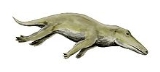
Ambulocetidae is a family
of early cetaceans from Pakistan
that still were able to walk on land. The genus Ambulocetus
, after which the family is named, is by far the most complete and well-known ambulocetid genus due to the discovery by Thewissen et al. of a partially complete specimen of Ambulocetus
natans. Another genus in the family, Gandakasia
, is known only from a single jaw fragment.
Ambulocetid fossils have been found in Pakistan
along the former coastline of Cimmeria
. The sedimentary facies in which these fossils were found indicates that ambulocetids inhabited a shallow, swampy nearshore marine environment.
Family
In human context, a family is a group of people affiliated by consanguinity, affinity, or co-residence. In most societies it is the principal institution for the socialization of children...
of early cetaceans from Pakistan
Pakistan
Pakistan , officially the Islamic Republic of Pakistan is a sovereign state in South Asia. It has a coastline along the Arabian Sea and the Gulf of Oman in the south and is bordered by Afghanistan and Iran in the west, India in the east and China in the far northeast. In the north, Tajikistan...
that still were able to walk on land. The genus Ambulocetus
Ambulocetus
Ambulocetus was an early cetacean that could walk as well as swim. It lived during early Eocene some 50-49 million years ago. It is a transitional fossil that shows how whales evolved from land-living mammals. The Ambulocetus fossils were found in Pakistan by anthropologist Johannes Thewissen...
, after which the family is named, is by far the most complete and well-known ambulocetid genus due to the discovery by Thewissen et al. of a partially complete specimen of Ambulocetus
Ambulocetus
Ambulocetus was an early cetacean that could walk as well as swim. It lived during early Eocene some 50-49 million years ago. It is a transitional fossil that shows how whales evolved from land-living mammals. The Ambulocetus fossils were found in Pakistan by anthropologist Johannes Thewissen...
natans. Another genus in the family, Gandakasia
Gandakasia
Gandakasia was a genus of ambulocetid from Pakistan, that lived in the Eocene epoch. It probably caught its prey near rivers or streams....
, is known only from a single jaw fragment.
Ambulocetid fossils have been found in Pakistan
Pakistan
Pakistan , officially the Islamic Republic of Pakistan is a sovereign state in South Asia. It has a coastline along the Arabian Sea and the Gulf of Oman in the south and is bordered by Afghanistan and Iran in the west, India in the east and China in the far northeast. In the north, Tajikistan...
along the former coastline of Cimmeria
Cimmerian Plate
The Cimmerian Plate is an ancient tectonic plate that comprises parts of present-day Anatolia, Iran, Afghanistan, Tibet, Indochina and Malaya regions. The Cimmerian Plate was formerly part of the ancient supercontinent of Pangaea. Pangaea was shaped like a vast "C", facing east, and inside of the...
. The sedimentary facies in which these fossils were found indicates that ambulocetids inhabited a shallow, swampy nearshore marine environment.