

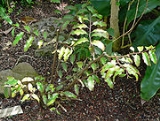
Amborellaceae

Encyclopedia
Amborella is a genus of rare understory shrub
s or small tree
s endemic to the island of New Caledonia
. The genus consists of only a single species, Amborella trichopoda, and is the only member of the family Amborellaceae. Wood of Amborella lacks the vessels characteristic of most flowering plants. It is of great interest to plant systematists because molecular phylogenetic analyses consistently place it at or near the base
of the flowering plant
lineage. That is, it represents a line of flowering plants that diverged very early on (about 130 million years ago) from all the other extant species of flowering plants. Comparing characteristics of this basal angiosperm, other flowering plants and fossils may provide clues about how flowers first appeared—what Darwin called the "abominable mystery".
or small tree
up to eight meters high. It bears alternate or decussate, simple evergreen leaves without stipule
s. The leaves
are two ranked, with distinctly serrated or rippled margins, and about 8 to 10 cm long.
The species is dioecious
: each flower produces both stamen
s and carpels, but only one sex develops fully and is fertile in the flowers of an individual plant. The small, creamy white, inconspicuous flower
s are arranged in terminal panicle
s of 2 to 30 flowers borne in the axils of foliage leaves. Each flower is subtended by bracts and has a perianth of tepal
s (undifferentiated sepals and petals) arranged in a spiral or possibly whorled at the periphery. These features suggest that, as with other basal angiosperms, there is a high degree of developmental plasticity. The bracts gradually transition into tepals, making it difficult to determine where a flower actually begins.
Carpellate flowers are approximately 3 to 4 mm in diameter, with 7 or 8 tepals. There are 1 to 3 (or rarely none) well differentiated staminodes and a spiral of 4 to 8 free carpels (apocarpous). Carpels have green ovaries and lack a style. They contain a single ovule with the micropyle directed downwards.
Staminate flowers are approximately 4 to 5 mm in diameter, with 6 to 15 tepals. These flowers bear 10 to 21 spirally arranged stamens, which become progessively smaller toward the center. The innermost may be sterile. Filaments are represented by a short broad stalk. Anthers are triangular and consist of four pollen sacs, two on each side, with a small sterile central
connective. Stamens have papillate secretory tips. A small pyramidal structure in the center of the flower may represent a vestigial gynoecium.
Typically, 1 to 3 carpels develop into fruit per flower. The fruit
is an ovoid red drupe (approximately 5 to 7 mm long and 5 mm wide) borne on a short (1 to 2 mm) stalk. The remains of the stigma can be seen at the tip of the fruit. The skin is papery, surrounding a thin fleshy layer containing a red juice. The inner pericarp is lignified and surrounds the single seed
. The embryo is small and surrounded by copious endosperm.
 This plant is currently accepted by plant systematists as the most basal lineage in the angiosperms clade
. By "most basal", scientists mean that the Amborellaceae diverged the earliest from all other lineages of flowering plants. Comparing the derived characteristics that all other angiosperms share with each other, but not with the Amborella Family, may give scientists clues to what features early flowering plants had and how these characteristics have evolved through time. One early twentieth century idea of "primitive", or less derived, angiosperms that was accepted until relatively recently was modeled on the Magnolia
blossom with numerous parts
arranged in spirals on an elongated receptacle rather than the small numbers of parts in distinct whorls of more derived flowers. However, studies of a well-preserved fossil putative aquatic angiosperm, Archaefructus
, have raised questions about what characteristics are more ancestral.
In a study designed to clarify relationships between the well-sequenced and well-studied model plants such as Arabidopsis thaliana
, and the basal angiosperms such as Amborella, Nuphar
of the Nymphaeaceae, Illicium
, the monocots, and more derived angiosperms, the eudicots, scientists examined the chloroplast genomes and expressed sequence tags of these organisms, and other seed plants to create this cladogram
. Note that in this image, the angiosperms are all of the plants not labeled "gymnosperms." This hypothesized relationship of the extant seed plants places Amborella as the sister taxon
to all other angiosperms, and shows the gymnosperms as a monophyletic group sister to the angiosperms, supporting the theory that Amborella branched off earliest from all other living angiosperms. The dashed line between Amborella and Nuphar is meant to indicate some uncertainty about the relationship between the Amborellaceae and the Nymphaeaceae, and whether or not they form a clade that is sister to the angiosperms, rather than Amborella alone being a monophyletic group sister to the angiosperms.
. The APG II system
recognized this family, but left it unplaced at order rank due to uncertainty about its relationship to the family Nymphaeaceae
. In the most recent APG
system, APG III
, the Amborellaceae is placed in the monotypic order Amborellales at the base of the angiosperm cladogram
.
, of 1981, assigned the family
The Thorne system (1992)
placed it
The Dahlgren system
placed it
due to overgrazing
, fire, mining (one of the most pervasive causes of ecosystem loss in New Caledonia), and urban expansion.
Shrub
A shrub or bush is distinguished from a tree by its multiple stems and shorter height, usually under 5–6 m tall. A large number of plants may become either shrubs or trees, depending on the growing conditions they experience...
s or small tree
Tree
A tree is a perennial woody plant. It is most often defined as a woody plant that has many secondary branches supported clear of the ground on a single main stem or trunk with clear apical dominance. A minimum height specification at maturity is cited by some authors, varying from 3 m to...
s endemic to the island of New Caledonia
New Caledonia
New Caledonia is a special collectivity of France located in the southwest Pacific Ocean, east of Australia and about from Metropolitan France. The archipelago, part of the Melanesia subregion, includes the main island of Grande Terre, the Loyalty Islands, the Belep archipelago, the Isle of...
. The genus consists of only a single species, Amborella trichopoda, and is the only member of the family Amborellaceae. Wood of Amborella lacks the vessels characteristic of most flowering plants. It is of great interest to plant systematists because molecular phylogenetic analyses consistently place it at or near the base
Basal (phylogenetics)
In phylogenetics, a basal clade is the earliest clade to branch in a larger clade; it appears at the base of a cladogram.A basal group forms an outgroup to the rest of the clade, such as in the following example:...
of the flowering plant
Flowering plant
The flowering plants , also known as Angiospermae or Magnoliophyta, are the most diverse group of land plants. Angiosperms are seed-producing plants like the gymnosperms and can be distinguished from the gymnosperms by a series of synapomorphies...
lineage. That is, it represents a line of flowering plants that diverged very early on (about 130 million years ago) from all the other extant species of flowering plants. Comparing characteristics of this basal angiosperm, other flowering plants and fossils may provide clues about how flowers first appeared—what Darwin called the "abominable mystery".
Description
Amborella is a sprawling shrubShrub
A shrub or bush is distinguished from a tree by its multiple stems and shorter height, usually under 5–6 m tall. A large number of plants may become either shrubs or trees, depending on the growing conditions they experience...
or small tree
Tree
A tree is a perennial woody plant. It is most often defined as a woody plant that has many secondary branches supported clear of the ground on a single main stem or trunk with clear apical dominance. A minimum height specification at maturity is cited by some authors, varying from 3 m to...
up to eight meters high. It bears alternate or decussate, simple evergreen leaves without stipule
Stipule
In botany, stipule is a term coined by Linnaeus which refers to outgrowths borne on either side of the base of a leafstalk...
s. The leaves
Leaf
A leaf is an organ of a vascular plant, as defined in botanical terms, and in particular in plant morphology. Foliage is a mass noun that refers to leaves as a feature of plants....
are two ranked, with distinctly serrated or rippled margins, and about 8 to 10 cm long.
The species is dioecious
Plant sexuality
Plant sexuality covers the wide variety of sexual reproduction systems found across the plant kingdom. This article describes morphological aspects of sexual reproduction of plants....
: each flower produces both stamen
Stamen
The stamen is the pollen producing reproductive organ of a flower...
s and carpels, but only one sex develops fully and is fertile in the flowers of an individual plant. The small, creamy white, inconspicuous flower
Flower
A flower, sometimes known as a bloom or blossom, is the reproductive structure found in flowering plants . The biological function of a flower is to effect reproduction, usually by providing a mechanism for the union of sperm with eggs...
s are arranged in terminal panicle
Panicle
A panicle is a compound raceme, a loose, much-branched indeterminate inflorescence with pedicellate flowers attached along the secondary branches; in other words, a branched cluster of flowers in which the branches are racemes....
s of 2 to 30 flowers borne in the axils of foliage leaves. Each flower is subtended by bracts and has a perianth of tepal
Tepal
Tepals are elements of the perianth, or outer part of a flower, which include the petals or sepals. The term tepal is more often applied specifically when all segments of the perianth are of similar shape and color, or undifferentiated, which is called perigone...
s (undifferentiated sepals and petals) arranged in a spiral or possibly whorled at the periphery. These features suggest that, as with other basal angiosperms, there is a high degree of developmental plasticity. The bracts gradually transition into tepals, making it difficult to determine where a flower actually begins.
Carpellate flowers are approximately 3 to 4 mm in diameter, with 7 or 8 tepals. There are 1 to 3 (or rarely none) well differentiated staminodes and a spiral of 4 to 8 free carpels (apocarpous). Carpels have green ovaries and lack a style. They contain a single ovule with the micropyle directed downwards.
Staminate flowers are approximately 4 to 5 mm in diameter, with 6 to 15 tepals. These flowers bear 10 to 21 spirally arranged stamens, which become progessively smaller toward the center. The innermost may be sterile. Filaments are represented by a short broad stalk. Anthers are triangular and consist of four pollen sacs, two on each side, with a small sterile central
connective. Stamens have papillate secretory tips. A small pyramidal structure in the center of the flower may represent a vestigial gynoecium.
Typically, 1 to 3 carpels develop into fruit per flower. The fruit
Fruit
In broad terms, a fruit is a structure of a plant that contains its seeds.The term has different meanings dependent on context. In non-technical usage, such as food preparation, fruit normally means the fleshy seed-associated structures of certain plants that are sweet and edible in the raw state,...
is an ovoid red drupe (approximately 5 to 7 mm long and 5 mm wide) borne on a short (1 to 2 mm) stalk. The remains of the stigma can be seen at the tip of the fruit. The skin is papery, surrounding a thin fleshy layer containing a red juice. The inner pericarp is lignified and surrounds the single seed
Seed
A seed is a small embryonic plant enclosed in a covering called the seed coat, usually with some stored food. It is the product of the ripened ovule of gymnosperm and angiosperm plants which occurs after fertilization and some growth within the mother plant...
. The embryo is small and surrounded by copious endosperm.
Phylogeny
Clade
A clade is a group consisting of a species and all its descendants. In the terms of biological systematics, a clade is a single "branch" on the "tree of life". The idea that such a "natural group" of organisms should be grouped together and given a taxonomic name is central to biological...
. By "most basal", scientists mean that the Amborellaceae diverged the earliest from all other lineages of flowering plants. Comparing the derived characteristics that all other angiosperms share with each other, but not with the Amborella Family, may give scientists clues to what features early flowering plants had and how these characteristics have evolved through time. One early twentieth century idea of "primitive", or less derived, angiosperms that was accepted until relatively recently was modeled on the Magnolia
Magnolia
Magnolia is a large genus of about 210 flowering plant species in the subfamily Magnolioideae of the family Magnoliaceae. It is named after French botanist Pierre Magnol....
blossom with numerous parts
Flower
A flower, sometimes known as a bloom or blossom, is the reproductive structure found in flowering plants . The biological function of a flower is to effect reproduction, usually by providing a mechanism for the union of sperm with eggs...
arranged in spirals on an elongated receptacle rather than the small numbers of parts in distinct whorls of more derived flowers. However, studies of a well-preserved fossil putative aquatic angiosperm, Archaefructus
Archaefructus
Archaefructus is an extinct genus of herbaceous aquatic seed plants with 3 known species. Fossil material assigned to this genus originates from the Yixian Formation in northeastern China, originally dated as late Jurassic but now thought to be approximately 125 million years old, or early...
, have raised questions about what characteristics are more ancestral.
In a study designed to clarify relationships between the well-sequenced and well-studied model plants such as Arabidopsis thaliana
Arabidopsis thaliana
Arabidopsis thaliana is a small flowering plant native to Europe, Asia, and northwestern Africa. A spring annual with a relatively short life cycle, arabidopsis is popular as a model organism in plant biology and genetics...
, and the basal angiosperms such as Amborella, Nuphar
Nuphar
Nuphar is genus of aquatic plants in the family Nymphaeaceae, with a temperate to subarctic Northern Hemisphere distribution. Common names include water-lily , pond-lily, and spatterdock .A total of eight species and three hybrids are currently accepted in the genus...
of the Nymphaeaceae, Illicium
Illicium
Illicium is a genus of flowering plants containing 42 species of evergreen shrubs and small trees, in family Schisandraceae. The species are native to the tropical and subtropical regions of eastern and southeastern Asia, southeastern North America, and the West Indies.Selected species*Illicium...
, the monocots, and more derived angiosperms, the eudicots, scientists examined the chloroplast genomes and expressed sequence tags of these organisms, and other seed plants to create this cladogram
Cladogram
A cladogram is a diagram used in cladistics which shows ancestral relations between organisms, to represent the evolutionary tree of life. Although traditionally such cladograms were generated largely on the basis of morphological characters, DNA and RNA sequencing data and computational...
. Note that in this image, the angiosperms are all of the plants not labeled "gymnosperms." This hypothesized relationship of the extant seed plants places Amborella as the sister taxon
Cladistics
Cladistics is a method of classifying species of organisms into groups called clades, which consist of an ancestor organism and all its descendants . For example, birds, dinosaurs, crocodiles, and all descendants of their most recent common ancestor form a clade...
to all other angiosperms, and shows the gymnosperms as a monophyletic group sister to the angiosperms, supporting the theory that Amborella branched off earliest from all other living angiosperms. The dashed line between Amborella and Nuphar is meant to indicate some uncertainty about the relationship between the Amborellaceae and the Nymphaeaceae, and whether or not they form a clade that is sister to the angiosperms, rather than Amborella alone being a monophyletic group sister to the angiosperms.
Classification
Amborella is placed alone in the family AmborellaceaeAmborellaceae
Amborella is a genus of rare understory shrubs or small trees endemic to the island of New Caledonia. The genus consists of only a single species, Amborella trichopoda, and is the only member of the family Amborellaceae. Wood of Amborella lacks the vessels characteristic of most flowering plants...
. The APG II system
APG II system
The APG II system of plant classification is the second, now obsolete, version of a modern, mostly molecular-based, system of plant taxonomy that was published in April 2003 by the Angiosperm Phylogeny Group. It was a revision of the first APG system, published in 1998, and was superseded in 2009...
recognized this family, but left it unplaced at order rank due to uncertainty about its relationship to the family Nymphaeaceae
Nymphaeaceae
Nymphaeaceae is a family of flowering plants. Members of this family are commonly called water lilies and live in freshwater areas in temperate and tropical climates around the world. The family contains eight genera. There are about 70 species of water lilies around the world. The genus...
. In the most recent APG
Angiosperm Phylogeny Group
The Angiosperm Phylogeny Group, or APG, refers to an informal international group of systematic botanists who came together to try to establish a consensus on the taxonomy of flowering plants that would reflect new knowledge about plant relationships discovered through phylogenetic studies., three...
system, APG III
APG III system
The APG III system of flowering plant classification is the third version of a modern, mostly molecular-based, system of plant taxonomy...
, the Amborellaceae is placed in the monotypic order Amborellales at the base of the angiosperm cladogram
Cladogram
A cladogram is a diagram used in cladistics which shows ancestral relations between organisms, to represent the evolutionary tree of life. Although traditionally such cladograms were generated largely on the basis of morphological characters, DNA and RNA sequencing data and computational...
.
Older systems
The Cronquist systemCronquist system
The Cronquist system is a taxonomic classification system of flowering plants. It was developed by Arthur Cronquist in his texts An Integrated System of Classification of Flowering Plants and The Evolution and Classification of Flowering Plants .Cronquist's system places flowering plants into two...
, of 1981, assigned the family
- to the order LauralesLauralesThe Laurales are an order of flowering plants. They are magnoliids, related to the Magnoliales.The order includes about 2500-2800 species from 85-90 genera, which comprise seven families of trees and shrubs. Most of the species are tropical and subtropical, though a few genera reach the temperate...
- in subclass MagnoliidaeMagnoliidaeMagnoliids are a group of about 9,000 species of flowering plants, including magnolias, nutmeg, bay laurel, cinnamon, avocado, black pepper, and many others. They are characterized by trimerous flowers, pollen with one pore, and usually branching-veined leaves.-Classification:Traditionally,...
,- in class MagnoliopsidaMagnoliopsidaMagnoliopsida is a valid botanical name for a class of flowering plants. By definition the class will include the family Magnoliaceae, but its circumscription can otherwise vary, being more inclusive or less inclusive depending upon the classification system being discussed.-Cronquist and...
[=dicotyledons]- of division Magnoliophyta [=angiosperms].
- in class Magnoliopsida
- in subclass Magnoliidae
The Thorne system (1992)
Thorne system (1992)
A modern system of plant taxonomy, the Thorne system of plant classification was drawn up by the botanist Robert F. Thorne . He replaced it in 2000 with a new system. These two systems were published in:...
placed it
- in the order MagnolialesMagnolialesMagnoliales is an order of flowering plants.-Classification:The Magnoliales includes six families:* Annonaceae...
, which was assigned- to superorder Magnolianae,
- in subclass Magnoliideae [=dicotyledons],
- in class Magnoliopsida [=angiosperms].
- in subclass Magnoliideae [=dicotyledons],
- to superorder Magnolianae,
The Dahlgren system
Dahlgren system
One of the modern systems of plant taxonomy, the Dahlgren system was published by monocot specialist Rolf Dahlgren. His wife Gertrud Dahlgren carried on after his death.According to the extensive listing by Professor Reveal One of the modern systems of plant taxonomy, the Dahlgren system was...
placed it
- in the order Laurales, which was assigned
- to superorder Magnolianae
- in subclass Magnoliideae [=dicotyledons],
- in class Magnoliopsida [=angiosperms].
- in subclass Magnoliideae [=dicotyledons],
- to superorder Magnolianae
Ecology
This species is threatened in the wild by habitat destructionHabitat destruction
Habitat destruction is the process in which natural habitat is rendered functionally unable to support the species present. In this process, the organisms that previously used the site are displaced or destroyed, reducing biodiversity. Habitat destruction by human activity mainly for the purpose of...
due to overgrazing
Overgrazing
Overgrazing occurs when plants are exposed to intensive grazing for extended periods of time, or without sufficient recovery periods. It can be caused by either livestock in poorly managed agricultural applications, or by overpopulations of native or non-native wild animals.Overgrazing reduces the...
, fire, mining (one of the most pervasive causes of ecosystem loss in New Caledonia), and urban expansion.
External links
- Amborellaceae in L. Watson and M.J. Dallwitz (1992 onwards). The families of flowering plants: descriptions, illustrations, identification, information retrieval. via Description language for taxonomy
- Ancient plant provides clues to evolutionary mystery (National Science Foundation)
- Description language for taxonomy
- http://www.ucalgary.ca/~laidlaw/amborella/amborella_web.htmlNational Tropical Botanical Garden (HawaiiHawaiiHawaii is the newest of the 50 U.S. states , and is the only U.S. state made up entirely of islands. It is the northernmost island group in Polynesia, occupying most of an archipelago in the central Pacific Ocean, southwest of the continental United States, southeast of Japan, and northeast of...
, USA), article with detailed photos of plants in cultivation] - Nova "First Flower" (transcript)
- NCBI Taxonomy Browser