


Alternating knot

Encyclopedia
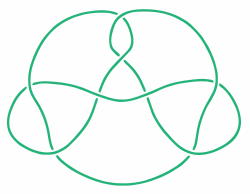
Knot theory
In topology, knot theory is the study of mathematical knots. While inspired by knots which appear in daily life in shoelaces and rope, a mathematician's knot differs in that the ends are joined together so that it cannot be undone. In precise mathematical language, a knot is an embedding of a...
, a link
Knot (mathematics)
In mathematics, a knot is an embedding of a circle in 3-dimensional Euclidean space, R3, considered up to continuous deformations . A crucial difference between the standard mathematical and conventional notions of a knot is that mathematical knots are closed—there are no ends to tie or untie on a...
diagram is alternating if the crossings alternate under, over, under, over, as you travel along each component of the link. A link is alternating if it has an alternating diagram.
Many of the knots with crossing number less than 10 are alternating. This fact and useful properties of alternating knots, such as the Tait conjectures, was what enabled early knot tabulators, such as Tait, to construct tables with relatively few mistakes or omissions. The simplest non-alternating prime knot
Prime knot
In knot theory, a prime knot is a knot that is, in a certain sense, indecomposable. Specifically, it is a non-trivial knot which cannot be written as the knot sum of two non-trivial knots. Knots that are not prime are said to be composite. It can be a nontrivial problem to determine whether a...
s have 8 crossings
Crossing number (knot theory)
In the mathematical area of knot theory, the crossing number of a knot is the minimal number of crossings of any diagram of the knot. It is a knot invariant....
(and there are three such).
It is conjectured that as the crossing number increases, the percentage of knots that are alternating goes to 0 exponentially quickly.
Alternating links end up having an important role in knot theory and 3-manifold theory, due to their complements having useful and interesting geometric and topological properties. This led Ralph Fox
Ralph Fox
Ralph Hartzler Fox was an American mathematician. As a professor at Princeton University, he taught and advised many of the contributors to the Golden Age of differential topology, and he played an important role in the modernization and main-streaming of knot theory.Ralph Fox attended Swarthmore...
to ask, "What is an alternating knot?" By this he was asking what non-diagrammatic properties of the knot complement would characterize alternating knots.
Various geometric and topological information is revealed in an alternating diagram. Primeness
Prime knot
In knot theory, a prime knot is a knot that is, in a certain sense, indecomposable. Specifically, it is a non-trivial knot which cannot be written as the knot sum of two non-trivial knots. Knots that are not prime are said to be composite. It can be a nontrivial problem to determine whether a...
and splittability
Split link
In the mathematical field of knot theory, a split link is a link that has a 2-sphere in its complement separating one or more link components from the others. A split link is said to be splittable, and a link that is not split is called a non-split link or not splittable...
of a link is easily seen from the diagram. The crossing number
Crossing number (knot theory)
In the mathematical area of knot theory, the crossing number of a knot is the minimal number of crossings of any diagram of the knot. It is a knot invariant....
of a reduced, alternating diagram is the crossing number of the knot. This last is one of the celebrated Tait Conjectures.
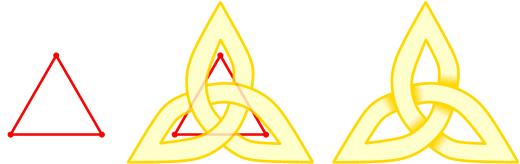
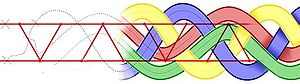
An alternating knot diagram is in one to one correspondence with a planar graph
Planar graph
In graph theory, a planar graph is a graph that can be embedded in the plane, i.e., it can be drawn on the plane in such a way that its edges intersect only at their endpoints...
. Each crossing is associated with an edge and half of the connected components of the complement of the diagram are associated with vertices in a checker board manner.
Tait conjectures
The Tait conjectures are:- Any reduced diagram of an alternating link has the fewest possible crossingsCrossing number (knot theory)In the mathematical area of knot theory, the crossing number of a knot is the minimal number of crossings of any diagram of the knot. It is a knot invariant....
. - Any two reduced diagrams of the same alternating knotKnot (mathematics)In mathematics, a knot is an embedding of a circle in 3-dimensional Euclidean space, R3, considered up to continuous deformations . A crucial difference between the standard mathematical and conventional notions of a knot is that mathematical knots are closed—there are no ends to tie or untie on a...
have the same writheWritheIn knot theory, the writhe is a property of an oriented link diagram. The writhe is the total number of positive crossings minus the total number of negative crossings....
. - Given any two reduced alternating diagrams D1 and D2 of an oriented, prime alternating link: D1 may be transformed to D2 by means of a sequence of certain simple moves called flypeFlypeIn the mathematical theory of knots, a flype is a kind of manipulation of knot and link diagramsused in the Tait flyping conjecture.It consists of twisting a part of a knot, a tangle: T by 180 degrees. Flype comes from an old Scottish word meaning to fold or to turn back. Two reduced alternating...
s. Also known as the Tait flyping conjecture.
Morwen Thistlethwaite
Morwen Thistlethwaite
Morwen B. Thistlethwaite is a knot theorist and professor of mathematics for the University of Tennessee in Knoxville. He has made important contributions to both knot theory, and Rubik's cube group theory.-Biography:...
, Louis Kauffman
Louis Kauffman
Louis H. Kauffman is an American mathematician, topologist, and professor of Mathematics in the Department of Mathematics, Statistics, and Computer science at the University of Illinois at Chicago...
and K. Murasugi proved the first two Tait conjectures in 1987 and Morwen Thistlethwaite
Morwen Thistlethwaite
Morwen B. Thistlethwaite is a knot theorist and professor of mathematics for the University of Tennessee in Knoxville. He has made important contributions to both knot theory, and Rubik's cube group theory.-Biography:...
and William Menasco
William Menasco
William W. Menasco is a topologist and a professor at the University at Buffalo. He is best known for his work in knot theory.-Biography:Menasco received is B.A. from the University of California, Los Angeles in 1975, and his Ph.D. from the University of California, Berkeley in 1981, where his...
proved the Tait flyping conjecture in 1991.
Hyperbolic volume
MenascoWilliam Menasco
William W. Menasco is a topologist and a professor at the University at Buffalo. He is best known for his work in knot theory.-Biography:Menasco received is B.A. from the University of California, Los Angeles in 1975, and his Ph.D. from the University of California, Berkeley in 1981, where his...
, applying Thurston
William Thurston
William Paul Thurston is an American mathematician. He is a pioneer in the field of low-dimensional topology. In 1982, he was awarded the Fields Medal for his contributions to the study of 3-manifolds...
's hyperbolization theorem
Hyperbolization theorem
In geometry, Thurston's geometrization theorem or hyperbolization theorem implies that closed atoroidal Haken manifolds are hyperbolic, and in particular satisfy the Thurston conjecture.-Statement:...
for Haken manifold
Haken manifold
In mathematics, a Haken manifold is a compact, P²-irreducible 3-manifold that is sufficiently large, meaning that it contains a properly embedded two-sided incompressible surface...
s, showed that any prime, non-split alternating link is hyperbolic
Hyperbolic link
In mathematics, a hyperbolic link is a link in the 3-sphere with complement that has a complete Riemannian metric of constant negative curvature, i.e. has a hyperbolic geometry...
, i.e. the link complement has a hyperbolic geometry
Hyperbolic geometry
In mathematics, hyperbolic geometry is a non-Euclidean geometry, meaning that the parallel postulate of Euclidean geometry is replaced...
, unless the link is a torus link.
Thus hyperbolic volume is an invariant of many alternating links. Marc Lackenby has shown that the volume has upper and lower linear bounds as functions of the number of twist regions of a reduced, alternating diagram.
External links
- Alternating Knot at MathWorldMathWorldMathWorld is an online mathematics reference work, created and largely written by Eric W. Weisstein. It is sponsored by and licensed to Wolfram Research, Inc. and was partially funded by the National Science Foundation's National Science Digital Library grant to the University of Illinois at...
- Tait's Knot Conjectures at MathWorld
- Celtic Knotwork to build an alternating knot from its planar graph