


Allotropy

Encyclopedia
Chemical element
A chemical element is a pure chemical substance consisting of one type of atom distinguished by its atomic number, which is the number of protons in its nucleus. Familiar examples of elements include carbon, oxygen, aluminum, iron, copper, gold, mercury, and lead.As of November 2011, 118 elements...
s to exist in two or more different forms, known as allotropes of these elements. Allotropes are different structural modifications of an element; the atoms of the element are bonded
Chemical bond
A chemical bond is an attraction between atoms that allows the formation of chemical substances that contain two or more atoms. The bond is caused by the electromagnetic force attraction between opposite charges, either between electrons and nuclei, or as the result of a dipole attraction...
together in a different manner.
Take carbon
Carbon
Carbon is the chemical element with symbol C and atomic number 6. As a member of group 14 on the periodic table, it is nonmetallic and tetravalent—making four electrons available to form covalent chemical bonds...
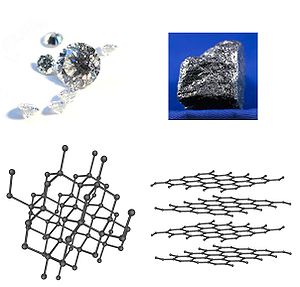
for example: 4 common allotropes of carbon
Allotropes of carbon
This is a list of the allotropes of carbon.-Diamond:Diamond is one of the most well known allotropes of carbon. The hardness and high dispersion of light of diamond make it useful for both industrial applications and jewellery. Diamond is the hardest known natural mineral. This makes it an...
are diamond
Diamond
In mineralogy, diamond is an allotrope of carbon, where the carbon atoms are arranged in a variation of the face-centered cubic crystal structure called a diamond lattice. Diamond is less stable than graphite, but the conversion rate from diamond to graphite is negligible at ambient conditions...
(where the carbon atoms are bonded together in a tetrahedral lattice arrangement), graphite
Graphite
The mineral graphite is one of the allotropes of carbon. It was named by Abraham Gottlob Werner in 1789 from the Ancient Greek γράφω , "to draw/write", for its use in pencils, where it is commonly called lead . Unlike diamond , graphite is an electrical conductor, a semimetal...
(where the carbon atoms are bonded together in sheets of a hexagonal lattice
Hexagonal lattice
The hexagonal lattice or equilateral triangular lattice is one of the five 2D lattice types.Three nearby points form an equilateral triangle. In images four orientations of such a triangle are by far the most common...
), graphene
Graphene
Graphene is an allotrope of carbon, whose structure is one-atom-thick planar sheets of sp2-bonded carbon atoms that are densely packed in a honeycomb crystal lattice. The term graphene was coined as a combination of graphite and the suffix -ene by Hanns-Peter Boehm, who described single-layer...
(single sheets of graphite), and fullerene
Fullerene
A fullerene is any molecule composed entirely of carbon, in the form of a hollow sphere, ellipsoid, or tube. Spherical fullerenes are also called buckyballs, and they resemble the balls used in association football. Cylindrical ones are called carbon nanotubes or buckytubes...
s (where the carbon atoms are bonded together in spherical, tubular, or ellipsoidal formations).
The term allotropy is used for elements only, not for compounds
Chemical compound
A chemical compound is a pure chemical substance consisting of two or more different chemical elements that can be separated into simpler substances by chemical reactions. Chemical compounds have a unique and defined chemical structure; they consist of a fixed ratio of atoms that are held together...
. The more general term, used for any crystalline material, is polymorphism
Polymorphism (materials science)
Polymorphism in materials science is the ability of a solid material to exist in more than one form or crystal structure. Polymorphism can potentially be found in any crystalline material including polymers, minerals, and metals, and is related to allotropy, which refers to chemical elements...
. Allotropy refers only to different forms of an element within the same phase
State of matter
States of matter are the distinct forms that different phases of matter take on. Solid, liquid and gas are the most common states of matter on Earth. However, much of the baryonic matter of the universe is in the form of hot plasma, both as rarefied interstellar medium and as dense...
(i.e. different solid
Solid
Solid is one of the three classical states of matter . It is characterized by structural rigidity and resistance to changes of shape or volume. Unlike a liquid, a solid object does not flow to take on the shape of its container, nor does it expand to fill the entire volume available to it like a...
, liquid
Liquid
Liquid is one of the three classical states of matter . Like a gas, a liquid is able to flow and take the shape of a container. Some liquids resist compression, while others can be compressed. Unlike a gas, a liquid does not disperse to fill every space of a container, and maintains a fairly...
or gas
Gas
Gas is one of the three classical states of matter . Near absolute zero, a substance exists as a solid. As heat is added to this substance it melts into a liquid at its melting point , boils into a gas at its boiling point, and if heated high enough would enter a plasma state in which the electrons...
forms); the changes of state between solid, liquid and gas in themselves are not considered allotropy.
For some elements, allotropes have different molecular formulae which can persist in different phases – for example, two allotropes of oxygen
Allotropes of oxygen
There are several known allotropes of oxygen. The most familiar is molecular oxygen , present at significant levels in Earth's atmosphere and also known as dioxygen or triplet oxygen. Another is the highly reactive ozone...
(dioxygen
Oxygen
Oxygen is the element with atomic number 8 and represented by the symbol O. Its name derives from the Greek roots ὀξύς and -γενής , because at the time of naming, it was mistakenly thought that all acids required oxygen in their composition...
, O2 and ozone
Ozone
Ozone , or trioxygen, is a triatomic molecule, consisting of three oxygen atoms. It is an allotrope of oxygen that is much less stable than the diatomic allotrope...
, O3), can both exist in the solid, liquid and gaseous states. Conversely, some elements do not maintain distinct allotropes in different phases – for example phosphorus
Phosphorus
Phosphorus is the chemical element that has the symbol P and atomic number 15. A multivalent nonmetal of the nitrogen group, phosphorus as a mineral is almost always present in its maximally oxidized state, as inorganic phosphate rocks...
has numerous solid allotropes
Allotropes of phosphorus
Elemental phosphorus can exist in several allotropes; the most common of which are white and red solids. Solid violet and black allotropes are also known. Gaseous phosphorus exists as diphosphorus and atomic phosphorus.-White phosphorus:...
, which all revert to the same P4 form when melted to the liquid state.
History
The concept of allotropy was originally proposed in 1841 by the Swedish scientist Baron Jöns Jakob BerzeliusJöns Jakob Berzelius
Jöns Jacob Berzelius was a Swedish chemist. He worked out the modern technique of chemical formula notation, and is together with John Dalton, Antoine Lavoisier, and Robert Boyle considered a father of modern chemistry...
(1779–1848) who offered no explanation. The term is derived from the Greek
Greek language
Greek is an independent branch of the Indo-European family of languages. Native to the southern Balkans, it has the longest documented history of any Indo-European language, spanning 34 centuries of written records. Its writing system has been the Greek alphabet for the majority of its history;...
(allotropia; variability, changeableness). After the acceptance of Avogadro's hypothesis
Avogadro's law
Avogadro's law is a gas law named after Amedeo Avogadro who, in 1811, hypothesized that two given samples of an ideal gas, at the same temperature, pressure and volume, contain the same number of molecules...
in 1860 it was understood that elements could exist as polyatomic molecules, and the two allotropes of oxygen were recognized as O2 and O3. In the early 20th century it was recognized that other cases such as carbon were due to differences in crystal structure.
By 1912, Ostwald
Wilhelm Ostwald
Friedrich Wilhelm Ostwald was a Baltic German chemist. He received the Nobel Prize in Chemistry in 1909 for his work on catalysis, chemical equilibria and reaction velocities...
noted that the allotropy of elements is just a special case of the phenomenon of polymorphism
Polymorphism (materials science)
Polymorphism in materials science is the ability of a solid material to exist in more than one form or crystal structure. Polymorphism can potentially be found in any crystalline material including polymers, minerals, and metals, and is related to allotropy, which refers to chemical elements...
known for compounds, and proposed that the terms allotrope and allotropy be abandoned and replaced by polymorph and polymorphism. Although many other chemists have repeated this advice, IUPAC and most chemistry texts still favour the usage of allotrope and allotropy for elements only.
Differences in properties of an element's allotropes
Allotropes are different structural forms of the same element and can exhibit quite different physical properties and chemical behaviours. The change between allotropic forms is triggered by the same forces that affect other structures, i.e. pressurePressure
Pressure is the force per unit area applied in a direction perpendicular to the surface of an object. Gauge pressure is the pressure relative to the local atmospheric or ambient pressure.- Definition :...
, light
Photochemistry
Photochemistry, a sub-discipline of chemistry, is the study of chemical reactions that proceed with the absorption of light by atoms or molecules.. Everyday examples include photosynthesis, the degradation of plastics and the formation of vitamin D with sunlight.-Principles:Light is a type of...
, and temperature
Temperature
Temperature is a physical property of matter that quantitatively expresses the common notions of hot and cold. Objects of low temperature are cold, while various degrees of higher temperatures are referred to as warm or hot...
. Therefore the stability of the particular allotropes depends on particular conditions. For instance, iron
Iron
Iron is a chemical element with the symbol Fe and atomic number 26. It is a metal in the first transition series. It is the most common element forming the planet Earth as a whole, forming much of Earth's outer and inner core. It is the fourth most common element in the Earth's crust...
changes from a body-centered cubic structure (ferrite)
Ferrite (iron)
Ferrite or alpha iron is a materials science term for iron, or a solid solution with iron as the main constituent, with a body centred cubic crystal structure. It is the component which gives steel and cast iron their magnetic properties, and is the classic example of a ferromagnetic material...
to a face-centered cubic structure (austenite
Austenite
Austenite, also known as gamma phase iron, is a metallic non-magnetic allotrope of iron or a solid solution of iron, with an alloying element. In plain-carbon steel, austenite exists above the critical eutectoid temperature of ; other alloys of steel have different eutectoid temperatures...
) above 906 °C, and tin
Tin
Tin is a chemical element with the symbol Sn and atomic number 50. It is a main group metal in group 14 of the periodic table. Tin shows chemical similarity to both neighboring group 14 elements, germanium and lead and has two possible oxidation states, +2 and the slightly more stable +4...
undergoes a transformation known as tin pest
Tin pest
Tin pest is an autocatalytic, allotropic transformation of the element tin, which causes deterioration of tin objects at low temperatures. Tin pest has also been called tin disease, tin blight or tin leprosy ....
from a metallic phase to a semiconductor
Semiconductor
A semiconductor is a material with electrical conductivity due to electron flow intermediate in magnitude between that of a conductor and an insulator. This means a conductivity roughly in the range of 103 to 10−8 siemens per centimeter...
phase below 13.2 °C. As an example of different chemical behaviour, ozone (O3) is a much stronger oxidizing agent than dioxygen (O2).
List of allotropes
Typically, elements capable of variable coordination numberCoordination number
In chemistry and crystallography, the coordination number of a central atom in a molecule or crystal is the number of its nearest neighbours. This number is determined somewhat differently for molecules and for crystals....
and/or oxidation states tend to exhibit greater numbers of allotropic forms. Another contributing factor is the ability of an element to catenate
Catenation
Catenation is the ability of a chemical element to form a long chain-like structure via a series of covalent bonds. Catenation occurs most readily in carbon, which forms covalent bonds with other carbon atoms. Catenation is the reason for the presence of a large number of organic compounds in nature...
. Allotropes are typically more noticeable in non-metals (excluding the halogen
Halogen
The halogens or halogen elements are a series of nonmetal elements from Group 17 IUPAC Style of the periodic table, comprising fluorine , chlorine , bromine , iodine , and astatine...
s and the noble gas
Noble gas
The noble gases are a group of chemical elements with very similar properties: under standard conditions, they are all odorless, colorless, monatomic gases, with very low chemical reactivity...
es) and metalloid
Metalloid
Metalloid is a term used in chemistry when classifying the chemical elements. On the basis of their general physical and chemical properties, each element can usually be classified as a metal or a nonmetal. However, some elements with intermediate or mixed properties can be harder to characterize...
s. Nevertheless, metal
Metal
A metal , is an element, compound, or alloy that is a good conductor of both electricity and heat. Metals are usually malleable and shiny, that is they reflect most of incident light...
s tend to have many allotropes.
Examples of allotropes include:
Non-metals and metalloids
| Element | Allotropes |
|---|---|
| Carbon Allotropes of carbon This is a list of the allotropes of carbon.-Diamond:Diamond is one of the most well known allotropes of carbon. The hardness and high dispersion of light of diamond make it useful for both industrial applications and jewellery. Diamond is the hardest known natural mineral. This makes it an... |
|
| Phosphorus Allotropes of phosphorus Elemental phosphorus can exist in several allotropes; the most common of which are white and red solids. Solid violet and black allotropes are also known. Gaseous phosphorus exists as diphosphorus and atomic phosphorus.-White phosphorus:... : |
Diphosphorus Diphosphorus, P2, is the diatomic form of phosphorus. Unlike its nitrogen group neighbor nitrogen, which forms a stable N2 molecule with a nitrogen to nitrogen triple bond, phosphorus prefers a tetrahedral form P4 because P-P pi-bonds are high in energy... |
| Oxygen Allotropes of oxygen There are several known allotropes of oxygen. The most familiar is molecular oxygen , present at significant levels in Earth's atmosphere and also known as dioxygen or triplet oxygen. Another is the highly reactive ozone... : |
Ozone Ozone , or trioxygen, is a triatomic molecule, consisting of three oxygen atoms. It is an allotrope of oxygen that is much less stable than the diatomic allotrope... , O3 - blue Tetraoxygen The tetraoxygen molecule , also called oxozone, was first predicted in 1924 by Gilbert N. Lewis, who proposed it as an explanation for the failure of liquid oxygen to obey Curie's law... , O4 - metastable Metastability Metastability describes the extended duration of certain equilibria acquired by complex systems when leaving their most stable state after an external action.... Solid oxygen Solid oxygen forms at normal atmospheric pressure at a temperature below 54.36 K . Solid oxygen O2, like liquid oxygen, is a clear substance with a light sky-blue color caused by absorption in the red.... , - red |
| Sulfur Allotropes of sulfur There are a large number of allotropes of sulfur. In this respect, sulfur is second only to carbon.The most common form found in nature is yellow orthorhombic α-sulfur, which contains puckered rings of . Chemistry students may have seen "plastic sulfur"; this is not an allotrope but a mixture of... : |
|
| Selenium Selenium Selenium is a chemical element with atomic number 34, chemical symbol Se, and an atomic mass of 78.96. It is a nonmetal, whose properties are intermediate between those of adjacent chalcogen elements sulfur and tellurium... : |
|
| Boron Allotropes of boron Elemental boron can exist in several allotropes, the most common of which are crystalline boron and brown amorphous boron. Crystalline boron has four major polymorphs: α, β, γ and T... : |
|
| Silicon Silicon Silicon is a chemical element with the symbol Si and atomic number 14. A tetravalent metalloid, it is less reactive than its chemical analog carbon, the nonmetal directly above it in the periodic table, but more reactive than germanium, the metalloid directly below it in the table... : |
|
| Arsenic Arsenic Arsenic is a chemical element with the symbol As, atomic number 33 and relative atomic mass 74.92. Arsenic occurs in many minerals, usually in conjunction with sulfur and metals, and also as a pure elemental crystal. It was first documented by Albertus Magnus in 1250.Arsenic is a metalloid... : |
|
Metals
Among the naturally occurring metallic elements (up to U, without Tc and Pm), 28 are allotropic at ambient pressure: Li, Be, Na, Ca, Sr, Ti, Mn, Fe, Co, Sr, Y, Zr, Sn, La, Ce, Pr, Nd, (Pm), Sm, Gd, Tb, Dy, Yb, Hf, Tl, Po, Th, Pa, U.Considering only the technologically-relevant metals, six metals are allotropic: Ti at 882˚C, Fe at 912˚C and 1394˚C, Co at 422˚C, Zr at 863˚C, Sn at 13˚C and U at 668˚C and 776˚C.
| Element | Allotropes |
|---|---|
| Tin |
|
| Iron Allotropes of iron Iron represents perhaps the best-known example for allotropy in a metal. At atmospheric pressure, there are three allotropic forms of iron, known as α, γ and δ. At high pressure, a fourth form exists, called ε... |
Ferrite (iron) Ferrite or alpha iron is a materials science term for iron, or a solid solution with iron as the main constituent, with a body centred cubic crystal structure. It is the component which gives steel and cast iron their magnetic properties, and is the classic example of a ferromagnetic material... (alpha iron) - forms below 770°C (the Curie point, TC); the iron becomes magnetic in its alpha form; BCC |
| Germanium Germanium Germanium is a chemical element with the symbol Ge and atomic number 32. It is a lustrous, hard, grayish-white metalloid in the carbon group, chemically similar to its group neighbors tin and silicon. The isolated element is a semiconductor, with an appearance most similar to elemental silicon.... |
|
| Antimony Antimony Antimony is a toxic chemical element with the symbol Sb and an atomic number of 51. A lustrous grey metalloid, it is found in nature mainly as the sulfide mineral stibnite... |
|
Lanthanides and actinides
- Cerium, samarium, terbium, dysprosium and ytterbium have three allotropes.
- Praseodymium, neodymium, gadolinium and terbium have two allotropes.
- PlutoniumAllotropes of plutoniumEven at ambient pressure, plutonium occurs in a variety of allotropes. These allotropes differ widely in crystal structure and density; the α and δ allotropes differ in density by more than 25% at constant pressure....
has six distinct solid allotropes under "normal" pressures. Their densities vary within a ratio of some 4:3, which vastly complicates all kinds of work with the metal (particularly casting, machining, and storage). A seventh plutonium allotrope exists at very high pressures. The transuranium metals Np, Am, and Cm are also allotropic.
- Promethium, americiumAmericiumAmericium is a synthetic element that has the symbol Am and atomic number 95. This transuranic element of the actinide series is located in the periodic table below the lanthanide element europium, and thus by analogy was named after another continent, America.Americium was first produced in 1944...
, berkeliumBerkeliumBerkelium , is a synthetic element with the symbol Bk and atomic number 97, a member of the actinide and transuranium element series. It is named after the city of Berkeley, California, the location of the University of California Radiation Laboratory where it was discovered in December 1949...
, californiumCaliforniumCalifornium is a radioactive metallic chemical element with the symbol Cf and atomic number 98. The element was first made in the laboratory in 1950 by bombarding curium with alpha particles at the University of California, Berkeley. It is the ninth member of the actinide series and was the...
have 3 allotropes
External links
- http://www.physics.uoguelph.ca/summer/scor/articles/scor40.htm
- Allotropes - Chemistry Encyclopedia