


Allopatric speciation

Encyclopedia
Allopatric speciation or geographic speciation is speciation
that occurs when biological populations of the same species become isolated due to geographical changes such as mountain building or social changes such as emigration
. The isolated populations then undergo genotypic and/or phenotypic divergence as: (a) they become subjected to different selective pressures, (b) they independently undergo genetic drift
, and (c) different mutations arise in the populations' gene pool
s.
The separate populations over time may evolve
distinctly different characteristics. If the geographical barriers are later removed, members of the two populations may be unable to successfully mate with each other, at which point, the genetically isolated groups have emerged as different species. Allopatric isolation is a key factor in speciation and a common process by which new species arise. Adaptive radiation
, as observed by Charles Darwin
in Galapagos finches, is a consequence of allopatric speciation among island populations.
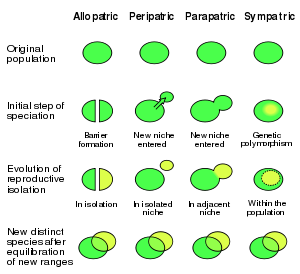 Allopatric speciation may occur when a species is subdivided into two genetically isolated populations. Allopatric and allopatry are terms from biogeography
, referring to organism
s whose ranges are entirely separate such that they do not occur in any one place together. If these organisms are closely related (e.g. sister species), such a distribution is usually the result of allopatric speciation. Separation may be attributed to either geological processes or population dispersal.
processes, the formation or destruction of land bridge
s, or the subsidence
of large bodies of water. On a global scale, plate tectonics
are major geological factors leading to separation of populations and the resulting distribution of species.
Approximately 50,000 years ago, the Death Valley region of the western United States
had a rainy climate which produced an interconnecting system of freshwater rivers and lakes. Climatic changes resulted in a drying trend that has continued for the last 10,000 years. As the lakes and rivers shrank, fish populations became geologically isolated. The few remaining (separated) springs are currently home to a variety of fish, many sharing a close common ancestor; yet each has uniquely adapted to its own particular pool.
The extent to which a geological barrier can effectively isolate a population correlates to the mobility of the organism or its offspring. For example physical barriers such as canyons may effectively block migration and dispersal of small mammals; however, have little impact on flying birds or wind-borne seeds.
or accidental relocations (such as birds being blown off course) may lead to population fragments; whereby groups merely become separated by distance. Once gene flow between the two groups is disrupted, speciation becomes a possibility.
Portions of a populations that exist along the edges of the parent population's geographic territory have higher likelihood of developing reproductive isolation. Such peripheral populations are likely to possess genes that are different from the parental population. After isolation, the founding population
is less likely to represent the gene pool of the parent population. In addition, peripheral isolates are likely to represent a small number of individuals, meaning their gene pool is more susceptible to the effects of genetic drift
(random chance). Furthermore, it is likely that the peripheral population will inhabit an environment different from its ancestral gene pool, likely causing it to be subjected to different selective pressures as it colonizes new areas. The outer periphery of a population's habitat tends to be extreme; hence, the reason range expansion is kept in check. For most peripheral isolates, it is more likely that they die off rather than survive and speciate.
of reproductive isolation, leading to speciation, is generally thought to be an incidental by-product of genetic divergence, particularly adaptive changes that evolve through natural selection
in response to different environmental conditions in separate geographic areas.
The Biological Species Concept, proposed by Ernst Mayr
, in the 1942, emphasizes reproductive isolation as the basis of defining a species. The definition states: "A species is defined as a population or group of populations whose members have the potential to interbreed with one another in nature and to produce viable offspring, but cannot produce viable, fertile offspring with members of other species." Mayr, a proponent of allopatric speciation, hypothesized that adaptive genetic changes that accumulate between allopatric populations cause negative epistasis
in hybrids, resulting in sterility
of the offspring.
If there is considerable genetic
and phenotypic
change without the loss of the capacity for interbreeding, then such hybridization is simply prevented by the geographical separation of populations. In this case the populations are normally regarded as subspecies
.
The frequency of other types of speciation, such as sympatric speciation
, parapatric speciation
, and heteropatric speciation
, is debated. Proponents of peripatric speciation contend that small population size
in the peripheral isolate (sometimes referred to as a "splinter population") increases genetic drift, which can be a more powerful force than natural selection in small populations. It deconstructs complex genotypes, allowing the creation of novel gene
combinations. Both forms need not be mutually exclusive. In practice, passive isolation or fragmentation as well as active dispersal seem to play a role in many cases of speciation.
represents an alternative method of speciation that does not require physical separation; instead speciation occurs within a population sharing the same geographic boundaries. For example, the development of polyploidy
in plant species can lead to a new species arising within the geographic range of its parent population.
In parapatric speciation
there is no physical barrier to gene exchange within the population. Instead, the population is continuous; however, mating is not random. Individuals mate with their closest neighbors rather than with individuals in a more distant location. Divergence may occur as a consequence of both reduced gene flow and natural selection, imposed by the large distance between individuals within a population's habitat.
Allopatric speciation is thought to be the dominant mode of speciation.
 The African Elephant has always been regarded as a single species but, because of morphological and DNA
differences, some scientists classify them into three subspecies
. Researchers at the University of California, San Diego
have argued that divergence due to geographical isolation has gone further, and the elephants of West Africa
should be regarded as a separate species from both the savanna
elephants of Central, Eastern and Southern Africa, or the forest elephants of Central Africa. A similar situation exists with the Asian Elephant
, which has four distinct living sub-species.
Other cases arise where two populations that are quite distinct morphologically, and are native to different continent
s, have been classified as different species; but when members of one species are introduced into the other's range, they are found to interbreed freely, showing that they were in fact only geographically isolated subspecies. This was found to be the case when the Mallard
was introduced into New Zealand
and interbred freely with the native Grey Duck
, which had been classified as a separate species. It is controversial whether its specific status can now be retained.
Speciation
Speciation is the evolutionary process by which new biological species arise. The biologist Orator F. Cook seems to have been the first to coin the term 'speciation' for the splitting of lineages or 'cladogenesis,' as opposed to 'anagenesis' or 'phyletic evolution' occurring within lineages...
that occurs when biological populations of the same species become isolated due to geographical changes such as mountain building or social changes such as emigration
Emigration
Emigration is the act of leaving one's country or region to settle in another. It is the same as immigration but from the perspective of the country of origin. Human movement before the establishment of political boundaries or within one state is termed migration. There are many reasons why people...
. The isolated populations then undergo genotypic and/or phenotypic divergence as: (a) they become subjected to different selective pressures, (b) they independently undergo genetic drift
Genetic drift
Genetic drift or allelic drift is the change in the frequency of a gene variant in a population due to random sampling.The alleles in the offspring are a sample of those in the parents, and chance has a role in determining whether a given individual survives and reproduces...
, and (c) different mutations arise in the populations' gene pool
Gene pool
In population genetics, a gene pool is the complete set of unique alleles in a species or population.- Description :A large gene pool indicates extensive genetic diversity, which is associated with robust populations that can survive bouts of intense selection...
s.
The separate populations over time may evolve
Evolution
Evolution is any change across successive generations in the heritable characteristics of biological populations. Evolutionary processes give rise to diversity at every level of biological organisation, including species, individual organisms and molecules such as DNA and proteins.Life on Earth...
distinctly different characteristics. If the geographical barriers are later removed, members of the two populations may be unable to successfully mate with each other, at which point, the genetically isolated groups have emerged as different species. Allopatric isolation is a key factor in speciation and a common process by which new species arise. Adaptive radiation
Adaptive radiation
In evolutionary biology, adaptive radiation is the evolution of ecological and phenotypic diversity within a rapidly multiplying lineage. Starting with a recent single ancestor, this process results in the speciation and phenotypic adaptation of an array of species exhibiting different...
, as observed by Charles Darwin
Charles Darwin
Charles Robert Darwin FRS was an English naturalist. He established that all species of life have descended over time from common ancestry, and proposed the scientific theory that this branching pattern of evolution resulted from a process that he called natural selection.He published his theory...
in Galapagos finches, is a consequence of allopatric speciation among island populations.
Isolating mechanisms
Biogeography
Biogeography is the study of the distribution of species , organisms, and ecosystems in space and through geological time. Organisms and biological communities vary in a highly regular fashion along geographic gradients of latitude, elevation, isolation and habitat area...
, referring to organism
Organism
In biology, an organism is any contiguous living system . In at least some form, all organisms are capable of response to stimuli, reproduction, growth and development, and maintenance of homoeostasis as a stable whole.An organism may either be unicellular or, as in the case of humans, comprise...
s whose ranges are entirely separate such that they do not occur in any one place together. If these organisms are closely related (e.g. sister species), such a distribution is usually the result of allopatric speciation. Separation may be attributed to either geological processes or population dispersal.
Geographical isolation
Geological processes can fragment a population through such events as emergence of mountain ranges, canyon formation, glacialGlacier
A glacier is a large persistent body of ice that forms where the accumulation of snow exceeds its ablation over many years, often centuries. At least 0.1 km² in area and 50 m thick, but often much larger, a glacier slowly deforms and flows due to stresses induced by its weight...
processes, the formation or destruction of land bridge
Land bridge
A land bridge, in biogeography, is an isthmus or wider land connection between otherwise separate areas, over which animals and plants are able to cross and colonise new lands...
s, or the subsidence
Subsidence
Subsidence is the motion of a surface as it shifts downward relative to a datum such as sea-level. The opposite of subsidence is uplift, which results in an increase in elevation...
of large bodies of water. On a global scale, plate tectonics
Plate tectonics
Plate tectonics is a scientific theory that describes the large scale motions of Earth's lithosphere...
are major geological factors leading to separation of populations and the resulting distribution of species.
Approximately 50,000 years ago, the Death Valley region of the western United States
Western United States
.The Western United States, commonly referred to as the American West or simply "the West," traditionally refers to the region comprising the westernmost states of the United States. Because the U.S. expanded westward after its founding, the meaning of the West has evolved over time...
had a rainy climate which produced an interconnecting system of freshwater rivers and lakes. Climatic changes resulted in a drying trend that has continued for the last 10,000 years. As the lakes and rivers shrank, fish populations became geologically isolated. The few remaining (separated) springs are currently home to a variety of fish, many sharing a close common ancestor; yet each has uniquely adapted to its own particular pool.
The extent to which a geological barrier can effectively isolate a population correlates to the mobility of the organism or its offspring. For example physical barriers such as canyons may effectively block migration and dispersal of small mammals; however, have little impact on flying birds or wind-borne seeds.
Population dispersal
Population dispersal is used to describe migratory events, either in the form of range expansion (natural movement away from parents) or jump dispersal (crossing of barriers), which may lead to genetic isolation. If the smaller population fragment becomes genetically isolated from the parental group, it may be subjected to its own unique mutations, selection forces, and genetic drift effects; thus, it will follow its own evolutionary pathway. MigrationsAnimal migration
Animal migration is the relatively long-distance movement of individuals, usually on a seasonal basis. It is a ubiquitous phenomenon, found in all major animal groups, including birds, mammals, fish, reptiles, amphibians, insects, and crustaceans. The trigger for the migration may be local...
or accidental relocations (such as birds being blown off course) may lead to population fragments; whereby groups merely become separated by distance. Once gene flow between the two groups is disrupted, speciation becomes a possibility.
Allopatric speciation in peripheral populations
When populations become genetically isolated, heritable variations may accumulate so that they become different from the parental population. Given sufficient time, these variations may lead to reproductive isolation.Portions of a populations that exist along the edges of the parent population's geographic territory have higher likelihood of developing reproductive isolation. Such peripheral populations are likely to possess genes that are different from the parental population. After isolation, the founding population
Founder effect
In population genetics, the founder effect is the loss of genetic variation that occurs when a new population is established by a very small number of individuals from a larger population. It was first fully outlined by Ernst Mayr in 1942, using existing theoretical work by those such as Sewall...
is less likely to represent the gene pool of the parent population. In addition, peripheral isolates are likely to represent a small number of individuals, meaning their gene pool is more susceptible to the effects of genetic drift
Genetic drift
Genetic drift or allelic drift is the change in the frequency of a gene variant in a population due to random sampling.The alleles in the offspring are a sample of those in the parents, and chance has a role in determining whether a given individual survives and reproduces...
(random chance). Furthermore, it is likely that the peripheral population will inhabit an environment different from its ancestral gene pool, likely causing it to be subjected to different selective pressures as it colonizes new areas. The outer periphery of a population's habitat tends to be extreme; hence, the reason range expansion is kept in check. For most peripheral isolates, it is more likely that they die off rather than survive and speciate.
Genesis of reproductive barriers
Adaptive divergence may occur when a population becomes geographically divided: followed by an accumulation of genetic differences as they adapt to their own unique environments. Reproductive barriers do not evolve as a consequence of external forces that drive populations toward speciation. Rather, the evolutionEvolution
Evolution is any change across successive generations in the heritable characteristics of biological populations. Evolutionary processes give rise to diversity at every level of biological organisation, including species, individual organisms and molecules such as DNA and proteins.Life on Earth...
of reproductive isolation, leading to speciation, is generally thought to be an incidental by-product of genetic divergence, particularly adaptive changes that evolve through natural selection
Natural selection
Natural selection is the nonrandom process by which biologic traits become either more or less common in a population as a function of differential reproduction of their bearers. It is a key mechanism of evolution....
in response to different environmental conditions in separate geographic areas.
The Biological Species Concept, proposed by Ernst Mayr
Ernst Mayr
Ernst Walter Mayr was one of the 20th century's leading evolutionary biologists. He was also a renowned taxonomist, tropical explorer, ornithologist, historian of science, and naturalist...
, in the 1942, emphasizes reproductive isolation as the basis of defining a species. The definition states: "A species is defined as a population or group of populations whose members have the potential to interbreed with one another in nature and to produce viable offspring, but cannot produce viable, fertile offspring with members of other species." Mayr, a proponent of allopatric speciation, hypothesized that adaptive genetic changes that accumulate between allopatric populations cause negative epistasis
Epistasis
In genetics, epistasis is the phenomenon where the effects of one gene are modified by one or several other genes, which are sometimes called modifier genes. The gene whose phenotype is expressed is called epistatic, while the phenotype altered or suppressed is called hypostatic...
in hybrids, resulting in sterility
Infertility
Infertility primarily refers to the biological inability of a person to contribute to conception. Infertility may also refer to the state of a woman who is unable to carry a pregnancy to full term...
of the offspring.
If there is considerable genetic
Genetics
Genetics , a discipline of biology, is the science of genes, heredity, and variation in living organisms....
and phenotypic
Phenotype
A phenotype is an organism's observable characteristics or traits: such as its morphology, development, biochemical or physiological properties, behavior, and products of behavior...
change without the loss of the capacity for interbreeding, then such hybridization is simply prevented by the geographical separation of populations. In this case the populations are normally regarded as subspecies
Subspecies
Subspecies in biological classification, is either a taxonomic rank subordinate to species, ora taxonomic unit in that rank . A subspecies cannot be recognized in isolation: a species will either be recognized as having no subspecies at all or two or more, never just one...
.
The frequency of other types of speciation, such as sympatric speciation
Sympatric speciation
Sympatric speciation is the process through which new species evolve from a single ancestral species while inhabiting the same geographic region. In evolutionary biology and biogeography, sympatric and sympatry are terms referring to organisms whose ranges overlap or are even identical, so that...
, parapatric speciation
Parapatric speciation
Parapatry is a term from biogeography, referring to organisms whose ranges do not significantly overlap but are immediately adjacent to each other; they only occur together in the narrow contact zone, if at all. This geographical distribution is opposed to sympatry & allopatry or peripatry...
, and heteropatric speciation
Heteropatric speciation
Heteropatric and heteropatry are terms from biogeography, referring to organisms whose geographical ranges overlap or are even identical, so that they occur together at least in some places, but which occupy ecological niches distinct enough to prevent frequent hybridization. Such organisms are...
, is debated. Proponents of peripatric speciation contend that small population size
Small population size
Small populations behave differently from larger populations. They often result in population bottlenecks, which have harmful consequences for the survival of that population.-Demographic effects:...
in the peripheral isolate (sometimes referred to as a "splinter population") increases genetic drift, which can be a more powerful force than natural selection in small populations. It deconstructs complex genotypes, allowing the creation of novel gene
Gene
A gene is a molecular unit of heredity of a living organism. It is a name given to some stretches of DNA and RNA that code for a type of protein or for an RNA chain that has a function in the organism. Living beings depend on genes, as they specify all proteins and functional RNA chains...
combinations. Both forms need not be mutually exclusive. In practice, passive isolation or fragmentation as well as active dispersal seem to play a role in many cases of speciation.
Alternative modes of speciation
Sympatric speciationSympatric speciation
Sympatric speciation is the process through which new species evolve from a single ancestral species while inhabiting the same geographic region. In evolutionary biology and biogeography, sympatric and sympatry are terms referring to organisms whose ranges overlap or are even identical, so that...
represents an alternative method of speciation that does not require physical separation; instead speciation occurs within a population sharing the same geographic boundaries. For example, the development of polyploidy
Polyploidy
Polyploid is a term used to describe cells and organisms containing more than two paired sets of chromosomes. Most eukaryotic species are diploid, meaning they have two sets of chromosomes — one set inherited from each parent. However polyploidy is found in some organisms and is especially common...
in plant species can lead to a new species arising within the geographic range of its parent population.
In parapatric speciation
Parapatric speciation
Parapatry is a term from biogeography, referring to organisms whose ranges do not significantly overlap but are immediately adjacent to each other; they only occur together in the narrow contact zone, if at all. This geographical distribution is opposed to sympatry & allopatry or peripatry...
there is no physical barrier to gene exchange within the population. Instead, the population is continuous; however, mating is not random. Individuals mate with their closest neighbors rather than with individuals in a more distant location. Divergence may occur as a consequence of both reduced gene flow and natural selection, imposed by the large distance between individuals within a population's habitat.
Allopatric speciation is thought to be the dominant mode of speciation.
Examples
DNA
Deoxyribonucleic acid is a nucleic acid that contains the genetic instructions used in the development and functioning of all known living organisms . The DNA segments that carry this genetic information are called genes, but other DNA sequences have structural purposes, or are involved in...
differences, some scientists classify them into three subspecies
Subspecies
Subspecies in biological classification, is either a taxonomic rank subordinate to species, ora taxonomic unit in that rank . A subspecies cannot be recognized in isolation: a species will either be recognized as having no subspecies at all or two or more, never just one...
. Researchers at the University of California, San Diego
University of California, San Diego
The University of California, San Diego, commonly known as UCSD or UC San Diego, is a public research university located in the La Jolla neighborhood of San Diego, California, United States...
have argued that divergence due to geographical isolation has gone further, and the elephants of West Africa
West Africa
West Africa or Western Africa is the westernmost region of the African continent. Geopolitically, the UN definition of Western Africa includes the following 16 countries and an area of approximately 5 million square km:-Flags of West Africa:...
should be regarded as a separate species from both the savanna
Savanna
A savanna, or savannah, is a grassland ecosystem characterized by the trees being sufficiently small or widely spaced so that the canopy does not close. The open canopy allows sufficient light to reach the ground to support an unbroken herbaceous layer consisting primarily of C4 grasses.Some...
elephants of Central, Eastern and Southern Africa, or the forest elephants of Central Africa. A similar situation exists with the Asian Elephant
Asian Elephant
The Asian or Asiatic elephant is the only living species of the genus Elephas and distributed in Southeast Asia from India in the west to Borneo in the east. Three subspecies are recognized — Elephas maximus maximus from Sri Lanka, the Indian elephant or E. m. indicus from mainland Asia, and E. m....
, which has four distinct living sub-species.
Other cases arise where two populations that are quite distinct morphologically, and are native to different continent
Continent
A continent is one of several very large landmasses on Earth. They are generally identified by convention rather than any strict criteria, with seven regions commonly regarded as continents—they are : Asia, Africa, North America, South America, Antarctica, Europe, and Australia.Plate tectonics is...
s, have been classified as different species; but when members of one species are introduced into the other's range, they are found to interbreed freely, showing that they were in fact only geographically isolated subspecies. This was found to be the case when the Mallard
Mallard
The Mallard , or Wild Duck , is a dabbling duck which breeds throughout the temperate and subtropical Americas, Europe, Asia, and North Africa, and has been introduced to New Zealand and Australia....
was introduced into New Zealand
New Zealand
New Zealand is an island country in the south-western Pacific Ocean comprising two main landmasses and numerous smaller islands. The country is situated some east of Australia across the Tasman Sea, and roughly south of the Pacific island nations of New Caledonia, Fiji, and Tonga...
and interbred freely with the native Grey Duck
Pacific Black Duck
The Pacific Black Duck is a dabbling duck found in much of Indonesia, New Guinea, Australia, New Zealand, and many islands in the southwestern Pacific, reaching to the Caroline Islands in the north and French Polynesia in the east. It is usually called the Grey Duck in New Zealand...
, which had been classified as a separate species. It is controversial whether its specific status can now be retained.