

Allahabad

Encyclopedia
Allahabad or Settled by God in Persian
, is a major city of India
and is one of the main holy cities of Hinduism
. It was renamed by the Mughals from the ancient name of Prayaga , and is by some accounts the second-oldest city in India. It is located in the north India
n state
of Uttar Pradesh
, lying some 205 kilometres (127 mi) south of the state capital, Lucknow
. It is the administrative headquarters of the Allahabad District
. Allahabad is one of the fastest growing cities in India at present. The ancient name of the city is Prayaga (Sanskrit
for "place of sacrifice"), as it is believed to be the spot where Brahma
offered his first sacrifice after creating the world. It is one of four sites of the mass Hindu pilgrimage Kumbh Mela
, the others being Haridwar
, Ujjain
and Nashik. It has a position of importance in Hindu scriptures for it is situated at Triveni Sangam, the confluence of the holy rivers Ganges and Yamuna
, and the ancient Sarasvati River
.
Many government offices of both central and state government are present in the city, such as the Allahabad High Court
, the Principal Accountant General Office (AG office), the Uttar Pradesh Public Service Commission Office, Uttar Pradesh Police Head Quarters (PHQ), headquarters of the North Central Railway
, the regional office of the Central Board of Secondary Education
and the Uttar Pradesh Board of High School and Intermediate Education, Uttar Pradesh Madhyamik Shiksha Seva Chayan Board Allahabad, Principal Controller of Defence Accounts (Pensions) Allahabad, etc.Allahabad is also home of India's 4th oldest university, AU
and UP's single National Institutes of Technology
Allahabad is a home to seven out of fourteen Prime Ministers of India. Jawaharlal Nehru
, Lal Bahadur Shastri
, Indira Gandhi
, Rajiv Gandhi
, Gulzarilal Nanda
, Vishwanath Pratap Singh and Chandra Shekhar
were all either born in Allahabad, were alumni of Allahabad University
or got elected from a constituency in Allahabad.
The Government of India
has selected Allahabad as one of the mission cities for the Jawaharlal Nehru National Urban Renewal Mission
, with the goals of improving urban infrastructure, efficient governance and basic services to urban citizens.
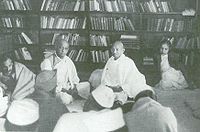 In ancient times, this city was known as Prayaga (place of the confluences), representing the sacred union of the rivers Ganga, Yamuna and Saraswati. According to Hinduism
's religious texts, it is believed to be where Brahma
, the Hindu
Creator of the Universe, attended a sacrificial ritual. Prayaga and the district of Kaushambi are holy cities of Hinduism
- the world's third largest religion - and holds a special place in the hearts of Hindus everywhere.
The area became a part of the Mauryan and Gupta
empires of the east and the Kushan empire of the west before becoming part of the Kannauj
empire. The Founder of Sikhism
Guru Nanak Dev visited Allahabad then known as Prayag. The Ninth Sikh Guru Tegh Bahadur visited Allahabad in 1666 to preach the Sikh religion.
Allahabad became a part of the Mughal Empire
after their invasion of India in 1526. The Mughal emperor Akbar built a magnificent fort
in Allahabad. The city was the scene of Maratha
incursions before colonial rule was imposed over India.
In 1765, the British established a garrison at Fort Allahabad. In 1857, Allahabad was active in the Indian Mutiny.
The annual convention of the Indian National Congress
was held on the extensive grounds of Darbhanga Castle
, Allahabad in 1888 and 1892.
In 1931, at Alfred Park in Allahabad, the revolutionary Chandrashekhar Azad killed himself when surrounded by the British Police. In the years of the struggle for Indian independence, the Nehru family homes of Anand Bhavan
and Swaraj Bhavan
, both in Allahabad, were at the center of the political activities of the Indian National Congress
. Thousands of satyagrahis
(nonviolent resistors) went to jail. The first Prime Minister of India
, Jawaharlal Nehru
, was from Allahabad.
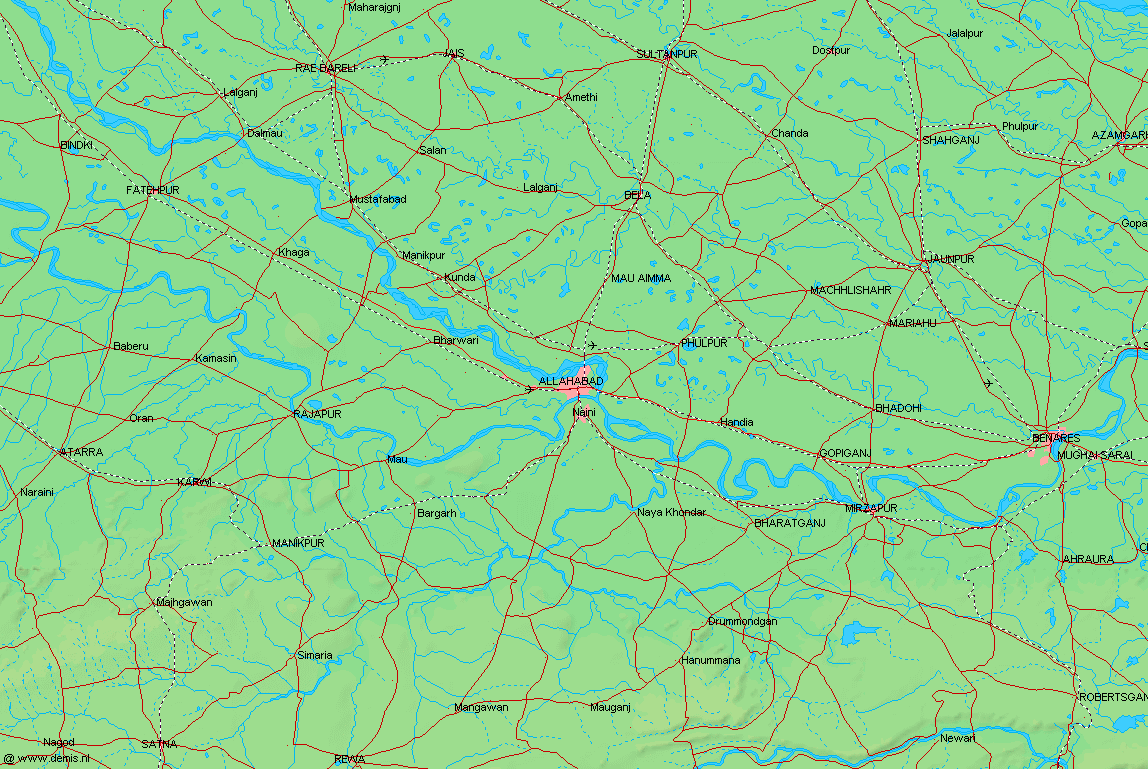 Allahabad is located at 25.45°N 81.84°E in the southern part of the Uttar Pradesh
at an elevation of 98 metres (322 ft) and stands at the confluence of two rivers, the Ganges and Yamuna. The region was known in antiquity as the Vats country. To its south and southeast is the Bagelkhand
region,To its east is middle Ganges valley of North India, or Purvanchal
, To its southwest is the Bundelkhand
region, to its north and northeast is the Awadh
region and to its west along with Kaushambi it forms the part of Doab
i.e. the Lower Doab
region.
Allahabad stands at a strategic point both geographically and culturally. An important part of the Ganges-Yamuna Doab region, it is the last point of the Yamuna River and is the last frontier of the Indian west.
The land of the Allahabad district
that falls between the Ganges and Yamuna is just like the rest of Doab, fertile but not too moist, and is especially suitable for the cultivation of wheat
. The non-doabi parts of the district, which are the southern and eastern part of the district, are somewhat similar to those of adjoining Bundelkhand and Bagelkhand regions - dry and rocky.
The Indian longitude that is associated with Jabalpur also passes through Allahabad, which is 343 km (213.1 mi) north of Jabalpur on the same longitude. Indian Standard Time
is calculated on the basis of 82.5° E longitude, which is just west of the town of Mirzapur, near Allahabad.
Hindi
, Urdu
and English are the languages that are spoken in Allahabad. The dialect of Hindi spoken in Allahabad is Awadhi
, although Khariboli
is most commonly used in the city area. In the eastern non-doabi part of Allahabad district Bagheli dialect is more common. Bengali
and Punjabi
are also spoken in some quarters.
All major religion
s are practised in Allahabad. Hindus comprise 86.81% and Muslims 12.72%. There are small groups of Christians, Sikhs and Buddhists with 0.18%, 0.13%, and 0.04% of the population, respectively.
that is common to cities in north-central India. Allahabad experiences three seasons: hot dry summer, cool dry winter and warm humid monsoon. The summer season lasts from April to June with the maximum temperatures ranging from 40 °C (104 °F) to 45 °C (113 °F). Monsoon
begins in early July and lasts till September. The winter season lasts from December to February. Temperatures rarely drop to the freezing point. Maximum temperatures are around 22 °C (71.6 °F) and minimum around 10 °C (50 °F). Allahabad also witnesses severe fog in January resulting in massive traffic and travel delays. It does not snow in Allahabad.
Lowest temperature recorded, -2 C ; highest 48 °C (118.4 °F).
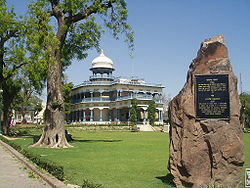 Allahabad is situated at the confluence of the Ganges and Yamuna
rivers. It encompasses a large area and is an inland peninsula surrounded by rivers on three sides with only one side connected to the mainland. Because of this fact, to handle growing traffic and connectivity demands, Allahabad has many bridges crossing rivers the Ganges and Yamuna.
The urban area of city can be classified into three categories:-
1. The Old City is the economic center of city. This is a high density area where major roads are used as transport corridors as well as market streets.
2. The Newer city around Civil Lines area, was conceived during British rule. This area is well planned on grid iron road pattern with additional diagonal roads, making it an efficient city. It is a low density area with wide tree-lined avenues. It houses major educational institutions, the High Court, Uttar Pradesh public service commission, offices, gardens and cantonment areas. It also has shopping malls and multiplexes.
3. The Outer growth areas include satellite towns along major highways passing through cities. It includes city areas trans Ganges and Yamuna areas like Naini, Jhunsi and Phaphamau.
Many real estate developers are investing in Allahabad, prominent being Omaxe, Ansals etc. A hi-tech city with an area of1535 acres (6.2 km²) is being built in the satellite city of Naini
by omaxe group called as omaxe waterfront".
Allahabad has good Medical colleges, Hospitals and up to the mark medical facilities.
Some of the Government Hospitals are- Swarooprani Hospital, Kamala Nehru Hospital, North Central Railway Hospital,Tej Bahadur Sapru Hospital, State Cancer Treatment Hospital, Motilal Nehru Hospital. Allahabad has an Allopethic Medical College,a Homeopaethic Medical College,an Unani and two Ayurvedic Medical College.
In the private hospitals, prominent are Apollo Hospitals
[Under Construction], Jeevan Jyoti Hospital
, Anand hospital, Bhola hospital, Preeti hospital, Prayag Medicare, Apollo clinic etc.
Various movies have been shot in and around Allahabad such as Omkara, Haasil
, Chal Chalein
and Road to Sangam
.
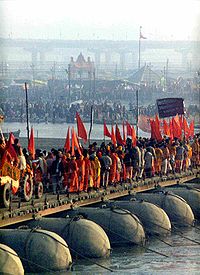
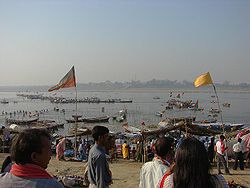 Every year thousands gather at Allahabad to take part in the festival on the banks of the Ganges, the Magh Mela. The same festival is organised in a larger scale every 12th year and attracts millions of people and is called the Kumbha Mela. Kumbh Mela (especially the Maha Kumbh Mela) is the most sacred of all the pilgrimages. Thousands of holy men and women (monks, saints and sadhu
s) attend, and the auspiciousness of the festival is in part attributable to this. The sadhus are seen clad in saffron sheets with plenty of ashes and powder dabbed on their skin per the requirements of ancient traditions. Some called nanga sanyasis or 'Dhigambers' may often be seen without any clothes even in severe winter, generally considered to live an extreme lifestyle. This tends to attract a lot of western attention as it is seemingly in contrast to a generally conservative social modesty practised in the country.Allahabad had witnessed the largest human gathering anywhere in the world with more than 70 million people while Kumbh Mela festival in 2007.
 The imprint of the British and Mughals
can be seen in buildings, gardens and places in Allahabad. The styles of buildings reflect a good mix of western Gothic
and Mughal
architectures.
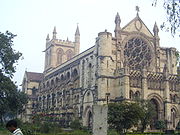
All Saints Cathedral, designed by great English architect William Emerson who also designed Victoria Memorial
of Calcutta. This cathedral is the most beautiful building in city. Styled in 13th Century Gothic architecture, building's interior is more beautiful than its exterior with high ceilings and stone Gothic arches.
Muir College (1874), designed by William Emerson, in Indo-Saracenic
architecture, an excellent mix of Gothic and Indian architectural elements. Its foundation was laid in 1874 and opened in 1886. It has an arcade quadrangle, which is dominated, by a 200 feet (61 m) minaret tower in cream coloured sandstone from Mirzapur
with marble and mosaic floors. The domes of the Indo-Saracenic structure are clad in Multan glazed tiles.
University Science Faculty buildings have classical architectural designs and have strong Victorian and Mughal
architectural influences.
Allahabad High Court (1916) - Chief Justice, Sir John Staley laid the foundation in 1911. It was finally completed in 1916 and opened by Viceroy Lord Chelmsford. Designed by Frank Lishman. this structure is subtly adapted to the climate as is evident from the double roofing with tiles from Allahabad on top to beat the summer heat. Conceived in a grand fashion, it has a domed pediment centre, arcade wings, stone balustrades and engrained arches. It reflects a beautiful synthesis of Eastern and Western architectural styles.
Khusro Bagh
- The three sandstone mausoleums within this walled garden, present an exquisite example of Mughal architecture
.
Public Library (1864)- Standing at Alfred Park it is a beautiful building designed by R.Roskell Rayne. This public library is another remarkable example of Gothic Style. The memorial has a lofty tower and accorded cloisters.
The Old High Court and Public Offices - They are five-storied block. Made of sandstone and ashore these were built by Colonel Pile in I 870 in the classical style. The Minto Park to the west of the ton has a Memorial Pillar enriched with Royal medallions and four lions carrying the Imperial coronet. This was a memorial pillar to the Royal Proclamation of the assumption of rule by the British crown in 1858. The Municipal Museum adjoining the library is yet another colonial structure that is a treasure-trove of archaeological artifacts.
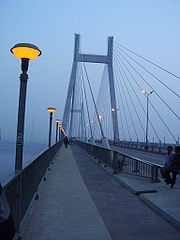
The new Yamuna bridge built jointly by Hindustan Construction Company
and Hyundai Engineering and Construction
, is India's first cable stayed four lane road bridge in India, representing modern design structure. This large bridge has two pylons made of concrete, which support a large part of bridge deck with the help of attached steel cables.
. Other larger airports in the vicinity are at Varanasi
(Lal Bahadur Shastri International Airport, 142 km (88.2 mi)) and Lucknow
(Amausi International Airport 200 km (124.3 mi)).
. Another is NH 27 which is 93 km (57.8 mi) long and starts from Allahabad and ends at Mangawan
in Madhya Pradesh
connecting to National Highway 7
. A four lane access controlled bypass road of 84.7 km aided by World Bank is completed.
There are other state highways that link Allahabad to all other parts of the country. A number of road bridges on rivers Ganges and Yamuna have been built to connect Allahabad with its suburb towns like Naini, Jhusi etc. A new eight lane access controlled expressway - Ganga Expressway
is also proposed to pass through Allahabad. A 8 laned outer ring road is proposed in the Allahabad district.Allahabad also has three bus stands catering to different routes. The buses from western destinations like Delhi, Agra, Lucknow and Kanpur halt at Leader Road Bus Stand. The Zero Road Bus Stand serves the buses going on the southern route i.e. Mahoba and Satna. Buses from Varanasi and other eastern towns arrive at M.G. Road Bus stand.
City buses, Tourist taxis, auto rickshaw
s (or tempos) are available for local transport. There are also city buses service run by UPSRTC
as well as private operators that connects various parts of the city. There are around 150 city buses that are run by UPSRTC under the name Allahabad Mahanagar Bus sewa and about 50 buses run by private operators. But the most convenient method of local transport inside the city is the cycle rickshaw
.NH 76, and 24B connects to Rajasthan
state, and Lucknow
respectively.
, Allahabad is the headquarters of the North Central Railway
Zone, and is well connected by trains with all major cities, namely, Kolkata
, Delhi
, Mumbai
, Chennai
, Hyderabad
, Indore
, Lucknow
, Bhopal, Gwalior, Jabalpur, Bhubaneswar
, Cuttack
Bangalore
and Jaipur
. Allahabad has eight railway stations within its city limits namely Prayag, Allahabad City (Rambagh
), Daraganj
, Allahabad Junction, Naini
Jn, Prayag Ghat, Subedar Ganj & Bamrauli.
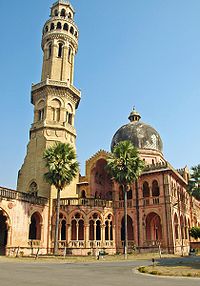 main building]]
Allahabad attracts students and learners from all over country. Allahabad has one central university, three deemed universities, an open university, research and technical institutions and colleges known for providing higher education in vast range of disciplines. Few of the reputed ones can be listed as following.
It is the first IIIT of the country to get the status of "Institute Of National Importance"
by Government of India.
Allahabad is one of the regional divisions of CBSE and head office of UP Board of High School and Intermediate Education. English is the medium of instructions in most private schools while government aided schools and colleges offer both Hindi and English medium education.
To cater needs of vocational, technical and professional education in rural areas of Allahabad and nearby districts, the Ministry of HRD, Government of India has recently started another university named Nehru Gram Bharti Vishwavidyalaya at Dubawal village of Allahabad. The university currently offers academic programs at graduate and post graduate levels in various disciplines including Arts, Commerce, Science, Education (as subject), Law, Management, Rural Development, Master of Social Works, Computer Applications, Journalism etc.
are the most popular sport in Allahabad. Football is also popular and many schools and colleges organise football tournaments. Other sports include basketball
, hockey
, athletics, volleyball
, and gymnastics
. The most popular sports in the rural areas near the city are kabaddi
, Kho-Kho, Gilli Danda, and akhada wrestling. Allahabad has produced many good sportsmen such as Dhyanchand (hockey), Mohammad Kaif (cricket), Abhinn Shyam Gupta
, Arjun Awardee (badminton), Ashish Kumar
(gymnastics); and also players like Shalabh Srivastava
, Ali Murtaza
, Danish Mujtaba
, Obeid Kamal, and Ashish Winston Zaidi Caleb are well known players of hockey and cricket.
The game of gully cricket (also known as street cricket) is popular among young people in the city. Children as well as teenagers play the game of cricket in alleys and lanes. There are several sports complexes for both amateurs and professionals, including the Madan Mohan Malaviya
Cricket stadium, Amitabh Bachchan
Sports Complex and the Boys' High School & College Gymnasium. There is an international level swimming complex at Georgetown. There is a National Sports Academy in Jhalwa [Allahabad west] which produces world class gymnasts, and was chosen as the flagbearer of Indian gymnastic in Commonwealth games
. In Allahabad every year the Indira Marathon is organised; it began in 1985-86 in memory of Indira Gandhi
. It was flagged off by then chief minister Vir Bahadur Singh
, while then prime minister Rajiv Gandhi
gave away the prizes. The inaugural race was won by Swaroop Singh and Rachna Govil.
Allahabad has glass, wire based industries. The main industrial area of Allahabad is Naini
and Phulpur
, where several public and private sector companies have their units, offices and factories. These include AREVA T&D India
http://www.areva-td.in/scripts/in_home/publigen/content/templates/show.asp?P=52&L=US.htm/ (a division of multinational Areva Group), Bharat Pumps & Compressors
(BPC)http://www.bharatpumps.co.in/ which is a Miniratna now, Indian Telephone Industries Limited
[ITI] was set up in Naini in the year 1971 for the manufacture of transmission equipment. The major products are optic fibre systems of both PDH and SDH and telephone instruments of various types, Reliance
Industries - Allahabad Manufacturing Division, Hindustan Cables also called as HCL which has now been taken over by defence for its revival, Triveni Structurals Limited (TSL, a subsidiary of Bharat Yantra Nigam
), GEEP battery factory etc. Indian Farmers Fertilizer Co-Operative is in Phulpur
. IFFCO's Phulpur complex has two Urea production units and once was world’s largest fertiliser complex based on naphtha as feed stock . But owing to environmental concerns, it has been switched to Natural Gas based Plant
Baidyanath Ayurved has its unit in Naini, Allahabad which has a state of the art manufacturing facility spread over 30 Acres. This unit was the largest manufacturing facility of its kind in the whole world was said by none other than the first Prime Minister of Independent India Pt Jawahar Lal Nehru, on his visit to the unit in 1965. This unit boasts of manufacturing not only over 800 formulations, it also is capable of manufacturing the bulk drugs required for these formulations, it also got recognition when the Managing Director of Shree Baidyanth Ayurved, Shri Ram Awtar Sharma was awarded The “Nagarjuna” award for Quality, by President Smt Pratibha Patil .
In the new projects, three mega thermal power projects are coming up at Meja, Bara and Karchna tehsils of the district being constructed by Jaypee Group and National Thermal Power Corporation, they are expected to be over by 2016.
BPCL (Bharat Petroleum Corporation Limited ),one of India’s largest oil marketing companies, the state-owned petroleum firm is setting up a seven million tonnes per annum (MTPA) capacity refinery with an estimated investment of 62 billion at Lohgara, Allahabad to meet the growing demand for petroleum products in the northern region, especially in Uttar Pradesh.It is expected to be over by 2020 http://www.livemint.com/2007/08/02005212/BPCL-plans-refinery-in-Allahab.html. Indian Railways is setting up a bottling plant of packaged water bottles Rail Neer in Allahabad under public-private partnership mode. http://articles.economictimes.indiatimes.com/2011-02-17/news/28554882_1_bottling-plants-rail-neer-rail-neer
, Amar Ujala, Aaj
, Dainik Hindustan, Pioneer, Amrit Prabhat, Daily News Activist, United Bharat, Rashtriya sahara, Compact(Amar Ujala Group),Prayagraj Times etc. in Hindi. The English dailies published are The Times of India
, Hindustan Times
, The Economic Times
, The Pioneer
, Northern India Patrika,Our Leader etc. There is also the Hinglish
Newspaper Tabloid Inext
which is also widely read. Rock Street Journal
magazine covering the rock scene in India and South Asia was started in January 1993 in Allahabad . A H Wheeler & Co
, the largest bookstore chain in India is headquartered in Allahabad. The chain was founded by Emile Moreau
, a French author, and TK Bannerjee, an Indian businessman in Allahabad.
There are currently Three FM radio stations and one All India Radio
Akashwani Station being broadcast in Allahabad. The 3 FM Radio Stations are following:
Upcoming:-
Persian language
Persian is an Iranian language within the Indo-Iranian branch of the Indo-European languages. It is primarily spoken in Iran, Afghanistan, Tajikistan and countries which historically came under Persian influence...
, is a major city of India
India
India , officially the Republic of India , is a country in South Asia. It is the seventh-largest country by geographical area, the second-most populous country with over 1.2 billion people, and the most populous democracy in the world...
and is one of the main holy cities of Hinduism
Hinduism
Hinduism is the predominant and indigenous religious tradition of the Indian Subcontinent. Hinduism is known to its followers as , amongst many other expressions...
. It was renamed by the Mughals from the ancient name of Prayaga , and is by some accounts the second-oldest city in India. It is located in the north India
North India
North India, known natively as Uttar Bhārat or Shumālī Hindustān , is a loosely defined region in the northern part of India. The exact meaning of the term varies by usage...
n state
States and territories of India
India is a federal union of states comprising twenty-eight states and seven union territories. The states and territories are further subdivided into districts and so on.-List of states and territories:...
of Uttar Pradesh
Uttar Pradesh
Uttar Pradesh abbreviation U.P. , is a state located in the northern part of India. With a population of over 200 million people, it is India's most populous state, as well as the world's most populous sub-national entity...
, lying some 205 kilometres (127 mi) south of the state capital, Lucknow
Lucknow
Lucknow is the capital city of Uttar Pradesh in India. Lucknow is the administrative headquarters of Lucknow District and Lucknow Division....
. It is the administrative headquarters of the Allahabad District
Allahabad District
Allahabad district is one of the districts of Uttar Pradesh state of India, and Allahabad town is the district headquarters. Allahabad district is a part of Allahabad Division.As of 2011 it is the most populous district of Uttar Pradesh ....
. Allahabad is one of the fastest growing cities in India at present. The ancient name of the city is Prayaga (Sanskrit
Sanskrit
Sanskrit , is a historical Indo-Aryan language and the primary liturgical language of Hinduism, Jainism and Buddhism.Buddhism: besides Pali, see Buddhist Hybrid Sanskrit Today, it is listed as one of the 22 scheduled languages of India and is an official language of the state of Uttarakhand...
for "place of sacrifice"), as it is believed to be the spot where Brahma
Brahma
Brahma is the Hindu god of creation and one of the Trimurti, the others being Vishnu and Shiva. According to the Brahma Purana, he is the father of Mānu, and from Mānu all human beings are descended. In the Ramayana and the...
offered his first sacrifice after creating the world. It is one of four sites of the mass Hindu pilgrimage Kumbh Mela
Kumbh Mela
Kumbh Mela is a mass Hindu pilgrimage in which Hindus gather at the Ganges river.The normal Kumbh Mela is celebrated every 3 years, the Ardh Kumbh Mela is celebrated every six years at Haridwar and Prayag, the Purna Kumbh takes place every twelve years, at four places Prayag, Haridwar, Ujjain,...
, the others being Haridwar
Haridwar
Haridwar is an important pilgrimage city and municipality in the Haridwar district of Uttarakhand, India...
, Ujjain
Ujjain
Ujjain , is an ancient city of Malwa region in central India, on the eastern bank of the Kshipra River , today part of the state of Madhya Pradesh. It is the administrative centre of Ujjain District and Ujjain Division.In ancient times the city was called Ujjayini...
and Nashik. It has a position of importance in Hindu scriptures for it is situated at Triveni Sangam, the confluence of the holy rivers Ganges and Yamuna
Yamuna
The Yamuna is the largest tributary river of the Ganges in northern India...
, and the ancient Sarasvati River
Sarasvati River
The Sarasvati River is one of the chief Rigvedic rivers mentioned in ancient Hindu texts. The Nadistuti hymn in the Rigveda mentions the Sarasvati between the Yamuna in the east and the Sutlej in the west, and later Vedic texts like Tandya and Jaiminiya Brahmanas as well as the Mahabharata...
.
Many government offices of both central and state government are present in the city, such as the Allahabad High Court
Allahabad High Court
The Allahabad High Court or the High Court of Judicature at Allahabad is a high court having jurisdiction over the Indian state of Uttar Pradesh since 1950...
, the Principal Accountant General Office (AG office), the Uttar Pradesh Public Service Commission Office, Uttar Pradesh Police Head Quarters (PHQ), headquarters of the North Central Railway
North Central Railway
The North Central Railway is one of the sixteen railway zones in India.The largest railway station in NCR is Kanpur Central followed by Mughal Sarai...
, the regional office of the Central Board of Secondary Education
Central Board of Secondary Education
The Central Board of Secondary Education is a Board of Education for public and private schools, under the Union Government of India.-History:...
and the Uttar Pradesh Board of High School and Intermediate Education, Uttar Pradesh Madhyamik Shiksha Seva Chayan Board Allahabad, Principal Controller of Defence Accounts (Pensions) Allahabad, etc.Allahabad is also home of India's 4th oldest university, AU
Au
-Science:*Absorbance Units, a reporting unit in spectroscopy*Astronomical unit, the average distance between the Earth and the Sun *Atomic units, a system of units convenient for atomic physics and other fields...
and UP's single National Institutes of Technology
National Institutes of Technology
The National Institutes of Technology , are a group of higher education engineering institutes in India. Comprising thirty autonomous institutes, they are located in one each major state/territory of India. On their inception decades ago, all NITs were referred as Regional Engineering Colleges ...
Allahabad is a home to seven out of fourteen Prime Ministers of India. Jawaharlal Nehru
Jawaharlal Nehru
Jawaharlal Nehru , often referred to with the epithet of Panditji, was an Indian statesman who became the first Prime Minister of independent India and became noted for his “neutralist” policies in foreign affairs. He was also one of the principal leaders of India’s independence movement in the...
, Lal Bahadur Shastri
Lal Bahadur Shastri
Lal Bahadur Srivastava Shastri was the second Prime Minister of the Republic of India and a significant figure in the Indian independence movement.-Early life:...
, Indira Gandhi
Indira Gandhi
Indira Priyadarshini Gandhara was an Indian politician who served as the third Prime Minister of India for three consecutive terms and a fourth term . She was assassinated by Sikh extremists...
, Rajiv Gandhi
Rajiv Gandhi
Rajiv Ratna Gandhi was the sixth Prime Minister of India . He took office after his mother's assassination on 31 October 1984; he himself was assassinated on 21 May 1991. He became the youngest Prime Minister of India when he took office at the age of 40.Rajiv Gandhi was the elder son of Indira...
, Gulzarilal Nanda
Gulzarilal Nanda
Gulzarilal Nanda was an Indian politician and an economist with specialization in labour problems. He was the interim Prime Minister of India twice for thirteen days each: the first time after the death of Prime Minister Jawaharlal Nehru in 1964, and the second time after the death of Prime...
, Vishwanath Pratap Singh and Chandra Shekhar
Chandra Shekhar
Chandra Shekhar Singh was the eighth Prime Minister of India.-Early years:He was born on 1 July 1927 to a Rajput farming family in Ibrahimpatti - Ballia in eastern Uttar Pradesh. Chandra Shekhar Singh did his Master of Arts at Allahabad University. He was known as a firebrand in student politics...
were all either born in Allahabad, were alumni of Allahabad University
Allahabad University
Allahabad University , is a premier Central University located in Allahabad, Uttar Pradesh, India. Its origins lie in the Muir Central College, named after Lt...
or got elected from a constituency in Allahabad.
The Government of India
Government of India
The Government of India, officially known as the Union Government, and also known as the Central Government, was established by the Constitution of India, and is the governing authority of the union of 28 states and seven union territories, collectively called the Republic of India...
has selected Allahabad as one of the mission cities for the Jawaharlal Nehru National Urban Renewal Mission
Jawaharlal Nehru National Urban Renewal Mission
Jawaharlal Nehru National Urban Renewal Mission is a massive city modernisation scheme launched by the Government of India under Ministry of Urban Development. It envisages a total investment of over...
, with the goals of improving urban infrastructure, efficient governance and basic services to urban citizens.
History
Hinduism
Hinduism is the predominant and indigenous religious tradition of the Indian Subcontinent. Hinduism is known to its followers as , amongst many other expressions...
's religious texts, it is believed to be where Brahma
Brahma
Brahma is the Hindu god of creation and one of the Trimurti, the others being Vishnu and Shiva. According to the Brahma Purana, he is the father of Mānu, and from Mānu all human beings are descended. In the Ramayana and the...
, the Hindu
Hindu
Hindu refers to an identity associated with the philosophical, religious and cultural systems that are indigenous to the Indian subcontinent. As used in the Constitution of India, the word "Hindu" is also attributed to all persons professing any Indian religion...
Creator of the Universe, attended a sacrificial ritual. Prayaga and the district of Kaushambi are holy cities of Hinduism
Hinduism
Hinduism is the predominant and indigenous religious tradition of the Indian Subcontinent. Hinduism is known to its followers as , amongst many other expressions...
- the world's third largest religion - and holds a special place in the hearts of Hindus everywhere.
The area became a part of the Mauryan and Gupta
Gupta
Gupta is a common surname of Indian origin.According to some academicians, the name Gupta is derived from Sanskrit goptri, meaning military governor. A more direct translation of the Sanskrit word gupta is 'secret' or 'hidden'. According to prominent historian R. C...
empires of the east and the Kushan empire of the west before becoming part of the Kannauj
Kannauj
Kannauj , also spelt Kanauj, is a city, administrative headquarters and a municipal board or Nagar Palika Parishad in Kannauj district in the Indian state of Uttar Pradesh. The city's name is traditionally derived from the term Kanyakubja . Kannauj is an ancient city, in earlier times the capital...
empire. The Founder of Sikhism
Sikhism
Sikhism is a monotheistic religion founded during the 15th century in the Punjab region, by Guru Nanak Dev and continued to progress with ten successive Sikh Gurus . It is the fifth-largest organized religion in the world and one of the fastest-growing...
Guru Nanak Dev visited Allahabad then known as Prayag. The Ninth Sikh Guru Tegh Bahadur visited Allahabad in 1666 to preach the Sikh religion.
Allahabad became a part of the Mughal Empire
Mughal Empire
The Mughal Empire , or Mogul Empire in traditional English usage, was an imperial power from the Indian Subcontinent. The Mughal emperors were descendants of the Timurids...
after their invasion of India in 1526. The Mughal emperor Akbar built a magnificent fort
Allahabad Fort
right|300px|thumb|Allahabad FortAllahabad Fort at Allahabad, Uttar Pradesh, India was built by Emperor Akbar in 1583. The fort stands on the banks of the Yamuna near the site of confluence with the river Ganges. It is the largest fort built by Akbar...
in Allahabad. The city was the scene of Maratha
Maratha Empire
The Maratha Empire or the Maratha Confederacy was an Indian imperial power that existed from 1674 to 1818. At its peak, the empire covered much of South Asia, encompassing a territory of over 2.8 million km²....
incursions before colonial rule was imposed over India.
In 1765, the British established a garrison at Fort Allahabad. In 1857, Allahabad was active in the Indian Mutiny.
The annual convention of the Indian National Congress
Indian National Congress
The Indian National Congress is one of the two major political parties in India, the other being the Bharatiya Janata Party. It is the largest and one of the oldest democratic political parties in the world. The party's modern liberal platform is largely considered center-left in the Indian...
was held on the extensive grounds of Darbhanga Castle
Darbhanga, Allahabad
Darbhanga is a locality/township of Allahabad, Uttar Pradesh, India. This colony was formerly owned by the Royal family of Darbhanga. That is the reason of this colony being known as Darbhanga. It still has Darbhanga House and Darbhanga Castle in the Colony...
, Allahabad in 1888 and 1892.
In 1931, at Alfred Park in Allahabad, the revolutionary Chandrashekhar Azad killed himself when surrounded by the British Police. In the years of the struggle for Indian independence, the Nehru family homes of Anand Bhavan
Anand Bhavan
Anand Bhavan is a large mansion located in Allahabad, India. It was owned by Indian political leader Motilal Nehru in the 19th century, it has served as the ancestral home of the Nehru-Gandhi Family — future Prime Minister of India Indira Gandhi was born there...
and Swaraj Bhavan
Swaraj Bhavan
The Swaraj Bhavan is a large bungalow in Allahabad, India. It was constructed by Indian political leader Motilal Nehru in the 1920s to serve as the residence of the Nehru family when the original mansion Anand Bhavan was transformed into the local headquarters of the Indian National Congress....
, both in Allahabad, were at the center of the political activities of the Indian National Congress
Indian National Congress
The Indian National Congress is one of the two major political parties in India, the other being the Bharatiya Janata Party. It is the largest and one of the oldest democratic political parties in the world. The party's modern liberal platform is largely considered center-left in the Indian...
. Thousands of satyagrahis
Satyagraha
Satyagraha , loosely translated as "insistence on truth satya agraha soul force" or "truth force" is a particular philosophy and practice within the broader overall category generally known as nonviolent resistance or civil resistance. The term "satyagraha" was conceived and developed by Mahatma...
(nonviolent resistors) went to jail. The first Prime Minister of India
Prime Minister of India
The Prime Minister of India , as addressed to in the Constitution of India — Prime Minister for the Union, is the chief of government, head of the Council of Ministers and the leader of the majority party in parliament...
, Jawaharlal Nehru
Jawaharlal Nehru
Jawaharlal Nehru , often referred to with the epithet of Panditji, was an Indian statesman who became the first Prime Minister of independent India and became noted for his “neutralist” policies in foreign affairs. He was also one of the principal leaders of India’s independence movement in the...
, was from Allahabad.
Geography
Uttar Pradesh
Uttar Pradesh abbreviation U.P. , is a state located in the northern part of India. With a population of over 200 million people, it is India's most populous state, as well as the world's most populous sub-national entity...
at an elevation of 98 metres (322 ft) and stands at the confluence of two rivers, the Ganges and Yamuna. The region was known in antiquity as the Vats country. To its south and southeast is the Bagelkhand
Bagelkhand
Bagelkhand or Baghelkhand, is a region in central India, in northeastern Madhya Pradesh state. It includes the Madhya Pradesh districts of Anuppur, Rewa, Satna, Shadol, Sidhi, and Umaria....
region,To its east is middle Ganges valley of North India, or Purvanchal
Purvanchal
Purvanchal is a geographic region of north-central India, which comprises the eastern end of Uttar Pradesh state...
, To its southwest is the Bundelkhand
Bundelkhand
Bundelkhand anciently known as Chedi Kingdom is a geographic region of central India...
region, to its north and northeast is the Awadh
Awadh
Awadh , also known in various British historical texts as Oudh or Oude derived from Ayodhya, is a region in the centre of the modern Indian state of Uttar Pradesh, which was before independence known as the United Provinces of Agra and Oudh...
region and to its west along with Kaushambi it forms the part of Doab
Doab
A Doab is a term used in India and Pakistan for a "tongue" or tract of land lying between two confluent rivers...
i.e. the Lower Doab
Doab
A Doab is a term used in India and Pakistan for a "tongue" or tract of land lying between two confluent rivers...
region.
Allahabad stands at a strategic point both geographically and culturally. An important part of the Ganges-Yamuna Doab region, it is the last point of the Yamuna River and is the last frontier of the Indian west.
The land of the Allahabad district
Allahabad District
Allahabad district is one of the districts of Uttar Pradesh state of India, and Allahabad town is the district headquarters. Allahabad district is a part of Allahabad Division.As of 2011 it is the most populous district of Uttar Pradesh ....
that falls between the Ganges and Yamuna is just like the rest of Doab, fertile but not too moist, and is especially suitable for the cultivation of wheat
Wheat
Wheat is a cereal grain, originally from the Levant region of the Near East, but now cultivated worldwide. In 2007 world production of wheat was 607 million tons, making it the third most-produced cereal after maize and rice...
. The non-doabi parts of the district, which are the southern and eastern part of the district, are somewhat similar to those of adjoining Bundelkhand and Bagelkhand regions - dry and rocky.
The Indian longitude that is associated with Jabalpur also passes through Allahabad, which is 343 km (213.1 mi) north of Jabalpur on the same longitude. Indian Standard Time
Indian Standard Time
Indian Standard Time is the time observed throughout India and Sri Lanka, with a time offset of UTC+05:30. India does not observe daylight saving time or other seasonal adjustments, although DST was used briefly during the Sino–Indian War of 1962 and the Indo–Pakistani Wars of 1965 and 1971...
is calculated on the basis of 82.5° E longitude, which is just west of the town of Mirzapur, near Allahabad.
Demographics
Allahabad district has a population of 4,936,105 while Allahabad city has a population of 1,206,785 as per the 2001 census. It lists as the 32nd most populous city in India. Allahabad literacy rate is 82%. Allahabad has an area of about 70 km² (27 sq mi) and is 98 m (321.5 ft) above sea level.Hindi
Hindi
Standard Hindi, or more precisely Modern Standard Hindi, also known as Manak Hindi , High Hindi, Nagari Hindi, and Literary Hindi, is a standardized and sanskritized register of the Hindustani language derived from the Khariboli dialect of Delhi...
, Urdu
Urdu
Urdu is a register of the Hindustani language that is identified with Muslims in South Asia. It belongs to the Indo-European family. Urdu is the national language and lingua franca of Pakistan. It is also widely spoken in some regions of India, where it is one of the 22 scheduled languages and an...
and English are the languages that are spoken in Allahabad. The dialect of Hindi spoken in Allahabad is Awadhi
Awadhi language
Awadhi is an Indo-Aryan language, part of the Hindi-Urdu continuum. It is spoken chiefly in the Awadh region of Uttar Pradesh, although its speakers are also found in Madhya Pradesh, Delhi and Nepal. Furthermore, the Fiji Hindi dialect spoken by Indo-Fijians is considered a variant of Awadhi,...
, although Khariboli
Khariboli
Khariboli , also Khari Boli, Khadiboli, Khadi Boli or simply Khari, is a Western Hindi dialect spoken mainly in the rural surroundings of Delhi, the northern areas of Western Uttar Pradesh and the southern areas of Uttarakhand in India...
is most commonly used in the city area. In the eastern non-doabi part of Allahabad district Bagheli dialect is more common. Bengali
Bengali language
Bengali or Bangla is an eastern Indo-Aryan language. It is native to the region of eastern South Asia known as Bengal, which comprises present day Bangladesh, the Indian state of West Bengal, and parts of the Indian states of Tripura and Assam. It is written with the Bengali script...
and Punjabi
Punjabi language
Punjabi is an Indo-Aryan language spoken by inhabitants of the historical Punjab region . For Sikhs, the Punjabi language stands as the official language in which all ceremonies take place. In Pakistan, Punjabi is the most widely spoken language...
are also spoken in some quarters.
All major religion
Religion
Religion is a collection of cultural systems, belief systems, and worldviews that establishes symbols that relate humanity to spirituality and, sometimes, to moral values. Many religions have narratives, symbols, traditions and sacred histories that are intended to give meaning to life or to...
s are practised in Allahabad. Hindus comprise 86.81% and Muslims 12.72%. There are small groups of Christians, Sikhs and Buddhists with 0.18%, 0.13%, and 0.04% of the population, respectively.
Climate
Allahabad features the typical version of a humid subtropical climateHumid subtropical climate
A humid subtropical climate is a climate zone characterized by hot, humid summers and mild to cool winters...
that is common to cities in north-central India. Allahabad experiences three seasons: hot dry summer, cool dry winter and warm humid monsoon. The summer season lasts from April to June with the maximum temperatures ranging from 40 °C (104 °F) to 45 °C (113 °F). Monsoon
Monsoon
Monsoon is traditionally defined as a seasonal reversing wind accompanied by corresponding changes in precipitation, but is now used to describe seasonal changes in atmospheric circulation and precipitation associated with the asymmetric heating of land and sea...
begins in early July and lasts till September. The winter season lasts from December to February. Temperatures rarely drop to the freezing point. Maximum temperatures are around 22 °C (71.6 °F) and minimum around 10 °C (50 °F). Allahabad also witnesses severe fog in January resulting in massive traffic and travel delays. It does not snow in Allahabad.
Lowest temperature recorded, -2 C ; highest 48 °C (118.4 °F).
Civic administration
Municipal Corporation of Allahabad (also called Allahabad Nagar Nigam), is one of the old municipalities of the state. The corporation came into existence in 1864, when Lucknow Municipal Act was passed by Government of India. City municipal area is divided in total 80 wards and a member (the Corporator) from each ward is elected to form the Municipal Committee. The Corporators elect the Mayor of city. The chief executive is the Commissioner of Allahabad who is appointed by the state government.Cityscape
Yamuna
The Yamuna is the largest tributary river of the Ganges in northern India...
rivers. It encompasses a large area and is an inland peninsula surrounded by rivers on three sides with only one side connected to the mainland. Because of this fact, to handle growing traffic and connectivity demands, Allahabad has many bridges crossing rivers the Ganges and Yamuna.
The urban area of city can be classified into three categories:-
1. The Old City is the economic center of city. This is a high density area where major roads are used as transport corridors as well as market streets.
2. The Newer city around Civil Lines area, was conceived during British rule. This area is well planned on grid iron road pattern with additional diagonal roads, making it an efficient city. It is a low density area with wide tree-lined avenues. It houses major educational institutions, the High Court, Uttar Pradesh public service commission, offices, gardens and cantonment areas. It also has shopping malls and multiplexes.
3. The Outer growth areas include satellite towns along major highways passing through cities. It includes city areas trans Ganges and Yamuna areas like Naini, Jhunsi and Phaphamau.
Many real estate developers are investing in Allahabad, prominent being Omaxe, Ansals etc. A hi-tech city with an area of1535 acres (6.2 km²) is being built in the satellite city of Naini
Naini
Naini is a satellite locality/township of the city of Allahabad, Uttar Pradesh, India in the south-east.-History:Naini was infamous for its prison, Naini Jail, where many freedom fighters—including Pt...
by omaxe group called as omaxe waterfront".
Allahabad has good Medical colleges, Hospitals and up to the mark medical facilities.
Some of the Government Hospitals are- Swarooprani Hospital, Kamala Nehru Hospital, North Central Railway Hospital,Tej Bahadur Sapru Hospital, State Cancer Treatment Hospital, Motilal Nehru Hospital. Allahabad has an Allopethic Medical College,a Homeopaethic Medical College,an Unani and two Ayurvedic Medical College.
In the private hospitals, prominent are Apollo Hospitals
Apollo Hospitals
Apollo Hospitals is a major hospital chain based in Chennai, India. It was founded by Dr. Prathap C. Reddy in 1983. Apollo is private healthcare provider in Asia with hospitals in India, Sri Lanka, Bangladesh, Ghana, Nigeria, Republic of Mauritius, Qatar,Oman and Kuwait.Several of the group's...
[Under Construction], Jeevan Jyoti Hospital
Jeevan Jyoti Hospital
Jeevan Jyoti Hospital is a multi-speciality 400 bed hospital situated in Bai-Ka-Bagh, Lowther Road, Allahabad, Uttar Pradesh, India. It is 3 km from Allahabad junction and 1 km away from Ram Bagh Station.-Surgical centre:...
, Anand hospital, Bhola hospital, Preeti hospital, Prayag Medicare, Apollo clinic etc.
Various movies have been shot in and around Allahabad such as Omkara, Haasil
Haasil
Haasil is Filmfare award-winning 2003 film directed by Tigmanshu Dhulia. Irfan Khan won Filmfare award for Best actor in negative role for his portrayal of Ranvijay Singh in the movie.Movie is set and shot in and around Allahabad, Uttar Pradesh.-Plot:...
, Chal Chalein
Chal Chalein
Chal Chalein is a 2009 Hindi family film. The film stars Mithun Chakraborty and Rati Agnihotri in a story about the academic pressures on children.- Plot :...
and Road to Sangam
Road to Sangam
Road to Sangam is a 2009 Bollywood film written and directed by Amit Rai. The film features Bollywood actors Paresh Rawal, Om Puri and Pawan Malhotra....
.
Places
Some places of interests in Allahabad are:- Sangam and surroundings, particularly in December to February, when Kumbh MelaKumbh MelaKumbh Mela is a mass Hindu pilgrimage in which Hindus gather at the Ganges river.The normal Kumbh Mela is celebrated every 3 years, the Ardh Kumbh Mela is celebrated every six years at Haridwar and Prayag, the Purna Kumbh takes place every twelve years, at four places Prayag, Haridwar, Ujjain,...
, Magh Mela is underway. - Anand BhavanAnand BhavanAnand Bhavan is a large mansion located in Allahabad, India. It was owned by Indian political leader Motilal Nehru in the 19th century, it has served as the ancestral home of the Nehru-Gandhi Family — future Prime Minister of India Indira Gandhi was born there...
and Jawahar Planetarium. - New Yamuna Bridge, Yamuna bank road.
- Company Bagh, Alfred Park and Allahabad Museum.
- Allahabad High CourtAllahabad High CourtThe Allahabad High Court or the High Court of Judicature at Allahabad is a high court having jurisdiction over the Indian state of Uttar Pradesh since 1950...
building - All Saints Cathedral - was built in Gothic Style in 19th Century. Also commonly known as Patthar Girja Ghar, this cathedral stands at a prominent location of the city in lush green premises. It figures among the finest Cathedrals of India. Though it was consecrated in 1887, it took another 40 years for it to be completed.
- Allahabad UniversityAllahabad UniversityAllahabad University , is a premier Central University located in Allahabad, Uttar Pradesh, India. Its origins lie in the Muir Central College, named after Lt...
, established on 23 September 1887, is the fourth oldest University of India after Calcutta, Bombay and Madras universities. Many people consider it to be the Oxford of India. Its sprawling 320 acres (1.3 km²) campus in the middle of the city has many heritage buildings. - Ewing Christian CollegeEwing Christian CollegeEwing Christian College was established in 1902, as Allahabad Christian College on the banks of river Jamuna in Allahabad, U.P. by the American Presbyterian Mission....
- American and Victorian Era architecture; the College was established by American Presbyterians in 1902 by the banks of the river Yamuna. - Sachcha Baba Ashram, Arail, Naini
- Narayan Ashram, Govindpur
- Shivkuti (Anceient temple of god Shiva), Shivkuti
Kumbh Mela
Sadhu
In Hinduism, sādhu denotes an ascetic, wandering monk. Although the vast majority of sādhus are yogīs, not all yogīs are sādhus. The sādhu is solely dedicated to achieving mokṣa , the fourth and final aśrama , through meditation and contemplation of brahman...
s) attend, and the auspiciousness of the festival is in part attributable to this. The sadhus are seen clad in saffron sheets with plenty of ashes and powder dabbed on their skin per the requirements of ancient traditions. Some called nanga sanyasis or 'Dhigambers' may often be seen without any clothes even in severe winter, generally considered to live an extreme lifestyle. This tends to attract a lot of western attention as it is seemingly in contrast to a generally conservative social modesty practised in the country.Allahabad had witnessed the largest human gathering anywhere in the world with more than 70 million people while Kumbh Mela festival in 2007.
Architecture
Mughal (tribe)
The term Mughal is simply a Turkic word and many groups in India, Pakistan, Afghanistan, and Bangladesh use the term Mughal to describe themselves...
can be seen in buildings, gardens and places in Allahabad. The styles of buildings reflect a good mix of western Gothic
Gothic architecture
Gothic architecture is a style of architecture that flourished during the high and late medieval period. It evolved from Romanesque architecture and was succeeded by Renaissance architecture....
and Mughal
Mughal architecture
Mughal architecture, an amalgam of Islamic, Persian, Turkish and Indian architecture, is the distinctive style developed by the Mughals in the 16th, 17th and 18th centuries in what is now India, Pakistan, Bangladesh and Afghanistan. It is symmetrical and decorative in style.The Mughal dynasty was...
architectures.
All Saints Cathedral, designed by great English architect William Emerson who also designed Victoria Memorial
Victoria Memorial (India)
The Victoria Memorial, officially the Victoria Memorial Hall, is a memorial building dedicated to Victoria, Queen of the United Kingdom and Empress of India, which is located in Kolkata, India – the capital of West Bengal and a former capital of British India. It currently serves as a museum and a...
of Calcutta. This cathedral is the most beautiful building in city. Styled in 13th Century Gothic architecture, building's interior is more beautiful than its exterior with high ceilings and stone Gothic arches.
Muir College (1874), designed by William Emerson, in Indo-Saracenic
Indo-Saracenic
The Indo-Saracenic Revival was an architectural style movement by British architects in the late 19th century in British India...
architecture, an excellent mix of Gothic and Indian architectural elements. Its foundation was laid in 1874 and opened in 1886. It has an arcade quadrangle, which is dominated, by a 200 feet (61 m) minaret tower in cream coloured sandstone from Mirzapur
Mirzapur
Mirzapur is a city in the heart of North India, nearly 650 km between Delhi and Kolkata and also equidistant from Allahabad and Varanasi. Located in the state of Uttar Pradesh, Mirzapur has a population of a little over 205,264 and is renowned for its famous carpet and brassware industry...
with marble and mosaic floors. The domes of the Indo-Saracenic structure are clad in Multan glazed tiles.
University Science Faculty buildings have classical architectural designs and have strong Victorian and Mughal
Mughal
Mughal, a word related to the Mongols, may refer to the:* Mughal Empire of South Asia* Mughal emperors* Mughal , the central Asian tribe from which the rulers of the Mughal Empire hailed* Mughal architecture* Mughal painting* Mughlai cuisine...
architectural influences.
Allahabad High Court (1916) - Chief Justice, Sir John Staley laid the foundation in 1911. It was finally completed in 1916 and opened by Viceroy Lord Chelmsford. Designed by Frank Lishman. this structure is subtly adapted to the climate as is evident from the double roofing with tiles from Allahabad on top to beat the summer heat. Conceived in a grand fashion, it has a domed pediment centre, arcade wings, stone balustrades and engrained arches. It reflects a beautiful synthesis of Eastern and Western architectural styles.
Khusro Bagh
Khusro Bagh
Khusro Bagh is a large walled garden, close to the Allahabad Junction Station, in Allahabad, India, surrounding the tombs of Khusraw , eldest son of emperor Jahangir, Shah Begum, Khusraw's mother , a Rajput princess and Jahangir's first wife, and that Princess Sultan Nithar Begam , Khusraw's sister...
- The three sandstone mausoleums within this walled garden, present an exquisite example of Mughal architecture
Mughal architecture
Mughal architecture, an amalgam of Islamic, Persian, Turkish and Indian architecture, is the distinctive style developed by the Mughals in the 16th, 17th and 18th centuries in what is now India, Pakistan, Bangladesh and Afghanistan. It is symmetrical and decorative in style.The Mughal dynasty was...
.
Public Library (1864)- Standing at Alfred Park it is a beautiful building designed by R.Roskell Rayne. This public library is another remarkable example of Gothic Style. The memorial has a lofty tower and accorded cloisters.
The Old High Court and Public Offices - They are five-storied block. Made of sandstone and ashore these were built by Colonel Pile in I 870 in the classical style. The Minto Park to the west of the ton has a Memorial Pillar enriched with Royal medallions and four lions carrying the Imperial coronet. This was a memorial pillar to the Royal Proclamation of the assumption of rule by the British crown in 1858. The Municipal Museum adjoining the library is yet another colonial structure that is a treasure-trove of archaeological artifacts.
The new Yamuna bridge built jointly by Hindustan Construction Company
Hindustan Construction Company
Hindustan Construction Company is a construction company based in Mumbai, India, founded in 1926. HCC works in various sectors including transportation, power, marine, oil and gas pipeline construction, irrigation, utilities and urban infrastructure. HCC specializes in large-scale civil...
and Hyundai Engineering and Construction
Hyundai Engineering and Construction
Hyundai Engineering and Construction Co., Ltd. is a major construction company in South Korea which has carried out projects not only in Korea but around the world. The company was founded by Chung Ju-yung in 1947 as the Hyundai Civil Works Company, and was a major component of the Hyundai Group...
, is India's first cable stayed four lane road bridge in India, representing modern design structure. This large bridge has two pylons made of concrete, which support a large part of bridge deck with the help of attached steel cables.
Transportation
Air
Allahabad is served by the Allahabad Airport (Bamrauli Air Force Base) (IXD) and is linked to Delhi by Air India RegionalAir India
Air India is the flag carrier airline of India. It is part of the government of India owned Air India Limited . The airline operates a fleet of Airbus and Boeing aircraft serving Asia, Australia, Europe and North America. Its corporate office is located at the Air India Building at Nariman...
. Other larger airports in the vicinity are at Varanasi
Varanasi
-Etymology:The name Varanasi has its origin possibly from the names of the two rivers Varuna and Assi, for the old city lies in the north shores of the Ganga bounded by its two tributaries, the Varuna and the Asi, with the Ganges being to its south...
(Lal Bahadur Shastri International Airport, 142 km (88.2 mi)) and Lucknow
Lucknow
Lucknow is the capital city of Uttar Pradesh in India. Lucknow is the administrative headquarters of Lucknow District and Lucknow Division....
(Amausi International Airport 200 km (124.3 mi)).
Road
National Highway 2 runs through the middle of the city. National Highway 2 is also proposed as one of the routes of Golden Quadrilateral Highway, Delhi-Kolkata section, but it runs out of the city through newly constructed bypass. NH 96 connects to NH 28 at FaizabadFaizabad
City of Faizabad , previous capital of Awadh, is the headquarters of Faizabad District and a municipal board in the state of Uttar Pradesh, India, situated on the banks of river Ghaghra . Faizabad has a twin city of Ayodhya, which is considered to be the birthplace of Rama...
. Another is NH 27 which is 93 km (57.8 mi) long and starts from Allahabad and ends at Mangawan
Mangawan
Mangawan is a town and a nagar panchayat in Rewa district in the Indian state of Madhya Pradesh.It is from District headquarters of Rewa. NH 7 and NH 27 goes through Mangawan. Allahabad is on NH 27 and Varanasi is on NH 7.-Geography:...
in Madhya Pradesh
Madhya Pradesh
Madhya Pradesh , often called the Heart of India, is a state in central India. Its capital is Bhopal and Indore is the largest city....
connecting to National Highway 7
National Highway 7 (India)
National Highway 7, commonly referred to as NH 7, is major North-South National Highway in India that runs through the states of Uttar Pradesh, Madhya Pradesh, Maharashtra, Andhra Pradesh, Karnataka, and Tamil Nadu....
. A four lane access controlled bypass road of 84.7 km aided by World Bank is completed.
There are other state highways that link Allahabad to all other parts of the country. A number of road bridges on rivers Ganges and Yamuna have been built to connect Allahabad with its suburb towns like Naini, Jhusi etc. A new eight lane access controlled expressway - Ganga Expressway
Ganga Expressway
The Ganga Expressway Project was launched by Uttar Pradesh Chief Minister Mayawati after coming to power in 2007. The project aims to construct a 1047 km access controlled eight-laned expressway running along the Ganga River...
is also proposed to pass through Allahabad. A 8 laned outer ring road is proposed in the Allahabad district.Allahabad also has three bus stands catering to different routes. The buses from western destinations like Delhi, Agra, Lucknow and Kanpur halt at Leader Road Bus Stand. The Zero Road Bus Stand serves the buses going on the southern route i.e. Mahoba and Satna. Buses from Varanasi and other eastern towns arrive at M.G. Road Bus stand.
City buses, Tourist taxis, auto rickshaw
Auto rickshaw
An auto rickshaw or three-wheeler is a usually three-wheeled cabin cycle for private use and as a vehicle for hire. It is a motorized version of the traditional pulled rickshaw or cycle rickshaw...
s (or tempos) are available for local transport. There are also city buses service run by UPSRTC
Upsrtc
Uttar Pradesh State Road Transport Corporation is a state transport company based in Uttar Pradesh, India operating intrastate and interstate bus services. Known as Uttar Pradesh Rajya Sarak Parivahan Nigam in Hindi, it is fondly called as 'Roadways' in State.-History:Passenger road transport...
as well as private operators that connects various parts of the city. There are around 150 city buses that are run by UPSRTC under the name Allahabad Mahanagar Bus sewa and about 50 buses run by private operators. But the most convenient method of local transport inside the city is the cycle rickshaw
Cycle rickshaw
The cycle rickshaw is a small-scale local means of transport; it is also known by a variety of other names such as velotaxi, pedicab, bikecab, cyclo, becak, trisikad, or trishaw or, simply, rickshaw which also refers to auto rickshaws, and the, now uncommon, rickshaws pulled by a person on foot...
.NH 76, and 24B connects to Rajasthan
Rajasthan
Rājasthān the land of Rajasthanis, , is the largest state of the Republic of India by area. It is located in the northwest of India. It encompasses most of the area of the large, inhospitable Great Indian Desert , which has an edge paralleling the Sutlej-Indus river valley along its border with...
state, and Lucknow
Lucknow
Lucknow is the capital city of Uttar Pradesh in India. Lucknow is the administrative headquarters of Lucknow District and Lucknow Division....
respectively.
Train
Served by Indian RailwaysIndian Railways
Indian Railways , abbreviated as IR , is a departmental undertaking of Government of India, which owns and operates most of India's rail transport. It is overseen by the Ministry of Railways of the Government of India....
, Allahabad is the headquarters of the North Central Railway
North Central Railway
The North Central Railway is one of the sixteen railway zones in India.The largest railway station in NCR is Kanpur Central followed by Mughal Sarai...
Zone, and is well connected by trains with all major cities, namely, Kolkata
Kolkata
Kolkata , formerly known as Calcutta, is the capital of the Indian state of West Bengal. Located on the east bank of the Hooghly River, it was the commercial capital of East India...
, Delhi
Delhi
Delhi , officially National Capital Territory of Delhi , is the largest metropolis by area and the second-largest by population in India, next to Mumbai. It is the eighth largest metropolis in the world by population with 16,753,265 inhabitants in the Territory at the 2011 Census...
, Mumbai
Mumbai
Mumbai , formerly known as Bombay in English, is the capital of the Indian state of Maharashtra. It is the most populous city in India, and the fourth most populous city in the world, with a total metropolitan area population of approximately 20.5 million...
, Chennai
Chennai
Chennai , formerly known as Madras or Madarasapatinam , is the capital city of the Indian state of Tamil Nadu, located on the Coromandel Coast off the Bay of Bengal. Chennai is the fourth most populous metropolitan area and the sixth most populous city in India...
, Hyderabad
Secunderabad Railway Station
Secunderabad Railway Station , also referred as Secunderabad Junction, is a major intercity rail station and a commuter rail hub in the Hyderabad Urban Area. It is located in the city of Secunderabad and falls under the South Central Railway zone of Indian Railways...
, Indore
Indore
Indore is one of the major city in India, the largest city and commercial center of the state of Madhya Pradesh in central India. Indore is located 190 km west of the state capital Bhopal. According to the 2011 Indian census, Indore city has a population of 1,960,631...
, Lucknow
Lucknow
Lucknow is the capital city of Uttar Pradesh in India. Lucknow is the administrative headquarters of Lucknow District and Lucknow Division....
, Bhopal, Gwalior, Jabalpur, Bhubaneswar
Bhubaneswar
Bhubaneswar is the capital of the Indian state of Orissa, officially Odisha. The city has a long history of over 2000 years starting with Chedi dynasty who had Sisupalgarh near present-day Bhubaneswar as their capital...
, Cuttack
Cuttack
Cuttack is the former capital of the state of Orissa, India. It is the headquarters of Cuttack district and is located about 20 km to the north east of Bhubaneswar, the capital of Orissa. The name of the city is an anglicised form of Kataka that literally means The Fort, a reference to the...
Bangalore
Bangalore
Bengaluru , formerly called Bengaluru is the capital of the Indian state of Karnataka. Bangalore is nicknamed the Garden City and was once called a pensioner's paradise. Located on the Deccan Plateau in the south-eastern part of Karnataka, Bangalore is India's third most populous city and...
and Jaipur
Jaipur
Jaipur , also popularly known as the Pink City, is the capital and largest city of the Indian state of Rajasthan. Founded on 18 November 1727 by Maharaja Sawai Jai Singh II, the ruler of Amber, the city today has a population of more than 3.1 million....
. Allahabad has eight railway stations within its city limits namely Prayag, Allahabad City (Rambagh
Rambagh
Rambagh is a locality/township of Allahabad, Uttar Pradesh, India....
), Daraganj
Daraganj
Daraganj is a prominent suburb and a landmark in the city of Allahabad, India. It is the oldest suburb of Prayag at the bank of celestial river Ganges and not far from Triveni Sangam - the confluence of three sacred rivers: Ganges and Yamuna, and the third invisible river...
, Allahabad Junction, Naini
Naini
Naini is a satellite locality/township of the city of Allahabad, Uttar Pradesh, India in the south-east.-History:Naini was infamous for its prison, Naini Jail, where many freedom fighters—including Pt...
Jn, Prayag Ghat, Subedar Ganj & Bamrauli.
Education
Allahabad attracts students and learners from all over country. Allahabad has one central university, three deemed universities, an open university, research and technical institutions and colleges known for providing higher education in vast range of disciplines. Few of the reputed ones can be listed as following.
- Motilal Nehru National Institute of TechnologyMotilal Nehru National Institute of Technology, AllahabadMotilal Nehru National Institute Of Technology is a Deemed University of National Importance as Declared by NIT Act, GOI, 2007 located in the city of Allahabad in the state of Uttar Pradesh...
(MNNIT) Allahabad is one of the twenty National Institutes of TechnologyNational Institutes of TechnologyThe National Institutes of Technology , are a group of higher education engineering institutes in India. Comprising thirty autonomous institutes, they are located in one each major state/territory of India. On their inception decades ago, all NITs were referred as Regional Engineering Colleges ...
and an Institute of National ImportanceInstitute of National ImportanceAn Institute of National Importance, in India is defined as one which serves as a pivotal player in developing highly skilled personnel within the specified region of the country/state. Institutes on the list are usually supported by the Government of India...
of India.The college is always ranked among the top 15 technical colleges of India. - Allahabad UniversityAllahabad UniversityAllahabad University , is a premier Central University located in Allahabad, Uttar Pradesh, India. Its origins lie in the Muir Central College, named after Lt...
founded in 1887 is the fourth oldest university of India. - Motilal Nehru Medical CollegeMotilal Nehru Medical CollegeMoti Lal Nehru Medical College is a medical school in Allahabad, Uttar Pradesh, India that was founded in memory of Pt...
it is one of the seven medical colleges in Uttar Pradesh, and has a hospital attached. - Prayag Sangeet SamitiPrayag Sangeet SamitiPrayag Sangeet Samiti is a semi-autonomous institute imparting education in Hindustani Classical music, in Allahabad, India. It awards its own diplomas and certificates. It was established in 1926. The major aim of this organization is to propagating and popularizing the cause of Indian Classical...
offers education in Hindustani classical music. - J.K. Institute of Applied Physics & Technology, University of Allahabad is one of the oldest Engineering Institutes of India offering B.Tech, M.Tech and higher courses in the field of Electronics & Telecommunications.
- Uttar Pradesh Rajarshi Tandon Open UniversityUttar Pradesh Rajarshi Tandon Open UniversityUttar Pradesh Rajarshi Tandon Open University is a public university in Allahabad, Uttar Pradesh, India. The university plans to provide access to higher education for large segments of population and, in particular, disadvantaged groups such as those living in remote and rural areas including...
is the lone open university of Uttar Pradesh. - Allahabad Agricultural InstituteAllahabad Agricultural InstituteThe Sam Higginbottom Institute of Agriculture, Technology and Sciences, formerly , is a university in Allahabad, Uttar Pradesh, India. This is one of the oldest agricultural institutes in South Asia....
, university established in 1910, is the oldest such institute in South Asia. - Harish-Chandra Research InstituteHarish-Chandra Research InstituteThe Harish-Chandra Research Institute is a research institution, named after the mathematician Harish-Chandra, located in Allahabad, Uttar Pradesh, India. It is an autonomous institute, funded by the Department of Atomic Energy of the Government of India...
is an institute funded by Department of Atomic EnergyDepartment of Atomic Energy (India)The Department of Atomic Energy is a department directly under the Prime Minister of India with headquartered in Mumbai. The department is responsible for nuclear technology, including nuclear power and research....
, Government of India, dedicated to research in mathematics and physics.
- Indian Institute of Information Technology, AllahabadIndian Institute of Information Technology, AllahabadThe Indian Institute of Information Technology, Allahabad is an Indian Institute of Information Technology established in 1999 by the government of India. The institute was conferred deemed university status in 2000, empowering it to award degrees following the setting of its own examinations...
[IIIT-A] is one of the top engineering colleges in India which offers undergraduate and postgraduate courses in computer science and allied areas. It was established by MHRD as a centre of excellence in IT. It is state's lone Indian Institute Of Information Technology, better known as IIIT.
It is the first IIIT of the country to get the status of "Institute Of National Importance"
by Government of India.
- Institute of Engineering and Rural TechnologyInstitute of Engineering and Rural TechnologyInstitute of Engineering and Rural Technology is an esteemed engineering institution of Allahabad. It is affiliated to U.P. Technical University, Lucknow, U.P., India. Admissions to the college are based upon the merit of the student in the State Entrance Exam conducted by U.P...
, Allahabad, was established to provide diploma courses in various engineering disciplines, and now offers degree courses also from Uttar Pradesh Technical UniversityUttar Pradesh Technical UniversityUttar Pradesh Technical University was a public university in the Indian state of Uttar Pradesh set up by the Government of Uttar Pradesh on May 8, 2000...
. - Ewing Christian CollegeEwing Christian CollegeEwing Christian College was established in 1902, as Allahabad Christian College on the banks of river Jamuna in Allahabad, U.P. by the American Presbyterian Mission....
, founded in 1902, is the only Autonomous Minority Co-Educational College of the Allahabad UniversityAllahabad UniversityAllahabad University , is a premier Central University located in Allahabad, Uttar Pradesh, India. Its origins lie in the Muir Central College, named after Lt...
. The College was established by The American Presbyterians visiting India on Christian Mission. - Birla Institute of Technology Allahabad is an extension center of Birla Institute of TechnologyBirla Institute of TechnologyBirla Institute of Technology, Mesra , is an autonomous engineering and technology oriented institute of higher education located in Ranchi, Jharkhand, India...
of Mesra
Allahabad is one of the regional divisions of CBSE and head office of UP Board of High School and Intermediate Education. English is the medium of instructions in most private schools while government aided schools and colleges offer both Hindi and English medium education.
To cater needs of vocational, technical and professional education in rural areas of Allahabad and nearby districts, the Ministry of HRD, Government of India has recently started another university named Nehru Gram Bharti Vishwavidyalaya at Dubawal village of Allahabad. The university currently offers academic programs at graduate and post graduate levels in various disciplines including Arts, Commerce, Science, Education (as subject), Law, Management, Rural Development, Master of Social Works, Computer Applications, Journalism etc.
Sports
Cricket and hockeyHockey
Hockey is a family of sports in which two teams play against each other by trying to maneuver a ball or a puck into the opponent's goal using a hockey stick.-Etymology:...
are the most popular sport in Allahabad. Football is also popular and many schools and colleges organise football tournaments. Other sports include basketball
Basketball
Basketball is a team sport in which two teams of five players try to score points by throwing or "shooting" a ball through the top of a basketball hoop while following a set of rules...
, hockey
Hockey
Hockey is a family of sports in which two teams play against each other by trying to maneuver a ball or a puck into the opponent's goal using a hockey stick.-Etymology:...
, athletics, volleyball
Volleyball
Volleyball is a team sport in which two teams of six players are separated by a net. Each team tries to score points by grounding a ball on the other team's court under organized rules.The complete rules are extensive...
, and gymnastics
Gymnastics
Gymnastics is a sport involving performance of exercises requiring physical strength, flexibility, agility, coordination, and balance. Internationally, all of the gymnastic sports are governed by the Fédération Internationale de Gymnastique with each country having its own national governing body...
. The most popular sports in the rural areas near the city are kabaddi
Kabaddi
Kabaddi is a South Asian team sport...
, Kho-Kho, Gilli Danda, and akhada wrestling. Allahabad has produced many good sportsmen such as Dhyanchand (hockey), Mohammad Kaif (cricket), Abhinn Shyam Gupta
Abhinn Shyam Gupta
Abhinn Shyam Gupta is a male badminton player from India. Presently he lives in City of Allahabad and is a former national champion in singles...
, Arjun Awardee (badminton), Ashish Kumar
Ashish Kumar
Ashish Kumar is an Indian gymnast from Allahabad, who won the first-ever medal in gymnastics for India, in October 2010 at the 2010 Commonwealth Games, when he won a Silver in Men's vault and a Bronze in Men's floor to become the most successful Indian gymnast in Commonwealth Games history, by...
(gymnastics); and also players like Shalabh Srivastava
Shalabh Srivastava
Shalabh Jagdishprasad Srivastava, in Allahabad is an Indian first class cricketer. A left arm fast-medium bowler, Srivastava plays for Uttar Pradesh....
, Ali Murtaza
Ali Murtaza
Ali Ghulam Murtaza is an Indian First Class cricketer. He is currently a member of Indian World Team in the Indian Cricket League Twenty20 competition. He bowled wonderfully in ICL games and earned a reputation of a very good left-arm spinner. In IPL 2010, he was a part of the Mumbai Indians...
, Danish Mujtaba
Danish Mujtaba
Danish Mujtaba is a member of Indian Men's National Hockey team. Represented India for the 1st time in 2009 under coach Jose Brasa. Hails from Allahabad, Uttar Pradesh.Date of Birth: 20/12/1988Height: 5'5"Weight: 66 Kg...
, Obeid Kamal, and Ashish Winston Zaidi Caleb are well known players of hockey and cricket.
The game of gully cricket (also known as street cricket) is popular among young people in the city. Children as well as teenagers play the game of cricket in alleys and lanes. There are several sports complexes for both amateurs and professionals, including the Madan Mohan Malaviya
Madan Mohan Malaviya
Madan Mohan Malaviya was an Indian educationist, and freedom fighter notable for his role in the Indian independence movement and his espousal of Hindu nationalism...
Cricket stadium, Amitabh Bachchan
Amitabh Bachchan
Amitabh Bachchan is an Indian film actor. He first gained popularity in the early 1970s as the "angry young man" of Hindi cinema, and has since appeared in over 180 Indian films in a career spanning more than four decades...
Sports Complex and the Boys' High School & College Gymnasium. There is an international level swimming complex at Georgetown. There is a National Sports Academy in Jhalwa [Allahabad west] which produces world class gymnasts, and was chosen as the flagbearer of Indian gymnastic in Commonwealth games
Commonwealth Games
The Commonwealth Games is an international, multi-sport event involving athletes from the Commonwealth of Nations. The event was first held in 1930 and takes place every four years....
. In Allahabad every year the Indira Marathon is organised; it began in 1985-86 in memory of Indira Gandhi
Indira Gandhi
Indira Priyadarshini Gandhara was an Indian politician who served as the third Prime Minister of India for three consecutive terms and a fourth term . She was assassinated by Sikh extremists...
. It was flagged off by then chief minister Vir Bahadur Singh
Vir Bahadur Singh
Vir Bahadur Singh was an Indian National Congress Leader from Gorakhpur and a former Chief Minister of Uttar Pradesh and Union Cabinet Minister of Communication.-Political career:He participated in Quit India movement in 1942....
, while then prime minister Rajiv Gandhi
Rajiv Gandhi
Rajiv Ratna Gandhi was the sixth Prime Minister of India . He took office after his mother's assassination on 31 October 1984; he himself was assassinated on 21 May 1991. He became the youngest Prime Minister of India when he took office at the age of 40.Rajiv Gandhi was the elder son of Indira...
gave away the prizes. The inaugural race was won by Swaroop Singh and Rachna Govil.
Industries
Allahabad city is one of the largest commercial centers in the state. It is also one of the most prominent industrial towns, with 18 medium and large industrial units, and more than 3,000 small scale industries operating there. The Third All India Census for Small Scale Industries shows that there are more than 10,000 unregistered small scale industry units in the district, employing thousands of people.Allahabad has glass, wire based industries. The main industrial area of Allahabad is Naini
Naini
Naini is a satellite locality/township of the city of Allahabad, Uttar Pradesh, India in the south-east.-History:Naini was infamous for its prison, Naini Jail, where many freedom fighters—including Pt...
and Phulpur
Phulpur
Phulpur is a town and a nagar panchayat in Allahabad district in the Indian state of Uttar Pradesh. It is known for being the Lok Sabha seat from which Jawaharlal Nehru got elected to the Indian Parliament.-Geography:...
, where several public and private sector companies have their units, offices and factories. These include AREVA T&D India
India
India , officially the Republic of India , is a country in South Asia. It is the seventh-largest country by geographical area, the second-most populous country with over 1.2 billion people, and the most populous democracy in the world...
http://www.areva-td.in/scripts/in_home/publigen/content/templates/show.asp?P=52&L=US.htm/ (a division of multinational Areva Group), Bharat Pumps & Compressors
Bharat Pumps & Compressors
Bharat Pumps & Compressors Limited is a Mini Navratna Company, Public Sector Undertaking of the Government of India. The company manufactures Reciprocating pumps, Centrifugal pumps, Reciprocating compressors, and high pressure seamless Gas cylinders...
(BPC)http://www.bharatpumps.co.in/ which is a Miniratna now, Indian Telephone Industries Limited
Indian Telephone Industries Limited
Indian Telephone Industries Limited is a state-owned manufacturer of telecommunications equipment in India. It was founded in 1948, and today has six manufacturing facilities which produce a range of...
[ITI] was set up in Naini in the year 1971 for the manufacture of transmission equipment. The major products are optic fibre systems of both PDH and SDH and telephone instruments of various types, Reliance
Reliance
-Companies:* Reliance Industries, an Indian conglomerate of companies headed by Mukesh Ambani** Reliance Petroleum** Reliance Life Sciences** Reliance Solar** Reliance Logistics** Reliance Industrial Infrastructure** Reliance Institute of Life Sciences...
Industries - Allahabad Manufacturing Division, Hindustan Cables also called as HCL which has now been taken over by defence for its revival, Triveni Structurals Limited (TSL, a subsidiary of Bharat Yantra Nigam
Bharat Yantra Nigam
Bharat Yantra Nigam Limited is a Public Sector Undertaking of the Government of India and is the holding company of six engineering PSUs, spread across five states...
), GEEP battery factory etc. Indian Farmers Fertilizer Co-Operative is in Phulpur
Phulpur
Phulpur is a town and a nagar panchayat in Allahabad district in the Indian state of Uttar Pradesh. It is known for being the Lok Sabha seat from which Jawaharlal Nehru got elected to the Indian Parliament.-Geography:...
. IFFCO's Phulpur complex has two Urea production units and once was world’s largest fertiliser complex based on naphtha as feed stock . But owing to environmental concerns, it has been switched to Natural Gas based Plant
Baidyanath Ayurved has its unit in Naini, Allahabad which has a state of the art manufacturing facility spread over 30 Acres. This unit was the largest manufacturing facility of its kind in the whole world was said by none other than the first Prime Minister of Independent India Pt Jawahar Lal Nehru, on his visit to the unit in 1965. This unit boasts of manufacturing not only over 800 formulations, it also is capable of manufacturing the bulk drugs required for these formulations, it also got recognition when the Managing Director of Shree Baidyanth Ayurved, Shri Ram Awtar Sharma was awarded The “Nagarjuna” award for Quality, by President Smt Pratibha Patil .
In the new projects, three mega thermal power projects are coming up at Meja, Bara and Karchna tehsils of the district being constructed by Jaypee Group and National Thermal Power Corporation, they are expected to be over by 2016.
BPCL (Bharat Petroleum Corporation Limited ),one of India’s largest oil marketing companies, the state-owned petroleum firm is setting up a seven million tonnes per annum (MTPA) capacity refinery with an estimated investment of 62 billion at Lohgara, Allahabad to meet the growing demand for petroleum products in the northern region, especially in Uttar Pradesh.It is expected to be over by 2020 http://www.livemint.com/2007/08/02005212/BPCL-plans-refinery-in-Allahab.html. Indian Railways is setting up a bottling plant of packaged water bottles Rail Neer in Allahabad under public-private partnership mode. http://articles.economictimes.indiatimes.com/2011-02-17/news/28554882_1_bottling-plants-rail-neer-rail-neer
Media
The newspapers that are published from Allahabad include Dainik JagranDainik Jagran
Dainik Jagran is a Hindi language daily broadsheet newspaper in India. According to the IRS Q1 2010, Dainik Jagran ranks No. 1 among the dailies with a Total Readership of 54,254,000.-Overview:...
, Amar Ujala, Aaj
AAJ
AAJ is a three-letter acronym that may refer to:* AAJ, IATA airport code for Cayana Airstrip in Suriname* Aaj Daily, an Urdu publication* Aaj, an Indian newspaper* AAJ TV, a television station in Pakistan...
, Dainik Hindustan, Pioneer, Amrit Prabhat, Daily News Activist, United Bharat, Rashtriya sahara, Compact(Amar Ujala Group),Prayagraj Times etc. in Hindi. The English dailies published are The Times of India
The Times of India
The Times of India is an Indian English-language daily newspaper. TOI has the largest circulation among all English-language newspaper in the world, across all formats . It is owned and managed by Bennett, Coleman & Co. Ltd...
, Hindustan Times
Hindustan Times
Hindustan Times is an Indian English-language daily newspaper founded in 1924 with roots in the Indian independence movement of the period ....
, The Economic Times
The Economic Times
The Economic Times is an English-language Indian daily newspaper published by the Bennett, Coleman & Co. Ltd.. The Economic Times was started in 1961. It is the most popular and widely read financial daily in India, read by more than 8 lakh people...
, The Pioneer
The Pioneer
The Pioneer or The Pioneers may refer to:* The Pioneer , a sculpture by Solon H. Borglum listed on the U.S. National Register of Historic Places*The Pioneers , a sculpture by Lorado Taft...
, Northern India Patrika,Our Leader etc. There is also the Hinglish
Hinglish
Hinglish, a blending of the words "Hindi" and "English", means to combine both languages in one sentence. This is more commonly seen in urban and semi-urban centers of the Hindi-speaking states of India, but is slowly spreading into rural and remote areas of these states via television, mobile...
Newspaper Tabloid Inext
Inext
inext is a tabloid bilingual daily newspaper published in India. It is published by the Jagran Prakshan Ltd., which also publishes the Dainik Jagran.inext is 24-28 pages long, and is focused towards the youth market....
which is also widely read. Rock Street Journal
Rock Street Journal
Rock Street Journal or RSJ is a monthly magazine covering the rock scene in India and South Asia. It was started in January 1993 in Allahabad by Amit Saigal and Shena Gamat Saigal after they realized the lack of support system for Indian rock musicians. The magazine has grown in popularity ever...
magazine covering the rock scene in India and South Asia was started in January 1993 in Allahabad . A H Wheeler & Co
A H Wheeler & Co
AH Wheeler & Co Ltd, is the largest bookstore chain in India. The chain was founded by Emile Moreau, a French author, and TK Banerjee, an Indian businessman in Allahabad. AH Wheeler borrowed its name from the then-successful London bookstore, Arthur Henry Wheeler's. AH Wheeler opened its first...
, the largest bookstore chain in India is headquartered in Allahabad. The chain was founded by Emile Moreau
Émile Moreau
Émile Moreau was a French playwright and screenwriter. In co-operation with Victorien Sardou, he wrote the plays Madame Sans-Gêne and Cleopatre . He also wrote the play Les Amours de la reine Élisabeth, and the script for its film adaptation, and was one of the co-founders of the Indian...
, a French author, and TK Bannerjee, an Indian businessman in Allahabad.
There are currently Three FM radio stations and one All India Radio
All India Radio
All India Radio , officially known since 1956 as Akashvani , is the radio broadcaster of India and a division of Prasar Bharati. Established in 1936, it is the sister service of Prasar Bharati's Doordarshan, the national television broadcaster. All India Radio is one of the largest radio networks...
Akashwani Station being broadcast in Allahabad. The 3 FM Radio Stations are following:
- BIG FM 92.7 at 92.7 MHz
- Red FMRed FM (India)Red FM is an Indian FM radio brand, with stations broadcasting at 93.5 megahertz in the cities of Mumbai, Delhi, Kolkata and Kanpur in addition to Jamshedpur, Bhopal, Gwalior, Jabalpur, Indore, Nashik, Aurangabad, Nagpur, Bangalore, Mysore, Mangalore, Gulbarga, Kochi, Trivandrum, Thrissur, Kannur,...
at 93.5 M - Gyan VaniGyan VaniGyan Vani is an educational FM radio station in several cities of India.-Description:Gyan Vani is an educational FM Radio station in several cities of India...
105.6 MHz - Vividh BharatiVividh BharatiThe Vividh Bharati Service of All India Radio was conceptualized to combat Radio Ceylon in 1957. Within no time it proved to be a popular channel of every household. Vividh Bharati radio channel was launched on October 3, 1957. The service provides entertainment for nearly 15 to 17 hours a day...
100.3 MHz
Malls and multiplexes
Operational:-- Atlantis Mall
- Vinayak City Center Mall
- PVR Cinemas Allahabad
- BIG CinemasBIG CinemasBIG Cinemas, a division of Reliance MediaWorks Ltd and a member of Reliance ADA Group is India’s largest cinema chain with over 515 screens spread across India, US, Malaysia and Netherlands and caters to over 40 million consumers.BIG Cinemas has established leadership in film exhibition in India...
Allahabad
Upcoming:-
- Omaxe Shopping Square [ Under Construction,slated to open by March 2013 ]
- Vinayak CitySquare.
- PSquare.
- Vinayak Solitaire.
- Vinayak Pushp.
Notable people from Allahabad
- Madan Mohan MalaviyaMadan Mohan MalaviyaMadan Mohan Malaviya was an Indian educationist, and freedom fighter notable for his role in the Indian independence movement and his espousal of Hindu nationalism...
(freedom fighter) - Motilal NehruMotilal NehruMotilal Nehru was an early Indian independence activist and leader of the Indian National Congress, who remained Congress President twice, and...
(advocate and politician) - Amitabh BachchanAmitabh BachchanAmitabh Bachchan is an Indian film actor. He first gained popularity in the early 1970s as the "angry young man" of Hindi cinema, and has since appeared in over 180 Indian films in a career spanning more than four decades...
(actor) - Jawaharlal NehruJawaharlal NehruJawaharlal Nehru , often referred to with the epithet of Panditji, was an Indian statesman who became the first Prime Minister of independent India and became noted for his “neutralist” policies in foreign affairs. He was also one of the principal leaders of India’s independence movement in the...
(politician and Prime Minister) - Indira GandhiIndira GandhiIndira Priyadarshini Gandhara was an Indian politician who served as the third Prime Minister of India for three consecutive terms and a fourth term . She was assassinated by Sikh extremists...
(Prime Minister) - Rajeev Gandhi (son of Indira Gandhi and Prime Minister)
- Sanjay GandhiSanjay GandhiSanjay Gandhi was an Indian politician. The younger son of Prime Minister Indira Gandhi and Feroze Gandhi, he was a member of the Nehru-Gandhi family...
(son of Indira Gandhi) - G. R. SharmaG. R. SharmaProfessor G.R.Sharma was an eminent Historian from Allahabad University who led the Kausambi excavations which added to original historical research in the country. The ruins of this ancient city were found on the left bank of the river Yamuna, 70 km south-west from Allahabad. Thus commenced...
(historian) - Harish Chandra (physicist, mathematician)
- Manindra AgrawalManindra AgrawalManindra Agrawal is a professor at the department of computer science and engineering and the Dean of Resource, Planning and Generation at the Indian Institute of Technology, Kanpur. He is also the recipient of the first Infosys Prize for Mathematics.-Early life:Manindra Agrawal obtained a...
(computer scientist) - C.R MitraChittaranjan MitraChittaranjan Mitra was an Indian scientist who is best remembered as the second Director of the Birla Institute of Technology and Science Pilani...
(educator) - Mriganka SurMriganka SurMriganka Sur is an Indian-born neuroscientist working in the USA.-Biography:Sur did his early schooling in Allahabad, India at the St. Joseph's Collegiate School...
(cognitive scientist) - Murli Manohar JoshiMurli Manohar JoshiMurli Manohar Joshi was the Union Human Resources Development minister of India in the NDA government. Joshi is a leading member of the Bharatiya Janata Party...
(politician, former cabinet minister) - Mukhtar Abbas NaqviMukhtar Abbas NaqviMukhtar Abbas Naqvi is a former Indian federal minister and a Bharatiya Janata Party leader. Born in Allahabad in 15 Oct 1957 he studied law and arts at Allahabad University, while Collage time he was President of Student Union Government Intermediate College Allahabad.He contested first for...
(politician, former cabinet minister, Vice President-BJP) - Harivansh Rai Bachchan (poet)
- Mrinal Pandey (writer and editor)
- Suryakant Tripathi 'Nirala'Suryakant Tripathi 'Nirala'Suryakant Tripathi 'Nirala' was one of the most famous figures of the modern Hindi literature. He was a poet, novelist, essayist and story-writer...
(Hindi poet) - Vibhuti Narain RaiVibhuti Narain RaiVibhuti Narain Rai did M.A. in English Literature from Allahabad University in the year 1971. He joined Indian Police Service in 1975 and was allotted Uttar Pradesh cadre. He served many sensitive districts as Superintendent of Police....
(writer) - Mahadevi VarmaMahadevi VarmaMahadevi Varma best known as an outstanding Hindi poet, was a freedom fighter, woman's activist and educationist from India. She is widely regarded as the "modern Meera". She was a major poet of the Chhayavaad generation, a period of romanticism in Modern Hindi poetry ranging from 1914-1938...
(poet and writer) - Firaq GorakhpuriFiraq GorakhpuriRaghupati Sahay , better known under his pen name Firaq Gorakhpuri , was a writer, critic, and one of the most noted contemporary Urdu poets from India...
(Urdu poet) - Dhyan ChandDhyan ChandDhyan Chand ; born August 29, 1905 in Allahabad, United Provinces, British India. – Died:December 3, 1979), was an Indian field hockey player, regarded as one of the greatest field hockey players of all time...
(hockey player) - Maulvi Liaquat AliMaulvi liaquat aliMaulvi Liaquat Ali was a Muslim religious leader from Allahabad, in the state of Uttar Pradesh in present day India. He was one of the leaders in the revolt against the British in 1857, in what is now known as the Indian Mutiny, or the Sepoy Mutiny...
(freedom fighter) - Mohammad Kaif (cricketer)
- Maharishi Mahesh YogiMaharishi Mahesh YogiMaharishi Mahesh Yogi , born Mahesh Prasad Varma , developed the Transcendental Meditation technique and was the leader and guru of the TM movement, characterised as a new religious movement and also as non-religious...
(spiritual leader) - Ravindra KhattreeRavindra KhattreeRavindra Khattree is an Indian born statistician and professor of statistics at Oakland University. His contribution to the Fountain-Khattree-Peddada Theorem in Pitman measure of closeness is one of the important results of his work. Khattree is the coauthor of two books and has coedited two...
(academic statistician) - Purushottam Das TandonPurushottam Das TandonPurushottam Das Tandon पुरुषोत्तम दास टंडन , was a freedom fighter from Uttar Pradesh in India, of Punjabi Khatri descent. He is widely remembered for his efforts in achieving the Official Language of India status for Hindi. He was customarily given the title Rajarshi...
(politician and freedom fighter) - Shubha MudgalShubha MudgalShubha Mudgal is a well-known Indian singer of Hindustani classical music, Khayal, Thumri, Dadra, and popular Indian Pop music.She has been awarded the 1996 National Film Award for Best Non-Feature Film Music Direction for 'Amrit Beej', the 1998 Gold Plaque Award for Special Achievement in Music,...
(singer, Hindustani classical music) - V. P. Singh (former Prime Minister of India)
- V. N. KhareV. N. KhareJustice V.N. Khare was Chief Justice of India from 19 December 2002 to 2 May 2004. He was a judge of the Supreme Court of India from 21 March 1997 until he was elevated to the position of Chief Justice of India....
(former Chief Justice of India) - Dharmveer BhartiDharamvir BharatiDr. Dharamvir Bharati was a renowned Hindi poet, author, playwright and a social thinker of India. He was the Chief-Editor of the popular Hindi weekly magazine Dharmayug....
(Hindi writer) - Dhirendra VermaDhirendra VermaDr. Dhirendra Verma was a prominent Indian Hindi and Brij Bhashi poet and writer.He headed the Hindi department of Allahabad University for several years. He wrote many books, some of which are considered to be classics, and along with Rahul Sankrityayan represented the spatial and temporal...
(Hindi poet) - Ramkumar VermaRamkumar VermaRamkumar Verma was a leading Hindi poet who published one act-plays and several anthologies of his work.-Life History:...
(Hindi poet) - Akbar AllahabadiAkbar AllahabadiSyed Akbar Hussain Rizvi popularly known as Akbar Allahabadi was an Indian Urdu poet.-Early life:...
(Urdu poet) - Nargis Dutt (actor)
- Vikas SwarupVikas SwarupVikas Swarup is an Indian novelist and diplomat who has served in Turkey, the United States, Ethiopia, the United Kingdom, South Africa and Japan, best known for his novels Q & A and Six Suspects.-Early life:...
(novelist) - Rehana SultanRehana SultanRehana Sultan, is an Indian film actress best known for her debut role in the 1970 acclaimed film Dastak which won her the National Film Award for Best Actress...
(film actress) - Hariprasad ChaurasiaHariprasad ChaurasiaPandit Hariprasad Chaurasia is an Indian classical instrumentalist. He is a player of the bansuri, the North Indian bamboo flute. Chaurasia is a classicist who has made a conscious effort to reach out and expand the audience for classical music.-Early life:Hariprasad Chaurasia was born in...
(classical instrumentalist) - Rai Bahadur Jagmal Raja ChauhanRai Bahadur Jagmal Raja ChauhanJagmal Raja Chauhan , better known as Rai Bahadur Jagmal Raja, was an industrialist in Bombay and a railway contractor at the time of Independence of India. He was born in a small village named Nagher, in Kutch and belonged the Kutch Gurjar Kashtriya community...
(industrialist and railway contractor) - Sumitranandan PantSumitranandan PantSumitranandan Pant was one of the most famous modern Hindi poets. He is considered one of the major poets of the Chhayavaadi school of Hindi literature. Pant mostly wrote in Sanskritized Hindi. Pant authored twenty eight published works including poetry, verse plays and essays.Pant was born at...
(Hindi poet) - Hemwati Nandan Bahuguna (former chief minister of Uttar Pradesh)
- Lakshmi Raj SharmaLakshmi Raj SharmaLakshmi Raj Sharma is an Indian author, novelist, and academician. He teaches English literature and literary theory. He is currently a Professor at the Department of English and Modern European Languages at the University of Allahabad, Allahabad. Recently his novel The Tailor’s Needle was...
(novelist) - Rajiv DixitRajiv DixitRajiv Radheshyam Dixit was an Indian social activist. He started social movements in order to spread awareness on topics of Indian national interest through the Swadeshi Movement, Azadi Bachao Andolan, and various other works...
(social activist, scientist and freedom fighter) - Vijay BoseVijay BoseVijay Bose is an India theatre director and actor, who also served at All India Radio , Allahabad from 1949 till his retirement in 1989, and is known for his radio plays and children's programmes like Bal Sangh and Aao Bachchon, where did the role of Bade Bhaiya , which later became his nickname...
(dramatist and broadcaster) - Vedita Pratap SinghVedita Pratap SinghVedita Pratap Singh was born on October 9, 1987 in Allahabad, U.P., India. Her debut film is Bhindi Baazaar, in which she is playing the role of Shabana. However she was first noticed as winner of MTV Model Hunt & Channel V's show, India's Hottest 2008-09....
(model and actress) - Tigmanshu DhuliaTigmanshu DhuliaTigmanshu Dhulia is an Indian film director, actor, screenwriter, and casting director. Dil Se, for which he wrote the screenplay, was the first Hindi movie to chart in the UK top ten.-Early life and education:...
(Bollywood director) - Vijoy S SahayVijoy S SahayVijoy S Sahay , is Professor and Head of the Department of Anthropology, University of Allahabad, Allahabad- 211 002, in India. His early training in anthropology has been in Ranchi University, Ranchi, under the leadership of Late Professor L. P. Vidyarthi. After having secured First position in...
(academician) - Smita AgarwalSmita AgarwalSmita Agarwal is a poet and professor of English at the University of Allahabad, India. In 1999 she was a writer in residence at the University of Stirling in Scotland, and the University of Kent in England....
(poet)