
|
|
|
|
Alice Walker
|
| |
|
| |
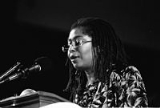
Alice Malsenior Walker (born February 9, 1944) is an American author, self-declared feminist and womanist—the latter a term she herself coined to make special distinction for the experiences of women of color. She has written at length on issues of race and gender, and is most famous for the critically acclaimed novel The Color Purple, for which she won the Pulitzer Prize for Fiction.
er was born in Eatonton, Georgia, the eighth child of sharecroppers.

Discussion
Ask a question about 'Alice Walker'
Start a new discussion about 'Alice Walker'
Answer questions from other users
|
Recent Posts

Encyclopedia
Alice Malsenior Walker (born February 9, 1944) is an American author, self-declared feminist and womanist—the latter a term she herself coined to make special distinction for the experiences of women of color. She has written at length on issues of race and gender, and is most famous for the critically acclaimed novel The Color Purple, for which she won the Pulitzer Prize for Fiction.
Early life
Walker was born in Eatonton, Georgia, the eighth child of sharecroppers. As well as being black, her family has Cherokee, Scottish and Irish lineage. Although she grew up in Georgia, she has stated that she often felt displaced there, and lives in Porterville, California. On the east coast she felt generally very squeezed. "People have so many hang-ups about how other people live their lives. People always want to keep you in a little box or they need to label you and fix you in time and location. I feel a greater fluidity here. People are much more willing to accept that nothing is permanent, everything is changeable so there is freedom and I do need to live where I can be free".
Biographer Evelyn C. White talks about an incident when Walker, who was eight years old at the time, was injured when her brother accidentally shot her in the eye with a BB gun. She became blind in her right eye as a result. White suggests this event had a large impact on Walker, especially when a doctor in town swindled her parents out of $250 they paid to repair her injury. Walker refers to this incident in her book Warrior Marks, a chronicle of female genital mutilation in Africa, and uses it to illustrate the sacrificial marks women bear that allow them to be "warriors" against female suppression.
Personal life and activism
After high school, Walker went to Spelman College in Atlanta on full scholarship in 1961 and later transferred up north to Sarah Lawrence College near New York City, graduating in 1965. Walker became interested in the U.S. civil rights movement in part due to the influence of activist Howard Zinn, who was one of her professors at Spelman College. Continuing the activism that she participated in during her college years, Walker returned to the South where she became involved with voter registration drives, campaigns for welfare rights, and children's programs in Mississippi.
In 1965, Walker met and later married Mel Leventhal, a Jewish civil rights lawyer. They were married on March 17, 1967 in New York City. Later that year the couple relocated to Jackson, Mississippi, becoming "the first legally married inter-racial couple in Mississippi." This brought them a steady stream of harassment and even murderous threats from the Ku Klux Klan. The couple had a daughter, Rebecca in 1969 - described in 2008 as "a living, breathing, mixed-race embodiment of the new America that they were trying to forge" - but divorced, amicably, in 1976. Walker would later become estranged from her daughter, who felt more of "a political symbol... than a cherished daughter," and would later publish a memoir entitled Black White and Jewish, chronicling the effects of her parents' relationship on her childhood.
In the mid-1990s, Walker was involved in a little known romance with singer-songwriter Tracy Chapman.
In March 2009, Alice Walker traveled to Gaza along with a group of 60 other female activists to highlight the devastation of the Israeli offensive on Gaza's residents. Walker is traveling to Gaza with Code Pink, a U.S. anti-war group, to deliver aid, to meet with NGOs and residents, and to try to get Israel and Egypt to open their borders into Gaza.
Walker is also a practicing vegan.
Writing career and success
Walker's first book of poetry was written while she was still a senior at Sarah Lawrence, and she took a brief sabbatical from writing when she was in Mississippi working in the civil rights movement. Walker resumed her writing career when she joined Ms. magazine as an editor before moving to northern California in the late 1970s. An article she published in 1975 was largely responsible for the renewal of interest in the work of Zora Neale Hurston, who was a large source of inspiration for Walker's writing and subject matter. In 1973, Walker and fellow Hurston scholar Charlotte D. Hunt discovered Hurston's unmarked grave in Ft. Pierce, Florida. Both women paid for a modest headstone for the gravesite.
In addition to her collected short stories and poetry, Walker's first novel, The Third Life of Grange Copeland, was published in 1970. In 1976, Walker's second novel, Meridian, was published. The novel dealt with activist workers in the South during the civil rights movement, and closely paralleled some of Walker's own experiences.
In 1982, Walker would publish what has become her best-known work, the novel The Color Purple. The story of a young black woman fighting her way through not only racist white culture but patriarchal black culture was a resounding commercial success. The book became a bestseller and was subsequently adapted into a critically acclaimed 1985 movie as well as a 2005 Broadway musical play.
Walker has written several other novels, including The Temple of My Familiar and Possessing the Secret of Joy (which featured several characters and descendants of characters from The Color Purple) and has published a number of collections of short stories, poetry, and other published work.
Her works typically focus on the struggles of blacks, particularly women, and their struggle against a racist, sexist, and violent society. Her writings also focus on the role of women of color in culture and history. Walker is a respected figure in the liberal political community for her support of unconventional and unpopular views as a matter of principle.
Additionally, Walker has published several short stories, including the 1973 Everyday Use, in which she discusses feminism and racism against blacks.
Awards and other recognition
In 1983, The Color Purple won the Pulitzer Prize for Fiction, making Walker the first black woman to win, as well as the National Book Award.
Walker also won the 1986 O. Henry Award for her short story "Kindred Spirits", published in Esquire magazine in August of 1985.
In 1997 she was honored by the American Humanist Association as "Humanist of the Year"
She has also received a number of other awards for her body of work, including:
- The Lillian Smith Award from the National Endowment for the Arts
- The Rosenthal Award from the National Institute of Arts & Letters
- The Radcliffe Institute Fellowship, the Merrill Fellowship, and a Guggenheim Fellowship
- The Front Page Award for Best Magazine Criticism from the Newswoman's Club of New York
On December 6, 2006, California Governor Arnold Schwarzenegger and First Lady Maria Shriver inducted Alice Walker into the California Hall of Fame located at The California Museum for History, Women, and the Arts.
Selected works
Novels and short story collections
Poetry collections
- Once (1968)
- Revolutionary Petunias and Other Poems (1973)
- Good Night, Willie Lee, I'll See You in the Morning (1979)
- Horses Make a Landscape Look More Beautiful (1985)
- Her Blue Body Everything We Know: Earthling Poems (1991)
- Absolute Trust in the Goodness of the Earth (2003)
- A Poem Traveled Down My Arm: Poems And Drawings (2003)
- Collected Poems (2005)
- Poem at Thirty-Nine
- Expect nothing
Non-fiction
- In Search of Our Mothers' Gardens: Womanist Prose (1983)
- Living by the Word (1988)
- Warrior Marks (1993)
- The Same River Twice: Honoring the Difficult (1996)
- Anything We Love Can Be Saved: A Writer's Activism (1997)
- Go Girl!: The Black Woman's Book of Travel and Adventure (1997)
- Pema Chodron and Alice Walker in Conversation (1999)
- Sent By Earth: A Message from the Grandmother Spirit After the Bombing of the World Trade Center and Pentagon (2001)
- Women
- We Are the Ones We Have Been Waiting For (2006)
- Mississippi Winter IV
External links
Video
|
| |
|
|