
|
|
|
|
Alice Paul
|
| |
|
| |
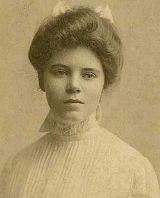
Alice Stokes Paul (January 11, 1885 – July 9, 1977) was an American suffragist leader. Along with Lucy Burns (a close friend) and others, she led a successful campaign for women's suffrage that resulted in the passage of the Nineteenth Amendment to the U.S. Constitution in 1920.
912, Alice Paul joined the National American Woman Suffrage Association (NAWSA) and was appointed Chairman of their Congressional Committee in Washington, DC. After months of fundraising and raising awareness for the cause, membership numbers went up and in 1913 Alice Paul and Lucy Burns formed the Congressional Union for Women Suffrage.

Discussion
Ask a question about 'Alice Paul'
Start a new discussion about 'Alice Paul'
Answer questions from other users
|
Recent Posts

Encyclopedia
Alice Stokes Paul (January 11, 1885 – July 9, 1977) was an American suffragist leader. Along with Lucy Burns (a close friend) and others, she led a successful campaign for women's suffrage that resulted in the passage of the Nineteenth Amendment to the U.S. Constitution in 1920.
Suffrage
In 1912, Alice Paul joined the National American Woman Suffrage Association (NAWSA) and was appointed Chairman of their Congressional Committee in Washington, DC. After months of fundraising and raising awareness for the cause, membership numbers went up and in 1913 Alice Paul and Lucy Burns formed the Congressional Union for Women Suffrage. Their focus was lobbying for a constitutional amendment to secure the right to vote for women. Such an amendment had originally been sought by suffragists Susan B. Anthony and Elizabeth Cady Stanton in 1878. However, by the early 20th century, attempts to secure a federal amendment had ceased. The focus of the suffrage movement had turned to securing the vote on a state-by-state basis.
When their lobbying efforts proved fruitless, Paul and her colleagues formed the National Woman's Party (NWP) in 1916 and began introducing some of the methods used by the suffrage movement in Britain. Tactics included demonstrations, parades, mass meetings, picketing, suffrage watch, fires, and hunger strikes. These actions were accompanied by press coverage and the publication of the weekly Suffragist.
In the US presidential election of 1916, Paul and the NWP campaigned against the continuing refusal of President Woodrow Wilson and other incumbent Democrats to support the Suffrage Amendment actively. In January 1917, the NWP staged the first political protest to picket the White House. The picketers, known as "Silent Sentinels," held banners demanding the right to vote. This was an example of a non-violent civil disobedience campaign. In July 1917, picketers were arrested on charges of "obstructing traffic." Many, including Paul, were convicted and incarcerated at the Occoquan Workhouse in Virginia (later the Lorton Correctional Complex) and the District of Columbia Jail.
In a protest of the conditions in Occoquan, Paul commenced a hunger strike. This led to her being moved to the prison’s psychiatric ward and force-fed raw eggs through a plastic tube. Other women joined the strike which, combined with the continuing demonstrations and attendant press coverage, kept the pressure on the Wilson administration. In January, 1918, he announced that women's suffrage was urgently needed as a "war measure." Wilson strongly urged Congress to pass the legislation. In 1920, after coming down to one vote in the state of Tennessee, the Nineteenth Amendment to the United States Constitution secured the vote for women.
Equal Rights Amendment
Paul was the original author of a proposed Equal Rights Amendment to the Constitution in 1923. She opposed linking the ERA to abortion rights, as did most early feminists. It has been widely reported that Paul called abortion "the ultimate exploitation of women." There has been a suggestion that although she did not want the ERA to be linked with abortion, it was for political, rather than ideological or moral, reasons. An article in pro-choice publication The Touchstone (2000) provides the following commentary on the relationship between the ERA and her views on abortion:
Alice Paul did oppose the linkage between the ERA and abortion, but that was because of her political astuteness rather than any disagreement with abortion. Paul felt that by linking the ERA with abortion, the ERA would not pass through Congress. Willis wrote, "She did not address issues of birth control, i.e., abortion, or even women's sexuality, and was concerned that the radical women of the 1960s might alienate support by emphasizing these issues...[S]he said that even if women did want to do many things that she wished they would not do with their freedom, it was not her business to tell them what to do with it, but to see that they had it." This demonstrates that Alice Paul supported equal rights for women, including the right to choose abortion...
However, it is not known for sure if Paul merely disliked abortion, as this article implies, or if she was morally opposed to it. The article also conflicts with a statement published by right-to-life activist Mary Meehan, from an interview with a colleague of Paul's:
When I worked with Alice Paul I asked her about the abortion question — point blank. She said directly, "Abortion is just another way of exploiting women." Then she went on to explain that the National Woman's Party was organized for the benefit of women. Killing female babies was no way to benefit or protect women.
The ERA would not find its way to the Senate until 1972 when it was approved by the Senate and submitted to the state legislatures for ratification. Approval by 38 states was required to ensure adoption of the amendment. Not enough states — only 35 — voted in favor in time for the deadline. However, efforts to pass the ERA passed by Congress in the 1970s are still afoot, as well as efforts to pass a new equality amendment, and almost half of the U.S. states have adopted the ERA into their state constitutions.
Later years
In 1929, she became the primary resident for 40 years of a house bought by Alva Belmont, located in the Capitol Hill neighborhood of Washington, D.C., for the NWP headquarters. The house is now known as the Sewall-Belmont House and Museum and is a historic house and museum of the U.S. women's suffrage and equal-rights movements.
Death
Alice Paul died at the age of 92 on July 9, 1977 at the Quaker Greenleaf Extension Home in Moorestown Township, New Jersey, near her family home of Paulsdale.
Legacy Alice Paul has created a long legacy of woman’s rights. Swarthmore College named a dormitory in her honor. Hilary Swank, in the HBO 2004 movie Iron Jawed Angels, portrayed Alice Paul during her struggle for passage of the 19th Amendment. Two countries have honored her by issuing a postage stamp: Great Britain in 1981 and the United States in 1995.
See also
She also was remembered for having fostered 50 children in her life span and saving millions.
External links
|
| |
|
|