
All Topics  
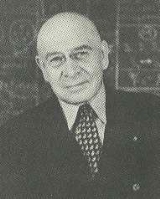
Alfred Korzybski

 
Alfred Korzybski

   Email Print
   Bookmark   Link


Alfred Korzybski


Alfred Habdank Skarbek Korzybski (July 3, 1879 – March 1, 1950) was a Polish-American philosopher and scientist
Scientist

A scientist, in the broadest sense, refers to any person that engages in a system activity to acquire knowledge or an individual that engages in such practices and traditions that are linked to schools of thought or philosophy....
. He is most remembered for developing the theory of general semantics
General Semantics

General Semantics is a non-Aristotelian educational discipline created by Alfred Korzybski during the years 1919 to 1933. General Semantics is distinct from semantics , a different subject....
.

as born in Warsaw
Warsaw

Warsaw is the Capital and World's largest cities of Poland. It is located on the Vistula River roughly from both the Baltic Sea coast and the Carpathian Mountains....
, Congress Poland
Congress Poland

Congress Poland [], officially and formally Kingdom of Poland and informally known as Russian Poland was a constitutional personal union of the Russian Empire created in 1815 by the Congress of Vienna, replaced by the Central Powers in 1915 with the Kingdom of Poland ....
. He came from an aristocratic family whose members had worked as mathematicians
Mathematics

Mathematics is the study of quantity, structure, space, change, and related topics of pattern and form. Mathematicians seek out patterns whether found in numbers, space, natural science, computers, imaginary abstractions, or elsewhere....
, scientists
Science

In its broadest sense, science refers to any systematic knowledge or practice. In its more usual restricted sense, science refers to a system of acquiring knowledge based on scientific method, as well as to the organized body of knowledge gained through such research....
, and engineers
Engineering

Engineering is the discipline and profession of applying Technology and science knowledge and utilizing natural laws and physical resources in order to design and implement materials, structures, machines, devices, systems, and process that safely realize a desired objective and meet specified criteria....
 for generations. He learned Polish
Polish language

Polish , an official language of Poland, has the largest number of speakers of any West Slavic languages. Polish-speakers use the language in a uniform manner through most of Poland, and it has a regular orthography....
 at home and Russian
Russian language

Russian is the most geographically widespread language of Eurasia, the most widely spoken of the Slavic languages, and the largest native language in Europe....
 in the schools; and having a French
France

France , officially the French Republic , is a country whose Metropolitan France is located in Western Europe and that also comprises various Overseas departments and territories of France....
 governess
Governess

A governess is a female employee of a family who teaches children within their home. In contrast to a nanny or a babysitter, she concentrates on teaching children, not their physical needs....
 and a German
Germany

Germany , officially the Federal Republic of Germany , is a country in Central Europe. It is bordered to the north by the North Sea, Denmark, and the Baltic Sea; to the east by Poland and the Czech Republic; to the south by Austria and Switzerland; and to the west by France, Luxembourg, Belgium, and the Netherlands....
 governess, he became fluent in these four languages as a child.

Korzybski was educated at the Warsaw University of Technology
Warsaw University of Technology

Warsaw University of Technology is the renowned academic school of technology in Poland, and one of the largest in Central Europe, employing 2,000 professors....
 in engineering
Engineering

Engineering is the discipline and profession of applying Technology and science knowledge and utilizing natural laws and physical resources in order to design and implement materials, structures, machines, devices, systems, and process that safely realize a desired objective and meet specified criteria....
.


Discussion
Ask a question about 'Alfred Korzybski'
Start a new discussion about 'Alfred Korzybski'
Answer questions from other users
Full Discussion Forum


Quotations


Any proposition containing the word 'is' creates a linguistical structural confusion which will eventually give birth to serious fallacies.

God may forgive your sins, but your nervous system won't. (Korzybski states that it is not his quote in S&S)

If a psychiatric and scientific enquiry were to be made upon our rulers, mankind would be appalled at the disclosures.

Incorrect symbolism... is bound to undermine any possibility of our building a structurally human civilization.

It is now no mystery that some quite influential 'philosophers' were 'mentally' ill.

The map is not the territory ... The only usefulness of a map depends on similarity of structure between the empirical world and the map...


Encyclopedia


Alfred Habdank Skarbek Korzybski (July 3, 1879 – March 1, 1950) was a Polish-American philosopher and scientist
Scientist

A scientist, in the broadest sense, refers to any person that engages in a system activity to acquire knowledge or an individual that engages in such practices and traditions that are linked to schools of thought or philosophy....
. He is most remembered for developing the theory of general semantics
General Semantics

General Semantics is a non-Aristotelian educational discipline created by Alfred Korzybski during the years 1919 to 1933. General Semantics is distinct from semantics , a different subject....
.

Early life and career

He was born in Warsaw
Warsaw

Warsaw is the Capital and World's largest cities of Poland. It is located on the Vistula River roughly from both the Baltic Sea coast and the Carpathian Mountains....
, Congress Poland
Congress Poland

Congress Poland [], officially and formally Kingdom of Poland and informally known as Russian Poland was a constitutional personal union of the Russian Empire created in 1815 by the Congress of Vienna, replaced by the Central Powers in 1915 with the Kingdom of Poland ....
. He came from an aristocratic family whose members had worked as mathematicians
Mathematics

Mathematics is the study of quantity, structure, space, change, and related topics of pattern and form. Mathematicians seek out patterns whether found in numbers, space, natural science, computers, imaginary abstractions, or elsewhere....
, scientists
Science

In its broadest sense, science refers to any systematic knowledge or practice. In its more usual restricted sense, science refers to a system of acquiring knowledge based on scientific method, as well as to the organized body of knowledge gained through such research....
, and engineers
Engineering

Engineering is the discipline and profession of applying Technology and science knowledge and utilizing natural laws and physical resources in order to design and implement materials, structures, machines, devices, systems, and process that safely realize a desired objective and meet specified criteria....
 for generations. He learned Polish
Polish language

Polish , an official language of Poland, has the largest number of speakers of any West Slavic languages. Polish-speakers use the language in a uniform manner through most of Poland, and it has a regular orthography....
 at home and Russian
Russian language

Russian is the most geographically widespread language of Eurasia, the most widely spoken of the Slavic languages, and the largest native language in Europe....
 in the schools; and having a French
France

France , officially the French Republic , is a country whose Metropolitan France is located in Western Europe and that also comprises various Overseas departments and territories of France....
 governess
Governess

A governess is a female employee of a family who teaches children within their home. In contrast to a nanny or a babysitter, she concentrates on teaching children, not their physical needs....
 and a German
Germany

Germany , officially the Federal Republic of Germany , is a country in Central Europe. It is bordered to the north by the North Sea, Denmark, and the Baltic Sea; to the east by Poland and the Czech Republic; to the south by Austria and Switzerland; and to the west by France, Luxembourg, Belgium, and the Netherlands....
 governess, he became fluent in these four languages as a child.

Korzybski was educated at the Warsaw University of Technology
Warsaw University of Technology

Warsaw University of Technology is the renowned academic school of technology in Poland, and one of the largest in Central Europe, employing 2,000 professors....
 in engineering
Engineering

Engineering is the discipline and profession of applying Technology and science knowledge and utilizing natural laws and physical resources in order to design and implement materials, structures, machines, devices, systems, and process that safely realize a desired objective and meet specified criteria....
. During the First World War
World War I

World War I, or the First World War , was a global military conflict which involved the Great powers, organized into two opposing military alliances: the Allies of World War I and the Central Powers....
 Korzybski served as an intelligence officer
Military intelligence

Military intelligence , is a military service that uses List of intelligence gathering disciplines which informs the commanders' decision making process by providing intelligence analysis of Intelligence from a wide range of sources including forecast environmental changes , and opposing force intentions....
 in the Russia
Russia

Russia , or the Russian Federation , is a list of countries spanning more than one continent country extending over much of northern Eurasia....
n Army. After being wounded in his leg and suffering other injuries, he came to North America
North America

North America is the northern continent of the Americas, situated in the Earth's northern hemisphere and almost totally in the western hemisphere....
 in 1916 (first to Canada
Canada

Canada is a country occupying most of northern North America, extending from the Atlantic Ocean in the east to the Pacific Ocean in the west and northward into the Arctic Ocean....
, then the United States
United States

The United States of America is a Federal government constitutional republic comprising U.S. state and a federal district. The country is situated mostly in central North America, where its Contiguous United States and Washington, D.C., the Capital districts and territories, lie between the Pacific Ocean and Atlantic Oceans, Borders of the U...
) to coordinate the shipment
Logistics

Logistics is the management of the flow of goods, information and other resources, including energy and people, between the point of origin and the point of consumption in order to meet the requirements of consumers ....
 of artillery
Artillery

Artillery is a military Combat Arms which employs any apparatus, machine, an assortment of tools or instruments, a system or systems used as weapons for the discharge of large projectiles in combat as a major contribution of fire power within the overall military capability of an armed force....
 to the war front. He also lectured to Polish-American audiences about the conflict, promoting the sale of war bonds. Following the War, he decided to remain in the United States, becoming a naturalized citizen
Naturalization

Naturalization is the acquisition of citizenship or nationality by somebody who was not a citizen or national of that country when he or she was born....
 in 1940. His first book, Manhood of Humanity, was published in 1921. In the book, he proposed and explained in detail a new theory of humankind: mankind as a time-binding class of life.

General semantics

Korzybski's work culminated in the founding of a discipline that he called general semantics
General Semantics

General Semantics is a non-Aristotelian educational discipline created by Alfred Korzybski during the years 1919 to 1933. General Semantics is distinct from semantics , a different subject....
 (GS). As Korzybski explicitly said, GS should not be confused with semantics
Semantics

Semantics is the study of meaning in communication. The word is derived from the Greek language word s??a?t???? , "significant", from s??a??? , "to signify, to indicate" and that from s??a , "sign, mark, token"....
, a different subject. The basic principles of general semantics, which include time-binding, are outlined in Science and Sanity, published in 1933. In 1938 Korzybski founded the Institute of General Semantics
Institute of General Semantics

The Institute of General Semantics is a not-for-profit corporation established in 1938 by Alfred Korzybski, to support research and publication on the topic of General Semantics....
 and directed it until his death in Lakeville, Connecticut, USA
United States

The United States of America is a Federal government constitutional republic comprising U.S. state and a federal district. The country is situated mostly in central North America, where its Contiguous United States and Washington, D.C., the Capital districts and territories, lie between the Pacific Ocean and Atlantic Oceans, Borders of the U...
.

Korzybski's work held a view that human beings are limited in what they know by (1) the structure of their nervous systems, and (2) the structure
Structure

Structure is a fundamental and sometimes intangible notion covering the recognition, observation, nature , and stability of patterns and relationships of entities....
 of their languages. Human beings cannot experience the world directly, but only through their "abstractions" (nonverbal impressions or "gleanings" derived from the nervous system, and verbal indicators expressed and derived from language). Sometimes our perceptions and our languages actually mislead us as to the "facts" with which we must deal. Our understanding of what is going on sometimes lacks similarity of structure with what is actually going on. He stressed training in awareness of abstracting, using techniques that he had derived from his study of mathematics and science. He called this awareness, this goal of his system, "consciousness of abstracting." His system included modifying the way we approach the world, e.g., with an attitude of "I don't know; let's see," to better discover or reflect its realities as shown by modern science. One of these techniques involved becoming inwardly and outwardly quiet, an experience that he called, "silence on the objective levels."

Korzybski and to be

Many supporters and critics of Korzybski reduced his rather complex system to a simple matter of what he said about the verb 'to be.' His system, however, is based primarily on such terminology as the different 'orders of abstraction,' and formulations such as 'consciousness of abstracting.' It is often said that Korzybski opposed the use of the verb "to be," an unfortunate exaggeration (see 'Criticisms' below). He thought that certain uses of the verb "to be," called the "is of identity" and the "is of predication
E-Prime

E-Prime, short for English-Prime, is a modified form of English language. It uses very slightly simplified syntax and vocabulary, eliminating all forms of the verb to be: be, is, am, are, was, were, been and being ....
," were faulty in structure, e.g., a statement such as, "Joe is a fool" (said of a person named 'Joe' who has done something that we regard as foolish). In Korzybski's system, one's assessment of Joe belongs to a higher order of abstraction than Joe himself. Korzybski's remedy was to deny identity; in this example, to be continually aware that 'Joe' is not what we call him. We find Joe not in the verbal domain, the world of words, but the nonverbal domain (the two, he said, amount to different orders of abstraction). This was expressed in Korzybski's most famous premise, "the map is not the territory." Note that this premise uses the phrase "is not", a form of "to be"; this and many other examples show that he did not intend to abandon "to be" as such. In fact, he expressly said that there were no structural problems with the verb "to be" when used as an auxiliary verb
E-Prime

E-Prime, short for English-Prime, is a modified form of English language. It uses very slightly simplified syntax and vocabulary, eliminating all forms of the verb to be: be, is, am, are, was, were, been and being ....
 or when used to state existence or location. It was even 'OK' sometimes to use the faulty forms of the verb 'to be,' as long as one was aware of their structural limitations. This was developed into E-prime
E-Prime

E-Prime, short for English-Prime, is a modified form of English language. It uses very slightly simplified syntax and vocabulary, eliminating all forms of the verb to be: be, is, am, are, was, were, been and being ....
 by one of his students 15 years after his death.

Anecdote about Korzybski

One day, Korzybski was giving a lecture to a group of students, and he suddenly interrupted the lesson in order to retrieve a packet of biscuits, wrapped in white paper, from his briefcase. He muttered that he just had to eat something, and he asked the students on the seats in the front row, if they would also like a biscuit. A few students took a biscuit. "Nice biscuit, don't you think", said Korzybski, while he took a second one. The students were chewing vigorously. Then he tore the white paper from the biscuits, in order to reveal the original packaging. On it was a big picture of a dog's head and the words "Dog Cookies". The students looked at the package, and were shocked. Two of them wanted to throw up, put their hands in front of their mouths, and ran out of the lecture hall to the toilet. "You see, ladies and gentlemen", Korzybski remarked, "I have just demonstrated that people don't just eat food, but also words, and that the taste of the former is often outdone by the taste of the latter." Apparently his prank aimed to illustrate how some human suffering originates from the confusion or conflation of linguistic representations of reality and reality itself.

Criticisms

See the criticism section
General Semantics

General Semantics is a non-Aristotelian educational discipline created by Alfred Korzybski during the years 1919 to 1933. General Semantics is distinct from semantics , a different subject....
 of the main General Semantics article.

Impact

Korzybski's work influenced Gestalt Therapy
Gestalt therapy

Gestalt therapy is an existential and experiential psychotherapy that focuses on the individual's experience in the present moment, the therapist-client relationship, the environmental and social contexts in which these things take place, and the self-regulating adjustments people make as a result of the overall situation....
, Rational Emotive Behavior Therapy
Rational emotive behavior therapy

Rational emotive behavior therapy , previously called rational therapy and rational emotive therapy, is a comprehensive, active-directive, philosophy and empirically based psychotherapy which focuses on resolving emotional and behavioral problems and disturbances and enabling people to lead happier and more fulfilling lives....
, and Neuro-linguistic programming
Neuro-linguistic programming

Neuro-linguistic programming is defined in the Oxford English Dictionary as "a model of interpersonal communication chiefly concerned with the relationship between successful patterns of behaviour and the subjective experiences underlying them" and "a system of alternative therapy based on this which seeks to educate people in self-awarenes...
 (especially the Meta model
Meta model (NLP)

The meta-model is a communications model for gathering, clarifying and specifying information, and effecting change. It was developed by the co-founders of Neuro-linguistic programming, Richard Bandler and linguist John Grinder between 1973 and 1975....
 and ideas behind human modeling for performance). As reported in the Third Edition of Science and Sanity, The U.S. Army in World War II used his system to treat battle fatigue in Europe under the supervision of Dr. Douglas M. Kelley, who also became the psychiatrist in charge of the Nazi prisoners at Nuremberg. Other individuals influenced by Korzybski include Kenneth Burke
Kenneth Burke

Kenneth Duva Burke was a major United States literary theory and philosophy. Burke's primary interests were in rhetoric and aesthetics....
, William S. Burroughs
William S. Burroughs

William Seward Burroughs II was an United States novelist, essayist, social critic, Painting and spoken word performer.Much of Burroughs's work is semi-autobiographical, drawn from his experiences as an opiate addict, a condition that marked the last fifty years of his life....
, Frank Herbert
Frank Herbert

Franklin Patrick Herbert, Jr. was a critically acclaimed and commercially successful American list of science fiction authors. Although also a short story author, he is best known for his novels, most notably Dune and its five sequels....
, Albert Ellis
Albert Ellis

Albert Ellis was an American psychologist who in 1955 developed Rational Emotive Behavior Therapy. He held M.A. and Ph.D. degrees in clinical psychology from Columbia University and founded and was the president and president emeritus of the New York City-based Albert Ellis Institute....
, Gregory Bateson
Gregory Bateson

Gregory Bateson was a United Kingdom anthropology, social sciences, linguistics, semiotics and cybernetics whose work intersected that of many other fields....
, John Grinder
John Grinder

John Grinder Ph.D. is an American linguist, author, management consultant, trainer and speaker. Grinder is credited with the co-creation with Richard Bandler of the field of Neuro-linguistic programming....
, Buckminster Fuller
Buckminster Fuller

Richard Buckminster ?Bucky? Fuller was an American architect, author, designer, futurist, inventor, and visionary. He was the second president of Mensa International....
, Douglas Engelbart
Douglas Engelbart

Dr. Douglas C. Engelbart is an United States inventor and early computer pioneer of German, Swedish ethnic group and Norwegian people descent....
, Stuart Chase
Stuart Chase

Stuart Chase Born in Somersworth, New Hampshire was an United States economist and engineer trained at MIT. His writings covered topics as diverse as general semantics and physical economy....
, Alvin Toffler
Alvin Toffler

Alvin Toffler is an United States writer and futures studies, known for his works discussing the digital revolution, communications revolution, corporate revolution and technological singularity....
, Robert A. Heinlein
Robert A. Heinlein

Robert Anson Heinlein was an United States novelist and science fiction writer. Often called "the dean of science fiction writers", he is one of the most popular, influential, and controversial authors of the genre....
 (Korzybski is mentioned in the 1949 novella Gulf), L. Ron Hubbard
L. Ron Hubbard

Lafayette Ronald Hubbard was an American science fiction writer who devised a self-help system called Dianetics, first published in 1950, which he developed over the next three decades into a set of doctrines and rituals he called Scientology....
, A. E. van Vogt
A. E. van Vogt

Alfred Elton van Vogt was a Canada-born science fiction author who was one of the most prolific and complex writers of the mid-twentieth century "Golden Age of Science Fiction" of the genre....
, Robert Anton Wilson
Robert Anton Wilson

Robert Anton Wilson or RAW was an United States novelist, essayist, philosopher, psychonaut, futurologist and libertarian.Wilson described his writing as an "attempt to break down conditioned associations?to look at the world in a new way, with many models recognized as models or maps and no one model elevated to the Truth." ... ...
, entertainer Steve Allen
Steve Allen (comedian)

Steve Allen, born Stephen Valentine Patrick William Allen , was an United States television personality, musician, actor, comedian, and writer....
, and Tommy Hall (lyricist for the 13th Floor Elevators
13th Floor Elevators

The 13th Floor Elevators were an American rock band from Austin, Texas which existed 1965-1969. During their career, the band released four LPs and seven 45s for the International Artists record label....
); and scientists such as William Alanson White
William Alanson White

William Alanson White was an United States Neurology and psychiatrist....
 (psychiatry), physicist P. W. Bridgman
Percy Williams Bridgman

Percy Williams Bridgman was an American List of physicists who won the 1946 Nobel Prize in Physics for his work on the physics of high pressures....
, and researcher W. Horsley Gantt (a former student and colleague of Pavlov). He also influenced the Belgian surrealist writer of comics Jan Bucquoy
Jan Bucquoy

Jan Bucquoy is an anarchist and author-filmmaker born in Harelbeke, Belgium who started as a theatre practitioner and who worked as a cartoon-scriptwriter....
 in the seventh part of the comics series Jaunes: Labyrinthe, with explicit reference in the plot to Korzybski's "the map is not the territory."

In part the General Semantics tradition was upheld by Samuel I. Hayakawa, who did have a falling out with Korzybski. When asked over what, Hayakawa is said to have replied: "Words".

See also

  • General Semantics
    General Semantics

    General Semantics is a non-Aristotelian educational discipline created by Alfred Korzybski during the years 1919 to 1933. General Semantics is distinct from semantics , a different subject....
  • The map is not the territory
  • Structural differential
    Structural differential

    The Structural differential is a physical chart or three-dimensional model illustrating the abstracting processes of the human nervous system. In one form, it looks like a pegboard with tags....
  • E-Prime
    E-Prime

    E-Prime, short for English-Prime, is a modified form of English language. It uses very slightly simplified syntax and vocabulary, eliminating all forms of the verb to be: be, is, am, are, was, were, been and being ....
  • Institute of General Semantics
    Institute of General Semantics

    The Institute of General Semantics is a not-for-profit corporation established in 1938 by Alfred Korzybski, to support research and publication on the topic of General Semantics....
  • Robert Pula
  • Alfred Korzybski Memorial Lecture
    Alfred Korzybski Memorial Lecture

    The distinguished Alfred Korzybski Memorial Lecture series was begun in 1952. It is an annual event sponsored by the Institute of General Semantics in honor of Alfred Korzybski....


Further reading

  • Alfred Korzybski, Manhood of Humanity, foreword by Edward Kasner, notes by M. Kendig, Institute of General Semantics, 1950, hardcover, 2nd edition, 391 pages, ISBN 0-937298-00-X. ()
  • Science and Sanity An Introduction to Non-Aristotelian Systems and General Semantics, Alfred Korzybski, Preface by Robert P. Pula
    Robert P. Pula

    Robert P. Pula, was a Director Emeritus of the Institute of General Semantics, author of A General-Semantics Glossary, and a composer. Pula served as the lead lecturer for the Institute of General Semantics for many years....
    , Institute of General Semantics, 1994, hardcover, 5th edition, ISBN 0-937298-01-8, ()
  • Alfred Korzybski, Collected Writings 1920-1950, Institute of General Semantics, 1990, hardcover, ISBN 0-685-40616-4
  • Montagu, M. F. A. (1953). Time-binding and the concept of culture. The Scientific Monthly, Vol. 77, No. 3 (Sep., 1953), pp. 148-155.
  • Murray, E. (1950). In memoriam: Alfred H. Korzybski. Sociometry, Vol. 13, No. 1 (Feb., 1950), pp. 76-77.


External links

  • Complete work online.