

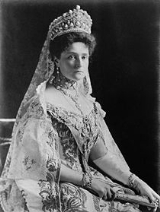
Alexandra Fyodorovna of Hesse

Encyclopedia
Alix of Hesse and by Rhine later Alexandra Feodorovna Romanova (6 June 1872 – 17 July 1918), was Empress consort
Queen consort
A queen consort is the wife of a reigning king. A queen consort usually shares her husband's rank and holds the feminine equivalent of the king's monarchical titles. Historically, queens consort do not share the king regnant's political and military powers. Most queens in history were queens consort...
of Russia
Russia
Russia or , officially known as both Russia and the Russian Federation , is a country in northern Eurasia. It is a federal semi-presidential republic, comprising 83 federal subjects...
as spouse of Nicholas II
Nicholas II of Russia
Nicholas II was the last Emperor of Russia, Grand Prince of Finland, and titular King of Poland. His official short title was Nicholas II, Emperor and Autocrat of All the Russias and he is known as Saint Nicholas the Passion-Bearer by the Russian Orthodox Church.Nicholas II ruled from 1894 until...
, the last Emperor
Emperor
An emperor is a monarch, usually the sovereign ruler of an empire or another type of imperial realm. Empress, the female equivalent, may indicate an emperor's wife or a woman who rules in her own right...
of the Russian Empire
Russian Empire
The Russian Empire was a state that existed from 1721 until the Russian Revolution of 1917. It was the successor to the Tsardom of Russia and the predecessor of the Soviet Union...
. Born a granddaughter of Queen Victoria
Victoria of the United Kingdom
Victoria was the monarch of the United Kingdom of Great Britain and Ireland from 20 June 1837 until her death. From 1 May 1876, she used the additional title of Empress of India....
of the United Kingdom
United Kingdom
The United Kingdom of Great Britain and Northern IrelandIn the United Kingdom and Dependencies, other languages have been officially recognised as legitimate autochthonous languages under the European Charter for Regional or Minority Languages...
, she was given the name Alexandra Feodorovna upon being received into the Russian Orthodox Church
Russian Orthodox Church
The Russian Orthodox Church or, alternatively, the Moscow Patriarchate The ROC is often said to be the largest of the Eastern Orthodox churches in the world; including all the autocephalous churches under its umbrella, its adherents number over 150 million worldwide—about half of the 300 million...
, which canonized her as Saint Alexandra the Passion Bearer in 2000.
Alexandra is best remembered as the last Tsarina
Tsaritsa
Tsaritsa , formerly spelled czaritsa , is the title of a female autocratic ruler of Bulgaria or Russia, or the title of a tsar's wife....
of Russia, as one of the most famous royal carriers of the haemophilia disease
Haemophilia in European royalty
Haemophilia figured prominently in the history of European royalty in the 19th and 20th centuries. Britain's Queen Victoria, through two of her five daughters , passed the mutation to various royal houses across the continent, including the royal families of Spain, Germany and Russia. Victoria's...
and for her support of autocratic control over the country. Her notorious friendship with the Russian mystic Grigori Rasputin
Grigori Rasputin
Grigori Yefimovich Rasputin was a Russian Orthodox Christian and mystic who is perceived as having influenced the latter days of the Russian Emperor Nicholas II, his wife Alexandra, and their only son Alexei...
was also an important factor in her life.
Early life
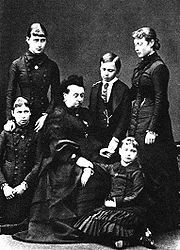
Darmstadt
Darmstadt is a city in the Bundesland of Hesse in Germany, located in the southern part of the Rhine Main Area.The sandy soils in the Darmstadt area, ill-suited for agriculture in times before industrial fertilisation, prevented any larger settlement from developing, until the city became the seat...
as Princess Alix Viktoria Helena Luise Beatrice of Hesse and by Rhine
Hesse
Hesse or Hessia is both a cultural region of Germany and the name of an individual German state.* The cultural region of Hesse includes both the State of Hesse and the area known as Rhenish Hesse in the neighbouring Rhineland-Palatinate state...
, a Grand Duchy
Grand duchy
A grand duchy, sometimes referred to as a grand dukedom, is a territory whose head of state is a monarch, either a grand duke or grand duchess.Today Luxembourg is the only remaining grand duchy...
that was then part of the German Empire
German Empire
The German Empire refers to Germany during the "Second Reich" period from the unification of Germany and proclamation of Wilhelm I as German Emperor on 18 January 1871, to 1918, when it became a federal republic after defeat in World War I and the abdication of the Emperor, Wilhelm II.The German...
. She was the sixth child among the seven children of Grand Duke Louis IV of Hesse and by Rhine
Louis IV, Grand Duke of Hesse
Louis IV , was the fourth Grand Duke of Hesse and by Rhine, reigning from 13 June 1877 until his death...
, and Princess Alice of the United Kingdom, the second daughter of Queen Victoria
Victoria of the United Kingdom
Victoria was the monarch of the United Kingdom of Great Britain and Ireland from 20 June 1837 until her death. From 1 May 1876, she used the additional title of Empress of India....
and Albert, the Prince Consort.
Alix was baptized on 1 July 1872 according to the rites of the Lutheran Church
Lutheranism
Lutheranism is a major branch of Western Christianity that identifies with the theology of Martin Luther, a German reformer. Luther's efforts to reform the theology and practice of the church launched the Protestant Reformation...
and given the names of her mother and each of her mother's four sisters, some of which were transliterated into German. Her godparents were the Prince of Wales
Edward VII of the United Kingdom
Edward VII was King of the United Kingdom and the British Dominions and Emperor of India from 22 January 1901 until his death in 1910...
, the Princess of Wales
Alexandra of Denmark
Alexandra of Denmark was the wife of Edward VII of the United Kingdom...
, the Tsarevich of Russia
Alexander III of Russia
Alexander Alexandrovich Romanov , historically remembered as Alexander III or Alexander the Peacemaker reigned as Emperor of Russia from until his death on .-Disposition:...
, the tsarevna of Russia, Princess Beatrice of the United Kingdom
Princess Beatrice of the United Kingdom
The Princess Beatrice was a member of the British Royal Family. She was the fifth daughter and youngest child of Queen Victoria and Prince Albert. Juan Carlos, King of Spain, is her great-grandson...
, the Duchess of Cambridge
Princess Augusta of Hesse-Kassel
Princess and Landgravine Augusta of Hesse-Kassel was the consort of Prince Adolphus, Duke of Cambridge, the tenth-born child, and seventh son, of George III and Charlotte of Mecklenburg-Strelitz...
and Anna of Prussia
Princess Anna of Prussia
Maria Anna Friederike was a Princess of Prussia. She was usually called Anna.-Suitors:...
. Her family nicknamed the girl "Alicky" or "Sunny," a practice picked up later by Nicholas.
In December 1878, diphtheria
Diphtheria
Diphtheria is an upper respiratory tract illness caused by Corynebacterium diphtheriae, a facultative anaerobic, Gram-positive bacterium. It is characterized by sore throat, low fever, and an adherent membrane on the tonsils, pharynx, and/or nasal cavity...
swept through the grandducal house of Hesse. Alix, her three sisters and her brother Ernst fell ill. Elisabeth, Alix's older sister, had been sent to visit her paternal grandmother, and escaped the outbreak. Alix's mother Alice tended to the children rather than abandon them to doctors. Alice herself soon fell ill with diphtheria and died on the anniversary of her father's death, 14 December 1878, when Alix was only six years old. Alix, Victoria
Princess Victoria of Hesse and by Rhine
Princess Victoria of Hesse and by Rhine, later Victoria Mountbatten, Marchioness of Milford Haven was the eldest daughter of Louis IV, Grand Duke of Hesse and by Rhine and his first wife Princess Alice of the United Kingdom .Her mother died while her brother and sisters...
, Irene
Princess Irene of Hesse and by Rhine
Princess Irene of Hesse and by Rhine was the third child and third daughter of Princess Alice of the United Kingdom and Ludwig IV, Grand Duke of Hesse and by Rhine. Her maternal grandparents were Queen Victoria of the United Kingdom and Prince Albert...
, and Ernst
Ernest Louis, Grand Duke of Hesse
Ernest Louis Charles Albert William , was the last Grand Duke of Hesse and by Rhine from 1892 until 1918...
survived the epidemic, but Princess Marie did not.
Engagement
Prince Albert Victor, Duke of Clarence
Prince Albert Victor, Duke of Clarence and Avondale was a member of the British Royal Family. He was the eldest son of Albert Edward, Prince of Wales and Alexandra, Princess of Wales , and the grandson of the reigning monarch, Queen Victoria...
(the eldest son of the Prince of Wales
Edward VII of the United Kingdom
Edward VII was King of the United Kingdom and the British Dominions and Emperor of India from 22 January 1901 until his death in 1910...
) despite strong familial pressure. It is said that Queen Victoria had wanted her two grandchildren to marry, but because she was very fond of Alix she accepted that she did not want to marry him; The Queen even went on to say that she was proud of Alix for standing up to her, something many people, including her own son the Prince of Wales did not do.
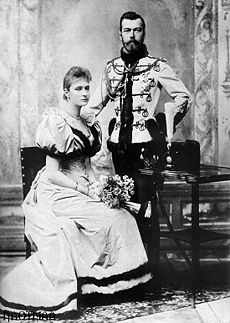
Alix however, had already met and fallen in love with Grand Duke Nicholas, heir to the throne of Russia
Nicholas II of Russia
Nicholas II was the last Emperor of Russia, Grand Prince of Finland, and titular King of Poland. His official short title was Nicholas II, Emperor and Autocrat of All the Russias and he is known as Saint Nicholas the Passion-Bearer by the Russian Orthodox Church.Nicholas II ruled from 1894 until...
, whose mother was the sister-in-law of Alix's uncle, the Prince of Wales
Edward VII of the United Kingdom
Edward VII was King of the United Kingdom and the British Dominions and Emperor of India from 22 January 1901 until his death in 1910...
and whose uncle Grand Duke Sergei Alexandrovich
Grand Duke Sergei Alexandrovich of Russia
Grand Duke Sergei Alexandrovich of Russia was a son of Emperor Alexander II of Russia...
was married to Alix's sister Elisabeth. They were also second cousins as they were both great-grandchildren of Princess Wilhelmina of Baden
Wilhelmine of Baden
Wilhelmine of Baden was Grand Duchess consort of Hesse and the Rhine.She was the youngest daughter of Charles Louis, Hereditary Prince of Baden and Amalia of Hesse-Darmstadt...
. Nicholas and Alix had first met in 1884 and when Alix returned to Russia in 1889 they fell in love. "It is my dream to one day marry Alix H. I have loved her for a long time, but more deeply and strongly since 1889 when she spent six weeks in Petersburg. For a long time, I have resisted my feeling that my dearest dream will come true." Nicholas wrote in his diary; and Alix reciprocated his feelings. At first, Nicholas' father, Tsar Alexander III
Alexander III of Russia
Alexander Alexandrovich Romanov , historically remembered as Alexander III or Alexander the Peacemaker reigned as Emperor of Russia from until his death on .-Disposition:...
, refused the prospect of marriage.
Society sniped openly at Princess Alix, safe in the knowledge that Alexander III and Maria Feodorovna (Dagmar of Denmark), both vigorously anti-German
Anti-German sentiment
Anti-German sentiment is defined as an opposition to or fear of Germany, its inhabitants, and the German language. Its opposite is Germanophilia.-Russia:...
, had no intention of permitting a match with the tsarevich. Although Princess Alix was his godchild, it was generally known that Alexander III was angling for a bigger catch for his son, someone like Princess Helene, the tall dark haired daughter of Philippe, comte de Paris
Philippe, Comte de Paris
Philippe d'Orléans, Count of Paris was the grandson of Louis Philippe I, King of the French. He was a claimant to the French throne from 1848 until his death.-Early life:...
, pretender to the throne of France. The approach to Helene did not please Nicholas. He wrote in his diary, "Mama made a few allusions to Helene, daughter of the Comte de Paris. I myself want to go in one direction and it is evident that Mama wants me to choose the other one." Fortunately Helene also resisted. She was Roman Catholic and unwilling to give up her faith to become Russian Orthodox. The tsar then sent emissaries to Princess Margaret of Prussia
Princess Margaret of Prussia
Princess Margaret of Prussia was a daughter of Frederick III, German Emperor and Victoria, Princess Royal. She married Prince Frederick Charles of Hesse. In 1926 they became Landgrave and Landgravine of Hesse...
, daughter of German Emperor Frederick III
Frederick III, German Emperor
Frederick III was German Emperor and King of Prussia for 99 days in 1888, the Year of the Three Emperors. Friedrich Wilhelm Nikolaus Karl known informally as Fritz, was the only son of Emperor William I and was raised in his family's tradition of military service...
and sister of German Emperor Wilhelm II. Nicholas flatly declared that he would rather become a monk than marry the plain and boring Margaret. Margaret stated that she was unwilling to give up her Protestant religion to become Russian Orthodox. As long as he was well, Alexander III ignored his son's demands. He only relented as his health began to fail in 1894. Alix was troubled by the requirement that she renounce her Lutheran faith, as a Russian tsarina had to be Orthodox; but she was persuaded and eventually became a fervent convert.
She and Nicholas became engaged in April 1894 in Coburg, Germany.
Empress of Russia
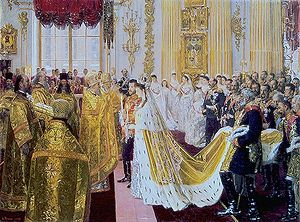
Alexander III died on 1 November 1894 and Nicholas became the Emperor and Autocrat of All the Russias at the age of twenty-six. The marriage was not delayed. Alexandra and Nicholas were wed in the Grand ChurchGrand Church of the Winter Palace
The Grand Church of the Winter Palace in Saint Petersburg, sometimes referred to as the Winter Palace's cathedral, was consecrated in 1763. It is located on the piano nobile in the eastern wing of the Winter Palace, and is the larger, and principal, of two churches within the Palace...
of the Winter Palace
Winter Palace
The Winter Palace in Saint Petersburg, Russia, was, from 1732 to 1917, the official residence of the Russian monarchs. Situated between the Palace Embankment and the Palace Square, adjacent to the site of Peter the Great's original Winter Palace, the present and fourth Winter Palace was built and...
of Saint Petersburg
Saint Petersburg
Saint Petersburg is a city and a federal subject of Russia located on the Neva River at the head of the Gulf of Finland on the Baltic Sea...
on 26 November 1894. The marriage that began that night remained unflawed for the rest of their lives. It was a Victorian marriage, outwardly serene and proper, but based on intensely passionate physical love.
Her older sister Ella was not only her sister, but her aunt by marriage. In fact, she, like Nicholas was a first cousin to Britain's King George V
George V of the United Kingdom
George V was King of the United Kingdom and the British Dominions, and Emperor of India, from 6 May 1910 through the First World War until his death in 1936....
; Nicholas was a first cousin to three other kings as well: Christian X of Denmark
Christian X of Denmark
Christian X was King of Denmark from 1912 to 1947 and the only King of Iceland between 1918 and 1944....
, Constantine I of Greece
Constantine I of Greece
Constantine I was King of Greece from 1913 to 1917 and from 1920 to 1922. He was commander-in-chief of the Hellenic Army during the unsuccessful Greco-Turkish War of 1897 and led the Greek forces during the successful Balkan Wars of 1912–1913, in which Greece won Thessaloniki and doubled in...
, and Haakon VII of Norway
Haakon VII of Norway
Haakon VII , known as Prince Carl of Denmark until 1905, was the first king of Norway after the 1905 dissolution of the personal union with Sweden. He was a member of the House of Schleswig-Holstein-Sonderburg-Glücksburg...
.
Coronation
Alexandra Feodorovna became Empress of Russia on her wedding day. It was not until 14 May 1896, that the coronation of Nicholas and Alexandra took place inside the KremlinMoscow Kremlin
The Moscow Kremlin , sometimes referred to as simply The Kremlin, is a historic fortified complex at the heart of Moscow, overlooking the Moskva River , Saint Basil's Cathedral and Red Square and the Alexander Garden...
in Moscow. The following day, tragedy struck the coronation celebrations when the deaths of several thousand peasants became known. The victims were trampled to death at the Khodynka Field in Moscow
Moscow
Moscow is the capital, the most populous city, and the most populous federal subject of Russia. The city is a major political, economic, cultural, scientific, religious, financial, educational, and transportation centre of Russia and the continent...
when they believed there was not enough food for everyone. By the time the police and more cossacks arrived, the meadow resembled a battlefield. By afternoon the city's hospitals were jammed with wounded and everybody knew what had happened. Nicholas and Alexandra were stunned. He declared he could not go to the ball being given that night by the French Ambassador, the Marquis da Montebello. The tsar's uncles urged him to attend not to offend the French. Nicholas gave in and he and Alexandra attended the ball. Sergius Witte commented, "We expected the party would be called off. Instead it took place if nothing had happened and the ball was opened by Their Majesties dancing a quadrille." It was a painful evening. "The Empress appeared in great distress, her eyes reddened by tears" the British Ambassador informed Queen Victoria. Masses of simple Russians took the disaster at Khodynka Meadow as an omen that the reign would be unhappy. Other Russians, more sophisticated or more vengeful, used the tragedy to underscore the heartlessness of the autocracy and the contemptible shallowness of the young tsar and his 'German woman'.
Rejection by the Russians
Unlike her predecessor, Marie Feodorovna (spouse to Alexander III), the new tsarina of Imperial Russia was heartily disliked among the country. As the tsarina, Alexandra seemed very cold and curt with her subjects, although according to her and many other close friends, she was only terribly shy and nervous in front of the Russian people. She felt her feelings were bruised and battered from the Russians' "hateful" nature. She was also frowned upon by the wealthy and poor alike by her distaste for Russian culture, whether it was the food or the manner of dancing. Her inability to produce a son also incensed the people; however, she was very fond of her four daughters. After the birth of the Grand Duchess Olga, Nicholas was reported to have said, "We are grateful she was a daughter; if she was a boy she would have belonged to the people, being a girl she belongs to us." When her 'Sunbeam' Alexei the tsarevitch was born, she further isolated herself from the Russian court by spending nearly all of her time with him, and his haemophiliac disorder did little to distance their close relationship. She associated herself with more solitary figures like Anna VyrubovaAnna Vyrubova
Anna Alexandrovna Vyrubova, née Taneyeva , was a lady-in-waiting, best friend and confidante to Tsaritsa Alexandra Fyodorovna.-Early life:...
and the invalid Princess Sonia Obeliani, rather than the 'frivolous' Russian aristocratic young ladies. These women were constantly ignored by the 'haughty' tsarina, therefore the Romanovs were hated more by her indifference to Russian court society.
Alexandra lived mainly as a recluse during her rule as the tsar's wife. She also was reported to have had a terrible relationship with her mother-in-law, Marie Feodorovna. Marie resented Alexandra for her use of her role as the tsar's young wife. Ironically, unlike other European courts of the day, the Dowager Empress would have more power than the tsarina, and Marie enforced this rule strictly. In royal balls and other formal, Imperial gatherings, Marie would enter on her son's arm, and Alexandra would silently trail behind them. In addition, Alexandra despised the great treatment of Marie by her husband the tsar, which only slightly evaporated after the birth of their five children. On Marie's part, she did not approve of her son's marriage to a German bride, and was appalled at her daughter-in-law's inability to win points with the Russian people. Also, Marie had spent seventeen years in Russia prior to her crowning with Alexander III; Alexandra had a scarce month to learn the rules of the Russian court (which she seldom ever followed), and this might have contributed to her unpopularity. Alexandra was also smart enough not to openly criticize the woman she publicly referred to as "Mother dear."
Alexandra's only real associations were with Nicholas' siblings and a very small number of the otherwise close-knit Romanov family: Grand Duke Alexander Mikhailovich
Grand Duke Alexander Mikhailovich of Russia
Grand Duke Alexander Mihailovich of Russia, Александр Михайлович Aleksandr Mihailovits was a dynast of the Russian Empire, a naval officer, an author, explorer, the brother-in-law of Emperor Nicholas II, and an advisor of the said Emperor.-Biography: Alexander was born the son of Grand Duke...
(husband of Nicholas' sister Xenia
Grand Duchess Xenia Alexandrovna of Russia
Grand Duchess Xenia Alexandrovna of Russia was a daughter of Tsar Alexander III of Russia and the elder of Tsar Nicholas II two sisters. She married her cousin Grand Duke Alexander Mikailovich of Russia, with whom she had seven children....
), Grand Duke Konstantin Konstantinovich
Grand Duke Konstantin Konstantinovich of Russia
Grand Duke Constantine Constantinovich of Russia was a grandson of Emperor Nicholas I of Russia, and a poet and playwright of some renown...
(the most artistic of the Imperial house) and his family, and Grand Duke George Mikhailovich (married to Nicholas' maternal first cousin, Maria of Greece). Alexandra disliked in particular the family of Nicholas' senior uncle, Grand Duke Vladimir Alexandrovich
Grand Duke Vladimir Alexandrovich of Russia
Grand Duke Vladimir Alexandrovich of Russia ) was a son of Emperor Alexander II of Russia...
, and his wife Marie of Mecklenburg-Schwerin
Marie of Mecklenburg-Schwerin (Maria Pavlovna of Russia)
Marie of Mecklenburg-Schwerin was born Marie Alexandrine Elisabeth Eleonore of Mecklenburg-Schwerin, daughter of Grand Duke Frederick Francis II of Mecklenburg-Schwerin and Princess Augusta of Reuss-Köstritz...
, who, during the war, openly criticized the Empress; she considered, quite accurately, their sons, Kyrill, Boris
Grand Duke Boris Vladimirovich of Russia
Grand Duke Boris Vladimirovich of Russia was a son of Grand Duke Vladimir Alexandrovich of Russia, a grandson of Czar Alexander II of Russia and a first cousin of Czar Nicholas II. He followed a military career and was a Major General in the Russian Army. He took part in the Russo-Japanese War and...
and Andrei
Grand Duke Andrei Vladimirovich of Russia
Grand Duke Andrei Vladimirovich of Russia was a Russian grand duke, the youngest son of Grand Duke Vladimir Alexandrovich of Russia and Grand Duchess Maria Pavlovna.-Biography:...
to be irredeemably immoral and in 1913 refused Boris' proposal for the hand of Grand Duchess Olga.
Alexandra was very supportive of her husband Nicholas, yet she often gave him bad advice. She was a fervent advocate of the "Divine Right To Rule", and believed that it was unnecessary to attempt to secure the approval of the people. Her aunt, German Empress Frederick
Victoria, Princess Royal
The Princess Victoria, Princess Royal was the eldest child of Queen Victoria of the United Kingdom and Prince Albert. She was created Princess Royal of the United Kingdom in 1841. She became German Empress and Queen of Prussia by marriage to German Emperor Frederick III...
, wrote to Queen Victoria that "Alix is very Imperious and will always insist on having her own way; she will never yield one iota of power she will imagine she wields..." During World War I, with the national citizens aroused, all the complaints Russians had about the Empress– for instance, her German birth, her poor ideals, her devotion to Rasputin, all circled and twisted around the deadly fates and designs that claimed the entire family and all of their potential descendants.
Relationship with her children
Almost one year after her marriage to the tsar, Alexandra gave birth to the couple's first child: a girl, named OlgaGrand Duchess Olga Nikolaevna of Russia
Grand Duchess Olga Nikolaevna of Russia ; , November 16 after 1900 – July 17, 1918) was the eldest daughter of the last autocratic ruler of the Russian Empire, Emperor Nicholas II, and of Empress Alexandra of Russia....
, was born on 15 November 1895. Olga could not be the heir presumptive
Heir Presumptive
An heir presumptive or heiress presumptive is the person provisionally scheduled to inherit a throne, peerage, or other hereditary honour, but whose position can be displaced by the birth of an heir or heiress apparent or of a new heir presumptive with a better claim to the position in question...
due to the Pauline Laws
Pauline Laws
The Pauline Laws are the house laws of the House of Romanov of the Russian Empire. The name comes from the fact that they were initially established by Emperor Paul I of Russia in 1797....
implemented by tsar Paul I
Paul I of Russia
Paul I was the Emperor of Russia between 1796 and 1801. He also was the 72nd Prince and Grand Master of the Order of Malta .-Childhood:...
: only a male could succeed to the Russian throne, although there were four female monarchs of Russia before Paul. Olga was well-loved by her young parents. Three more girls followed Olga: Tatiana
Grand Duchess Tatiana Nikolaevna of Russia
Grand Duchess Tatiana Nikolaevna of Russia , , was the second daughter of Tsar Nicholas II, the last monarch of Russia, and of Tsarina Alexandra...
on 10 June 1897, Maria on 26 June 1899 and Anastasia
Grand Duchess Anastasia Nikolaevna of Russia
Grand Duchess Anastasia Nikolaevna of Russia was the youngest daughter of Tsar Nicholas II of Russia, the last sovereign of Imperial Russia, and his wife Alexandra Fyodorovna....
on 18 June 1901. Three more years passed before the Empress gave birth to the long-awaited heir. Alexei Nikolaevich was born in Peterhof on 12 August 1904. To his parents' dismay, Alexei was born with hemophilia, an incurable bleeding disease.
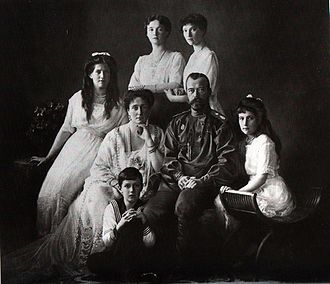
When they were children, Alexandra dressed her daughters as pairs, the oldest two and the youngest two wearing matching dresses. As Olga and Tatiana grew older, they played a more serious role in public affairs. Although in private they still referred to their parents as 'Mama' and 'Papa' in public, they referred to them as 'the Empress' and 'the Emperor'. Nicholas and Alexandra intended that both their older daughters should make their official debuts in 1914 when Olga was nineteen and Tatiana seventeen. The first world war intervened and the plans were canceled. By 1917, the four daughters of Nicholas and Alexandra had blossomed into young women whose talents and personalities were, as fate decreed, never to be unfolded and revealed.
Alexandra doted on Alexei. The children's tutor, Pierre Gilliard
Pierre Gilliard
Pierre Gilliard was a Swiss academic, who was French language tutor to the five children of Tsar Nicholas II from 1905 to 1918. Years after the Imperial Family was assassinated by the Bolsheviks in July 1918, Gilliard wrote a book Thirteen Years at the Russian Court, about his time with the family...
wrote, "Alexei was the center of a united family, the focus of all its hopes and affections. His sisters worshiped him. He was his parents' pride and joy. When he was well, the palace was transformed. Everyone and everything in it seemed bathed in sunshine."
Having to live with the knowledge that she had given him the bleeding disease, Alexandra was obsessed with protecting her son; she kept a close eye on him at all times and consulted a number of mystics who claimed to be able to heal him during his nearly fatal attacks. Alexandra spoiled her only son and let him have his way. In 1912, Alexandra finally revealed the truth about Alexei's illness, in confidence, to her mother-in-law and Nicholas' sisters, but the knowledge soon reached a limited circle of courtiers and relatives. The revelation backfired on Alexandra, since she was now blamed for Alexei's frail health and, because it had first appeared among Queen Victoria's children, his condition was known to some as "the English disease," adding to the element of foreignness that clung to Alexandra. Increasingly, she became an unpopular figure with the Imperial Family, the aristocracy and the Russian people. During the Great War
World War I
World War I , which was predominantly called the World War or the Great War from its occurrence until 1939, and the First World War or World War I thereafter, was a major war centred in Europe that began on 28 July 1914 and lasted until 11 November 1918...
, her German birth further inflamed this hatred and made her the immediate and primary focus for almost any aspect of opposition to the monarchy.
Issue
| Image | Name | Birth | Death | Notes |
|---|---|---|---|---|
| Grand Duchess Olga Nikolaevna Grand Duchess Olga Nikolaevna of Russia Grand Duchess Olga Nikolaevna of Russia ; , November 16 after 1900 – July 17, 1918) was the eldest daughter of the last autocratic ruler of the Russian Empire, Emperor Nicholas II, and of Empress Alexandra of Russia.... |
18 July 1918 | |||
| Grand Duchess Tatiana Nikolaevna Grand Duchess Tatiana Nikolaevna of Russia Grand Duchess Tatiana Nikolaevna of Russia , , was the second daughter of Tsar Nicholas II, the last monarch of Russia, and of Tsarina Alexandra... |
18 July 1918 | |||
| Grand Duchess Maria Nikolaevna | 18 July 1918 | |||
| Grand Duchess Anastasia Nikolaevna Grand Duchess Anastasia Nikolaevna of Russia Grand Duchess Anastasia Nikolaevna of Russia was the youngest daughter of Tsar Nicholas II of Russia, the last sovereign of Imperial Russia, and his wife Alexandra Fyodorovna.... |
18 July 1918 | |||
| Tsarevich Alexei Nikolaevich | 18 July 1918 |
In addition to her five live-born children, Alexandra allegedly suffered a miscarriage in the summer of 1896, presumably because she became physically exhausted during her coronation festivities, and another in August 1902. Some writers state that the 1902 pregnancy was psychological, inspired by the chicanery of the French mystic Philippe Vachot, but a miscarriage was officially announced and the tsar's sister Xenia described it as "a minor miscarriage."
Alexandra's health was never robust and her frequent pregnancies exacerbated the situation. Without exception, however, her biographers, including Robert Massie, Carrolly Erickson, Greg King and Peter Kurth, ascribe the semi-invalidism of her later years to nervous exhaustion from obsessive worry over the fragile tsarevich. She spent most of her time in bed or reclining on a chaise in her boudoir or on a veranda. This immobility let her avoid the social occasions that she found distasteful.
Haemophilia and Rasputin

Tsarevich Alexei Nikolaevich of Russia
Alexei Nikolaevich of the House of Romanov, was the Tsesarevich and heir apparent to the throne of the Russian Empire. In English, his title is usually given as Tsarevich, a title that has a separate meaning in Russia. Alexei was the youngest child and only son of Emperor Nicholas II and Empress...
was born during the height of the Russo-Japanese War
Russo-Japanese War
The Russo-Japanese War was "the first great war of the 20th century." It grew out of rival imperial ambitions of the Russian Empire and Japanese Empire over Manchuria and Korea...
on 12 August 1904. The tsarevich was the Heir Apparent
Heir apparent
An heir apparent or heiress apparent is a person who is first in line of succession and cannot be displaced from inheriting, except by a change in the rules of succession....
to the throne of Russia, and Alexandra had fulfilled her most important role as tsarina by bearing a male child. At first the boy seemed healthy and normal, but in only a few weeks' time it was noticed that, when he bumped himself, his bruises did not heal, but became worse when he began to bleed from the navel and his blood was slow to clot. It was soon discovered Alexei suffered from Haemophilia
Haemophilia
Haemophilia is a group of hereditary genetic disorders that impair the body's ability to control blood clotting or coagulation, which is used to stop bleeding when a blood vessel is broken. Haemophilia A is the most common form of the disorder, present in about 1 in 5,000–10,000 male births...
, which could only have been transmitted from Alexandra's side of the family. Haemophilia was generally fatal in the early 20th century, and had entered The Royal Houses of Europe via the daughters of Queen Victoria, who herself was a carrier. Alexandra had lost a brother, Friedrich
Prince Friedrich of Hesse and by Rhine
Prince Friedrich of Hesse and by Rhine , , was the haemophiliac second son of Ludwig IV, Grand Duke of Hesse and by Rhine and Princess Alice of the United Kingdom, thus he is a grandson of Queen Victoria...
, to the disease, as well as an uncle, Prince Leopold, Duke of Albany
Prince Leopold, Duke of Albany
The Prince Leopold, Duke of Albany was the eighth child and fourth son of Queen Victoria and Prince Albert of Saxe-Coburg and Gotha. Leopold was later created Duke of Albany, Earl of Clarence, and Baron Arklow...
; her sister Princess Irene of Hesse and by Rhine
Princess Irene of Hesse and by Rhine
Princess Irene of Hesse and by Rhine was the third child and third daughter of Princess Alice of the United Kingdom and Ludwig IV, Grand Duke of Hesse and by Rhine. Her maternal grandparents were Queen Victoria of the United Kingdom and Prince Albert...
was also a carrier of the gene and, through her marriage to her cousin Prince Heinrich of Prussia
Prince Heinrich of Prussia
Prince Henry of Prussia was a younger brother of German Emperor William II and a Prince of Prussia...
, spread it into a junior branch of the Prussian Royal Family. Princess Victoria Eugenie of Battenberg, another of Queen Victoria's granddaughters and a first cousin of Alexandra, was also a carrier of the haemophilia gene. She married King Alfonso XIII of Spain
Alfonso XIII of Spain
Alfonso XIII was King of Spain from 1886 until 1931. His mother, Maria Christina of Austria, was appointed regent during his minority...
and two of her sons were haemophiliacs. As an incurable and life threatening illness, suffered by the sole male heir, the decision was made to keep the heir's condition secret from the Russian people. As a carrier of the haemophilia gene, Alexandra was not a haemophiliac but she likely produced lower-than-normal clotting factor, having only one normal copy of the gene instead of two. Her status as a carrier, in addition to her worry over her son's health, might have been one reason for her reportedly poor health.
At first Alexandra turned to Russian doctors to treat Alexei. Their treatments generally failed as there was no known cure. Burdened with the knowledge that any fall or cut could actually kill her son, Alexandra herself did even more charity work. She also turned toward God for comfort, familiarizing herself with all the Orthodox Rituals and Saints and spent hours praying in her private chapel for deliverance. In desperation, Alexandra increasingly turned to mystics and so-called holy men. One of these, Grigori Rasputin
Grigori Rasputin
Grigori Yefimovich Rasputin was a Russian Orthodox Christian and mystic who is perceived as having influenced the latter days of the Russian Emperor Nicholas II, his wife Alexandra, and their only son Alexei...
, appeared to have a success.
Rasputin's debauched lifestyle led Nicholas at times to distance him from the family. Even after Alexandra was told by the director of the national police that a drunk Rasputin exposed himself at a popular Moscow restaurant and bragged to the crowd that Nicholas let him top his wife whenever he wanted, she blamed it on malicious gossip. "Saints are always calumniated." she once wrote. "He is hated because we love him." Nicholas was not nearly as blind, but even he felt powerless to do anything about the man who seemingly saved his only son's life. One minister of Nicholas wrote, " He did not like to send Rasputin away, for if Alexei died, in the eyes of the mother, he would have been the murderer of his own son."
From the start there were persistent murmurs and snickers behind Rasputin's back. Although some of Saint Petersburg's top clergy accepted Rasputin as a living prophet, others angrily denounced him as a fraud and a heretic. Stories from back home in Siberia chased him, such as how he conducted weddings for villagers in exchange of sleeping the first night with the bride. In his apartment in Saint Petersburg, where he lived with his daughter Maria, Rasputin was visited by anyone seeking his blessing, a healing or a favor with the tsarina. Women, enchanted by the monk's crude mystique, also came to Rasputin for more 'private blessings' and received a private audience in his bedroom, jokingly called the 'Holy of Holies'. Rasputin liked to preach a unique theology, that one must first become familiar with sin before one can have a chance in overturning it.
In 1912, Alexei suffered a life-threatening hemorrhage
Bleeding
Bleeding, technically known as hemorrhaging or haemorrhaging is the loss of blood or blood escape from the circulatory system...
in the thigh while the family were at Spala, Poland
Poland
Poland , officially the Republic of Poland , is a country in Central Europe bordered by Germany to the west; the Czech Republic and Slovakia to the south; Ukraine, Belarus and Lithuania to the east; and the Baltic Sea and Kaliningrad Oblast, a Russian exclave, to the north...
. Alexandra and Nicholas took turns at his bedside and tried in vain to comfort him from his intense pain. In one rare moment of peace, Alexei was heard to whisper to his mother, "When I am dead, it will not hurt any more, will it, Mama?" Devastatingly, it seemed to Alexandra that God was not answering her prayers for her son's relief. Believing Alexei would die, Alexandra in desperation sent a telegram to Grigori Rasputin. Right away he sent a reply, "God has seen your tears and heard your prayers. Do not grieve. The Little One will not die. Do not allow the doctors to bother him too much." Rasputin's advice just happened to coincide with signs of a recovery. From 1912 onwards, Alexandra came to rely increasingly on Rasputin, and to believe in his ability to ease Alexei's suffering. This reliance enhanced Rasputin's political power, which was seriously to undermine Romanov rule during the First World War.
Rasputin's perceived interference in political matters eventually led to his murder in December 1916. Amongst the conspirators was a nobleman Prince Felix Yusupov
Felix Yusupov
Prince Felix Felixovich Yusupov, Count Sumarokov-Elston , was best known for participating in the murder of Grigori Rasputin, the faith healer who was said to have influenced decisions of Tsar Nicholas II and Tsaritsa Alexandra Feodorovna.-Biography:...
, married to Grand Duchess Xenia Alexandrovna's daughter, Princess Irina of Russia
Princess Irina of Russia
Princess Irina Alexandrovna of Russia was the only daughter of Grand Duke Alexander Mikhailovich of Russia and Grand Duchess Xenia Alexandrovna of Russia...
, and a member of the Romanov family Grand Duke Dmitri Pavlovich. Newspaper reporter Michael Smith
Michael Smith (newspaper reporter)
Michael Smith is a British journalist for The Sunday Times who specializes in defence and intelligence issues. He is well known for, among other things, obtaining the document known as the Downing Street memo...
wrote in his book that British Secret Intelligence Bureau head Mansfield Cumming ordered three of his agents in Russia to eliminate Rasputin in December 1916.
World War I
The outbreak of World War IWorld War I
World War I , which was predominantly called the World War or the Great War from its occurrence until 1939, and the First World War or World War I thereafter, was a major war centred in Europe that began on 28 July 1914 and lasted until 11 November 1918...
was a pivotal moment for Russia and Alexandra. The war pitted the Russian Empire of the Romanov dynasty against the much stronger German Empire of the Hohenzollern dynasty. When Alexandra learned of the Russian mobilization, she stormed into her husband's study and said: "War! And I know nothing of it! This is the end of everything."
The Grand Duchy of Hesse and by Rhine, ruled by her brother, formed part of the German Empire. This was, of course the place of Alexandra's birth. This made Alexandra very unpopular with the Russian people, who accused her of collaboration with the Germans. The German Emperor, Wilhelm II, was also Alexandra's first cousin. Ironically, one of the few things that Empress Alexandra and her mother-in-law Empress Maria had in common was their utter distaste for Emperor Wilhelm II.
When the tsar travelled to the front line in 1915 to take personal command of the Army, he left Alexandra in charge as Regent in the capital Saint Petersburg. Her brother-in-law, Grand Duke Alexander Mikhailovich
Grand Duke Alexander Mikhailovich of Russia
Grand Duke Alexander Mihailovich of Russia, Александр Михайлович Aleksandr Mihailovits was a dynast of the Russian Empire, a naval officer, an author, explorer, the brother-in-law of Emperor Nicholas II, and an advisor of the said Emperor.-Biography: Alexander was born the son of Grand Duke...
recorded, "When the Emperor went to war of course his wife governed instead of him." Alexandra had no experience of government, and constantly appointed and reappointed incompetent new ministers, which meant the government was never stable or efficient. This was particularly dangerous in a war of attrition, as neither the troops nor the civilian population were ever adequately supplied. She paid attention to the self-serving advice of Rasputin, and their relationship was widely, though falsely, believed to be sexual in nature. Alexandra was the focus of ever increasing negative rumors, and widely believed to be a German spy at the Russian court.
Revolution
World War IWorld War I
World War I , which was predominantly called the World War or the Great War from its occurrence until 1939, and the First World War or World War I thereafter, was a major war centred in Europe that began on 28 July 1914 and lasted until 11 November 1918...
put what proved to be unbearable burden on Imperial Russia's government and economy, both of which were dangerously weak. Mass shortages and hunger became the daily situation for tens of millions of Russians due to the disruptions of the war economy
War economy
War economy is the term used to describe the contingencies undertaken by the modern state to mobilise its economy for war production. Philippe Le Billon describes a war economy as a "system of producing, mobilising and allocating resources to sustain the violence".Many states increase the degree of...
. Fifteen million men were diverted from agricultural production to fight in the war, and the transportation infrastructure (primarily railroads) were diverted towards war use, exacerbating food shortages in the cities as available agricultural products could not be brought to urban areas. Inflation was rampant which, combined with the food shortages and the poor performance by the Russian military in the war, generated a great deal of anger and unrest among the people in Saint Petersburg
Saint Petersburg
Saint Petersburg is a city and a federal subject of Russia located on the Neva River at the head of the Gulf of Finland on the Baltic Sea...
and other cities.
The decision of the tsar to take personal command of the military against advice was disastrous as he was directly blamed for all losses. His relocation to the front, leaving the Empress in charge of the government, helped undermine the Romanov dynasty. The poor performance of the military led to rumors believed by the people that the German-born Empress was part of a conspiracy to help Germany win the war. The severe winter of 1916–17 essentially doomed Imperial Russia. Food shortages worsened and famine
Famine
A famine is a widespread scarcity of food, caused by several factors including crop failure, overpopulation, or government policies. This phenomenon is usually accompanied or followed by regional malnutrition, starvation, epidemic, and increased mortality. Every continent in the world has...
gripped the cities. The mismanagement and failures of the war turned the soldiers against the tsar. The mood of the army is perhaps captured well by one scene in Jean Renoir
Jean Renoir
Jean Renoir was a French film director, screenwriter, actor, producer and author. As a film director and actor, he made more than forty films from the silent era to the end of the 1960s...
's movie, La Grande Illusion. Alexandra sends boxes to Russian prisoners of war. Thrilled to think they are receiving vodka
Vodka
Vodka , is a distilled beverage. It is composed primarily of water and ethanol with traces of impurities and flavorings. Vodka is made by the distillation of fermented substances such as grains, potatoes, or sometimes fruits....
, they open them to discover bibles, and promptly riot.
By March 1917, conditions had worsened. Steelworkers went out on strike on 7 March, and the following day, International Women’s Day, crowds hungry for bread began rioting on the streets of Saint Petersburg to protest food shortages and the war. After two days of rioting, the tsar ordered the Army to restore order and on 11 March they fired on the crowd. That very same day, the Duma
Duma
A Duma is any of various representative assemblies in modern Russia and Russian history. The State Duma in the Russian Empire and Russian Federation corresponds to the lower house of the parliament. Simply it is a form of Russian governmental institution, that was formed during the reign of the...
, the elected legislature, urged the tsar to take action to ameliorate the concerns of the people. The tsar responded by dissolving the Duma.
On 12 March soldiers sent to suppress the rioting crowds mutinied and joined the rebellion, thus providing the spark to ignite the February Revolution (like the later October Revolution of November 1917, the Russian Revolutions of 1917 get their names due to the Old Style calendar). Soldiers and workers set up the "Petrograd Soviet
Petrograd Soviet
The Petrograd Soviet of Workers' and Soldiers' Deputies , usually called the Petrograd Soviet , was the soviet in Petrograd , Russia, established in March 1917 after the February Revolution as the representative body of the city's workers.The Petrograd Soviet became important during the Russian...
" of 2,500 elected deputies while the Duma declared a Provisional Government on 13 March. Alexander Kerensky
Alexander Kerensky
Alexander Fyodorovich Kerensky was a major political leader before and during the Russian Revolutions of 1917.Kerensky served as the second Prime Minister of the Russian Provisional Government until Vladimir Lenin was elected by the All-Russian Congress of Soviets following the October Revolution...
was a key player in the new regime. The Duma informed the tsar that day that he must abdicate.
In an effort to put an end to the uprising in the capital, Nicholas tried to get to Saint Petersburg by train from army headquarters at Mogiliev. The route was blocked so he tried another way. His train was stopped at Pskov where, after receiving advice from his generals, he first abdicated the throne for himself and later, on seeking medical advice, for himself and his son the tsarevich Alexei
Alexei
Alexey is a male first name of Eastern-European and East Slavic descent, and is pronounced . It is sometimes romanized as "Alexei", "Aleksei", "Aleksey", "Alexej", "Aleksej", etc....
. Alexandra was now in a perilous position as the wife of the deposed tsar, hated by the Russian people. Nicholas finally was allowed to return to the Alexander Palace at Tsarskoe Selo where he was placed under arrest with his family. Despite the fact he was a first cousin of both Nicholas and Alexandra, King George V
George V of the United Kingdom
George V was King of the United Kingdom and the British Dominions, and Emperor of India, from 6 May 1910 through the First World War until his death in 1936....
refused to allow them to evacuate to the United Kingdom
United Kingdom of Great Britain and Ireland
The United Kingdom of Great Britain and Ireland was the formal name of the United Kingdom during the period when what is now the Republic of Ireland formed a part of it....
, as he was alarmed by their unpopularity in his country and the potential repercussions to his own throne.
Imprisonment
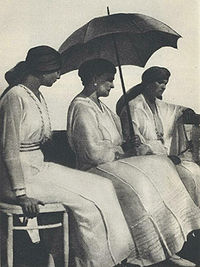
Russian Provisional Government
The Russian Provisional Government was the short-lived administrative body which sought to govern Russia immediately following the abdication of Tsar Nicholas II . On September 14, the State Duma of the Russian Empire was officially dissolved by the newly created Directorate, and the country was...
formed after the revolution kept Nicholas, Alexandra, and their children confined in their primary residence, the Alexander Palace
Alexander Palace
The Alexander Palace is a former imperial residence at Tsarskoye Selo, on a plateau around 30 minutes by train from St Petersburg. It is known as the favourite residence of the last Russian Emperor, Nicholas II, and his family and their initial place of imprisonment after the revolution that...
at Tsarskoye Selo
Tsarskoye Selo
Tsarskoye Selo is the town containing a former Russian residence of the imperial family and visiting nobility, located south from the center of St. Petersburg. It is now part of the town of Pushkin and of the World Heritage Site Saint Petersburg and Related Groups of Monuments.-History:In...
, until they were moved to Tobolsk
Tobolsk
Tobolsk is a town in Tyumen Oblast, Russia, located at the confluence of the Tobol and Irtysh Rivers. It is a historic capital of Siberia. Population: -History:...
in Siberia
Siberia
Siberia is an extensive region constituting almost all of Northern Asia. Comprising the central and eastern portion of the Russian Federation, it was part of the Soviet Union from its beginning, as its predecessor states, the Tsardom of Russia and the Russian Empire, conquered it during the 16th...
in August 1917, a step by the Kerensky
Alexander Kerensky
Alexander Fyodorovich Kerensky was a major political leader before and during the Russian Revolutions of 1917.Kerensky served as the second Prime Minister of the Russian Provisional Government until Vladimir Lenin was elected by the All-Russian Congress of Soviets following the October Revolution...
government designed to remove them from the capital and possible harm. From Tobolsk, Alexandra managed to send a letter to sister-in-law, Xenia Alexandrovna
Grand Duchess Xenia Alexandrovna of Russia
Grand Duchess Xenia Alexandrovna of Russia was a daughter of Tsar Alexander III of Russia and the elder of Tsar Nicholas II two sisters. She married her cousin Grand Duke Alexander Mikailovich of Russia, with whom she had seven children....
, in the Crimea
Crimea
Crimea , or the Autonomous Republic of Crimea , is a sub-national unit, an autonomous republic, of Ukraine. It is located on the northern coast of the Black Sea, occupying a peninsula of the same name...
,
"My darling Xenia,
My thoughts are with you, how magically good and beautiful everything must be with you – you are the flowers. But it is indescribably painful for the kind motherland, I cannot explain. I am glad for you that you are finally with all your family as you have been apart. I would like to see Olga in all her new big happiness. Everybody is healthy, but myself, during the last 6 weeks I experience nerve pains in my face with toothache. Very tormenting ...
We live quietly, have established ourselves well [in Tobolsk] although it is far, far away from everybody, But God is merciful. He gives us strength and consolation ...."
Alexandra and her family remained in Tobolsk until after the Bolshevik Revolution
October Revolution
The October Revolution , also known as the Great October Socialist Revolution , Red October, the October Uprising or the Bolshevik Revolution, was a political revolution and a part of the Russian Revolution of 1917...
in November 1917, but were subsequently moved to Bolshevik controlled Yekaterinburg
Yekaterinburg
Yekaterinburg is a major city in the central part of Russia, the administrative center of Sverdlovsk Oblast. Situated on the eastern side of the Ural mountain range, it is the main industrial and cultural center of the Urals Federal District with a population of 1,350,136 , making it Russia's...
in 1918. Nicholas was ordered to Ekaterinburg. Alexandra and their daughter Maria went with him arriving at the Ipatiev House
Ipatiev House
Ipatiev House was a merchant's house in Yekaterinburg where the former Emperor Nicholas II of Russia, his family and members of his household were executed following the Bolshevik Revolution...
on 30 April 1918. On entering their new prison, they were ordered to open all their luggage. Alexandra immediately objected. Nicholas tried to come to her defense saying, "So far we have had polite treatment and men who were gentlemen but now -" The former Tsar was quickly cut off. The guards informed him he was no longer at Tsarskoe Selo and that refusal to comply with their request would result in his removal from the rest of his family; a second offence would be rewarded with hard labour. Fearing for her husband's safety, Alexandra quickly gave in and allowed the search. On the window frame of what was to be her last bedroom in the Ipatiev House, Alexandra scrawled a swastika
Swastika
The swastika is an equilateral cross with its arms bent at right angles, in either right-facing form in counter clock motion or its mirrored left-facing form in clock motion. Earliest archaeological evidence of swastika-shaped ornaments dates back to the Indus Valley Civilization of Ancient...
, her favorite good luck symbol, and pencilled the date 17/30 April 1918. In May, the rest of the family arrived in Ekaterinburg. They had not been able to travel earlier due to the illness of Alexei. Alexandra was pleased to be reunited with her family once more.
Seventy-five men did guard duty at the Ipatiev House. Many of the men were factory workers from the local Zlokazovsky Factory and the Verkh-Isetsk Factory. The commandant of the Ipatiev House, Alexander Avadeyev was described as "a real Bolshevik". The majority of witnesses recall him as coarse, brutish and a heavy drinker. If a request for a favor on behalf of the family reached Avadeyev, he always gave the same response, "Let them go to hell!!" The guards in the house often heard him refer to the deposed tsar as "Nicholas the Blood-Drinker" and to Alexandra as "The German Bitch".
For the Romanovs, life at the Ipatiev House was a nightmare of uncertainty and fear. The Imperial Family never knew if they would still be in the Ipatiev House from one day to the next or if they might be separated or killed. The privileges allowed to them were few. For an hour each afternoon they could exercise in the rear garden under the watchful eye of the guards. Alexei could still not walk, and his sailor Nagorny had to carry him. Alexandra rarely joined her family in these daily activities. Instead she spent most of her time sitting in a wheelchair, reading the Bible or the works of St. Seraphim. At night the Romanovs played cards or read; they received little mail from the outside world, and the only newspapers they were allowed were outdated editions.
We now know that Lenin personally ordered the execution of the Imperial Family. Although official Soviet accounts place the responsibility for the decision with the Ural Regional Soviet. Leon Trotsky
Leon Trotsky
Leon Trotsky , born Lev Davidovich Bronshtein, was a Russian Marxist revolutionary and theorist, Soviet politician, and the founder and first leader of the Red Army....
, in his diary, makes it quite clear that the assassination took place on the authority of Lenin. Trotsky wrote,
"My next visit to Moscow took place after the fall of Ekaterinburg. Talking to Sverdlov I asked in passing, "Oh yes, and where is the tsar?" "It's all over," he answered. "He has been shot." "And where is his family?" "And the family with him." "All of them?" I asked, apparently with a touch of surprise. "All of them," replied Sverdlov. "What about it?" He was waiting to see my reaction. I made no reply. "And who made the decision?" I asked. "We decided it here. Ilyich (Lenin) believed that we shouldn't leave The Whites a live banner to rally around, especially under the present difficult circumstances."
On 4 July 1918, Yakov Yurovsky
Yakov Yurovsky
Yakov Mikhaylovich Yurovsky was an Old Bolshevik best known as the chief executioner of Russia's last Tsar, Nicholas II and his family in 1918, during the Russian Civil War.- Early life :...
, the chief of the Ekaterinburg Cheka, was appointed commandant of the Ipatiev House. Yurovsky was a loyal Bolshevik, a man Moscow could rely on to carry out its orders regarding The Imperial Family. Yurovsky quickly tightened security. From The Imperial Family he collected all of their jewellery and valuables. These he placed in a box which he sealed and left with the prisoners. Alexandra kept only two bracelets which her uncle, Prince Leopold, Duke of Albany
Prince Leopold, Duke of Albany
The Prince Leopold, Duke of Albany was the eighth child and fourth son of Queen Victoria and Prince Albert of Saxe-Coburg and Gotha. Leopold was later created Duke of Albany, Earl of Clarence, and Baron Arklow...
, had given her as a child and which she could not take off. He did not know that the former tsarina and her daughters wore concealed on their person diamonds, emeralds, rubies and ropes of pearls. These would be discovered only after the murders. Yurovsky had been given the order for the murder on 13 July.
On Sunday, 14 July 1918, two priests came to the Ipatiev House to celebrate the Divine Liturgy. One of the priests, Father Storozhev later recalled, "I went into the living room first, then the deacon and Yurovsky. At the same time Nicholas and Alexandra entered through the doors leading into the inner room. Two of his daughters were with him. I did not have a chance to see exactly which ones. I believe Yurovsky asked Nicholas Alexandrovich, "Well, are you all here?" Nicholas Alexandrovich answered firmly, "Yes, all of us." Ahead beyond the archway, Alexandra Feodorovna was already in place with two daughters and Alexei Nicolaievich. He was sitting in a wheelchair and wore a jacket, as it seemed to me, with a sailor's collar. He was pale, but not so much as at the time of my first service. In general he looked more healthy. Alexandra Feodorovna also had a healthier appearance. ...According to the liturgy of the service it is customary at a certain point to read the prayer, "Who Resteth with the Saints." On this occasion for some reason the deacon, instead of reading the prayer began to sing it, and I as well, somewhat embarrassed by this departure from the ritual. But we had secretly begun to sing when I heard the members of the Romanov family, standing behind me, fall on their knees ...."
Execution
Tuesday, 16 July 1918 dawned hot and dusty in Yekaterinburg. The day passed normally for the former Imperial Family. At four o'clock in the afternoon, Nicholas and his daughters took their usual walk in the small garden. Early in the evening Yurovsky sent away the fifteen year old kitchen boy Leonid Sedinev, saying that his uncle wished to see him. At 7pm, Yurovsky summoned all the Cheka men into his room and ordered them to collect all the revolvers from the outside guards. With twelve heavy military revolvers lying before him on the table he said, "Tonight, we shoot the entire family, everybody." Upstairs Nicholas and Alexandra passed the evening playing beziqueBezique
Bezique is a 19th-century French melding and trick-taking card game for two players derived from Marriage via Briscan by the addition of more scoring features, notably the peculiar liaison of Q and J, under the names Bésigue, Binokel, Pinochle, etc., according to the country.-History:Bezique was...
; at ten thirty, they went to bed.
The former tsar and tsaritsa and all of their family, including the gravely ill Alexei, along with several family servants, were executed by firing squad and bayonets in the basement of the Ipatiev House, where they had been imprisoned, early in the morning of 17 July 1918, by a detachment of Bolshevik
Bolshevik
The Bolsheviks, originally also Bolshevists , derived from bol'shinstvo, "majority") were a faction of the Marxist Russian Social Democratic Labour Party which split apart from the Menshevik faction at the Second Party Congress in 1903....
s led by Yakov Yurovsky
Yakov Yurovsky
Yakov Mikhaylovich Yurovsky was an Old Bolshevik best known as the chief executioner of Russia's last Tsar, Nicholas II and his family in 1918, during the Russian Civil War.- Early life :...
. In the basement room of the Ipatiev House, Nicholas asked for and received three chairs from the guards. Minutes later, at about 2:15 a.m., a squad of soldiers, each armed with a revolver, entered the room. Their leader Yurovsky ordered all the party to stand; Alexandra complied "with a flash of anger," and Yurovsky then casually pronounced, "Your relations have tried to save you. They have failed and we must now shoot you." Nicholas rose from his chair and only had time to utter "What...?" before he was shot several times, not (as is usually said) in the head, but in the chest; his skull bears no bullet wounds, but his ribs were shattered by at least 3 fatal bullet wounds. Standing about six feet from the gunmen and facing them, Alexandra watched the murder of her husband and two menservants before military commissar Peter Ermakov
Peter Ermakov
Pyotr Ermakov was a Bolshevik commissar, notable as having been among those responsible for the assassinations of the deposed Tsar Nicholas II, his immediate family, and their retinue....
took aim at her. She instinctively turned away from him and began to make the sign of the cross, but before she could finish the gesture, Ermakov killed her with a gunshot which, as she had partly turned away, entered her head just above the left ear and exited at the same spot above her right ear. After all the victims had been shot, Ermakov in a drunken haze stabbed Alexandra's body and that of her husband, shattering both their rib cages and even chipping some of Alexandra's vertebrae.
Identification of remains
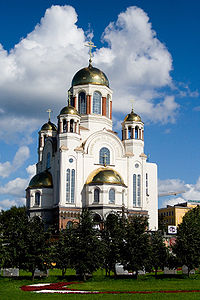
Ganina Yama
Ganina Yama was a 9' deep pit in the Four Brothers mine near the village of Koptyaki, 15 km north from Yekaterinburg...
, 12 miles (19 km) north of Yekaterinburg. A short time later they were retrieved, their faces were smashed and the bodies dismembered and disfigured with sulphuric acid were hurriedly buried under railway sleepers with the exception of two of the children whose bodies were not discovered until 2007. In 2007, the bodies missing were those of a daughter—Maria or Anastasia—and Alexei. In the early 1990s, following the fall of the Soviet Union
Soviet Union
The Soviet Union , officially the Union of Soviet Socialist Republics , was a constitutionally socialist state that existed in Eurasia between 1922 and 1991....
, the bodies of the majority of the Romanovs were located along with their loyal servants, exhumed and formally identified. A secret report by Yurovsky, which came to light in the late 1970s, but did not become public knowledge until the 1990s, helped the authorities to locate the bodies. Preliminary results of genetic analysis carried out on the remains of a boy and a young woman believed to belong to Nicholas II's son and heir Alexei, and daughter Anastasia were revealed on 22 January 2008. The Ekaterinburg region's chief forensic expert said, "Tests conducted in Yekaterinburg and Moscow allowed DNA to be extracted from the bones, which proved positive," Nikolai Nevolin said. "Once the genetic analysis has been completed in Russia, its results will be compared with test results from foreign experts." Nevolin said the final results would be published in April or May 2008. Certainty about the remains would definitively put an end to the claim that Anna Anderson
Anna Anderson
Anna Anderson was the best known of several impostors who claimed to be Grand Duchess Anastasia of Russia...
could be connected with the Romanovs, as all remaining bodies would be accounted for.
DNA analysis represented a key means of identifying the bodies. A blood sample from Prince Philip, Duke of Edinburgh
Prince Philip, Duke of Edinburgh
Prince Philip, Duke of Edinburgh is the husband of Elizabeth II. He is the United Kingdom's longest-serving consort and the oldest serving spouse of a reigning British monarch....
(a grandson of Alexandra's oldest sister, Princess Victoria of Hesse and by Rhine
Princess Victoria of Hesse and by Rhine
Princess Victoria of Hesse and by Rhine, later Victoria Mountbatten, Marchioness of Milford Haven was the eldest daughter of Louis IV, Grand Duke of Hesse and by Rhine and his first wife Princess Alice of the United Kingdom .Her mother died while her brother and sisters...
) was employed to identify Alexandra and her daughters through their mitochondrial DNA
Mitochondrial DNA
Mitochondrial DNA is the DNA located in organelles called mitochondria, structures within eukaryotic cells that convert the chemical energy from food into a form that cells can use, adenosine triphosphate...
. They belonged to Haplogroup H (mtDNA)
Haplogroup H (mtDNA)
In human mitochondrial genetics, Haplogroup H is a human mitochondrial DNA haplogroup that likely originated in Southwest Asia 25,000-30,000 YBP.-Origin:...
. Nicholas was identified from DNA obtained from among others his late brother Grand Duke George Alexandrovich of Russia
Grand Duke George Alexandrovich of Russia
Grand Duke George Alexandrovich of Russia, , was the third son of Alexander III and Empress Marie of Russia. He was named George after his mother's younger brother, King George I of Greece...
. Grand Duke George had died of tuberculosis
Tuberculosis
Tuberculosis, MTB, or TB is a common, and in many cases lethal, infectious disease caused by various strains of mycobacteria, usually Mycobacterium tuberculosis. Tuberculosis usually attacks the lungs but can also affect other parts of the body...
in the late 1890s and was buried in the Peter and Paul Fortress in Saint Petersburg.
Burial and sainthood

Peter and Paul Cathedral
The Peter and Paul Cathedral is a Russian Orthodox cathedral located inside the Peter and Paul Fortress in St. Petersburg, Russia. It is the first and oldest landmark in St. Petersburg, built between 1712 and 1733 on Zayachy Island along the Neva River. Both the cathedral and the fortress were...
at the Fortress of St. Peter and St. Paul in Saint Petersburg in 1998, with much ceremony, on the eightieth anniversary of the execution.
In 2000, Alexandra was canonized by the Russian Orthodox Church
Russian Orthodox Church
The Russian Orthodox Church or, alternatively, the Moscow Patriarchate The ROC is often said to be the largest of the Eastern Orthodox churches in the world; including all the autocephalous churches under its umbrella, its adherents number over 150 million worldwide—about half of the 300 million...
together with her husband Nicholas II, their children and others including her sister Grand Duchess Elizabeth and her fellow nun Varvara.
In popular culture
- A rather romanticised version of Alexandra's life was dramatized in the 1971 movie Nicholas and AlexandraNicholas and AlexandraNicholas and Alexandra is a 1971 biographical film which tells the story of the last Russian monarch, Tsar Nicholas II of Russia, and his wife, Tsarina Alexandra....
, based on the book by the same title written by Robert Massie, in which the tsaritsa/Empress was played by Janet SuzmanJanet SuzmanDame Janet Suzman, DBE is a South African-born-British actress and director.-Early life:Janet Suzman was born in Johannesburg to a Jewish family, the daughter of Betty and Saul Suzman, a wealthy importer of tobacco....
. - Rasputin and the EmpressRasputin and the EmpressRasputin and the Empress is a 1932 film about Imperial Russia starring the Barrymore siblings—John , Ethel , and Lionel Barrymore . It is the only film in which all three appeared together...
(1932), an MGM film that is less famous than the lawsuit it spawned. Alexandra was portrayed by Ethel BarrymoreEthel BarrymoreEthel Barrymore was an American actress and a member of the Barrymore family of actors.-Early life:Ethel Barrymore was born Ethel Mae Blythe in Philadelphia, Pennsylvania, the second child of the actors Maurice Barrymore and Georgiana Drew...
. - The highly fictionalized 1966 film Rasputin, the Mad MonkRasputin, the Mad MonkRasputin, the Mad Monk is a 1966 Hammer film directed by Don Sharp.It stars Christopher Lee as Grigori Rasputin, the Russian peasant-mystic notable for gaining great influence with the Tsars prior to the Russian Revolution. It also stars Barbara Shelley, Francis Matthews, Suzan Farmer, Richard...
, in which Renee AshersonRenee AshersonRenée Asherson , born Dorothy Renée Ascherson, is an English actress of stage, film and television.Much of Asherson's theatrical career was spent in Shakespearean plays, appearing at such venues as the Old Vic, the Liverpool Playhouse and the Westminster Theatre...
portrayed the Empress. - 1974's Fall of EaglesFall of EaglesFall of Eagles is a 13-part British television drama aired by the BBC in 1974. The series was created by John Elliot and produced by Stuart Burge....
, a BBC series dramatizing the demise of Europe's ruling familiesRoyal HouseA royal house or royal dynasty consists of at least one, but usually more monarchs who are related to one another, as well as their non-reigning descendants and spouses. Monarchs of the same realm who are not related to one another are usually deemed to belong to different houses, and each house is...
. Alexandra, portrayed by Gayle HunnicuttGayle HunnicuttGayle, Lady Jenkins , known by her birth name Gayle Hunnicutt, is an American actress.-Personal life:Hunnicutt was born in Fort Worth, Texas, the daughter of Colonel Sam Lloyd Hunnicutt and Virginia Hunnicutt, and attended the University of California, Los Angeles. She worked as a fashion model...
, is a prominent character in the series. - Rasputin: Dark Servant of DestinyRasputin: Dark Servant of DestinyRasputin: Dark Servant of Destiny is a biographical 1996 TV film about Rasputin.-Awards:Rasputin: Dark Servant of Destiny won a Golden Globe for Best Mini-Series or Motion Picture made for TV. Alan Rickman, starring as Rasputin, won an Emmy and a Golden Globe for his work in this movie...
is a 1996 HBO TV film for which Greta ScacchiGreta ScacchiGreta Scacchi is an Italian-Australian actor.-Early life:Scacchi was born Greta Gracco in Milan, Italy, on 18 February 1960, the daughter of Luca Scacchi Gracco, an Italian art dealer and painter, and Pamela Carsaniga, an English dancer and antiques dealer...
won an EmmyEmmy AwardAn Emmy Award, often referred to simply as the Emmy, is a television production award, similar in nature to the Peabody Awards but more focused on entertainment, and is considered the television equivalent to the Academy Awards and the Grammy Awards .A majority of Emmys are presented in various...
for her portrayal of Empress Alexandra. - Rasputin: The Mad Monk, (1997) is a biographical documentary.
- The Lost PrinceThe Lost PrinceThe Lost Prince is an acclaimed British television drama serial, produced by Talkback Thames for the BBC and originally broadcast in two episodes on BBC One in January 2003...
, a BBC mini-series in which she is played by Lithuanian actress Ingeborga DapkūnaitėIngeborga DapkunaiteIngeborga Dapkūnaitė is a Lithuanian actress, who stars mostly in Russian movies.-Youth:Ingeborga Dapkunaite was born in Vilnius, Lithuanian SSR. Her father was a diplomat and her mother a meteorologist. For many years her parents worked in Moscow, and she only saw them on holidays...
.
Documentaries
- The episode Love and Revolution devoted to the fall of the Romanov dynasty is featured in the Danish television A Royal Family, a series about the descendants of King Christian IX of Denmark.
Titles and styles
- Her Grand Ducal Highness Princess Alix of Hesse and by Rhine (1872–1894)
- Her Imperial Highness Grand Duchess Alexandra Feodorovna of Russia (created in 1894 by Alexander III prior to her marriage)
- Her Imperial Majesty The Empress of all the Russias (1894 – February 1917) – title lost at the time of the abdication of her husband.
Ancestry
External links
The Murder of Russia's Imperial Family, Nicolay Sokolov. Investigation of murder of the Romanov Imperial Family in 1918.- FrozenTears.org, A media library on the Last Imperial Family.
- Alexander Palace Time Machine
- God in All Things, the Religious Beliefs of Russia's Last Empress by Janet Ashton.
- Nicholas and Alexandra Exhibition
- Hemophilia A (Factor VIII Deficiency)
- The Romanovs in Film, a complete filmography.
- A short biography of the Alexandra
|-
|-
|-