


Aldehyde dehydrogenase

Encyclopedia
Aldehyde dehydrogenases are a group of enzyme
s that catalyse the oxidation (dehydrogenation) of aldehyde
s.
enzyme responsible for the oxidation of aldehydes to carboxylic acids, which leave the liver and are metabolized by the body’s muscle and heart. There are three different classes of these enzymes in mammals: class 1 (low Km, cytosolic), class 2 (low Km, mitochondrial), and class 3 (high Km, such as those expressed in tumors, stomach, and cornea). In all three classes, constitutive and inducible forms exist. ALDH1 and ALDH2 are the most important enzymes for aldehyde oxidation, and both are tetrameric enzymes composed of 54kDA subunits. These enzymes are found in many tissues of the body but are at the highest concentration in the liver.
In this NAD(P)+-dependent reaction, the aldehyde enters the active site
through a channel located on the outside of the enzyme. The active site contains a Rossman fold, and interactions between the cofactor and the fold allow for the isomerization of the enzyme while keeping the active site functional.
A sulfur
from a cysteine in the active site makes a nucleophilic attack on the carbonyl
carbon of the aldehyde. The hydrogen is kicked off as a hydride
and attacks NAD(P)+ to make NAD(P)H. The enzyme's active site then goes through an isomorphic change whereby the NAD(P)H is moved, creating room for a water molecule to access the substrate. The water is primed by a glutamate in the active site, and the water makes a nucleophilic attack on the carbonyl carbon, kicking off the sulfur as a leaving group
.
There is a mutant form of aldehyde dehydrogenase, termed ALDH2*2, wherein a lysine
residue replaces a glutamate in the active site at position 487 of ALDH2. Homozygous individuals with the mutant allele have almost no ALDH2 activity, and those heterozygous for the mutation have reduced activity. Thus, the mutation is partially dominant. The ineffective homozygous allele
works at a rate of about 8% of the normal allele, for it shows a higher km for NAD+ and has a higher maximum velocity than the wild-type allele. This mutation is common in Japan, where 41% of a non-alcoholic control group were ALDH2 deficient, where only 2-5% of an alcoholic group were ALDH2-deficient. In Taiwan, the numbers are similar, with 30% of the control group showing the deficiency and 6% of alcoholics displaying it. The deficiency is manifested by slow acetaldehyde removal, with low alcohol tolerance perhaps leading to a lower frequency of alcoholism.
These symptoms are the same as those observed in people who drink while being treated by the drug disulfiram
, which is why it is used to treat alcoholism. The patients show higher blood levels of acetaldehyde, and become violently ill upon consumption of even small amounts of alcohol. Several drugs (e.g., metronidazole) cause a similar reaction known as "disulfiram-like reaction."
Yokoyama et al. found that decreased enzyme activity of aldehyde dehydrogenase-2, caused by the mutated ALDH2 allele, contributes to a higher chance of esophageal
and oropharyngolaryngeal cancers. The metabolized acetaldehyde in the blood, which is six times higher than in individuals without the mutation, has shown to be a carcinogen in lab animals. ALDH2*2 is associated with increased odds of oropharyngolaryngeal, esophageal, gastric, colon, and lung cancer. However, they found no connection between increased levels of ALDH2*2 in the blood and an increased risk of liver cancer.
Enzyme
Enzymes are proteins that catalyze chemical reactions. In enzymatic reactions, the molecules at the beginning of the process, called substrates, are converted into different molecules, called products. Almost all chemical reactions in a biological cell need enzymes in order to occur at rates...
s that catalyse the oxidation (dehydrogenation) of aldehyde
Aldehyde
An aldehyde is an organic compound containing a formyl group. This functional group, with the structure R-CHO, consists of a carbonyl center bonded to hydrogen and an R group....
s.
Function
Aldehyde dehydrogenase is a polymorphicPolymorphism (biology)
Polymorphism in biology occurs when two or more clearly different phenotypes exist in the same population of a species — in other words, the occurrence of more than one form or morph...
enzyme responsible for the oxidation of aldehydes to carboxylic acids, which leave the liver and are metabolized by the body’s muscle and heart. There are three different classes of these enzymes in mammals: class 1 (low Km, cytosolic), class 2 (low Km, mitochondrial), and class 3 (high Km, such as those expressed in tumors, stomach, and cornea). In all three classes, constitutive and inducible forms exist. ALDH1 and ALDH2 are the most important enzymes for aldehyde oxidation, and both are tetrameric enzymes composed of 54kDA subunits. These enzymes are found in many tissues of the body but are at the highest concentration in the liver.
Enzyme Active Site
The active site of the aldehyde dehydrogenase enzyme is largely conserved throughout the different classes of the enzyme and, although the number of amino acids present in a subunit can change, the overall function of the site changes little. The active site binds to one molecule of an aldehyde and an NAD(P)+ that functions as a cofactor. A cysteine and a glutamate will interact with the aldehyde substrate. Many other residues will interact with the NAD(P)+ to hold it in place. A magnesium may be used to help the enzyme function, although the amount it helps the enzyme can vary between different classes of aldehydes.Mechanism
The overall reaction catalysed by the aldehyde dehydrogenases is:- RCHOAldehydeAn aldehyde is an organic compound containing a formyl group. This functional group, with the structure R-CHO, consists of a carbonyl center bonded to hydrogen and an R group....
+ NAD+ + H2O → RCOOHCarboxylic acidCarboxylic acids are organic acids characterized by the presence of at least one carboxyl group. The general formula of a carboxylic acid is R-COOH, where R is some monovalent functional group...
+ NADH + H+
In this NAD(P)+-dependent reaction, the aldehyde enters the active site
Active site
In biology the active site is part of an enzyme where substrates bind and undergo a chemical reaction. The majority of enzymes are proteins but RNA enzymes called ribozymes also exist. The active site of an enzyme is usually found in a cleft or pocket that is lined by amino acid residues that...
through a channel located on the outside of the enzyme. The active site contains a Rossman fold, and interactions between the cofactor and the fold allow for the isomerization of the enzyme while keeping the active site functional.
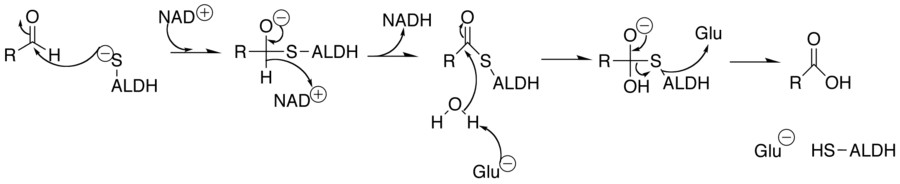 |
A sulfur
Sulfur
Sulfur or sulphur is the chemical element with atomic number 16. In the periodic table it is represented by the symbol S. It is an abundant, multivalent non-metal. Under normal conditions, sulfur atoms form cyclic octatomic molecules with chemical formula S8. Elemental sulfur is a bright yellow...
from a cysteine in the active site makes a nucleophilic attack on the carbonyl
Carbonyl
In organic chemistry, a carbonyl group is a functional group composed of a carbon atom double-bonded to an oxygen atom: C=O. It is common to several classes of organic compounds, as part of many larger functional groups....
carbon of the aldehyde. The hydrogen is kicked off as a hydride
Hydride
In chemistry, a hydride is the anion of hydrogen, H−, or, more commonly, a compound in which one or more hydrogen centres have nucleophilic, reducing, or basic properties. In compounds that are regarded as hydrides, hydrogen is bonded to a more electropositive element or group...
and attacks NAD(P)+ to make NAD(P)H. The enzyme's active site then goes through an isomorphic change whereby the NAD(P)H is moved, creating room for a water molecule to access the substrate. The water is primed by a glutamate in the active site, and the water makes a nucleophilic attack on the carbonyl carbon, kicking off the sulfur as a leaving group
Leaving group
In chemistry, a leaving group is a molecular fragment that departs with a pair of electrons in heterolytic bond cleavage. Leaving groups can be anions or neutral molecules. Common anionic leaving groups are halides such as Cl−, Br−, and I−, and sulfonate esters, such as para-toluenesulfonate...
.
Pathology
ALDH2 plays a crucial role in maintaining low blood levels of acetaldehyde during alcohol oxidation. In this pathway, the intermediate structures can be toxic, and health problems arise when those intermediates cannot be cleared. When high levels of acetaldehyde occur in the blood, facial flushing, light headedness, palpitations, nausea, and general “hangover” symptoms occur. These symptoms are indicative of a disease known as “Asian Flush” or “Oriental Flushing Syndrome”.There is a mutant form of aldehyde dehydrogenase, termed ALDH2*2, wherein a lysine
Lysine
Lysine is an α-amino acid with the chemical formula HO2CCH4NH2. It is an essential amino acid, which means that the human body cannot synthesize it. Its codons are AAA and AAG....
residue replaces a glutamate in the active site at position 487 of ALDH2. Homozygous individuals with the mutant allele have almost no ALDH2 activity, and those heterozygous for the mutation have reduced activity. Thus, the mutation is partially dominant. The ineffective homozygous allele
Allele
An allele is one of two or more forms of a gene or a genetic locus . "Allel" is an abbreviation of allelomorph. Sometimes, different alleles can result in different observable phenotypic traits, such as different pigmentation...
works at a rate of about 8% of the normal allele, for it shows a higher km for NAD+ and has a higher maximum velocity than the wild-type allele. This mutation is common in Japan, where 41% of a non-alcoholic control group were ALDH2 deficient, where only 2-5% of an alcoholic group were ALDH2-deficient. In Taiwan, the numbers are similar, with 30% of the control group showing the deficiency and 6% of alcoholics displaying it. The deficiency is manifested by slow acetaldehyde removal, with low alcohol tolerance perhaps leading to a lower frequency of alcoholism.
These symptoms are the same as those observed in people who drink while being treated by the drug disulfiram
Disulfiram
Disulfiram is a drug discovered in the 1920s and used to support the treatment of chronic alcoholism by producing an acute sensitivity to alcohol. Trade names for disulfiram in different countries are Antabuse and Antabus manufactured by Odyssey Pharmaceuticals...
, which is why it is used to treat alcoholism. The patients show higher blood levels of acetaldehyde, and become violently ill upon consumption of even small amounts of alcohol. Several drugs (e.g., metronidazole) cause a similar reaction known as "disulfiram-like reaction."
Yokoyama et al. found that decreased enzyme activity of aldehyde dehydrogenase-2, caused by the mutated ALDH2 allele, contributes to a higher chance of esophageal
Esophageal
Esophageal can refer to:* The esophagus* Esophageal arteries* Esophageal glands...
and oropharyngolaryngeal cancers. The metabolized acetaldehyde in the blood, which is six times higher than in individuals without the mutation, has shown to be a carcinogen in lab animals. ALDH2*2 is associated with increased odds of oropharyngolaryngeal, esophageal, gastric, colon, and lung cancer. However, they found no connection between increased levels of ALDH2*2 in the blood and an increased risk of liver cancer.
Genes
- ALDH1A1ALDH1A1Aldehyde dehydrogenase 1 family, member A1 also known as ALDH1A1 is an enzyme that in humans is encoded by the ALDH1A1 gene.- Function :...
, ALDH1A2ALDH1A2Retinaldehyde dehydrogenase 2 is an enzyme that in humans is encoded by the ALDH1A2 gene.-Further reading:...
, ALDH1A3ALDH1A3Aldehyde dehydrogenase 1 family, member A3 also known as ALDH1A3 is an enzyme that in humans is encoded by the ALDH1A3 gene,- Function :...
, ALDH1B1ALDH1B1Aldehyde dehydrogenase X, mitochondrial is an enzyme that in humans is encoded by the ALDH1B1 gene.-Further reading:...
, ALDH1L1ALDH1L110-formyltetrahydrofolate dehydrogenase is an enzyme that in humans is encoded by the ALDH1L1 gene.-Further reading:...
, ALDH1L2ALDH1L2Aldehyde dehydrogenase 1 family, member L2 also known as ALDH1L2 is an enzyme that in humans is encoded by the ALDH1L2 gene. ALDH1L2 is an aldehyde dehydrogenase.... - ALDH2ALDH2Aldehyde dehydrogenase 2 family , also known as ALDH2, is a human gene found on chromosome 12.-Function:The enzyme encoded by this gene belongs to the aldehyde dehydrogenase family of enzymes that catalyze the chemical transformation from acetaldehyde to acetic acid...
- ALDH3A1ALDH3A1Aldehyde dehydrogenase, dimeric NADP-preferring is an enzyme that in humans is encoded by the ALDH3A1 gene.Aldehyde dehydrogenases oxidize various aldehydes to the corresponding acids. They are involved in the detoxification of alcohol-derived acetaldehyde and in the metabolism of corticosteroids,...
, ALDH3A2, ALDH3B1ALDH3B1Aldehyde dehydrogenase 3 family, member B1 also known as ALDH3B1 is an enzyme that in humans is encoded by the ALDH3B1 gene.- Function :...
, ALDH3B2ALDH3B2Aldehyde dehydrogenase family 3 member B2 is an enzyme that in humans is encoded by the ALDH3B2 gene.-Further reading:... - ALDH4A1ALDH4A1Delta-1-pyrroline-5-carboxylate dehydrogenase, mitochondrial is an enzyme that in humans is encoded by the ALDH4A1 gene.-Further reading:...
, ALDH5A1 , ALDH6A1ALDH6A1Methylmalonate-semialdehyde dehydrogenase [acylating], mitochondrial is an enzyme that in humans is encoded by the ALDH6A1 gene.-Further reading:...
, ALDH7A1ALDH7A1Aldehyde dehydrogenase 7 family, member A1 also known as ALDH7A1 or antiquitin is an enzyme that in humans is encoded by the ALDH7A1 gene.-Function:...
, ALDH8A1ALDH8A1Aldehyde dehydrogenase 8 family, member A1 also known as ALDH8A1 is an enzyme that in humans is encoded by the ALDH8A1 gene.- Function :...
, ALDH9A1ALDH9A14-trimethylaminobutyraldehyde dehydrogenase is an enzyme that in humans is encoded by the ALDH9A1 gene.-Further reading:...
, ALDH16A1ALDH16A1Aldehyde dehydrogenase 16 family, member A1 also known as ALDH16A1 is an aldehyde dehydrogenase gene.- Clinical significance :Mutations in the SPG21 gene are associated with the mast syndrome, a type of spastic paraplegia. The protein encoded by the SPG21 gene has been shown to interact with the...
, ALDH18A1ALDH18A1Delta-1-pyrroline-5-carboxylate synthetase is an enzyme that in humans is encoded by the ALDH18A1 gene.-Further reading:...