
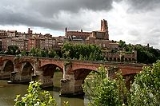
Albi is a commune in southern France. It is the
prefectureA prefecture is an administrative jurisdiction or subdivision in any of various countries and within some international church structures, and in antiquity a Roman district governed by an appointed prefect.-Antiquity:...
of the Tarn department. It is located on the
River TarnThe Tarn is a long river in southern France , right tributary of the Garonne.The Tarn runs in a roughly westerly direction, from its source at an altitude of 1,550 m on Mont Lozère in the Cévennes mountains , through the deep gorges and canyons of the Gorges du Tarn The Tarn is a long...
, c. 85 km northeast of
ToulouseToulouse is a city in the Haute-Garonne department in southwestern FranceIt lies on the banks of the River Garonne, 590 km away from Paris and half-way between the Atlantic Ocean and the Mediterranean Sea...
. Its inhabitants are called
Albigensians . It was the seat of the Archbishop of Albi and is the seat of the
DioceseA diocese is the district or see under the supervision of a bishop. It is divided into parishes.An archdiocese is more significant than a diocese. An archdiocese is presided over by an archbishop whose see may have or had importance due to size or historical significance...
of Albi. The episcopal city, situated in the center of the actual city, around the
cathedralAlbi Cathedral, formally the Cathedral of Saint Cecilia , is the most important religious building in Albi, southern France, and the seat of the Archbishop of Albi...
, was added to the
UNESCOThe United Nations Educational, Scientific and Cultural Organization is a specialized agency of the United Nations...
list of World Heritage Sites in 2010.
Administration
Albi is the seat of 6 cantons, covering 18 communes, with a total population of 67,729.
History
The first human settlement in Albi was in the
Bronze AgeThe Bronze Age is a period characterized by the use of copper and its alloy bronze as the chief hard materials in the manufacture of some implements and weapons. Chronologically, it stands between the Stone Age and Iron Age...
(3000-600 BC). After the
RomanAncient Rome was a thriving civilization that grew on the Italian Peninsula as early as the 8th century BC. Located along the Mediterranean Sea and centered on the city of Rome, it expanded to one of the largest empires in the ancient world....
conquest of
GaulGaul was a region of Western Europe during the Iron Age and Roman era, encompassing present day France, Luxembourg and Belgium, most of Switzerland, the western part of Northern Italy, as well as the parts of the Netherlands and Germany on the left bank of the Rhine. The Gauls were the speakers of...
in 51 BC, the town became
Civitas Albigensium, the territory of the Albigeois,
Albiga. Archaeological digs have not revealed any traces of Roman buildings, which seems to indicate that Albi was a modest Roman settlement.
In 1040, Albi expanded and constructed the
Pont Vieux (Old Bridge). New quarters were built, indicative of considerable urban growth. The city grew rich at this time, thanks to trade and commercial exchanges, and also to the tolls charged to travelers for using the Pont Vieux.
In 1208, the Pope and the French king joined forces to combat the Cathars, who had developed their own version of Christianity (a heresy considered dangerous by the dominant Catholic Church). Repression was severe, and many Cathars were burnt at the stake throughout the region. The area, until then virtually independent, was reduced to such a condition that it was subsequently annexed by the French Crown.
After the upheaval of the
Albigensian CrusadeThe Albigensian Crusade or Cathar Crusade was a 20-year military campaign initiated by the Catholic Church to eliminate Catharism in Languedoc...
against the Cathars, the bishop
Bernard de CastanetBernard de Castanet was the bishop of the Diocese of Albi from 1276 to 1308. While bishop Castenet was involved in a struggle with the local landowners to preserve his temporal power...
, in the late 13th century, completed work on the Palais de la Berbie, a Bishops' Palace with the look of a fortress. He ordered the building of the cathedral of Sainte-Cécile starting in 1282. The town enjoyed a period of commercial prosperity largely due to the cultivation of
Isatis Tinctoria, commonly known as
woadIsatis tinctoria, with Woad as the common name, is a flowering plant in the family Brassicaceae. It is commonly called dyer's woad, and sometimes incorrectly listed as Isatis indigotica . It is occasionally known as Asp of Jerusalem...
. The fine houses built during the
RenaissanceThe Renaissance was a cultural movement that spanned roughly the 14th to the 17th century, beginning in Italy in the Late Middle Ages and later spreading to the rest of Europe. The term is also used more loosely to refer to the historical era, but since the changes of the Renaissance were not...
bear witness to the vast fortunes amassed by the pastel merchants.
Albi has conserved its rich architectural heritage which encapsulates the various brilliant periods of its history. Considerable improvement and restoration work has been done, to embellish the old quarters and to give them a new look, in which brick reigns supreme.
Main sights
Albi was built around the original cathedral and episcopal group of buildings. This historic area covers 63 hectares. Red brick and tiles are the main feature of most of the edifices. Along with
ToulouseToulouse is a city in the Haute-Garonne department in southwestern FranceIt lies on the banks of the River Garonne, 590 km away from Paris and half-way between the Atlantic Ocean and the Mediterranean Sea...
and
MontaubanMontauban is a commune in the Tarn-et-Garonne department in the Midi-Pyrénées region in southern France. It is the capital of the department and lies north of Toulouse....
, Albi is one of the main cities built in
LanguedocLanguedoc is a former province of France, now continued in the modern-day régions of Languedoc-Roussillon and Midi-Pyrénées in the south of France, and whose capital city was Toulouse, now in Midi-Pyrénées. It had an area of approximately 42,700 km² .-Geographical Extent:The traditional...
-style red brick.
Among the buildings of the town is the
Sainte Cécile cathedralAlbi Cathedral, formally the Cathedral of Saint Cecilia , is the most important religious building in Albi, southern France, and the seat of the Archbishop of Albi...
, a masterpiece of the Southern
GothicGothic architecture is a style of architecture that flourished during the high and late medieval period. It evolved from Romanesque architecture and was succeeded by Renaissance architecture....
style, built between the 13th and 15th centuries. It is characterised by a strong contrast between its austere, defensive exterior and its sumptuous interior decoration. Built as a statement of the Christian faith after the upheavals of the
CatharCatharism was a name given to a Christian religious sect with dualistic and gnostic elements that appeared in the Languedoc region of France and other parts of Europe in the 11th century and flourished in the 12th and 13th centuries...
heresy, this gigantic brick structure was embellished over the centuries: the
Dominique de Florence Doorway, the 78 m high bell tower, the Baldaquin over the entrance (1515–1540). The
rood screenThe rood screen is a common feature in late medieval church architecture. It is typically an ornate partition between the chancel and nave, of more or less open tracery constructed of wood, stone, or wrought iron...
is a filigree work in stone in the Flamboyant Gothic style. It is decorated with a magnificent group of polychrome statuary carved by artists from the Burgundian workshops of
ClunyCluny or Clungy is a commune in the Saône-et-Loire department in the region of Bourgogne in eastern France. It is 20 km northwest of Mâcon.The town grew up around the Benedictine Cluny Abbey, founded by Duke William I of Aquitaine in 910...
and comprising over 200 statues, which have retained their original colours.
Older than the
Palais des PapesThe Palais des Papes is a historical palace in Avignon, southern France, one of the largest and most important medieval Gothic buildings in Europe....
in
AvignonAvignon is a French commune in southeastern France in the départment of the Vaucluse bordered by the left bank of the Rhône river. Of the 94,787 inhabitants of the city on 1 January 2010, 12 000 live in the ancient town centre surrounded by its medieval ramparts.Often referred to as the...
, the
Palais de la Berbie, formerly the Bishops'
PalaceA palace is a grand residence, especially a royal residence or the home of a head of state or some other high-ranking dignitary, such as a bishop or archbishop. The word itself is derived from the Latin name Palātium, for Palatine Hill, one of the seven hills in Rome. In many parts of Europe, the...
of Albi, now the Toulouse-Lautrec Museum, is one of the oldest and best-preserved castles in France. This imposing fortress was completed at the end of the 13th century. Its name comes from the Occitan word
Bisbia, meaning Bishops' Palace.
The Old Bridge (
Pont Vieux) is still in use after almost a millennium. Originally built in stone (in 1035), then clad with brick, it rests on eight arches and is 151 m long. In the 14th century, it was fortified and reinforced with a drawbridge, and houses were built on the piers.
Albi is a city known for its elite
Lycée Lapérouse, a high school with 500 students situated inside an old monastery. It has several advanced literature classes. Furthermore, it is one of the few holding a full-scale music section with special high-tech rooms for this section.
Albi is the home of the Toulouse-Lautrec Museum . More than 1000 works, including the 31 famous posters, are held here. This body of work forms the largest public collection in the world devoted to Toulouse-Lautrec.
A World Heritage Site
Climate
Albi experiences an
oceanic climateAn oceanic climate, also called marine west coast climate, maritime climate, Cascadian climate and British climate for Köppen climate classification Cfb and subtropical highland for Köppen Cfb or Cwb, is a type of climate typically found along the west coasts at the middle latitudes of some of the...
(
Köppen climate classificationThe Köppen climate classification is one of the most widely used climate classification systems. It was first published by Crimea German climatologist Wladimir Köppen in 1884, with several later modifications by Köppen himself, notably in 1918 and 1936...
Cfb). Like much of southwestern France, the summers tend to be warmer and the winters milder than most areas of similar classification. Substantial summer rainfall prevents its climate from being classified as Mediterranean.
Transport
Albi is served by two train stations on the line from Toulouse to Rodez:
- Gare d'Albi-Ville
Albi-Ville is a railway station in Albi, Midi-Pyrénées, France. It is situated on the Toulouse to Rodez railway line.-Train Services:The following services currently call at Albi-Ville:*night services Paris - Orléans - Figeac - Rodez - Albi...
- Gare d'Albi-Madeleine
Albi-Madeleine is a railway station in Albi, Midi-Pyrénées, France. The original station opened in 1857 and the current station opened in 1899. It is situated on the Toulouse to Rodez railway line...
.
The
A68The A68 autoroute is a motorway in southern France. It connects Toulouse to Albi. It starts with a junction with the A61 and a junction with the A20 and the N20...
motorway connects Albi with Toulouse (and Lyon N 88 , future motorway).
Sport
- SC Albi
Sporting Club Albigeois is a professional French rugby union club playing the second-level Rugby Pro D2. During the past years it went back and forth between Top 14, the highest level of the French league system and the second-level Rugby Pro D2. Their last time in the Top 14 was for 2009–10 after...
– The city's rugby unionRugby union, often simply referred to as rugby, is a full contact team sport which originated in England in the early 19th century. One of the two codes of rugby football, it is based on running with the ball in hand...
team competing in the second-level Rugby Pro D2Rugby Pro D2, also known as Pro D2 is the second level of domestic club rugby union in France, below the first division, Top 14. The competition was introduced in 2000. There is relegation and promotion between both the Top 14 and Fédérale 1, the third-level competition...
.
- RC Albi
RC Albi XIII is a French rugby league club in the Elite Two Championship. They are based in Albi, Tarn.- Club honours :* French championship : 1938, 1956, 1958, 1962, 1977* Runners-up : 1960* French cup : 1974...
– A rugby leagueRugby league football, usually called rugby league, is a full contact sport played by two teams of thirteen players on a rectangular grass field. One of the two codes of rugby football, it originated in England in 1895 by a split from Rugby Football Union over paying players...
team that compete in the Elite Two ChampionshipThe Elite Two Championship is the second tier semi-professional rugby league competition in France below the Elite One Championship, but above the National Division East and West....
.
- Albi held Stage 13 of the 2007 Tour de France
The 2007 Tour de France, the 94th running of the race, took place from 7 July to 29 July 2007. The Tour began with a prologue in London, and ended with the traditional finish in Paris. Along the way, the route also passed through Belgium and Spain...
. The stage was a 55 km (34.2 mi) individual time trial which started and finished in the city.
- Circuit d'Albi
The Circuit d'Albi is an auto racing circuit near the small South Western French town of Le Séquestre. The circuit has 70 years of history in motor-racing .- External links :**...
, a motor racing circuit used for national racing surrounding Albi's airport.
Twin towns — sister cities
Albi is twinned with:
| Girona Girona is a city in the northeast of Catalonia, Spain at the confluence of the rivers Ter, Onyar, Galligants and Güell, with an official population of 96,236 in January 2009. It is the capital of the province of the same name and of the comarca of the Gironès... , SpainSpain , officially the Kingdom of Spain languages]] under the European Charter for Regional or Minority Languages. In each of these, Spain's official name is as follows:;;;;;;), is a country and member state of the European Union located in southwestern Europe on the Iberian Peninsula... Palo AltoPalo Alto is a California charter city located in the northwest corner of Santa Clara County, in the San Francisco Bay Area of California, United States. The city shares its borders with East Palo Alto, Mountain View, Los Altos, Los Altos Hills, Stanford, Portola Valley, and Menlo Park. It is... , United StatesThe United States of America is a federal constitutional republic comprising fifty states and a federal district... Randwick City Council, Australia AbomeyWhen UNESCO designated the royal palaces of Abomey as a World Heritage Site in 1985 it statedFrom 1993, 50 of the 56 bas-reliefs that formerly decorated the walls of King Glèlè have been located and replaced on the rebuilt structure... , BeninBenin , officially the Republic of Benin, is a country in West Africa. It borders Togo to the west, Nigeria to the east and Burkina Faso and Niger to the north. Its small southern coastline on the Bight of Benin is where a majority of the population is located...
|
See also
- Communes of the Tarn department
- Lion and Sun#Other (non-Iranian) variants
- Tourism in Tarn
From the Gaillac Vineyard to the Sidobre, the Montagne Noire and the stunning Gorges du Tarn, the Tarn department, in the southwest of France, offers a great range of sights and tourist attractions.-Statistics:In 2009, there were :...
External links