

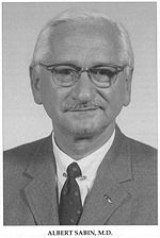
Albert Sabin

Encyclopedia
Albert Bruce Sabin was an American
medical researcher best known for having developed an oral polio vaccine
.
, to Jewish parents, Jacob and Tillie Saperstein. In 1921 he immigrated with his family to America. In 1930 he became a naturalized citizen of the United States
and changed his name to Sabin.
Sabin received a medical degree from New York University
in 1931. He trained in internal medicine, pathology and surgery at Bellevue Hospital in New York City from 1931-1933. In 1934 he conducted research at The Lister Institute for Preventive Medicine in England, then joined the Rockefeller Institute for Medical Research (now Rockefeller University
). During this time he developed an intense interest in research, especially in the area of infectious diseases. In 1939 he moved to Cincinnati Children's Hospital
in Cincinnati, Ohio
. During World War II he was a lieutenant colonel in the U.S. Army Medical Corps
and helped develop a vaccine against Japanese encephalitis
. Maintaining his association with Children's Hospital, by 1946 he had also become the head of Pediatric Research at the University of Cincinnati
. At Cincinnati's Children's Hospital, Sabin supervised the fellowship
of Robert M. Chanock
, whom he called his "star scientific son."
In 1969-1972 he lived and worked in Israel
as the President of Weizmann Institute of Science
in Rehovot
. After his return to the United States he worked (1974–1982) as a Research Professor at the Medical University of South Carolina
. He later moved to Washington, D.C.
area where he was a Resident Scholar at the John E. Fogarty International Center
on NIH campus in Bethesda, MD.
in Pittsburgh and Hilary Koprowski
and Herald Cox in New York and Philadelphia, sought a vaccine to prevent or mitigate the illness. An oral vaccine, the Sabin vaccine consists of weakened forms of the viruses that cause polio. It protects the body against polio without causing the disease. In 1955, Salk's "killed" vaccine was released for use. It was effective in preventing most of the complications of polio, but did not prevent the initial, intestinal infection. The Sabin vaccine is easier to give than the earlier vaccine, developed by Jonas E. Salk in 1954, and its effects last longer. In addition, those who received the Salk vaccine could pass on the polio virus. Sabin first tested his live attenuated oral vaccine at the Chillicothe Ohio Reformatory in late 1954. From 1956-1960 he worked with Russian colleagues to perfect the oral vaccine and prove its extraordinary effectiveness and safety. The Sabin vaccine worked in the intestines to block the poliovirus from entering the bloodstream. It was in the intestines, Sabin had discovered, that the poliovirus multiplied and attacked. Thus, the oral vaccine broke the chain of transmission of the virus and allowed for the possibility that polio might one day be eradicated.
Between 1955-1961, the oral vaccine was tested on at least 100 million people in the USSR, parts of Eastern Europe, Singapore, Mexico and the Netherlands. The first industrial production and mass use of Oral Poliovirus Vaccine (OPV) from Sabin strains was organized by Soviet scientist Mikhail Chumakov
. This provided the critical impetus for allowing large scale clinical trial of OPV in the United States in April 1960 on 180,000 Cincinnati school children. The mass immunization techniques that Sabin pioneered with his associates effectively eradicated polio in Cincinnati. Against considerable opposition from The March of Dimes Foundation, which supported the relatively effective killed vaccine, Sabin prevailed on the Public Health Service to license his three strains of vaccine. While the PHS stalled, the USSR sent millions of doses of the oral vaccine to places with polio epidemics, such as Japan, and reaped the humanitarian benefit. Indeed it was not clear to many that the vaccine was an American one, financed by US dollars, but not available to ordinary Americans.
Sabin also developed vaccines against other viruse diseases, including encephalitis and dengue. In addition, he has investigated possible links between viruses and some forms of cancer.
In 1983, Sabin developed calcification of the cervical spine, which caused paralysis and intense pain. According to Keith Olbermann
, Sabin revealed in a television interview that the experience had made him decide to spend the rest of his life working on alleviating pain. This condition was successfully treated by surgery conducted at Johns Hopkins Hospital
in 1992 when Sabin was 86. A year later Sabin died in Washington, D.C.
from heart failure.
United States
The United States of America is a federal constitutional republic comprising fifty states and a federal district...
medical researcher best known for having developed an oral polio vaccine
Polio vaccine
Two polio vaccines are used throughout the world to combat poliomyelitis . The first was developed by Jonas Salk and first tested in 1952. Announced to the world by Salk on April 12, 1955, it consists of an injected dose of inactivated poliovirus. An oral vaccine was developed by Albert Sabin...
.
Life
Sabin was born in Białystok, PolandPoland
Poland , officially the Republic of Poland , is a country in Central Europe bordered by Germany to the west; the Czech Republic and Slovakia to the south; Ukraine, Belarus and Lithuania to the east; and the Baltic Sea and Kaliningrad Oblast, a Russian exclave, to the north...
, to Jewish parents, Jacob and Tillie Saperstein. In 1921 he immigrated with his family to America. In 1930 he became a naturalized citizen of the United States
United States
The United States of America is a federal constitutional republic comprising fifty states and a federal district...
and changed his name to Sabin.
Sabin received a medical degree from New York University
New York University
New York University is a private, nonsectarian research university based in New York City. NYU's main campus is situated in the Greenwich Village section of Manhattan...
in 1931. He trained in internal medicine, pathology and surgery at Bellevue Hospital in New York City from 1931-1933. In 1934 he conducted research at The Lister Institute for Preventive Medicine in England, then joined the Rockefeller Institute for Medical Research (now Rockefeller University
Rockefeller University
The Rockefeller University is a private university offering postgraduate and postdoctoral education. It has a strong concentration in the biological sciences. It is also known for producing numerous Nobel laureates...
). During this time he developed an intense interest in research, especially in the area of infectious diseases. In 1939 he moved to Cincinnati Children's Hospital
Cincinnati Children's Hospital Medical Center
Cincinnati Children's Hospital Medical Center is a 523-bed pediatric hospital located in Cincinnati, Ohio. It is currently ranked the third-best pediatric medical center in the United States by US News and World Report...
in Cincinnati, Ohio
Cincinnati, Ohio
Cincinnati is a city in the U.S. state of Ohio. Cincinnati is the county seat of Hamilton County. Settled in 1788, the city is located to north of the Ohio River at the Ohio-Kentucky border, near Indiana. The population within city limits is 296,943 according to the 2010 census, making it Ohio's...
. During World War II he was a lieutenant colonel in the U.S. Army Medical Corps
Medical Corps (United States Army)
The Medical Corps of the U.S. Army is a staff corps of the U.S. Army Medical Department consisting of commissioned medical officers – physicians with either an MD or a DO degree, at least one year of post-graduate clinical training, and a state medical license.The MC traces its earliest origins...
and helped develop a vaccine against Japanese encephalitis
Japanese Encephalitis
Japanese encephalitis —previously known as Japanese B encephalitis to distinguish it from von Economo's A encephalitis—is a disease caused by the mosquito-borne Japanese encephalitis virus. The Japanese encephalitis virus is a virus from the family Flaviviridae. Domestic pigs and wild birds are...
. Maintaining his association with Children's Hospital, by 1946 he had also become the head of Pediatric Research at the University of Cincinnati
University of Cincinnati
The University of Cincinnati is a comprehensive public research university in Cincinnati, Ohio, and a part of the University System of Ohio....
. At Cincinnati's Children's Hospital, Sabin supervised the fellowship
Fellowship (medicine)
A fellowship is the period of medical training in the United States and Canada that a physician may undertake after completing a specialty training program . During this time , the physician is known as a fellow...
of Robert M. Chanock
Robert M. Chanock
Robert Merritt Chanock was an American pediatrician and virologist who made major contributions to the prevention and treatment of childhood respiratory infections in more than 50 years spent at the National Institute of Allergy and Infectious Diseases.Chanock was born July 8, 1924 in Chicago. His...
, whom he called his "star scientific son."
In 1969-1972 he lived and worked in Israel
Israel
The State of Israel is a parliamentary republic located in the Middle East, along the eastern shore of the Mediterranean Sea...
as the President of Weizmann Institute of Science
Weizmann Institute of Science
The Weizmann Institute of Science , known as Machon Weizmann, is a university and research institute in Rehovot, Israel. It differs from other Israeli universities in that it offers only graduate and post-graduate studies in the sciences....
in Rehovot
Rehovot
Rehovot is a city in the Center District of Israel, about south of Tel Aviv. According to the Israel Central Bureau of Statistics , at the end of 2009 the city had a total population of 112,700. Rehovot's official website estimates the population at 114,000.Rehovot was built on the site of Doron,...
. After his return to the United States he worked (1974–1982) as a Research Professor at the Medical University of South Carolina
Medical University of South Carolina
The Medical University of South Carolina opened in Charleston, South Carolina in 1824 as a small private college for the training of physicians. It is one of the oldest continually operating school of medicine in the United States and the oldest in the Deep South...
. He later moved to Washington, D.C.
Washington, D.C.
Washington, D.C., formally the District of Columbia and commonly referred to as Washington, "the District", or simply D.C., is the capital of the United States. On July 16, 1790, the United States Congress approved the creation of a permanent national capital as permitted by the U.S. Constitution....
area where he was a Resident Scholar at the John E. Fogarty International Center
John E. Fogarty International Center
The John E. Fogarty International Center is part of the federal government of the United States and is the only arm of the National Institutes of Health whose sole mission is to support global health. It is one of the 27 component organizations of the NIH, which is in turn part of the U.S....
on NIH campus in Bethesda, MD.
Polio Research
With the menace of polio growing, Sabin and other researchers, most notably Jonas SalkJonas Salk
Jonas Edward Salk was an American medical researcher and virologist, best known for his discovery and development of the first safe and effective polio vaccine. He was born in New York City to parents from Ashkenazi Jewish Russian immigrant families...
in Pittsburgh and Hilary Koprowski
Hilary Koprowski
Hilary Koprowski is a Polish virologist and immunologist, and inventor of the world's first effective live polio vaccine.-Life:...
and Herald Cox in New York and Philadelphia, sought a vaccine to prevent or mitigate the illness. An oral vaccine, the Sabin vaccine consists of weakened forms of the viruses that cause polio. It protects the body against polio without causing the disease. In 1955, Salk's "killed" vaccine was released for use. It was effective in preventing most of the complications of polio, but did not prevent the initial, intestinal infection. The Sabin vaccine is easier to give than the earlier vaccine, developed by Jonas E. Salk in 1954, and its effects last longer. In addition, those who received the Salk vaccine could pass on the polio virus. Sabin first tested his live attenuated oral vaccine at the Chillicothe Ohio Reformatory in late 1954. From 1956-1960 he worked with Russian colleagues to perfect the oral vaccine and prove its extraordinary effectiveness and safety. The Sabin vaccine worked in the intestines to block the poliovirus from entering the bloodstream. It was in the intestines, Sabin had discovered, that the poliovirus multiplied and attacked. Thus, the oral vaccine broke the chain of transmission of the virus and allowed for the possibility that polio might one day be eradicated.
Between 1955-1961, the oral vaccine was tested on at least 100 million people in the USSR, parts of Eastern Europe, Singapore, Mexico and the Netherlands. The first industrial production and mass use of Oral Poliovirus Vaccine (OPV) from Sabin strains was organized by Soviet scientist Mikhail Chumakov
Mikhail Chumakov
Mikhail Petrovich Chumakov was a Soviet microbiologist and virologist most famous for conducting pivotal large-scale clinical trials that led to licensure of Oral Polio Vaccine developed by Albert B. Sabin....
. This provided the critical impetus for allowing large scale clinical trial of OPV in the United States in April 1960 on 180,000 Cincinnati school children. The mass immunization techniques that Sabin pioneered with his associates effectively eradicated polio in Cincinnati. Against considerable opposition from The March of Dimes Foundation, which supported the relatively effective killed vaccine, Sabin prevailed on the Public Health Service to license his three strains of vaccine. While the PHS stalled, the USSR sent millions of doses of the oral vaccine to places with polio epidemics, such as Japan, and reaped the humanitarian benefit. Indeed it was not clear to many that the vaccine was an American one, financed by US dollars, but not available to ordinary Americans.
Sabin also developed vaccines against other viruse diseases, including encephalitis and dengue. In addition, he has investigated possible links between viruses and some forms of cancer.
Sabin vs. Salk vaccine controversy
Sabin vehemently opposed the use of the Salk inactivated vaccine and attempted to block its use.In 1983, Sabin developed calcification of the cervical spine, which caused paralysis and intense pain. According to Keith Olbermann
Keith Olbermann
Keith Theodore Olbermann is an American political commentator and writer. He has been the chief news officer of the Current TV network and the host of Current TV's weeknight political commentary program, Countdown with Keith Olbermann, since June 20, 2011...
, Sabin revealed in a television interview that the experience had made him decide to spend the rest of his life working on alleviating pain. This condition was successfully treated by surgery conducted at Johns Hopkins Hospital
Johns Hopkins Hospital
The Johns Hopkins Hospital is the teaching hospital and biomedical research facility of Johns Hopkins University School of Medicine, located in Baltimore, Maryland . It was founded using money from a bequest by philanthropist Johns Hopkins...
in 1992 when Sabin was 86. A year later Sabin died in Washington, D.C.
Washington, D.C.
Washington, D.C., formally the District of Columbia and commonly referred to as Washington, "the District", or simply D.C., is the capital of the United States. On July 16, 1790, the United States Congress approved the creation of a permanent national capital as permitted by the U.S. Constitution....
from heart failure.
Honors
- Election to the Polio Hall of FamePolio Hall of FameThe Polio Hall of Fame consists of a linear grouping of sculptured busts of fifteen scientists and two laymen who made important contributions to the knowledge and treatment of poliomyelitis...
, which was dedicated in Warm Springs, GeorgiaWarm Springs, GeorgiaWarm Springs is a city in Meriwether County, Georgia, United States. The population was 478 at the 2010 census.-History:Warm Springs first came to prominence in the 19th century as a spa town, due to its mineral springs which flow constantly at nearly 32 °C...
, on January 2, 1958 - National Medal of ScienceNational Medal of ScienceThe National Medal of Science is an honor bestowed by the President of the United States to individuals in science and engineering who have made important contributions to the advancement of knowledge in the fields of behavioral and social sciences, biology, chemistry, engineering, mathematics and...
(1970) - Presidential Medal of FreedomPresidential Medal of FreedomThe Presidential Medal of Freedom is an award bestowed by the President of the United States and is—along with thecomparable Congressional Gold Medal bestowed by an act of U.S. Congress—the highest civilian award in the United States...
(1986) - In 1999, Cincinnati Children's Hospital Medical CenterCincinnati Children's Hospital Medical CenterCincinnati Children's Hospital Medical Center is a 523-bed pediatric hospital located in Cincinnati, Ohio. It is currently ranked the third-best pediatric medical center in the United States by US News and World Report...
named its new education and conference center for Sabin. - On March 6, 2006, the US Postal Service issued an 87¢ postage stampPostage stampA postage stamp is a small piece of paper that is purchased and displayed on an item of mail as evidence of payment of postage. Typically, stamps are made from special paper, with a national designation and denomination on the face, and a gum adhesive on the reverse side...
carrying his image, in its Distinguished Americans seriesDistinguished Americans seriesThe Distinguished Americans series is a set of definitive stamps issued by the United States Postal Service which was started in 2000 with a 10¢ stamp depicting Joseph Stilwell...
. - In early 2010, Sabin was proposed by the Ohio Historical SocietyOhio Historical SocietyThe Ohio Historical Society is a non-profit organization incorporated in 1885 as The Ohio State Archaeological and Historical Society "to promote a knowledge of archaeology and history, especially in Ohio"...
as a finalist in a statewide vote for inclusion in Statuary Hall at the United States CapitolUnited States CapitolThe United States Capitol is the meeting place of the United States Congress, the legislature of the federal government of the United States. Located in Washington, D.C., it sits atop Capitol Hill at the eastern end of the National Mall...
.
See also
- Polio vaccinePolio vaccineTwo polio vaccines are used throughout the world to combat poliomyelitis . The first was developed by Jonas Salk and first tested in 1952. Announced to the world by Salk on April 12, 1955, it consists of an injected dose of inactivated poliovirus. An oral vaccine was developed by Albert Sabin...
- Hilary KoprowskiHilary KoprowskiHilary Koprowski is a Polish virologist and immunologist, and inventor of the world's first effective live polio vaccine.-Life:...
- Mikhail ChumakovMikhail ChumakovMikhail Petrovich Chumakov was a Soviet microbiologist and virologist most famous for conducting pivotal large-scale clinical trials that led to licensure of Oral Polio Vaccine developed by Albert B. Sabin....
- Sabin Vaccine InstituteSabin Vaccine InstituteThe Sabin Vaccine Institute is a non-profit, 501 organization dedicated to reducing needless humansuffering from vaccine preventable and neglected tropical diseases through prevention and treatment...
- List of Poles