

Albert Gleizes

Encyclopedia
Albert Gleizes was a French painter. Born Albert Léon Gleizes and raised in Paris, he was the son of a fabric designer who ran a large industrial design workshop. He was also the nephew of Léon Comerre
, a successful portrait painter who won the 1875 Prix de Rome
.
The young Albert Gleizes did not like school and often skipped classes to idle away the time writing poetry and wandering through the nearby Montmartre cemetery. Finally, after completing his secondary schooling, Gleizes spent four years in the French army then began pursuing a career as a painter, primarily doing landscapes. Initially influenced by the Impressionists
, he was only twenty-one years of age when his work titled La Seine à Asnières was exhibited at the Société Nationale des Beaux-Arts in 1902.
In 1907 Gleizes and some of his friends pursued the idea of creating the Abbaye de Créteil
, a self-supporting community of artists which would allow them to develop their art free of any commercial concerns. For nearly a year, at a large house in Créteil
, Gleizes along with other painters, poets, musicians and writers, gathered to create. A lack of income forced them to give up their cherished Abbaye de Créteil in early 1908 and Gleizes moved temporarily into La Ruche
, the artist commune in the Montparnasse Quarter of Paris.
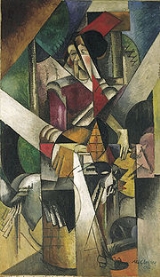
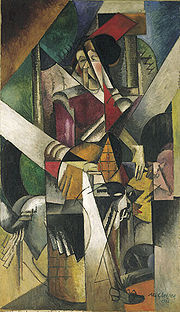
Gleizes' evolving cubism
saw him exhibit at the Salon des Indépendants in Paris in 1911 in a room together with Robert Delaunay
, Jean Metzinger
, Henri le Fauconnier
and Fernand Léger
. The result was a public scandal which brought Cubism for the first time to the attention of the general public (Picasso and Braque were exhibiting in a private gallery selling to a small circle of connoisseurs). Gleizes then collaborated with Jean Metzinger to produce a theoretical essay about cubism - Du "Cubisme" - that was published in 1912. In the fall of that year, he joined the Puteaux Group which met in the studio of Jacques Villon
(Gaston Duchamp) and also included Villon's brothers, Raymond Duchamp-Villon
and Marcel Duchamp
. In February 1913, Gleizes and other artists introduced the new style of painting to an American audience at the Armory Show in New York City
.
 With the outbreak of World War I
, Albert Gleizes re-enlisted in the French army. He was put in charge of organizing entertainment for the troops and as a result was approached by Jean Cocteau
to design the set and costumes for the William Shakespeare
play, A Midsummer Night's Dream
.
Discharged from the military in the fall of 1915, Gleizes and his new wife, Juliette Roche, the daughter of a prominent and wealthy French statesman, moved to New York City. From there, the couple sailed to Barcelona where they were joined by Marie Laurencin
plus Francis Picabia
and his wife. The group spent the summer painting at the resort area of Tossa del Mar and in December Gleizes had the first solo exhibition of his works at the Galeries Dalmau in Barcelona. Returning to New York city, Gleizes began writing poetic sketches in verse and in prose. Traveling to Bermuda
, he painted a number of landscapes but when the war in Europe ended he returned to France where his career evolved more towards teaching through writing and he became involved with the committee of the Unions Intellectuelles Françaises. In 1927, still dreaming of the communal days at the Abbaye de Créteil, he founded an artist's colony at a rented house called the Moly-Sabata in Sablons
near his wife's family home in Serrières in the Ardèche
département in the Rhône Valley.
In 1931, Gleizes was part of the committee of Abstraction-Création
that acted as a forum for international non-representational art
. By this time, his work reflected the strengthening of his religious convictions and his 1932 book, La Forme et l’histoire examines Celt
ic, Romanesque
, and Oriental art. On tour in Poland
and Germany
, he gave lectures titled Art et Religion, Art et Production and Art et Science and wrote a book on Robert Delaunay
but it was never published. In 1937, Gleizes was hired to paint murals for the Exposition Internationale des Arts et Techniques dans la Vie Moderne
at the Paris World’s Fair. He collaborated with Delaunay in the Pavillon de l'Air and with Léopold Survage
and Fernand Léger
for the Pavillon de l'Union des Artistes Modernes. At the end of 1938, Gleizes volunteered to participate in the free seminars and discussion groups for young painters set up by Robert Delaunay at his Paris studio.
In the late 1930s, the wealthy American art connoisseur Peggy Guggenheim
purchased a great deal of the new art in Paris including works by Albert Gleizes. She brought these works to the United States which today form part of the Peggy Guggenheim Collection
. During World War II
, Gleizes and his wife remained in France under the German occupation. His religious convictions deepened and at war's end he was hailed by some as having laid out the principles for a renewal of religious art. In 1948, Gleizes accepted an offer from a publisher in Casablanca
to create a series of etchings illustrating the Pensées sur l'Homme et Dieu of Blaise Pascal
. In 1951, he was made a jury member for the Prix de Rome and the government of France awarded him the Legion of Honor. In 1952, he did his last major work, a fresco titled Eucharist that he painted for a Jesuit
chapel in Chantilly
.
Albert Gleizes died in Avignon
in the Vaucluse
département on 23 June 1953 and was interred in his wife's family mausoleum in the cemetery at Serrières.
Léon Comerre
Léon François Comerre was a French academic painter, famous for his portraits of beautiful women.-Life:Comerre was born in Trélon, in the Département du Nord, the son of a schoolteacher. He moved to Lille with his family in 1853...
, a successful portrait painter who won the 1875 Prix de Rome
Prix de Rome
The Prix de Rome was a scholarship for arts students, principally of painting, sculpture, and architecture. It was created, initially for painters and sculptors, in 1663 in France during the reign of Louis XIV. It was an annual bursary for promising artists having proved their talents by...
.
The young Albert Gleizes did not like school and often skipped classes to idle away the time writing poetry and wandering through the nearby Montmartre cemetery. Finally, after completing his secondary schooling, Gleizes spent four years in the French army then began pursuing a career as a painter, primarily doing landscapes. Initially influenced by the Impressionists
Impressionism
Impressionism was a 19th-century art movement that originated with a group of Paris-based artists whose independent exhibitions brought them to prominence during the 1870s and 1880s...
, he was only twenty-one years of age when his work titled La Seine à Asnières was exhibited at the Société Nationale des Beaux-Arts in 1902.
In 1907 Gleizes and some of his friends pursued the idea of creating the Abbaye de Créteil
Abbaye de Créteil
The Abbaye de Créteil or Abbaye group was an utopian, artitstic and literary community founded in 1907...
, a self-supporting community of artists which would allow them to develop their art free of any commercial concerns. For nearly a year, at a large house in Créteil
Créteil
-Health:As of 1 January 2006, 27 pharmacies, about 60 dentists, about 60 general practitioners, 10 pediatricians, and a half-dozen ophthalmologists and dermatologists constitute the general medical staff of the city.Health facilities include:...
, Gleizes along with other painters, poets, musicians and writers, gathered to create. A lack of income forced them to give up their cherished Abbaye de Créteil in early 1908 and Gleizes moved temporarily into La Ruche
La Ruche
La Ruche is an artist's residence at the Paris South-Western outskirts.Located in the "Passage Dantzig," in the 15th arrondissement of Paris, La Ruche was an old three-storey circular structure that got its name because it looked more like a large beehive than any dwelling for humans...
, the artist commune in the Montparnasse Quarter of Paris.
Gleizes' evolving cubism
Cubism
Cubism was a 20th century avant-garde art movement, pioneered by Pablo Picasso and Georges Braque, that revolutionized European painting and sculpture, and inspired related movements in music, literature and architecture...
saw him exhibit at the Salon des Indépendants in Paris in 1911 in a room together with Robert Delaunay
Robert Delaunay
Robert Delaunay was a French artist who, with his wife Sonia Delaunay and others, cofounded the Orphism art movement, noted for its use of strong colours and geometric shapes. His later works were more abstract, reminiscent of Paul Klee...
, Jean Metzinger
Jean Metzinger
Jean Metzinger was a French painter.Metzinger was born in Nantes, France. Initially he was influenced by Fauvism and Impressionism, but from 1908 he was associated with Cubism. Metzinger was a member of the Section d'Or group of artists...
, Henri le Fauconnier
Henri Le Fauconnier
Henri Victor Gabriel Le Fauconnier was a French cubist painter born in Hesdin. He studied art in Paris at the Academie Julian and later exhibited with the Puteaux Group.He died in Paris....
and Fernand Léger
Fernand Léger
Joseph Fernand Henri Léger was a French painter, sculptor, and filmmaker. In his early works he created a personal form of Cubism which he gradually modified into a more figurative, populist style...
. The result was a public scandal which brought Cubism for the first time to the attention of the general public (Picasso and Braque were exhibiting in a private gallery selling to a small circle of connoisseurs). Gleizes then collaborated with Jean Metzinger to produce a theoretical essay about cubism - Du "Cubisme" - that was published in 1912. In the fall of that year, he joined the Puteaux Group which met in the studio of Jacques Villon
Jacques Villon
Jacques Villon was a French cubist painter and printmaker.-Early life:Born Gaston Emile Duchamp in Damville, Eure, in the Haute-Normandie region of France, he came from a prosperous and artistically inclined family...
(Gaston Duchamp) and also included Villon's brothers, Raymond Duchamp-Villon
Raymond Duchamp-Villon
Raymond Duchamp-Villon was a French sculptor.Duchamp-Villon was born Pierre-Maurice-Raymond Duchamp in Damville, Eure, in the Haute-Normandie region of France, the second son of Eugene and Lucie Duchamp. Of the six Duchamp children, four would become successful artists...
and Marcel Duchamp
Marcel Duchamp
Marcel Duchamp was a French artist whose work is most often associated with the Dadaist and Surrealist movements. Considered by some to be one of the most important artists of the 20th century, Duchamp's output influenced the development of post-World War I Western art...
. In February 1913, Gleizes and other artists introduced the new style of painting to an American audience at the Armory Show in New York City
New York City
New York is the most populous city in the United States and the center of the New York Metropolitan Area, one of the most populous metropolitan areas in the world. New York exerts a significant impact upon global commerce, finance, media, art, fashion, research, technology, education, and...
.
World War I
World War I , which was predominantly called the World War or the Great War from its occurrence until 1939, and the First World War or World War I thereafter, was a major war centred in Europe that began on 28 July 1914 and lasted until 11 November 1918...
, Albert Gleizes re-enlisted in the French army. He was put in charge of organizing entertainment for the troops and as a result was approached by Jean Cocteau
Jean Cocteau
Jean Maurice Eugène Clément Cocteau was a French poet, novelist, dramatist, designer, playwright, artist and filmmaker. His circle of associates, friends and lovers included Kenneth Anger, Pablo Picasso, Jean Hugo, Jean Marais, Henri Bernstein, Marlene Dietrich, Coco Chanel, Erik Satie, María...
to design the set and costumes for the William Shakespeare
William Shakespeare
William Shakespeare was an English poet and playwright, widely regarded as the greatest writer in the English language and the world's pre-eminent dramatist. He is often called England's national poet and the "Bard of Avon"...
play, A Midsummer Night's Dream
A Midsummer Night's Dream
A Midsummer Night's Dream is a play that was written by William Shakespeare. It is believed to have been written between 1590 and 1596. It portrays the events surrounding the marriage of the Duke of Athens, Theseus, and the Queen of the Amazons, Hippolyta...
.
Discharged from the military in the fall of 1915, Gleizes and his new wife, Juliette Roche, the daughter of a prominent and wealthy French statesman, moved to New York City. From there, the couple sailed to Barcelona where they were joined by Marie Laurencin
Marie Laurencin
Marie Laurencin was a French painter and printmaker. -Biography:Laurencin was born in Paris, where she was raised by her mother and lived much of her life. At 18, she studied porcelain painting in Sèvres...
plus Francis Picabia
Francis Picabia
Francis Picabia was a French painter, poet, and typographist, associated with both the Dada and Surrealist art movements.- Early life :...
and his wife. The group spent the summer painting at the resort area of Tossa del Mar and in December Gleizes had the first solo exhibition of his works at the Galeries Dalmau in Barcelona. Returning to New York city, Gleizes began writing poetic sketches in verse and in prose. Traveling to Bermuda
Bermuda
Bermuda is a British overseas territory in the North Atlantic Ocean. Located off the east coast of the United States, its nearest landmass is Cape Hatteras, North Carolina, about to the west-northwest. It is about south of Halifax, Nova Scotia, Canada, and northeast of Miami, Florida...
, he painted a number of landscapes but when the war in Europe ended he returned to France where his career evolved more towards teaching through writing and he became involved with the committee of the Unions Intellectuelles Françaises. In 1927, still dreaming of the communal days at the Abbaye de Créteil, he founded an artist's colony at a rented house called the Moly-Sabata in Sablons
Sablons
Sablons may refer to the following communes in France:*Sablons, Gironde, in the Gironde département*Sablons, Isère, in the Isère département...
near his wife's family home in Serrières in the Ardèche
Ardèche
Ardèche is a department in south-central France named after the Ardèche River.- History :The area has been inhabited by humans at least since the Upper Paleolithic, as attested by the famous cave paintings at Chauvet Pont d'Arc. The plateau of the Ardeche River has extensive standing stones ,...
département in the Rhône Valley.
In 1931, Gleizes was part of the committee of Abstraction-Création
Abstraction-Création
Abstraction-Création was a loose association of artists formed in Paris in 1931 to counteract the influence of the Surrealist group led by André Breton....
that acted as a forum for international non-representational art
Abstract art
Abstract art uses a visual language of form, color and line to create a composition which may exist with a degree of independence from visual references in the world. Western art had been, from the Renaissance up to the middle of the 19th century, underpinned by the logic of perspective and an...
. By this time, his work reflected the strengthening of his religious convictions and his 1932 book, La Forme et l’histoire examines Celt
Celt
The Celts were a diverse group of tribal societies in Iron Age and Roman-era Europe who spoke Celtic languages.The earliest archaeological culture commonly accepted as Celtic, or rather Proto-Celtic, was the central European Hallstatt culture , named for the rich grave finds in Hallstatt, Austria....
ic, Romanesque
Romanesque art
Romanesque art refers to the art of Western Europe from approximately 1000 AD to the rise of the Gothic style in the 13th century, or later, depending on region. The preceding period is increasingly known as the Pre-Romanesque...
, and Oriental art. On tour in Poland
Poland
Poland , officially the Republic of Poland , is a country in Central Europe bordered by Germany to the west; the Czech Republic and Slovakia to the south; Ukraine, Belarus and Lithuania to the east; and the Baltic Sea and Kaliningrad Oblast, a Russian exclave, to the north...
and Germany
Germany
Germany , officially the Federal Republic of Germany , is a federal parliamentary republic in Europe. The country consists of 16 states while the capital and largest city is Berlin. Germany covers an area of 357,021 km2 and has a largely temperate seasonal climate...
, he gave lectures titled Art et Religion, Art et Production and Art et Science and wrote a book on Robert Delaunay
Robert Delaunay
Robert Delaunay was a French artist who, with his wife Sonia Delaunay and others, cofounded the Orphism art movement, noted for its use of strong colours and geometric shapes. His later works were more abstract, reminiscent of Paul Klee...
but it was never published. In 1937, Gleizes was hired to paint murals for the Exposition Internationale des Arts et Techniques dans la Vie Moderne
Exposition Internationale des Arts et Techniques dans la Vie Moderne (1937)
The Exposition Internationale des Arts et Techniques dans la Vie Moderne was held from May 25 to November 25, 1937 in Paris, France...
at the Paris World’s Fair. He collaborated with Delaunay in the Pavillon de l'Air and with Léopold Survage
Léopold Survage
Léopold Survage was an important French painter of Russian-Danish-Finnish descent born in Vilmanstrand, Finland .-Biography:At a young age, Survage was...
and Fernand Léger
Fernand Léger
Joseph Fernand Henri Léger was a French painter, sculptor, and filmmaker. In his early works he created a personal form of Cubism which he gradually modified into a more figurative, populist style...
for the Pavillon de l'Union des Artistes Modernes. At the end of 1938, Gleizes volunteered to participate in the free seminars and discussion groups for young painters set up by Robert Delaunay at his Paris studio.
In the late 1930s, the wealthy American art connoisseur Peggy Guggenheim
Peggy Guggenheim
Marguerite "Peggy" Guggenheim was an American art collector. Born to a wealthy New York City family, she was the daughter of Benjamin Guggenheim, who went down with the Titanic in 1912 and the niece of Solomon R. Guggenheim, who would establish the Solomon R...
purchased a great deal of the new art in Paris including works by Albert Gleizes. She brought these works to the United States which today form part of the Peggy Guggenheim Collection
Peggy Guggenheim Collection
The Peggy Guggenheim Collection is an art museum on the Grand Canal in Venice, Italy. It is one of several museums of the Solomon R. Guggenheim Foundation....
. During World War II
World War II
World War II, or the Second World War , was a global conflict lasting from 1939 to 1945, involving most of the world's nations—including all of the great powers—eventually forming two opposing military alliances: the Allies and the Axis...
, Gleizes and his wife remained in France under the German occupation. His religious convictions deepened and at war's end he was hailed by some as having laid out the principles for a renewal of religious art. In 1948, Gleizes accepted an offer from a publisher in Casablanca
Casablanca
Casablanca is a city in western Morocco, located on the Atlantic Ocean. It is the capital of the Grand Casablanca region.Casablanca is Morocco's largest city as well as its chief port. It is also the biggest city in the Maghreb. The 2004 census recorded a population of 2,949,805 in the prefecture...
to create a series of etchings illustrating the Pensées sur l'Homme et Dieu of Blaise Pascal
Blaise Pascal
Blaise Pascal , was a French mathematician, physicist, inventor, writer and Catholic philosopher. He was a child prodigy who was educated by his father, a tax collector in Rouen...
. In 1951, he was made a jury member for the Prix de Rome and the government of France awarded him the Legion of Honor. In 1952, he did his last major work, a fresco titled Eucharist that he painted for a Jesuit
Society of Jesus
The Society of Jesus is a Catholic male religious order that follows the teachings of the Catholic Church. The members are called Jesuits, and are also known colloquially as "God's Army" and as "The Company," these being references to founder Ignatius of Loyola's military background and a...
chapel in Chantilly
Chantilly, Oise
Chantilly is a small city in northern France. It is designated municipally as a commune in the department of Oise.It is in the metropolitan area of Paris 38.4 km...
.
Albert Gleizes died in Avignon
Avignon
Avignon is a French commune in southeastern France in the départment of the Vaucluse bordered by the left bank of the Rhône river. Of the 94,787 inhabitants of the city on 1 January 2010, 12 000 live in the ancient town centre surrounded by its medieval ramparts.Often referred to as the...
in the Vaucluse
Vaucluse
The Vaucluse is a department in the southeast of France, named after the famous spring, the Fontaine-de-Vaucluse.- History :Vaucluse was created on 12 August 1793 out of parts of the departments of Bouches-du-Rhône, Drôme, and Basses-Alpes...
département on 23 June 1953 and was interred in his wife's family mausoleum in the cemetery at Serrières.
External Sources
- Albert Gleizes, illustrated article in French from the website of the Association des Amis de Jean Chevalier. Chevalier, a painter based in Lyon, was closely associated with Gleizes from the late 1930s until Gleizes's death in 1953.
- Albert Gleizes, entry in Wikipédia (translated 24 Oct 2007)
- Examples of the work of Gleizes and his pupils, together with a range of articles and translations of his writings can be found at the Form and History section of Peter Brooke's website
- Further information, in French and English, can be found at the website of the Fondation Albert Gleizes, copyright holders of Gleizes's work.