


Alaungsithu

Encyclopedia
Alaungsithu or Sithu I was king of Pagan Dynasty of Burma (Myanmar) from 1113 to 1167. Sithu's reign was a prosperous one in which Pagan was an integral part of in-land and maritime trading networks. Sithu engaged in a massive building campaign throughout the kingdom, which included colonies, forts and outposts at strategic locations to strengthen the frontiers, ordination halls and pagodas for the support of religion, as well as reservoirs, dams and other land improvements to assist the farmers. He also introduced standardized weights and measures throughout the country to assist administration as well as trade. He presided over the beginning of a transition away from the Mon
culture toward the expression of a distinctive Burman
style.
Sithu is remembered a peripatetic king who traveled extensively throughout his realm, built monuments and nurtured Theravada Buddhism with acts of piety.
) and Shwe Einsi
(daughter of King Kyansittha
) circa 1086 (or 1089). At Sithu's birth, Kyansittha, who thought that he had no son, was so delighted that he crowned the infant as king, and presented the baby to the people saying "Behold your king! Henceforth, I reign only as his regent." (It turned out that Kyansittha did have a son by a wife during one of his exiles in the 1070s. That son, Yazakumar
, made no claims of the throne.)
Sithu faced no opposition to the throne after his grandfather died in 1113. His coronation was presided by an aging Primate Shin Arahan
who also presided the coronations of the two predecessor kings, and adviser to three previous kings. Upon ascending the throne, Sithu assumed the royal style Sri Tribhuwanaditya Pavarapandita Sudhammaraja Mahadhipati Narapatisithu.
. A Pali
inscription found at Mergui
(Myeik) is evidence that Tenasserim then paid allegiance to the Pagan monarchy. In north Arakan, a usurper (Kahton, lord of Thets) had driven out the rightful heir, who fled to Pagan, where he subsequently died. Pagan's initial attempt to restore the rightful heir Letya Min Nan—a combined land and seaborne invasion—failed but the second attempt in 1118 succeeded. (The Arakanese chronicles report the date as 1103.) Letya Min Nan, in gratitude, repaired the Buddhagaya shrine in the honor of his overlord Sithu.
Sithu traveled far and wide throughout his dominions, building many works of merit. These pious pilgrimages form the main theme of the chronicles of his reign. He reportedly sailed as far south as Malaya
and Bengal
in the west. Like his great-grandfather Anawrahta, he also traveled to Nanzhao Kingdom. There was apparently much disorder during his long absences from the capital.
The rulings given at his court, some of which by himself, once existed in a collection, the Alaungsithu Hpyatton.
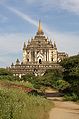 The wealth funded the temple building boom that began in his grandfather's reign. However, a noticeable shift from the Mon architecture to a Burman-style architecture began. The temples built during his reign include the last examples of Mon architecture at Pagan as well as the earliest efforts to construct Burman-style temples, the most famous example of which is the Thatbyinnyu
. Consecrated in 1144, the temple stands about 500 yards from the Ananda Temple
, and with its spire rising to a height of over 200 feet (61 m), it is the tallest of all the Pagan monuments. He also built the Shwegugyi Temple
, next to the palace.
was the heir-apparent for most of Sithu's reign. In the 1060s, the king banished Min Shin Saw for the latter's ill treatment of people. Having sent Min Shin Saw a small town about 90 miles north of Pagan, Sithu then appointed the second son Narathu
as heir apparent.
Sithu is posthumously remembered in Burmese history as Alaungsithu (lit. Sithu the Maitreya Buddha) for his numerous pious deeds. The devout Buddhist king was also inducted into the pantheon of Burmese animist nats
as Min Sithu. (Almost all of the nat sprits in the pantheon were murdered.)
Mon people
The Mon are an ethnic group from Burma , living mostly in Mon State, Bago Division, the Irrawaddy Delta, and along the southern Thai–Burmese border. One of the earliest peoples to reside in Southeast Asia, the Mon were responsible for the spread of Theravada Buddhism in Burma and Thailand...
culture toward the expression of a distinctive Burman
Bamar
The Bamar are the dominant ethnic group of Burma , constituting approximately two-thirds of the population. The Bamar live primarily in the Irrawaddy basin, and speak the Burmese language, which is also the official language of Burma. Bamar customs and identity are closely intertwined with general...
style.
Sithu is remembered a peripatetic king who traveled extensively throughout his realm, built monuments and nurtured Theravada Buddhism with acts of piety.
Early life
Sithu was born Zeyathura Sithu to Sawyun (son of King SawluSawlu
Sawlu was king of Pagan dynasty from 1077 to 1084. He inherited from his father Anawrahta the Pagan Empire, the first ever unified kingdom of Burma but proved an inexperienced ruler. In 1084, he faced a rebellion in Lower Burma, and was captured and killed.-Early life:Sawlu was born in 1039 to...
) and Shwe Einsi
Shwe Einsi
Princess Shwe Einsi was the daughter of Kyansittha, King of the Pagan Dynasty of Burma and his first love, Abeyadanar who was granted the honorary title of High Queen. It is believed that Shwe Einsi was born around the year 1080...
(daughter of King Kyansittha
Kyansittha
Kyansittha was king of Pagan dynasty of Burma from 1084 to 1113, and is considered one of the greatest Burmese monarchs. He continued the social, economic and cultural reforms begun by his father, King Anawrahta. Pagan became an internationally recognized power during his 28-year reign...
) circa 1086 (or 1089). At Sithu's birth, Kyansittha, who thought that he had no son, was so delighted that he crowned the infant as king, and presented the baby to the people saying "Behold your king! Henceforth, I reign only as his regent." (It turned out that Kyansittha did have a son by a wife during one of his exiles in the 1070s. That son, Yazakumar
Yazakumar
Yazakumar was the titular governor of north Arakan during the reign of his father King Kyansittha of the Pagan Dynasty of Myanmar . He is best known for the Myazedi inscription of 1113, which he donated in his father's honor...
, made no claims of the throne.)
Sithu faced no opposition to the throne after his grandfather died in 1113. His coronation was presided by an aging Primate Shin Arahan
Shin Arahan
The Venerable Shin Arahan was primate of Pagan Kingdom from 1056 to 1115. The monk, a native of Thaton Kingdom, was the religious adviser to four Pagan kings from Anawrahta to Alaungsithu. He is credited with converting Anawrahta to Theravada Buddhism, and overseeing the subsequent reformation of...
who also presided the coronations of the two predecessor kings, and adviser to three previous kings. Upon ascending the throne, Sithu assumed the royal style Sri Tribhuwanaditya Pavarapandita Sudhammaraja Mahadhipati Narapatisithu.
Administration
The early part of Sithu's reign was spent repressing revolts, especially in Tenasserim and north ArakanRakhine State
Rakhine State is a Burmese state. Situated on the western coast, it is bordered by Chin State in the north, Magway Region, Bago Region and Ayeyarwady Region in the east, the Bay of Bengal to the west, and the Chittagong Division of Bangladesh to the northwest. It is located approximately between...
. A Pali
Páli
- External links :* *...
inscription found at Mergui
Mergui
Myeik is a city in Tanintharyi Division in Myanmar , located in the extreme south of the country on the coast of an island on the Andaman Sea. the estimated population was over 209,000. The area inland from the city is a major smuggling corridor into Thailand.-History:Myeik was the southernmost...
(Myeik) is evidence that Tenasserim then paid allegiance to the Pagan monarchy. In north Arakan, a usurper (Kahton, lord of Thets) had driven out the rightful heir, who fled to Pagan, where he subsequently died. Pagan's initial attempt to restore the rightful heir Letya Min Nan—a combined land and seaborne invasion—failed but the second attempt in 1118 succeeded. (The Arakanese chronicles report the date as 1103.) Letya Min Nan, in gratitude, repaired the Buddhagaya shrine in the honor of his overlord Sithu.
Sithu traveled far and wide throughout his dominions, building many works of merit. These pious pilgrimages form the main theme of the chronicles of his reign. He reportedly sailed as far south as Malaya
Malay Peninsula
The Malay Peninsula or Thai-Malay Peninsula is a peninsula in Southeast Asia. The land mass runs approximately north-south and, at its terminus, is the southern-most point of the Asian mainland...
and Bengal
Bengal
Bengal is a historical and geographical region in the northeast region of the Indian Subcontinent at the apex of the Bay of Bengal. Today, it is mainly divided between the sovereign land of People's Republic of Bangladesh and the Indian state of West Bengal, although some regions of the previous...
in the west. Like his great-grandfather Anawrahta, he also traveled to Nanzhao Kingdom. There was apparently much disorder during his long absences from the capital.
The rulings given at his court, some of which by himself, once existed in a collection, the Alaungsithu Hpyatton.
Economy
Sithu's reign was a prosperous one in which Pagan was an integral part of in-land and maritime trading networks. Sithu engaged in a massive building campaign throughout the kingdom, which included colonies, forts and outposts at strategic locations to strengthen the frontiers, ordination halls and pagodas for the support of religion, as well as reservoirs, dams and other land improvements to assist the farmers. He also introduced standardized weights and measures throughout the country to assist administration as well as trade. The standardization provided an impetus for the monetization of Pagan's economy, the full impact of which however would not be felt until later in the 12th century.Culture
Thatbyinnyu Temple
Thatbyinnyu Temple is a famous temple located in Bagan , built in the mid-12th century during the reign of King Alaungsithu. It is adjacent to Ananda Temple. Thatbyinnyu Temple is shaped like a cross, but is not symmetrical. The temple has two primary storeys, with the seated Buddha image located...
. Consecrated in 1144, the temple stands about 500 yards from the Ananda Temple
Ananda Temple
The Ananda Temple , located in Bagan, Myanmar is a Buddhist temple built in 1105 AD during the reign of King Kyanzittha of the Pagan Dynasty. It is one of four surviving temples in Bagan...
, and with its spire rising to a height of over 200 feet (61 m), it is the tallest of all the Pagan monuments. He also built the Shwegugyi Temple
Shwegugyi Temple
Shwegugyi Temple is a Buddhist temple built during the reign of King Alaungsithu in 1131. The temple itself is built on an expansive brick foundation 3 metres tall. The temple is known for its arched windows, and its history, which is inscribed in two stone slabs in Pali. According to its...
, next to the palace.
Fall out with Min Shin Saw
His eldest son Min Shin SawMin Shin Saw
Min Shin Saw was the eldest son of King Alaungsithu of Pagan dynasty of Burma . The prince was the heir apparent of the kingdom for a long time until he ran into disagreements with his father, late in his father's life. He was exiled to a place near Ava, a few miles north of Pagan. He turned the...
was the heir-apparent for most of Sithu's reign. In the 1060s, the king banished Min Shin Saw for the latter's ill treatment of people. Having sent Min Shin Saw a small town about 90 miles north of Pagan, Sithu then appointed the second son Narathu
Narathu
Narathu was king of Pagan dynasty of Burma from 1167 to 1170. Narahthu ascended to the throne by murdering his father King Alaungsithu and his elder brother Min Shin Saw. In atonement for his many cruelties, Narathu built the largest of all the Pagan temples, the Dhammayangyi.Narathu's conduct...
as heir apparent.
Death
In 1167, Sithu aged 80 fell ill. Narathu, who could not wait to be king, moved the king from the palace to the nearby Shwegugyi Temple. When he regained consciousness, Sithu was furious that he had been set aside. Narathu came in and smothered the king with bedclothes.Sithu is posthumously remembered in Burmese history as Alaungsithu (lit. Sithu the Maitreya Buddha) for his numerous pious deeds. The devout Buddhist king was also inducted into the pantheon of Burmese animist nats
Nat (spirit)
The nats are spirits worshipped in Burma in conjunction with Buddhism. They are divided between the 37 Great Nats and all the rest . Almost all of the 37 Great Nats were human beings who met violent deaths . They may thus also be called nat sein...
as Min Sithu. (Almost all of the nat sprits in the pantheon were murdered.)