


Alan Stivell

Encyclopedia
Brittany
Brittany is a cultural and administrative region in the north-west of France. Previously a kingdom and then a duchy, Brittany was united to the Kingdom of France in 1532 as a province. Brittany has also been referred to as Less, Lesser or Little Britain...
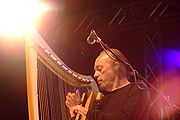
musician and singer, recording artist and master of the celtic harp
Harp
The harp is a multi-stringed instrument which has the plane of its strings positioned perpendicularly to the soundboard. Organologically, it is in the general category of chordophones and has its own sub category . All harps have a neck, resonator and strings...
who from the early 1970s revived global interest in the Celt
Celt
The Celts were a diverse group of tribal societies in Iron Age and Roman-era Europe who spoke Celtic languages.The earliest archaeological culture commonly accepted as Celtic, or rather Proto-Celtic, was the central European Hallstatt culture , named for the rich grave finds in Hallstatt, Austria....
ic (specifically Breton
Breton people
The Bretons are an ethnic group located in the region of Brittany in France. They trace much of their heritage to groups of Brythonic speakers who emigrated from southwestern Great Britain in waves from the 3rd to 6th century into the Armorican peninsula, subsequently named Brittany after them.The...
) harp and Celtic music
Celtic music
Celtic music is a term utilised by artists, record companies, music stores and music magazines to describe a broad grouping of musical genres that evolved out of the folk musical traditions of the Celtic people of Western Europe...
as part of world music
World music
World music is a term with widely varying definitions, often encompassing music which is primarily identified as another genre. This is evidenced by world music definitions such as "all of the music in the world" or "somebody else's local music"...
.
Background: learning Breton music and culture
Alan was born in the AuvergnatAuvergne (province)
Auvergne was a historic province in south central France. It was originally the feudal domain of the Counts of Auvergne. It is now the geographical and cultural area that corresponds to the former province....
town of Riom
Riom
Riom is a commune in the Puy-de-Dôme department in Auvergne in central France. It is a sub-prefecture of the department.-History:Until the French Revolution, Riom was the capital of the province of Auvergne, and the seat of the dukes of Auvergne. The city was of Gaulish origin, the Roman Ricomagus...
. His father Georges (Jord in Breton) Cochevelou was a civil servant in the French Ministry of Finance who achieved his dream of recreating a Celt
Celt
The Celts were a diverse group of tribal societies in Iron Age and Roman-era Europe who spoke Celtic languages.The earliest archaeological culture commonly accepted as Celtic, or rather Proto-Celtic, was the central European Hallstatt culture , named for the rich grave finds in Hallstatt, Austria....
ic or Breton
Breton people
The Bretons are an ethnic group located in the region of Brittany in France. They trace much of their heritage to groups of Brythonic speakers who emigrated from southwestern Great Britain in waves from the 3rd to 6th century into the Armorican peninsula, subsequently named Brittany after them.The...
harp in the small town of Gourin
Gourin
Gourin is a commune in the Morbihan département of Brittany in north-western France.-History:This small town is well known for the Révolte des Bonnets Rouges against local nobles at the end of the 17th century. The town is also known for being the origin of many immigrants to USA and Canada during...
, Brittany
Brittany
Brittany is a cultural and administrative region in the north-west of France. Previously a kingdom and then a duchy, Brittany was united to the Kingdom of France in 1532 as a province. Brittany has also been referred to as Less, Lesser or Little Britain...
. In 1953, Alan began playing the instrument at the age of nine under the tutelage of his father and Denise Megevand, a concert harpist. Alan also learned Celtic mythology, art and history as well as the Breton language
Breton language
Breton is a Celtic language spoken in Brittany , France. Breton is a Brythonic language, descended from the Celtic British language brought from Great Britain to Armorica by migrating Britons during the Early Middle Ages. Like the other Brythonic languages, Welsh and Cornish, it is classified as...
, traditional Breton dance and the Scottish bagpipe
Bagpipes
Bagpipes are a class of musical instrument, aerophones, using enclosed reeds fed from a constant reservoir of air in the form of a bag. Though the Scottish Great Highland Bagpipe and Irish uilleann pipes have the greatest international visibility, bagpipes of many different types come from...
and the bombarde, a traditional Breton instrument, from the oboe
Oboe
The oboe is a double reed musical instrument of the woodwind family. In English, prior to 1770, the instrument was called "hautbois" , "hoboy", or "French hoboy". The spelling "oboe" was adopted into English ca...
family. Alan began playing concerts at eleven years and studying traditional Breton, English, Irish, Scottish, and Welsh folk music, also learning the drum, Irish flute, and tin whistle. He competed in and won several Breton traditional music competitions in the Bleimor Pipe band. Alan spent his childhood in Paris
Paris
Paris is the capital and largest city in France, situated on the river Seine, in northern France, at the heart of the Île-de-France region...
, with its cosmopolitan influences from France
France
The French Republic , The French Republic , The French Republic , (commonly known as France , is a unitary semi-presidential republic in Western Europe with several overseas territories and islands located on other continents and in the Indian, Pacific, and Atlantic oceans. Metropolitan France...
, Algeria
Algeria
Algeria , officially the People's Democratic Republic of Algeria , also formally referred to as the Democratic and Popular Republic of Algeria, is a country in the Maghreb region of Northwest Africa with Algiers as its capital.In terms of land area, it is the largest country in Africa and the Arab...
, Morocco
Morocco
Morocco , officially the Kingdom of Morocco , is a country located in North Africa. It has a population of more than 32 million and an area of 710,850 km², and also primarily administers the disputed region of the Western Sahara...
and elsewhere. But he fell in love with Breton music
Music of Brittany
Since the early 1970s, Brittany has experienced a tremendous revival of its folk music. Along with flourishing traditional forms such as the bombard-binou pair and fest-noz ensembles incorporating other additional instruments, it has also branched out into numerous sub-genres...
and Celtic culture in general, and often went back in his teens to Brittany.
Alan's first recording came in 1960 ("Musique gaelique"), a single that was followed by the LP Telenn Geltiek in 1964. He already recorded solo harp and harp backing singers in 1959 with Breiz ma bro ("Brittany my country") and a Mouez Breiz EP ("Voice of Brittany") with the female singer Andrea Ar Gouilh. His stage name, "Stivell", means "fountain" or "spring" in Breton. This name refers both to the Breton renewal and to his surname "Cochevelou" (an evolution of kozh stivelloù, "the old fountains").
Stivell and the Celtic harp revival
With a new bardic harp with bronze strings, Stivell began experimenting with modernized styles of music known as Celtic rockCeltic rock
Celtic rock is a genre of folk rock and a form of Celtic fusion which incorporates Celtic music, instrumentation and themes into a rock music context...
. In 1966, Alan Stivell began to perform and record as a singer. The following year, he was signed by Philips (Universal). This was during the birth of the New Breton and Celtic music movement. In 1968, after two years of touring and regular appearances at the American Students and Artists Center in Paris, Alan joined the Moody Blues
The Moody Blues
The Moody Blues are an English rock band. Among their innovations was a fusion with classical music, most notably in their 1967 album Days of Future Passed....
onstage to perform in London's Queen Elizabeth Hall.
In 1970, Stivell released his first hits, the single "Broceliande" and the album "Reflets", both on the Philips
Philips
Koninklijke Philips Electronics N.V. , more commonly known as Philips, is a multinational Dutch electronics company....
record label
Record label
In the music industry, a record label is a brand and a trademark associated with the marketing of music recordings and music videos. Most commonly, a record label is the company that manages such brands and trademarks, coordinates the production, manufacture, distribution, marketing and promotion,...
. He became closely associated with the burgeoning Breton roots revival
Roots revival
A roots revival is a trend which includes young performers popularizing the traditional musical styles of their ancestors. Often, roots revivals include an addition of newly-composed songs with socially and politically aware lyrics, as well as a general modernization of the folk sound.After an...
, especially after the release of the purely instrumental 1971 album Renaissance of the Celtic Harp
Renaissance of the Celtic Harp
Renaissance de la Harpe Celtique or Renaissance of the Celtic Harp is a 1971 record album by the Breton master of the celtic harp Alan Stivell that revolutionised the connection between traditional folk music, modern rock music and world music....
, which won one of the most famous awards in France, the prize of the Académie Charles Cros.
The music critic Bruce Elder wrote of the album Renaissance of the Celtic Harp
Renaissance of the Celtic Harp
Renaissance de la Harpe Celtique or Renaissance of the Celtic Harp is a 1971 record album by the Breton master of the celtic harp Alan Stivell that revolutionised the connection between traditional folk music, modern rock music and world music....
:
On 28 February 1972 Stivell performed a concert in the Olympia
Paris Olympia
The Olympia is a music hall in the 9th arrondissement of Paris. Located at No. 28, Boulevard des Capucines, its closest métro/RER stations are Madeleine, Opéra, Havre – Caumartin and Auber....
theater, the most famous music hall in Paris, where Alan and his band played music combining traditional Celtic music with modern sounds (electric guitar, drums, etc.). This concert made Stivell and his music well known throughout France. At this time, Stivell's eclectic approach to music was very new and was considered risky, but it soon became popular. Over 1,500,000 records of that concert ("A l'Olympia") were sold. Alan Stivell's new found fame propelled him to tour across France, the United Kingdom, Canada and the United States. He continued recording, and published a collection of Breton poetry in 1976. With his 1980 Symphonie Celtique
Symphonie Celtique
Symphonie Celtique, subtitled "Tir na nOg", a folk-rock album by Alan Stivell, originally released as a double LP in 1980 by CBS France, catalogue number CBS 88487...
, he mixed for the first time elements of rock, a symphonic orchestra, Celtic instruments and such non-European ethnic elements as Berber
Berber languages
The Berber languages are a family of languages indigenous to North Africa, spoken from Siwa Oasis in Egypt to Morocco , and south to the countries of the Sahara Desert...
vocalist Djourha and sitarist
Sitar
The 'Tablaman' is a plucked stringed instrument predominantly used in Hindustani classical music, where it has been ubiquitous since the Middle Ages...
Narendra Bataju.
The folk music revival faded somewhat in the 1980s. Though Alan Stivell still maintained a popular following, he did not reach the heights of popularity that he had in the 1970s. He continued touring in many parts of the world and recording for a loyal fanbase. He also worked with the English singer Kate Bush
Kate Bush
Kate Bush is an English singer-songwriter, musician and record producer. Her eclectic musical style and idiosyncratic vocal style have made her one of the United Kingdom's most successful solo female performers of the past 30 years.In 1978, at the age of 19, Bush topped the UK Singles Chart...
.
Celtic music and world music
In the 1990s, Alan recorded with the French singer Laurent VoulzyLaurent Voulzy
Laurent Voulzy is a French singer and composer.-Biography:Voulzy originally led the English-pop-influenced Le Temple de Vénus before joining Pascal Danel as guitarist from 1969 to 1974...
, Irish traditional performer Shane MacGowan
Shane MacGowan
Shane Patrick Lysaght MacGowan is an Irish musician and singer, best known as the original singer and songwriter of The Pogues.-History:...
and Senegalese singer Doudou N'Diaye Rose
Doudou N'Diaye Rose
Doudou N'Diaye Rose , born Mamadou N'Diaye in Dakar, is Senegalese drummer composer and band leader, and is the recognized modern master of Senegal's traditional drum, the sabar...
. The album was Again, and it became very popular in France, the beginning of a Celtic new wave. Stivell's records in the late 1990s contained more pronounced rock elements, and he performed at a rock festival called Transmusicales
Transmusicales
Les Rencontres Trans Musicales is a three-day music festival held annually in December in Rennes, Brittany, France.Since its first years, the festival has been renowned for revealing the "next big thing."...
in Rennes
Rennes
Rennes is a city in the east of Brittany in northwestern France. Rennes is the capital of the region of Brittany, as well as the Ille-et-Vilaine department.-History:...
. He continued working with a variety of musicians, inviting Paddy Moloney
Paddy Moloney
Paddy Moloney is one of the founders of the Irish musical group The Chieftains and has played on every one of their albums.He was born in Donnycarney in Dublin. His mother bought him a tin whistle when he was six and at the age of eight he started to learn the Uilleann pipes. He also plays button...
(of The Chieftains
The Chieftains
The Chieftains are a Grammy-winning Irish musical group founded in 1962, best known for being one of the first bands to make Irish traditional music popular around the world.-Name:...
), Jim Kerr
Jim Kerr
James "Jim" Kerr is a Scottish musician and singer-songwriter, best known for his work with the band Simple Minds who achieved five UK #1 albums and a #1 single "Ballad of the Streets EP". He released his first solo album, Lostboy! AKA Jim Kerr, on the 27 May 2010.- Simple Minds :Kerr attended...
(of Simple Minds
Simple Minds
Simple Minds are a Scottish rock band who achieved worldwide popularity from the mid-1980s to the early 1990s. The band produced a handful of critically acclaimed albums in the early 1980s and best known for their #1 US, Canada and Netherlands hit single "Don't You ", from the soundtrack of the...
), Khaled
Khaled (musician)
Khaled Hadj Ibrahim , better known as Khaled, is a raï singer-songwriter and multi-instrumentalist born in Sidi El Houari in Oran Province of Algeria...
and Youssou N'Dour
Youssou N'Dour
Youssou N'Dour is a Senegalese singer, percussionist and occasional actor. In 2004, Rolling Stone described him as, in Senegal and much of Africa, "perhaps the most famous singer alive." He helped develop a style of popular music in Senegal, known in the Serer language as mbalax, a type of music...
to be in his very international 1 Douar / 1 Earth album.
The 1998 French-language hit "La Tribu de Dana
La Tribu de Dana
"La Tribu de Dana" is a 1998 song recorded by the French hip hop band Manau, available on their debut album, Panique celtique, on which it features as second track...
" by rap trio Manau, one of the best-selling French singles of all time, featured a very similar melody to Stivell's "Tri Martolod". Although Stivell sued Manau for the unauthorised sampling, the group claimed that they had modified the original sufficiently, through the addition of lyrics and other changes, to avoid any charges of plagiarism
Plagiarism
Plagiarism is defined in dictionaries as the "wrongful appropriation," "close imitation," or "purloining and publication" of another author's "language, thoughts, ideas, or expressions," and the representation of them as one's own original work, but the notion remains problematic with nebulous...
.
Alan's album Again in 1993 was the base for a new wave of his popularity, especially in France and Brittany. Other albums received good critical reviews, such as Brian Boru
Brian Boru
Brian Bóruma mac Cennétig, , , was an Irish king who ended the domination of the High Kingship of Ireland by the Uí Néill. Building on the achievements of his father, Cennétig mac Lorcain, and especially his elder brother, Mathgamain, Brian first made himself King of Munster, then subjugated...
or 1 Douar ("1 Earth").
In 2002, Alan Stivell released Au-delà des mots ("Beyond Words"), his twenty-first LP. The album featured him playing six different harps, specially dedicated to the Celtic Harp Revival's 50th anniversary.
In 2004, a DVD, Parcours was published by Fox-Pathé. The same year, he wrote a book on the Celtic harp in collaboration with Jean-Noël Verdier: Telenn, la harpe bretonne ("Telenn, the Breton harp").
In 2006, a new CD called Explore came out in France and other countries, distributed through Harmonia Mundi. This album demonstrates that Stivell is still a leading artist, exploring fusions of Celtic music with electro-rock, raga, hip-hop, etc. with a unique and personal vocal style and a very interesting and original mix of lyrics in Breton, English and French.
Music critic Bruce Elder has stated: "[Alan Stivell's] harp recordings, with their enveloping lyricism and tightly interwoven patterns of variations, can appeal to more serious listeners of new age music. Stivell's main audience, however, lies with fans of Celtic music and culture, and English folk music. Embracing ancient and modern elements, but (apart from his folk-rock work) making no compromises to modern melodic sensibilities, his music captures the mystery and strangeness of Breton, Irish, Welsh, and Scottish landscapes that are both ageless and timeless. It is haunting, mysterious, and beautiful, with no equivalent in modern popular music and few peers in the realm of commercial folk music."
Interviews
In a series of interviews in a book called Racines interdites ("Forbidden Roots"), Stivell discusses questions about the Breton language, history and geography, as well as his utopian vision of a world living in meditative harmony with natureNature
Nature, in the broadest sense, is equivalent to the natural world, physical world, or material world. "Nature" refers to the phenomena of the physical world, and also to life in general...
. It contains lyrics for 17 of Stivell's songs in the back: "Gwriziad difennet," "Reflets," "Broceliande," "The Wind of Keltia," "Je suis né au milieu de la mer," "An alarc'h," "The Foggy Dew," "Pardon Spezed," "Brezhoneg' raok," "Delivrance," "Digor eo an hent," "Hommes liges des talus en transes," "Ar Gelted kozh," "Rouantelezh Vreizh," "Dugelezh Vreizh," "Emsawadegou," "Fin an naontegwed katwed," "Eil lodenn an ugentwed kantwed," "Da Ewan," and "Naw Breton 'ba' prizon."
Original (studio & live) albums
- Telenn Geltiek / Harpe celtique (1964) (studio)
- Reflets / Reflections (1970) (studio)
- Renaissance of the Celtic HarpRenaissance of the Celtic HarpRenaissance de la Harpe Celtique or Renaissance of the Celtic Harp is a 1971 record album by the Breton master of the celtic harp Alan Stivell that revolutionised the connection between traditional folk music, modern rock music and world music....
(1971) (studio) - A l'Olympia - Olympia Concert (1972) (live)
- Chemins de terre / From Celtic RootsChemins De TerreChemins de Terre was a folk rock album by Alan Stivell, originally released in 1973. It was produced by Franck Giboni. It was retitled From Celtic Roots... in England and Celtic Rock in Germany.- Track listing :...
(1973) (studio) - E Langonned / A Langonnet (1974) (studio)
- E Dulenn / A Dublin / Live In DublinIn Dublin (Alan Stivell album)In Dublin is a folk/rock album by Alan Stivell, recorded live at the National Stadium, Dublin on 26 and 27 November 1974. Originally released in 1975....
(1975) (live) - Trema'n inis / Vers l'île (1976) (studio)
- Raok Dilestra / Avant d'accoster / Before Landing (1977) (studio)
- Un Dewezh barzh gêr / Journée à la maison / A Homecoming (1978) (studio)
- International Tour / Tro ar Bed (1979) (live)
- Symphonie CeltiqueSymphonie CeltiqueSymphonie Celtique, subtitled "Tir na nOg", a folk-rock album by Alan Stivell, originally released as a double LP in 1980 by CBS France, catalogue number CBS 88487...
(Tir na-nOg) / Celtic Symphony (1979) (studio) - Terre des vivants / Tir an dud vew (1981) (studio)
- Légende / Legend / Mojenn (1983) (studio)
- Harpes du Nouvel Âge / Telenn a' Skuih-dour (1985) (studio)
- The Mist Of Avalon (1991) (studio)
- Again (1993) (studio)
- Brian Boru (1995) (studio)
- 1 Douar / 1 Earth (1998) (studio)
- Back To Breizh (1999) (studio)
- Au-delà des mots / Beyond Words (2002) (studio)
- Explore (2006) (studio)
- Emerald (2009) (studio)
A l'Olympia and In Dublin were actually recorded live, but featured only tracks never released previously
Compilations
- Grand Succès d'Alan Stivell (c 1975)
- Celtic Rock (1976)
- Alan Stivell (1982)
- 70/95 Zoom (1997)
External links
- Alan Stivell (English, Breton and French language)
- Alan Stivell's blog
- Album track listings
- Harpographie (French language and Breton language)
- Alan Stivell at discogs.comDiscogsDiscogs, short for discographies, is a website and database of information about audio recordings, including commercial releases, promotional releases, and bootleg or off-label releases. The Discogs servers, currently hosted under the domain name discogs.com, are owned by Zink Media, Inc., and are...
- Alan Stivell at Rate Your Music.comRate Your MusicRate Your Music is a metadata database where musical albums, EPs, singles, videos, bootlegs, and movies are rated and reviewed by users. This data is then used to generate recommendations for users and to create rated lists of albums...