

Alabama's 6th congressional district

Encyclopedia
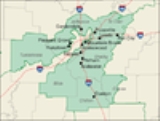
Alabama's 6th congressional district is a U.S. congressional district
in Alabama
, which elects a representative to the United States House of Representatives
. It encompasses the counties of Chilton
, Bibb
and Shelby
. It also includes parts of St. Clair County
, Jefferson
, Tuscaloosa
, and Coosa
counties. It almost surrounds the entire city of Birmingham, Alabama
.
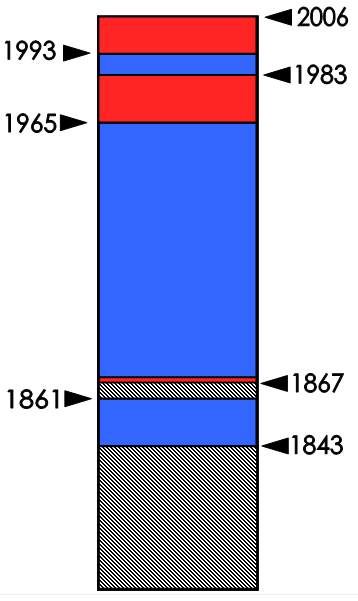
It is currently represented by Republican Spencer Bachus
. The Cook Partisan Voting Index
rating lists the district as tied with Texas's 13th congressional district
as being the most Republican districts in the United States.
and Jefferson County
, Alabama's 6th Congressional District is now the suburban Birmingham-area district with nearly all of the urban precincts having been removed over the past couple of decades. A continual process of redistricting by Democratic state governments has seen the 6th District take on an increasingly unusual shape and becoming one of the most Republican districts in the country, voting 78% for George W. Bush
in 2004
. John McCain
swept the district in 2008
, taking 75.91% of the vote while Barack Obama
received 23.28%.
The demography of the district consists mostly of middle and upper middle-class white-collar families who work in Birmingham. Increasingly, the population of the Birmingham districts has become racially polarized, with most whites moving from the city to the suburbs
mostly in nearby Shelby County (which both grew by 44% in the 1990s and has become more than 90% white), whilst the African American population has remained largely in urban areas.
Once the vanguard district for issues of steel production and metalworking in the South, the economic issues of the district in recent years have centered around the banking industry (Birmingham being the second largest banking area in the South) and health care/medical research. Socially the district remains conservative; however, fiscal conservatism
is the most salient feature of this district.
, Jackson
, Madison
, Marshall
, Etowah
, St. Clair
, Blount
and Cullman
.
The district had a population of 66,111 as of the 1840 U.S. Census, which made it the second least populous district in Alabama. Neither Cullman County nor Etowah County existed at the time, so only the eastern portion of what today is Cullman County was in the district. In the case of St. Clair County, it appears that only about half of St. Clair County in 1843 was in the district.
The district was redrawn in 1855. This was done in time for the election of representatives to the 34th Congress
which was held August 6th, 1855. The new boundaries put Cherokee County
in the 6th District and removed St. Clair County. These boundaries remained in place until the Civil War
.
When Alabama again elected representatives to the U.S. Congress in 1868 for the halfway completed 40th Congress
, the 6th District consisted of northwestern Alabama. The only county remaining in the district from before was Blount County. It also encompassed Jefferson
, Marion
, Walker
, Morgan
, Limestone
, Franklin
, Lauderdale
and Winston
counties. Colbert County did not exist at the time, but was part of Franklin County. This was one of the areas of Alabama where the Democrats soonest regained control after the Civil War.
In 1876, the 6th District was redrawn again. The sixth-most northern counties (including Colbert County
which now existed) were transferred to the new Alabama 8th Congressional District, while the six counties southwestward from Jefferson County were transferred to the 6th District.
This set of boundaries only existed for one election. By the time of the 1878 election, Cullman County had been formed. It was in the 6th District, but Blount County was moved to the 8th District. The boundaries did not exactly correspond to county lines at that time, and with another change in county boundaries by 1880 even more area in the general vicinity of Blount County was moved to the 7th District. This process was continued in 1884 with the removal of Cullman County from the district.
The year of 1892 saw more changes in the boundaries of the 6th District. Winston County was moved to the 7th District. At the same time Jefferson County was placed in the new 9th District. By this time the 6th District consisted of west central Alabama. In the 1892 election there were about 22,000 votes cast in the 6th District as opposed to 30,000 cast in the 9th District.
In 1902, Perry County
and some other areas in the southern portion of Alabama's 9th Congressional District were transferred to the 6th District.
Congressional district
A congressional district is “a geographical division of a state from which one member of the House of Representatives is elected.”Congressional Districts are made up of three main components, a representative, constituents, and the specific land area that both the representative and the...
in Alabama
Alabama
Alabama is a state located in the southeastern region of the United States. It is bordered by Tennessee to the north, Georgia to the east, Florida and the Gulf of Mexico to the south, and Mississippi to the west. Alabama ranks 30th in total land area and ranks second in the size of its inland...
, which elects a representative to the United States House of Representatives
United States House of Representatives
The United States House of Representatives is one of the two Houses of the United States Congress, the bicameral legislature which also includes the Senate.The composition and powers of the House are established in Article One of the Constitution...
. It encompasses the counties of Chilton
Chilton County, Alabama
-2010:Whereas according to the 2010 U.S. Census Bureau:*84.1% White*9.7% Black*0.4% Native American*0.3% Asian*0.0% Native Hawaiian or Pacific Islander*1.2% Two or more races*7.8% Hispanic or Latino -2000:...
, Bibb
Bibb County, Alabama
Bibb County is a county in the U.S. state of Alabama. Its name is in honor of William W. Bibb, the first Governor of Alabama. As of 2010 the population was 22,915. The county seat is Centreville...
and Shelby
Shelby County, Alabama
Shelby County is a county of the U.S. state of Alabama and a part of the Birmingham–Hoover–Cullman Combined Statistical Area. It is named in honor of Isaac Shelby, Governor of Kentucky. The county seat of Shelby County is Columbiana. As of 2010 U.S. Census the population was 195,085. Shelby...
. It also includes parts of St. Clair County
St. Clair County, Alabama
St. Clair County is a county of the U.S. state of Alabama.It is a part of the Birmingham–Hoover–Cullman Combined Statistical Area. Its name is in honor of General Arthur St...
, Jefferson
Jefferson County, Alabama
Jefferson County is the most populous county in the U.S. state of Alabama, with its county seat being located in Birmingham.As of the 2010 U.S. Census, the population of Jefferson County was 658,466...
, Tuscaloosa
Tuscaloosa County, Alabama
Tuscaloosa County is a county of the U.S. state of Alabama.It is named in honor of the pre-Choctaw chief Tuskaloosa. In 2010, the population was 194,656...
, and Coosa
Coosa County, Alabama
Coosa County is a county of the U.S. state of Alabama. Its name derives from a town of the Creek tribe. As of 2010 the population was 11,539, but since that time it has lost the most population by percentage of any Alabama county...
counties. It almost surrounds the entire city of Birmingham, Alabama
Birmingham, Alabama
Birmingham is the largest city in Alabama. The city is the county seat of Jefferson County. According to the 2010 United States Census, Birmingham had a population of 212,237. The Birmingham-Hoover Metropolitan Area, in estimate by the U.S...
.
It is currently represented by Republican Spencer Bachus
Spencer Bachus
Spencer Thomas Bachus III is the U.S. Representative for , serving since 1993. He is a member of the Republican Party and the senior member of the Alabama U. S. House delegation...
. The Cook Partisan Voting Index
Cook Partisan Voting Index
The Cook Partisan Voting Index , sometimes referred to as simply the Partisan Voting Index , is a measurement of how strongly an American congressional district or state leans toward one political party compared to the nation as a whole...
rating lists the district as tied with Texas's 13th congressional district
Texas's 13th congressional district
-References:*...
as being the most Republican districts in the United States.
Character
Once encompassing all of BirminghamBirmingham, Alabama
Birmingham is the largest city in Alabama. The city is the county seat of Jefferson County. According to the 2010 United States Census, Birmingham had a population of 212,237. The Birmingham-Hoover Metropolitan Area, in estimate by the U.S...
and Jefferson County
Jefferson County, Alabama
Jefferson County is the most populous county in the U.S. state of Alabama, with its county seat being located in Birmingham.As of the 2010 U.S. Census, the population of Jefferson County was 658,466...
, Alabama's 6th Congressional District is now the suburban Birmingham-area district with nearly all of the urban precincts having been removed over the past couple of decades. A continual process of redistricting by Democratic state governments has seen the 6th District take on an increasingly unusual shape and becoming one of the most Republican districts in the country, voting 78% for George W. Bush
George W. Bush
George Walker Bush is an American politician who served as the 43rd President of the United States, from 2001 to 2009. Before that, he was the 46th Governor of Texas, having served from 1995 to 2000....
in 2004
United States presidential election, 2004
The United States presidential election of 2004 was the United States' 55th quadrennial presidential election. It was held on Tuesday, November 2, 2004. Republican Party candidate and incumbent President George W. Bush defeated Democratic Party candidate John Kerry, the then-junior U.S. Senator...
. John McCain
John McCain
John Sidney McCain III is the senior United States Senator from Arizona. He was the Republican nominee for president in the 2008 United States election....
swept the district in 2008
United States presidential election, 2008
The United States presidential election of 2008 was the 56th quadrennial presidential election. It was held on November 4, 2008. Democrat Barack Obama, then the junior United States Senator from Illinois, defeated Republican John McCain, the senior U.S. Senator from Arizona. Obama received 365...
, taking 75.91% of the vote while Barack Obama
Barack Obama
Barack Hussein Obama II is the 44th and current President of the United States. He is the first African American to hold the office. Obama previously served as a United States Senator from Illinois, from January 2005 until he resigned following his victory in the 2008 presidential election.Born in...
received 23.28%.
The demography of the district consists mostly of middle and upper middle-class white-collar families who work in Birmingham. Increasingly, the population of the Birmingham districts has become racially polarized, with most whites moving from the city to the suburbs
White flight
White flight has been a term that originated in the United States, starting in the mid-20th century, and applied to the large-scale migration of whites of various European ancestries from racially mixed urban regions to more racially homogeneous suburban or exurban regions. It was first seen as...
mostly in nearby Shelby County (which both grew by 44% in the 1990s and has become more than 90% white), whilst the African American population has remained largely in urban areas.
Once the vanguard district for issues of steel production and metalworking in the South, the economic issues of the district in recent years have centered around the banking industry (Birmingham being the second largest banking area in the South) and health care/medical research. Socially the district remains conservative; however, fiscal conservatism
Fiscal conservatism
Fiscal conservatism is a political term used to describe a fiscal policy that advocates avoiding deficit spending. Fiscal conservatives often consider reduction of overall government spending and national debt as well as ensuring balanced budget of paramount importance...
is the most salient feature of this district.
History
Alabama's 6th Congressional District was originally created in 1843. It encompassed the northeastern portion of Alabama, approximately the modern counties of DeKalbDeKalb County, Alabama
As of the 2010 Census DeKalb County had a population of 71,109. The median age was 37.5. The racial and ethnic makeup of the population was 81.6% non-Hispanic white, 1.5% African American, 1.4% Native American, 0.3% Asian, 0.2% Pacific Islander , 9.9% from some other race, 2.2% reporting two or...
, Jackson
Jackson County, Alabama
Jackson County is a county of the U.S. state of Alabama. Its name is in honor of Andrew Jackson, general in the United States Army and President of the United States of America. As of 2010, the population was 53,227. The county seat is Scottsboro. Jackson County is a prohibition or dry county,...
, Madison
Madison County, Alabama
Madison County is a county of the U.S. state of Alabama, and is a major part of the Huntsville Metropolitan Area.It is also included in the merged Huntsville-Decatur Combined Statistical Area. The county is named in honor of James Madison, fourth President of the United States of America, and the...
, Marshall
Marshall County, Alabama
Marshall County is a county of the U.S. state of Alabama, and is included in the Huntsville-Decatur Combined Statistical Area. Its name is in honor of John Marshall, famous Chief Justice of the United States. As of 2010 the population was 93,019...
, Etowah
Etowah County, Alabama
Etowah County is a county of the U.S. state of Alabama. Its name is from the Cherokee language, which means "edible tree". It is the center of the Gadsden Metropolitan Area which includes Etowah and Cherokee Counties. As of 2010 the population was 104,430. Its county seat is Gadsden...
, St. Clair
St. Clair County, Alabama
St. Clair County is a county of the U.S. state of Alabama.It is a part of the Birmingham–Hoover–Cullman Combined Statistical Area. Its name is in honor of General Arthur St...
, Blount
Blount County, Alabama
Blount County is a county located in the U.S. state of Alabama. As of the 2010 United States Census, the population was 57,322. Its county seat is Oneonta.Blount County is a dry county.-History:...
and Cullman
Cullman County, Alabama
Cullman County is a county of the U.S. state of Alabama. Its name is in honor of Colonel John G. Cullmann. As of 2010, the population was 80,406. Its county seat is the town of the same name, Cullman, Alabama. It is a "moist" county in terms of availablity of alcoholic beverages, which means...
.
The district had a population of 66,111 as of the 1840 U.S. Census, which made it the second least populous district in Alabama. Neither Cullman County nor Etowah County existed at the time, so only the eastern portion of what today is Cullman County was in the district. In the case of St. Clair County, it appears that only about half of St. Clair County in 1843 was in the district.
The district was redrawn in 1855. This was done in time for the election of representatives to the 34th Congress
34th United States Congress
The Thirty-fourth United States Congress was a meeting of the legislative branch of the United States federal government, consisting of the United States Senate and the United States House of Representatives. It met in Washington, D.C. from March 4, 1855 to March 4, 1857, during the last two years...
which was held August 6th, 1855. The new boundaries put Cherokee County
Cherokee County, Alabama
Cherokee County, Alabama is a county of the U.S. state of Alabama. It is named for the Cherokee tribe. As of 2010 the population was 25,989. Its county seat is Centre and it is a prohibition or dry county.- History :...
in the 6th District and removed St. Clair County. These boundaries remained in place until the Civil War
American Civil War
The American Civil War was a civil war fought in the United States of America. In response to the election of Abraham Lincoln as President of the United States, 11 southern slave states declared their secession from the United States and formed the Confederate States of America ; the other 25...
.
When Alabama again elected representatives to the U.S. Congress in 1868 for the halfway completed 40th Congress
40th United States Congress
The Fortieth United States Congress was a meeting of the legislative branch of the United States federal government, consisting of the United States Senate and the United States House of Representatives. It met in Washington, D.C. from March 4, 1867 to March 4, 1869, during the third and fourth...
, the 6th District consisted of northwestern Alabama. The only county remaining in the district from before was Blount County. It also encompassed Jefferson
Jefferson County, Alabama
Jefferson County is the most populous county in the U.S. state of Alabama, with its county seat being located in Birmingham.As of the 2010 U.S. Census, the population of Jefferson County was 658,466...
, Marion
Marion County, Alabama
Marion County is a county of the U.S. state of Alabama. Marion County was created by an act of the Alabama Territorial General Assembly on February 13, 1818. The county is located in the northwestern part of the state, bounded on the west by the state of Mississippi. It encompasses . Marion County...
, Walker
Walker County, Alabama
Walker County is a county of the U.S. state of Alabama.Its name is in honor of John Williams Walker, a member of the United States Senate. As of 2010 the population was 67,023...
, Morgan
Morgan County, Alabama
Morgan County is the most populous county in the Decatur Metropolitan Area, and the second most populous county in the Huntsville-Decatur Combined Statistical Area in the U.S. State of Alabama. It was created by the Alabama Territorial legislature on February 6, 1818 from land acquired from the...
, Limestone
Limestone County, Alabama
Limestone County is a county of the U.S. state of Alabama, and is included in the Huntsville Metropolitan Area.It is also included in the merged Huntsville-Decatur Metro Area. Its name comes from Limestone Creek, a local stream. In 2000, the population was 65,676. As of 2010 the county's...
, Franklin
Franklin County, Alabama
Franklin County is a county of the U.S. state of Alabama. Its name is in honor of Benjamin Franklin, famous statesman, scientist, and printer. As of 2010, the population was 31,704...
, Lauderdale
Lauderdale County, Alabama
-2010:Whereas according to the 2010 U.S. Census Bureau:*86.4% White*10.0% Black*0.4% Native American*0.7% Asian*0.0% Native Hawaiian or Pacific Islander*1.4% Two or more races*2.2% Hispanic or Latino -2000:...
and Winston
Winston County, Alabama
Winston County is a county of the U.S. state of Alabama, formerly known as Hancock County before 1858.Its name is in honor of John A. Winston, the 15th Governor of Alabama. As of 2010, the population was 24,484. Its county seat is Double Springs....
counties. Colbert County did not exist at the time, but was part of Franklin County. This was one of the areas of Alabama where the Democrats soonest regained control after the Civil War.
In 1876, the 6th District was redrawn again. The sixth-most northern counties (including Colbert County
Colbert County, Alabama
Colbert County is a county of the U.S. state of Alabama. Its name is in honor of brothers George and Levi Colbert, Chickasaw Indian chiefs. George Colbert operated a ferry across the Tennessee River in 1790 near present day Cherokee....
which now existed) were transferred to the new Alabama 8th Congressional District, while the six counties southwestward from Jefferson County were transferred to the 6th District.
This set of boundaries only existed for one election. By the time of the 1878 election, Cullman County had been formed. It was in the 6th District, but Blount County was moved to the 8th District. The boundaries did not exactly correspond to county lines at that time, and with another change in county boundaries by 1880 even more area in the general vicinity of Blount County was moved to the 7th District. This process was continued in 1884 with the removal of Cullman County from the district.
The year of 1892 saw more changes in the boundaries of the 6th District. Winston County was moved to the 7th District. At the same time Jefferson County was placed in the new 9th District. By this time the 6th District consisted of west central Alabama. In the 1892 election there were about 22,000 votes cast in the 6th District as opposed to 30,000 cast in the 9th District.
In 1902, Perry County
Perry County, Alabama
Perry County is a county of the U.S. state of Alabama. It was established in 1819, and is named in honor of Commodore Oliver Hazard Perry of Rhode Island and the United States Navy. As of 2010 the population was 10,591...
and some other areas in the southern portion of Alabama's 9th Congressional District were transferred to the 6th District.
Representation
| Congress | Years | Representative | Party | Notes | |
|---|---|---|---|---|---|
| District created March 4, 1843 | |||||
| 28th 28th United States Congress -House of Representatives:Following the 1840 United States Census, Congress reapportioned the House to include 223 seats . During this congress, one House seat was added for the new state of Florida .- Senate :*President: Vacant... -29th 29th United States Congress -House of Representatives:During this congress, two House seats were added for each of the new states of Texas and Iowa.-Leadership:-Senate:* President: George M. Dallas * President pro tempore: Willie P. Mangum... |
March 4, 1843 - March 3, 1847 | Reuben Chapman Reuben Chapman Reuben Chapman was an American lawyer and politician. Born in 1799 in Bowling Green, Virginia, he represented Alabama in the U.S. House from 1835 to 1847 and served as the 13th Governor of the U.S. state of Alabama from 1847 to 1849. He died in Huntsville, Alabama in 1882.-External links:**... |
Democratic Democratic Party (United States) The Democratic Party is one of two major contemporary political parties in the United States, along with the Republican Party. The party's socially liberal and progressive platform is largely considered center-left in the U.S. political spectrum. The party has the lengthiest record of continuous... |
Redistricted Redistricting Redistricting is the process of drawing United States electoral district boundaries, often in response to population changes determined by the results of the decennial census. In 36 states, the state legislature has primary responsibility for creating a redistricting plan, in many cases subject to... from the |
|
| 30th 30th United States Congress The Thirtieth United States Congress was a meeting of the legislative branch of the United States federal government, consisting of the United States Senate and the United States House of Representatives. It met in Washington, D.C. from March 4, 1847 to March 3, 1849, during the last two years of... -36th 36th United States Congress The Thirty-sixth United States Congress was a meeting of the legislative branch of the United States federal government, consisting of the United States Senate and the United States House of Representatives. It met in Washington, D.C. from March 4, 1859 to March 4, 1861, during the third and fourth... |
March 4, 1847 - January 30, 1861 | Williamson Robert Winfield Cobb Williamson Robert Winfield Cobb Williamson Robert Winfield Cobb was an American politician who served the state of Alabama in the U.S. House of Representatives between 1847 and 1861. He was born in Rhea County, Tennessee on June 8, 1807 to David Cobb and Martha Bryant. He moved with his father, David Cobb, in 1809 to Bellefonte,... |
|||
| 37th 37th United States Congress The Thirty-seventh United States Congress was a meeting of the legislative branch of the United States federal government, consisting of the United States Senate and the United States House of Representatives. It met in Washington, D.C. from March 4, 1861 to March 4, 1863, during the first two... -39th 39th United States Congress The Thirty-ninth United States Congress was a meeting of the legislative branch of the United States federal government, consisting of the United States Senate and the United States House of Representatives. It met in Washington, D.C. from March 4, 1865 to March 4, 1867, during the first month of... |
(1861-1868) | Civil War American Civil War The American Civil War was a civil war fought in the United States of America. In response to the election of Abraham Lincoln as President of the United States, 11 southern slave states declared their secession from the United States and formed the Confederate States of America ; the other 25... and Reconstruction |
|||
| 40th 40th United States Congress The Fortieth United States Congress was a meeting of the legislative branch of the United States federal government, consisting of the United States Senate and the United States House of Representatives. It met in Washington, D.C. from March 4, 1867 to March 4, 1869, during the third and fourth... |
July 21, 1868 - March 3, 1869 | Thomas Haughey Thomas Haughey Thomas Haughey was a U.S. Representative from Alabama.Born in Glasgow, Scotland, Haughey received a limited education.Immigrated to the United States with his father, who settled in New York City.... |
Republican Republican Party (United States) The Republican Party is one of the two major contemporary political parties in the United States, along with the Democratic Party. Founded by anti-slavery expansion activists in 1854, it is often called the GOP . The party's platform generally reflects American conservatism in the U.S... |
||
| 41st 41st United States Congress -House of Representatives:- Senate :* President : Schuyler Colfax* President pro tempore: Henry B. Anthony - House of Representatives :* Speaker: James G. Blaine -Members:This list is arranged by chamber, then by state... |
March 4, 1869 - March 3, 1871 | William Crawford Sherrod William Crawford Sherrod William Crawford Sherrod was an American politician and Confederate officer from Alabama. He attended the University of North Carolina at Chapel Hill. Afterward, he was a planter and served as a Delegate to the Democratic National Convention from Alabama in 1860... |
Democratic Democratic Party (United States) The Democratic Party is one of two major contemporary political parties in the United States, along with the Republican Party. The party's socially liberal and progressive platform is largely considered center-left in the U.S. political spectrum. The party has the lengthiest record of continuous... |
||
| 42nd 42nd United States Congress The Forty-second United States Congress was a meeting of the legislative branch of the United States federal government, consisting of the United States Senate and the United States House of Representatives. It met in Washington, D.C. from March 4, 1871 to March 3, 1873, during the third and fourth... -43rd 43rd United States Congress The Forty-third United States Congress was a meeting of the legislative branch of the United States federal government, consisting of the United States Senate and the United States House of Representatives. It met in Washington, D.C. from March 4, 1873 to March 4, 1875, during the fifth and sixth... |
March 4, 1871 - March 3, 1875 | Joseph Humphrey Sloss Joseph Humphrey Sloss Joseph Humphrey Sloss was an American politician who served the state of Alabama in the U.S. House of Representatives between 1871 and 1875. He was born in Somerville, Morgan County, Alabama on October 12, 1826. He studied law, was admitted to the bar, and entered practice in St. Louis, Missouri... |
|||
| 44th 44th United States Congress The Forty-fourth United States Congress was a meeting of the legislative branch of the United States federal government, consisting of the United States Senate and the United States House of Representatives. It met in Washington, D.C. from March 4, 1875 to March 4, 1877, during the seventh and... -45th 45th United States Congress -House of Representatives:-Leadership:-Senate:*President: William A. Wheeler *President pro tempore: Thomas W. Ferry -House of Representatives:*Speaker: Samuel J. Randall -Members:This list is arranged by chamber, then by state... |
March 4, 1875 - March 3, 1879 | Goldsmith W. Hewitt Goldsmith W. Hewitt Goldsmith Whitehouse Hewitt was a U.S. Representative from Alabama.-Biography:Born near Elyton , Jefferson County, Alabama, Hewitt attended the country schools.... |
|||
| 46th 46th United States Congress The Forty-sixth United States Congress was a meeting of the legislative branch of the United States federal government, consisting of the United States Senate and the United States House of Representatives. It met in Washington, D.C. from March 4, 1879 to March 4, 1881, during the last two years of... |
March 4, 1879 - October 1, 1880 | Burwell Boykin Lewis Burwell Boykin Lewis Burwell Boykin Lewis represented both Alabama's 6th congressional district and Alabama's 8th congressional district in the United States House of Representatives.- Early life :... |
Resigned after accepting position as President of the University of Alabama University of Alabama The University of Alabama is a public coeducational university located in Tuscaloosa, Alabama, United States.... |
||
| 46th 46th United States Congress The Forty-sixth United States Congress was a meeting of the legislative branch of the United States federal government, consisting of the United States Senate and the United States House of Representatives. It met in Washington, D.C. from March 4, 1879 to March 4, 1881, during the last two years of... |
December 8, 1880 - March 3, 1881 | Newton Nash Clements Newton Nash Clements Newton Nash Clements was a U.S. Representative from Alabama.Born in Tuscaloosa County, Alabama, Clements was graduated from the University of Alabama at Tuscaloosa in 1858... |
|||
| 47th 47th United States Congress The Forty-seventh United States Congress was a meeting of the legislative branch of the United States federal government, consisting of the United States Senate and the United States House of Representatives. It met in Washington, D.C. from March 4, 1881 to March 4, 1883, during the administration... -48th 48th United States Congress The Forty-eighth United States Congress was a meeting of the legislative branch of the United States federal government, consisting of the United States Senate and the United States House of Representatives. It met in Washington, D.C. from March 4, 1883 to March 4, 1885, during the last two years... |
March 4, 1881 - March 3, 1885 | Goldsmith W. Hewitt Goldsmith W. Hewitt Goldsmith Whitehouse Hewitt was a U.S. Representative from Alabama.-Biography:Born near Elyton , Jefferson County, Alabama, Hewitt attended the country schools.... |
|||
| 49th 49th United States Congress The Forty-ninth United States Congress was a meeting of the legislative branch of the United States federal government, consisting of the United States Senate and the United States House of Representatives. It met in Washington, D.C. from March 4, 1885 to March 4, 1887, during the first two years... |
March 4, 1885 - March 3, 1887 | John Mason Martin John Mason Martin John Mason Martin was a U.S. Representative from Alabama, son of Joshua Lanier Martin.Born in Athens, Alabama, Martin attended the common schools, the high school in Green Springs, Alabama, and the University of Alabama at Tuscaloosa.He was graduated from Centre College, Danville, Kentucky, in... |
|||
| 50th 50th United States Congress The Fiftieth United States Congress was a meeting of the legislative branch of the United States federal government, consisting of the United States Senate and the United States House of Representatives. It met in Washington, D.C. from March 4, 1887 to March 4, 1889, during the third and fourth... -59th 59th United States Congress The Fifty-ninth United States Congress was a meeting of the legislative branch of the United States federal government, composed of the United States Senate and the United States House of Representatives. It met in Washington, DC from March 4, 1905 to March 4, 1907, during the fifth and sixth... |
March 4, 1887 - March 3, 1907 | John H. Bankhead John H. Bankhead John Hollis Bankhead was a U.S. senator from the state of Alabama.-Biography:He was born on September 13, 1842. He was appointed, then elected, to serve out the remainder of the term left by the death of John Tyler Morgan, and was later re-elected twice. He served in the Senate from June 18, 1907... |
|||
| 60th 60th United States Congress The Sixtieth United States Congress was a meeting of the legislative branch of the United States federal government, composed of the United States Senate and the United States House of Representatives. It met in Washington, DC from March 4, 1907 to March 4, 1909, during the last two years of... -63rd 63rd United States Congress - House of Representatives:*Democratic : 291 *Republican : 134*Progressive : 9*Independent : 1TOTAL members: 435-Senate:*President of the Senate: Thomas R. Marshall*President pro tempore: James P. Clarke-Senate:... |
March 4, 1907 - March 3, 1915 | Richmond P. Hobson | |||
| 64th 64th United States Congress The Sixty-fourth United States Congress was a meeting of the legislative branch of the United States federal government, composed of the United States Senate and the United States House of Representatives. It met in Washington, DC from March 4, 1915 to March 4, 1917, during the third and fourth... -74th 74th United States Congress -House:Also 2 Delegates, 3 Resident Commissioners-Senate:*President of the Senate: John N. Garner *President pro tempore: Key Pittman -Majority leadership:*Majority leader: Joseph T. Robinson... |
March 4, 1915 - January 3, 1937 | William B. Oliver | |||
| 75th 75th United States Congress The Seventy-fifth United States Congress was a meeting of the legislative branch of the United States federal government, composed of the United States Senate and the United States House of Representatives. It met in Washington, DC from January 3, 1937 to January 3, 1939, during the first two years... -80th 80th United States Congress The Eightieth United States Congress was a meeting of the legislative branch of the United States federal government, composed of the United States Senate and the United States House of Representatives. It met in Washington, DC from January 3, 1947 to January 3, 1949, during the third and fourth... |
January 3, 1937 - January 3, 1949 | Pete Jarman Pete Jarman Peterson Bryant Jarman was a U.S. Representative from Alabama.-Early life:Born in Greensboro, Alabama, Jarman attended the public schools, the Normal College, Livingston, Alabama, and Southern University, Greensboro, Alabama... |
|||
| 81st 81st United States Congress The Eighty-first United States Congress was a meeting of the legislative branch of the United States federal government, composed of the United States Senate and the United States House of Representatives... -82nd 82nd United States Congress The Eighty-second United States Congress was a meeting of the legislative branch of the United States federal government, composed of the United States Senate and the United States House of Representatives. It met in Washington, DC from January 3, 1951 to January 3, 1953, during the last two years... |
January 3, 1949 - January 3, 1953 | Edward deGraffenried Edward deGraffenried Edward Degraffenried was a U.S. Representative from Alabama.Born in Eutlw, Alabama, Degraffenried graduated from Gulf Coast Military Academy, Gulfport, Mississippi, in 1917.... |
|||
| 83rd 83rd United States Congress The Eighty-third United States Congress was a meeting of the legislative branch of the United States federal government, composed of the United States Senate and the United States House of Representatives. It met in Washington, DC from January 3, 1953 to January 3, 1955, during the first two years... -87th 87th United States Congress -House of Representatives :-Senate:* President: Richard Nixon , until January 20, 1961** Lyndon Johnson , from January 20, 1961* President pro tempore: Carl Hayden -House of Representatives:... |
January 3, 1953 - January 3, 1963 | Armistead I. Selden, Jr. Armistead I. Selden, Jr. Armistead Inge Selden, Jr. was a U.S. Representative from Alabama.-Early life and military service:Born in Greensboro, Alabama, Selden attended the public schools. He graduated from Greensboro High School in 1938 and from the University of the South, Sewanee, Tennessee, in 1942... |
Redistricted Redistricting Redistricting is the process of drawing United States electoral district boundaries, often in response to population changes determined by the results of the decennial census. In 36 states, the state legislature has primary responsibility for creating a redistricting plan, in many cases subject to... to the |
||
| 88th 88th United States Congress The Eighty-eighth United States Congress was a meeting of the legislative branch of the United States federal government, composed of the United States Senate and the United States House of Representatives. It met in Washington, DC from January 3, 1963 to January 3, 1965, during the last year of... |
January 3, 1963 - January 3, 1965 | District inactive, all representatives elected At-large on a general ticket | |||
| 89th 89th United States Congress -House of Representatives:- Senate :* President of the Senate: Hubert Humphrey , starting January 20, 1965* President pro tempore: Carl Hayden - Majority leadership :* Majority Leader and Democratic Conference Chairman: Mike Mansfield... -96th 96th United States Congress The Ninety-sixth United States Congress was a meeting of the legislative branch of the United States federal government, composed of the United States Senate and the United States House of Representatives. It met in Washington, DC from January 3, 1979 to January 3, 1981, during the last two years... |
January 3, 1965 - January 3, 1981 | John H. Buchanan, Jr. | Republican Republican Party (United States) The Republican Party is one of the two major contemporary political parties in the United States, along with the Democratic Party. Founded by anti-slavery expansion activists in 1854, it is often called the GOP . The party's platform generally reflects American conservatism in the U.S... |
||
| 97th 97th United States Congress The Ninety-seventh United States Congress was a meeting of the legislative branch of the United States federal government, composed of the United States Senate and the United States House of Representatives. It met in Washington, DC from January 3, 1981 to January 3, 1983, during the final weeks of... |
January 3, 1981 - January 3, 1983 | Albert L. Smith, Jr. Albert L. Smith, Jr. Albert Lee Smith, Jr. was an Alabama politician who represented the 6th district in the United States House of Representatives during the 97th Congress .-Early life:... |
|||
| 98th 98th United States Congress The Ninety-eighth United States Congress was a meeting of the legislative branch of the United States federal government, composed of the United States Senate and the United States House of Representatives. It met in Washington, DC from January 3, 1983 to January 3, 1985, during the third and... -102nd 102nd United States Congress -House of Representatives:- Senate :* President:Dan Quayle * President pro tempore: Robert Byrd - Majority leadership :* Majority Leader: George Mitchell* Majority Whip: Wendell Ford- Minority leadership :... |
January 3, 1983 - January 3, 1993 | Ben Erdreich Ben Erdreich Benjamin Erdreich is a former United States congressman from Alabama.-Early life:Erdreich was born in Birmingham, Alabama to an upper-middle class family. He attended Yale University, graduating in 1960. He served as editor of the Alabama Law Review while attending the University of Alabama law... |
Democratic Democratic Party (United States) The Democratic Party is one of two major contemporary political parties in the United States, along with the Republican Party. The party's socially liberal and progressive platform is largely considered center-left in the U.S. political spectrum. The party has the lengthiest record of continuous... |
||
| 103rd 103rd United States Congress - House of Representatives :- Leadership :- Senate :* President: Dan Quayle , until January 20, 1993** Al Gore , from January 20, 1993* President pro tempore: Robert Byrd - Majority leadership :* Majority Leader: George Mitchell... -111th 111th United States Congress The One Hundred Eleventh United States Congress was the meeting of the legislative branch of the United States federal government from January 3, 2009 until January 3, 2011. It began during the last two weeks of the George W. Bush administration, with the remainder spanning the first two years of... |
January 3, 1993 - Present | Spencer Bachus Spencer Bachus Spencer Thomas Bachus III is the U.S. Representative for , serving since 1993. He is a member of the Republican Party and the senior member of the Alabama U. S. House delegation... |
Republican Republican Party (United States) The Republican Party is one of the two major contemporary political parties in the United States, along with the Democratic Party. Founded by anti-slavery expansion activists in 1854, it is often called the GOP . The party's platform generally reflects American conservatism in the U.S... |
||