


Al-Kindi

Encyclopedia
(c. 801–873 CE), known as "the Philosopher of the Arabs", was a Muslim
Arab
philosopher, mathematician
, physician
, and musician
. Al-Kindi was the first of the Muslim peripatetic philosophers, and is unanimously hailed as the "father of Islamic or Arabic philosophy
" for his synthesis, adaptation and promotion of Greek
and Hellenistic philosophy
in the Muslim world
.
Al-Kindi was a descendant of the Kinda tribe. He was born and educated in Kufa
, before going to pursue further studies in Baghdad
. Al-Kindi became a prominent figure in the House of Wisdom
, and a number of Abbasid
Caliphs appointed him to oversee the translation of Greek
scientific and philosophical texts into the Arabic language
. This contact with "the philosophy of the ancients" (as Greek philosophy was often referred to by Muslim scholars) had a profound effect on his intellectual development, and lead him to write hundreds of original treatises of his own on a range of subjects ranging from metaphysics
, ethics
, logic
and psychology
, to medicine
, pharmacology
, mathematics
, astronomy
, astrology
and optics
, and further afield to more practical topics like perfumes, swords
, jewels, glass
, dyes, zoology
, tides, mirrors, meteorology
and earthquakes.
In the field of mathematics, al-Kindi played an important role in introducing Indian numerals
to the Islamic and Christian world. He was a pioneer in cryptanalysis
and devised several new methods of breaking ciphers. Using his mathematical and medical expertise, he was able to develop a scale that would allow doctors to quantify the potency of their medication.
The central theme underpinning al-Kindi's philosophical writings is the compatibility between philosophy and other "orthodox" Islamic sciences, particularly theology
. And many of his works deal with subjects that theology had an immediate interest in. These include the nature of God, the soul
and prophetic knowledge
. But despite the important role he played in making philosophy accessible to Muslim intellectuals, his own philosophical output was largely overshadowed by that of al-Farabi
and very few of his texts are available for modern scholars to examine.
to an aristocratic family of the Kinda
tribe, which had migrated there from Nejd modern day central Saudi Arabia
.His full name was, in ; (in ). His father was the governor of Kufa, and al-Kindi received his preliminary education there. He later went to complete his studies in Baghdad, where he was patronized by the Abbasid
Caliphs al-Ma'mun
and al-Mu'tasim
. On account of his learning and aptitude for study, al-Ma'mun appointed him to House of Wisdom
, a recently established centre for the translation of Greek
philosophical and scientific texts, in Baghdad. He was also well known for his beautiful calligraphy
, and at one point was employed as a calligrapher by al-Mutawakkil
.
When al-Ma'mun died, his brother, al-Mu'tasim became Caliph. Al-Kindi's position would be enhanced under al-Mu'tasim, who appointed him as a tutor to his son. But on the accession of al-Wathiq
, and especially of al-Mutawakkil
, al-Kindi's star waned. There are various theories concerning this: some attribute al-Kindi's downfall to scholarly rivalries at the House of Wisdom; others refer to al-Mutawakkil’s often violent persecution of unorthodox Muslims (as well as of non-Muslims); at one point al-Kindi was beaten and his library temporarily confiscated. Henry Corbin
, an authority on Islamic studies, says that in 873, al-Kindi died "a lonely man", in Baghdad during the reign of Al-Mu'tamid
.
After his death, al-Kindi's philosophical works quickly fell into obscurity and many of them were lost even to later Islamic scholars and historians. Felix Klein-Franke suggests a number of reasons for this: aside from the militant orthodoxy of al-Mutawakkil, the Mongols
also destroyed countless libraries during their invasion. However, he says the most probable cause of this was that his writings never found popularity amongst subsequent influential philosophers such as al-Farabi
and Avicenna
, who ultimately overshadowed him.
and Avicenna
, he was held to be one of the greatest Islam
ic philosophers of his time.
The Italian Renaissance scholar Geralomo Cardano (1501-1575) considered him one of the twelve greatest minds of the Middle Ages. According to Ibn al-Nadim, al-Kindi wrote at least two hundred and sixty books, contributing heavily to geometry
(thirty-two books), medicine and philosophy (twenty-two books each), logic
(nine books), and physics
(twelve books). His influence in the fields of physics, mathematics, medicine, philosophy and music were far-reaching and lasted for several centuries. Although most of his books have been lost over the centuries, a few have survived in the form of Latin
translations by Gerard of Cremona
, and others have been rediscovered in Arabic manuscripts; most importantly, twenty-four of his lost works were located in the mid-twentieth century in a Turkish library.
, an institute of translation and learning patronized by the Abbasid
Caliphs, in Baghdad. As well as translating many important texts, much of what was to become standard Arabic philosophical vocabulary originated with al-Kindi; indeed, if it had not been for him, the work of philosophers like Al-Farabi
, Avicenna
, and al-Ghazali
might not have been possible.
In his writings, one of al-Kindi's central concerns was to demonstrate the compatibility between philosophy and natural theology
on the one hand, and revealed or speculative theology
on the other (though in fact he rejected speculative theology). Despite this, he did make clear that he believed revelation was a superior source of knowledge to reason because it guaranteed matters of faith that reason could not uncover. And while his philosophical approach was not always original, and was even considered clumsy by later thinkers (mainly because he was the first philosopher writing in the Arabic language), he successfully incorporated Aristotelian
and (especially) neo-Platonist thought into an Islamic philosophical framework. This was an important factor in the introduction and popularization Greek philosophy in the Muslim intellectual world.
, who placed the Earth at the centre of a series of concentric spheres, in which the known heavenly bodies (the Moon, Mercury, Venus, the Sun, Mars, Jupiter, and the stars) are embedded. In one of his treatises on the subject, he says that these bodies are rational entities, whose circular motion is in obedience to and worship of God. Their role, al-Kindi believes, is to act as instruments for divine providence. He furnishes empirical evidence as proof for this assertion; different seasons are marked by particular arrangements of the planets and stars (most notably the sun); the appearance and manner of people varies according to the arrangement of heavenly bodies situated above their homeland.
However, he is ambiguous when it comes to the actual process by which the heavenly bodies affect the material world. One theory he posits in his works is from Aristotle, who conceived that the movement of these bodies causes friction in the sub-lunar region, which stirs up the primary elements of earth, fire, air and water, and these combine to produce everything in the material world. An alternative view found his treatise On Rays is that the planets exercize their influence in straight lines. In each of these, he presents two fundamentally different views of physical interaction; action by contact and action at a distance. This dichotomy is duplicated in his writings on optics
.
Some of the notable astrological works by al-Kindi include:
The Book of the Judgement of the Stars, including The Forty Chapters, on questions and elections.
On the Stellar Rays.
Several epistles on weather and meteorology, including De mutatione temporum, ‘On the Changing of the Weather’.
Treatise on the Judgement of Eclipses.
Treatise on the Dominion of the Arabs and its Duration (used to predict the end of Arab rule).
The Choices of Days (on elections).
On the Revolutions of the Years (on mundane astrology and natal revolutions).
De Signis Astronomiae Applicitis as Mediciam ‘On the Signs of Astronomy as applied to Medicine’
Treatise on the Spirituality of the Planets.
appear in the writings of al-Kindi; Aristotelian
and Euclid
ian. Aristotle had believed that in order for the eye to perceive an object, both the eye and the object must be in contact with a transparent medium (such as air) that is filled with light. When these criteria are met, the "sensible form" of the object is transmitted through the medium to the eye. On the other hand, Euclid proposed that vision occurred in straight lines when "rays" from the eye reached an illuminated object and were reflected back. As with his theories on Astrology, the dichotomy of contact and distance is present in al-Kindi's writings on this subject as well.
The factor which al-Kindi relied upon to determine which of these theories was most correct was how adequately each one explained the experience of seeing. For example, Aristotle's theory was unable to account for why the angle at which an individual sees an object affects his perception of it. For example, why a circle viewed from the side will appear as a line. According to Aristotle, the complete sensible form of a circle should be transmitted to the eye and it should appear as a circle. On the other hand, Eulcidian optics provided a geometric model that was able to account for this, as well as the length of shadows and reflections in mirrors, because Eulcid believed that the visual "rays" could only travel in straight lines (something which is commonly accepted in modern science). For this reason, al-Kindi considered the latter preponderant.
, in which he was chiefly influenced by the ideas of Galen
. His most important work in this field is probably De Gradibus
, in which he demonstrates the application of mathematics to medicine, particularly in the field of pharmacology. For example, he developed a mathematical scale to quantify the strength of drug and a system, based the phases of the moon, that would allow a doctor to determine in advance the most critical days of a patient's illness.
, he was also an opponent of alchemy
; he debunked the myth that simple, base metal
s could be transformed into precious metals such as gold
or silver
.
is a mathematical and logical absurdity.
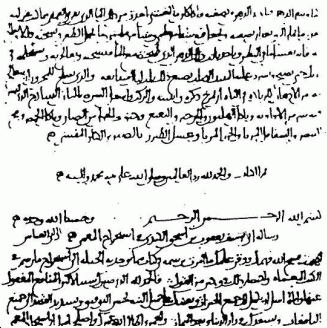
), al-Kindi is credited with being the first real Muslim philosopher. His own thought was largely influenced by the Neo-Platonic philosophy of Proclus
, Plotinus
and John Philoponus
, amongst others, although he does appear to have borrowed ideas from other Hellenistic schools as well. He makes many references to Aristotle
in his writings, but these are often unwittingly re-interpreted in a Neo-Platonic framework. This trend is most obvious in areas such as metaphysics and the nature of God as a causal entity. Earlier experts had suggested that he was influenced by the Mutazilite school of theology, because of the mutual concern both he and they demonstrated for maintaining the pure unity (tawhid
) of God. However, such agreements are now considered incidental, as further study has shown that they disagreed on a number of equally important topics.
is the knowledge of God. For this reason, he does make a clear distinction between philosophy
and theology
, because he believes they are both concerned with the same subject. Later philosophers, particularly al-Farabi
and Avicenna
, would strongly disagree with him on this issue, by saying that metaphysics is actually concerned with qua being, and as such, the nature of God is purely incidental.
Central to al-Kindi's understanding of metaphysics is God's absolute oneness
, which he considers an attribute uniquely associated with God (and therefore not shared with anything else). By this he means that while we may think of any existent thing as being "one", it is in fact both "one" and many". For example, he says that while a body is one, it is also composed of many different parts. A person might say "I see an elephant", by which he means "I see one elephant", but the term 'elephant' refers to a species of animal that contains many. Therefore, only God is absolutely one, both in being and in concept, lacking any multiplicity whatsoever. Some feel this understanding entails a very rigorous negative theology
because it implies that any description which can be predicated to anything else, cannot be said about God.
In addition to absolute oneness, al-Kindi also described God as the Creator. This means that He acts as both a final and efficient cause. Unlike later Muslim Neo-Platonic philosophers (who asserted that the universe existed as a result of God's existence "overflowing", which is a passive act), al-Kindi conceived of God as an active agent. In fact, of God as the agent, because all other intermediary agencies are contingent upon Him. The key idea here is that God "acts" through created intermediaries, which in turn "act" on one another - through a chain of cause and effect - to produce the desired result. In reality, these intermediary agents do not "act" at all, they are merely a conduit for God's own action. This is especially significant in the development of Islamic philosophy, as it portrayed the "first cause" and "unmoved mover" of Aristotelian
philosophy as compatible with the concept of God according to Islamic revelation.
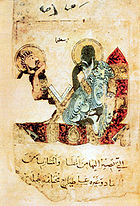 Al-Kindi theorized that there was a separate, incorporeal and universal intellect (known as the "First Intellect"). It was the first of God's creation and the intermediary through which all other things came into creation. Aside from its obvious metaphysical importance, it was also crucial to al-Kindi's epistemology, which was influenced by Platonic realism
.
According to Plato, everything that exists in the material world corresponds to certain universal forms in the heavenly realm. These forms are really abstract concepts such as a species, quality or relation, which apply to all physical objects and beings. For example, a red apple has the quality of "redness" derived from the appropriate universal. However, al-Kindi says that human intellects are only potentially able to comprehend these. This potential is actualized by the First Intellect, which is perpetually thinking about all of the universals. He argues that the external agency of this intellect is necessary by saying that human beings cannot arrive at a universal concept merely through perception. In other words, an intellect cannot understand the species of a thing simply by examining one or more of its instances. According to him, this will only yield an inferior "sensible form", and not the universal form which we desire. The universal form can only be attained through contemplation and actualization by the First Intellect.
The analogy he provides to explain his theory is that of wood and fire. Wood, he argues, is potentially hot (just as a human is potentially thinking about a universal), and therefore requires something else which is already hot (such as fire) to actualize this. This means that for the human intellect to think about something, the First Intellect must already be thinking about it. Therefore he says that the First Intellect must always be thinking about everything. Once the human intellect comprehends a universal by this process, it becomes part of the individual's "acquired intellect" and can be thought about whenever he or she wishes.
) compares it to a ship which has, during the course of its ocean voyage, temporarily anchored itself at an island and allowed its passengers to disembark. The implicit warning is that those passengers who linger too long on the island may be left behind when the ship sets sail again. Here, al-Kindi displays a stoic
concept, that we must not become attached to material things (represented by the island), as they will invariably be taken away from us (when the ship sets sail again). He then connects this with a Neo-Platonist idea, by saying that our soul can be directed towards the pursuit of desire or the pursuit of intellect; the former will tie it to the body, so that when the body dies, it will also die, but the latter will free it from the body and allow it to survive "in the light of the Creator" in a realm of pure intelligence.
In addition to this, al-Kindi adopted a naturalistic view of prophetic visions. He argued that, through the faculty of "imagination" as conceived of in Aristotelian philosophy, certain "pure" and well-prepared souls, were able to receive information about future events. Significantly, he does not attribute such visions or dreams to revelation from God, but instead explains that imagination enables human beings to receive the "form" of something without needing to perceive the physical entity to which it refers. Therefore, it would seem to imply that anyone who has purified themselves would be able to receive such visions. It is precisely this idea, amongst other naturalistic explanations of prophetic miracles that al-Ghazali
attacks in his Incoherence of the Philosophers.
, an expert on Islamic philosophy, points out that the objections of notable theologians are rarely directed at philosophy itself, but rather at the conclusions the philosophers arrived at. Even al-Ghazali
, who is famous for his critique of the philosophers, was himself an expert in philosophy and logic
. And his criticism was that they arrived at theologically erroneous conclusions. The three most serious of these, in his view, were believing in the co-eternity of the universe with God, denying the bodily resurrection, and asserting that God only has knowledge of abstract universals, not of particular things (but it should be noted that not all philosophers subscribed to these same views).
During his life, al-Kindi was fortunate enough to enjoy the patronage of thepro- Mutazilite Caliphs al-Ma'mun
and al-Mu'tasim
, which meant he could carry out his philosophical speculations with relative ease. This would change significantly towards the end of his life when al-Mutawakkil
supported the more orthodox Asharite school, and initiated persecution of various unorthodox schools of thought, including the philosophers. In his own time, al-Kindi would be criticized for extolling the "intellect" as being the most immanent creation in proximity to God, which was commonly held to be the position of the angels. He also engaged in disputations with the Mutazilites, whom he attacked for their belief in atoms. But the real role of al-Kindi in the conflict between philosophers and theologians would be to prepare the ground for debate. His works, says Deborah Black, contained all the seeds of future controversy that would be fully realized in al-Ghazali's Incoherence of the Philosophers.
}}
Muslim
A Muslim, also spelled Moslem, is an adherent of Islam, a monotheistic, Abrahamic religion based on the Quran, which Muslims consider the verbatim word of God as revealed to prophet Muhammad. "Muslim" is the Arabic term for "submitter" .Muslims believe that God is one and incomparable...
Arab
Arab
Arab people, also known as Arabs , are a panethnicity primarily living in the Arab world, which is located in Western Asia and North Africa. They are identified as such on one or more of genealogical, linguistic, or cultural grounds, with tribal affiliations, and intra-tribal relationships playing...
philosopher, mathematician
Mathematician
A mathematician is a person whose primary area of study is the field of mathematics. Mathematicians are concerned with quantity, structure, space, and change....
, physician
Physician
A physician is a health care provider who practices the profession of medicine, which is concerned with promoting, maintaining or restoring human health through the study, diagnosis, and treatment of disease, injury and other physical and mental impairments...
, and musician
Musician
A musician is an artist who plays a musical instrument. It may or may not be the person's profession. Musicians can be classified by their roles in performing music and writing music.Also....* A person who makes music a profession....
. Al-Kindi was the first of the Muslim peripatetic philosophers, and is unanimously hailed as the "father of Islamic or Arabic philosophy
Islamic philosophy
Islamic philosophy is a branch of Islamic studies. It is the continuous search for Hekma in the light of Islamic view of life, universe, ethics, society, and so on...
" for his synthesis, adaptation and promotion of Greek
Greek philosophy
Ancient Greek philosophy arose in the 6th century BCE and continued through the Hellenistic period, at which point Ancient Greece was incorporated in the Roman Empire...
and Hellenistic philosophy
Hellenistic philosophy
Hellenistic philosophy is the period of Western philosophy that was developed in the Hellenistic civilization following Aristotle and ending with the beginning of Neoplatonism.-Pythagoreanism:...
in the Muslim world
Muslim world
The term Muslim world has several meanings. In a religious sense, it refers to those who adhere to the teachings of Islam, referred to as Muslims. In a cultural sense, it refers to Islamic civilization, inclusive of non-Muslims living in that civilization...
.
Al-Kindi was a descendant of the Kinda tribe. He was born and educated in Kufa
Kufa
Kufa is a city in Iraq, about south of Baghdad, and northeast of Najaf. It is located on the banks of the Euphrates River. The estimated population in 2003 was 110,000....
, before going to pursue further studies in Baghdad
Baghdad
Baghdad is the capital of Iraq, as well as the coterminous Baghdad Governorate. The population of Baghdad in 2011 is approximately 7,216,040...
. Al-Kindi became a prominent figure in the House of Wisdom
House of Wisdom
The House of Wisdom was a library and translation institute established in Abbassid-era Baghdad, Iraq. It was a key institution in the Translation Movement and considered to have been a major intellectual centre during the Islamic Golden Age...
, and a number of Abbasid
Abbasid
The Abbasid Caliphate or, more simply, the Abbasids , was the third of the Islamic caliphates. It was ruled by the Abbasid dynasty of caliphs, who built their capital in Baghdad after overthrowing the Umayyad caliphate from all but the al-Andalus region....
Caliphs appointed him to oversee the translation of Greek
Ancient Greece
Ancient Greece is a civilization belonging to a period of Greek history that lasted from the Archaic period of the 8th to 6th centuries BC to the end of antiquity. Immediately following this period was the beginning of the Early Middle Ages and the Byzantine era. Included in Ancient Greece is the...
scientific and philosophical texts into the Arabic language
Arabic language
Arabic is a name applied to the descendants of the Classical Arabic language of the 6th century AD, used most prominently in the Quran, the Islamic Holy Book...
. This contact with "the philosophy of the ancients" (as Greek philosophy was often referred to by Muslim scholars) had a profound effect on his intellectual development, and lead him to write hundreds of original treatises of his own on a range of subjects ranging from metaphysics
Metaphysics
Metaphysics is a branch of philosophy concerned with explaining the fundamental nature of being and the world, although the term is not easily defined. Traditionally, metaphysics attempts to answer two basic questions in the broadest possible terms:...
, ethics
Ethics
Ethics, also known as moral philosophy, is a branch of philosophy that addresses questions about morality—that is, concepts such as good and evil, right and wrong, virtue and vice, justice and crime, etc.Major branches of ethics include:...
, logic
Logic
In philosophy, Logic is the formal systematic study of the principles of valid inference and correct reasoning. Logic is used in most intellectual activities, but is studied primarily in the disciplines of philosophy, mathematics, semantics, and computer science...
and psychology
Psychology
Psychology is the study of the mind and behavior. Its immediate goal is to understand individuals and groups by both establishing general principles and researching specific cases. For many, the ultimate goal of psychology is to benefit society...
, to medicine
Medicine
Medicine is the science and art of healing. It encompasses a variety of health care practices evolved to maintain and restore health by the prevention and treatment of illness....
, pharmacology
Pharmacology
Pharmacology is the branch of medicine and biology concerned with the study of drug action. More specifically, it is the study of the interactions that occur between a living organism and chemicals that affect normal or abnormal biochemical function...
, mathematics
Mathematics
Mathematics is the study of quantity, space, structure, and change. Mathematicians seek out patterns and formulate new conjectures. Mathematicians resolve the truth or falsity of conjectures by mathematical proofs, which are arguments sufficient to convince other mathematicians of their validity...
, astronomy
Astronomy
Astronomy is a natural science that deals with the study of celestial objects and phenomena that originate outside the atmosphere of Earth...
, astrology
Astrology
Astrology consists of a number of belief systems which hold that there is a relationship between astronomical phenomena and events in the human world...
and optics
Optics
Optics is the branch of physics which involves the behavior and properties of light, including its interactions with matter and the construction of instruments that use or detect it. Optics usually describes the behavior of visible, ultraviolet, and infrared light...
, and further afield to more practical topics like perfumes, swords
Swords
A sword is a cutting/thrusting weapon made of metal. Sword or swords may also refer to:* Swords, County Dublin, Ireland* Suit of swords, a suit in Latin-suited playing cards and Tarot decks* SWORDS, a ground-based military robot...
, jewels, glass
Glass
Glass is an amorphous solid material. Glasses are typically brittle and optically transparent.The most familiar type of glass, used for centuries in windows and drinking vessels, is soda-lime glass, composed of about 75% silica plus Na2O, CaO, and several minor additives...
, dyes, zoology
Zoology
Zoology |zoölogy]]), is the branch of biology that relates to the animal kingdom, including the structure, embryology, evolution, classification, habits, and distribution of all animals, both living and extinct...
, tides, mirrors, meteorology
Meteorology
Meteorology is the interdisciplinary scientific study of the atmosphere. Studies in the field stretch back millennia, though significant progress in meteorology did not occur until the 18th century. The 19th century saw breakthroughs occur after observing networks developed across several countries...
and earthquakes.
In the field of mathematics, al-Kindi played an important role in introducing Indian numerals
Indian numerals
Most of the positional base 10 numeral systems in the world have originated from India, where the concept of positional numeration was first developed...
to the Islamic and Christian world. He was a pioneer in cryptanalysis
Cryptanalysis
Cryptanalysis is the study of methods for obtaining the meaning of encrypted information, without access to the secret information that is normally required to do so. Typically, this involves knowing how the system works and finding a secret key...
and devised several new methods of breaking ciphers. Using his mathematical and medical expertise, he was able to develop a scale that would allow doctors to quantify the potency of their medication.
The central theme underpinning al-Kindi's philosophical writings is the compatibility between philosophy and other "orthodox" Islamic sciences, particularly theology
Theology
Theology is the systematic and rational study of religion and its influences and of the nature of religious truths, or the learned profession acquired by completing specialized training in religious studies, usually at a university or school of divinity or seminary.-Definition:Augustine of Hippo...
. And many of his works deal with subjects that theology had an immediate interest in. These include the nature of God, the soul
Soul
A soul in certain spiritual, philosophical, and psychological traditions is the incorporeal essence of a person or living thing or object. Many philosophical and spiritual systems teach that humans have souls, and others teach that all living things and even inanimate objects have souls. The...
and prophetic knowledge
Revelation
In religion and theology, revelation is the revealing or disclosing, through active or passive communication with a supernatural or a divine entity...
. But despite the important role he played in making philosophy accessible to Muslim intellectuals, his own philosophical output was largely overshadowed by that of al-Farabi
Al-Farabi
' known in the West as Alpharabius , was a scientist and philosopher of the Islamic world...
and very few of his texts are available for modern scholars to examine.
Life
Al-Kindi was born in KufaKufa
Kufa is a city in Iraq, about south of Baghdad, and northeast of Najaf. It is located on the banks of the Euphrates River. The estimated population in 2003 was 110,000....
to an aristocratic family of the Kinda
Kindah
The kingdom of Kindah was a vassal kingdom which ruled from Qaryah dhat Kahl in Nejd, Central Arabia . The kingdom controlled much of the northern Arabian peninsula in the 4th and 5th centuries AD.-Origin:...
tribe, which had migrated there from Nejd modern day central Saudi Arabia
Saudi Arabia
The Kingdom of Saudi Arabia , commonly known in British English as Saudi Arabia and in Arabic as as-Sa‘ūdiyyah , is the largest state in Western Asia by land area, constituting the bulk of the Arabian Peninsula, and the second-largest in the Arab World...
.His full name was, in ; (in ). His father was the governor of Kufa, and al-Kindi received his preliminary education there. He later went to complete his studies in Baghdad, where he was patronized by the Abbasid
Abbasid
The Abbasid Caliphate or, more simply, the Abbasids , was the third of the Islamic caliphates. It was ruled by the Abbasid dynasty of caliphs, who built their capital in Baghdad after overthrowing the Umayyad caliphate from all but the al-Andalus region....
Caliphs al-Ma'mun
Al-Ma'mun
Abū Jaʿfar Abdullāh al-Māʾmūn ibn Harūn was an Abbasid caliph who reigned from 813 until his death in 833...
and al-Mu'tasim
Al-Mu'tasim
Abu Ishaq 'Abbas al-Mu'tasim ibn Harun was an Abbasid caliph . He succeeded his half-brother al-Ma'mun...
. On account of his learning and aptitude for study, al-Ma'mun appointed him to House of Wisdom
House of Wisdom
The House of Wisdom was a library and translation institute established in Abbassid-era Baghdad, Iraq. It was a key institution in the Translation Movement and considered to have been a major intellectual centre during the Islamic Golden Age...
, a recently established centre for the translation of Greek
Ancient Greece
Ancient Greece is a civilization belonging to a period of Greek history that lasted from the Archaic period of the 8th to 6th centuries BC to the end of antiquity. Immediately following this period was the beginning of the Early Middle Ages and the Byzantine era. Included in Ancient Greece is the...
philosophical and scientific texts, in Baghdad. He was also well known for his beautiful calligraphy
Calligraphy
Calligraphy is a type of visual art. It is often called the art of fancy lettering . A contemporary definition of calligraphic practice is "the art of giving form to signs in an expressive, harmonious and skillful manner"...
, and at one point was employed as a calligrapher by al-Mutawakkil
Al-Mutawakkil
Al-Mutawakkil ʻAlā Allāh Jaʻfar ibn al-Muʻtasim was an Abbasid caliph who reigned in Samarra from 847 until 861...
.
When al-Ma'mun died, his brother, al-Mu'tasim became Caliph. Al-Kindi's position would be enhanced under al-Mu'tasim, who appointed him as a tutor to his son. But on the accession of al-Wathiq
Al-Wathiq
Al-Wathiq ibn Mutasim was an Abbasid caliph who reigned from 842 until 847 AD .-Biography:...
, and especially of al-Mutawakkil
Al-Mutawakkil
Al-Mutawakkil ʻAlā Allāh Jaʻfar ibn al-Muʻtasim was an Abbasid caliph who reigned in Samarra from 847 until 861...
, al-Kindi's star waned. There are various theories concerning this: some attribute al-Kindi's downfall to scholarly rivalries at the House of Wisdom; others refer to al-Mutawakkil’s often violent persecution of unorthodox Muslims (as well as of non-Muslims); at one point al-Kindi was beaten and his library temporarily confiscated. Henry Corbin
Henry Corbin
Henry Corbin was a philosopher, theologian and professor of Islamic Studies at the Sorbonne in Paris, France.Corbin was born in Paris in April 1903. As a boy he revealed the profound sensitivity to music so evident in his work...
, an authority on Islamic studies, says that in 873, al-Kindi died "a lonely man", in Baghdad during the reign of Al-Mu'tamid
Al-Mu'tamid
This article is about the Abbasid Caliph al-Mu'tamid of Baghdad. For the Andalusi Arabic poet who was also the Abbadid king of Seville, see Muhammad Ibn Abbad Al Mutamid...
.
After his death, al-Kindi's philosophical works quickly fell into obscurity and many of them were lost even to later Islamic scholars and historians. Felix Klein-Franke suggests a number of reasons for this: aside from the militant orthodoxy of al-Mutawakkil, the Mongols
Mongols
Mongols ) are a Central-East Asian ethnic group that lives mainly in the countries of Mongolia, China, and Russia. In China, ethnic Mongols can be found mainly in the central north region of China such as Inner Mongolia...
also destroyed countless libraries during their invasion. However, he says the most probable cause of this was that his writings never found popularity amongst subsequent influential philosophers such as al-Farabi
Al-Farabi
' known in the West as Alpharabius , was a scientist and philosopher of the Islamic world...
and Avicenna
Avicenna
Abū ʿAlī al-Ḥusayn ibn ʿAbd Allāh ibn Sīnā , commonly known as Ibn Sīnā or by his Latinized name Avicenna, was a Persian polymath, who wrote almost 450 treatises on a wide range of subjects, of which around 240 have survived...
, who ultimately overshadowed him.
Accomplishments
Al-Kindi was a master of many different areas of thought. And although he would eventually be eclipsed by names such as al-FarabiAl-Farabi
' known in the West as Alpharabius , was a scientist and philosopher of the Islamic world...
and Avicenna
Avicenna
Abū ʿAlī al-Ḥusayn ibn ʿAbd Allāh ibn Sīnā , commonly known as Ibn Sīnā or by his Latinized name Avicenna, was a Persian polymath, who wrote almost 450 treatises on a wide range of subjects, of which around 240 have survived...
, he was held to be one of the greatest Islam
Islam
Islam . The most common are and . : Arabic pronunciation varies regionally. The first vowel ranges from ~~. The second vowel ranges from ~~~...
ic philosophers of his time.
The Italian Renaissance scholar Geralomo Cardano (1501-1575) considered him one of the twelve greatest minds of the Middle Ages. According to Ibn al-Nadim, al-Kindi wrote at least two hundred and sixty books, contributing heavily to geometry
Geometry
Geometry arose as the field of knowledge dealing with spatial relationships. Geometry was one of the two fields of pre-modern mathematics, the other being the study of numbers ....
(thirty-two books), medicine and philosophy (twenty-two books each), logic
Logic
In philosophy, Logic is the formal systematic study of the principles of valid inference and correct reasoning. Logic is used in most intellectual activities, but is studied primarily in the disciplines of philosophy, mathematics, semantics, and computer science...
(nine books), and physics
Physics
Physics is a natural science that involves the study of matter and its motion through spacetime, along with related concepts such as energy and force. More broadly, it is the general analysis of nature, conducted in order to understand how the universe behaves.Physics is one of the oldest academic...
(twelve books). His influence in the fields of physics, mathematics, medicine, philosophy and music were far-reaching and lasted for several centuries. Although most of his books have been lost over the centuries, a few have survived in the form of Latin
Latin
Latin is an Italic language originally spoken in Latium and Ancient Rome. It, along with most European languages, is a descendant of the ancient Proto-Indo-European language. Although it is considered a dead language, a number of scholars and members of the Christian clergy speak it fluently, and...
translations by Gerard of Cremona
Gerard of Cremona
Gerard of Cremona was an Italian translator of Arabic scientific works found in the abandoned Arab libraries of Toledo, Spain....
, and others have been rediscovered in Arabic manuscripts; most importantly, twenty-four of his lost works were located in the mid-twentieth century in a Turkish library.
Philosophy
His greatest contribution to the development of Islamic philosophy was his efforts to make Greek thought both accessible and acceptable to a Muslim audience. Al-Kindi carried out this mission from the House of WisdomHouse of Wisdom
The House of Wisdom was a library and translation institute established in Abbassid-era Baghdad, Iraq. It was a key institution in the Translation Movement and considered to have been a major intellectual centre during the Islamic Golden Age...
, an institute of translation and learning patronized by the Abbasid
Abbasid
The Abbasid Caliphate or, more simply, the Abbasids , was the third of the Islamic caliphates. It was ruled by the Abbasid dynasty of caliphs, who built their capital in Baghdad after overthrowing the Umayyad caliphate from all but the al-Andalus region....
Caliphs, in Baghdad. As well as translating many important texts, much of what was to become standard Arabic philosophical vocabulary originated with al-Kindi; indeed, if it had not been for him, the work of philosophers like Al-Farabi
Al-Farabi
' known in the West as Alpharabius , was a scientist and philosopher of the Islamic world...
, Avicenna
Avicenna
Abū ʿAlī al-Ḥusayn ibn ʿAbd Allāh ibn Sīnā , commonly known as Ibn Sīnā or by his Latinized name Avicenna, was a Persian polymath, who wrote almost 450 treatises on a wide range of subjects, of which around 240 have survived...
, and al-Ghazali
Al-Ghazali
Abu Hāmed Mohammad ibn Mohammad al-Ghazzālī , known as Algazel to the western medieval world, born and died in Tus, in the Khorasan province of Persia was a Persian Muslim theologian, jurist, philosopher, and mystic....
might not have been possible.
In his writings, one of al-Kindi's central concerns was to demonstrate the compatibility between philosophy and natural theology
Natural theology
Natural theology is a branch of theology based on reason and ordinary experience. Thus it is distinguished from revealed theology which is based on scripture and religious experiences of various kinds; and also from transcendental theology, theology from a priori reasoning.Marcus Terentius Varro ...
on the one hand, and revealed or speculative theology
Kalam
ʿIlm al-Kalām is the Islamic philosophical discipline of seeking theological principles through dialectic. Kalām in Islamic practice relates to the discipline of seeking theological knowledge through debate and argument. A scholar of kalām is referred to as a mutakallim...
on the other (though in fact he rejected speculative theology). Despite this, he did make clear that he believed revelation was a superior source of knowledge to reason because it guaranteed matters of faith that reason could not uncover. And while his philosophical approach was not always original, and was even considered clumsy by later thinkers (mainly because he was the first philosopher writing in the Arabic language), he successfully incorporated Aristotelian
Aristotle
Aristotle was a Greek philosopher and polymath, a student of Plato and teacher of Alexander the Great. His writings cover many subjects, including physics, metaphysics, poetry, theater, music, logic, rhetoric, linguistics, politics, government, ethics, biology, and zoology...
and (especially) neo-Platonist thought into an Islamic philosophical framework. This was an important factor in the introduction and popularization Greek philosophy in the Muslim intellectual world.
Astrology
Al-Kindi took his view of the solar system from PtolemyPtolemy
Claudius Ptolemy , was a Roman citizen of Egypt who wrote in Greek. He was a mathematician, astronomer, geographer, astrologer, and poet of a single epigram in the Greek Anthology. He lived in Egypt under Roman rule, and is believed to have been born in the town of Ptolemais Hermiou in the...
, who placed the Earth at the centre of a series of concentric spheres, in which the known heavenly bodies (the Moon, Mercury, Venus, the Sun, Mars, Jupiter, and the stars) are embedded. In one of his treatises on the subject, he says that these bodies are rational entities, whose circular motion is in obedience to and worship of God. Their role, al-Kindi believes, is to act as instruments for divine providence. He furnishes empirical evidence as proof for this assertion; different seasons are marked by particular arrangements of the planets and stars (most notably the sun); the appearance and manner of people varies according to the arrangement of heavenly bodies situated above their homeland.
However, he is ambiguous when it comes to the actual process by which the heavenly bodies affect the material world. One theory he posits in his works is from Aristotle, who conceived that the movement of these bodies causes friction in the sub-lunar region, which stirs up the primary elements of earth, fire, air and water, and these combine to produce everything in the material world. An alternative view found his treatise On Rays is that the planets exercize their influence in straight lines. In each of these, he presents two fundamentally different views of physical interaction; action by contact and action at a distance. This dichotomy is duplicated in his writings on optics
Optics
Optics is the branch of physics which involves the behavior and properties of light, including its interactions with matter and the construction of instruments that use or detect it. Optics usually describes the behavior of visible, ultraviolet, and infrared light...
.
Some of the notable astrological works by al-Kindi include:
The Book of the Judgement of the Stars, including The Forty Chapters, on questions and elections.
On the Stellar Rays.
Several epistles on weather and meteorology, including De mutatione temporum, ‘On the Changing of the Weather’.
Treatise on the Judgement of Eclipses.
Treatise on the Dominion of the Arabs and its Duration (used to predict the end of Arab rule).
The Choices of Days (on elections).
On the Revolutions of the Years (on mundane astrology and natal revolutions).
De Signis Astronomiae Applicitis as Mediciam ‘On the Signs of Astronomy as applied to Medicine’
Treatise on the Spirituality of the Planets.
Optics
Two major theories of opticsOptics
Optics is the branch of physics which involves the behavior and properties of light, including its interactions with matter and the construction of instruments that use or detect it. Optics usually describes the behavior of visible, ultraviolet, and infrared light...
appear in the writings of al-Kindi; Aristotelian
Aristotle
Aristotle was a Greek philosopher and polymath, a student of Plato and teacher of Alexander the Great. His writings cover many subjects, including physics, metaphysics, poetry, theater, music, logic, rhetoric, linguistics, politics, government, ethics, biology, and zoology...
and Euclid
Euclid
Euclid , fl. 300 BC, also known as Euclid of Alexandria, was a Greek mathematician, often referred to as the "Father of Geometry". He was active in Alexandria during the reign of Ptolemy I...
ian. Aristotle had believed that in order for the eye to perceive an object, both the eye and the object must be in contact with a transparent medium (such as air) that is filled with light. When these criteria are met, the "sensible form" of the object is transmitted through the medium to the eye. On the other hand, Euclid proposed that vision occurred in straight lines when "rays" from the eye reached an illuminated object and were reflected back. As with his theories on Astrology, the dichotomy of contact and distance is present in al-Kindi's writings on this subject as well.
The factor which al-Kindi relied upon to determine which of these theories was most correct was how adequately each one explained the experience of seeing. For example, Aristotle's theory was unable to account for why the angle at which an individual sees an object affects his perception of it. For example, why a circle viewed from the side will appear as a line. According to Aristotle, the complete sensible form of a circle should be transmitted to the eye and it should appear as a circle. On the other hand, Eulcidian optics provided a geometric model that was able to account for this, as well as the length of shadows and reflections in mirrors, because Eulcid believed that the visual "rays" could only travel in straight lines (something which is commonly accepted in modern science). For this reason, al-Kindi considered the latter preponderant.
Medicine
There are more than thirty treatises attributed to al-Kindi in the field of medicineMedicine
Medicine is the science and art of healing. It encompasses a variety of health care practices evolved to maintain and restore health by the prevention and treatment of illness....
, in which he was chiefly influenced by the ideas of Galen
Galen
Aelius Galenus or Claudius Galenus , better known as Galen of Pergamon , was a prominent Roman physician, surgeon and philosopher...
. His most important work in this field is probably De Gradibus
De Gradibus
De Gradibus was an Arabic book published by the Arab physician Al-Kindi . De gradibus is the Latinized name of the book. An alternative name for the book was Quia Primos....
, in which he demonstrates the application of mathematics to medicine, particularly in the field of pharmacology. For example, he developed a mathematical scale to quantify the strength of drug and a system, based the phases of the moon, that would allow a doctor to determine in advance the most critical days of a patient's illness.
Chemistry
As an advanced chemistChemist
A chemist is a scientist trained in the study of chemistry. Chemists study the composition of matter and its properties such as density and acidity. Chemists carefully describe the properties they study in terms of quantities, with detail on the level of molecules and their component atoms...
, he was also an opponent of alchemy
Alchemy
Alchemy is an influential philosophical tradition whose early practitioners’ claims to profound powers were known from antiquity. The defining objectives of alchemy are varied; these include the creation of the fabled philosopher's stone possessing powers including the capability of turning base...
; he debunked the myth that simple, base metal
Metal
A metal , is an element, compound, or alloy that is a good conductor of both electricity and heat. Metals are usually malleable and shiny, that is they reflect most of incident light...
s could be transformed into precious metals such as gold
Gold
Gold is a chemical element with the symbol Au and an atomic number of 79. Gold is a dense, soft, shiny, malleable and ductile metal. Pure gold has a bright yellow color and luster traditionally considered attractive, which it maintains without oxidizing in air or water. Chemically, gold is a...
or silver
Silver
Silver is a metallic chemical element with the chemical symbol Ag and atomic number 47. A soft, white, lustrous transition metal, it has the highest electrical conductivity of any element and the highest thermal conductivity of any metal...
.
Mathematics
Al-Kindi authored works on a number of important mathematical subjects, including arithmetic, geometry, the Indian numbers, the harmony of numbers, lines and multiplication with numbers, relative quantities, measuring proportion and time, and numerical procedures and cancellation. He also wrote four volumes, On the Use of the Indian Numerals (Ketab fi Isti'mal al-'Adad al-Hindi) which contributed greatly to diffusion of the Indian system of numeration in the Middle-East and the West. In geometry, among other works, he wrote on the theory of parallels. Also related to geometry were two works on optics. One of the ways in which he made use of mathematics as a philosopher was to attempt to disprove the eternity of the world by demonstrating that actual infinityInfinity
Infinity is a concept in many fields, most predominantly mathematics and physics, that refers to a quantity without bound or end. People have developed various ideas throughout history about the nature of infinity...
is a mathematical and logical absurdity.
Cryptography
Al-Kindi is credited with developing a method whereby variations in the frequency of the occurrence of letters could be analyzed and exploited to break ciphers (i.e. crypanalysis by frequency analysis).Influences
While Muslim intellectuals were already acquainted with Greek philosophy (especially logicLogic
In philosophy, Logic is the formal systematic study of the principles of valid inference and correct reasoning. Logic is used in most intellectual activities, but is studied primarily in the disciplines of philosophy, mathematics, semantics, and computer science...
), al-Kindi is credited with being the first real Muslim philosopher. His own thought was largely influenced by the Neo-Platonic philosophy of Proclus
Proclus
Proclus Lycaeus , called "The Successor" or "Diadochos" , was a Greek Neoplatonist philosopher, one of the last major Classical philosophers . He set forth one of the most elaborate and fully developed systems of Neoplatonism...
, Plotinus
Plotinus
Plotinus was a major philosopher of the ancient world. In his system of theory there are the three principles: the One, the Intellect, and the Soul. His teacher was Ammonius Saccas and he is of the Platonic tradition...
and John Philoponus
John Philoponus
John Philoponus , also known as John the Grammarian or John of Alexandria, was a Christian and Aristotelian commentator and the author of a considerable number of philosophical treatises and theological works...
, amongst others, although he does appear to have borrowed ideas from other Hellenistic schools as well. He makes many references to Aristotle
Aristotle
Aristotle was a Greek philosopher and polymath, a student of Plato and teacher of Alexander the Great. His writings cover many subjects, including physics, metaphysics, poetry, theater, music, logic, rhetoric, linguistics, politics, government, ethics, biology, and zoology...
in his writings, but these are often unwittingly re-interpreted in a Neo-Platonic framework. This trend is most obvious in areas such as metaphysics and the nature of God as a causal entity. Earlier experts had suggested that he was influenced by the Mutazilite school of theology, because of the mutual concern both he and they demonstrated for maintaining the pure unity (tawhid
Tawhid
Tawhid is the concept of monotheism in Islam. It is the religion's most fundamental concept and holds God is one and unique ....
) of God. However, such agreements are now considered incidental, as further study has shown that they disagreed on a number of equally important topics.
Metaphysics
According to al-Kindi, the goal of metaphysicsMetaphysics
Metaphysics is a branch of philosophy concerned with explaining the fundamental nature of being and the world, although the term is not easily defined. Traditionally, metaphysics attempts to answer two basic questions in the broadest possible terms:...
is the knowledge of God. For this reason, he does make a clear distinction between philosophy
Philosophy
Philosophy is the study of general and fundamental problems, such as those connected with existence, knowledge, values, reason, mind, and language. Philosophy is distinguished from other ways of addressing such problems by its critical, generally systematic approach and its reliance on rational...
and theology
Theology
Theology is the systematic and rational study of religion and its influences and of the nature of religious truths, or the learned profession acquired by completing specialized training in religious studies, usually at a university or school of divinity or seminary.-Definition:Augustine of Hippo...
, because he believes they are both concerned with the same subject. Later philosophers, particularly al-Farabi
Al-Farabi
' known in the West as Alpharabius , was a scientist and philosopher of the Islamic world...
and Avicenna
Avicenna
Abū ʿAlī al-Ḥusayn ibn ʿAbd Allāh ibn Sīnā , commonly known as Ibn Sīnā or by his Latinized name Avicenna, was a Persian polymath, who wrote almost 450 treatises on a wide range of subjects, of which around 240 have survived...
, would strongly disagree with him on this issue, by saying that metaphysics is actually concerned with qua being, and as such, the nature of God is purely incidental.
Central to al-Kindi's understanding of metaphysics is God's absolute oneness
Tawhid
Tawhid is the concept of monotheism in Islam. It is the religion's most fundamental concept and holds God is one and unique ....
, which he considers an attribute uniquely associated with God (and therefore not shared with anything else). By this he means that while we may think of any existent thing as being "one", it is in fact both "one" and many". For example, he says that while a body is one, it is also composed of many different parts. A person might say "I see an elephant", by which he means "I see one elephant", but the term 'elephant' refers to a species of animal that contains many. Therefore, only God is absolutely one, both in being and in concept, lacking any multiplicity whatsoever. Some feel this understanding entails a very rigorous negative theology
Negative theology
Apophatic theology —also known as negative theology or via negativa —is a theology that attempts to describe God, the Divine Good, by negation, to speak only in terms of what may not be said about the perfect goodness that is God...
because it implies that any description which can be predicated to anything else, cannot be said about God.
In addition to absolute oneness, al-Kindi also described God as the Creator. This means that He acts as both a final and efficient cause. Unlike later Muslim Neo-Platonic philosophers (who asserted that the universe existed as a result of God's existence "overflowing", which is a passive act), al-Kindi conceived of God as an active agent. In fact, of God as the agent, because all other intermediary agencies are contingent upon Him. The key idea here is that God "acts" through created intermediaries, which in turn "act" on one another - through a chain of cause and effect - to produce the desired result. In reality, these intermediary agents do not "act" at all, they are merely a conduit for God's own action. This is especially significant in the development of Islamic philosophy, as it portrayed the "first cause" and "unmoved mover" of Aristotelian
Aristotelianism
Aristotelianism is a tradition of philosophy that takes its defining inspiration from the work of Aristotle. The works of Aristotle were initially defended by the members of the Peripatetic school, and, later on, by the Neoplatonists, who produced many commentaries on Aristotle's writings...
philosophy as compatible with the concept of God according to Islamic revelation.
Epistemology
Platonic realism
Platonic realism is a philosophical term usually used to refer to the idea of realism regarding the existence of universals or abstract objects after the Greek philosopher Plato , a student of Socrates. As universals were considered by Plato to be ideal forms, this stance is confusingly also called...
.
According to Plato, everything that exists in the material world corresponds to certain universal forms in the heavenly realm. These forms are really abstract concepts such as a species, quality or relation, which apply to all physical objects and beings. For example, a red apple has the quality of "redness" derived from the appropriate universal. However, al-Kindi says that human intellects are only potentially able to comprehend these. This potential is actualized by the First Intellect, which is perpetually thinking about all of the universals. He argues that the external agency of this intellect is necessary by saying that human beings cannot arrive at a universal concept merely through perception. In other words, an intellect cannot understand the species of a thing simply by examining one or more of its instances. According to him, this will only yield an inferior "sensible form", and not the universal form which we desire. The universal form can only be attained through contemplation and actualization by the First Intellect.
The analogy he provides to explain his theory is that of wood and fire. Wood, he argues, is potentially hot (just as a human is potentially thinking about a universal), and therefore requires something else which is already hot (such as fire) to actualize this. This means that for the human intellect to think about something, the First Intellect must already be thinking about it. Therefore he says that the First Intellect must always be thinking about everything. Once the human intellect comprehends a universal by this process, it becomes part of the individual's "acquired intellect" and can be thought about whenever he or she wishes.
The soul and the afterlife
Al-Kindi says that the soul is a simple, immaterial substance, which is related to the material world only because of its faculties which operate through the physical body. To explain the nature of our worldly existence, he (borrowing from EpictetusEpictetus
Epictetus was a Greek sage and Stoic philosopher. He was born a slave at Hierapolis, Phrygia , and lived in Rome until banishment when he went to Nicopolis in northwestern Greece where he lived the rest of his life. His teachings were noted down and published by his pupil Arrian in his Discourses...
) compares it to a ship which has, during the course of its ocean voyage, temporarily anchored itself at an island and allowed its passengers to disembark. The implicit warning is that those passengers who linger too long on the island may be left behind when the ship sets sail again. Here, al-Kindi displays a stoic
STOIC
STOIC was a variant of Forth.It started out at the MIT and Harvard Biomedical Engineering Centre in Boston, and was written in the mid 1970s by Jonathan Sachs...
concept, that we must not become attached to material things (represented by the island), as they will invariably be taken away from us (when the ship sets sail again). He then connects this with a Neo-Platonist idea, by saying that our soul can be directed towards the pursuit of desire or the pursuit of intellect; the former will tie it to the body, so that when the body dies, it will also die, but the latter will free it from the body and allow it to survive "in the light of the Creator" in a realm of pure intelligence.
The relationship between revelation and philosophy
In the view of al-Kindi, prophecy and philosophy were two different routes to arrive at the truth. He contrasts the two positions in four ways. Firstly, while a person must undergo a long period of training and study to become a philosopher, prophecy is bestowed upon someone by God. Secondly, the philosopher must arrive at the truth by his own devices (and with great difficulty), whereas the prophet has the truth revealed to him by God. Thirdly, the understanding of the prophet - being divinely revealed - is clearer and more comprehensive than that of the philosopher. Fourthly, the way in which the prophet is able to express this understanding to the ordinary people is superior. Therefore al-Kindi says the prophet is superior in two fields: the ease and certainty with which he receives the truth, and the way in which he presents it. However, the crucial implication is that the content of the prophet's and the philosopher's knowledge is the same. This, says Adamson, demonstrates how limited the superiority al-Kindi afforded to prophecy was.In addition to this, al-Kindi adopted a naturalistic view of prophetic visions. He argued that, through the faculty of "imagination" as conceived of in Aristotelian philosophy, certain "pure" and well-prepared souls, were able to receive information about future events. Significantly, he does not attribute such visions or dreams to revelation from God, but instead explains that imagination enables human beings to receive the "form" of something without needing to perceive the physical entity to which it refers. Therefore, it would seem to imply that anyone who has purified themselves would be able to receive such visions. It is precisely this idea, amongst other naturalistic explanations of prophetic miracles that al-Ghazali
Al-Ghazali
Abu Hāmed Mohammad ibn Mohammad al-Ghazzālī , known as Algazel to the western medieval world, born and died in Tus, in the Khorasan province of Persia was a Persian Muslim theologian, jurist, philosopher, and mystic....
attacks in his Incoherence of the Philosophers.
Controversies
While al-Kindi appreciated the usefulness of philosophy in answering questions of a religious nature, there would be many Islamic thinkers who were not as enthusiastic about its potential. But it would be incorrect to assume that they opposed philosophy simply because it was a "foreign science". Oliver LeamanOliver Leaman
Oliver Leaman is a Professor of Philosophy and Zantker Professor of Judaic Studies. He has been teaching at the University of Kentucky since August 2000, and is particularly interested in Islamic, Jewish and Eastern philosophy.". He has got his Ph.D...
, an expert on Islamic philosophy, points out that the objections of notable theologians are rarely directed at philosophy itself, but rather at the conclusions the philosophers arrived at. Even al-Ghazali
Al-Ghazali
Abu Hāmed Mohammad ibn Mohammad al-Ghazzālī , known as Algazel to the western medieval world, born and died in Tus, in the Khorasan province of Persia was a Persian Muslim theologian, jurist, philosopher, and mystic....
, who is famous for his critique of the philosophers, was himself an expert in philosophy and logic
Logic
In philosophy, Logic is the formal systematic study of the principles of valid inference and correct reasoning. Logic is used in most intellectual activities, but is studied primarily in the disciplines of philosophy, mathematics, semantics, and computer science...
. And his criticism was that they arrived at theologically erroneous conclusions. The three most serious of these, in his view, were believing in the co-eternity of the universe with God, denying the bodily resurrection, and asserting that God only has knowledge of abstract universals, not of particular things (but it should be noted that not all philosophers subscribed to these same views).
During his life, al-Kindi was fortunate enough to enjoy the patronage of the
Al-Ma'mun
Abū Jaʿfar Abdullāh al-Māʾmūn ibn Harūn was an Abbasid caliph who reigned from 813 until his death in 833...
and al-Mu'tasim
Al-Mu'tasim
Abu Ishaq 'Abbas al-Mu'tasim ibn Harun was an Abbasid caliph . He succeeded his half-brother al-Ma'mun...
, which meant he could carry out his philosophical speculations with relative ease. This would change significantly towards the end of his life when al-Mutawakkil
Al-Mutawakkil
Al-Mutawakkil ʻAlā Allāh Jaʻfar ibn al-Muʻtasim was an Abbasid caliph who reigned in Samarra from 847 until 861...
supported the more orthodox Asharite school, and initiated persecution of various unorthodox schools of thought, including the philosophers. In his own time, al-Kindi would be criticized for extolling the "intellect" as being the most immanent creation in proximity to God, which was commonly held to be the position of the angels. He also engaged in disputations with the Mutazilites, whom he attacked for their belief in atoms. But the real role of al-Kindi in the conflict between philosophers and theologians would be to prepare the ground for debate. His works, says Deborah Black, contained all the seeds of future controversy that would be fully realized in al-Ghazali's Incoherence of the Philosophers.
External links
(PDF version)- Al-Kindi — Famous Muslims
- Al-Kindi's website — Islamic Philosophy Online - Three texts by Al Kindi in the Islamic Philosophy section
- Benjamnin N. Dyke's translation of Al-Kindi's Forty Chapters with PDF extracts from the Introduction and main text
}}