

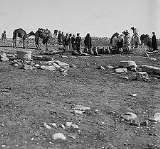
Al-Khalasa

Encyclopedia
Al-Khalasa was a Palestinian
village, located 23 kilometers southwest of the city of Beersheba
. The village was originally founded by the Nabateans under the name of "al-Khalus", and then "Elusa" under the Byzantines where it served an administrative center in the Negev Desert. It continued as a major town by its modern name "al-Khalasa" during Mamluk
rule, but was abandoned sometime in the fifteenth century CE. It was repopulated by Bedouin
s in the early twentieth century, after western archaeologists took an interest in it. In October 1948, it was captured by Israel
during the 1948 Arab-Israeli War
. The population of al-Khalasa is unknown, but all of the inhabitants were Muslim
s, from the al-Azizma tribe.
. Roman
historian Ptolemy
identifies it as a town in Idumea west of the Jordan River. After the Roman conquest, al-Khalus was renamed "Elusa", and in the late Roman period it grew to become the principal town of the western Arabia Petraea
province. It was the birthplace of Abraham Zenobius
a prominent Rhetorician in Antioch. Elusa became one of the first Negev
towns to have a large Christian
population, and Christians and pagans lived side-by-side. The Bishops of Elusa participated in the church councils 431 and 451 CE. Tomb-stones found in the local cemetery indicate that there were pagans at Elusa as late as the early 5th century. In this period the city belonged to Palestina Tertia.
After the Islamic conquest of Palestine
, its Arabic
name was restored with slight alterations to become al-Khalasa. It retained its prominence as an administrative center during the early Arab Caliphate period until the late 7th century. Eventually, however, the town declined and the place was abandoned for centuries, becoming a place where mainly Gaza
n plunderers stole stones. Thirteenth-century Syria
n geographer Al-Dimashqi records it as one of the major towns of the Negev Desert. Fourteenth century Egypt
ian geographer, al-Maqrizi
said it was one of the larger "cities" in southern desert of Palestine. However, as the Negev trade routes declined, al-Khalasa eventually diminished. By 1841, Edward Robinson
recognized that Al-Khalasa was old Elusa.
In 1905, the Ecole Biblique of Jerusalem studied archaeological remains in al-Khalasa, and a British survey drew up the plan of an entire the archaeological site. The renewed interest of the village encouraged al-Khalasa's resettlement by the al-Azizma Bedouin
tribe of the Negev. They built the village with a triangular plan in between two wadi
s, with houses constructed of mud and stone. An elementary school was established in the village in 1941, and there were several shops. Most of the inhabitants earned their living through animal husbandry and commerce, and used a well for drinking water.
During the 1948 Arab-Israeli War
, the village was defended by the Egyptian Army
and local militia volunteers. The Arab
forces were defeated by Israel's Negev Brigade
during Operation Yoav
in the last days of October 1948.
Palestinian people
The Palestinian people, also referred to as Palestinians or Palestinian Arabs , are an Arabic-speaking people with origins in Palestine. Despite various wars and exoduses, roughly one third of the world's Palestinian population continues to reside in the area encompassing the West Bank, the Gaza...
village, located 23 kilometers southwest of the city of Beersheba
Beersheba
Beersheba is the largest city in the Negev desert of southern Israel. Often referred to as the "Capital of the Negev", it is the seventh-largest city in Israel with a population of 194,300....
. The village was originally founded by the Nabateans under the name of "al-Khalus", and then "Elusa" under the Byzantines where it served an administrative center in the Negev Desert. It continued as a major town by its modern name "al-Khalasa" during Mamluk
Mamluk
A Mamluk was a soldier of slave origin, who were predominantly Cumans/Kipchaks The "mamluk phenomenon", as David Ayalon dubbed the creation of the specific warrior...
rule, but was abandoned sometime in the fifteenth century CE. It was repopulated by Bedouin
Bedouin
The Bedouin are a part of a predominantly desert-dwelling Arab ethnic group traditionally divided into tribes or clans, known in Arabic as ..-Etymology:...
s in the early twentieth century, after western archaeologists took an interest in it. In October 1948, it was captured by Israel
Israel
The State of Israel is a parliamentary republic located in the Middle East, along the eastern shore of the Mediterranean Sea...
during the 1948 Arab-Israeli War
1948 Arab-Israeli War
The 1948 Arab–Israeli War, known to Israelis as the War of Independence or War of Liberation The war commenced after the termination of the British Mandate for Palestine and the creation of an independent Israel at midnight on 14 May 1948 when, following a period of civil war, Arab armies invaded...
. The population of al-Khalasa is unknown, but all of the inhabitants were Muslim
Muslim
A Muslim, also spelled Moslem, is an adherent of Islam, a monotheistic, Abrahamic religion based on the Quran, which Muslims consider the verbatim word of God as revealed to prophet Muhammad. "Muslim" is the Arabic term for "submitter" .Muslims believe that God is one and incomparable...
s, from the al-Azizma tribe.
History
Al-Khalasa was founded by the Nabateans in the early 4th century BCE as "al-Khalus" or HaluzaHaluza
Haluza , also known as Halasa, Chellous , al-Khalasa and Elusa, is a city in the Negev, Israel, that was once part of the Nabataean Incense Route. Due to this historic importance, UNESCO have granted four cities in the Negev the joint status of a World Heritage Site; Haluza is one of these, the...
. Roman
Ancient Rome
Ancient Rome was a thriving civilization that grew on the Italian Peninsula as early as the 8th century BC. Located along the Mediterranean Sea and centered on the city of Rome, it expanded to one of the largest empires in the ancient world....
historian Ptolemy
Ptolemy
Claudius Ptolemy , was a Roman citizen of Egypt who wrote in Greek. He was a mathematician, astronomer, geographer, astrologer, and poet of a single epigram in the Greek Anthology. He lived in Egypt under Roman rule, and is believed to have been born in the town of Ptolemais Hermiou in the...
identifies it as a town in Idumea west of the Jordan River. After the Roman conquest, al-Khalus was renamed "Elusa", and in the late Roman period it grew to become the principal town of the western Arabia Petraea
Arabia Petraea
Arabia Petraea, also called Provincia Arabia or simply Arabia, was a frontier province of the Roman Empire beginning in the 2nd century; it consisted of the former Nabataean kingdom in modern Jordan, southern modern Syria, the Sinai Peninsula and northwestern Saudi Arabia. Its capital was Petra...
province. It was the birthplace of Abraham Zenobius
Zenobius
Zenobius was a Greek sophist, who taught rhetoric at Rome during the reign of Emperor Hadrian .-Biography:He was the author of a collection of proverbs in three books, still extant in an abridged form, compiled, according to the Suda, from Didymus of Alexandria and "The Tarrhaean"...
a prominent Rhetorician in Antioch. Elusa became one of the first Negev
Negev
The Negev is a desert and semidesert region of southern Israel. The Arabs, including the native Bedouin population of the region, refer to the desert as al-Naqab. The origin of the word Neghebh is from the Hebrew root denoting 'dry'...
towns to have a large Christian
Christian
A Christian is a person who adheres to Christianity, an Abrahamic, monotheistic religion based on the life and teachings of Jesus of Nazareth as recorded in the Canonical gospels and the letters of the New Testament...
population, and Christians and pagans lived side-by-side. The Bishops of Elusa participated in the church councils 431 and 451 CE. Tomb-stones found in the local cemetery indicate that there were pagans at Elusa as late as the early 5th century. In this period the city belonged to Palestina Tertia.
After the Islamic conquest of Palestine
Muslim conquest of Syria
The Muslim conquest of Syria occurred in the first half of the 7th century, and refers to the region known as the Bilad al-Sham, the Levant, or Greater Syria...
, its Arabic
Arabic language
Arabic is a name applied to the descendants of the Classical Arabic language of the 6th century AD, used most prominently in the Quran, the Islamic Holy Book...
name was restored with slight alterations to become al-Khalasa. It retained its prominence as an administrative center during the early Arab Caliphate period until the late 7th century. Eventually, however, the town declined and the place was abandoned for centuries, becoming a place where mainly Gaza
Gaza
Gaza , also referred to as Gaza City, is a Palestinian city in the Gaza Strip, with a population of about 450,000, making it the largest city in the Palestinian territories.Inhabited since at least the 15th century BC,...
n plunderers stole stones. Thirteenth-century Syria
Syria
Syria , officially the Syrian Arab Republic , is a country in Western Asia, bordering Lebanon and the Mediterranean Sea to the West, Turkey to the north, Iraq to the east, Jordan to the south, and Israel to the southwest....
n geographer Al-Dimashqi records it as one of the major towns of the Negev Desert. Fourteenth century Egypt
Egypt
Egypt , officially the Arab Republic of Egypt, Arabic: , is a country mainly in North Africa, with the Sinai Peninsula forming a land bridge in Southwest Asia. Egypt is thus a transcontinental country, and a major power in Africa, the Mediterranean Basin, the Middle East and the Muslim world...
ian geographer, al-Maqrizi
Al-Maqrizi
Taqi al-Din Ahmad ibn 'Ali ibn 'Abd al-Qadir ibn Muhammad al-Maqrizi ; Arabic: , was an Egyptian historian more commonly known as al-Maqrizi or Makrizi...
said it was one of the larger "cities" in southern desert of Palestine. However, as the Negev trade routes declined, al-Khalasa eventually diminished. By 1841, Edward Robinson
Edward Robinson (scholar)
Edward Robinson was an American biblical scholar, known as the “Father of Biblical Geography.” He has been referred to as the “founder of modern Palestinology.” -Biography:...
recognized that Al-Khalasa was old Elusa.
In 1905, the Ecole Biblique of Jerusalem studied archaeological remains in al-Khalasa, and a British survey drew up the plan of an entire the archaeological site. The renewed interest of the village encouraged al-Khalasa's resettlement by the al-Azizma Bedouin
Bedouin
The Bedouin are a part of a predominantly desert-dwelling Arab ethnic group traditionally divided into tribes or clans, known in Arabic as ..-Etymology:...
tribe of the Negev. They built the village with a triangular plan in between two wadi
Wadi
Wadi is the Arabic term traditionally referring to a valley. In some cases, it may refer to a dry riverbed that contains water only during times of heavy rain or simply an intermittent stream.-Variant names:...
s, with houses constructed of mud and stone. An elementary school was established in the village in 1941, and there were several shops. Most of the inhabitants earned their living through animal husbandry and commerce, and used a well for drinking water.
During the 1948 Arab-Israeli War
1948 Arab-Israeli War
The 1948 Arab–Israeli War, known to Israelis as the War of Independence or War of Liberation The war commenced after the termination of the British Mandate for Palestine and the creation of an independent Israel at midnight on 14 May 1948 when, following a period of civil war, Arab armies invaded...
, the village was defended by the Egyptian Army
Egyptian Army
The Egyptian Army is the largest service branch within the Egyptian Armed Forces and holds power in the current Egyptian government. It is estimated to number around 379,000, in addition to 479,000 reservists for a total of 858,000 strong. The modern army was created in the 1820s, and during the...
and local militia volunteers. The Arab
Arab
Arab people, also known as Arabs , are a panethnicity primarily living in the Arab world, which is located in Western Asia and North Africa. They are identified as such on one or more of genealogical, linguistic, or cultural grounds, with tribal affiliations, and intra-tribal relationships playing...
forces were defeated by Israel's Negev Brigade
Negev Brigade
The 12th Negev Brigade was an Israeli infantry brigade that served in the 1948 Arab-Israeli war. It was commanded by Nahum "Sergei" Sarig and consisted of four Palmach battalions...
during Operation Yoav
Operation Yoav
Operation Yoav was an Israeli military operation carried out from 15–22 October 1948 in the Negev Desert, during the 1948 Arab-Israeli War. Its goal was to drive a wedge between the Egyptian forces along the coast and the Beersheba–Hebron–Jerusalem road and ultimately to conquer the whole Negev...
in the last days of October 1948.
See also
- List of Arab towns and villages depopulated during the 1948 Arab-Israeli War
- List of villages depopulated during the Arab-Israeli conflict
- HaluzaHaluzaHaluza , also known as Halasa, Chellous , al-Khalasa and Elusa, is a city in the Negev, Israel, that was once part of the Nabataean Incense Route. Due to this historic importance, UNESCO have granted four cities in the Negev the joint status of a World Heritage Site; Haluza is one of these, the...