

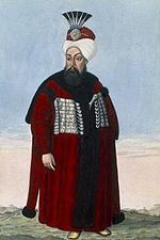
Ahmed II

Encyclopedia
Ahmed II Khan Ghazi (February 25, 1643 – February 6, 1695) was the Sultan
of the Ottoman Empire
from 1691 to 1695. Ahmed II was born at Topkapı Palace
, Constantinople
, the son of Sultan Ibrahim I
(1640–48) by Valide Sultan
Khadija Muazzez, and succeeded his brother Suleiman II
(1687–91) in 1691.
Ahmed II's best known act was to confirm Mustafa Köprülü as grand vizier
. Only a few weeks after his accession the Ottoman Empire sustained a crushing defeat at the Battle of Slankamen
from the Austria
ns under Margrave Louis William
of Baden
and was driven from Hungary
. During the four years of his reign disaster followed on disaster, and in 1695 Ahmed II died at Edirne
Palace, worn out by disease and sorrow.
Sultan
Sultan is a title with several historical meanings. Originally, it was an Arabic language abstract noun meaning "strength", "authority", "rulership", and "dictatorship", derived from the masdar سلطة , meaning "authority" or "power". Later, it came to be used as the title of certain rulers who...
of the Ottoman Empire
Ottoman Empire
The Ottoman EmpireIt was usually referred to as the "Ottoman Empire", the "Turkish Empire", the "Ottoman Caliphate" or more commonly "Turkey" by its contemporaries...
from 1691 to 1695. Ahmed II was born at Topkapı Palace
Topkapi Palace
The Topkapı Palace is a large palace in Istanbul, Turkey, that was the primary residence of the Ottoman Sultans for approximately 400 years of their 624-year reign....
, Constantinople
Constantinople
Constantinople was the capital of the Roman, Eastern Roman, Byzantine, Latin, and Ottoman Empires. Throughout most of the Middle Ages, Constantinople was Europe's largest and wealthiest city.-Names:...
, the son of Sultan Ibrahim I
Ibrahim I
Ibrahim I was the Sultan of the Ottoman Empire from 1640 until 1648. He was born in Istanbul the son of Ahmed I by Valide Sultan Kadinefendi Kösem Sultan, an ethnic Greek originally named Anastasia...
(1640–48) by Valide Sultan
Valide Sultan
Valide Sultan was the title held by the mother of a ruling Sultan in the Ottoman Empire. The Turkish pronunciation of the word Valide is . The title is sometimes translated as Queen Mother, although the position of Valide Sultan was quite different.The position was perhaps the most important...
Khadija Muazzez, and succeeded his brother Suleiman II
Suleiman II
Suleiman II was the Sultan of the Ottoman Empire from 1687 to 1691...
(1687–91) in 1691.
Ahmed II's best known act was to confirm Mustafa Köprülü as grand vizier
Grand Vizier
Grand Vizier, in Turkish Vezir-i Azam or Sadr-ı Azam , deriving from the Arabic word vizier , was the greatest minister of the Sultan, with absolute power of attorney and, in principle, dismissable only by the Sultan himself...
. Only a few weeks after his accession the Ottoman Empire sustained a crushing defeat at the Battle of Slankamen
Battle of Slankamen
The Battle of Slankamen was fought near Slankamen in the Ottoman Sanjak of Syrmia on August 19, 1691 between the Ottoman Empire, and the forces of Austria and states of the Holy Roman Empire as part of the Great Turkish War.The Ottomans had suffered partial military collapse against the Austrians...
from the Austria
Austria
Austria , officially the Republic of Austria , is a landlocked country of roughly 8.4 million people in Central Europe. It is bordered by the Czech Republic and Germany to the north, Slovakia and Hungary to the east, Slovenia and Italy to the south, and Switzerland and Liechtenstein to the...
ns under Margrave Louis William
Louis William, Margrave of Baden-Baden
Louis William, Margrave of Baden was the ruler of Baden in Germany and chief commander of the Imperial army. He was also known as Türkenlouis...
of Baden
Grand Duchy of Baden
The Grand Duchy of Baden was a historical state in the southwest of Germany, on the east bank of the Rhine. It existed between 1806 and 1918.-History:...
and was driven from Hungary
Hungary
Hungary , officially the Republic of Hungary , is a landlocked country in Central Europe. It is situated in the Carpathian Basin and is bordered by Slovakia to the north, Ukraine and Romania to the east, Serbia and Croatia to the south, Slovenia to the southwest and Austria to the west. The...
. During the four years of his reign disaster followed on disaster, and in 1695 Ahmed II died at Edirne
Edirne
Edirne is a city in Eastern Thrace, the northwestern part of Turkey, close to the borders with Greece and Bulgaria. Edirne served as the capital city of the Ottoman Empire from 1365 to 1453, before Constantinople became the empire's new capital. At present, Edirne is the capital of the Edirne...
Palace, worn out by disease and sorrow.