

Ahmad ibn Tulun

Encyclopedia
Ahmad ibn Ṭūlūn was the founder of the Tulunid dynasty that ruled Egypt
briefly between 868 and 905 AD. Originally sent by the Abbasid
caliph as governor to Egypt, ibn Ṭūlūn established himself as an independent ruler.
during the month of Ramadan
220 AH (September 835). His father, Ṭūlūn, was one of the Turkic
slaves included with a tribute sent by the governor of Bukhara
to the Abbasid
Caliph
al-Ma'mun
around the year 815-16. The Abbasid court recruited Turkish slaves to serve as military officers, and Tulun did well for himself, eventually coming to command the Caliph's private guard.
The family moved to Samarra in 850, and ibn Tulun received his military training there, and also studied theology. He was appointed commander of special forces for the Caliph al-Mutawakkil
in 855. Tulun died around this time, and his widow married an influential Turkish commander in the palace, Bayik Bey (Bākbāk in some of the Arabic sources). Ibn Ṭūlūn married Hatun, the daughter of another influential Turkish general in the palace guard, who bore him two children: ‘Abbās and Fāṭimah.
After serving in military campaigns against the Byzantine Empire
in Tarsus
, ibn Tulun gained the favor of the Caliph al-Musta'in
. On returning to Baghdad in 863, the Caliph presented him with a concubine, Meyyaz, with whom he had Khumarawaih, the son who eventually succeeded him as ruler of Egypt.
In 868, the Caliph al-Mu'tazz
appointed Bayik Bey as the governor of Egypt; Bayik Bey in turn sent Ahmad ibn Ṭūlūn as his regent. Ibn Ṭūlūn arrived in Egypt in September 868.
On arriving in Egypt, ibn Ṭūlūn found that the existing capital of Egypt
, al-Fustat, founded by Amr ibn al-'As in 641, was too small to accommodate his armies. He founded a new city to serve as his capital, Madinat al-Qatta'i
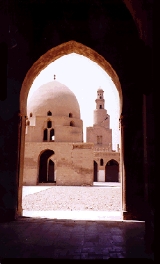
, or the quartered city. Al-Qatta'i was laid out in the style of grand cities of Persia and the Byzantine Empire, including a large public square, hippodrome, a palace for the governor, and a large ceremonial Mosque of Ibn Tulun
, which was named for ibn Ṭūlūn. The city was razed in 905 AD, and the mosque alone has survived.
Initially, ibn Ṭūlūn's rule in Egypt was marked by a struggle for control with the existing head of the council of financial affairs, Ibn al-Mudabbir. Ibn al-Mudabbir was disliked by the local population because of high rates of taxation (particularly against non-Muslim citizens
, which comprised over half of Egypt's population) and greed. Ibn al-Mudabbir reported directly to the Caliph, not to the governor of Egypt, and as such ignored ibn Ṭūlūn entirely. Ibn Ṭūlūn used his influence at the Abbasid court to work against Ibn al-Mudabbir, and finally was able to have him removed after four years.
Bayik Bey was murdered around 870, and governorship passed to Yarjukh al-Turki, father of ibn Tulun's wife, Hatun. Yarjukh retained ibn Ṭūlūn as his regent in Egypt, and increased his power by granting him authority over Alexandria and other territories in the region. Ibn Ṭūlūn led a campaign against the rebeliious governor of Syria, ‘Īsā ibn Shaykh ash-Shaybanī, which allowed him to amass an army of 100,000 men.
In 871, the Caliph al-Mu'tamid
appointed his brother Al-Muwaffaq
as governor of Damascus
, and his son, later the Caliph Al-Mu'tadid
, to succeed Yarjukh as governor of Egypt. The rebellion of the Zanj
i, a group of black
slaves who seized control of Basra
and much of southern Iraq
during this decade, siphoned much of the caliphate's resources away from the provinces. In 874, ibn Ṭūlūn took advantage of the chaos in Iraq
to sever relations with Baghdad
and declare independence.
It was not until 877 that Al-Mu'tadid
sent armed forces under Musa ibn Bugha to retake control of Egypt
. But the attempted invasion was a rout, with most of Musa's army scattering before the larger forces led by ibn Ṭūlūn. Ibn Ṭūlūn's forces followed and took control of large portions of Syria
, but the campaign was cut short when ibn Ṭūlūn had to return to Egypt to deal with a revolt led by his own son, ‘Abbās.
Following his return from Syria
, ibn Ṭūlūn added his own name to coins issued by the dynasty, along with those of the Caliph and heir apparent
. In 882, ibn Ṭūlūn invited the nearly powerless Caliph al-Mu'tamid
to Egypt to offer him protection against his brother, Al-Muwaffaq
, who was trying to remain in power as regent. Al-Muta'mid was intercepted en route to Egypt
, and ibn Ṭūlūn and Al-Muwaffaq
began an endless campaign against each other. Ibn Ṭūlūn was able to have a group of prominent jurists declare Al-Muwaffaq
a usurper, and both leaders had the other cursed during Friday prayers.
Military skirmishes followed. After leading the siege of Tarsus
in 883, ibn Ṭūlūn fell ill on his return to Egypt and died on May 10, 884. He was succeeded by his 20-year old son, Khumarraweh, who lacked much of the charisma and cunning that kept ibn Ṭūlūn in power. The Tulunid dynasty was short-lived, and Egypt was reoccupied by Abbasid forces in the winter of 904–05.
Egypt
Egypt , officially the Arab Republic of Egypt, Arabic: , is a country mainly in North Africa, with the Sinai Peninsula forming a land bridge in Southwest Asia. Egypt is thus a transcontinental country, and a major power in Africa, the Mediterranean Basin, the Middle East and the Muslim world...
briefly between 868 and 905 AD. Originally sent by the Abbasid
Abbasid
The Abbasid Caliphate or, more simply, the Abbasids , was the third of the Islamic caliphates. It was ruled by the Abbasid dynasty of caliphs, who built their capital in Baghdad after overthrowing the Umayyad caliphate from all but the al-Andalus region....
caliph as governor to Egypt, ibn Ṭūlūn established himself as an independent ruler.
Biography
Ibn Ṭūlūn was born in BaghdadBaghdad
Baghdad is the capital of Iraq, as well as the coterminous Baghdad Governorate. The population of Baghdad in 2011 is approximately 7,216,040...
during the month of Ramadan
Ramadan
Ramadan is the ninth month of the Islamic calendar, which lasts 29 or 30 days. It is the Islamic month of fasting, in which participating Muslims refrain from eating, drinking, smoking and sex during daylight hours and is intended to teach Muslims about patience, spirituality, humility and...
220 AH (September 835). His father, Ṭūlūn, was one of the Turkic
Turkic peoples
The Turkic peoples are peoples residing in northern, central and western Asia, southern Siberia and northwestern China and parts of eastern Europe. They speak languages belonging to the Turkic language family. They share, to varying degrees, certain cultural traits and historical backgrounds...
slaves included with a tribute sent by the governor of Bukhara
Bukhara
Bukhara , from the Soghdian βuxārak , is the capital of the Bukhara Province of Uzbekistan. The nation's fifth-largest city, it has a population of 263,400 . The region around Bukhara has been inhabited for at least five millennia, and the city has existed for half that time...
to the Abbasid
Abbasid
The Abbasid Caliphate or, more simply, the Abbasids , was the third of the Islamic caliphates. It was ruled by the Abbasid dynasty of caliphs, who built their capital in Baghdad after overthrowing the Umayyad caliphate from all but the al-Andalus region....
Caliph
Caliph
The Caliph is the head of state in a Caliphate, and the title for the ruler of the Islamic Ummah, an Islamic community ruled by the Shari'ah. It is a transcribed version of the Arabic word which means "successor" or "representative"...
al-Ma'mun
Al-Ma'mun
Abū Jaʿfar Abdullāh al-Māʾmūn ibn Harūn was an Abbasid caliph who reigned from 813 until his death in 833...
around the year 815-16. The Abbasid court recruited Turkish slaves to serve as military officers, and Tulun did well for himself, eventually coming to command the Caliph's private guard.
The family moved to Samarra in 850, and ibn Tulun received his military training there, and also studied theology. He was appointed commander of special forces for the Caliph al-Mutawakkil
Al-Mutawakkil
Al-Mutawakkil ʻAlā Allāh Jaʻfar ibn al-Muʻtasim was an Abbasid caliph who reigned in Samarra from 847 until 861...
in 855. Tulun died around this time, and his widow married an influential Turkish commander in the palace, Bayik Bey (Bākbāk in some of the Arabic sources). Ibn Ṭūlūn married Hatun, the daughter of another influential Turkish general in the palace guard, who bore him two children: ‘Abbās and Fāṭimah.
After serving in military campaigns against the Byzantine Empire
Byzantine Empire
The Byzantine Empire was the Eastern Roman Empire during the periods of Late Antiquity and the Middle Ages, centred on the capital of Constantinople. Known simply as the Roman Empire or Romania to its inhabitants and neighbours, the Empire was the direct continuation of the Ancient Roman State...
in Tarsus
Tarsus (city)
Tarsus is a historic city in south-central Turkey, 20 km inland from the Mediterranean Sea. It is part of the Adana-Mersin Metropolitan Area, the fourth-largest metropolitan area in Turkey with a population of 2.75 million...
, ibn Tulun gained the favor of the Caliph al-Musta'in
Al-Musta'in
Al-Musta'in was the Abbasid Caliph in Baghdad from 862 to 866. After the death of previous Caliph, al-Muntasir, the Turkish chiefs held a council to select his successor; they would have none of al-Mu'tazz, nor his brothers; so they elected him, another grandson of al-Mu'tasim.The Arabs and...
. On returning to Baghdad in 863, the Caliph presented him with a concubine, Meyyaz, with whom he had Khumarawaih, the son who eventually succeeded him as ruler of Egypt.
In 868, the Caliph al-Mu'tazz
Al-Mu'tazz
Al-Mu'tazz was the title of the Abbasid Caliph in Baghdad from 866 to 869. Placed upon the throne by the Turks, he proved but too apt a pupil of his Turkish masters.He became the caliph at 19 he was the youngest Abbasaid Caliph to assume power. He was surrounded by parties each jealous of the other...
appointed Bayik Bey as the governor of Egypt; Bayik Bey in turn sent Ahmad ibn Ṭūlūn as his regent. Ibn Ṭūlūn arrived in Egypt in September 868.
On arriving in Egypt, ibn Ṭūlūn found that the existing capital of Egypt
Capital of Egypt
The current capital of Egypt is Cairo. Over the course of history, however, Egypt's capital has repeatedly changed.- List of Egyptian capitals :This is a list of Egyptian capitals in a chronological order....
, al-Fustat, founded by Amr ibn al-'As in 641, was too small to accommodate his armies. He founded a new city to serve as his capital, Madinat al-Qatta'i
Al-Qatta'i
Al-Qatta'i was the short-lived Tulunid capital of Egypt, founded by Ahmad ibn Tulun in the year 868 CE. Al-Qatta'i was located immediately to the northeast of the previous capital, Al-'Askar, which in turn was adjacent to the settlement of Fustat. All three settlements were later incorporated...
, or the quartered city. Al-Qatta'i was laid out in the style of grand cities of Persia and the Byzantine Empire, including a large public square, hippodrome, a palace for the governor, and a large ceremonial Mosque of Ibn Tulun
Mosque of Ibn Tulun
The Mosque of Ahmad Ibn Ţūlūn is located in Cairo, Egypt. It is arguably the oldest mosque in the city surviving in its original form, and is the largest mosque in Cairo in terms of land area....
, which was named for ibn Ṭūlūn. The city was razed in 905 AD, and the mosque alone has survived.
Initially, ibn Ṭūlūn's rule in Egypt was marked by a struggle for control with the existing head of the council of financial affairs, Ibn al-Mudabbir. Ibn al-Mudabbir was disliked by the local population because of high rates of taxation (particularly against non-Muslim citizens
Dhimmi
A , is a non-Muslim subject of a state governed in accordance with sharia law. Linguistically, the word means "one whose responsibility has been taken". This has to be understood in the context of the definition of state in Islam...
, which comprised over half of Egypt's population) and greed. Ibn al-Mudabbir reported directly to the Caliph, not to the governor of Egypt, and as such ignored ibn Ṭūlūn entirely. Ibn Ṭūlūn used his influence at the Abbasid court to work against Ibn al-Mudabbir, and finally was able to have him removed after four years.
Bayik Bey was murdered around 870, and governorship passed to Yarjukh al-Turki, father of ibn Tulun's wife, Hatun. Yarjukh retained ibn Ṭūlūn as his regent in Egypt, and increased his power by granting him authority over Alexandria and other territories in the region. Ibn Ṭūlūn led a campaign against the rebeliious governor of Syria, ‘Īsā ibn Shaykh ash-Shaybanī, which allowed him to amass an army of 100,000 men.
In 871, the Caliph al-Mu'tamid
Al-Mu'tamid
This article is about the Abbasid Caliph al-Mu'tamid of Baghdad. For the Andalusi Arabic poet who was also the Abbadid king of Seville, see Muhammad Ibn Abbad Al Mutamid...
appointed his brother Al-Muwaffaq
Al-Muwaffaq (vizier)
Abu Ahmad ibn al-Mutawakkil , better known as al-Muwaffaq , was the brother and regent of the Abbasid Caliph Al-Mu'tamid....
as governor of Damascus
Damascus
Damascus , commonly known in Syria as Al Sham , and as the City of Jasmine , is the capital and the second largest city of Syria after Aleppo, both are part of the country's 14 governorates. In addition to being one of the oldest continuously inhabited cities in the world, Damascus is a major...
, and his son, later the Caliph Al-Mu'tadid
Al-Mu'tadid
Al-Mu'tadid was the Abbasid Caliph in Baghdad from 892 to 902. As the son and heir of the powerful vizier and virtual regent Al-Muwaffaq , Mu'tadid was already in possession of supreme power even before he was appointed Caliph, and continued as Caliph to ably administer the Government...
, to succeed Yarjukh as governor of Egypt. The rebellion of the Zanj
Zanj
Zanj was a name used by medieval Arab geographers to refer to both a certain portion of the coast of East Africa and its inhabitants, Bantu-speaking peoples called the Zanj...
i, a group of black
Black
Black is the color of objects that do not emit or reflect light in any part of the visible spectrum; they absorb all such frequencies of light...
slaves who seized control of Basra
Basra
Basra is the capital of Basra Governorate, in southern Iraq near Kuwait and Iran. It had an estimated population of two million as of 2009...
and much of southern Iraq
Iraq
Iraq ; officially the Republic of Iraq is a country in Western Asia spanning most of the northwestern end of the Zagros mountain range, the eastern part of the Syrian Desert and the northern part of the Arabian Desert....
during this decade, siphoned much of the caliphate's resources away from the provinces. In 874, ibn Ṭūlūn took advantage of the chaos in Iraq
Iraq
Iraq ; officially the Republic of Iraq is a country in Western Asia spanning most of the northwestern end of the Zagros mountain range, the eastern part of the Syrian Desert and the northern part of the Arabian Desert....
to sever relations with Baghdad
Baghdad
Baghdad is the capital of Iraq, as well as the coterminous Baghdad Governorate. The population of Baghdad in 2011 is approximately 7,216,040...
and declare independence.
It was not until 877 that Al-Mu'tadid
Al-Mu'tadid
Al-Mu'tadid was the Abbasid Caliph in Baghdad from 892 to 902. As the son and heir of the powerful vizier and virtual regent Al-Muwaffaq , Mu'tadid was already in possession of supreme power even before he was appointed Caliph, and continued as Caliph to ably administer the Government...
sent armed forces under Musa ibn Bugha to retake control of Egypt
Egypt
Egypt , officially the Arab Republic of Egypt, Arabic: , is a country mainly in North Africa, with the Sinai Peninsula forming a land bridge in Southwest Asia. Egypt is thus a transcontinental country, and a major power in Africa, the Mediterranean Basin, the Middle East and the Muslim world...
. But the attempted invasion was a rout, with most of Musa's army scattering before the larger forces led by ibn Ṭūlūn. Ibn Ṭūlūn's forces followed and took control of large portions of Syria
Syria
Syria , officially the Syrian Arab Republic , is a country in Western Asia, bordering Lebanon and the Mediterranean Sea to the West, Turkey to the north, Iraq to the east, Jordan to the south, and Israel to the southwest....
, but the campaign was cut short when ibn Ṭūlūn had to return to Egypt to deal with a revolt led by his own son, ‘Abbās.
Following his return from Syria
Syria
Syria , officially the Syrian Arab Republic , is a country in Western Asia, bordering Lebanon and the Mediterranean Sea to the West, Turkey to the north, Iraq to the east, Jordan to the south, and Israel to the southwest....
, ibn Ṭūlūn added his own name to coins issued by the dynasty, along with those of the Caliph and heir apparent
Heir apparent
An heir apparent or heiress apparent is a person who is first in line of succession and cannot be displaced from inheriting, except by a change in the rules of succession....
. In 882, ibn Ṭūlūn invited the nearly powerless Caliph al-Mu'tamid
Al-Mu'tamid
This article is about the Abbasid Caliph al-Mu'tamid of Baghdad. For the Andalusi Arabic poet who was also the Abbadid king of Seville, see Muhammad Ibn Abbad Al Mutamid...
to Egypt to offer him protection against his brother, Al-Muwaffaq
Al-Muwaffaq (vizier)
Abu Ahmad ibn al-Mutawakkil , better known as al-Muwaffaq , was the brother and regent of the Abbasid Caliph Al-Mu'tamid....
, who was trying to remain in power as regent. Al-Muta'mid was intercepted en route to Egypt
Egypt
Egypt , officially the Arab Republic of Egypt, Arabic: , is a country mainly in North Africa, with the Sinai Peninsula forming a land bridge in Southwest Asia. Egypt is thus a transcontinental country, and a major power in Africa, the Mediterranean Basin, the Middle East and the Muslim world...
, and ibn Ṭūlūn and Al-Muwaffaq
Al-Muwaffaq (vizier)
Abu Ahmad ibn al-Mutawakkil , better known as al-Muwaffaq , was the brother and regent of the Abbasid Caliph Al-Mu'tamid....
began an endless campaign against each other. Ibn Ṭūlūn was able to have a group of prominent jurists declare Al-Muwaffaq
Al-Muwaffaq (vizier)
Abu Ahmad ibn al-Mutawakkil , better known as al-Muwaffaq , was the brother and regent of the Abbasid Caliph Al-Mu'tamid....
a usurper, and both leaders had the other cursed during Friday prayers.
Military skirmishes followed. After leading the siege of Tarsus
Tarsus (city)
Tarsus is a historic city in south-central Turkey, 20 km inland from the Mediterranean Sea. It is part of the Adana-Mersin Metropolitan Area, the fourth-largest metropolitan area in Turkey with a population of 2.75 million...
in 883, ibn Ṭūlūn fell ill on his return to Egypt and died on May 10, 884. He was succeeded by his 20-year old son, Khumarraweh, who lacked much of the charisma and cunning that kept ibn Ṭūlūn in power. The Tulunid dynasty was short-lived, and Egypt was reoccupied by Abbasid forces in the winter of 904–05.