


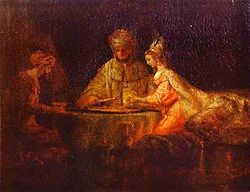
Ahasuerus and Haman at the feast of Esther

Encyclopedia
Provenance
Provenance, from the French provenir, "to come from", refers to the chronology of the ownership or location of an historical object. The term was originally mostly used for works of art, but is now used in similar senses in a wide range of fields, including science and computing...
is known. The origin of the painting can be traced back to 1662, two years after its completion.
Subject
The subject is an episode from chapters 5-7 of the book of EstherBook of Esther
The Book of Esther is a book in the Ketuvim , the third section of the Jewish Tanakh and is part of the Christian Old Testament. The Book of Esther or the Megillah is the basis for the Jewish celebration of Purim...
in the Old Testament
Old Testament
The Old Testament, of which Christians hold different views, is a Christian term for the religious writings of ancient Israel held sacred and inspired by Christians which overlaps with the 24-book canon of the Masoretic Text of Judaism...
. Haman
Haman
Haman can be a surname which is a corruption of the German Hamann. It is also a biblical surname as described below. It also refers to:*Haman , appears in the Book of Esther and is the main antagonist in the Jewish holiday of Purim....
, counciller to the king Ahasuerus
Ahasuerus
Ahasuerus is a name used several times in the Hebrew Bible, as well as related legends and Apocrypha. This name is applied in the Hebrew Scriptures to three rulers...
, proposed to hang Mordechai for not paying him respect by standing as he entered the room or by greeting him, and the entire Jewish nation as revenge for their pride. The Jews were saved by the intercession of Mordechai's cousin Esther
Esther
Esther , born Hadassah, is the eponymous heroine of the Biblical Book of Esther.According to the Bible, she was a Jewish queen of the Persian king Ahasuerus...
, who was also Ahasuerus' wife. It is this rescue that is still celebrated in the Jewish festival of Purim
Purim
Purim is a Jewish holiday that commemorates the deliverance of the Jewish people in the ancient Persian Empire from destruction in the wake of a plot by Haman, a story recorded in the Biblical Book of Esther .Purim is celebrated annually according to the Hebrew calendar on the 14th...
. In that festival, Haman is portrayed as the villain, and this is reflected in Rembrandt's depiction of him.
According to the Pushkin Museum
Pushkin Museum
The Pushkin Museum of Fine Arts is the largest museum of European art in Moscow, located in Volkhonka street, just opposite the Cathedral of Christ the Saviour....
this is one of the best creations of Rembrandt's late period.
Rembrandt
Rembrandt was inspired by the play Hester, by Johannes Serwouters (1623-1677), when painting "Ahasuerus and Haman at the feast of Esther". The playwrightPlaywright
A playwright, also called a dramatist, is a person who writes plays.The term is not a variant spelling of "playwrite", but something quite distinct: the word wright is an archaic English term for a craftsman or builder...
was first performed in 1659 in the Schouwburg of Van Campen and dedicated to Leonore Huydecoper, the daughter of Joan Huydecoper van Maarsseveen
Joan Huydecoper I
Joan Huydecoper van Maarsseveen took over the family tannery business and the trade in pelts and armaments. The name Huydecoper means literally 'buyer of pelts'. Huydecoper had a prosperous political career: first he was elected to the vroedschap of Amsterdam...
. Serwouters wrote his play as a reaction to the pogrom
Pogrom
A pogrom is a form of violent riot, a mob attack directed against a minority group, and characterized by killings and destruction of their homes and properties, businesses, and religious centres...
s in Eastern Europe. Her husband may have ordered the painting, in this way helping Rembrandt being in financial difficulties.
After its completion in 1660, Rembrandt sold the painting Ahasuerus and Haman at the feast of Esther to Jan J. Hinlopen. In the year 1662 a poetry book by Jan Vos
Jan Vos (poet)
Jan Jansz. Vos was a Dutch playwright and poet. A glassmaker by trade , he also played an important role as stage-manager and director of the theatre...
was published, in which there were a number of poems based on the paintings belonging to Jan J. Hinlopen. Jan Vos describes the painting as following:

Provenance
Part of Jan Hinlopen's collection passed to his two daughters, this painting was one of them.Sara Hinlopen, the longest living of her family, died 89 years old, but without children. Most of her belongings passed to Nicolaes Geelvinck
Geelvinck
Geelvinck was a Dutch surname. The family died out in the early 19th century.Some notable members of the family include:* Jan Cornelis Geelvinck, the son of a merchant in beans and peas, and involved in the West India Company...
and his three sisters. Unfortunately, her will does not mention any painting, most probably to avoid inheritance taxes.
In 1760 Ahasuerus and Haman at the Feast of Esther was sold as number 45 at an auction, listed as coming from Nicolaes Geelvinck
Nicolaes Geelvinck
Nicolaes Geelvinck was lord of Castricum, Bakkum, Santpoort, Velsen, Stabroek, schepen, and owner of the country estate Akerendam-by-Beverwijk...
, and organized after the death of Gerard Hoet
Gerard Hoet
-Biography:Gerard Hoet trained with his father and brother who were glass painters, and Warnard van Rijsen, who lived in Zaltbommel, and who himself was a pupil of Cornelis van Poelenburgh in Utrecht. In 1672 Hoet moved to The Hague, but when the Count of Salis bought paintings at his mother's...
, a minor painter but important collector in The Hague
The Hague
The Hague is the capital city of the province of South Holland in the Netherlands. With a population of 500,000 inhabitants , it is the third largest city of the Netherlands, after Amsterdam and Rotterdam...
.
In 1764 the painting came to Catherine the Great, most probably through the German entrepreneur Johann Ernst Gotzkowsky
Johann Ernst Gotzkowsky
Johann Ernst Gotzkowsky was a Prussian merchant with a successful trade in trinkets, silk, taft and porcelain. A relief on Meissen porcelain introduced in 1740s was named after him. Moreover he acted as a diplomat and art dealer...
, in financial trouble after the Seven Year War
Seven Year War
Seven Year War may refer to:*Seven Years' War , among European powers and their colonies, encompassing the French and Indian War**Great Britain in the Seven Years War**France in the Seven Years War...
. After receiving 320 paintings at one time from Gotzkowsky, the Russian Tsarina started the Hermitage
Hermitage Museum
The State Hermitage is a museum of art and culture in Saint Petersburg, Russia. One of the largest and oldest museums of the world, it was founded in 1764 by Catherine the Great and has been opened to the public since 1852. Its collections, of which only a small part is on permanent display,...
.
Probably advised by Gustav Friedrich Waagen
Gustav Friedrich Waagen
Gustav Friedrich Waagen was a German art historian.Waagen was born in Hamburg, the son of a painter and nephew of the poet Ludwig Tieck. Having passed through the college of Hirschberg, he volunteered for service in the Napoleonic campaign of 1813-1814, and on his return attended the lectures at...
the painting went in 1862 to the Museum Rumyantsev in Moscow. Since 1924 'Ahasuerus and Haman at the Feast of Esther' can be seen in the Pushkin Museum
Pushkin Museum
The Pushkin Museum of Fine Arts is the largest museum of European art in Moscow, located in Volkhonka street, just opposite the Cathedral of Christ the Saviour....
, also in Moscow.