

Aguaruna

Encyclopedia
For the Aguaruna people's language, see Aguaruna language
.
The Aguaruna (or Awajún, their endonym) are an indigenous people
of the Peruvian jungle. Historically, they lived primarily on the banks of the Marañón River, a tributary of the Amazon
in northern Peru
near the border with Ecuador
. Currently, they possess titled community lands in four of Peru's regions: Amazonas, Cajamarca, Loreto
, and San Martin. According to Peru's 1993 Census the Aguaruna numbered approximately 45,000. World Census data for 2000 lists their population at just over 38,000.
The Awahún have the reputation of being brave warrior
s, standing out for their skills in war. They live in the geographical area of the Marañón river
, that is to say in the banks of the Marañón river
and of its tributaries, the rivers Santiago, Nieva
, Cenepa
, Numpatakay and Chiriaco
.
family, along with Shuar
, Achuar and Huambisa.
The Aguaruna families, either monogamous
or polygamous
, live in dispersed areas and are grouped into extensive families or towns of major magnitude.
Examples of Aguaruna towns include Yutupiza on the Santiago River and Japaime on the Nieva
.
The towns for which there exists a pattern of nucleate population are called "yáakat" in their native language, and do not have streets, footpaths, or squares, but rather are constituted of houses of traditional construction. These houses are distributed in a kind of asymmetric form and the tendency is usually to place them in a linear form along the river.
Between the Aguarunas, there is the traditional institution of mutual help known in their language as ipáámu, which can be seen in action primarily when they are constructing housing for young couples, cleaning small farms and, with less frequency, sowing yuca
and peanut
s.
The Aguarunas are traditionally a seminomadic population, due to the unsuitability of the soil for agriculture and the extremely elementary traditional agrarian technology, which consequently depletes the soil in a short period of two or three years.
Hunting, gathering and agriculture
Major species of animals that are hunted by the Aguaruna include the sajino
, the huangana
, the Brazilian Tapir
(sachavaca
), the Little Red Brocket
, the ocelot
and the otorongo
(jaguar
). Species which are less commonly hunted include the majaz
, the ronsoco
, the achuni
, the añuje
, the carachupa, the otter
, diverse classes of monkey
s and birds.
_7.jpg) The animals that they hunt not only provide meat
The animals that they hunt not only provide meat
; the skin, feather
s, teeth
and bone
s are also used. Hunting therefore has a double purpose: for dietary needs and also for making handicrafts, medicines and items used in witchcraft
. Traditionally, the tribe hunted with a spear
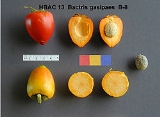
perfected with pijuayo
(a palm tree of very hard wood) and the blowpipe
. At present the spear
has been almost completely displaced by the pellet shotgun
but they also continue using the blowpipe
.
They gather the wild fruit of some palm tree
s, like the uvilla some shrub
s, and bud
s of palm trees, as well as stem
s, bark
, and resin
s. They extract leche caspi
and gather the honey
of wild bee
s, edible worm
s (suri
s), coleopterous
, medicinal plants
and liana
s. They use everything that they gather either for food, crafts, traditional medicine
, in witchcraft
or as fuel
, adhering to an ancestral pattern of self-sufficiency.
As agricultural instruments, they use the traditional tacarpo
(a stick with a sharp end, made from the wood of the palm tree pijuayo
), along with the axe
, the machete
and the shovel
.
Other activities
The principal crafts are masculine activities like rope
making, basketry
, the construction of canoe
s, and textile
s; and feminine activities like ceramics
and making necklace
s from seed
s, insect
s' small wing
s and bead
s. The men make headdresses of exquisite feather
s as well as cotton
ribbon
s on the ends of which they place feather
s and human hair. These adornments are kept in bamboo
cases.
, although there are accounts of attempts to extend into the territory by Incas Huayna Capac
and Tupac Inca Yupanqui
.
The Spanish
conquistadors first encountered the Aguaruna in 1549 when the towns of Jaén de Bracamoros and Santa Maria de Nieva
were founded. Fifty years later, a rebellion among the indigenous people of the region forced the Spaniards out of the area. An agricultural colony was later established at Borja in 1865. Attempts by Dominican
and Jesuit missionaries to convert the Aguarunas were largely unsuccessful.
Traditionally, the economy of the Aguaruna is based mostly on hunting, fishing and subsistence agriculture. However, over the last few decades they have increasingly become engaged in various market activities. Some communities now cultivate rice, coffee, cocoa and bananas for sale, either in local markets or for transport to coastal cities like Chiclayo
. Maintenance of the transandean oil pipeline and the medicinal plant industry also play roles in the local economy.
, allows one to communicate with other superior worlds.
Young men would traditionally take drugs including ayahuasca
to help them see visions. The visions were believed to be the souls of dead warriors, and if the young man showed no fear he would receive spirit power known as ajútap. A man with such spirit power would be invulnerable in battle.
In the past, the Aguarunas engaged in the practice of shrinking human heads to make tzantza.
Evangelical missionaries began contacting the Aguaruna in the mid-20th century, and today many Aguarunas have converted to Christianity.
. The most historic organizations of Aguaruna communities include the Organización Central de Comunidades Aguarunas del Alto Marañon (OCCAAM), founded in 1975, and the Consejo Aguaruna y Huambisa (CAH), an organization founded in 1977 that represents the Aguaruna and a closely related ethnic group, the Huambisa. Since then, Aguaruna community organizers have founded more than 12 local organizations (including an Aguaruna women's federation), although not all "local organizations" attain the same stature.
The Consejo Aguaruna y Huambisa is widely regarded the primary political entity representing the Aguaruna (and Huambisa) peoples. The Aguaruna, through the Consejo Aguaruna Huambisa (CAH), played an absolutely central role in national level indigenous movements in Peru and in the founding of the Coordinating Body of Indigenous Organizations of the Amazon Basin (COICA), which represents Amazonian peoples from all over the South American continent.
In the mid 1990s Aguaruna were involved in negotiating a novel bioprospecting agreement with a US based pharmaceutical multinational, G.D. Searle & Company (then part of Monsanto), and a group of ethnobotanists from Washington University. The project involved a controversy over violations of the Aguarunas' rights over their genetic and cultural resources and to an equitable share in the potential profits derived from pharmaceuticals based on their traditional knowledge
of medicinal plants. The US National Institutes of Health froze funding to the Washington University scientists,
Negotiations that began between Washington University and CAH on a bioprospecting agreement failed when Washington University's Walter Lewis collected Aguaruna medicinal plants and knowledge without a benefit-sharing agreement in place, leading to claims of biopiracy. The CAH terminated its relationship with Walter Lewis, Washington University, and their US government sponsors.
As Tim Cahill wrote in his Outside Magazine account of a father's search for closure, A Darkness on the River, "On the evening of January 18, 1995", just before the outbreak of the border war with neighboring Ecuador, "two 26-year-old Americans, Josh Silver and Patchen Miller, floated down the Maranon on a large balsa-wood raft they had built several days earlier. They tied off in the eddy at the downriver tail of the island. About 9:30 that night, they were shot and left for dead. Josh Silver survived and was treated for his wounds at an army base and then transferred to a hospital in Santa María de Nieva. The American consul general in Peru, Thomas Holladay, was informed that two Americans had been attacked. One was alive; the other was missing and feared dead." Patchen's body was never recovered nor the crime solved. The attackers were drunk Aguarunas, probably from the nearby village of Huaracayo. There has been speculation that the two Americans were mistaken by the Aguaruna for Washington University specimen hunters. It is also possible the Peruvian Army suspected them of espionage on the eve of the outbreak of war with Ecuador in the nearby border area. Despite Embassy attempts to elicit strong action, the Peruvian government showed no serious effort to get to the bottom of the killing, leaving the investigation to the badly equipped local police outpost at Nieva. The Army conducted its own investigation immediately after Josh showed up on the jetty of the army outpost at Urakuza but does not appear to have shared its findings with civilian authorities. The outbreak of war may have distracted them from following up.
Subsequently Washington University entered into negotiations with OCCAAM as well as their national representative organisation the Confederación de Nacionalidades Amazónicas del Perú (CONAP). One of the first demands of these organisations was that all material and knowledge previously collected by Washington University be returned. They also demanded that a traditional meeting in the form of an IPAAMAMU be held on Aguaruna territory. At the IPAAMAMU attended by over eighty representatives of sixty Aguaruna communities particiapnts approved continuing negotiations and called upon CONAP, its legal adviser and a representative of the Peruvian Environmental Law Society (SPDA) to provide them with advice and support in the negotiations.
The SPDA legal advisor, the Irish lawyer Brendan Tobin, had repeatedly offered his legal services to the Consejo Aguaruna Huambisa (CAH), and had repeatedly been turned down. In significant measure, this was due to SPDA's tight relationship with the corrupt and human rights violating government of then Peruvian President Alberto Fujimori
.
The negotiations with OCCAAM and the other participating organisations led to the conclusuion of a group of agreements including a "know-how license" which was entered into by the participating Agaurauna organisations CONAP, and Monsanto's pharmaceutical arm Searle and Company. The licensing arrangement was designed to give the Aguarunas greater control over the use of their knowledge once it left their direct control.
The "know-how license" concept as applied to indigenous peoples' knowledge is a legal first, according to Professor Charles McManis of Washington University School of Law. Professor McManis worked for the same university profiting from the arrangement and, in any event, the license earned nobody any money or fame except the SPDA advisor. For the Aguaruna, it earned them exactly nothing.
Aguaruna language
Aguaruna is an indigenous American language of the Jivaroan family spoken by about 45,000 Aguaruna people in Peru. The speakers live along the western portion of the Marañón River and also along the Potro, Mayo, and Cahuapanas rivers. Native speakers currently prefer the name Awajún. According to...
.
The Aguaruna (or Awajún, their endonym) are an indigenous people
Indigenous peoples of the Americas
The indigenous peoples of the Americas are the pre-Columbian inhabitants of North and South America, their descendants and other ethnic groups who are identified with those peoples. Indigenous peoples are known in Canada as Aboriginal peoples, and in the United States as Native Americans...
of the Peruvian jungle. Historically, they lived primarily on the banks of the Marañón River, a tributary of the Amazon
Amazon River
The Amazon of South America is the second longest river in the world and by far the largest by waterflow with an average discharge greater than the next seven largest rivers combined...
in northern Peru
Peru
Peru , officially the Republic of Peru , is a country in western South America. It is bordered on the north by Ecuador and Colombia, on the east by Brazil, on the southeast by Bolivia, on the south by Chile, and on the west by the Pacific Ocean....
near the border with Ecuador
Ecuador
Ecuador , officially the Republic of Ecuador is a representative democratic republic in South America, bordered by Colombia on the north, Peru on the east and south, and by the Pacific Ocean to the west. It is one of only two countries in South America, along with Chile, that do not have a border...
. Currently, they possess titled community lands in four of Peru's regions: Amazonas, Cajamarca, Loreto
Loreto Region
Loreto is Peru's northernmost region. Covering almost one-third of Peru's territory, Loreto is by far the nation's largest region and also one of the most sparsely populated ones, due to its remote location in the Amazon Rainforest...
, and San Martin. According to Peru's 1993 Census the Aguaruna numbered approximately 45,000. World Census data for 2000 lists their population at just over 38,000.
The Awahún have the reputation of being brave warrior
Warrior
A warrior is a person skilled in combat or warfare, especially within the context of a tribal or clan-based society that recognizes a separate warrior class.-Warrior classes in tribal culture:...
s, standing out for their skills in war. They live in the geographical area of the Marañón river
Marañón River
The Marañón River rises about 160 km to the northeast of Lima, Peru, flows through a deeply-eroded Andean valley in a northwesterly direction, along the eastern base of the Cordillera of the Andes, as far as 5 degrees 36' southern latitude; then it makes a great bend to the northeast, and...
, that is to say in the banks of the Marañón river
Marañón River
The Marañón River rises about 160 km to the northeast of Lima, Peru, flows through a deeply-eroded Andean valley in a northwesterly direction, along the eastern base of the Cordillera of the Andes, as far as 5 degrees 36' southern latitude; then it makes a great bend to the northeast, and...
and of its tributaries, the rivers Santiago, Nieva
Nieva River
The Nieva River is a tributary of the Marañón River in Peru. Its length, from the east in the mountain range of Campanquiz to the mouth is approximately 150 kilometers....
, Cenepa
Cenepa River
The Cenepa River rises in the Condor mountain range in Peru, South America and has a length of 185 km. It borders to the North on Ecuador, to the East on the districts of Río Santiago and Nieva, on the South with the district of Imaza, and on the West with Ecuador....
, Numpatakay and Chiriaco
Chiriaco River
The Chiriaco river is a river in Peru. The Chiriaco is a tributary of the Marañón and takes Tuntungos, Shushug and Wawas as principal tributaries....
.
Language
The language of the Awajun belongs to the JivaroanJivaroan languages
Jivaroan is a small language family, or perhaps a language isolate, of northern Peru and eastern Ecuador.-Family division:Jivaroan consists of 4 languages:-Genetic relations:...
family, along with Shuar
Shuar language
Shuar, also known as Chiwaro, Jibaro, Jivaro, Shuara, or Xivaro, is a Jivaroan language spoken in the Southeastern jungle of the Morona-Santiago Province in Ecuador....
, Achuar and Huambisa.
Customs
Living arrangementsThe Aguaruna families, either monogamous
Monogamy
Monogamy /Gr. μονός+γάμος - one+marriage/ a form of marriage in which an individual has only one spouse at any one time. In current usage monogamy often refers to having one sexual partner irrespective of marriage or reproduction...
or polygamous
Polygamy
Polygamy is a marriage which includes more than two partners...
, live in dispersed areas and are grouped into extensive families or towns of major magnitude.
Examples of Aguaruna towns include Yutupiza on the Santiago River and Japaime on the Nieva
Nieva River
The Nieva River is a tributary of the Marañón River in Peru. Its length, from the east in the mountain range of Campanquiz to the mouth is approximately 150 kilometers....
.
The towns for which there exists a pattern of nucleate population are called "yáakat" in their native language, and do not have streets, footpaths, or squares, but rather are constituted of houses of traditional construction. These houses are distributed in a kind of asymmetric form and the tendency is usually to place them in a linear form along the river.
Between the Aguarunas, there is the traditional institution of mutual help known in their language as ipáámu, which can be seen in action primarily when they are constructing housing for young couples, cleaning small farms and, with less frequency, sowing yuca
Cassava
Cassava , also called yuca or manioc, a woody shrub of the Euphorbiaceae native to South America, is extensively cultivated as an annual crop in tropical and subtropical regions for its edible starchy tuberous root, a major source of carbohydrates...
and peanut
Peanut
The peanut, or groundnut , is a species in the legume or "bean" family , so it is not a nut. The peanut was probably first cultivated in the valleys of Peru. It is an annual herbaceous plant growing tall...
s.
The Aguarunas are traditionally a seminomadic population, due to the unsuitability of the soil for agriculture and the extremely elementary traditional agrarian technology, which consequently depletes the soil in a short period of two or three years.
Hunting, gathering and agriculture
Major species of animals that are hunted by the Aguaruna include the sajino
White-lipped Peccary
The White-lipped Peccary, Tayassu pecari, is a peccary species found in Central and South America, living in rainforest, dry forest and chaco scrub. It is monotypic within the genus Tayassu....
, the huangana
White-lipped Peccary
The White-lipped Peccary, Tayassu pecari, is a peccary species found in Central and South America, living in rainforest, dry forest and chaco scrub. It is monotypic within the genus Tayassu....
, the Brazilian Tapir
Brazilian Tapir
The South American Tapir , or Brazilian Tapir or Lowland Tapir or Anta, is one of four species in the tapir family, along with the Mountain Tapir, the Malayan Tapir, and Baird's Tapir...
(sachavaca
Brazilian Tapir
The South American Tapir , or Brazilian Tapir or Lowland Tapir or Anta, is one of four species in the tapir family, along with the Mountain Tapir, the Malayan Tapir, and Baird's Tapir...
), the Little Red Brocket
Little Red Brocket
The Little Red Brocket , also known as the Ecuador Red Brocket, is a small, little-studied deer native to the Andes of Colombia, Ecuador and northern Peru, where found in forest and páramo at altitudes between . It is one of the smallest brocket deer. The coat is reddish, and the legs and crown are...
, the ocelot
Ocelot
The ocelot , pronounced /ˈɒsəˌlɒt/, also known as the dwarf leopard or McKenney's wildcat is a wild cat distributed over South and Central America and Mexico, but has been reported as far north as Texas and in Trinidad, in the Caribbean...
and the otorongo
Jaguar
The jaguar is a big cat, a feline in the Panthera genus, and is the only Panthera species found in the Americas. The jaguar is the third-largest feline after the tiger and the lion, and the largest in the Western Hemisphere. The jaguar's present range extends from Southern United States and Mexico...
(jaguar
Jaguar
The jaguar is a big cat, a feline in the Panthera genus, and is the only Panthera species found in the Americas. The jaguar is the third-largest feline after the tiger and the lion, and the largest in the Western Hemisphere. The jaguar's present range extends from Southern United States and Mexico...
). Species which are less commonly hunted include the majaz
Paca
The Lowland Paca , also known as the Spotted Paca, is a large rodent found in tropical and sub-tropical America, from East-Central Mexico to Northern Argentina...
, the ronsoco
Capybara
The capybara , also known as capivara in Portuguese, and capibara, chigüire in Venezuela, Colombia, and Ecuador ronsoco in Peru, chigüiro, and carpincho in Spanish, is the largest living rodent in the world. Its closest relatives are agouti, chinchillas, coyphillas, and guinea pigs...
, the achuni
Coati
Coatis, genera Nasua and Nasuella, also known as the Brazilian aardvark, Mexican tejón, hog-nosed coon, pizotes, crackoons and snookum bears, are members of the raccoon family . They are diurnal mammals native to South America, Central America, and south-western North America...
, the añuje
Black Agouti
The Black Agouti, Dasyprocta fuliginosa, is a South American agouti species from the family Dasyproctidae. It is found in Venezuela, Colombia, Ecuador and Brazil. The agouti is the only animal that has sharp enough teeth to crack open the tough shell of a brazil nut, something that similar rodents...
, the carachupa, the otter
Giant Otter
The giant otter is a South American carnivorous mammal. It is the longest member of the Mustelidae, or weasel family, a globally successful group of predators. Unusually for a mustelid, the giant otter is a social species, with family groups typically supporting three to eight members...
, diverse classes of monkey
Monkey
A monkey is a primate, either an Old World monkey or a New World monkey. There are about 260 known living species of monkey. Many are arboreal, although there are species that live primarily on the ground, such as baboons. Monkeys are generally considered to be intelligent. Unlike apes, monkeys...
s and birds.
Meat
Meat is animal flesh that is used as food. Most often, this means the skeletal muscle and associated fat and other tissues, but it may also describe other edible tissues such as organs and offal...
; the skin, feather
Feather
Feathers are one of the epidermal growths that form the distinctive outer covering, or plumage, on birds and some non-avian theropod dinosaurs. They are considered the most complex integumentary structures found in vertebrates, and indeed a premier example of a complex evolutionary novelty. They...
s, teeth
Tooth
Teeth are small, calcified, whitish structures found in the jaws of many vertebrates that are used to break down food. Some animals, particularly carnivores, also use teeth for hunting or for defensive purposes. The roots of teeth are embedded in the Mandible bone or the Maxillary bone and are...
and bone
Bone
Bones are rigid organs that constitute part of the endoskeleton of vertebrates. They support, and protect the various organs of the body, produce red and white blood cells and store minerals. Bone tissue is a type of dense connective tissue...
s are also used. Hunting therefore has a double purpose: for dietary needs and also for making handicrafts, medicines and items used in witchcraft
Witchcraft
Witchcraft, in historical, anthropological, religious, and mythological contexts, is the alleged use of supernatural or magical powers. A witch is a practitioner of witchcraft...
. Traditionally, the tribe hunted with a spear
Spear
A spear is a pole weapon consisting of a shaft, usually of wood, with a pointed head.The head may be simply the sharpened end of the shaft itself, as is the case with bamboo spears, or it may be made of a more durable material fastened to the shaft, such as flint, obsidian, iron, steel or...
perfected with pijuayo
Bactris gasipaes
Bactris gasipaes is a species of palm native to the tropical forests of South and Central America.There are numerous common names for this plant in several languages and many countries...
(a palm tree of very hard wood) and the blowpipe
Blowgun
"Blowpipe" and "blow tube" redirect here. For other uses of the terms, see GlassblowingA blowgun is a simple weapon consisting of a small tube for firing light projectiles, or darts....
. At present the spear
Spear
A spear is a pole weapon consisting of a shaft, usually of wood, with a pointed head.The head may be simply the sharpened end of the shaft itself, as is the case with bamboo spears, or it may be made of a more durable material fastened to the shaft, such as flint, obsidian, iron, steel or...
has been almost completely displaced by the pellet shotgun
Shotgun
A shotgun is a firearm that is usually designed to be fired from the shoulder, which uses the energy of a fixed shell to fire a number of small spherical pellets called shot, or a solid projectile called a slug...
but they also continue using the blowpipe
Blowgun
"Blowpipe" and "blow tube" redirect here. For other uses of the terms, see GlassblowingA blowgun is a simple weapon consisting of a small tube for firing light projectiles, or darts....
.
They gather the wild fruit of some palm tree
Arecaceae
Arecaceae or Palmae , are a family of flowering plants, the only family in the monocot order Arecales. There are roughly 202 currently known genera with around 2600 species, most of which are restricted to tropical, subtropical, and warm temperate climates...
s, like the uvilla some shrub
Shrub
A shrub or bush is distinguished from a tree by its multiple stems and shorter height, usually under 5–6 m tall. A large number of plants may become either shrubs or trees, depending on the growing conditions they experience...
s, and bud
Bud
In botany, a bud is an undeveloped or embryonic shoot and normally occurs in the axil of a leaf or at the tip of the stem. Once formed, a bud may remain for some time in a dormant condition, or it may form a shoot immediately. Buds may be specialized to develop flowers or short shoots, or may have...
s of palm trees, as well as stem
Plant stem
A stem is one of two main structural axes of a vascular plant. The stem is normally divided into nodes and internodes, the nodes hold buds which grow into one or more leaves, inflorescence , conifer cones, roots, other stems etc. The internodes distance one node from another...
s, bark
Bark
Bark is the outermost layers of stems and roots of woody plants. Plants with bark include trees, woody vines and shrubs. Bark refers to all the tissues outside of the vascular cambium and is a nontechnical term. It overlays the wood and consists of the inner bark and the outer bark. The inner...
, and resin
Resin
Resin in the most specific use of the term is a hydrocarbon secretion of many plants, particularly coniferous trees. Resins are valued for their chemical properties and associated uses, such as the production of varnishes, adhesives, and food glazing agents; as an important source of raw materials...
s. They extract leche caspi
Leche caspi (Couma macrocarpa)
Couma macrocarpa, known by the common names leche caspi, leche huayo, sorva, and cow tree, is a species of tropical plant native to tropical, humid Central and South America....
and gather the honey
Honey
Honey is a sweet food made by bees using nectar from flowers. The variety produced by honey bees is the one most commonly referred to and is the type of honey collected by beekeepers and consumed by humans...
of wild bee
Bee
Bees are flying insects closely related to wasps and ants, and are known for their role in pollination and for producing honey and beeswax. Bees are a monophyletic lineage within the superfamily Apoidea, presently classified by the unranked taxon name Anthophila...
s, edible worm
Worm
The term worm refers to an obsolete taxon used by Carolus Linnaeus and Jean-Baptiste Lamarck for all non-arthropod invertebrate animals, and stems from the Old English word wyrm. Currently it is used to describe many different distantly-related animals that typically have a long cylindrical...
s (suri
Suri
-Places:* Suri, Birbhum, a town in West Bengal, India* Suri , an assembly constituency in Birbhum district in the Indian state of West Bengal* Suri dynasty, a former South Asian empire* Şuri, a commune in Drochia District, Moldova*...
s), coleopterous
Beetle
Coleoptera is an order of insects commonly called beetles. The word "coleoptera" is from the Greek , koleos, "sheath"; and , pteron, "wing", thus "sheathed wing". Coleoptera contains more species than any other order, constituting almost 25% of all known life-forms...
, medicinal plants
Herbalism
Herbalism is a traditional medicinal or folk medicine practice based on the use of plants and plant extracts. Herbalism is also known as botanical medicine, medical herbalism, herbal medicine, herbology, herblore, and phytotherapy...
and liana
Liana
A liana is any of various long-stemmed, woody vines that are rooted in the soil at ground level and use trees, as well as other means of vertical support, to climb up to the canopy to get access to well-lit areas of the forest. Lianas are especially characteristic of tropical moist deciduous...
s. They use everything that they gather either for food, crafts, traditional medicine
Traditional medicine
Traditional medicine comprises unscientific knowledge systems that developed over generations within various societies before the era of modern medicine...
, in witchcraft
Witchcraft
Witchcraft, in historical, anthropological, religious, and mythological contexts, is the alleged use of supernatural or magical powers. A witch is a practitioner of witchcraft...
or as fuel
Fuel
Fuel is any material that stores energy that can later be extracted to perform mechanical work in a controlled manner. Most fuels used by humans undergo combustion, a redox reaction in which a combustible substance releases energy after it ignites and reacts with the oxygen in the air...
, adhering to an ancestral pattern of self-sufficiency.
As agricultural instruments, they use the traditional tacarpo
Tacarpo
The Tacarpo is an agricultural traditional tool of the Peruvian Amazonía, of approximately 2 m long and 4 cm of diameter. It is made of the trunk or the branch of a tree of hard wood; one of its ends is cut to make a point....
(a stick with a sharp end, made from the wood of the palm tree pijuayo
Bactris gasipaes
Bactris gasipaes is a species of palm native to the tropical forests of South and Central America.There are numerous common names for this plant in several languages and many countries...
), along with the axe
Axe
The axe, or ax, is an implement that has been used for millennia to shape, split and cut wood; to harvest timber; as a weapon; and as a ceremonial or heraldic symbol...
, the machete
Machete
The machete is a large cleaver-like cutting tool. The blade is typically long and usually under thick. In the English language, an equivalent term is matchet, though it is less commonly known...
and the shovel
Shovel
A shovel is a tool for digging, lifting, and moving bulk materials, such as soil, coal, gravel, snow, sand, or ore. Shovels are extremely common tools that are used extensively in agriculture, construction, and gardening....
.
Other activities
The principal crafts are masculine activities like rope
Rope
A rope is a length of fibres, twisted or braided together to improve strength for pulling and connecting. It has tensile strength but is too flexible to provide compressive strength...
making, basketry
Basket weaving
Basket weaving is the process of weaving unspun vegetable fibres into a basket or other similar form. People and artists who weave baskets are called basketmakers and basket weavers.Basketry is made from a variety of fibrous or pliable materials•anything that will bend and form a shape...
, the construction of canoe
Canoe
A canoe or Canadian canoe is a small narrow boat, typically human-powered, though it may also be powered by sails or small electric or gas motors. Canoes are usually pointed at both bow and stern and are normally open on top, but can be decked over A canoe (North American English) or Canadian...
s, and textile
Textile
A textile or cloth is a flexible woven material consisting of a network of natural or artificial fibres often referred to as thread or yarn. Yarn is produced by spinning raw fibres of wool, flax, cotton, or other material to produce long strands...
s; and feminine activities like ceramics
Pottery
Pottery is the material from which the potteryware is made, of which major types include earthenware, stoneware and porcelain. The place where such wares are made is also called a pottery . Pottery also refers to the art or craft of the potter or the manufacture of pottery...
and making necklace
Necklace
A necklace is an article of jewellery which is worn around the neck. Necklaces are frequently formed from a metal jewellery chain. Others are woven or manufactured from cloth using string or twine....
s from seed
Seed
A seed is a small embryonic plant enclosed in a covering called the seed coat, usually with some stored food. It is the product of the ripened ovule of gymnosperm and angiosperm plants which occurs after fertilization and some growth within the mother plant...
s, insect
Insect
Insects are a class of living creatures within the arthropods that have a chitinous exoskeleton, a three-part body , three pairs of jointed legs, compound eyes, and two antennae...
s' small wing
Wing
A wing is an appendage with a surface that produces lift for flight or propulsion through the atmosphere, or through another gaseous or liquid fluid...
s and bead
Bead
A bead is a small, decorative object that is usually pierced for threading or stringing. Beads range in size from under to over in diameter. A pair of beads made from Nassarius sea snail shells, approximately 100,000 years old, are thought to be the earliest known examples of jewellery. Beadwork...
s. The men make headdresses of exquisite feather
Feather
Feathers are one of the epidermal growths that form the distinctive outer covering, or plumage, on birds and some non-avian theropod dinosaurs. They are considered the most complex integumentary structures found in vertebrates, and indeed a premier example of a complex evolutionary novelty. They...
s as well as cotton
Cotton
Cotton is a soft, fluffy staple fiber that grows in a boll, or protective capsule, around the seeds of cotton plants of the genus Gossypium. The fiber is almost pure cellulose. The botanical purpose of cotton fiber is to aid in seed dispersal....
ribbon
Ribbon
A ribbon or riband is a thin band of material, typically cloth but also plastic or sometimes metal, used primarily for binding and tying. Cloth ribbons, most commonly silk, are often used in connection with clothing, but are also applied for innumerable useful, ornamental and symbolic purposes...
s on the ends of which they place feather
Feather
Feathers are one of the epidermal growths that form the distinctive outer covering, or plumage, on birds and some non-avian theropod dinosaurs. They are considered the most complex integumentary structures found in vertebrates, and indeed a premier example of a complex evolutionary novelty. They...
s and human hair. These adornments are kept in bamboo
Bamboo
Bamboo is a group of perennial evergreens in the true grass family Poaceae, subfamily Bambusoideae, tribe Bambuseae. Giant bamboos are the largest members of the grass family....
cases.
History
Unlike many other cultural groups in what is now Peru, the Aguaruna were never successfully conquered by the IncaInca Empire
The Inca Empire, or Inka Empire , was the largest empire in pre-Columbian America. The administrative, political and military center of the empire was located in Cusco in modern-day Peru. The Inca civilization arose from the highlands of Peru sometime in the early 13th century...
, although there are accounts of attempts to extend into the territory by Incas Huayna Capac
Huayna Capac
Huayna Capac was the eleventh Sapa Inca of the Inca Empire and sixth of the Hanan dynasty. He was the successor to Tupac Inca Yupanqui.-Name:In Quechua, his name is spelled Wayna Qhapaq, and in Southern Quechua, it is Vaina Ghapakh...
and Tupac Inca Yupanqui
Tupac Inca Yupanqui
Topa Inca Yupanqui , translated as "noble Inca accountant," was the tenth Sapa Inca of the Inca Empire, and fifth of the Hanan dynasty. His father was Pachacuti, and his son was Huayna Capac. Topa Inca belonged to the Qhapaq panaca....
.
The Spanish
Spain
Spain , officially the Kingdom of Spain languages]] under the European Charter for Regional or Minority Languages. In each of these, Spain's official name is as follows:;;;;;;), is a country and member state of the European Union located in southwestern Europe on the Iberian Peninsula...
conquistadors first encountered the Aguaruna in 1549 when the towns of Jaén de Bracamoros and Santa Maria de Nieva
Santa María de Nieva
The town of Santa Maria de Nieva, is a capital of the province of Condorcanqui in the department of Amazonas Region. It was constituted as such in 1984....
were founded. Fifty years later, a rebellion among the indigenous people of the region forced the Spaniards out of the area. An agricultural colony was later established at Borja in 1865. Attempts by Dominican
Dominican Order
The Order of Preachers , after the 15th century more commonly known as the Dominican Order or Dominicans, is a Catholic religious order founded by Saint Dominic and approved by Pope Honorius III on 22 December 1216 in France...
and Jesuit missionaries to convert the Aguarunas were largely unsuccessful.
Traditionally, the economy of the Aguaruna is based mostly on hunting, fishing and subsistence agriculture. However, over the last few decades they have increasingly become engaged in various market activities. Some communities now cultivate rice, coffee, cocoa and bananas for sale, either in local markets or for transport to coastal cities like Chiclayo
Chiclayo
Chiclayo is the capital city of the Lambayeque region in northern Peru. It is located 13 kilometers inland from the Pacific coast and 770 kilometers from the nation's capital, Lima...
. Maintenance of the transandean oil pipeline and the medicinal plant industry also play roles in the local economy.
Religion
The Aguarunas traditionally believed in many spirits and mythological figures, among them: Etsa, or the Sun; Núgkui, or mother earth, who ensures agricultural success and provides the clay for ceramics; Tsúgki, water spirits who live in the rivers; and Bikut, or father shaman, who transforms himself into hallucinogenic plants that, mixed with ayahuascaAyahuasca
Ayahuasca is any of various psychoactive infusions or decoctions prepared from the Banisteriopsis spp. vine, usually mixed with the leaves of dimethyltryptamine-containing species of shrubs from the Psychotria genus...
, allows one to communicate with other superior worlds.
Young men would traditionally take drugs including ayahuasca
Ayahuasca
Ayahuasca is any of various psychoactive infusions or decoctions prepared from the Banisteriopsis spp. vine, usually mixed with the leaves of dimethyltryptamine-containing species of shrubs from the Psychotria genus...
to help them see visions. The visions were believed to be the souls of dead warriors, and if the young man showed no fear he would receive spirit power known as ajútap. A man with such spirit power would be invulnerable in battle.
In the past, the Aguarunas engaged in the practice of shrinking human heads to make tzantza.
Evangelical missionaries began contacting the Aguaruna in the mid-20th century, and today many Aguarunas have converted to Christianity.
Biopiracy Controversy
In the latter half of the 20th century, the arrival of Protestant and Jesuit missionaries, the building of roads, and the construction of an oil pipeline created substantial tension between the Aguaruna people, poor agricultural colonists, state agencies, and profit-seeking corporations http://www.native-net.org/archive/nl/9512/0020.html. In response to new threats to their way of life the Aguaruna began to organize a political and social response to defend themselves on the basis of principles consistent with other rights of indigenous peoplesIndigenous rights
Indigenous rights are those rights that exist in recognition of the specific condition of the indigenous peoples. This includes not only the most basic human rights of physical survival and integrity, but also the preservation of their land, language, religion and other elements of cultural...
. The most historic organizations of Aguaruna communities include the Organización Central de Comunidades Aguarunas del Alto Marañon (OCCAAM), founded in 1975, and the Consejo Aguaruna y Huambisa (CAH), an organization founded in 1977 that represents the Aguaruna and a closely related ethnic group, the Huambisa. Since then, Aguaruna community organizers have founded more than 12 local organizations (including an Aguaruna women's federation), although not all "local organizations" attain the same stature.
The Consejo Aguaruna y Huambisa is widely regarded the primary political entity representing the Aguaruna (and Huambisa) peoples. The Aguaruna, through the Consejo Aguaruna Huambisa (CAH), played an absolutely central role in national level indigenous movements in Peru and in the founding of the Coordinating Body of Indigenous Organizations of the Amazon Basin (COICA), which represents Amazonian peoples from all over the South American continent.
In the mid 1990s Aguaruna were involved in negotiating a novel bioprospecting agreement with a US based pharmaceutical multinational, G.D. Searle & Company (then part of Monsanto), and a group of ethnobotanists from Washington University. The project involved a controversy over violations of the Aguarunas' rights over their genetic and cultural resources and to an equitable share in the potential profits derived from pharmaceuticals based on their traditional knowledge
Traditional knowledge
Traditional knowledge , indigenous knowledge , traditional environmental knowledge and local knowledge generally refer to the long-standing traditions and practices of certain regional, indigenous, or local communities. Traditional knowledge also encompasses the wisdom, knowledge, and teachings...
of medicinal plants. The US National Institutes of Health froze funding to the Washington University scientists,
Negotiations that began between Washington University and CAH on a bioprospecting agreement failed when Washington University's Walter Lewis collected Aguaruna medicinal plants and knowledge without a benefit-sharing agreement in place, leading to claims of biopiracy. The CAH terminated its relationship with Walter Lewis, Washington University, and their US government sponsors.
As Tim Cahill wrote in his Outside Magazine account of a father's search for closure, A Darkness on the River, "On the evening of January 18, 1995", just before the outbreak of the border war with neighboring Ecuador, "two 26-year-old Americans, Josh Silver and Patchen Miller, floated down the Maranon on a large balsa-wood raft they had built several days earlier. They tied off in the eddy at the downriver tail of the island. About 9:30 that night, they were shot and left for dead. Josh Silver survived and was treated for his wounds at an army base and then transferred to a hospital in Santa María de Nieva. The American consul general in Peru, Thomas Holladay, was informed that two Americans had been attacked. One was alive; the other was missing and feared dead." Patchen's body was never recovered nor the crime solved. The attackers were drunk Aguarunas, probably from the nearby village of Huaracayo. There has been speculation that the two Americans were mistaken by the Aguaruna for Washington University specimen hunters. It is also possible the Peruvian Army suspected them of espionage on the eve of the outbreak of war with Ecuador in the nearby border area. Despite Embassy attempts to elicit strong action, the Peruvian government showed no serious effort to get to the bottom of the killing, leaving the investigation to the badly equipped local police outpost at Nieva. The Army conducted its own investigation immediately after Josh showed up on the jetty of the army outpost at Urakuza but does not appear to have shared its findings with civilian authorities. The outbreak of war may have distracted them from following up.
Subsequently Washington University entered into negotiations with OCCAAM as well as their national representative organisation the Confederación de Nacionalidades Amazónicas del Perú (CONAP). One of the first demands of these organisations was that all material and knowledge previously collected by Washington University be returned. They also demanded that a traditional meeting in the form of an IPAAMAMU be held on Aguaruna territory. At the IPAAMAMU attended by over eighty representatives of sixty Aguaruna communities particiapnts approved continuing negotiations and called upon CONAP, its legal adviser and a representative of the Peruvian Environmental Law Society (SPDA) to provide them with advice and support in the negotiations.
The SPDA legal advisor, the Irish lawyer Brendan Tobin, had repeatedly offered his legal services to the Consejo Aguaruna Huambisa (CAH), and had repeatedly been turned down. In significant measure, this was due to SPDA's tight relationship with the corrupt and human rights violating government of then Peruvian President Alberto Fujimori
Alberto Fujimori
Alberto Fujimori Fujimori served as President of Peru from 28 July 1990 to 17 November 2000. A controversial figure, Fujimori has been credited with the creation of Fujimorism, uprooting terrorism in Peru and restoring its macroeconomic stability, though his methods have drawn charges of...
.
The negotiations with OCCAAM and the other participating organisations led to the conclusuion of a group of agreements including a "know-how license" which was entered into by the participating Agaurauna organisations CONAP, and Monsanto's pharmaceutical arm Searle and Company. The licensing arrangement was designed to give the Aguarunas greater control over the use of their knowledge once it left their direct control.
The "know-how license" concept as applied to indigenous peoples' knowledge is a legal first, according to Professor Charles McManis of Washington University School of Law. Professor McManis worked for the same university profiting from the arrangement and, in any event, the license earned nobody any money or fame except the SPDA advisor. For the Aguaruna, it earned them exactly nothing.