

Aftershock

Encyclopedia
Earthquake
An earthquake is the result of a sudden release of energy in the Earth's crust that creates seismic waves. The seismicity, seismism or seismic activity of an area refers to the frequency, type and size of earthquakes experienced over a period of time...
that occurs after a previous large earthquake, in the same area of the main shock. If an aftershock is larger than the main shock, the aftershock is redesignated as the main shock and the original main shock is redesignated as a foreshock
Foreshock
A foreshock is an earthquake that occurs before a larger seismic event and is related to it in both time and space. The designation of an earthquake as foreshock, mainshock or aftershock is only possible after the event....
. Aftershocks are formed as the crust around the displaced fault plane adjusts to the effects of the main shock.
Distribution of aftershocks
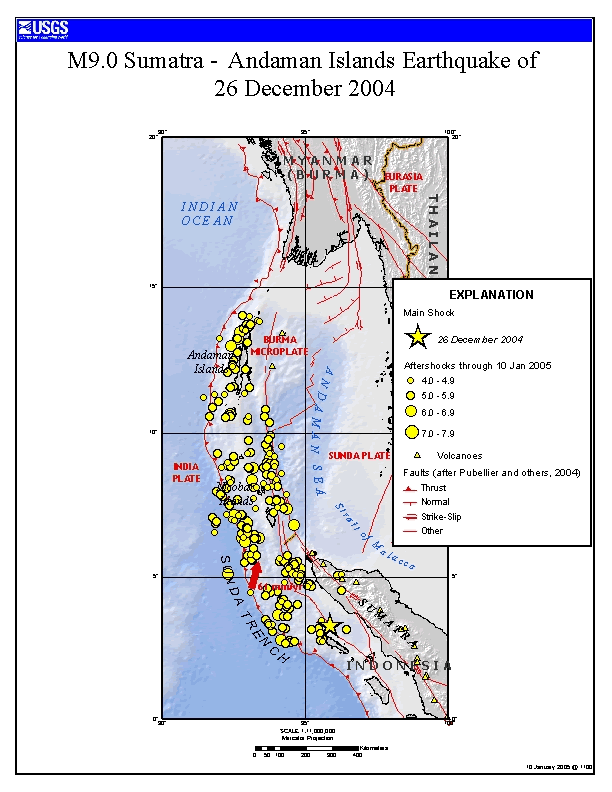
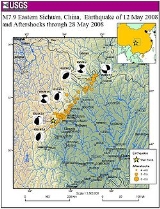
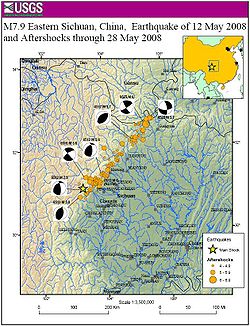
The pattern of aftershocks helps confirm the size of area that slipped during the main shock. In the case of the 2004 Indian Ocean earthquake
2004 Indian Ocean earthquake
The 2004 Indian Ocean earthquake was an undersea megathrust earthquake that occurred at 00:58:53 UTC on Sunday, December 26, 2004, with an epicentre off the west coast of Sumatra, Indonesia. The quake itself is known by the scientific community as the Sumatra-Andaman earthquake...
and the 2008 Sichuan earthquake
2008 Sichuan earthquake
The 2008 Sichuan earthquake or the Great Sichuan Earthquake was a deadly earthquake that measured at 8.0 Msand 7.9 Mw occurred at 14:28:01 CST...
the aftershock distribution shows in both cases that the epicenter
Epicenter
The epicenter or epicentre is the point on the Earth's surface that is directly above the hypocenter or focus, the point where an earthquake or underground explosion originates...
(where the rupture initiated) lies to one end of the final area of slip, implying strongly asymmetric rupture propagation.
Aftershock size and frequency with time
Aftershocks rates and magnitudes follow several well-established empirical laws.Omori's Law
The rate of aftershocks with time follows Omori's law. Omori's law, or more correctly the modified Omori's law, is an empirical relation for the temporal decay of aftershock rates. In 1894, Fusakichi OmoriFusakichi Omori
was a pioneer Japanese seismologist, second chairman of seismology at the Imperial University of Tokyo and president of the Japanese Imperial Earthquake Investigation Committee.-Education:...
published his work on the aftershocks of earthquakes, in which he stated that aftershock frequency decreases by roughly the reciprocal of time after the main shock.

where:
- n(t) is the rate of earthquakes measured in a certain time t after the main shock,
- K is the amplitude, and
- c is the "time offset" parameter.
The modified version of Omori's law, now commonly used, was proposed by Utsu in 1961.

where
- p modifies the decay rate and typically falls in the range 0.7–1.5.
According to these equations, the rate of aftershocks decreases quickly with time. The rate of aftershocks is proportional to the inverse of time since the mainshock. Thus whatever the odds of an aftershock are on the first day, the second day will have 1/2 the odds of the first day and the tenth day will have approximately 1/10 the odds of the first day (when p is equal to 1). These patterns describe only the statistical behavior of aftershocks; the actual times, numbers and locations of the aftershocks are stochastic, while tending to follow these patterns. As this is an empirical law, values of the parameters are obtained by fitting to data after a mainshock has occurred, and they imply no specific physical mechanism in any given case.
Båth's Law
The other main law describing aftershocks is known as Båth's Law and this states that the difference in magnitude between a main shock and its largest aftershock is approximately constant, independent of the main shock magnitude, typically 1.1-1.2 on the Moment magnitude scaleMoment magnitude scale
The moment magnitude scale is used by seismologists to measure the size of earthquakes in terms of the energy released. The magnitude is based on the seismic moment of the earthquake, which is equal to the rigidity of the Earth multiplied by the average amount of slip on the fault and the size of...
.
Gutenberg-Richter law
Aftershock sequences also typically follow the Gutenberg-Richter law of size scaling, which refers to the relationship between the magnitude and total number of earthquakes in a region in a given time period.
Where:
-
 is the number of events greater or equal to
-
 is magnitude
 - and
 are constants
In summary, there are more small aftershocks and fewer large aftershocks.
Impact of aftershocks
Aftershocks are dangerous because they are usually unpredictable, can be of a large magnitude, and can collapse buildings that are damaged from the main shock. Bigger earthquakes have more and larger aftershocks and the sequences can last for years or even longer especially when a large event occurs in a seismically quiet area; see, for example, the New Madrid Seismic ZoneNew Madrid Seismic Zone
The New Madrid Seismic Zone , sometimes called the New Madrid Fault Line, is a major seismic zone and a prolific source of intraplate earthquakes in the southern and midwestern United States, stretching to the southwest from New Madrid, Missouri.The New Madrid fault system was responsible for the...
, where events still follow Omori's law from the main shocks of 1811–1812. An aftershock sequence is deemed to have ended when the rate of seismicity drops back to a background level; i.e., no further decay in the number of events with time can be detected.
Land movement around the New Madrid is reported to be no more than 0.2 mm (0.0078740157480315 in) a year, in contrast to the San Andreas Fault
San Andreas Fault
The San Andreas Fault is a continental strike-slip fault that runs a length of roughly through California in the United States. The fault's motion is right-lateral strike-slip...
which averages up to 37 mm (1.5 in) a year across California. Aftershocks on the San Andreas are now believed to top out at 10 years while earthquakes in New Madrid are considered aftershocks nearly 200 years after the 1812 New Madrid earthquake.
Foreshocks
Some scientists have tried to use foreshocks to help predict upcoming earthquakesEarthquake prediction
An earthquake prediction is a prediction that an earthquake of a specific magnitude will occur in a particular place at a particular time . Despite considerable research efforts by seismologists, scientifically reproducible predictions cannot yet be made to a specific day or month...
, but the 1975 Haicheng earthquake
1975 Haicheng earthquake
The 1975 Haicheng earthquake measuring 7.3 on the Richter Scale occurred at 19:36 CST on February 4, 1975 in Haicheng, Liaoning, China, a city that at the time had approximately 1 million residents....
in China is one of the few successes. On the East Pacific Rise
East Pacific Rise
The East Pacific Rise is a mid-oceanic ridge, a divergent tectonic plate boundary located along the floor of the Pacific Ocean. It separates the Pacific Plate to the west from the North American Plate, the Rivera Plate, the Cocos Plate, the Nazca Plate, and the Antarctic Plate...
however, transform fault
Transform fault
A transform fault or transform boundary, also known as conservative plate boundary since these faults neither create nor destroy lithosphere, is a type of fault whose relative motion is predominantly horizontal in either sinistral or dextral direction. Furthermore, transform faults end abruptly...
s show quite predictable foreshock behaviour before the main seismic event. Reviews of data of past events and their foreshocks showed that they have a low number of aftershocks and high foreshock rates compared to continental strike-slip faults. (McGuire et al., 2005)