


Afrocentrism

Encyclopedia
Afrocentrism is cultural ideology mostly limited to the United States
, dedicated to the history of Black people
a response to global racist (Eurocentric/Orientalist
) attitudes about African people
and their historical contributions by revisiting this history with an African cultural and ideological center. Afrocentricity deals primarily with self-determination
and African agency and is an Pan-African ideology in culture, philosophy, and history.
It can be traced back to the work of black intellectuals in the late nineteenth and early twentieth centuries, but flowered into its modern form due to the activism of black intellectuals in the U.S. Civil Rights Movement and in the development of African American Studies programs in universities.
Proponents of Afrocentrism support the claim that the contributions of various African people have been downplayed or discredited as part of the legacy of colonialism and slavery's pathology of "writing Africans out of history" Critics contend that such "Afrocentric historical research" is grounded in identity politics
within African American culture
rather than objective scholarship.
, possibly due to W. E. B. Du Bois. The idiosyncratic spelling Africentrism is the one preferred by Jeremiah Wright
. The abstract noun "Afrocentricity" dates to the 1970s, and was popularized by Molefi Asante's Afrocentricity: The Theory of Social Change (1980).
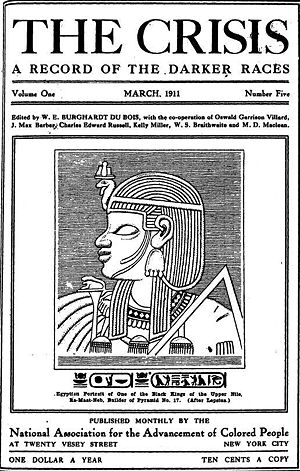 Afrocentrism has its origins in the work of Africa
n and African diaspora
intellectuals in the late 19th and early 20th centuries, following social changes in the United States and Africa due both to the end of slavery
and the decline of colonialism
. Following the American Civil War
, African Americans in the South
gathered together in communities to evade white control, established their own church congregations, and worked hard to gain education. They increasingly took more active public roles despite severe racial discrimination and segregation. American and African intellectuals looked to the African past for a re-evaluation of what its civilizations had achieved and what they meant for contemporary people.
As an ideology and political movement, Afrocentrism had its beginnings in activism among black intellectuals, political figures and historians in the context of the US American civil rights movement
.
According to U.S. professor Victor Oguejiofor Okafor, concepts of Afrocentricity lie at the core of disciplines such as African American studies
. But Wilson J. Moses claims that Afrocentrism roots are not exclusively African:
In 1987, Martin Bernal
published his Black Athena
, in which he claims ancient Greece was colonized by northern invaders mixing with a colony established by Phoenicia
(modern Lebanon). A major theme of the work is the alleged denial by Western academia of the African and (western) Asiatic influence on ancient Greek culture.
, chair of the Department of African American Studies at Temple University
gave a lecture at the University of Liverpool
entitled "Afrocentricity: Toward a New Understanding of African Thought in this Millennium," in which he presented many of his ideas:
Asante also stated:
However, Wilson J. Moses, says "his second book, The Afrocentric Idea (1987), was a creative and in some respects brilliant but rambling theoretical work, much influenced by the revolution in "critical theory
" that occurred in American intellectual life during the late 1970s and early 1980s." Some also assert that the definition of Afrocentricity has never sat still long enough to be properly described and accurately critiqued.
, racism
, extreme degrees of Anti-Europeanism
and antisemitic rhetoric and can ultimately become a form of Black Supremacy
. According to Radical Afrocentrism, Africans were responsible for many of the great innovations in ancient philosophy, science, and technology, which were later stolen by Middle Eastern and European peoples. Some of the scholars who are considered to be radical are Dr. Ben, and Leonard Jeffries
.
is the notion that human beings can be subjugated and made servile by limiting their consciousness
of themselves and by imposing certain selective aspects of alien knowledge on them. Afrocentrists claim that what educates one group of people does not necessarily educate and empower another group of people.
The term "mis-education" was coined by Dr. Carter G. Woodson
to describe the process of systematically depriving African American
s of their knowledge of self. Dr. Woodson believed that mis-education was the root of the problems of the masses of the African-American community and that if the masses of the African American-community had been given the correct knowledge and education from the beginning, they would not be in the situation that they find themselves in today.
The problem concerning formal education is seen by Afrocentrists to be that African-American students are taught to perceive the world through the eyes of another culture, and unconsciously learn to see themselves as an insignificant part of their world. An Afrocentric education does not wish to isolate Africans from a Eurocentric education system. It wishes to assert the autonomy of Africans and encompass the cultural uniqueness of all learners. A school based on African values, eliminates the patterns of rejection and alienation that engulf so many African-American school children, especially males.
The movement for African-centered education is based on the assumption that a school immersed in African traditions, rituals, values, and symbols will provide a learning environment that is more congruent with the lifestyles and values of African-American families. People who disagree with this point of view note the achievements of many African Americans educated according to contemporary United States and European standards, such as W. E. B. Du Bois and other intellectuals of the early 20th century, as well as Henry Louis Gates, Jr.
and others of the later 20th and 21st century.
In recent years Africana Studies
or Africology departments at many major universities have developed from the Afrocentric "Black Studies" departments formed in the 1970s. Rather than focusing on black topics in the African diaspora (often exclusively African-American topics), these departments intend to expand the field of studies to encompass all of the African diaspora. They also seek to better align themselves with other University departments and find continuity between the radical Afrocentrism of the past decades and the multicultural scholarship found in many fields today.
of African spirituality and European-American Christianity
; early members of the churches made certain stories their own. During the antebellum
years, the idea of deliverance out of slavery
, as in the story of Exodus, was especially important. After Reconstruction and the restoration of white supremacy, their hope was based on deliverance from segregation and other abuses. They found much to respond to in the idea of a personal relationship with Jesus
, and shaped their churches by the growth of music and worship styles that related to African as well as European-American traditions.
Twentieth-century "Africentric approaches" to Christian theology
and preaching have been more deliberate. Writers and thinkers emphasize "Black presence" in the Christian Bible, including the idea of a "Black Jesus
". "Africentric theology" is the cornerstone of the self-proclaimed identity of the Trinity United Church of Christ
, Chicago, the former church of U.S. President Barack Obama
. Jeremiah Wright
, the pastor for more than 30 years, based his emphasis on James H. Cone's Black Theology & Black Power (1969).
as the first specifically African American holiday. Karenga said his goal was to "give Blacks an alternative to the existing holiday and give Blacks an opportunity to celebrate themselves and history, rather than simply imitate the practice of the dominant society." During the early years of Kwanzaa, Karenga said that it was meant to be an alternative to Christmas
, because Christianity
was a white religion that black people should shun. However, as Kwanzaa gained mainstream adherents, Karenga altered his position so that practicing Christians would not be alienated."
and the Chinese Xia
cultures.
Yaacov Shavit
, a critic of the movement, summarises its goals in the preface to his book History in Black, in which he states:
Other critics contend that some Afrocentric historical research is grounded in identity politics
and myth
rather than scholarship. In The Skeptic's Dictionary, philosophy professor Robert Todd Carroll labeled Afrocentrism "pseudohistorical". He argued that Afrocentrism's prime goal was to encourage black nationalism
and ethnic pride in order to effectively combat the destructive consequences of cultural and universal racism. Similarly, African-American professor Clarence E. Walker, who teaches history at the University of California, Davis
, has described Afrocentrism as "a mythology that is racist, reactionary, essentially therapeutic and is eurocentrism in black face."
Mary Lefkowitz
, Professor Emerita of Classical Studies at Wellesley College in Massachusetts, has rejected George James's theories about Egyptian contributions to Greek civilization as being faulty scholarship. She notes that he used sources that predated the deciphering of Egyptian hieroglyphs
. He failed to acknowledge that many of his theories were overturned by the evidence of later findings. She contends that ancient Egyptian texts show little similarity to Greek philosophy. Lefkowitz also pointed out that Aristotle
could not have stolen his ideas from the great Library at Alexandria as James suggested, because the library was founded after Aristotle's death. Because of such fundamental errors of fact, Lefkowitz has criticized Afrocentrism as "an excuse to teach myth as history."
In 1994 the Manhattan Institute, a public policy forum, published Alternatives to Afrocentrism, a collection of highly critical essays by, among others, Lefkowitz, Gerald Early
, Stanley Crouch, Wilson Moses, and Frank Yurco. Early, an African American, has been especially critical and dismisses Afrocentrism as just another North American experiment in "group therapy," a kind of "intellectual fast food".
In 2002 Ibrahim Sundiata noted in the American Historical Review
that
Cain Hope Felder
, a Professor of New Testament
Language and Literature at Howard University
and supporter of Afrocentric ideas, has warned Afrocentrists to avoid certain pitfalls, including:
Nathan Glazer
writes that although Afrocentricity can mean many things, the popular press has generally given most attention to its most outlandish theories. Glazer agrees with many of the findings and conclusions presented in Lefkowitz's book Not Out of Africa. Yet he also argues that Afrocentrism often presents legitimate and relevant scholarship. Similarly, Owen Alik Shahadah defends the historical need for the Afrocentric world view while also warning that "Continually viewing history through a modern racial lens distorts the historical timeline and creates academic anachronism." The late Manning Marable was also a critic of Afrocentrism. He wrote:
The African-American academic community does not widely accept all the claims of Afrocentrists, and some Afrocentrists agree in rejecting those works which critics have characterized as examples of bad scholarship. Adisa A. Alkebulan notes that the work of Afrocentric scholars is not fully appreciated because critics use the claims of "a few non-Afrocentrists" as "an indictment against Afrocentricity."
In 1996 the historian August Meier critically reviewed the new work of Mary Lefkowitz on Afrocentrism as "Eurocentric". He criticized her book Not out of Africa: How Afrocentrism became an Excuse to Teach Myth as History for what he saw as her neglect of the African-American historic literature of the 19th and 20th centuries. Meier believes she fails to take the African-American experiences into account, to the extent that she "fails to answer the question raised in this book's subtitle".
Maghan Keita describes the controversy over Afrocentrism as a cultural war. He believes certain "epistemologies" are warring with each other: the "epistemology of blackness" argues for the “responsibilities and potential of black peoples to function in and contribute to the progress of civilization.”
Eugene D. Genovese
, in his work The Southern Front: History and Politics in the Cultural War, states that the decadence within American society is not only the consequence of modern liberalism but its actual agenda, and that the cultural elites who control American campuses mean to destroy Western civilization (p. 132). Genovese attempts to demonstrate mistreatment of things and thoughts Southern by America’s cultural elite, and he links this to a concerted culture war.
.
Afrocentrists hold that Africans exhibit a range of types and physical characteristics, and that such elements as wavy hair or aquiline facial features are part of a continuum of African types that do not depend on admixture with Caucasian groups. They cite work by Hiernaux and Hassan that they believe demonstrates that populations could vary based on micro-evolutionary principles (climate adaptation, drift, selection), and that such variations existed in both living and fossil Africans.
Afrocentrists have condemned what they consider to be attempts at dividing African peoples into racial clusters as new versions of what they deem older, discredited theories, such as the "Hamitic Hypothesis" and the Dynastic Race Theory
. These theories, they contend, attempted to identify certain African ethnicities, such as Nubians, Ethiopians and Somalis, as "Caucasoid" groups that entered Africa to bring civilization to the natives. They believe that Western academics have traditionally limited the peoples they defined as "Black" Africans to those south of the Sahara
, but used broader "Caucasoid" or related categories to classify peoples of Egypt or North Africa. Afrocentrists also believe strongly in the work of certain anthropologists who have suggested that there is little evidence to support that the North African populations are closely related to "Caucasoids" of Europe and western Asia.
In 1964 Afrocentric scholar Cheikh Anta Diop
expressed a belief in such a double standard:
French historian Jean Vercoutter has claimed that archaeological workers routinely classified Negroid remains as Mediterranean, even though they found such remains in substantial numbers with ancient artefacts.
Afrocentrists argue against continued use of the classification of people they deem indigenous "Black" Africans as Caucasoid. They advocate use of the term Africoid to encompass the varying phenotypes of African populations, as well as phenotypically Negroid Australasian populations. They contend that it is more appropriate to name Africans in a manner that reflects their geographical origin, as are Asians as Mongoloids (or to some in recent years Turanians), and Europeans as Caucasians (or Aryans earlier in the 20th century). Afrocentrism has sometimes included Puerto Ricans
and other Caribbean
Hispanic
peoples among Africoids, although Latinos and Latin American culture are multiracial and of European (Spanish) and indigenous American origins, in addition to African.
Some Afrocentrists have adopted a pan-Africanist
perspective that people of color are all "African people" or "diasporic
Africans," citing physical characteristics they exhibit in common with Black Africans. Afrocentric scholar Runoko Rashidi
writes that they are all part of the "global African community." Some Afrocentric writers include in the African diaspora
the Dravidians of India, the people of the rest of the Indian subcontinent
, "Negrito
s" of Southeast Asia (Thailand
, the Philippines
and Malaysia); and the aboriginal
peoples of Australia, Melanesia, Micronesia
, and Polynesia
.
A few Afrocentrists claim that the Olmecs of Mexico
were a hybrid society of Native American peoples and Africans. Mainstream historians of Mesoamerica overwhelmingly reject that view with detailed rebuttals.
Critics of Afrocentrism note that the Afrocentric designation of Southeast Asians and Melanesians as "African diaspora" is made without reference to the self-identities of the peoples in question. They may not identify themselves as African, as they have tens of thousands of years of history in the places where they live. In the largest sense, all humans are descended from ancestors in Africa but cultures and civilizations have aisen around the world that distinguish themselves as separate. Anthropologists note that modern man is the product of evolution of populations in many different areas of the globe after the migrations out of Africa.
advanced the theory that the complex civilizations of the Americas were the result of trans-oceanic influence from the Egyptians or other African civilizations. Such a claim is his primary thesis in They Came Before Columbus, published in 1978. The few hyper-diffusionist writers seek to establish that the Olmec
people, who built the first highly complex civilization in Mesoamerica
and are considered by some to be the mother civilization for all other civilizations of Mesoamerica, were deeply influenced by Africans. Van Sertima said that the Olmec civilization was a hybrid one of Africans and Native Americans. His theory of pre-Columbian American-African contact has since met with considerable and detailed opposition by scholars of Mesoamerica. Van Sertima has been accused of "doctoring" and twisting data to fit his conclusions, inventing evidence, and ignoring the work of respected Central and South American scholars in the advance of his own theory, and his claims are not taken seriously by mainstream scholars.
were indigenous to Africa and that these features were present in other early African civilizations such as the Kerma
and the Meroitic
civilizations of Nubia
. Scholars who have held this view include Marcus Garvey
, George James, Cheikh Anta Diop
, Martin Bernal
, Ivan van Sertima
, John Henrik Clarke
, Chancellor Williams
, and Molefi Kete Asante
. The claim has also been made by many Afrocentric scholars that the Ancient Egyptians themselves were Black African or Africoid people and that the various invasions on Egypt resulted in the Africanity of Ancient Egypt becoming diluted, resulting in the modern diversity seen today.
Scholars have challenged the various assertions of Afrocentrists on the cultural and biological characteristics of Ancient Egyptian civilization and its people. At a UNESCO Symposium in the 1970s, the vast majority of the delegates repudiated the Afrocentric assertions. Zahi Hawass
has gone on record as saying that the Ancient Egyptians were not black and Ancient Egypt was not an African Civilization.
It should also be noted that Egyptians themselves did not refer to themselves as 'Black' as they had no conception of 'race'. S.O.Y. Keita, a biological anthropologist studying the controversy however, finds simplistic political appellations (in the negative or affirmative) describing ancient populations as 'black' or 'white' to be inaccurate and instead focuses on the ancestry of ancient Egypt as being a part of the native biological variation of Africa, which includes a variety of phenotypes and skin gradients. Responding to Hawass' assertion in the press that Egyptians were not Black or that Egypt was not an African civilization, Keita claims that Hawass' statement obscures the reality of research in the Nile valley that paints a very complex picture and that most people familiar with this research would not get up in front of a group to make such a claim so openly.
Hypothesis" as "Eurocentric". In Afrocentrism, Howe summarizes the development of the Hamitic hypothesis in the 19th and 20th centuries. He further describes how some Afrocentric writers adopted 'their version' of it. In this context, he calls the original Hamitic hypothesis "Eurocentric". Howe distinguishes three clusters of controversies related to the history of ancient Egypt
. About the third cluster (<--What is it? Why is it salient to US?-->}} he says that these are "controversies that have been especially salient in relation to the United States, have interacted heavily with sensitive issues of current public policy, and involve questions both wide and fundamentally about the United States."<--Needs more explanation of what the controversies are-->
Afrocentric websites
United States
The United States of America is a federal constitutional republic comprising fifty states and a federal district...
, dedicated to the history of Black people
Black people
The term black people is used in systems of racial classification for humans of a dark skinned phenotype, relative to other racial groups.Different societies apply different criteria regarding who is classified as "black", and often social variables such as class, socio-economic status also plays a...
a response to global racist (Eurocentric/Orientalist
Orientalist
Orientalist may refer to:*A scholar of Oriental studies*A person or thing relating to the Western intellectual or artistic paradigm known as Orientalism...
) attitudes about African people
African people
African people refers to natives, inhabitants, or citizen of Africa and to people of African descent.-Etymology:Many etymological hypotheses that have been postulated for the ancient name "Africa":...
and their historical contributions by revisiting this history with an African cultural and ideological center. Afrocentricity deals primarily with self-determination
Self-determination
Self-determination is the principle in international law that nations have the right to freely choose their sovereignty and international political status with no external compulsion or external interference...
and African agency and is an Pan-African ideology in culture, philosophy, and history.
It can be traced back to the work of black intellectuals in the late nineteenth and early twentieth centuries, but flowered into its modern form due to the activism of black intellectuals in the U.S. Civil Rights Movement and in the development of African American Studies programs in universities.
Proponents of Afrocentrism support the claim that the contributions of various African people have been downplayed or discredited as part of the legacy of colonialism and slavery's pathology of "writing Africans out of history" Critics contend that such "Afrocentric historical research" is grounded in identity politics
Identity politics
Identity politics are political arguments that focus upon the self interest and perspectives of self-identified social interest groups and ways in which people's politics may be shaped by aspects of their identity through race, class, religion, sexual orientation or traditional dominance...
within African American culture
African American culture
African-American culture, also known as black culture, in the United States refers to the cultural contributions of Americans of African descent to the culture of the United States, either as part of or distinct from American culture. The distinct identity of African-American culture is rooted in...
rather than objective scholarship.
Terminology
The term "Afrocentrism" dates to 1961 or 1962. The adjective "Afrocentric" appears in a typescript proposal for an entry in Encyclopedia AfricanaEncyclopedia Africana
Africana: The Encyclopedia of the African and African-American Experience edited by Henry Louis Gates andAnthony Appiah is a compendium of Africana studies including African studies and the "Pan-African diaspora" inspired by W. E. B. Du Bois' project of an "Encyclopedia Africana"...
, possibly due to W. E. B. Du Bois. The idiosyncratic spelling Africentrism is the one preferred by Jeremiah Wright
Jeremiah Wright
Jeremiah Alvesta Wright, Jr. is Pastor Emeritus of Trinity United Church of Christ , a megachurch in Chicago exceeding 6,000 members...
. The abstract noun "Afrocentricity" dates to the 1970s, and was popularized by Molefi Asante's Afrocentricity: The Theory of Social Change (1980).
History
Africa
Africa is the world's second largest and second most populous continent, after Asia. At about 30.2 million km² including adjacent islands, it covers 6% of the Earth's total surface area and 20.4% of the total land area...
n and African diaspora
African diaspora
The African diaspora was the movement of Africans and their descendants to places throughout the world—predominantly to the Americas also to Europe, the Middle East and other places around the globe...
intellectuals in the late 19th and early 20th centuries, following social changes in the United States and Africa due both to the end of slavery
Slavery
Slavery is a system under which people are treated as property to be bought and sold, and are forced to work. Slaves can be held against their will from the time of their capture, purchase or birth, and deprived of the right to leave, to refuse to work, or to demand compensation...
and the decline of colonialism
Colonialism
Colonialism is the establishment, maintenance, acquisition and expansion of colonies in one territory by people from another territory. It is a process whereby the metropole claims sovereignty over the colony and the social structure, government, and economics of the colony are changed by...
. Following the American Civil War
American Civil War
The American Civil War was a civil war fought in the United States of America. In response to the election of Abraham Lincoln as President of the United States, 11 southern slave states declared their secession from the United States and formed the Confederate States of America ; the other 25...
, African Americans in the South
The South
-Geography:* Southern United States* South of England* South of France* South Italy* South Korea* Republic of Ireland* South Province * Global South, the developing nations of the world-Other uses:* The South , by Victor Erice...
gathered together in communities to evade white control, established their own church congregations, and worked hard to gain education. They increasingly took more active public roles despite severe racial discrimination and segregation. American and African intellectuals looked to the African past for a re-evaluation of what its civilizations had achieved and what they meant for contemporary people.
As an ideology and political movement, Afrocentrism had its beginnings in activism among black intellectuals, political figures and historians in the context of the US American civil rights movement
Civil rights movement
The civil rights movement was a worldwide political movement for equality before the law occurring between approximately 1950 and 1980. In many situations it took the form of campaigns of civil resistance aimed at achieving change by nonviolent forms of resistance. In some situations it was...
.
According to U.S. professor Victor Oguejiofor Okafor, concepts of Afrocentricity lie at the core of disciplines such as African American studies
African American studies
African American studies is a subset of Black studies or Africana studies. It is an interdisciplinary academic field devoted to the study of the history, culture, and politics of African Americans...
. But Wilson J. Moses claims that Afrocentrism roots are not exclusively African:
In 1987, Martin Bernal
Martin Bernal
Martin Gardiner Bernal is a Professor Emeritus of Government and Near Eastern Studies at Cornell University. He is a scholar of modern Chinese political history...
published his Black Athena
Black Athena
Black Athena: The Afroasiatic Roots of Classical Civilization is a highly controversial three-volume work by Martin Bernal. He discusses Ancient Greece in a new light. Bernal's thesis discusses the perception of ancient Greece in relation to Greece's African and Asiatic neighbors, which he...
, in which he claims ancient Greece was colonized by northern invaders mixing with a colony established by Phoenicia
Phoenicia
Phoenicia , was an ancient civilization in Canaan which covered most of the western, coastal part of the Fertile Crescent. Several major Phoenician cities were built on the coastline of the Mediterranean. It was an enterprising maritime trading culture that spread across the Mediterranean from 1550...
(modern Lebanon). A major theme of the work is the alleged denial by Western academia of the African and (western) Asiatic influence on ancient Greek culture.
Afrocentricity Book
In 2000, Molefi Kete AsanteMolefi Kete Asante
Molefi Kete Asante is an African-American scholar, historian, and philosopher. He is a leading figure in the fields of African American studies, African Studies and Communication Studies...
, chair of the Department of African American Studies at Temple University
Temple University
Temple University is a comprehensive public research university in Philadelphia, Pennsylvania, United States. Originally founded in 1884 by Dr. Russell Conwell, Temple University is among the nation's largest providers of professional education and prepares the largest body of professional...
gave a lecture at the University of Liverpool
University of Liverpool
The University of Liverpool is a teaching and research university in the city of Liverpool, England. It is a member of the Russell Group of large research-intensive universities and the N8 Group for research collaboration. Founded in 1881 , it is also one of the six original "red brick" civic...
entitled "Afrocentricity: Toward a New Understanding of African Thought in this Millennium," in which he presented many of his ideas:
- Africa has been betrayed by international commerce, by missionaries and imams, by the structure of knowledge imposed by the Western world, by its own leaders, and by the ignorance of its own people of its past.
- PhilosophyPhilosophyPhilosophy is the study of general and fundamental problems, such as those connected with existence, knowledge, values, reason, mind, and language. Philosophy is distinguished from other ways of addressing such problems by its critical, generally systematic approach and its reliance on rational...
originated in Africa and the first philosophers in the world were Africans. - Afrocentricity constitutes a new way of examining data, and a novel orientation to data; it carries with it assumptions about the current state of the African world.
- His aim is “to help lay out a plan for the recovery of African place, respectability, accountability, and leadership.”
Asante also stated:
However, Wilson J. Moses, says "his second book, The Afrocentric Idea (1987), was a creative and in some respects brilliant but rambling theoretical work, much influenced by the revolution in "critical theory
Critical theory
Critical theory is an examination and critique of society and culture, drawing from knowledge across the social sciences and humanities. The term has two different meanings with different origins and histories: one originating in sociology and the other in literary criticism...
" that occurred in American intellectual life during the late 1970s and early 1980s." Some also assert that the definition of Afrocentricity has never sat still long enough to be properly described and accurately critiqued.
Radical Afrocentrism
Radical Afrocentrism can be characterized by elements of Black orientalismBlack orientalism
Black orientalism is an intellectual and cultural movement found primarily within African American circles. While similar to the general movement of Orientalism in its negative outlook upon Western Asian - especially Arab - culture and religion, it differs in both its emphasis upon the role of the...
, racism
Racism
Racism is the belief that inherent different traits in human racial groups justify discrimination. In the modern English language, the term "racism" is used predominantly as a pejorative epithet. It is applied especially to the practice or advocacy of racial discrimination of a pernicious nature...
, extreme degrees of Anti-Europeanism
Anti-Europeanism
Anti-Europeanism refers to rejection of the culture of Europe and Europeanisation, sentiments, opinions and discrimination against European ethnic groups, and criticism of policies of European governments and the European Union...
and antisemitic rhetoric and can ultimately become a form of Black Supremacy
Black supremacy
The term black supremacy is a blanket term for various ideologies which hold that black people are superior to people of other races.-Overview:...
. According to Radical Afrocentrism, Africans were responsible for many of the great innovations in ancient philosophy, science, and technology, which were later stolen by Middle Eastern and European peoples. Some of the scholars who are considered to be radical are Dr. Ben, and Leonard Jeffries
Leonard Jeffries
Leonard Jeffries Jr. is an American professor of black studies at the City College of New York, part of the City University of New York. He achieved national prominence in the early 1990s for his controversial statements about Jews and other white people...
.
"African-centered education"
The premise behind African-Centered EducationAfrican-Centered Education
Afrocentric education is education designed to empower African people. A central premise behind it is that many Africans have been subjugated by limiting their awareness of themselves and indoctrinating them with ideas that work against them. To control a people's culture is to control their tools...
is the notion that human beings can be subjugated and made servile by limiting their consciousness
Consciousness
Consciousness is a term that refers to the relationship between the mind and the world with which it interacts. It has been defined as: subjectivity, awareness, the ability to experience or to feel, wakefulness, having a sense of selfhood, and the executive control system of the mind...
of themselves and by imposing certain selective aspects of alien knowledge on them. Afrocentrists claim that what educates one group of people does not necessarily educate and empower another group of people.
The term "mis-education" was coined by Dr. Carter G. Woodson
Carter G. Woodson
Carter Godwin Woodson was an African-American historian, author, journalist and the founder of the Association for the Study of African American Life and History. Woodson was one of the first scholars to study African American history. A founder of Journal of Negro History , Dr...
to describe the process of systematically depriving African American
African American
African Americans are citizens or residents of the United States who have at least partial ancestry from any of the native populations of Sub-Saharan Africa and are the direct descendants of enslaved Africans within the boundaries of the present United States...
s of their knowledge of self. Dr. Woodson believed that mis-education was the root of the problems of the masses of the African-American community and that if the masses of the African American-community had been given the correct knowledge and education from the beginning, they would not be in the situation that they find themselves in today.
The problem concerning formal education is seen by Afrocentrists to be that African-American students are taught to perceive the world through the eyes of another culture, and unconsciously learn to see themselves as an insignificant part of their world. An Afrocentric education does not wish to isolate Africans from a Eurocentric education system. It wishes to assert the autonomy of Africans and encompass the cultural uniqueness of all learners. A school based on African values, eliminates the patterns of rejection and alienation that engulf so many African-American school children, especially males.
The movement for African-centered education is based on the assumption that a school immersed in African traditions, rituals, values, and symbols will provide a learning environment that is more congruent with the lifestyles and values of African-American families. People who disagree with this point of view note the achievements of many African Americans educated according to contemporary United States and European standards, such as W. E. B. Du Bois and other intellectuals of the early 20th century, as well as Henry Louis Gates, Jr.
Henry Louis Gates, Jr.
Henry Louis “Skip” Gates, Jr., is an American literary critic, educator, scholar, writer, editor, and public intellectual. He was the first African American to receive the Andrew W. Mellon Foundation Fellowship. He has received numerous honorary degrees and awards for his teaching, research, and...
and others of the later 20th and 21st century.
In recent years Africana Studies
Africana studies
In United States education, Africana studies, or Africology is the study of the histories, politics and cultures of peoples of African origin both in Africa and in the African diaspora....
or Africology departments at many major universities have developed from the Afrocentric "Black Studies" departments formed in the 1970s. Rather than focusing on black topics in the African diaspora (often exclusively African-American topics), these departments intend to expand the field of studies to encompass all of the African diaspora. They also seek to better align themselves with other University departments and find continuity between the radical Afrocentrism of the past decades and the multicultural scholarship found in many fields today.
Afrocentric theology
The black church in the United States developed out of the creolizationCreolization
Creolization is a concept that refers to the process in which new African American cultures emerge in the New World. As a result of colonization there was a mixture between people of indigenous, African, and European decent, which became to be understood as Creolization...
of African spirituality and European-American Christianity
Christianity
Christianity is a monotheistic religion based on the life and teachings of Jesus as presented in canonical gospels and other New Testament writings...
; early members of the churches made certain stories their own. During the antebellum
American Civil War
The American Civil War was a civil war fought in the United States of America. In response to the election of Abraham Lincoln as President of the United States, 11 southern slave states declared their secession from the United States and formed the Confederate States of America ; the other 25...
years, the idea of deliverance out of slavery
Slavery
Slavery is a system under which people are treated as property to be bought and sold, and are forced to work. Slaves can be held against their will from the time of their capture, purchase or birth, and deprived of the right to leave, to refuse to work, or to demand compensation...
, as in the story of Exodus, was especially important. After Reconstruction and the restoration of white supremacy, their hope was based on deliverance from segregation and other abuses. They found much to respond to in the idea of a personal relationship with Jesus
Jesus
Jesus of Nazareth , commonly referred to as Jesus Christ or simply as Jesus or Christ, is the central figure of Christianity...
, and shaped their churches by the growth of music and worship styles that related to African as well as European-American traditions.
Twentieth-century "Africentric approaches" to Christian theology
Theology
Theology is the systematic and rational study of religion and its influences and of the nature of religious truths, or the learned profession acquired by completing specialized training in religious studies, usually at a university or school of divinity or seminary.-Definition:Augustine of Hippo...
and preaching have been more deliberate. Writers and thinkers emphasize "Black presence" in the Christian Bible, including the idea of a "Black Jesus
Race of Jesus
The race and appearance of Jesus have been discussed on a number of grounds since early Christianity, although the New Testament includes no description of the physical appearance of Jesus before his death and its narrative is generally indifferent to racial appearances.Despite the lack of direct...
". "Africentric theology" is the cornerstone of the self-proclaimed identity of the Trinity United Church of Christ
Trinity United Church of Christ
Trinity United Church of Christ is a predominantly black church with more than 8,500 members, located on the southwest side of Chicago. It is the largest church affiliated with the United Church of Christ, a predominantly white Christian denomination with roots in Congregationalism, which branched...
, Chicago, the former church of U.S. President Barack Obama
Barack Obama
Barack Hussein Obama II is the 44th and current President of the United States. He is the first African American to hold the office. Obama previously served as a United States Senator from Illinois, from January 2005 until he resigned following his victory in the 2008 presidential election.Born in...
. Jeremiah Wright
Jeremiah Wright
Jeremiah Alvesta Wright, Jr. is Pastor Emeritus of Trinity United Church of Christ , a megachurch in Chicago exceeding 6,000 members...
, the pastor for more than 30 years, based his emphasis on James H. Cone's Black Theology & Black Power (1969).
Kwanzaa
In 1966 Maulana Karenga of the US Organization created KwanzaaKwanzaa
Kwanzaa is a week long celebration held in the United States honoring universal African-American heritage and culture, observed from December 26 to January 1 each year. It features activities such as lighting a candle holder with seven candles and culminates in a feast and gift giving...
as the first specifically African American holiday. Karenga said his goal was to "give Blacks an alternative to the existing holiday and give Blacks an opportunity to celebrate themselves and history, rather than simply imitate the practice of the dominant society." During the early years of Kwanzaa, Karenga said that it was meant to be an alternative to Christmas
Christmas
Christmas or Christmas Day is an annual holiday generally celebrated on December 25 by billions of people around the world. It is a Christian feast that commemorates the birth of Jesus Christ, liturgically closing the Advent season and initiating the season of Christmastide, which lasts twelve days...
, because Christianity
Christianity
Christianity is a monotheistic religion based on the life and teachings of Jesus as presented in canonical gospels and other New Testament writings...
was a white religion that black people should shun. However, as Kwanzaa gained mainstream adherents, Karenga altered his position so that practicing Christians would not be alienated."
Pseudohistorical claims
Within Afrocentrism, claims were forwarded involving the contention that African civilizations were founding influences on such distant civilizations as the American OlmecOlmec
The Olmec were the first major Pre-Columbian civilization in Mexico. They lived in the tropical lowlands of south-central Mexico, in the modern-day states of Veracruz and Tabasco....
and the Chinese Xia
Xia Dynasty
The Xia Dynasty is the first dynasty in China to be described in ancient historical chronicles such as Bamboo Annals, Classic of History and Records of the Grand Historian. The Xia Dynasty was established by the legendary Yu the Great after Shun, the last of the Five Emperors gave his throne to him...
cultures.
Yaacov Shavit
Yaacov Shavit
thumb|right|200pxYaacov Shavit is a professor at the Department of Jewish History, Tel Aviv University. His main fields of study are the history of modern Israel and modern Jewish intellectual and cultural history...
, a critic of the movement, summarises its goals in the preface to his book History in Black, in which he states:
Other critics contend that some Afrocentric historical research is grounded in identity politics
Identity politics
Identity politics are political arguments that focus upon the self interest and perspectives of self-identified social interest groups and ways in which people's politics may be shaped by aspects of their identity through race, class, religion, sexual orientation or traditional dominance...
and myth
Mythology
The term mythology can refer either to the study of myths, or to a body or collection of myths. As examples, comparative mythology is the study of connections between myths from different cultures, whereas Greek mythology is the body of myths from ancient Greece...
rather than scholarship. In The Skeptic's Dictionary, philosophy professor Robert Todd Carroll labeled Afrocentrism "pseudohistorical". He argued that Afrocentrism's prime goal was to encourage black nationalism
Black nationalism
Black nationalism advocates a racial definition of indigenous national identity, as opposed to multiculturalism. There are different indigenous nationalist philosophies but the principles of all African nationalist ideologies are unity, and self-determination or independence from European society...
and ethnic pride in order to effectively combat the destructive consequences of cultural and universal racism. Similarly, African-American professor Clarence E. Walker, who teaches history at the University of California, Davis
University of California, Davis
The University of California, Davis is a public teaching and research university established in 1905 and located in Davis, California, USA. Spanning over , the campus is the largest within the University of California system and third largest by enrollment...
, has described Afrocentrism as "a mythology that is racist, reactionary, essentially therapeutic and is eurocentrism in black face."
Mary Lefkowitz
Mary Lefkowitz
Mary R. Lefkowitz is an American classical scholar and Professor Emerita of Classical Studies at Wellesley College. She is best known to non-Classicists for her anti-Afrocentrism book, Not Out of Africa . She is the widow of Sir Hugh Lloyd-Jones.-Biography:Lefkowitz earned her B.A...
, Professor Emerita of Classical Studies at Wellesley College in Massachusetts, has rejected George James's theories about Egyptian contributions to Greek civilization as being faulty scholarship. She notes that he used sources that predated the deciphering of Egyptian hieroglyphs
Egyptian hieroglyphs
Egyptian hieroglyphs were a formal writing system used by the ancient Egyptians that combined logographic and alphabetic elements. Egyptians used cursive hieroglyphs for religious literature on papyrus and wood...
. He failed to acknowledge that many of his theories were overturned by the evidence of later findings. She contends that ancient Egyptian texts show little similarity to Greek philosophy. Lefkowitz also pointed out that Aristotle
Aristotle
Aristotle was a Greek philosopher and polymath, a student of Plato and teacher of Alexander the Great. His writings cover many subjects, including physics, metaphysics, poetry, theater, music, logic, rhetoric, linguistics, politics, government, ethics, biology, and zoology...
could not have stolen his ideas from the great Library at Alexandria as James suggested, because the library was founded after Aristotle's death. Because of such fundamental errors of fact, Lefkowitz has criticized Afrocentrism as "an excuse to teach myth as history."
In 1994 the Manhattan Institute, a public policy forum, published Alternatives to Afrocentrism, a collection of highly critical essays by, among others, Lefkowitz, Gerald Early
Gerald Early
Gerald L. Early is an American essayist and American culture critic. He is currently the Merle Kling Professor of Modern letters, of English, African studies, African American studies, American culture studies, and Director, Center for Joint Projects in the Humanities and Social Sciences at ...
, Stanley Crouch, Wilson Moses, and Frank Yurco. Early, an African American, has been especially critical and dismisses Afrocentrism as just another North American experiment in "group therapy," a kind of "intellectual fast food".
In 2002 Ibrahim Sundiata noted in the American Historical Review
American Historical Review
The American Historical Review is the official publication of the American Historical Association, established in 1895 "for the promotion of historical studies, the collection and preservation of historical documents and artifacts, and the dissemination of historical research." It targets readers...
that
Cain Hope Felder
Cain Hope Felder
Cain Hope Felder is professor of New Testament Language and Literature and editor of The Journal of Religious Thought at the Howard University School of Divinity. He also serves as chair of the Ph.D. program and immediate past chair of the Doctor of Ministry program...
, a Professor of New Testament
New Testament
The New Testament is the second major division of the Christian biblical canon, the first such division being the much longer Old Testament....
Language and Literature at Howard University
Howard University
Howard University is a federally chartered, non-profit, private, coeducational, nonsectarian, historically black university located in Washington, D.C., United States...
and supporter of Afrocentric ideas, has warned Afrocentrists to avoid certain pitfalls, including:
- Demonizing categorically all white people, without careful differentiation between persons of goodwill and those who consciously perpetuate racism.
- Adopting multiculturalismMulticulturalismMulticulturalism is the appreciation, acceptance or promotion of multiple cultures, applied to the demographic make-up of a specific place, usually at the organizational level, e.g...
as a curricular alternative that eliminates, marginalizes, or vilifies European heritage to the point that Europe epitomizes all the evil in the world. - Gross over-generalizations and using factually or incorrect material is bad history and bad scholarship.
Nathan Glazer
Nathan Glazer
Nathan Glazer is an American sociologist who taught at the University of California, Berkeley and for several decades at Harvard University...
writes that although Afrocentricity can mean many things, the popular press has generally given most attention to its most outlandish theories. Glazer agrees with many of the findings and conclusions presented in Lefkowitz's book Not Out of Africa. Yet he also argues that Afrocentrism often presents legitimate and relevant scholarship. Similarly, Owen Alik Shahadah defends the historical need for the Afrocentric world view while also warning that "Continually viewing history through a modern racial lens distorts the historical timeline and creates academic anachronism." The late Manning Marable was also a critic of Afrocentrism. He wrote:
The African-American academic community does not widely accept all the claims of Afrocentrists, and some Afrocentrists agree in rejecting those works which critics have characterized as examples of bad scholarship. Adisa A. Alkebulan notes that the work of Afrocentric scholars is not fully appreciated because critics use the claims of "a few non-Afrocentrists" as "an indictment against Afrocentricity."
In 1996 the historian August Meier critically reviewed the new work of Mary Lefkowitz on Afrocentrism as "Eurocentric". He criticized her book Not out of Africa: How Afrocentrism became an Excuse to Teach Myth as History for what he saw as her neglect of the African-American historic literature of the 19th and 20th centuries. Meier believes she fails to take the African-American experiences into account, to the extent that she "fails to answer the question raised in this book's subtitle".
Maghan Keita describes the controversy over Afrocentrism as a cultural war. He believes certain "epistemologies" are warring with each other: the "epistemology of blackness" argues for the “responsibilities and potential of black peoples to function in and contribute to the progress of civilization.”
Eugene D. Genovese
Eugene D. Genovese
Eugene Dominic Genovese is an American historian of the American South and American slavery. He has been noted for bringing a Marxist perspective to the study of power, class and relations between planters and slaves in the South. His work Roll, Jordan, Roll: The World the Slaves Made won the...
, in his work The Southern Front: History and Politics in the Cultural War, states that the decadence within American society is not only the consequence of modern liberalism but its actual agenda, and that the cultural elites who control American campuses mean to destroy Western civilization (p. 132). Genovese attempts to demonstrate mistreatment of things and thoughts Southern by America’s cultural elite, and he links this to a concerted culture war.
Views on race and the Pan-African identity
Afrocentricity contends that race exists primarily as a social and political construct – that is, that race is important because of its cultural rather than its biological significance. Many Afrocentrists seek to challenge concepts such as white privilege, so-called color-blind perspectives, and race-neutral pedagogies. There are strong ties between Afrocentricity and Critical race theoryCritical race theory
Critical Race Theory is an academic discipline focused upon the intersection of race, law and power.Although no set of canonical doctrines or methodologies defines CRT, the movement is loosely unified by two common areas of inquiry...
.
Afrocentrists hold that Africans exhibit a range of types and physical characteristics, and that such elements as wavy hair or aquiline facial features are part of a continuum of African types that do not depend on admixture with Caucasian groups. They cite work by Hiernaux and Hassan that they believe demonstrates that populations could vary based on micro-evolutionary principles (climate adaptation, drift, selection), and that such variations existed in both living and fossil Africans.
Afrocentrists have condemned what they consider to be attempts at dividing African peoples into racial clusters as new versions of what they deem older, discredited theories, such as the "Hamitic Hypothesis" and the Dynastic Race Theory
Dynastic Race Theory
The Dynastic Race Theory was the earliest thesis to attempt to explain how predynastic Egypt developed into the sophisticated monarchy of Dynastic Egypt. The Theory holds that the earliest roots of the Ancient Egyptian dynastic civilisation were imported by invaders from Mesopotamia who then...
. These theories, they contend, attempted to identify certain African ethnicities, such as Nubians, Ethiopians and Somalis, as "Caucasoid" groups that entered Africa to bring civilization to the natives. They believe that Western academics have traditionally limited the peoples they defined as "Black" Africans to those south of the Sahara
Sahara
The Sahara is the world's second largest desert, after Antarctica. At over , it covers most of Northern Africa, making it almost as large as Europe or the United States. The Sahara stretches from the Red Sea, including parts of the Mediterranean coasts, to the outskirts of the Atlantic Ocean...
, but used broader "Caucasoid" or related categories to classify peoples of Egypt or North Africa. Afrocentrists also believe strongly in the work of certain anthropologists who have suggested that there is little evidence to support that the North African populations are closely related to "Caucasoids" of Europe and western Asia.
In 1964 Afrocentric scholar Cheikh Anta Diop
Cheikh Anta Diop
Cheikh Anta Diop was a historian, anthropologist, physicist, and politician who studied the human race's origins and pre-colonial African culture. He is regarded as an important figure in the development of the Afrocentric viewpoint, in particular for his theory that the ancient Egyptians were...
expressed a belief in such a double standard:
French historian Jean Vercoutter has claimed that archaeological workers routinely classified Negroid remains as Mediterranean, even though they found such remains in substantial numbers with ancient artefacts.
Afrocentrists argue against continued use of the classification of people they deem indigenous "Black" Africans as Caucasoid. They advocate use of the term Africoid to encompass the varying phenotypes of African populations, as well as phenotypically Negroid Australasian populations. They contend that it is more appropriate to name Africans in a manner that reflects their geographical origin, as are Asians as Mongoloids (or to some in recent years Turanians), and Europeans as Caucasians (or Aryans earlier in the 20th century). Afrocentrism has sometimes included Puerto Ricans
Puerto Rican people
A Puerto Rican is a person who was born in Puerto Rico.Puerto Ricans born and raised in the continental United States are also sometimes referred to as Puerto Ricans, although they were not born in Puerto Rico...
and other Caribbean
Caribbean
The Caribbean is a crescent-shaped group of islands more than 2,000 miles long separating the Gulf of Mexico and the Caribbean Sea, to the west and south, from the Atlantic Ocean, to the east and north...
Hispanic
Hispanic
Hispanic is a term that originally denoted a relationship to Hispania, which is to say the Iberian Peninsula: Andorra, Gibraltar, Portugal and Spain. During the Modern Era, Hispanic sometimes takes on a more limited meaning, particularly in the United States, where the term means a person of ...
peoples among Africoids, although Latinos and Latin American culture are multiracial and of European (Spanish) and indigenous American origins, in addition to African.
Some Afrocentrists have adopted a pan-Africanist
Pan-Africanism
Pan-Africanism is a movement that seeks to unify African people or people living in Africa, into a "one African community". Differing types of Pan-Africanism seek different levels of economic, racial, social, or political unity...
perspective that people of color are all "African people" or "diasporic
Diaspora
A diaspora is "the movement, migration, or scattering of people away from an established or ancestral homeland" or "people dispersed by whatever cause to more than one location", or "people settled far from their ancestral homelands".The word has come to refer to historical mass-dispersions of...
Africans," citing physical characteristics they exhibit in common with Black Africans. Afrocentric scholar Runoko Rashidi
Runoko Rashidi
Runoko Rashidi is a writer and public lecturer based in Los Angeles. His academic focus is on "the Black foundations of world civilizations". Many of his claims are incorrect, however, as evidenced by various anthropological and DNA studies...
writes that they are all part of the "global African community." Some Afrocentric writers include in the African diaspora
African diaspora
The African diaspora was the movement of Africans and their descendants to places throughout the world—predominantly to the Americas also to Europe, the Middle East and other places around the globe...
the Dravidians of India, the people of the rest of the Indian subcontinent
Indian subcontinent
The Indian subcontinent, also Indian Subcontinent, Indo-Pak Subcontinent or South Asian Subcontinent is a region of the Asian continent on the Indian tectonic plate from the Hindu Kush or Hindu Koh, Himalayas and including the Kuen Lun and Karakoram ranges, forming a land mass which extends...
, "Negrito
Negrito
The Negrito are a class of several ethnic groups who inhabit isolated parts of Southeast Asia.Their current populations include 12 Andamanese peoples of the Andaman Islands, six Semang peoples of Malaysia, the Mani of Thailand, and the Aeta, Agta, Ati, and 30 other peoples of the Philippines....
s" of Southeast Asia (Thailand
Thailand
Thailand , officially the Kingdom of Thailand , formerly known as Siam , is a country located at the centre of the Indochina peninsula and Southeast Asia. It is bordered to the north by Burma and Laos, to the east by Laos and Cambodia, to the south by the Gulf of Thailand and Malaysia, and to the...
, the Philippines
Philippines
The Philippines , officially known as the Republic of the Philippines , is a country in Southeast Asia in the western Pacific Ocean. To its north across the Luzon Strait lies Taiwan. West across the South China Sea sits Vietnam...
and Malaysia); and the aboriginal
Indigenous peoples
Indigenous peoples are ethnic groups that are defined as indigenous according to one of the various definitions of the term, there is no universally accepted definition but most of which carry connotations of being the "original inhabitants" of a territory....
peoples of Australia, Melanesia, Micronesia
Micronesia
Micronesia is a subregion of Oceania, comprising thousands of small islands in the western Pacific Ocean. It is distinct from Melanesia to the south, and Polynesia to the east. The Philippines lie to the west, and Indonesia to the southwest....
, and Polynesia
Polynesia
Polynesia is a subregion of Oceania, made up of over 1,000 islands scattered over the central and southern Pacific Ocean. The indigenous people who inhabit the islands of Polynesia are termed Polynesians and they share many similar traits including language, culture and beliefs...
.
A few Afrocentrists claim that the Olmecs of Mexico
Mexico
The United Mexican States , commonly known as Mexico , is a federal constitutional republic in North America. It is bordered on the north by the United States; on the south and west by the Pacific Ocean; on the southeast by Guatemala, Belize, and the Caribbean Sea; and on the east by the Gulf of...
were a hybrid society of Native American peoples and Africans. Mainstream historians of Mesoamerica overwhelmingly reject that view with detailed rebuttals.
Critics of Afrocentrism note that the Afrocentric designation of Southeast Asians and Melanesians as "African diaspora" is made without reference to the self-identities of the peoples in question. They may not identify themselves as African, as they have tens of thousands of years of history in the places where they live. In the largest sense, all humans are descended from ancestors in Africa but cultures and civilizations have aisen around the world that distinguish themselves as separate. Anthropologists note that modern man is the product of evolution of populations in many different areas of the globe after the migrations out of Africa.
Pre-Columbian Africa-Americas contact theories
In the 1970s, Ivan van SertimaIvan van Sertima
Ivan Gladstone Van Sertima was an associate professor of Africana Studies at Rutgers University in the United States....
advanced the theory that the complex civilizations of the Americas were the result of trans-oceanic influence from the Egyptians or other African civilizations. Such a claim is his primary thesis in They Came Before Columbus, published in 1978. The few hyper-diffusionist writers seek to establish that the Olmec
Olmec
The Olmec were the first major Pre-Columbian civilization in Mexico. They lived in the tropical lowlands of south-central Mexico, in the modern-day states of Veracruz and Tabasco....
people, who built the first highly complex civilization in Mesoamerica
Mesoamerica
Mesoamerica is a region and culture area in the Americas, extending approximately from central Mexico to Belize, Guatemala, El Salvador, Honduras, Nicaragua, and Costa Rica, within which a number of pre-Columbian societies flourished before the Spanish colonization of the Americas in the 15th and...
and are considered by some to be the mother civilization for all other civilizations of Mesoamerica, were deeply influenced by Africans. Van Sertima said that the Olmec civilization was a hybrid one of Africans and Native Americans. His theory of pre-Columbian American-African contact has since met with considerable and detailed opposition by scholars of Mesoamerica. Van Sertima has been accused of "doctoring" and twisting data to fit his conclusions, inventing evidence, and ignoring the work of respected Central and South American scholars in the advance of his own theory, and his claims are not taken seriously by mainstream scholars.
Afrocentrism and Ancient Egypt
Several Afrocentrists have claimed that important cultural characteristics of ancient EgyptEgypt
Egypt , officially the Arab Republic of Egypt, Arabic: , is a country mainly in North Africa, with the Sinai Peninsula forming a land bridge in Southwest Asia. Egypt is thus a transcontinental country, and a major power in Africa, the Mediterranean Basin, the Middle East and the Muslim world...
were indigenous to Africa and that these features were present in other early African civilizations such as the Kerma
Kingdom of Kerma
The Kerma culture is a prehistoric culture which flourished from around 2500 BCE to about 1520 BCE in what is now Sudan, centered at Kerma.It emerged as a major centre during the Middle Kingdom period of Ancient Egypt....
and the Meroitic
Meroë
Meroë Meroitic: Medewi or Bedewi; Arabic: and Meruwi) is an ancient city on the east bank of the Nile about 6 km north-east of the Kabushiya station near Shendi, Sudan, approximately 200 km north-east of Khartoum. Near the site are a group of villages called Bagrawiyah...
civilizations of Nubia
Nubia
Nubia is a region along the Nile river, which is located in northern Sudan and southern Egypt.There were a number of small Nubian kingdoms throughout the Middle Ages, the last of which collapsed in 1504, when Nubia became divided between Egypt and the Sennar sultanate resulting in the Arabization...
. Scholars who have held this view include Marcus Garvey
Marcus Garvey
Marcus Mosiah Garvey, Jr., ONH was a Jamaican publisher, journalist, entrepreneur, and orator who was a staunch proponent of the Black Nationalism and Pan-Africanism movements, to which end he founded the Universal Negro Improvement Association and African Communities League...
, George James, Cheikh Anta Diop
Cheikh Anta Diop
Cheikh Anta Diop was a historian, anthropologist, physicist, and politician who studied the human race's origins and pre-colonial African culture. He is regarded as an important figure in the development of the Afrocentric viewpoint, in particular for his theory that the ancient Egyptians were...
, Martin Bernal
Martin Bernal
Martin Gardiner Bernal is a Professor Emeritus of Government and Near Eastern Studies at Cornell University. He is a scholar of modern Chinese political history...
, Ivan van Sertima
Ivan van Sertima
Ivan Gladstone Van Sertima was an associate professor of Africana Studies at Rutgers University in the United States....
, John Henrik Clarke
John Henrik Clarke
John Henrik Clarke , born John Henry Clark, was a Pan-Africanist American writer, historian, professor, and a pioneer in the creation of Africana studies and professional institutions in academia starting in the late 1960s.He was Professor of African World History and in 1969 founding chairman of...
, Chancellor Williams
Chancellor Williams
Chancellor James Williams was an African American sociologist, historian and writer....
, and Molefi Kete Asante
Molefi Kete Asante
Molefi Kete Asante is an African-American scholar, historian, and philosopher. He is a leading figure in the fields of African American studies, African Studies and Communication Studies...
. The claim has also been made by many Afrocentric scholars that the Ancient Egyptians themselves were Black African or Africoid people and that the various invasions on Egypt resulted in the Africanity of Ancient Egypt becoming diluted, resulting in the modern diversity seen today.
Scholars have challenged the various assertions of Afrocentrists on the cultural and biological characteristics of Ancient Egyptian civilization and its people. At a UNESCO Symposium in the 1970s, the vast majority of the delegates repudiated the Afrocentric assertions. Zahi Hawass
Zahi Hawass
Zahi Hawass is an Egyptian archaeologist, an Egyptologist, and former Minister of State for Antiquities Affairs. He has also worked at archaeological sites in the Nile Delta, the Western Desert, and the Upper Nile Valley....
has gone on record as saying that the Ancient Egyptians were not black and Ancient Egypt was not an African Civilization.
It should also be noted that Egyptians themselves did not refer to themselves as 'Black' as they had no conception of 'race'. S.O.Y. Keita, a biological anthropologist studying the controversy however, finds simplistic political appellations (in the negative or affirmative) describing ancient populations as 'black' or 'white' to be inaccurate and instead focuses on the ancestry of ancient Egypt as being a part of the native biological variation of Africa, which includes a variety of phenotypes and skin gradients. Responding to Hawass' assertion in the press that Egyptians were not Black or that Egypt was not an African civilization, Keita claims that Hawass' statement obscures the reality of research in the Nile valley that paints a very complex picture and that most people familiar with this research would not get up in front of a group to make such a claim so openly.
Hamitic Hypothesis
Stephen Howe understands the original "HamiticHamitic
Hamitic is an historical term for the peoples supposedly descended from Noah's son Ham, paralleling Semitic and Japhetic.It was formerly used for grouping the non-Semitic Afroasiatic languages , but since, unlike the Semitic branch, these have not been shown to form a phylogenetic unity, the term...
Hypothesis" as "Eurocentric". In Afrocentrism, Howe summarizes the development of the Hamitic hypothesis in the 19th and 20th centuries. He further describes how some Afrocentric writers adopted 'their version' of it. In this context, he calls the original Hamitic hypothesis "Eurocentric". Howe distinguishes three clusters of controversies related to the history of ancient Egypt
Ancient Egypt
Ancient Egypt was an ancient civilization of Northeastern Africa, concentrated along the lower reaches of the Nile River in what is now the modern country of Egypt. Egyptian civilization coalesced around 3150 BC with the political unification of Upper and Lower Egypt under the first pharaoh...
. About the third cluster (<--What is it? Why is it salient to US?-->}} he says that these are "controversies that have been especially salient in relation to the United States, have interacted heavily with sensitive issues of current public policy, and involve questions both wide and fundamentally about the United States."<--Needs more explanation of what the controversies are-->
List of prominent authors
- Marimba AniMarimba AniMarimba Ani is an anthropologist and African Studies scholar best known for her work Yurugu, a comprehensive critique of European thought and culture, and her coining of the term Maafa for the African holocaust.-Life and Work:...
, professor, author and activist: Yurugu: An Afrikan-centered Critique of European Cultural Thought and Behavior (Trenton: Africa World Press, 1994). - Molefi Kete AsanteMolefi Kete AsanteMolefi Kete Asante is an African-American scholar, historian, and philosopher. He is a leading figure in the fields of African American studies, African Studies and Communication Studies...
, professor, author: Afrocentricity: The theory of Social Change; The Afrocentric Idea; The Egyptian Philosophers: Ancient African Voices from Imhotep to Akhenaten - Ishakamusa Barashango, college professor and lecturer; founder, Temple of the Black Messiah, School of History and Religion; co-founder and creative director, Fourth Dynasty Publishing Company, Silver Spring, MarylandMarylandMaryland is a U.S. state located in the Mid Atlantic region of the United States, bordering Virginia, West Virginia, and the District of Columbia to its south and west; Pennsylvania to its north; and Delaware to its east...
- Jacob CarruthersJacob CarruthersJacob Hudson Carruthers was an American academic, noted as an African-centered scholar.-External links:* *...
, Egyptologist; founding director of the Association for the Study of Classical African Civilization; founder and director of the Kemetic Institute, ChicagoChicagoChicago is the largest city in the US state of Illinois. With nearly 2.7 million residents, it is the most populous city in the Midwestern United States and the third most populous in the US, after New York City and Los Angeles... - Cheikh Anta DiopCheikh Anta DiopCheikh Anta Diop was a historian, anthropologist, physicist, and politician who studied the human race's origins and pre-colonial African culture. He is regarded as an important figure in the development of the Afrocentric viewpoint, in particular for his theory that the ancient Egyptians were...
, author: The African Origin of Civilization: Myth or Reality; Civilization or Barbarism: An Authentic Anthropology; Precolonial Black Africa; The Cultural Unity of Black Africa: The Domains of Patriarchy and of Matriarchy in Classical Antiquity; The Peopling of Ancient Egypt & the Deciphering of the Meroitic Script - H. B. ("Barry") FellBarry FellBarry Fell was a professor of invertebrate zoology at the Harvard Museum of Comparative Zoology. His primary research was on starfish and sea urchins...
, Harvard professor, biologist, author: Saga America, 1980 - Charles S. Finch, medical doctor and author: Echoes of the Old Darkland: Themes from the African Eden (1991), Africa and the Birth of Science and Technology (1991), The Star of Deep Beginnings (1998), Biblio Africana: An Annotated Reader's Guide to African Cultural History and Related Subjects (1999), The African Background to Medical Science: Essays on African History, Science & Civilizations (2000), The Afrikan Origins of the Major World Religions (with Yosef Ben-Jochannan and Modupe Oduyoye) (1987)
- Drusilla Dunjee Houston, lecturer, syndicated columnist, author: Wonderful Ethiopians of the Ancient Cushite Empire, 1926.
- Yosef Ben-JochannanYosef Ben-JochannanYosef A.A. Ben-Jochannan was born in Gonder, Ethiopia), also known as Dr. Ben, is an Afrocentric historian. He is notable for his writings and teachings about Black Jews and ancient Africans, and how Europeans, notably white Jews, appropriated their culture and legacy...
, author: African Origins of Major "Western Religions"; Black Man of the Nile and His Family; Africa: Mother of Western Civilization; New Dimensions in African History; The Myth of Exodus and Genesis and the Exclusion of Their African Origins; Africa: Mother of Western Civilization; Abu Simbel to Ghizeh: A Guide Book and Manual - Runoko RashidiRunoko RashidiRunoko Rashidi is a writer and public lecturer based in Los Angeles. His academic focus is on "the Black foundations of world civilizations". Many of his claims are incorrect, however, as evidenced by various anthropological and DNA studies...
, author: Introduction to African Civilizations; The global African community: The African presence in Asia, Australia, and the South Pacific - J.A. Rogers, author: Sex and Race: Negro-Caucasian Mixing in All Ages and All Lands: The Old World; Nature Knows No Color Line; Sex and Race: A History of White, Negro, and Indian Miscegenation in the Two Americas: The New World; 100 Amazing Facts About the Negro With Complete Proof: A Short Cut to the World History of the Negro
- Ivan van SertimaIvan van SertimaIvan Gladstone Van Sertima was an associate professor of Africana Studies at Rutgers University in the United States....
, author: They Came before Columbus: The African Presence in Ancient America, African Presence in Early Europe ISBN 0-88738-664-4; Blacks in Science Ancient and Modern; African Presence in Early Asia; African Presence in Early America; Early America Revisited; Egypt Revisited: Journal of African Civilizations; Nile Valley Civilizations; Egypt: Child of Africa (Journal of African Civilizations, V. 12); The Golden Age of the Moor (Journal of African Civilizations, Vol. 11, Fall 1991); Great Black Leaders: Ancient and Modern; Great African Thinkers: Cheikh Anta Diop - Chancellor WilliamsChancellor WilliamsChancellor James Williams was an African American sociologist, historian and writer....
, author: The Destruction of Black Civilization: Great Issues of a Race from 4500 B.C. to 2000 A.D. - Bekeh Ukelina Utietiang, author: "Afridentity: Essays on Africa" Silver Spring: Africa Reads Books, 2007.
- Théophile ObengaTheophile ObengaThéophile Obenga is a professor emeritus, formerly at San Francisco State University, in the Africana Studies Center. He was born in 1936 in Brazzaville, French Equatorial Africa ....
, author: Ancient Egypt and Black Africa: a student's handbook for the study of Ancient Egypt in philosophy, linguistics, and gender relations - Asa Hilliard, III, author: SBA: The Reawakening of the African Mind; The Teachings of Ptahhotep
See also
- African American CultureAfrican American cultureAfrican-American culture, also known as black culture, in the United States refers to the cultural contributions of Americans of African descent to the culture of the United States, either as part of or distinct from American culture. The distinct identity of African-American culture is rooted in...
- African philosophyAfrican philosophyAfrican philosophy is used in different ways by different philosophers. Although African philosophers spend their time doing work in many different areas, such as metaphysics, epistemology, moral philosophy, and political philosophy, a great deal of the literature is taken up with a debate...
- African RenaissanceAfrican RenaissanceThe African Renaissance is the concept that African people and nations overcome the current challenges confronting the continent and achieve cultural, scientific, economic, etc. renewal. This concept has been popularized by South African President Thabo Mbeki during his term of office...
- Anti-EuropeanismAnti-EuropeanismAnti-Europeanism refers to rejection of the culture of Europe and Europeanisation, sentiments, opinions and discrimination against European ethnic groups, and criticism of policies of European governments and the European Union...
- Ausar Auset
- Black orientalismBlack orientalismBlack orientalism is an intellectual and cultural movement found primarily within African American circles. While similar to the general movement of Orientalism in its negative outlook upon Western Asian - especially Arab - culture and religion, it differs in both its emphasis upon the role of the...
- EthnocentrismEthnocentrismEthnocentrism is the tendency to believe that one's ethnic or cultural group is centrally important, and that all other groups are measured in relation to one's own. The ethnocentric individual will judge other groups relative to his or her own particular ethnic group or culture, especially with...
- EurocentrismEurocentrismEurocentrism is the practice of viewing the world from a European perspective and with an implied belief, either consciously or subconsciously, in the preeminence of European culture...
- Grimaldi manGrimaldi ManGrimaldi man was a name given in the early 20th century to an Italian find of two paleolithic skeletons, supposedly showing negroid traits. When found, the skeletons were the subject of dubious scientific theories on human evolution, partly fueled by biased reconstruction of the skulls by the...
- Kingdom of KushKingdom of KushThe native name of the Kingdom was likely kaš, recorded in Egyptian as .The name Kash is probably connected to Cush in the Hebrew Bible , son of Ham ....
- Melanin TheoryMelanin theoryMelanin theory is a pseudoscientific theory, founded in the distortion of the known physical properties of melanin, a natural polymer and organic semiconductor. In humans, melanin is the primary determinant of skin color. People whose ancestors lived for long periods in the regions of the globe...
- NégritudeNégritudeNégritude is a literary and ideological movement, developed by francophone black intellectuals, writers, and politiciansin France in the 1930s by a group that included the future Senegalese President Léopold Sédar Senghor, Martinican poet Aimé Césaire, and the Guianan Léon Damas.The Négritude...
- NuwaubianismNuwaubianismThe Nuwaubian Nation or Nuwaubian movement led by Malachi York,...
- Race in ancient history
- Race in the United StatesRace in the United StatesThe United States is a racially diverse country. Modern issues of "race", as well as its impact in the political and economic development of the nation, have been examined by numerous historians and researchers across a variety of academic disciplines....
- Race of Ancient Egyptians
- Reverse discriminationReverse discriminationReverse discrimination is a controversial term referring to discrimination against members of a dominant or majority group, including the city or state, or in favor of members of a minority or historically disadvantaged group such as African Americans being slaves. Groups may be defined in terms of...
Secondary
- Konstan, David. "Inventing Ancient Greece: [Review article]", History and Theory, Vol. 36, No. 2. (May, 1997), pp. 261–269.
External links
- Afrocentricity by Molefi Kete AsanteMolefi Kete AsanteMolefi Kete Asante is an African-American scholar, historian, and philosopher. He is a leading figure in the fields of African American studies, African Studies and Communication Studies...
, asante.net - "The Afrocentric Hustle" Stanley CrouchStanley CrouchStanley Crouch is an American music and cultural critic, syndicated columnist, and novelist, perhaps best known for his jazz criticism, and his novel Don't the Moon Look Lonesome?- Biography :...
comments on the emergence of Afrocentric thought in the African American community. - 'Were the Ancient Egyptians Black or White' Biblical Archaeology Review for September– October, 1989. Frank Joseph Yurco's perspective on the race controversy of the ancient Egyptians.
- Afrocentrism: The Argument We're Really Having by Ibrahim Sundiata
- Building Bridges to Afrocentrism by Ann Macy Roth, for the University of Pennsylvania's African Studies Center
- Afrocentrist multicultural pseudo-history by The Association for Rational Thought
- UC Davis History Professor Clarence Walker's take on Afrocentrism
- Safari Scholarship Reinvents History by Ilana Mercer
Afrocentric websites