


African empires

Encyclopedia
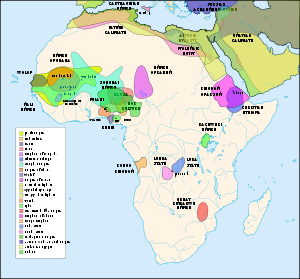
- Iron AgeIron AgeThe Iron Age is the archaeological period generally occurring after the Bronze Age, marked by the prevalent use of iron. The early period of the age is characterized by the widespread use of iron or steel. The adoption of such material coincided with other changes in society, including differing...
empires of North AfricaNorth AfricaNorth Africa or Northern Africa is the northernmost region of the African continent, linked by the Sahara to Sub-Saharan Africa. Geopolitically, the United Nations definition of Northern Africa includes eight countries or territories; Algeria, Egypt, Libya, Morocco, South Sudan, Sudan, Tunisia, and... - Medieval (8th to 13th century) IslamIslamIslam . The most common are and . : Arabic pronunciation varies regionally. The first vowel ranges from ~~. The second vowel ranges from ~~~...
ic empires (caliphateCaliphateThe term caliphate, "dominion of a caliph " , refers to the first system of government established in Islam and represented the political unity of the Muslim Ummah...
s) in North Africa and the Horn of AfricaHorn of AfricaThe Horn of Africa is a peninsula in East Africa that juts hundreds of kilometers into the Arabian Sea and lies along the southern side of the Gulf of Aden. It is the easternmost projection of the African continent... - The medieval Sahelian kingdoms
- The Ethiopian EmpireEthiopian EmpireThe Ethiopian Empire also known as Abyssinia, covered a geographical area that the present-day northern half of Ethiopia and Eritrea covers, and included in its peripheries Zeila, Djibouti, Yemen and Western Saudi Arabia...
is notable as an empire in continuous existence from the 13th to the 20th centuries, succumbing neither to the Islamic conquests nor to European colonialism. - Empires of the 15th to 19th centuries.
- Islamic sultanates of the SudanSudanSudan , officially the Republic of the Sudan , is a country in North Africa, sometimes considered part of the Middle East politically. It is bordered by Egypt to the north, the Red Sea to the northeast, Eritrea and Ethiopia to the east, South Sudan to the south, the Central African Republic to the...
and the Horn of Africa - Kingdoms of West AfricaWest AfricaWest Africa or Western Africa is the westernmost region of the African continent. Geopolitically, the UN definition of Western Africa includes the following 16 countries and an area of approximately 5 million square km:-Flags of West Africa:...
succeeding the Sahelian kingdoms - Kingdoms of Central and Southern Africa such as the Kongo Kingdom and the Mutapa Empire.
- Islamic sultanates of the Sudan
Comparison
Vansina (1962) discusses the classification of Sub-Saharan AfricaSub-Saharan Africa
Sub-Saharan Africa as a geographical term refers to the area of the African continent which lies south of the Sahara. A political definition of Sub-Saharan Africa, instead, covers all African countries which are fully or partially located south of the Sahara...
n kingdoms ,mostly of Central, South and East Africa, with some additional data on West African (Sahelian) kingdoms distinguishing five types, by decreasing centralization of power:
- despotic kingdoms: kingdoms where the king controls the internal and external affairs directly. Examples are Ruanda, Nkore, Soga and Kongo in the 16th century
- regal kingdoms: kingdoms where the king controls the external affairs directly, and the internal affairs via a system of overseers. The king and his chiefs belong to the same clans or lineages.
- incorporative kingdoms: kingdoms where the king only controls only the external affairs with no permanent administrative links between him and the chiefs of the provinces. The hereditary chiefdoms of the provinces were left undisturbed after conquest. Examples are the Bamileke, Lunda, Luba, Lozi.
- aristocratic kingdoms: the only link between central authority and the provinces is payment of tribute. These kingdoms are morphologically intermediate between regal kingdoms and federations. This type is rather common in Africa, examples including the Kongo of the 17th century, the Cazembe, Luapula, Kuba, Ngonde, Mlanje, Ha, Zinza and Chagga states of the 18th century
- federations such as the Ashanti Union. kingdoms where the external affairs are regulated by a council of elders headed by the king, who is simply primus inter pares.
The Islamic empires of North and Northeast Africa do not fall into this categorization and should be discussed as part of the Muslim world
Muslim world
The term Muslim world has several meanings. In a religious sense, it refers to those who adhere to the teachings of Islam, referred to as Muslims. In a cultural sense, it refers to Islamic civilization, inclusive of non-Muslims living in that civilization...
.
List of African kingdoms
Listed below are known pre-Colonial empireEmpire
The term empire derives from the Latin imperium . Politically, an empire is a geographically extensive group of states and peoples united and ruled either by a monarch or an oligarchy....
s with their capital cities on the African continent.
Ancient North Africa
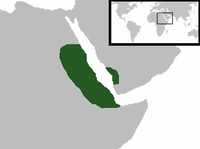
- Egyptian Empire (3100 BC – 870 BC)
- Ancient Carthage (575 BC - 146 BC)
Islamic empires
.png)
- Caliphate of CórdobaCaliphate of CórdobaThe Caliphate of Córdoba ruled the Iberian peninsula and part of North Africa, from the city of Córdoba, from 929 to 1031. This period was characterized by remarkable success in trade and culture; many of the masterpieces of Islamic Iberia were constructed in this period, including the famous...
(756 – 1031) - Idrisid dynasty (789 - 974)
- Fatimid Caliphate (910 - 1171)
- Maghrawa dynastyMaghrawaThe Maghrawa or Meghrawa were a Berber tribe in Morocco and central and western Algeria.-History:The Meghrawa, a tribe of Zanata Berbers, were one of the first Berber tribes to submit to Islam in the 7th century. They supported Uqba ibn Nafi in his campaign to the Atlantic in 683...
(987 - 1070) - Almoravid Caliphate (1061 - 1147)
- Almohad Caliphate (1121 - 1269)
- Ayyubid Sultanate (1171–1254)
- Marinid Morocco (1195 - 1465)
- Mamluk SultanateMamluk Sultanate (Cairo)The Mamluk Sultanate of Egypt was the final independent Egyptian state prior to the establishment of the Muhammad Ali Dynasty in 1805. It lasted from the overthrow of the Ayyubid Dynasty until the Ottoman conquest of Egypt in 1517. The sultanate's ruling caste was composed of Mamluks, Arabised...
(1250 - 1517) - Wattasid dynasty (1420 – 1554)
- Saadi dynastySaadi DynastyThe Saadi dynasty of Morocco , began with the reign of Sultan Mohammed ash-Sheikh in 1554, when he vanquished the last Wattasids at the Battle of Tadla....
(1554 – 1659) - Alaouite dynastyAlaouite DynastyThe Alaouite Dynasty is the name of the current Moroccan royal family. The name Alaouite comes from the ‘Alī of its founder Moulay Ali Cherif who became Prince of Tafilalt in 1631. His son Mulay r-Rshid was able to unite and pacify the country...
(1666 - current)
North East Africa
- Kushite Empire (780 BC – 656 BC)
- Aksumite EmpireAksumite EmpireThe Kingdom of Aksum or Axum, also known as the Aksumite Empire, was an important trading nation in northeastern Africa, growing from the proto-Aksumite Iron Age period ca. 4th century BC to achieve prominence by the 1st century AD...
(50 - 937) - Zagwe dynastyZagwe dynastyThe Zagwe dynasty was an historical kingdom in present-day Ethiopia. It ruled large parts of the territory from approximately 1137 to 1270, when the last Zagwe King Za-Ilmaknun was killed in battle by the forces of Yekuno Amlak...
(1137 - 1270) - Ifat Sultanate (1285 - 1415)
- Warsangali Sultanate (1298 - present)
- Ajuuraan Empire (1300s - 1600s]
- Adal SultanateAdal SultanateThe Adal Sultanate or the Kingdom of Adal was a medieval multi-ethnic Muslim state located in the Horn of Africa.-Overview:...
(1415 - 1555) - Kingdom of GommaKingdom of GommaThe Kingdom of Gomma was one of the kingdoms in the Gibe region of Ethiopia that emerged in the 18th century. It shared its northern border with Limmu-Ennarea, its western border with Gumma, its southern border with Gera, and its eastern border with Jimma...
(early 1800s – 1886) - Kingdom of JimmaKingdom of JimmaThe Kingdom of Jimma was one of the kingdoms in the Gibe region of Ethiopia that emerged in the 19th century. It shared its western border with Limmu-Ennarea, its eastern border with the Sidamo kingdom of Janjero, and was separated from the Kingdom of Kaffa to the south by the Gojeb River. Jimma...
(1830 – 1932) - Kingdom of GummaKingdom of GummaThe Kingdom of Gumma was one of the kingdoms in the Gibe region of Ethiopia that emerged in the 18th century. Its eastern border was formed by the bend of the Didessa River, which separated it from Limmu-Ennarea to the northeast, and Gomma and Gera to the south. Beyond its northern border were...
(1840 – 1902) - Sultanate of HobyoSultanate of HobyoThe Sultanate of Hobyo was a 19th century Somali ruling house in present-day northern Somalia. It was carved out of the former Majeerteen Sultanate by Yusuf Ali Kenadid, cousin of the Majeerteen Sultanate's ruler, Boqor Osman Mahamuud....
(1880s - 1920s) - Dervish StateDervish StateThe Dervish state was an early 20th century Somali Sunni Muslim state that was established by Muhammad Abdullah Hassan, a religious leader who gathered Somali soldiers from across the Horn of Africa and united them into a loyal army known as the Dervishes...
(1896 – 1920)
Sahelian kingdoms
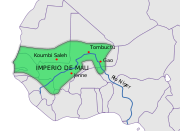
Sahel
The Sahel is the ecoclimatic and biogeographic zone of transition between the Sahara desert in the North and the Sudanian Savannas in the south.It stretches across the North African continent between the Atlantic Ocean and the Red Sea....
, the area of grasslands south of the Sahara
Sahara
The Sahara is the world's second largest desert, after Antarctica. At over , it covers most of Northern Africa, making it almost as large as Europe or the United States. The Sahara stretches from the Red Sea, including parts of the Mediterranean coasts, to the outskirts of the Atlantic Ocean...
.
- The Nok Civilization is considered to be one of the most advanced ancient sub-Saharan civilizations in African history. Beginning some time around 500 BCE, it was largely concentrated in what is now Nigeria but produced some of the first sub-Saharan iron smelting and terracotta architecture. Mysteriously died out around 200 CE.
- The first major state to rise in this region was the Kingdom of Ghana. Centered in what is today SenegalSenegalSenegal , officially the Republic of Senegal , is a country in western Africa. It owes its name to the Sénégal River that borders it to the east and north...
and MauritaniaMauritaniaMauritania is a country in the Maghreb and West Africa. It is bordered by the Atlantic Ocean in the west, by Western Sahara in the north, by Algeria in the northeast, by Mali in the east and southeast, and by Senegal in the southwest...
, it was the first to benefit from the introduction of pack animals by ArabArabArab people, also known as Arabs , are a panethnicity primarily living in the Arab world, which is located in Western Asia and North Africa. They are identified as such on one or more of genealogical, linguistic, or cultural grounds, with tribal affiliations, and intra-tribal relationships playing...
traders. Ghana dominated the region between about 750 and 1078. Smaller states in the region at this time included TakrurTakrurTakrur, Tekrur, or Tekrour was an ancient state of West Africa, which flourished roughly parallel to the Ghana Empire.-Origin:Takrur was the the name of the capital of the state which flourished on the lower Senegal River...
to the west, the Malinke kingdom of Mali to the south, and the Songhai EmpireSonghai EmpireThe Songhai Empire, also known as the Songhay Empire, was a state located in western Africa. From the early 15th to the late 16th century, Songhai was one of the largest Islamic empires in history. This empire bore the same name as its leading ethnic group, the Songhai. Its capital was the city...
centred around GaoGaoGao is a town in eastern Mali on the River Niger lying ESE of Timbuktu. Situated on the left bank of the river at the junction with the Tilemsi valley, it is the capital of the Gao Region and had a population of 86,663 in 2009....
to the east. - When Ghana collapsed in the face of invasion from the AlmoravidsAlmoravidsThe Almoravids were a Berber dynasty of Morocco, who formed an empire in the 11th-century that stretched over the western Maghreb and Al-Andalus. Their capital was Marrakesh, a city which they founded in 1062 C.E...
, a series of brief kingdoms followed, notably that of the SossoSossoThe Sosso Empire was a twelfth-century Kaniaga kingdom of West Africa.-Medieval Sosso:The modern Sosso people trace their history to a 12th- and 13th-century Kaniaga kingdom known as the "Sosso." With the fall of the Ghana Empire, the Sosso expanded into a number of its former holdings, including...
; after 1235, the Mali EmpireMali EmpireThe Mali Empire or Mandingo Empire or Manden Kurufa was a West African empire of the Mandinka from c. 1230 to c. 1600. The empire was founded by Sundiata Keita and became renowned for the wealth of its rulers, especially Mansa Musa I...
rose to dominate the region. Located on the Niger RiverNiger RiverThe Niger River is the principal river of western Africa, extending about . Its drainage basin is in area. Its source is in the Guinea Highlands in southeastern Guinea...
to the west of Ghana in what is today NigerNigerNiger , officially named the Republic of Niger, is a landlocked country in Western Africa, named after the Niger River. It borders Nigeria and Benin to the south, Burkina Faso and Mali to the west, Algeria and Libya to the north and Chad to the east...
and MaliMaliMali , officially the Republic of Mali , is a landlocked country in Western Africa. Mali borders Algeria on the north, Niger on the east, Burkina Faso and the Côte d'Ivoire on the south, Guinea on the south-west, and Senegal and Mauritania on the west. Its size is just over 1,240,000 km² with...
, it reached its peak in the 1350s, but had lost control of a number of vassal states by 1400. - The most powerful of these states was the Songhai EmpireSonghai EmpireThe Songhai Empire, also known as the Songhay Empire, was a state located in western Africa. From the early 15th to the late 16th century, Songhai was one of the largest Islamic empires in history. This empire bore the same name as its leading ethnic group, the Songhai. Its capital was the city...
, which expanded rapidly beginning with king Sonni AliSonni AliSonni Ali, also known as Sunni Ali Ber or "Sunni Ali", was born Ali Kolon. He reigned from about 1464 to 1492. Sunni Ali was the first king of the Songhai Empire, located in west Africa and the 15th ruler of the Sonni dynasty...
in the 1460s. By 1500, it had risen to stretch from CameroonCameroonCameroon, officially the Republic of Cameroon , is a country in west Central Africa. It is bordered by Nigeria to the west; Chad to the northeast; the Central African Republic to the east; and Equatorial Guinea, Gabon, and the Republic of the Congo to the south. Cameroon's coastline lies on the...
to the MaghrebMaghrebThe Maghreb is the region of Northwest Africa, west of Egypt. It includes five countries: Morocco, Algeria, Tunisia, Libya, and Mauritania and the disputed territory of Western Sahara...
, the largest state in African history. It too was quite short-lived and collapsed in 1591 as a result of MoroccanMoroccoMorocco , officially the Kingdom of Morocco , is a country located in North Africa. It has a population of more than 32 million and an area of 710,850 km², and also primarily administers the disputed region of the Western Sahara...
musketMusketA musket is a muzzle-loaded, smooth bore long gun, fired from the shoulder. Muskets were designed for use by infantry. A soldier armed with a musket had the designation musketman or musketeer....
ry. - Far to the east, on Lake ChadLake ChadLake Chad is a historically large, shallow, endorheic lake in Africa, whose size has varied over the centuries. According to the Global Resource Information Database of the United Nations Environment Programme, it shrank as much as 95% from about 1963 to 1998; yet it also states that "the 2007 ...
, the state of Kanem-BornuBornu EmpireThe Bornu Empire was an African state of Nigeria from 1396 to 1893. It was a continuation of the great Kanem Empire founded centuries earlier by the Sayfawa Dynasty...
, founded as Kanem in the 9th century, now rose to greater preeminence in the central Sahel region. To their west, the loosely united HausaHausa peopleThe Hausa are one of the largest ethnic groups in West Africa. They are a Sahelian people chiefly located in northern Nigeria and southeastern Niger, but having significant numbers living in regions of Cameroon, Ghana, Cote d'Ivoire, Chad and Sudan...
city-states became dominant. These two states coexisted uneasily, but were quite stable. - In 1810 the Fulani EmpireFulani EmpireThe Sokoto Caliphate is an Islamic spiritual community in Nigeria, led by the Sultan of Sokoto, Sa’adu Abubakar. Founded during the Fulani Jihad in 1809 by Usuman dan Fodio, it was one of the most powerful empires in sub-Saharan Africa prior to European conquest and colonization...
rose and conquered the Hausa, creating a more centralized state. It and Kanem-Bornu would continue to exist until the arrival of Europeans, when both states would fall and the region would be divided between FranceFranceThe French Republic , The French Republic , The French Republic , (commonly known as France , is a unitary semi-presidential republic in Western Europe with several overseas territories and islands located on other continents and in the Indian, Pacific, and Atlantic oceans. Metropolitan France...
and Great BritainGreat BritainGreat Britain or Britain is an island situated to the northwest of Continental Europe. It is the ninth largest island in the world, and the largest European island, as well as the largest of the British Isles...
. - Wolof Empire (1350 - 1889)
Ethiopian Empire
The Ethiopian EmpireEthiopian Empire
The Ethiopian Empire also known as Abyssinia, covered a geographical area that the present-day northern half of Ethiopia and Eritrea covers, and included in its peripheries Zeila, Djibouti, Yemen and Western Saudi Arabia...
existed from approximately 1270 (beginning of Solomonid Dynasty) until 1974 when the monarchy was overthrown in a coup d'etat
Coup d'état
A coup d'état state, literally: strike/blow of state)—also known as a coup, putsch, and overthrow—is the sudden, extrajudicial deposition of a government, usually by a small group of the existing state establishment—typically the military—to replace the deposed government with another body; either...
. It was the only native African nation to successfully resist the Scramble for Africa
Scramble for Africa
The Scramble for Africa, also known as the Race for Africa or Partition of Africa was a process of invasion, occupation, colonization and annexation of African territory by European powers during the New Imperialism period, between 1881 and World War I in 1914...
by the colonial powers during the 19th century.
Empires of Transition Age Africa
From the 15th century until the final Scramble for AfricaScramble for Africa
The Scramble for Africa, also known as the Race for Africa or Partition of Africa was a process of invasion, occupation, colonization and annexation of African territory by European powers during the New Imperialism period, between 1881 and World War I in 1914...
in the late 19th century, a number of empires emerge also south of the Sahel, especially in West Africa
West Africa
West Africa or Western Africa is the westernmost region of the African continent. Geopolitically, the UN definition of Western Africa includes the following 16 countries and an area of approximately 5 million square km:-Flags of West Africa:...
, prospering on the Transatlantic slave trade of the period.
West Africa
- The Kingdom of NriKingdom of NriThe Kingdom of Nri was the West African medieval state of the Nri-Igbo, a subgroup of the Igbo people, and is the oldest kingdom in Nigeria. The Kingdom of Nri was unusual in the history of world government in that its leader exercised no military power over his subjects...
(1043 - 1911) was the West AfricaWest AfricaWest Africa or Western Africa is the westernmost region of the African continent. Geopolitically, the UN definition of Western Africa includes the following 16 countries and an area of approximately 5 million square km:-Flags of West Africa:...
n medieval state of the Nri-IgboNri-IgboNri is an ancient Igbo city-state in Anambra State Nigeria. The Kingdom of Nri was a center of learning, religion, and commerce in pre-colonial West Africa...
, a subgroup of the Igbo peopleIgbo peopleIgbo people, also referred to as the Ibo, Ebo, Eboans or Heebo are an ethnic group living chiefly in southeastern Nigeria. They speak Igbo, which includes various Igboid languages and dialects; today, a majority of them speak English alongside Igbo as a result of British colonialism...
, and is the oldest kingdom in NigeriaNigeriaNigeria , officially the Federal Republic of Nigeria, is a federal constitutional republic comprising 36 states and its Federal Capital Territory, Abuja. The country is located in West Africa and shares land borders with the Republic of Benin in the west, Chad and Cameroon in the east, and Niger in...
. The Kingdom of Nri was unusual in the history of world government in that its leader exercised no military power over his subjects. The kingdom existed as a sphere of religious and political influence over much of IgbolandIgbolandIgboland, or Igbo land , also known as the Ibo, Ebo, and Heebo Country, is a cultural region in Nigeria that includes the indigenous territory and cultural reach of the Igbo people...
, and was administered by a priestPriestA priest is a person authorized to perform the sacred rites of a religion, especially as a mediatory agent between humans and deities. They also have the authority or power to administer religious rites; in particular, rites of sacrifice to, and propitiation of, a deity or deities...
-kingKing- Centers of population :* King, Ontario, CanadaIn USA:* King, Indiana* King, North Carolina* King, Lincoln County, Wisconsin* King, Waupaca County, Wisconsin* King County, Washington- Moving-image works :Television:...
called the eze Nri. The eze Nri managed trade and diplomacy on behalf of the Igbo people, and was the possessor of divine authority in religious matters. - The Oyo EmpireOyo EmpireThe Oyo Empire was a Yoruba empire of what is today southwestern Nigeria. The empire was established before the 14th century and grew to become one of the largest West African states encountered by European explorers. It rose to preeminence through its possession of a powerful cavalry and wealth...
(1400 - 1895) was a West African empire of what is today western NigeriaNigeriaNigeria , officially the Federal Republic of Nigeria, is a federal constitutional republic comprising 36 states and its Federal Capital Territory, Abuja. The country is located in West Africa and shares land borders with the Republic of Benin in the west, Chad and Cameroon in the east, and Niger in...
. The empire was established by the YorubaYoruba peopleThe Yoruba people are one of the largest ethnic groups in West Africa. The majority of the Yoruba speak the Yoruba language...
in the 15th century and grew to become one of the largest West African states encountered by colonial explorers. It rose to preeminence through wealth gained from trade and its possession of a powerful cavalryCavalryCavalry or horsemen were soldiers or warriors who fought mounted on horseback. Cavalry were historically the third oldest and the most mobile of the combat arms...
. The Oyo Empire was the most politically important state in the region from the mid-17th to the late 18th century, holding sway not only over other Yoruba states, but also over the Fon kingdom of Dahomey (located in the state now known as the Republic of BeninBeninBenin , officially the Republic of Benin, is a country in West Africa. It borders Togo to the west, Nigeria to the east and Burkina Faso and Niger to the north. Its small southern coastline on the Bight of Benin is where a majority of the population is located...
). - Benin EmpireBenin EmpireThe Benin Empire was a pre-colonial African state in what is now modern Nigeria. It is not to be confused with the modern-day country called Benin, formerly called Dahomey.-Origin:...
(1440 - 1897), a large pre-colonial African state of modern NigeriaNigeriaNigeria , officially the Federal Republic of Nigeria, is a federal constitutional republic comprising 36 states and its Federal Capital Territory, Abuja. The country is located in West Africa and shares land borders with the Republic of Benin in the west, Chad and Cameroon in the east, and Niger in...
. - Kaabu Empire (1537 - 1867), a MandinkaMandinka peopleThe Mandinka, Malinke are one of the largest ethnic groups in West Africa with an estimated population of eleven million ....
Kingdom of Senegambia (centered on modern northeastern Guinea-BissauGuinea-BissauThe Republic of Guinea-Bissau is a country in West Africa. It is bordered by Senegal to the north, and Guinea to the south and east, with the Atlantic Ocean to its west....
but extending into CasamanceCasamanceCasamance is the area of Senegal south of The Gambia including the Casamance River. It consists of Basse Casamance and Haute Casamance...
, SenegalSenegalSenegal , officially the Republic of Senegal , is a country in western Africa. It owes its name to the Sénégal River that borders it to the east and north...
) that rose to prominence in the region thanks to its origins as a former province of the Mali EmpireMali EmpireThe Mali Empire or Mandingo Empire or Manden Kurufa was a West African empire of the Mandinka from c. 1230 to c. 1600. The empire was founded by Sundiata Keita and became renowned for the wealth of its rulers, especially Mansa Musa I...
. After the decline of the Mali Empire, Kaabu became an independent kingdom. - Aro ConfederacyAro ConfederacyThe Aro Confederacy was a political union orchestrated by the Igbo subgroup, the Aro people, centered in Arochukwu in present day Southeastern Nigeria. Their influence and presence was across Eastern Nigeria into parts of the Niger Delta and Southern Igala during the 18th and 19th centuries...
(1690 - 1902), a slave trading political union orchestrated by the IgboIgbo peopleIgbo people, also referred to as the Ibo, Ebo, Eboans or Heebo are an ethnic group living chiefly in southeastern Nigeria. They speak Igbo, which includes various Igboid languages and dialects; today, a majority of them speak English alongside Igbo as a result of British colonialism...
subgroup, the Aro peopleAro peopleThe Aro people or Aros is an Igbo subgroup with Akpa and Ibibio elements who originated from Arochukwu kingdom in present day Abia state, Southeastern Nigeria. The Aros can also be found in about 250 other settlements mostly in the Southeastern region and adjacent areas...
, centered in ArochukwuArochukwuArochukwu, sometimes referred to as Arochuku, or Aro-Okigbo, is the third largest city in Abia State in southeastern Nigeria and homeland of the Igbo subgroup, Aro people....
in present day Southeastern NigeriaNigeriaNigeria , officially the Federal Republic of Nigeria, is a federal constitutional republic comprising 36 states and its Federal Capital Territory, Abuja. The country is located in West Africa and shares land borders with the Republic of Benin in the west, Chad and Cameroon in the east, and Niger in...
. - Asante Union (1701 - 1894), a pre-colonial West African state of what is now the Ashanti Region in GhanaGhanaGhana , officially the Republic of Ghana, is a country located in West Africa. It is bordered by Côte d'Ivoire to the west, Burkina Faso to the north, Togo to the east, and the Gulf of Guinea to the south...
. The empire stretched from central GhanaGhanaGhana , officially the Republic of Ghana, is a country located in West Africa. It is bordered by Côte d'Ivoire to the west, Burkina Faso to the north, Togo to the east, and the Gulf of Guinea to the south...
to present day TogoTogoTogo, officially the Togolese Republic , is a country in West Africa bordered by Ghana to the west, Benin to the east and Burkina Faso to the north. It extends south to the Gulf of Guinea, on which the capital Lomé is located. Togo covers an area of approximately with a population of approximately...
and Côte d'IvoireCôte d'IvoireThe Republic of Côte d'Ivoire or Ivory Coast is a country in West Africa. It has an area of , and borders the countries Liberia, Guinea, Mali, Burkina Faso and Ghana; its southern boundary is along the Gulf of Guinea. The country's population was 15,366,672 in 1998 and was estimated to be...
, bordered by the DagombaDagombaThe Dagomba are an ethnic group of Northern Ghana. They inhabit the sparse savanna region below the sahelian belt, known as the Sudan. They speak the Dagbani language which belongs to the More-Dagbani sub-group of Gur languages...
kingdom to the north and DahomeyDahomeyDahomey was a country in west Africa in what is now the Republic of Benin. The Kingdom of Dahomey was a powerful west African state that was founded in the seventeenth century and survived until 1894. From 1894 until 1960 Dahomey was a part of French West Africa. The independent Republic of Dahomey...
to the east. Today, the Ashanti monarchy continues as one of the constitutionally protected, sub-national traditional states within the Republic of Ghana. - Kong EmpireKong EmpireThe Kong Empire , also known as the Wattara Empire or Ouattara Empire for its founder, was a pre-colonial African Muslim state centered in north eastern Cote d'Ivoire that also encompassed much of present-day Burkina Faso.-Early Period:...
(1710 - 1894) centered in north eastern Côte d'IvoireCôte d'IvoireThe Republic of Côte d'Ivoire or Ivory Coast is a country in West Africa. It has an area of , and borders the countries Liberia, Guinea, Mali, Burkina Faso and Ghana; its southern boundary is along the Gulf of Guinea. The country's population was 15,366,672 in 1998 and was estimated to be...
that also encompassed much of present-day Burkina FasoBurkina FasoBurkina Faso – also known by its short-form name Burkina – is a landlocked country in west Africa. It is surrounded by six countries: Mali to the north, Niger to the east, Benin to the southeast, Togo and Ghana to the south, and Côte d'Ivoire to the southwest.Its size is with an estimated...
. - Bamana Empire (1712 - 1896) based at SégouSégouSégou is a city in south-central Mali, lying northeast of Bamako on the River Niger, in the region of Ségou. It was founded by the Bozo people, on a site about from the present town...
, now in MaliMaliMali , officially the Republic of Mali , is a landlocked country in Western Africa. Mali borders Algeria on the north, Niger on the east, Burkina Faso and the Côte d'Ivoire on the south, Guinea on the south-west, and Senegal and Mauritania on the west. Its size is just over 1,240,000 km² with...
. It was ruled by the Kulubali or Coulibaly dynasty established circa 1640 by Fa Sine also known as Biton-si-u. The empire existed as a centralized state from 1712 to the 1861 invasion of ToucouleurToucouleurThe Toucouleurs are a Fula agricultural people who live primarily in West Africa: the north of Senegal in the Senegal River valley, Mauritania, and Mali.-History:...
conqueror El Hadj Umar TallUmar TallEl Hadj Umar ibn Sa'id Tall , , born in what is now actual Senegal was a West African political leader, Islamic scholar, and Toucouleur military commander who founded a brief empire encompassing much of what is now Guinea, Senegal, and Mali.-Name:Umar Tall's name is spelled variously: in...
. - Sokoto Caliphate (1804 - 1903), an Islamic empire in NigeriaNigeriaNigeria , officially the Federal Republic of Nigeria, is a federal constitutional republic comprising 36 states and its Federal Capital Territory, Abuja. The country is located in West Africa and shares land borders with the Republic of Benin in the west, Chad and Cameroon in the east, and Niger in...
, led by the Sultan of Sokoto, Sa’adu AbubakarSa’adu AbubakarAmirul Mumineen Sultan Muhammadu Sa'ad Abubakar III is the 20th Sultan of Sokoto, the titular ruler of Sokoto in northern Nigeria, head of Jama’atu Nasril Islam , and president-general of the Nigerian National Supreme Council for Islamic Affairs...
. Founded during the Fulani Jihad in the early 19th century, it was one of the most powerful empires in sub-Saharan Africa prior to European conquest and colonization. The caliphate remained extant through the colonial period and afterwards, though with reduced power.
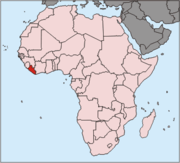
- Liberian Republic (1847 - 1980)
- The Republic of Liberia was established as a republic under the model of the US; it fully fits the model of empire in its conquest of other polities of different ethnic groups.
- Wassoulou EmpireWassoulou EmpireThe Wassoulou Empire, sometimes referred to as the Mandinka Empire, was a short-lived empire of West Africa built from the conquests of Dyula ruler Samori Ture and destroyed by the French colonial army....
(1878 - 1898), a short-lived empire of built from the conquests of DyulaDyulaThe Dyula are a Mande ethnic group inhabiting several West African countries, including the Mali, Burkina Faso, Senegal and Guinea-Bissau....
ruler Samori TureSamoriSamory Toure was the founder of the Wassoulou Empire, an Islamic state that resisted French rule in West Africa from 1882 until his capture in 1898.-Early life and career:...
and destroyed by the French colonial army.
East Africa
- The Sennar Sultanate (1502 - 1821) was a sultanate in the north of SudanSudanSudan , officially the Republic of the Sudan , is a country in North Africa, sometimes considered part of the Middle East politically. It is bordered by Egypt to the north, the Red Sea to the northeast, Eritrea and Ethiopia to the east, South Sudan to the south, the Central African Republic to the...
, named Funj after the ethnic group of its dynasty or Sinnar (or Sennar) after its capital, which ruled a substantial area of northeast AfricaAfricaAfrica is the world's second largest and second most populous continent, after Asia. At about 30.2 million km² including adjacent islands, it covers 6% of the Earth's total surface area and 20.4% of the total land area...
.
- An Empire of KitaraEmpire of KitaraThe Empire of Kitara is a strong part of oral tradition in the area of the Great Lakes of Africa, including the modern countries of Uganda, northern Tanzania, eastern Democratic Republic of the Congo, Rwanda and Burundi...
in the area of the Great Lakes of Africa has long been treated as a historical entity, but is now mostly considered an unhistorical narrative created as a response to the dawn of rule under the LwoLuo (Kenya and Tanzania)The Luo are an ethnic group in Kenya, eastern Uganda, and northern Tanzania. They are part of a larger group of ethnolinguistically related Luo peoples who inhabit an area including southern Sudan, northern and eastern Uganda, western Kenya, and northern Tanzania.The Luo are the third largest...
empire, the sole historical record of an organized NiloticNiloticNilotic people or Nilotes, in its contemporary usage, refers to some ethnic groups mainly in South Sudan, Uganda, Kenya, and northern Tanzania, who speak Nilotic languages, a large sub-group of the Nilo-Saharan languages...
migration into the area.
- The Buganda (1300 - present), home of the Buganda peopleBugandaBuganda is a subnational kingdom within Uganda. The kingdom of the Ganda people, Buganda is the largest of the traditional kingdoms in present-day Uganda, comprising all of Uganda's Central Region, including the Ugandan capital Kampala, with the exception of the disputed eastern Kayunga District...
of UgandaUgandaUganda , officially the Republic of Uganda, is a landlocked country in East Africa. Uganda is also known as the "Pearl of Africa". It is bordered on the east by Kenya, on the north by South Sudan, on the west by the Democratic Republic of the Congo, on the southwest by Rwanda, and on the south by...
Kongo
- The Kongo Kingdom (1400 - 1888) was a quasi-imperial state as is evident by the number of peoples and kingdoms that paid it tribute. If not for the large amount of text written by the EssiKongo that repeatedly called themselves a kingdom, they would be listed as the "Kongo Empire".
- The Luba Empire (1585 - 1885) arose in the marshy grasslands of the Upemba DepressionUpemba DepressionUpemba Depression or Kamalondo Depression which is more commonly known by its French name Dépression de l'Upemba is a large marshy bowl area in the Democratic Republic of the Congo comprising some fifty lakes, including 22 of relatively large size including Lake Upemba and Lake Kisale...
in what is now southern Democratic Republic of Congo. - Lunda Empire (1660 - 1887) in what is now the Democratic Republic of Congo, north-eastern AngolaAngolaAngola, officially the Republic of Angola , is a country in south-central Africa bordered by Namibia on the south, the Democratic Republic of the Congo on the north, and Zambia on the east; its west coast is on the Atlantic Ocean with Luanda as its capital city...
and northwestern ZambiaZambiaZambia , officially the Republic of Zambia, is a landlocked country in Southern Africa. The neighbouring countries are the Democratic Republic of the Congo to the north, Tanzania to the north-east, Malawi to the east, Mozambique, Zimbabwe, Botswana and Namibia to the south, and Angola to the west....
. Its central state was in KatangaKatanga ProvinceKatanga Province is one of the provinces of the Democratic Republic of the Congo. Between 1971 and 1997, its official name was Shaba Province. Under the new constitution, the province was to be replaced by four smaller provinces by February 2009; this did not actually take place.Katanga's regional...
.
Southern Africa
The Mutapa Empire or Empire of Great Zimbabwe (1450 - 1629) was a medieval kingdom located between the ZambeziZambezi
The Zambezi is the fourth-longest river in Africa, and the largest flowing into the Indian Ocean from Africa. The area of its basin is , slightly less than half that of the Nile...
and Limpopo
Limpopo River
The Limpopo River rises in central southern Africa, and flows generally eastwards to the Indian Ocean. It is around long, with a drainage basin in size. Its mean annual discharge is 170 m³/s at its mouth...
rivers of Southern Africa
Southern Africa
Southern Africa is the southernmost region of the African continent, variably defined by geography or geopolitics. Within the region are numerous territories, including the Republic of South Africa ; nowadays, the simpler term South Africa is generally reserved for the country in English.-UN...
in the modern states of Zimbabwe
Zimbabwe
Zimbabwe is a landlocked country located in the southern part of the African continent, between the Zambezi and Limpopo rivers. It is bordered by South Africa to the south, Botswana to the southwest, Zambia and a tip of Namibia to the northwest and Mozambique to the east. Zimbabwe has three...
and Mozambique
Mozambique
Mozambique, officially the Republic of Mozambique , is a country in southeastern Africa bordered by the Indian Ocean to the east, Tanzania to the north, Malawi and Zambia to the northwest, Zimbabwe to the west and Swaziland and South Africa to the southwest...
. Remnants of the historical capitol are found in the ruins of Great Zimbabwe
Great Zimbabwe
Great Zimbabwe is a ruined city that was once the capital of the Kingdom of Zimbabwe, which existed from 1100 to 1450 C.E. during the country’s Late Iron Age. The monument, which first began to be constructed in the 11th century and which continued to be built until the 14th century, spanned an...
.
Madagascar
The Merina KingdomMerina Kingdom
The Merina Kingdom was a pre-colonial south-eastern African state that dominated most of what is now Madagascar. It spread outward from Imerina, the central highlands region primarily inhabited by the Merina ethnic group with a modern and historic political capital at Antananarivo and a spiritual...
ruled most of Madagascar
Madagascar
The Republic of Madagascar is an island country located in the Indian Ocean off the southeastern coast of Africa...
from the late 18th century until the island became a French colony in the 1890s and the last monarch, Ranavalona III was sent into exile.
Sources
- J. Vansina, A Comparison of African Kingdoms, Africa: Journal of the International African Institute (1962), pp. 324–335.
- Turchin, Peter and Jonathan M. Adams and Thomas D. Hall: "East-West Orientation of Historical Empires and Modern States", Journal of World-Systems Research, Vol. XII, No. II, 2006